Relationship Intelligence Platforms: 10 Tools Ranked for 2026
 By Jan Suski. I go deep on every review, checking every number against its source and digging up details other coverage misses, a habit from six years of SEO and link building for tech companies. Bylines at Surfer, Brand24, and Senuto. How the scoring works.
· Prefer this source on Google
Quick comparison of relationship intelligence software
Each row matches the ranked entry below it, in the same order. The score column counts passes against the five criteria in the next section, with a partial pass worth half.
| # | Provider | Relationship signal it documents | Score (of 5) | Entry price | Best fit |
|---|---|---|---|---|---|
| 1 | Affinity | Firm-wide 10 to 100 strength score, refreshed every 6 hours | 5 | $2,000 per user per year | VC and PE deal teams |
| 2 | Intapp DealCloud | Outlook and Teams interactions plus 200 million enriched contacts | 4 | Quote; Vendr median $125,369 a year* | Law firms, banks, private capital |
| 3 | The Swarm | Connection strength across up to 50 connectors | 4 | $0; Premium $99 per company per month | Startups and VC platform teams |
| 4 | Dynamics 365 Sales | Health score plus up to 5 colleagues per contact | 4 | $150 per user per month (Premium) | Microsoft 365 sales orgs |
| 5 | folk | Strongest connection from 5 documented inputs | 4 | $24 per member per month, yearly | Small teams and agencies |
| 6 | 4Degrees | Relationship strength scoring plus 4,000+ signals | 3.5 | Custom quote, per user per month | Small VC, PE and real estate teams |
| 7 | Introhive | 300+ contacts captured per user, synced into Salesforce | 3.5 | Quote; Vendr median $36,000 a year* | Professional services on Salesforce |
| 8 | Attio | Connection strength from recency and frequency | 3.5 | $0 for 3 seats; Plus $35 per seat, yearly | Startups with custom data models |
| 9 | Nektar | Email and meeting capture into 3 native CRMs | 3 | Quote; Vendr median $32,776 a year* | B2B SaaS RevOps teams |
| 10 | Salesforce Sales Cloud | Automatic email, event and contact sync | 2.5 | $25 per user per month (Starter) | Existing Salesforce orgs |
Medians marked * are anonymized buyer-reported contract values published by Vendr. Everything else is the price the vendor publishes itself.
Where these figures come from
Seat prices are each vendor's own published rate, read off its pricing page. The three medians marked * are Vendr's anonymised buyer-reported contract values for Intapp DealCloud, Introhive and Nektar.
User quotes come from G2, Capterra and TrustRadius and link to the review page; our reports on G2's review moderation and Capterra's reviewer verification cover how those sites vet reviewers. Intapp, 4Degrees, Introhive and Nektar publish no scoring inputs, and 4Degrees publishes no price, so no row claims either.
Introhive also ranks on the customer intelligence platforms ranking, scored there on CRM write-back. Call recording sits on the conversation intelligence software ranking, deal forecasting on the revenue intelligence software ranking and prospect contact data on the sales intelligence ranking. This page ranks ten tools on who-knows-whom.
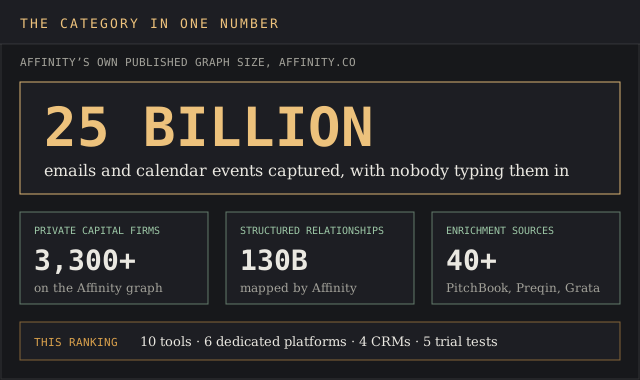
Relationship intelligence software reads the email and calendar traffic a business already exchanges with customers and prospects and turns it into a map of relationships: who knows whom, how well, and how recently. Affinity says its graph holds 25 billion emails and calendar events captured for 3,300 private capital firms. That's the category in one number: the data exists, and nobody has to type it in.
This page ranks ten products against five tests a buyer can run in a two-week trial. Six are dedicated platforms. Four are CRM systems that ship relationship features inside a seat you may already pay for.
It's written for three readers: deal teams in venture capital & private equity who source through partner networks, partners at law and accounting firms who need to know which colleague holds a client, and B2B sales reps who need context on prospects across accounts with large buying groups.
The timing argument is Salesforce's own, and it's a productivity cost every sales leader already pays. Its State of Sales research found reps spend 28% of their week selling, with the rest going to administrative work. Manual data entry is part of that admin, and it's the exact job automated capture removes.
Evaluation criteria for a relationship intelligence platform
Five criteria decide the shortlist, and the ranking below applies them in this order. Each tool earns a pass (1), a partial pass (0.5) or a fail (0) on each, and tools sort by total. Each test fits inside a standard trial for a data analyst with read access to the vendor's reports and a handful of users' mailboxes.
A tie goes to the tool that does better on criterion 1, then criterion 2, and so on down the list.
1. Firm-wide who-knows-whom
Pick 20 target contacts and count how many colleagues the tool lists for each one, ranked by strength. A pass names every colleague with a connection. Dynamics 365 caps the list at five per contact, folk names one strongest connection, and both score a partial.
2. Automatic capture with zero manual data entry
Connect five mailboxes for 30 days, then count the email conversations and meetings logged without anyone typing. A pass captures email and calendar on its own once an admin connects the mail server, with no users asked to integrate their inbox by hand. A tool that imports contact lists and calendars but skips email bodies gets a partial.
3. A documented strength score
Find the vendor's own help article naming the inputs it uses to score relationships and how often it recalculates. Affinity documents both. A vendor that advertises scoring without publishing its inputs gets a partial, and one with no contact-level score fails.
4. External data behind the graph
Count the named enrichment sources or records the vendor publishes, such as Affinity's 40+ sources or Intapp's 200 million contacts. Credit-metered enrichment inside a CRM seat is a partial.
5. A price a buyer can check
A published per-seat price passes. So does a Vendr marketplace median built from anonymised buyer contracts, since a procurement team can benchmark against it. A custom quote with no public benchmark fails.
The 10 best relationship intelligence platforms, ranked
Affinity
Best fit
Venture capital and private equity deal teams that source most deals through partner networks, the firms Affinity puts its focus on.
Affinity builds the CRM out of the inbox, creating contact and company records from conversations its users already have. Every plan captures email and calendar activity automatically, and each connection gets a score from 10 (weak) to 100 (strong) based on recency and frequency, recalculated every 6 hours. The company says its graph covers 130 billion structured relationships and 40+ enrichment sources, including PitchBook, Preqin and Grata.
Key features
- Affinity Labs early AI access and relationship scoring on the $2,000 Essential seat, shown as green, orange and gray bars on each contact's Connections tab
- Notetaker meeting capture, AI Chat and an MCP server for Claude and ChatGPT on the $2,300 Scale seat
- PitchBook, Dealroom & Crunchbase enrichment on the $2,700 Advanced seat
- Packaged Salesforce, Slack and Box integrations on Advanced
- 100,000 API calls a month on Scale and Advanced, unlimited on Enterprise
Pricing
Affinity publishes per-seat prices billed annually: Essential $2,000, Scale $2,300 and Advanced $2,700 per user per year, with Enterprise on a custom quote. Vendr's anonymised buyer data puts the median annual contract at $49,757, across a range of $5,340 to $149,330.
Pros
- Scoring method documented down to the 6-hour refresh, Affinity's clearest advantage over competitors Intapp and Introhive
- SOC 2 Type II audited annually, plus ISO 27001
- A published seat price in a category where four of six dedicated vendors quote
Cons
- The score can't be tuned; Affinity's own help center says users can't choose which emails or meetings feed it
- PitchBook-grade enrichment starts at $2,700 a seat
- Ten seats on Essential cost $20,000 a year at list, before any add-on
- A Capterra reviewer flagged limited analytics and reports in August 2022
The fit complaint shows up in reviews from funds. A G2 reviewer at a VC and PE firm with 50 or fewer employees wrote in April 2022:
"While I know it's the product best situated for VC, it still doesn't feel fully invested in making the VC use case a native experience. It required some customization and adjustment to really make it fit our workflow."
G2 review, verified user, venture capital & private equity, small business, April 5, 2022
Why it’s ranked #1. Affinity passes all 5 criteria. Intapp at #2 publishes no scoring inputs and fails criterion 3, where Affinity documents a 10 to 100 score refreshed every 6 hours, which decides the top spot.
Intapp DealCloud
Best fit
Law firms, investment banks and private capital firms that want relationship intelligence and deal management in one Microsoft-native system.
Intapp sells DealCloud to professional firms at a scale nobody else on this list matches: 1,400+ clients paying $50,000+ a year, 97 of the Am Law 100 and 17 of the top 20 accounting firms. It pulls matter history, relationship context, client news and recent interactions out of Outlook and Teams into one view, so a partner sees the customer context before a pitch.
Intapp cites a Haven case study claiming a 95% reduction in manual data entry.
Key features
- Outlook and Teams capture, with an Outlook add-in that suggests contacts
- Intapp Data enrichment covering 14 million companies and 200 million contacts
- Creating custom data objects and fields for deal, matter and fund records
- Third-party data partners including PitchBook, FactSet and Preqin
Pricing
Quote only. Vendr's buyer data shows a median annual contract of $125,369, with a low of $61,251 and a high of $418,327.
Pros
- 97 of the Am Law 100 already run it, so references are easy to find
- The largest owned enrichment dataset here, at 200 million contacts
- Intapp credits DealCloud with saving FMI Capital Advisors 8+ hours a week on bidder lists, time otherwise spent on manual research
Cons
- The highest Vendr median in the ranking, 3.5 times Introhive's
- Intapp keeps its strength-scoring inputs private
- Reviewers flag a slow interface and slow support
Users split along a predictable line. An investment operations analyst praised the Microsoft fit in a June 2026 G2 review: "The system is easy to use and can be integrated easily into the Microsoft suite." A manager of information systems at an investment bank, writing on Capterra in September 2025, saw the opposite edge:
"Working with other CRMs, they offer more customization that DealCloud currently doesn't offer."
Capterra review, Michael M., manager of information systems, investment banking, September 2025
Why it’s ranked #2. DealCloud scores 4 of 5 and wins the tie with The Swarm on criterion 2, capturing Outlook email The Swarm never reads. It trails Affinity because its scoring inputs stay unpublished, a fail on criterion 3.
The Swarm
Best fit
Seed-stage startups, accelerators and VC platform teams that want warm introductions to prospects and investors mapped across a portfolio network on a small budget.
The Swarm pools the networks of everyone connected to an account and shows who can introduce whom to prospects, investors and customers. The free plan covers 10 connectors, connection strength, intro requests and work and education overlaps, built from LinkedIn connection imports, Google Contacts and Google Calendar. It's an outlier in this group, with a free tier and SOC 2 compliance listed side by side.
Key features
- Connection strength visibility and creating intro requests on the $0 plan
- AI Network Mapper plus LinkedIn, Google Contacts and Google Calendar imports
- Full API and MCP access on Premium, with 12,000 API credits a month and $0.10 per extra credit
- HubSpot, Clay and Attio integrations
- CSV exports of up to 10,000 people and priority Slack support on Premium
Pricing
The Swarm prices per company. Free is $0 for 10 connectors; Premium lists $99 per company per month on the monthly toggle and $2,990 per company per year on the annual toggle for 50 connectors; Enterprise is quoted.
Pros
- A usable free plan, the only $0 entry among the six dedicated platforms
- SOC 2, GDPR and CCPA compliance listed on the vendor's site
- Per-company pricing, so a fund adding partners doesn't add seat cost
Cons
- Scores for relationships rest on LinkedIn imports, Google Contacts and Google Calendar alone
- The homepage quotes two different profile and company counts, a red flag for any buyer comparing database size
- Premium's annual toggle reads $2,990, against $1,188 for twelve monthly payments of $99
Data accuracy is the recurring caveat. A G2 reviewer, September 2023, put a number on it:
"The Swarm can sometimes have inaccurate data, although they're working on this. That's 5% of my prospect's data"
G2 review, Maciej B., September 18, 2023
Why it’s ranked #3. The Swarm's 4 of 5 includes a full pass on criterion 1 that Dynamics 365 at #4 lacks, since Microsoft caps colleagues at five per contact. It loses to DealCloud on criterion 2, with calendar imports and no email capture.
Dynamics 365 Sales
Best fit
Sales orgs already standardised on Microsoft 365 and Exchange that want relationship scoring inside the CRM seat.
Microsoft folds relationship intelligence into Dynamics 365 Sales as two features:
- Relationship analytics turns activity history into KPIs, including frequency and recency of communication, response time and a health score, and compares a deal against similar won opportunities from the past two years.
- Who knows whom analyses email and meeting patterns and shows up to five colleagues who've interacted with a lead or contact, which adds context before an intro request.
Key features
- Who knows whom with a "Get introduced" button, upgraded through Exchange server-side sync
- Relationship analytics KPIs and health scores on contacts, accounts, leads and opportunities, inside the Sales Insights forms
- Conversation intelligence capacity with call transcription on Enterprise and Premium
- 1,000 Copilot Credits per user per month on Premium
Pricing
Microsoft lists Sales Professional at $65, Sales Enterprise at $105 and Sales Premium at $150 per user per month, paid yearly. Who knows whom appears under Premium. Microsoft Relationship Sales carries variable pricing and a 10-seat minimum.
Pros
- Relationship analytics documents 3 scoring inputs, including response time, which no dedicated platform here publishes
- Runs inside the Outlook and Exchange tenant a Microsoft shop already owns
- Published list prices on every core plan
Cons
- Five colleagues per contact is the ceiling
- Exchange-based suggestions need specific licences and admin setup
- External enrichment runs through the LinkedIn bundle alone
Setup cost is the complaint that keeps coming back. A Capterra reviewer in apparel and fashion wrote in November 2024:
"The cost of Dynamics 365 can be high for smaller businesses, and its complex setup process may require significant time"
Capterra review, Omur M., design, apparel and fashion, November 23, 2024
An innovation director in environmental services, on the same page in October 2024, named the upside:
"What I liked most about Dynamics 365 is its [...] integration with other Microsoft tools, especially Office 365 and Azure"
Capterra review, David R., innovation director, environmental services, October 26, 2024
Why it’s ranked #4. Dynamics scores 4 of 5 and edges folk at #5 on criterion 1, surfacing five colleagues per contact against folk's one. It trails The Swarm because that five-colleague cap is a partial on criterion 1.
folk
Best fit
Founders, agencies and small sales teams who want relationship data without a dedicated platform's price.
folk names every input behind its relationship score. The Strongest Connection field weighs the number of interactions, days since the first interaction, type of interaction (1:1 or group email), two-way or one-way exchange, and days since the last interaction. Team Last Interaction and Last Interaction By show which of the users on a team last talked to a customer. Our folk CRM review covers the full plan structure.
Key features
- Email, calendar and WhatsApp interaction capture on every customer and prospect record, for all users on the plan
- Strongest Connection, My Total Interactions and Team Last Interaction fields, filled automatically
- 500 enrichment credits a month on Standard, 1,000 on Premium
- Custom objects and deals on Premium
Pricing
folk lists Standard at $24, Premium at $48 and Enterprise from $80 per member per month billed yearly, or $30, $60 and $100 billed monthly. Relationship intelligence ships on Standard.
Pros
- Five documented scoring inputs, the most on this page
- $2,880 a year for ten Standard seats, the lowest ten-seat list price among per-seat tools here
- Contact merging that keeps the fields you pick
Cons
- Names one strongest connection per contact, against Dynamics 365's five colleagues
- Enrichment is metered at 500 credits a month per seat on Standard
- Duplicate handling on LinkedIn imports draws complaints
Both edges show up on Capterra. An engineer praised the merge tool in August 2025:
"Not only will it merge the contacts but it lets you select which portions of each contact to use for the final record without smashing it together willy-nilly."
Capterra review, engineer, August 2025
A COO, in April 2025, hit the opposite problem:
"When we use folk on Sales Navigator for example, it takes all the leads even though some leads are already in the system. And we have to check for every lead if it's a duplicate or not manually."
Capterra review, COO, April 2025
Why it’s ranked #5. folk scores 4 of 5 and beats 4Degrees at #6 on criterion 5 with a $24 published seat. It loses the four-point tie to Dynamics on criterion 1, naming one strongest connection against Microsoft's five colleagues.
4Degrees
Best fit
Small venture capital, private equity, M&A and commercial real estate teams that want deal tracking and relationship scoring in one tool.
4Degrees captures email through Gmail and Outlook extensions, logs calendar activity, and pulls profiles and messages from LinkedIn through a browser extension. The vendor advertises relationship strength scoring and 4,000+ new signals, enrichment from Crunchbase and PitchBook, and job-change alerts. Its pitch leans on its own figure that 80%+ of VC and PE deals are sourced from firm networks.
Key features
- Gmail, Outlook and LinkedIn extensions for capture
- X-ray Chrome extension that shows mutual connections on any website
- Alerts on job changes, published content and media appearances
- Crunchbase and PitchBook data on company records
Pricing
4Degrees prices per user per month on a custom quote, set by industry and team size.
Pros
- Built for five named deal industries, with matching pipeline templates
- LinkedIn message capture, which most rivals skip
- Alerts on job changes and media appearances for every tracked contact
Cons
- Price and scoring inputs both sit behind a sales call
- G2 lists 5 reviews at 4.5 stars, a thin base for reference checks
- Tags need hand correction, per G2
Reviewers praise the cost and flag the cleanup. A VC and PE reviewer on Capterra in June 2019 wrote: "Serves our needs well at a very competitive price." An associate engineer at an enterprise firm, writing on G2 in June 2024, named the chore: "The only thing which can be improved is the prepopulated tags require manual adjustment."
Why it’s ranked #6. 4Degrees scores 3.5 of 5 and beats Introhive at #7 on criterion 3, advertising a strength score Introhive never documents. It falls below folk on criterion 5, where folk publishes a $24 seat and 4Degrees quotes every deal.
Introhive
Best fit
Law, accounting and consulting firms with hundreds of fee earners that already run Salesforce and want it filled from partners' inboxes.
Introhive sits behind an existing CRM and writes into it, which suits business development teams whose partners never open the CRM. Its Salesforce integration automatically syncs contacts, emails and meetings to Salesforce and captures 300+ contacts per user on average. The vendor's homepage claims 90% data accuracy and quotes Freshfields reporting a 97% accuracy rate for its CRM systems.
Key features
- Contact, email and meeting sync into Salesforce
- Searchable relationship intelligence on which colleagues hold a target company
- Data Quality and Contact Management modules, the vendor's other focus
- Introhive MCP for AI assistant access
- Client news monitoring on company records
Pricing
Introhive quotes every deal. Vendr's anonymised buyer data puts the median annual contract at $36,000, within a narrow $19,333 to $47,400 range.
Pros
- A tight Vendr range, so budgets rarely surprise anyone
- Reps can work from email without opening the CRM
- Client list includes Baker Tilly, Grant Thornton and Knight Frank
Cons
- The method behind its relationship scores stays unpublished
- News matching struggles with common company names
- Some features stay off until someone checks them after integration
A marketing reviewer at a mid-market firm, on G2 in May 2021, described the core benefit:
"It keeps our CRM data clean and up to date which is difficult to do without Introhive at a large organization"
G2 review, Allie D., marketing, mid-market, May 11, 2021
A legal services reviewer the same month flagged the news feed:
"The only issue we have seen is the accuracy of client news. If your client has a widely used/common name, you will see many unrelated news articles."
G2 review, verified user, legal services, mid-market, May 10, 2021
Why it’s ranked #7. Introhive's 3.5 of 5 beats Attio at #8 on criterion 1, with a firm-wide graph where Attio scores per user. It loses to 4Degrees on criterion 3, with no advertised strength score.
Attio
Best fit
Startups and scale-ups of up to 10 seats that want a flexible CRM data model with relationship strength included free.
Attio calculates connection strength with each person and company by weighting the recency and frequency of communication. Its own example: ten emails exchanged a year ago score weaker than ten exchanged last month. Every plan, including the free one, gives users email and calendar sync, so customer records fill themselves from day one. Our Attio review tests the data model in depth.
Key features
- Connection strength on people and companies, on all plans
- Email sync for 1 account per user on Free and Plus, 2 on Pro
- 50,000 records free, 250,000 on Plus and 1,000,000 on Pro
- Creating custom objects and relationships between them
Pricing
Attio lists Free at $0 for up to 3 seats, Plus at $44 per user per month ($35 billed annually) for up to 10 seats, and Pro at $99 ($79 annually) with unlimited seats.
Pros
- Relationship scoring at $0 for three seats
- A data model reviewers rate highly
- Clear seat and record limits on every tier
Cons
- Two documented scoring inputs, against folk's five
- Owns no enrichment dataset, against Intapp's 200 million contacts
- Plus stops at 10 seats
A marketing manager at a small business wrote on G2 in July 2026 that "Attio's biggest strength is how flexible the underlying data model is." Reliability draws the sharpest criticism, from a founder on the same site in December 2025:
"No SLA. Lost leads because their servers went down and they won't even try to fix the problem. They don't even offer compensation for the loss."
G2 review, founder, small business, December 2025
Why it’s ranked #8. Attio scores 3.5 of 5 and beats Nektar at #9 on criterion 3, publishing its recency and frequency inputs. It loses to Introhive on criterion 1 because its connection strength is calculated per user.
Nektar
Best fit
RevOps teams at mid-size and large B2B SaaS companies whose Salesforce or HubSpot records miss most email and meeting activity.
Nektar captures customer conversations and meetings and writes them into the CRM, creating contacts and opportunity contact roles along the way. The company claims more than 97% entity-matching accuracy and says it goes live in under 2 weeks. Its relationship features put their focus on the buyer side: buying group detection, multithreading scores and executive engagement tracking.
Share of emails and meetings that never reach the CRM, by Nektar's own count.
Key features
- Native Salesforce, HubSpot and Dynamics integrations
- Bi-directional Snowflake integration for teams that join CRM activity with product analytics in a data warehouse
- DAISY AI insights on deal health and churn risk signals
- Historical backfill at go-live
- SOC 2, ISO 27001 and CASA Tier 2 certification
Pricing
Quote only. Vendr's buyer data shows a median annual contract of $32,776, ranging from $12,040 to $155,000.
Pros
- Three native CRMs, the most in this ranking
- Zero-adoption setup, per multiple reviewers
- G2 lists 51 reviews at 4.7 stars
Cons
- Scores map buyer-side relationships alone: buying groups, multithreading and executive engagement
- Data comes from first-party email and meetings alone
- Sync runs on a delay
A product owner wrote on G2 in September 2026 that "The zero adoption model is hands down the biggest win for us." A computer software reviewer on the same site, in July 2025, timed the catch:
"Sync timing is slow. On average, there's a ~75-minute delay"
G2 review, verified user, computer software, mid-market, July 2025
Why it’s ranked #9. Nektar scores 3 of 5 and beats Salesforce at #10 on criterion 1, mapping buying groups across 3 native CRMs. It trails Attio on criterion 3, publishing no inputs behind its scores.
Salesforce Sales Cloud
Best fit
Teams already running Salesforce that want customer email and calendar sync before buying a separate platform.
Salesforce ships automatic capture from the bottom tier: the $25 Starter Suite lists "AI Automatically Syncs Emails, Events, and Contacts" among its first four features. Einstein Relationship Insights goes further with natural language processing, reading news articles, search engines and social profiles to show how prospects know each other.
Key features
- Email, event and contact sync on Starter Suite
- Einstein Relationship Insights for external relationship mapping
- Agentforce for Sales and Agentforce Coworker on the Max edition
- Forecasting and quoting from Pro Suite up
Pricing
Salesforce lists Starter Suite at $25, Pro Suite at $100, Core at $195, Advanced at $395 and Max at $550 per user per month, with Pro and above billed annually.
Pros
- Capture starts at $25 a seat
- External relationship mapping from unstructured text
- Introhive, Nektar and Affinity all integrate with it and write into it
Cons
- Contact-level strength scoring goes undocumented
- Colleague-side who-knows-whom sits outside the standard editions
- Full AI tooling sits on the $550 Max edition
A reviewer at a mid-sized company on TrustRadius in March 2024 summed up the ramp: "The learning curve to use Salesforce Sales Cloud is very steep."
Why it’s ranked #10. Salesforce scores 2.5 of 5, with a fail on criterion 1 and on criterion 3. Nektar beats it on both, and Salesforce stays on the list because its $25 Starter Suite passes criterion 2.
What relationship intelligence software does: key features and examples
Relationship intelligence is the practice of measuring business relationships from the communication data a company already holds. The software has to integrate with email, calendar and sometimes call and messaging systems, then builds a graph of who has talked to whom, how often, and how recently. It answers one question a CRM can't: which colleague at our company is best placed to reach a given customer contact at theirs.
Five capabilities show up across the category, and the ranked tools above each document some of them:
- Automated capture that logs email and meetings without manual data entry
- A relationship graph showing which colleagues know a client, an expert or a target
- Strength scoring based on interaction recency and frequency
- Creating warm introduction requests routed to the colleague with the strongest connection
- Alerts when engagement drops, a job changes or an account goes quiet
Three examples show relational intelligence at work. A fund partner asks who knows a founder, and Affinity returns the warmest path with a strength score. A law firm loses a partner, and the client's interaction history stays in the firm's graph because it came from the firm's mail server. A RevOps lead sees that a renewal has one engaged contact, and Nektar flags the multithreading gap before the renewal date.
The benefits are easiest to see where client knowledge lives in partners' heads. Tools split between graphs built from a firm's own conversations and graphs filled with bought external data, and most of the ranked platforms do some of both.
Integration matters as much as the graph. Introhive, Nektar and Affinity all write into existing CRM systems, so reps keep working in Salesforce or Dynamics and the data lands where reports and analytics already run. Teams that build relationships across thousands of contacts get the real value from that write-back, since a score nobody sees in their daily tool changes nothing.
Who uses relationship intelligence software
Three buyer groups account for most of the category, and each one measures value differently. Private capital firms want deal flow; Affinity says 3,300+ private capital firms use its graph, and 4Degrees builds its pitch on its own figure that 80%+ of VC and PE deals come from firm networks.
Professional services firms want to know which partner holds which clients' relationships. Intapp counts 97 of the Am Law 100 and 17 of the top 20 accounting firms as DealCloud users, and Introhive's client list runs through Grant Thornton and Freshfields. Their challenge is human: client relationships sit with partners who rarely log conversations in a CRM.
B2B sales and customer success teams want multithreading and early churn warnings. For these teams the support case is simple: sales reps who see every customer conversation on the account record engage more of the buying group, and leaders keep watching the accounts where engagement drops.
Nektar cites Mimecast attributing $10M in expansion revenue to its data, a vendor-published figure worth checking against your own pipeline analytics and reports.
The benefits look different in each group. Funds measure growth in sourced deals, law firms measure cross-selling between practice groups, and SaaS teams that want to stay ahead of churn measure renewal rates. A tool that makes sense for one rarely fits the other two, which explains why the trends in vendor positioning split along these three lines.
How relationship strength scoring works
Every vendor that documents a score starts with the same two inputs. Affinity, Attio, folk and Dynamics 365 all weigh how recently and how often two people held conversations. After that, the methods split, and the devil's in the details.
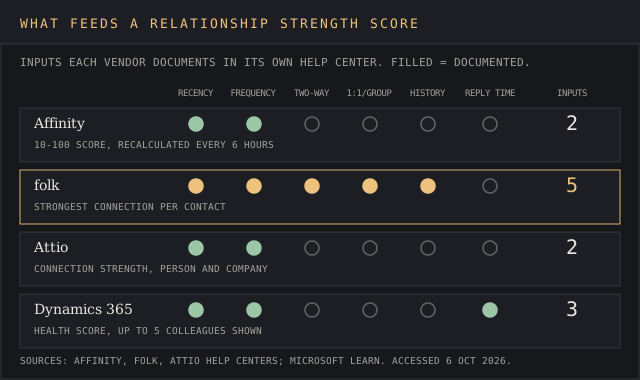
folk adds three more documented inputs: two-way versus one-way exchanges, 1:1 versus group email, and how long the relationship has run. Dynamics 365 relationship analytics adds response time, the one input that tracks churn risk directly, since a client whose replies keep slowing is a churn risk long before the contract says so. Affinity recalculates every 6 hours and says users can't reweight the score.
Read between the lines of a vendor's scoring page before trusting the number. A score that counts group emails equally with 1:1 threads will rate a name copied on every group thread as a strong connection. The test in criterion 3 exists for that reason: if the inputs aren't published, a buyer can't tell what the score measures.
Scores on dormant relationships also decay by design, and the challenge for any score is a quiet relationship that's still warm but sits under the radar. Attio's example of ten emails a year ago scoring below ten emails last month is the general rule, so a relationship that went quiet six months ago will show as weak even if the contact would still take the call.
A score can't determine intent. The human answer is a quick check with the colleague before any intro request goes out; that knowledge rarely sits in a complete form anywhere else.
AI powered insights in relationship intelligence software
The newest layer is AI chat, and it's where vendors' AI roadmaps differ most. Four vendors here expose relationship data to AI assistants:
- Affinity's Scale plan adds AI Chat and an MCP server so users can query relationship data from Claude or ChatGPT in natural language.
- The Swarm includes API and MCP access on Premium.
- Introhive lists an MCP connector for AI assistants.
- folk ships one as well, tested in our folk CRM MCP review.
Natural language queries such as "who at the firm knows the CFO of this company" replace a filter-building session.
Insights from AI are only as good as the capture underneath, and a human still decides who sends the intro. AI-driven natural language processing also reads sources outside the inbox. Salesforce describes Einstein Relationship Insights as automatically reading natural language, including news articles that mention two people together, to infer a connection.
Microsoft bundles 1,000 Copilot Credits per user per month into Dynamics 365 Sales Premium, and Salesforce keeps Agentforce for Sales on its $550 Max edition. Nektar's DAISY AI puts its focus at account level, scoring deal health and churn risk from engagement signals.
For a data analyst, the most valuable AI feature is often the plumbing, and the ability to export makes sense to test first. Nektar pushes captured activity both ways with Snowflake, so a team can join relationship data with product usage and revenue in its own data warehouse. That's where key insights about which relationships predict renewals get built, and where the AI powered insights a vendor demos can be checked against the firm's own outcomes.
Relationship intelligence versus conversation intelligence
The two categories get confused because both start from customer communication. Conversation intelligence records and analyses calls; Salesforce defines it as software that analyses text, speech, and video data from customer interactions, with real-time guidance during calls and coaching opportunities found by analysing calls at scale. Relationship intelligence measures the network around those conversations: who knows whom, and how strong each connection is.
The survey numbers Salesforce cites belong to conversation tools. In its State of Sales research, 39% of respondents said conversation intelligence helped them understand competitors better and 40% said it helped them understand customer needs. Salesforce also describes a food delivery app that raised productivity by more than 20% with these tools. Citing them for relationship scoring is barking up the wrong tree, since they describe call analysis.
Many firms run both technology stacks, and the benefits of each stay separate. Conversations recorded by a call tool rarely feed a relationship score. A call tool's output is a transcript and a set of coaching flags for one recorded call. Picking the colleague who should place the next call takes the relationship graph, which ranks colleagues by connection strength to the buyer.
Call-analysis contracts carry their own price list, which our revenue intelligence pricing report breaks down across 16 vendors.
Pricing across relationship intelligence software
Prices in this category run from $0 to six figures, and the spread follows the buyer. Seat-priced CRMs that added the technology to an existing seat start at $0 on Attio's Free plan. Intapp DealCloud, sold to law firms, carries the highest Vendr median at $125,369.
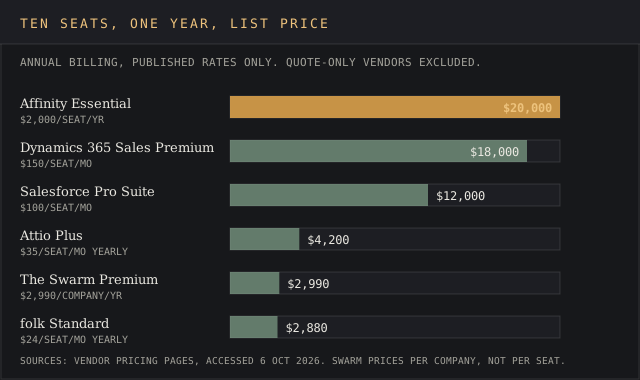
At list, ten seats cost $20,000 a year on Affinity Essential, $18,000 on Dynamics 365 Sales Premium and $12,000 on Salesforce Pro Suite. Attio Plus comes to $4,200, folk Standard to $2,880, and The Swarm charges $2,990 a year per company regardless of seats. Quote-only vendors don't appear on that chart, so Vendr's buyer medians fill the gap with insights from real contracts.

Intapp's $125,369 median is 3.8 times Nektar's $32,776, and its $418,327 high would cost an arm and a leg for a fund with 20 staff. Affinity's Vendr median of $49,757 equals about 25 Essential seats at its $2,000 list price. Introhive's range is the tightest, at $19,333 to $47,400.
CRM vendors have moved into the category, and the trends show in this ranking: four of ten tools are CRMs that added relationship scoring to an existing seat, at a fraction of a dedicated platform's price.
Keep your eyes peeled for three contract details:
- Microsoft Relationship Sales requires 10 seats minimum.
- Attio's Plus plan stops at 10 seats, so the eleventh user forces Pro at $79 to $99 a seat.
- Affinity bills annually only.
Our CRM software cost report prices the wider CRM market seat by seat.
How a data analyst should test relationship intelligence software
A trial run by whoever owns the CRM data catches problems a sales demo hides and gets the team up to speed before signature. Easier said than done, since most vendors set up the trial themselves. The challenge is getting the vendor to grant read access to raw capture. Expect the metrics from a vendor-run pilot to beat your own count, then run five checks:
- Capture rate: connect five mailboxes for 30 days and count logged emails and meetings against what the mail server holds
- Score sanity, the most valuable test: list ten relationships the team knows are strong and ten it knows are cold, then compare the tool's scores
- Latency: time how long an email takes to appear on the CRM record; one Nektar reviewer measured about 75 minutes
- Exit: export the full graph with interaction history and check what the CSV or API returns, since a thin export sends the next migration back to square one
- Integration: confirm captured activity can integrate with your BI analytics stack or data warehouse without a paid connector
The skills needed are basic: a spreadsheet and access to the mail server's logs.
Privacy needs a sign-off before the first mailbox connects. Capture reads metadata from every partner's email conversations, and some firms exclude personal or HR threads by domain. Ask each vendor which fields leave the mail server and if message bodies are stored, then keep an eye on how exclusion rules behave during the trial and how fast vendor support answers a ticket.
Adoption is the other trap. A platform that needs reps to open a new interface fights for attention against the CRM they already use, which is why Introhive and Nektar sell write-back and why reviewers praise Nektar's zero-adoption model. The technology only pays off when the score shows up where reps decide who to engage. Teams that want to stay ahead of a renewal date should zero in on where the score appears, since the best graph is useless if nobody's watching it.
Questions buyers ask about relationship intelligence
What is relationship intelligence?
Relationship intelligence is software that measures who at a company knows whom outside it, using data from email conversations, calendars and meetings captured automatically. The output is a relationship graph with strength scores, used to find warm introductions and surface insights on accounts going quiet.
What is the #1 CRM platform for relationship intelligence?
Affinity ranks first here, scoring 5 of 5 against the criteria. For a general CRM with relationship features, Dynamics 365 Sales and folk both scored 4, at $150 and $24 a seat a month respectively.
What is the best customer tracking software for a small team?
folk and Attio both track customer interactions automatically from email and calendar. folk's Strongest Connection field uses five documented inputs at $24 a seat. Attio gives three seats connection strength for $0.
What is the best relationship manager app?
For a firm, the answer is Affinity or Intapp DealCloud, depending on budget: $2,000 a seat versus a $125,369 Vendr median. For a solo user managing a network, The Swarm's free plan covers 10 connectors at $0.
What are examples of relational intelligence?
Common examples include finding the colleague with the strongest connection to a prospect, routing a warm intro request, flagging a client whose reply time is slipping, and keeping a departed partner's client history in the firm's graph.
How much does relationship intelligence software cost?
List prices run from $0, on The Swarm's free plan and Attio's Free plan for 3 seats, to $2,700 a seat a year on Affinity Advanced. Quote-only vendors sit higher: Vendr's buyer medians run from $32,776 a year at Nektar to $125,369 at Intapp DealCloud.
How does relationship intelligence differ from conversation intelligence?
Conversation intelligence records and analyses calls, with transcripts and coaching flags. Relationship intelligence measures the network around those calls: which colleagues know a contact, and how strong each connection is, scored from email and calendar data.
Which relationship intelligence platforms publish security certifications?
Affinity is SOC 2 Type II audited annually and holds ISO 27001, Nektar lists SOC 2, ISO 27001 and CASA Tier 2, and The Swarm lists SOC 2, GDPR and CCPA compliance. Ask each vendor which fields leave the mail server before the first mailbox connects.
Bottom line
In a nutshell, Affinity wins for venture capital and private equity firms that want a documented score and a published price, and it's the only tool here that passes all five tests. Intapp DealCloud is the pick for law firms and banks with a six-figure budget and a Microsoft stack; Introhive fits the same buyers when Salesforce stays the system of record.
Microsoft and Salesforce shops can start with what they own: Dynamics 365 Sales Premium for who knows whom, Salesforce Starter for capture. Small teams get the best of both worlds from folk or Attio, and a founder mapping intros on no budget should open The Swarm's free plan first.