Legal intelligence platform rankings for 2026: 10 legal AI tools compared
 By Jan Suski. I go deep on every review, checking every number against its source and digging up details other coverage misses, a habit from six years of SEO and link building for tech companies. Bylines at Surfer, Brand24, and Senuto. How the scoring works.
· Prefer this source on Google
Legal AI tools compared: quick table
One row per tool, in ranked order. Coverage is each vendor's own published figure, so the units differ by row.
| Rank | Provider | Coverage figure | Entry price on record | Best fit |
|---|---|---|---|---|
| 1 | CoCounsel Legal (Thomson Reuters) | 10,000 documents per Tabular Analysis run | From $551.85 a month; Vendr median $13,956* | Law firms already on Westlaw |
| 2 | Bloomberg Law | 400+ state courts added to dockets in July 2024 | Vendr median $10,360* | Docket-heavy litigators |
| 3 | Harvey | 200,000+ professionals at 3,500+ organizations | Vendr median $30,000* a year | Am Law firms buying one platform firm-wide |
| 4 | Lexis+ AI with Protégé | Lex Machina: 8K+ judges, 10M+ cases | Vendr median $18,450* | Shepard's and judge analytics |
| 5 | Vincent AI (vLex, part of Clio) | 1 billion+ documents from 100+ countries | Quote only, free trial | Cross-border legal research |
| 6 | Everlaw | 1M documents processed per hour | Vendr median $40,000* | Litigation lawyers and government agencies |
| 7 | Relativity | 2.5+ TB processed per day on average | Quote only, volume-based | Am Law 200 discovery and investigations |
| 8 | Spellbook | 5,000+ legal teams | Quote only, 7-day trial | Transactional lawyers working in Microsoft Word |
| 9 | DISCO | 32,000 documents reviewed per hour | Quote only, per-GB rate | Mid-size litigation firms |
| 10 | LEGALFLY | 110+ jurisdictions | Quote only | European in-house legal teams |
Medians marked * are anonymised buyer-reported contract values published by Vendr. Everything else is the price the vendor publishes itself.
Where these figures come from
Coverage and throughput figures are each vendor's own published number, with the source linked in each entry, so the units differ by row. Medians marked * are Vendr's anonymised buyer-reported contract values, and Bloomberg's covers Bloomberg Industry Group across four products. Vincent AI, Relativity, Spellbook, DISCO and LEGALFLY publish no price and carry no Vendr median, so their rows say quote only.
Field-extraction platforms such as ABBYY are ranked separately on the document intelligence ranking, and patent databases for IP teams on the patent search tools ranking. This page ranks tools built for legal research, litigation analytics, discovery and contract review.
Legal intelligence software turns court opinions, dockets, statutes and a firm's own legal documents into answers lawyers can check. The category spans legal research with generative AI, litigation analytics on judges and opposing counsel, AI-powered document review for discovery, and contract review inside Microsoft Word.
Adoption moved fast across the legal sector. The 2026 General Counsel Report from FTI Consulting and Relativity found 87% of general counsel report generative AI use in their teams, up from 44% in 2025, across 224 respondents.
This page ranks ten legal AI tools for law firms, corporate legal departments and in-house legal teams. Every entry carries a price on record or says it has none, a sourced coverage figure and a user quote. It's written for the legal professionals who sign the order form: a litigation partner, a general counsel or the legal ops lead.
General counsel reporting generative AI use in their teams in the 2026 General Counsel Report from FTI Consulting and Relativity, up from 44% a year earlier.
Evaluation criteria for legal intelligence tools
Five criteria decide the shortlist, and the ranking below applies them in this order. A tool's rank is its pass count; ties break on the earliest criterion one tool passes and the other fails, and a full tie breaks on G2 review volume.
1. Citation validation by a named citator
The tool checks the case law it cites against a named citator: KeyCite, Shepard's or BCite. Hallucinated citations land lawyers in hot water with a judge, so the test is short: can you name the citator the AI runs against?
2. A published coverage or throughput figure
The vendor publishes a number for what the platform covers or how fast it works: judges and cases profiled, documents in the corpus, documents reviewed per hour. A coverage claim with no figure fails.
3. A named security attestation plus a written no-training statement
Both halves count. The vendor names an audit (SOC 2 Type II, ISO 27001, ISO 42001 or FedRAMP) and states in writing that customer documents don't train its AI models. One half without the other fails.
4. A price on record
A list price on the vendor's site, or a Vendr median from anonymised buyer contracts. "Request pricing" with nothing behind it fails.
5. A published adoption count
A count of customers, users or firms on the vendor's own domain. Logos with no number fail.

Ranked tools that pass all five criteria: CoCounsel Legal. Bloomberg Law and Harvey pass four each, and DISCO and LEGALFLY pass one.
The 10 best legal AI platforms, ranked
CoCounsel Legal
Best fit
Law firms and corporate legal departments that already pay for Westlaw and Practical Law.
CoCounsel Legal is Thomson Reuters' generative AI assistant, grounded in Westlaw content, Practical Law guidance and the firm's own legal documents. Thomson Reuters says 20,000+ law firms and legal departments and 94% of state courts rely on it. Its Tabular Analysis feature runs document analysis on up to 10,000 documents against 100 questions in one pass.
Key features
- Deep Research, an agentic legal research mode built on Westlaw, and KeyCite Overruling Risk
- Tabular Analysis across 10,000 documents and 100 questions
- Integrations with iManage, NetDocuments, SharePoint, Box and Microsoft Word, Outlook and Teams
- A CoCounsel Legal MCP connection for Claude
Pricing
Thomson Reuters lists CoCounsel Legal from $551.85 a month, Westlaw Advantage from $288.60 and Westlaw Edge from $107.25, without saying per user or per firm. Vendr's anonymised buyer data puts the median Thomson Reuters contract at $13,956 across 141 purchases, from $2,374 to $37,500.
Pros
- KeyCite and Westlaw content sit under every answer
- The only published monthly list price for an AI tier here
- SOC 2 and ISO 42001 certified, with a written promise never to use customer data to train underlying models
Cons
- Response times draw complaints in recent G2 reviews
- Files of thousands of pages need splitting before upload
- The 33% time-saving figure on the product page names no method
G2 reviewer Suzanne Y., listed as a partner, wrote on 20 August 2026:
"I sometimes have technical issues with large quantities of documents. For instance, when I was uploading a few medical record files, CoCounsel Legal struggled because two of the files were thousands of pages each."
G2 review, Suzanne Y., 20 August 2026
Why it's ranked #1. It passes all 5 criteria. It beats Bloomberg Law on criterion 3, a named SOC 2 and ISO 42001 attestation with a no-training pledge for its AI, and nothing ranks above it.
Bloomberg Law
Best fit
Litigators and in-house counsel who live in dockets and need news on the same screen.
Bloomberg Law pairs a legal research database with PACER dockets, Bloomberg Law News and an AI Assistant. Bloomberg says 97% of Am Law 100 firms and 100% of federal circuit courts use it.
In July 2024 it added over 400 state courts to its dockets, and in June 2026 Bloomberg Industry Group bought Regology, whose AI agents handle regulatory monitoring across 135+ countries. BCite, its citator, shows positive, caution and negative references beside each case.
Key features
- BCite citation analysis on every case
- Litigation Analytics, plus Draft Analyzer for benchmarking contract language
- Docket Key, which classifies 200+ federal motion types
- Regology regulatory change tracking, acquired June 2026
Pricing
One subscription, quoted on request. Vendr's anonymised data for Bloomberg Industry Group shows a $10,360 median a year, from $2,573 to $32,928, across Bloomberg Law and three other products, with no purchase count.
Pros
- All PACER and state dockets on the same subscription as research
- Lowest Vendr median among the four AI research platforms here
- Regulatory intelligence now sits inside the same company
Cons
- The AI pages name no SOC 2 or ISO audit and no written no-training statement
- Vendr's median mixes four Bloomberg products
- No list price on Bloomberg's site
A vice-president in legal at a 10,001+ employee company reviewed it on TrustRadius on 25 June 2024:
"It's best suited for in-house counsel that wishes to stay on top of recent case law and labor decisions."
TrustRadius review, verified VP in Legal, 25 June 2024
Why it's ranked #2. It passes 4 of 5, with a $10,360 Vendr median. It beats Harvey on criterion 2 with 400+ state courts on record, and loses to CoCounsel Legal on criterion 3.
Harvey
Best fit
Large law firms and in-house legal departments buying one legal AI platform across practice areas.
Harvey's homepage lists 200,000+ professionals, 3,500+ legal organizations, 85+ countries and 80+ Am Law 100 firms. Harvey is legal AI without its own primary law database: a June 2025 alliance with LexisNexis gives users answers grounded in LexisNexis U.S. case law and statutes, validated through Shepard's Citations.
Key features
- Agents and Workflows for workflow automation across practice areas
- Vault for bulk document analysis, contract analysis and due diligence
- Knowledge, which searches a firm's own precedent and past legal work
- Ask LexisNexis, with Shepard's-validated citations
Pricing
Quote only. Vendr's anonymised buyer data shows a $30,000 median a year, from $27,000 to $116,840; Vendr gives no purchase count.
Pros
- The longest security list here: SOC 2 Type II, ISO 27001, ISO 27701, ISO 42001 and AIUC-1
- No training on inputs, outputs or uploaded documents, guaranteed in the Platform Agreement
- Data residency in the EU or Switzerland, the US or Australia
Cons
- No published coverage or throughput figure
- Primary law comes through a licence from a competitor
- The $27,000 Vendr floor is twice the Thomson Reuters median
The skeptical view comes from Hacker News user DannyBee, a self-described lawyer, on 15 May 2026: "It mostly exists so large law firms can say they do AI." (Hacker News)
Why it's ranked #3. It passes 4 of 5 with 200,000+ users. It beats Lexis+ AI on criteria 3 and 5, and loses to Bloomberg Law because it publishes no coverage figure.
Lexis+ AI with Protégé
Best fit
Research-heavy litigation teams that want Shepard's and Lex Machina analytics under one contract.
Lexis+ AI with Protégé is LexisNexis' generative AI layer over its legal research library, with Shepard's Verify checking citations in AI answers and drafts. Protégé blends several large language models, and Protégé General AI offers AI models from OpenAI, Google and Anthropic.
LexisNexis also owns Lex Machina, which profiles 8K+ judges across over ten million cases in all 94 federal district courts, data that feeds litigation strategy.
Key features
- Shepard's Verify, which flags unsupported statements in AI output
- Vault: up to 50 Vaults with 1 to 500 documents per Vault
- Practical Guidance across 25 practice areas
- Lex Machina analytics on judges, counsel, experts and parties
Pricing
Quote only, with a 2-day free trial. Vendr's anonymised data puts the LexisNexis median at $18,450 across 94 purchases, from $3,410 to $44,723.
Pros
- Shepard's checks citations inside the AI answer
- Judge and court analytics from the same vendor
- LexisNexis says it never uses customer data to train AI models
Cons
- The Protégé AI page names no SOC 2 or ISO audit
- Up to 10 unsaved uploads are purged at the end of each session
- Median contract runs $4,494 above Thomson Reuters
A director in IT at an 11-50 person firm wrote on TrustRadius on 2 April 2020: "I seem to find more relevant case law on Lexis than I have through Westlaw." The same reviewer's con: "Going outside of your subscription costs an arm and a leg." (TrustRadius)
Why it's ranked #4. It passes 3 of 5, with an $18,450 median. It beats Vincent AI on criterion 1 through Shepard's, and loses to Harvey on criteria 3 and 5.
Vincent AI
Best fit
Lawyers with cross-border matters who need primary law outside the US and UK.
Vincent AI is vLex's legal research and analysis assistant. Clio completed its $1 billion acquisition of vLex on 10 November 2025. The library holds over one billion documents from 100+ countries, and vLex says 8 out of 10 of the world's top law firms use Vincent.
vLex cites zero-retention agreements with its LLM providers but no separate training clause. We count those agreements as the criterion 3 statement, since a provider that keeps nothing has nothing to train models on.
Key features
- 50-State Survey and Compare Jurisdictions research workflows
- Profile a Judge, Lawyer, Law Firm or Party
- Analyze a Contract, Redline Analysis and Compare Documents
- Vincent Studio, a no-code workflow automation builder for custom legal workflows, plus 20+ pre-built ones
Pricing
No figure on vLex's site or Vendr; a free trial and a demo.
Pros
- 17 named jurisdictions on the Vincent page, from Brazil to Singapore
- SOC 2, ISO 27001 and zero-retention agreements with LLM providers
- Judge and party profiles on the same plan
Cons
- No price on record anywhere
- No named citator on the Vincent page
- Roadmap now set by Clio
The State Bar of Nevada published a December 2024 review for solo lawyers and smaller firms. It found Vincent "performs well for basic legal research but can struggle with complex queries" (State Bar of Nevada).
Why it's ranked #5. It passes 3 of 5, backed by one billion documents. It beats Everlaw on criterion 3, and loses to Lexis+ AI because it names no citator.
Everlaw
Best fit
Litigation lawyers and government agencies running document review on large productions.
Everlaw is a cloud eDiscovery platform with an AI-powered suite on top. Its pricing page lists High-Speed Processing at 1M documents an hour and unlimited user licenses. Everlaw holds FedRAMP Moderate authorization, ISO/IEC 27001:2022 and a SOC 2 Type 2 attestation.
Key features
- Deep Dive, natural-language questions across a whole project (credit-metered)
- Predictive coding and concept clustering
- StoryBuilder for chronologies and deposition outlines
- Coding Suggestions and Review Assistant
Pricing
Quote only. Vendr's anonymised buyer data shows an Everlaw median of $40,000, from $28,000 to $48,000, the highest median in this ranking.
Pros
- FedRAMP Moderate, which most rivals here lack
- Unlimited users on the platform licence
- Single-document AI use is free; only bulk Deep Dive uses credits
Cons
- No written statement on AI training data on its AI or security pages
- Deep Dive, translation and coding suggestions consume credits
- StoryBuilder exports poorly to Word
David Sifre, owner of the Law Office of David Sifre LLC, wrote on TrustRadius on 28 June 2021 that the StoryBuilder outline function "does not export well to word" (TrustRadius).
Why it's ranked #6. It passes 2 of 5, with a $40,000 Vendr median. It beats Relativity on criterion 4, a price on record, and loses to Vincent AI on criterion 3.
Relativity
Best fit
Am Law 200 law firms and service providers running high-volume discovery and investigations.
Relativity is the incumbent eDiscovery platform, with the aiR for Review AI layered on top. Relativity says 300K+ legal professionals and 193 of the Am Law 200 work on it, and that aiR for Review reaches 90%+ recall. Processing averages 2.5+ TB a day.
Key features
- aiR for Review, Privilege and Case Strategy
- Assist, with up to 1.5 million documents per workspace
- Relativity aiR Government under a FedRAMP Moderate ATO
- ISO/IEC 27001:2022 and 27018, SOC 2 Type II and SOC 3
Pricing
No list price. Relativity's pricing page sells pay as you go or one- and three-year commitments, with AI tied to committed data volume and no per-user fees.
Pros
- AI included in committed data volume, with no separate AI licence
- Published 90%+ recall claim for aiR for Review
- 193 of the Am Law 200 on the platform
Cons
- No price on record and no Vendr median
- No written no-training statement on the aiR page
- Legal Hold, Translate and FOIA are licensed separately
A manager at a 201-500 person services firm wrote on TrustRadius on 31 May 2022: "The interface is simple compared to the competition", but "Their pricing models can be difficult given they have a lot of spend criteria" (TrustRadius).
Why it's ranked #7. It passes 2 of 5 with 300K+ users. It beats Spellbook on criterion 2, a published 2.5+ TB daily processing figure, and loses to Everlaw on criterion 4.
Spellbook
Best fit
A transactional lawyer or a small in-house team doing contract drafting and redlines in Microsoft Word.
Spellbook is an AI-powered contract tool that runs inside Microsoft Word, with Review, Draft, Associate, Compare, Ask and Playbooks. Its homepage claims 5,000+ legal teams and law firms, a 4.7 rating on G2 and a 7-day free trial. Playbooks give in-house teams playbook-driven contract review with clause suggestions.
Key features
- Review and redline inside Microsoft Word
- Playbooks for playbook enforcement across agreements
- Associate, a multi-step agent for document drafting
- Integrations into legal workflows on Google Docs, iManage, SharePoint, OneDrive and Slack
Pricing
No list price and no Vendr median; a 7-day free trial.
Pros
- SOC 2 Type II, HIPAA and GDPR, with zero data retention: its LLM providers "never learn from, train on, or store your data"
- Works where transactional lawyers and in-house teams already draft
- 5,000+ legal teams on record
Cons
- No case law corpus or citator for its AI
- No price on record
- Formatting can skew after redlines are applied
A team lead in legal at a 51-200 person company praised it on TrustRadius on 21 August 2026: "Quickly reviews redlines and identifies meaningful changes." The same review's main con: "Spellbook often forgets which party I want it to represent." (TrustRadius)
Why it's ranked #8. It passes 2 of 5 with 5,000+ teams. It beats DISCO on criteria 3 and 5, and loses to Relativity because it publishes no coverage or throughput figure.
DISCO
Best fit
Mid-size litigation firms that want AI included in the per-GB rate.
DISCO is a cloud eDiscovery platform with the AI-powered Cecilia assistant. Its homepage lists 32,000 documents reviewed per hour with Auto Review and 98% faster deposition summaries. Its pricing page promises no additional charge for unlimited Cecilia AI.
Key features
- Auto Review, billed per document
- Cecilia Q&A, document summaries and auto timelines
- Deposition Management with Cecilia summaries
- Case Builder and Hold for legal holds
Pricing
A per-GB structure, AI included, with no published rate.
Pros
- Cecilia AI bundled into the per-GB rate
- 32,000 documents an hour on Auto Review
- Four professional services levels, from self-service to managed
Cons
- No named security audit on the homepage or pricing page
- No price on record
- No adoption count
A C-level executive at an 11-50 person company rated it 10 of 10 on TrustRadius on 1 October 2024, with one complaint: "Navigation through the platform could be more user friendly." (TrustRadius)
Why it's ranked #9. It passes 1 of 5, its 32,000 documents an hour. It ties LEGALFLY on criteria and wins on G2 volume, 172 reviews to 3, and loses to Spellbook on criteria 3 and 5.
LEGALFLY
Best fit
European in-house legal teams and corporate legal departments that need anonymisation before any AI sees a file.
LEGALFLY is a Belgian legal AI platform for in-house legal teams, built around anonymisation. It anonymises documents before analysis begins, holds ISO 27001 and SOC 2 Type II, and offers single-tenant deployment in a customer's Azure region. Its homepage claims coverage of 110+ jurisdictions.
Multi Review runs AI-powered contract analysis on hundreds of documents at once against a playbook for due diligence, then exports audit-ready reports. LEGALFLY's blog says it flags non-standard indemnities and missing termination provisions.
Key features
- Multi Review for due diligence across hundreds of documents
- Playbook contract review and negotiation
- Local anonymisation before processing
- Single-tenant deployment in a chosen Azure region
Pricing
Quote only; no Vendr median.
Pros
- Anonymisation runs before any AI analysis
- ISO 27001 and SOC 2 Type II, with annual penetration tests
- Data residency through Azure region choice
Cons
- No written no-training statement on the security page
- Jurisdiction claims run 60+ on its blog and 110+ and 130+ on its homepage
- Three G2 reviews, one of them on citation accuracy
A verified G2 reviewer in banking at an enterprise wrote on 11 April 2025: "References to articles in the legislation are not always correct" (G2).
Why it's ranked #10. It passes 1 of 5, its 110+ jurisdictions. It ties DISCO on criteria and loses on G2 volume, 3 reviews to 172; nothing ranks below it.
What a legal AI platform does with legal data
Every tool above runs the same AI technology pipeline, starting with data ingestion. The platform pulls in court opinions, dockets, statutes and contracts, then uses natural language processing to tag parties, judges, clauses and dates, so lawyers can ask a question in a sentence and get a cited answer.
Validation is the second layer. KeyCite, Shepard's and BCite track how later rulings treat a decision, so the AI's answer gets checked against changes in case law. Large language models and other AI models write fluent text either way; the citator tells you a cited case was overruled last spring.
Analytics come third. Lex Machina, Bloomberg's Litigation Analytics and Vincent's Profile a Judge identify patterns in how a judge rules on a given motion type. Litigation teams use that to price a matter; no vendor here publishes an accuracy rate for predicting a verdict.

Discovery runs on older machine learning: Everlaw's predictive coding and Relativity's active learning rank documents by relevance, and aiR for Review adds generative AI technology on top of that machine learning stack.
Internal knowledge is the fourth layer, and the one a legal practice tends to underrate. Harvey's Knowledge and Lexis Vault search a firm's past work, so the answer one senior counsel found in 2019 stays after she leaves. iManage and NetDocuments integrations decide how much of that work a platform reaches inside existing legal workflows, and every answer should link to its source document.
Legal AI tools by type: research, analytics, document review and contract analysis
The ranking mixes four kinds of legal AI tools, built for different legal workflows, and the right one depends on the legal work your lawyers do most.
- Research assistants (CoCounsel Legal, Lexis+ AI, Bloomberg Law, Vincent AI): case law, statutes and a citator. Legal professionals in litigation buy these first.
- Litigation analytics (Lex Machina, Bloomberg Litigation Analytics): judge, counsel and party data for litigation strategy.
- Document review for discovery (Everlaw, Relativity, DISCO): machine learning and AI-powered tools for review and investigations across millions of files.
- Contract review and drafting (Spellbook, LEGALFLY, Harvey): AI-powered tools for contract analysis, clause extraction and redlining, used by transactional and advisory teams.
Contract lifecycle management is a fifth category. Spellbook and LEGALFLY review a contract before signature; contract lifecycle management software such as Ironclad runs the contract repository and obligation tracking after it, and our contract intelligence software ranking covers that part of the legal stack. Legal operations teams that track rule changes and regulatory filings should start with the regulatory intelligence ranking.
For a small in-house team, GC AI is built specifically for in-house legal work and misses the ten for lack of an independent user review we could quote. Its $500 Individual plan includes a Word add-in, enough for an in-house lawyer working alone.
Legal AI platform pricing: what buyers pay
Prices on record run from $107.25 a month for Westlaw Edge to a $40,000 median for Everlaw. Five of the ten have no price on record, which puts the vendor in the driver's seat.
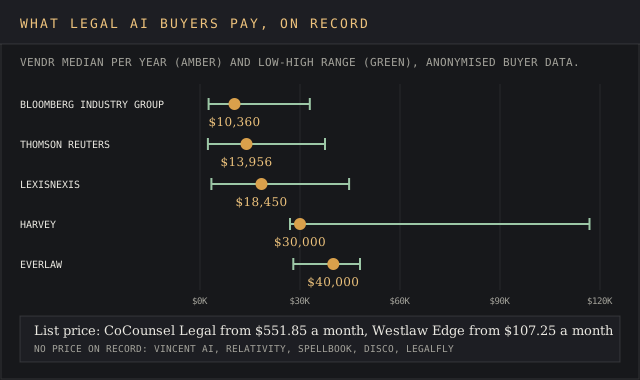
The billing unit follows the legal workflows each tool serves. AI research tools sell seats; Relativity and DISCO bill on data volume, and Relativity charges no per-user fees. Vendr reports each median per year, for contracts billed annually.
Three costs hide below the list price, and the devil's in the details. Everlaw's Deep Dive and translation consume credits. Relativity licenses Legal Hold and Translate separately. Lexis users report that searching outside the subscribed content costs extra. Ask for the out-of-plan rate card in writing before you sign.
The enterprise tier is where legal operations sets AI governance. Harvey's data residency choices and LEGALFLY's single-tenant deployment both point to enterprise scale contracts. Smaller firms should ask which controls their plan includes.
Data privacy, training data and data retention in legal AI
Confidential client files are what lawyers and in-house teams feed legal AI tools, so enterprise grade security comes ahead of features. Four questions settle most of it.
- Do customer documents train the AI models? Harvey, Thomson Reuters, LexisNexis and Spellbook say no in writing. Ask the others to put it in the contract.
- What's the data retention period? Protégé keeps Vault results for 90 days, and Harvey lets customers set their own retention policies.
- Which audits? SOC 2 Type II and ISO 27001 are the baseline; ISO 42001 covers AI management specifically.
- Where does the data sit? Harvey offers the EU or Switzerland, the US and Australia; LEGALFLY runs in a chosen Azure region.
LEGALFLY goes furthest: identifiable details are stripped before processing, so sensitive data reaches the model only in anonymised form.
Time-saving and adoption claims for legal AI, checked against the source
Most headline numbers in the legal sector's AI market come from vendors. Lawyers and legal departments should read them as claims and ask for the method.
- LEGALFLY's blog says contract review drops from two hours to 15 minutes, an 87.5% reduction, and names no study behind it.
- GC AI's December 2025 survey of 100+ customers reports 14 hours saved per user per week and a 14% cut in outside counsel spend, all self-reported.
- Thomson Reuters' product page lists a 33% average cut in time on document review, research and drafting, beside figures footnoted to a 2026 Forrester study it commissioned.
The 87% General Counsel Report figure is the one independent survey here, and Relativity co-published it. Treat each number as the opening bid for your own trial.
How to choose the right legal AI tool in a one-week trial
Run the legal AI trial on your own paper from your own legal practice. Pick 20 legal research questions your lawyers answered last quarter and run each through two tools, counting wrong or unsupported citations. Then time one real 2,000-page production.
For contract AI tools, in-house teams should take 50 executed agreements and one playbook and check clause extraction against what the legal ops team logged. Get the security answers in writing before day 7.
Legal AI FAQ
Is there an AI platform for legal advice?
The platforms here are tools for legal professionals, and none is licensed to give legal advice to the public. CoCounsel Legal, Harvey and the rest produce research and drafts that a lawyer reviews and signs.
Which legal AI tools work inside Microsoft Word?
Spellbook's AI is built around Word for law firms and lawyers who draft there. CoCounsel Legal, GC AI and Lexis+ AI also connect to Word, and GC AI includes a Word add-in on its $500 Individual plan.
Bottom line
CoCounsel Legal wins for most law firms and corporate legal departments: it passes all five tests and is the only AI tier with a published monthly price. Bloomberg Law is the better buy for docket-heavy litigators at a $10,360 Vendr median.
Harvey fits the Am Law firm whose lawyers want one legal AI platform everywhere at a $30,000 median, and Lexis+ AI fits when Shepard's and Lex Machina outweigh a $4,494 gap. For AI-assisted discovery, pick Everlaw for FedRAMP Moderate or Relativity for volume billing. Transactional lawyers who want AI in Word should trial Spellbook, and European in-house teams that need anonymisation first should start with LEGALFLY.