Trademark search cost in 2026: $0 to $1,800, before the $350 USPTO filing fee
 By Jan Suski. I go deep on every review, checking every number against its source and digging up details other coverage misses, a habit from six years of SEO and link building for tech companies. Bylines at Surfer, Brand24, and Senuto. How the scoring works.
The numbers Trademark search cost, checked 4 October 2026
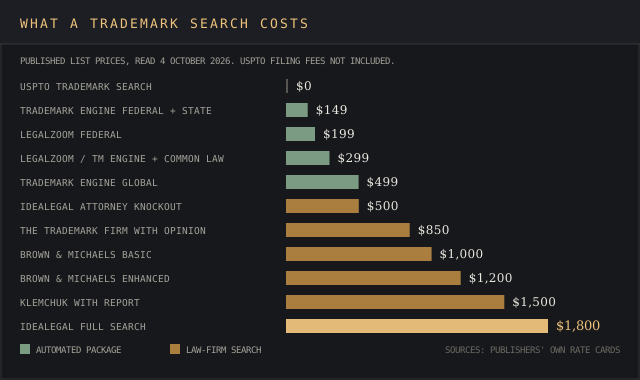
IdeaLegal's $1,800 attorney search costs 6.0 times LegalZoom's $299 package, and both read the same three record types: federal, state and common law.
Klemchuk's $1,500 flat fee costs 4.3 times the $350 in USPTO filing fees for a single class.
At the AIPLA average of $550 an hour, a $1,500 flat-fee search buys 2.7 hours of a trademark attorney's time.
A trademark search costs $0 on the USPTO's own Trademark Search system and $1,800 for the priciest published attorney search, IdeaLegal's top tier. Between those two sit automated packages at $149 to $499 and law-firm clearance searches at $850 to $1,500, all read on 4 October 2026.
None of those prices includes government fees. The United States Patent and Trademark Office charges $350 per class of goods or services on top, so a trademark application in two international classes starts at $700 before any search is bought.
A knockout search checks federal records for direct hits. A full trademark clearance search adds 50 state registers, common law use online, domain names and an attorney's reading of the results, and that attorney analysis carries fees of its own: Brown & Michaels charges $600 to read a search the client already ran.
This report prices the search services of five law firms, two online filing services and the USPTO for founders filing a first trademark application, from knockout and full clearance to opinion letter, international and watch trademark costs.
How much does it cost to search a trademark, by search type
Each row comes from the publisher's own page of fees.
| Search type | What it reads | Published price | Publisher |
|---|---|---|---|
| Do-it-yourself federal search | Registered and pending federal marks | $0 | USPTO |
| Free exact-match tool | USPTO records, exact matches | $0 | LegalZoom |
| Automated federal and state search | USPTO plus all 50 state registers | $149 | Trademark Engine |
| Automated federal search | USPTO records, exact and phonetic matches | $199 | LegalZoom |
| Automated federal, state and common law search | Adds unregistered use | $299 | LegalZoom, Trademark Engine |
| Automated global search | Adds Canada, UK, EU and WIPO databases | $499 | Trademark Engine |
| Attorney knockout search | Basic brand search of USPTO records | $500 | IdeaLegal |
| Attorney full search with opinion letter | Federal, state, common law and domain databases | $850 | The Trademark Firm |
| Attorney register search | USPTO registrations and applications | $1,000 | Brown & Michaels |
| Attorney register search with report | Federal and state registers | $1,500 | Klemchuk LLP |
| Attorney full search | USPTO, state registries and unregistered use online | $1,800 | IdeaLegal |
| Opinion on a search you already ran | Attorney reading only | $600 | Brown & Michaels |
All prices are list prices read on 4 October 2026.
None of the rows includes USPTO fees. Clarivate's CompuMark trademark search page and Corsearch, which says it watches 240 jurisdictions and territories for new marks, publish no fees for their search services and route buyers to "Contact us" and "Talk to an expert" buttons.
The free USPTO database and what a knockout search finds
The USPTO launched its cloud-based Trademark Search system on 30 November 2023 as the successor to TESS. The free search reads federally registered and pending marks in the USPTO database, the starting point for any knockout check.
The office's federal searching guide tells applicants to search sound-alike marks, alternate spellings and design codes for logos, such as DC:050101 for evergreens. An exact-match check skips phonetic equivalents, a red flag on the USPTO's own refusal list. Abandoned applications "can't bar your registration," the guide says, though "they can present other legal problems."
Applicants run this search themselves before filing. The USPTO's Basic Facts About Trademarks booklet says it "will not search your mark for you prior to your filing an application." An examining attorney searches the same records after the trademark application arrives, and by then the filing fees are spent.
LegalZoom says its free search results "show exact matches from the USPTO database," and Trademark Engine runs a free basic search with no card required. The Schenk Law Firm lists what the federal database leaves out: the 50 state registers, common law trademark use, and similar marks a searcher never typed in. Finding those by hand is a needle in a haystack.
Automated search packages from $149 to $499
Two online filing services publish a full ladder of fees. LegalZoom charges $199 for a federal search covering "exact and phonetic matches" with ranked results, and $299 for a federal, state and common law search. Its $899 trademark registration package, plus federal fees, adds attorney preparation of the trademark application and guidance through the application process.
Trademark Engine's ladder:
- $149 for the USPTO plus all 50 state registers
- $299 to add common law use, for marks in use but never registered
- $499 to add databases in Canada, the UK, the EU and the World Intellectual Property Organization
The $149 tier is the cheapest paid automated search on either rate card. LegalZoom lists attorney guidance only in its $899 package, so the $199 and $299 tiers hand the buyer a ranked list to read alone, a quick and dirty filter before money goes to a trademark attorney for a professional search.
Attorney clearance search prices and the opinion letter
Law firms that publish flat fees price a trademark clearance search at $500 to $1,800, and five rate cards show what the attorney's reading adds to trademark costs and services.
Firm by firm
The Trademark Firm, run by the law firm Dawsey Co., L.P.A., charges $850 for a "Comprehensive Trademark Search" of federal, state, common law and domain databases, opinion letter included.
Brown & Michaels, in a fee list updated 23 July 2026, charges $1,000 for a basic search of USPTO registrations and applications and $1,200 for an "Enhanced Search" that adds WIPO's Global Brand Database. Its $600 opinion on a pre-existing search is the only price for attorney analysis alone among these five firms.
Klemchuk LLP's $1,500 flat fee covers a review of all US state and federal registers and a report with findings and recommendations. Common law trademark research beyond that scope bills hourly, and all flat fees are paid in advance.
IdeaLegal splits its menu in two: a $500 "High-level" search of USPTO records, and an $1,800 "Comprehensive" search of USPTO records, state registries and unregistered uses found online. Add-on work bills at $400 an hour. The Rapacke Law Group sells one $1,950 flat fee that bundles the search, the trademark application and unlimited responses to office actions.
Trademark attorney costs by the hour
The AIPLA 2025 Report of the Economic Survey, published in February 2026, puts the average billing rate for intellectual property work at $550 an hour, the figure the USPTO itself used in a July 2026 Federal Register notice.
Application preparation adds a few hundred dollars to a thousand dollars in attorney fees on top of the government filing fee. Brown & Michaels charges $800 for an intent-to-use trademark application and $1,100 for one based on actual use, a single class included; IdeaLegal charges $600 for the first class plus $150 for each additional class.
What pushes a trademark clearance search cost up
Five variables move the bill, and each shows up as a step on the published rate cards:
- Record types. LegalZoom's federal search costs $199, and adding state and common law records takes it to $299.
- Jurisdictions. Trademark Engine's $299 search becomes $499 once it reads Canada, the UK, the EU and WIPO.
- Classes. Schenk Law Firm ties search pricing to "the number of classes involved," and every trademark class adds $350 in USPTO fees to the trademark application.
- Design elements. Schenk names a logo's design as a price factor alongside classes.
- Attorney services. Brown & Michaels prices the reading alone at $600.
Classes catch founders out because conflicts cross them. A Hacker News user described a dispute with IBM over a product slogan in September 2025:
"I wound up having to license my own tag line from them to settle the trademark dispute, even though it wasn't actually infringing (it was a different trademark class, hardware, and I was making software.) Then, my attorney explained that, while possibly winnable, taking on that case would cost $50,000."
dtagames, Hacker News, 13 September 2025
The USPTO's list of common refusals explains the risk. Marks conflict when they're confusingly similar "in appearance, sound, or meaning, and used with related goods or services," and a mark built on a descriptive word gets refused even after a clean search. Our report on trademark infringement costs prices a missed conflict.
USPTO filing fees after the search
USPTO fees are the part of trademark costs nobody negotiates. The schedule below took effect on 18 January 2025, and the devil's in the details: three surcharges punish a weak description of goods or services.
| Filing | USPTO fees | When it's due |
|---|---|---|
| Base application, electronic filing | $350 per class | At filing |
| Base application, paper | $850 per class | At filing |
| Insufficient information surcharge | $100 per class | At filing |
| Free-form text in place of the ID Manual | $200 per class | At filing |
| Each extra 1,000 characters of free-form text | $200 per class | At filing |
| Statement of use, intent-to-use basis | $150 per class | Before registration |
| Extension of time to file a statement of use | $125 per class | Each request |
| Section 8 declaration of use | $325 per class | Five years after registration |
| Section 15 incontestability declaration | $250 per class | Alongside or after Section 8 |
| Section 8 declaration plus Section 9 renewal | $650 per class | Every 10 years |
| Grace period surcharge, late maintenance filing | $100 per class | With the late filing |
| Petition to revive an abandoned application | $250 per petition | After abandonment |
Amounts come from the USPTO's trademark fee information page and its fee schedule, last revised 14 August 2026.
Paper applications cost 2.4 times the electronic filing fee. A vague description adds $100 to $200 per class in additional fees, a few hundred dollars on a multi-class trademark application.
Maintenance fees outrun the base fee. A registration kept for ten years pays $325 at year five and $650 at year ten, $975 per class, against a $350 government filing fee at the start. The filing basis changes the bill too: an intent-to-use trademark application adds the $150 statement of use and $125 per extension, extra costs a use-based filing never sees.
Office actions and what a response costs
The USPTO's July 2026 Federal Register notice on its office action response forms (OMB control number 0651-0050) estimates 300,000 responses to office actions a year. It budgets 0.83 hours (50 minutes) per response, 249,000 hours a year at the AIPLA rate of $550 an hour, a $136,950,000 total, or $456.50 per office action response.
Brown & Michaels quotes a response at "between $600 and $1,800, but could be more," priced on time spent, so office actions bill hourly there. Rapacke's $1,950 flat fee includes unlimited responses, and the trademark office charges $125 for each extension of time to answer a pre-registration office action.
Office actions over likelihood of confusion are the expensive kind, which the Rapacke Law Group says require legal research, drafted arguments and evidence. Office actions also stretch the application process.
International search and filing fees
A brand sold in multiple countries needs a search of each register it will file in. Trademark Engine's $499 global package reads Canada, the UK, the EU and WIPO, and Brown & Michaels charges $1,200 to add WIPO's Global Brand Database, a free database of Madrid System marks and national office records.
The Madrid Protocol lets a US owner file one international application through the USPTO, which charges a $100 certification fee per class for a single basic application and $150 per class for more than one. The World Intellectual Property Organization then charges a basic fee of 653 Swiss francs, or 903 francs for a mark in colour, plus additional fees for each designated country.
Brown & Michaels adds $1,100 for its own Madrid filing work, one class included. Founders can cross that bridge when they come to it: the US filing becomes the Madrid basic application. Direct national filings in other countries price by class too:
- The EUIPO charges €850 online for the first class, €50 for the second and €150 for each class from the third.
- The UK Intellectual Property Office charges £205 for the first class and £60 for each additional class, rates revised in April 2026, and its trade mark search carries no fees, no strings attached.
Watch services after the trademark is registered
Klemchuk notes that its search reads the registers at one point in time. A trademark registered at the USPTO still needs someone to keep an eye on new filings, and watch services sell brand protection by the mark, register or seat.
Markify publishes the plainest price list: $39 a year per mark for a US federal watch and $129 a year for a global watch across 190 registers, with bulk pricing for trademark owners with 50 watches or more. Next to an $1,800 search, a $39 watch is a drop in the bucket of trademark costs.
Professional search services price per seat. TM TKO charges $280 a month for one user, or $84 for a 24-hour day pass. Trademark Engine's monitoring service sends alerts but "does not prevent or enforce against infringement."
Our ranking of social listening tools covers software that flags confused customers in reviews, a second layer of brand protection for many trademark owners.
Three budgets for a first trademark, search to registration
Adding the published search prices to USPTO filing fees gives three entry points for trademark costs on a single class of goods or services:
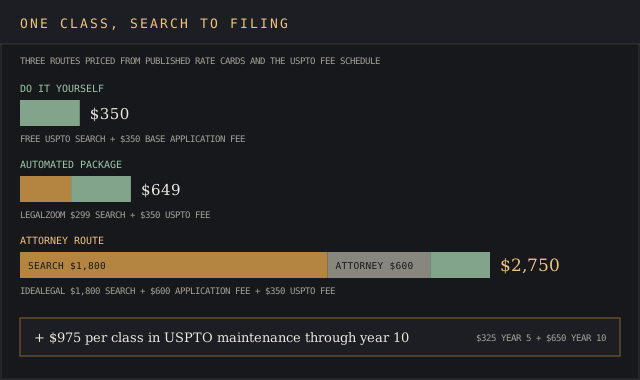
The do-it-yourself route costs $350: a free search and the base fee. The automated route costs $649, LegalZoom's $299 search plus $350. The attorney route at IdeaLegal costs $2,750 for the entire process up to trademark registration, its $1,800 search, $600 application fee and $350 in USPTO fees, so the search takes the lion's share at 65%. Two classes cost $3,250 in fees.
For a founder raising money on a new brand, the $2,400 gap buys the state, common law and attorney layers that cutting corners skips. Teams still choosing a name can start with our positioning statement template, our focus group cost report and our market research cost report. Patent filers face the same split in our patent search cost report and the patent search tools ranking.
Frequently asked questions
How much does a trademark search cost?
The USPTO search costs $0. Automated packages from filing services cost $149 to $499, and attorney clearance searches cost $500 to $1,800 on published law-firm rate cards.
Can I do a trademark search myself?
Yes. The USPTO Trademark Search system is free, and the office's guide tells applicants to search phonetic equivalents, alternate spellings and design codes. It reads federal records only, so state registrations and common law use need legal help or a paid check, which adds to trademark costs.
Is a trademark search free?
A free search of federal records costs $0 at the Patent and Trademark Office, on LegalZoom's exact-match tool and on Trademark Engine's basic search.
How do I do a trademark clearance search?
The USPTO's page titled "Comprehensive clearance search for similar trademarks" gives detailed information on sources: the federal database, state trademark and business registries, domain name registries, Madrid Monitor, TMview and search engines. It suggests a US-licensed trademark attorney for "a more in-depth search."
How much does it cost to file after the search?
USPTO fees start at $350 per class for a trademark application filed electronically, with $100 to $200 surcharges per class for incomplete or free-form descriptions. Maintenance costs $325 per class at year five and $650 per class every 10 years.
How long does it take to get a trademark approved?
Five months from filing to a first action is the current-year target on the USPTO's trademarks dashboard, with 11 months or less of total pendency for the application process.
Should I get a trademark or LLC first?
An LLC and a trademark protect different things. The USPTO says "a state's authorization to form a business with a particular name does not also give you trademark rights," so a business name registration leaves the brand without federal trademark protection.
What's the cheapest way to trademark your name?
A free USPTO search plus a $350 electronic trademark application in a single class, filed with an ID Manual description to avoid surcharge fees. Use alone creates common law rights, which the USPTO says "only apply to the geographic area" where you sell, and registration turns them into nationwide, enforceable rights under trademark law.
Bottom line
Trademark search cost runs from $0 at the USPTO to $1,800 at the top of the published attorney rate cards, and the steps between them follow record types: federal, then state, then common law, then an attorney's opinion. The $350 per-class filing fee and $975 per class of maintenance through year ten add to trademark costs on every route in the trademark process.
Free and automated searches catch direct hits. The attorney tiers at $850 to $1,800 buy the reading that spots confusingly similar marks, the conflict behind the office actions that slow a trademark registration. That reading is the line in total trademark costs that decides if the filing fees get a trademark registered.
Where each fee was read, and the search prices two vendors keep private
Official fees and guidance come from uspto.gov: the trademark fee information page, the fee schedule revised 14 August 2026, the Trademark Search launch notice of 30 November 2023, the federal searching guide, the clearance search page for similar trademarks, Basic Facts About Trademarks, the common refusals list and the trademarks dashboard.
The office action burden figures come from Federal Register document 2026-14389, published 17 July 2026 (OMB control number 0651-0050), which cites the AIPLA 2025 Report of the Economic Survey, published February 2026 on aipla.org. Fees outside the US come from wipo.int (the Madrid fee schedule and the Global Brand Database), euipo.europa.eu and gov.uk.
Rate cards were read on 4 October 2026 at legalzoom.com, trademarkengine.com, thetrademarkfirm.com, klemchuk.com, idealegal.com, bpmlegal.com (fee list updated 23 July 2026), markify.com and tmtko.com, with search price factors from schenklawfirm.com and the Hacker News thread of 13 September 2025.
Clarivate's CompuMark and Corsearch print no search prices, and Brown & Michaels ends its office action response range with the words "could be more."