OpenCorporates review: legal entity data at world scale
 By Jan Suski. I go deep on every review, checking every number against its source and digging up details other coverage misses, a habit from six years of SEO and link building for tech companies. Bylines at Surfer, Brand24, and Senuto. How the scoring works.
· Prefer this source on Google
Best for
Compliance and onboarding teams that need officer, director and company-registry data pulled through an API.
Not for
Anyone needing credit scores, trade references or verified financial records; OpenCorporates carries none of that, only official-register filings.
What it costs
Basic search and officer or director records after registration cost nothing. The API runs on paid, metered self-serve tiers, moving to a custom enterprise agreement at higher volume.
- Companies listed
- More than 192 million
- Jurisdictions
- 140 worldwide, standardized into one common format
- Search volume
- More than 5 million searches a month
- Banking adoption
- 80% of North America's largest banks, on the company's own statement
- Sourcing
- Official primary sources
- Free search fields
- Company names, registered addresses, officers and directors across the full 140-jurisdiction footprint
- Deeper records
- Full filing histories, released behind a registration
- API
- Feeds entity records straight into screening and onboarding workflows, replacing manual copy-paste from a web page
- Data principles
- Legal Entity Data Principles, open-licensed, published July 2023
- Principle one
- Entity identification starts at the official register, not at an intermediary that might reprocess a filing
- Freshness
- Set by each registry's publication schedule; a weekly-updating registry beats a quarterly one
- Record quality
- Varies by jurisdiction, since a registry processing paper filings produces dirtier records than one on modern systems
- Corrections
- Registry-level fixes take weeks, and OpenCorporates can't make them unilaterally
- Privacy exposure
- Officer and director names sit on a public page, and an address public in one jurisdiction can be restricted in another
- Not included
- No credit scores, no trade references, and no records it creates or verifies itself
- Basic search
- Free, with no account needed for company names, registered addresses or jurisdictions
- Registration
- Required to receive officer and director records and filing history
- API access
- Paid and metered, tiered by call volume
- Self-serve tiers
- A fixed number of queries per tier, paid per tier
- Enterprise plan
- A custom agreement once usage runs past the self-serve tiers
- Funding model
- Independent since launch, funded by the API and enterprise data plans
- Support included
- A small team covering enterprise accounts
- Award
- Open Data Business Award, Open Data Institute, July 2015, the only entrant to reach the finals in both the Business and Publisher categories
Alternatives to OpenCorporates
Sayari
Not forA team that needs one jurisdiction's registered name, address and officers; Sayari is built and priced for cross-border ownership investigations.
Veridion
Not forA compliance team that has to show a regulator the primary registry source behind every field.
Coresignal
Not forA KYC or onboarding workflow that has to trace each field back to an official register.
Pairs well with OpenCorporates
Which of these figures are the company's own, and which come from user reports
The 192 million companies, the 140 jurisdictions, the 5 million monthly searches and the 80% banking adoption figure are OpenCorporates' own published statements, restated here as the company's claims. The record-quality, correction-delay and privacy rows come from public user feedback. The API rows describe tiers by call volume, which is as far as the published pricing detail goes. Figures current as of this review's update on 5 August 2026.
This review covers what the world's largest open database of companies does, how it sources legal entity data, what that data costs to look up versus pull through the API, and how it compares with paid alternatives like Veridion and Sayari.
OpenCorporates today lists more than 192 million companies across 140 jurisdictions worldwide, its search engines process more than 5 million searches a month, and the company states that 80% of North America's largest banks use it.
↑ FACT SHEETWhat is OpenCorporates
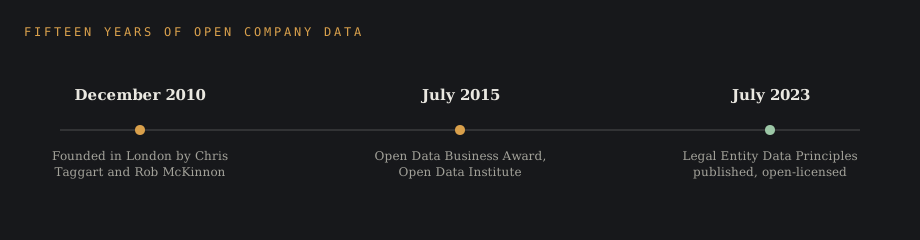
OpenCorporates is an open database of company data, built from official primary sources. Chris Taggart and Rob McKinnon founded the business in London in December 2010, incorporating OpenCorporates Ltd on December 18 and launching the public website two days later.
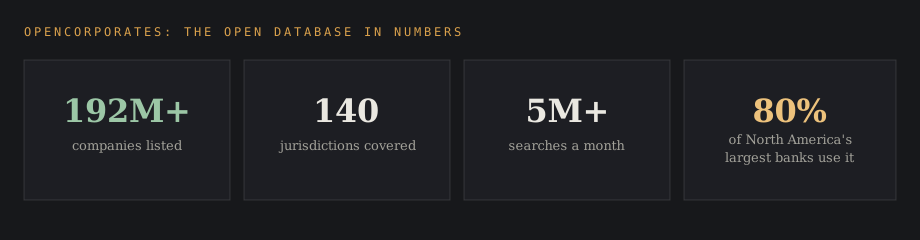
On its own website, OpenCorporates describes "world-leading expertise in legal-entity data," providing "fresh, standardized, auditable information direct from official primary sources across 140+ jurisdictions." Financial institutions cite the database most for counterparties outside the US and UK because it aggregates primary-source registry data across those 140+ jurisdictions in one place.
The pitch has stayed the same for fifteen years: every jurisdiction on earth runs a statutory registry of the companies inside it, and OpenCorporates functions as a statutory registry aggregator that pulls those registries into one open database, standardized into a common format.
That scale brings a practical advantage: one interface returns registered addresses, officer and director names, and filing data for companies large and small across all 140 jurisdictions, replacing 140 separate websites and data formats. That lets researchers understand a company's structure fast.
Who uses it, and the banking benchmark
OpenCorporates states that 80% of North America's largest banks use the database, a concentration that matters because those institutions run the most heavily audited know-your-customer and anti-money-laundering programmes in the market.
The adoption figure is the one worth weighing against any paid alternative's marketing. A compliance function that has already cleared a data source for that use has done diligence a smaller buyer can lean on.
Alongside the banks, more than 5 million searches run across the platform each month, spanning corporate compliance teams, investigative journalists, procurement functions and academic researchers working on corporate ownership.
↑ FACT SHEETLegal entity data principles
In July 2023, OpenCorporates published its Legal Entity Data Principles, an open-licensed framework for trustworthy legal entity information. Principle one underpins everything else: foundational data has to come from official sources, with entity identification starting at the official register. That avoids the errors an intermediary might introduce by reprocessing a filing.
That principle answers a fair question: why trust OpenCorporates over a paid data broker's own database? The legal entity data principles hold that primary-source sourcing lets a company data record earn trust. It helps compliance teams understand which parts trace to the registry itself, and helps journalists understand how much weight a filing carries.
Results still depend on the registry behind them; freshness varies by jurisdiction, since a weekly-updating registry produces fresher records than a quarterly one, and information updates depend on the publication schedules of those official registries.
↑ FACT SHEETCoverage, search and the API
Basic search on OpenCorporates is free and covers the names of companies, registered addresses, officers and directors across the 140-jurisdiction footprint in one search, replacing registry-by-registry lookups for each country. Anyone can look up companies for free; registration is required to receive deeper detail like full filing histories, and larger or automated usage runs through the OpenCorporates API instead.
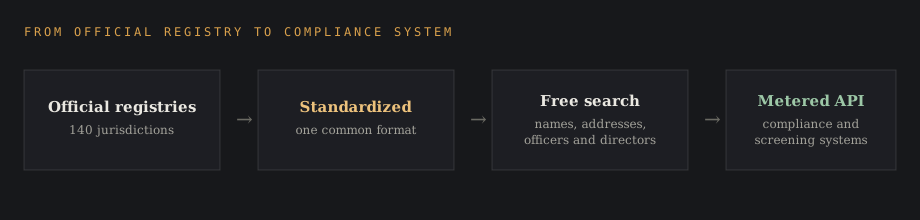
The API is what turns the database into infrastructure. OpenCorporates provides an API for integrating data into compliance systems, so entity records flow into screening and onboarding workflows. That API access, underpinned by the same registries as the website, serves compliance systems and due-diligence applications that need company data flowing into an existing workflow.
Access is metered and tiered by call volume; self-serve customers pay per tier for a fixed number of queries, and heavier usage moves to a custom enterprise agreement for larger users. Security is a recurring question compliance employees raise, since registries vary in how much personal data they publish and how those processes handle a director's home address; a supplier's address, for example, might be public in one jurisdiction and restricted for security reasons.
↑ FACT SHEETCorporate transparency and what OpenCorporates is used for
OpenCorporates was built to advance corporate transparency, a mission pursued since 2010: open, standardized company data as a public good.
That framing is why OpenCorporates won the Open Data Business Award at the Open Data Institute Awards in July 2015, presented by ODI founders Sir Tim Berners-Lee and Sir Nigel Shadbolt to that year's winner, the only entrant to reach the finals in both the Business and Publisher categories.
That data supports several use cases across companies of every size. Financial institutions use it for due diligence, sanctions screening and anti-money laundering verification, checking a counterparty's registered address, directors and reputation against a primary source, a powerful check against shell companies that exist only on paper.
Investigative journalists use it to understand corporate ownership, tracing which individuals sit behind related companies around the world and building fraud-risk insights. Buyers wondering if a supplier is legitimate can check officer information for free, keeping a company's incorporation date in mind.
What users say
Public feedback splits in a predictable way. Corporate professionals using the API tend to trust the primary-source model, while individuals and small business owners have a rougher time with the free tool for searching companies one at a time.
Some raise privacy concerns about personal information, officer and director names among them, visible on a public page; others report mixed experiences with response times on data correction requests, describing weeks spent waiting for a registry-level fix OpenCorporates can't make unilaterally, since it doesn't control the record it standardizes.
Record quality varies by jurisdiction, a result of aggregating information from official sources with different update processes. A well-resourced registry with modern systems produces cleaner information than one processing paper filings, and OpenCorporates' own coverage of companies in those jurisdictions reflects that gap.
OpenCorporates alternatives
A handful of paid competitors offer companies' data worldwide at comparable or larger scale, and all of them sit in the same company data providers category.
| Provider | Claimed scale | Built for |
|---|---|---|
| OpenCorporates | 192M+ companies, 140 jurisdictions | Registry-grade verification, primary sources |
| Sayari | 7B+ records, 724M companies | Ownership-network mapping in risk-heavy jurisdictions |
| BoldData | 350M+ companies, 500M contacts | Sales use over registry-grade verification |
| Veridion | 120M+ companies, 250 locations | Paid company data at scale |
| Coresignal | 73M+ companies, 185 countries | Enrichment pipelines |
| Success.ai | 30M+ companies, 200+ countries | Outbound and prospecting |
None of those alternatives match OpenCorporates on its core claim: data built from official primary sources, an important distinction for risk teams even when a competitor lists a bigger company count. Buyers receive data straight from a registry, a trust signal the alternatives can't fully replicate, whatever their scale across other companies and other lines of business.
The data providers category guide maps where registry data ends and B2B contact data begins.
Frequently asked questions
How reliable is OpenCorporates?
OpenCorporates sources its data and information directly from official government registries, the basis of its reliability claim and principle one of the framework it publishes. The company states that 80% of North America's largest banks use it, which is the strongest external signal available.
Record quality still depends on the registry behind a given company: a well-run national register yields more current information than a jurisdiction still processing filings on paper.
Is OpenCorporates free?
Basic search is free, and anyone can look up company names, registered addresses or jurisdictions without an account. Registration is required to receive officer and director records and filing history, and the API runs on paid, metered plans, from self-serve tiers to enterprise agreements.
Who owns OpenCorporates?
Chris Taggart and Rob McKinnon founded OpenCorporates in London in December 2010. Taggart, who led the company as chief executive for most of its history, now serves as founder and chief strategy officer, with day-to-day leadership handed on. It has operated as an independent business since launch, funded by its API and enterprise data plans, with a small team providing support to enterprise accounts.
How do OpenCorporates work?
OpenCorporates pulls filings directly from official company registries across 140 jurisdictions, standardizes that legal entity data into a common format, and makes it searchable through a website or API. It doesn't create or independently verify new records; it aggregates and standardizes what official registries already publish, as of each registry's own filing date.
What is OpenCorporates used for?
Three groups account for most of the usage:
- Financial institutions, for compliance checks, know-your-customer verification and anti-money laundering screening, drawing security-relevant insights on companies across all 140 jurisdictions; 80% of North America's largest banks are among them.
- Journalists, for corporate ownership research and fraud insights.
- Businesses of every size, for due diligence before signing a contract or wiring funds.
All three work from the same open data researchers worldwide rely on to learn who owns a company.
How are OpenCorporates different from Dun & Bradstreet?
Dun & Bradstreet builds its company data from proprietary research, business surveys and commercial licensing, sold as a paid business-intelligence product. OpenCorporates instead standardizes and republishes what official government registries already make public, and keeps basic search free.
A note on scope: Dun & Bradstreet often carries more commercial detail per company, like credit scores and trade references, which OpenCorporates doesn't provide.