Document intelligence platforms: 10 options ranked for 2026
 By Jan Suski. I go deep on every review, checking every number against its source and digging up details other coverage misses, a habit from six years of SEO and link building for tech companies. Bylines at Surfer, Brand24, and Senuto. How the scoring works.
Quick comparison of document intelligence platforms
Ten platforms with the one coverage figure each vendor names, what it costs to start, and the buyer it fits. Coverage figures are each vendor's own published count.
| # | Provider | Prebuilt model / document-type coverage | Entry price | Best fit |
|---|---|---|---|---|
| 1 | Azure AI Document Intelligence | 21+ named prebuilt models | Free: 500 pages/month | Broadest named model catalog |
| 2 | Google Document AI | 11 pretrained processors | $1.50 / 1,000 pages (OCR) | Fully published rate card |
| 3 | Amazon Textract | 6 named capability APIs | $1.50 / 1,000 pages (text) | HIPAA-eligible extraction |
| 4 | ABBYY Vantage | 150+ skills; 10,000+ ID types | Vendr median $61,647/yr* | Many document families, low-code |
| 5 | Hyperscience | No published model count | Vendr median $17,325/yr* | FedRAMP-authorized workloads |
| 6 | UiPath Document Understanding | 49 named document types | Vendr platform median $45,338/yr*† | Teams already on UiPath |
| 7 | Nanonets | No published catalog count | $100/mo, 100 credits | Pay-per-run, no annual deal |
| 8 | Docsumo | 18 named document types | Free: 1,000 pages, 14 days | Fixed trial before an annual deal |
| 9 | Rossum | 4 types by design (invoices, POs) | From $18,000/year | One AP workflow, deliberately narrow |
| 10 | Instabase | No published catalog | Quote only, no public floor | Negotiating from a blank page |
Medians marked * are anonymized buyer-reported contract values published by Vendr. UiPath's figure† covers its platform-wide licensing; UiPath publishes no module-specific price for Document Understanding itself. Everything else is the price the vendor states on its own site.
Where these figures come from
Model and document-type counts come from each vendor's own documentation, read this session. Medians marked * are Vendr's anonymized buyer-reported contract values; none of these vendors publish a comparable list price.
Azure's region-gated pricing page didn't render a dollar rate this session, so its row states only the confirmed 500-page free tier. Rossum's Vendr listing was gated behind a paywall this session, so its row carries only the $18,000 figure Rossum publishes itself. A Vendr buyer-reported median for Rossum isn't available this session. Instabase publishes no number at any tier, and Vendr carries no listing for it either.
Document intelligence sits next to two rankings that judge a different slice of the same buying problem.
Contract intelligence software ranks platforms built around the contract lifecycle; this page ranks platforms built around raw field extraction. Data intelligence tools ranks the governance and cataloging layer that sits downstream of whatever a document-intelligence platform extracts. None of the ten platforms below appear on either of those two lists.
Document intelligence turns a scanned invoice or a 40-page contract into fields a database can use. Traditional OCR just recognizes characters on a page. Document intelligence interprets layout and meaning well enough to tell a line item from a header, and it hands every extracted field a confidence score before a human sees it. That's why the same job costs $1.50 per 1,000 pages at one vendor and six figures a year with a sales call attached at another.
This page ranks ten platforms: three cloud-hyperscaler APIs (Azure AI Document Intelligence, Google Document AI, Amazon Textract), four enterprise intelligent document processing (IDP) platforms (ABBYY Vantage, Hyperscience, UiPath Document Understanding, Rossum), and three self-serve tools (Nanonets, Docsumo, Instabase).
Buyers who stay ahead of the curve run their own accuracy test on 50 of their own documents before signing anything; the vendor's demo set rarely looks like a Tuesday-morning invoice backlog.

Evaluation criteria for document intelligence platforms
Five criteria decide the order below, and each resolves to a yes, a no, or a number. Call a spade a spade: a factor that can't be checked on the vendor's own page doesn't belong on this list.
Prebuilt model and document-type coverage
How many named document types does the vendor list by name? Azure names 21 models plus tax-form variants. Rossum names four, on purpose, because it only sells accounts-payable extraction.
Custom model training floor
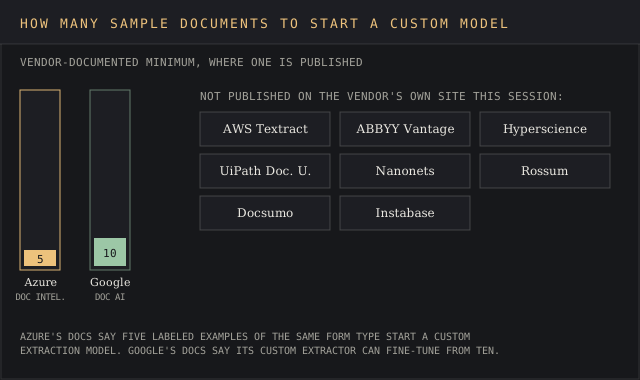
How many labeled sample documents does the vendor say a custom model needs to start? Azure's docs say five. Google's custom extractor fine-tunes from ten. Six of the ten vendors publish no figure.
Pricing transparency
Does the vendor publish a per-page rate, or does a buyer need a sales call for a number? Three APIs publish a rate card. The four enterprise platforms publish nothing; the only public numbers come from Vendr's anonymized buyer data.
Two rows in the comparison table carry a disclosed gap. Azure's region-gated pricing page didn't render a dollar rate this session, so its entry price above reflects only the confirmed 500-page free tier.
Rossum's Vendr marketplace page was gated behind a paywall this session, so its $18,000 figure is Rossum's own published floor. A Vendr buyer-reported median for Rossum isn't available this session either. Neither gap moves either platform's rank; both are flagged here and in the sources note above.
Published accuracy claim
Does the vendor state an accuracy or straight-through-processing percentage tied to a method? A plain claim of "high accuracy" with no number doesn't count. Hyperscience claims 99.5%; Azure and Google's own pages state no figure.
Compliance certification
Does the vendor name a specific, dated certification, such as SOC 2 Type II or FedRAMP High? Four of the ten name one on the pages checked for this ranking.
Top 10 document intelligence platforms, ranked
Azure AI Document Intelligence
Best fit
Azure-native teams wanting the broadest named prebuilt-model catalog without a long procurement cycle.
Azure's documentation lists 21 named prebuilt models across financial, tax, mortgage, and identity documents, plus tax-form variants (W-2, 1098, 1099, 1040) that push the real count higher. A custom extraction model needs five labeled examples of the same form type to start, the lowest documented floor of any platform here. The free tier covers 500 pages a month before metered billing begins.
Key features
- Read, Layout, and prebuilt models for invoices, receipts, IDs, and US tax/mortgage forms.
- Custom Template, Custom Neural, and Custom Classifier model types.
- Confidence scores per field, with a documented 0.80 routing threshold.
- Customer-managed key encryption in Azure Key Vault.
- Document Intelligence Studio for labeling without code.
Pricing
Pay-as-you-go tiers meter Read, prebuilt, and custom-model calls per 1,000 pages across 0-1M and 1M+ bands, though the region-gated pricing page didn't render dollar figures this session; only the 500-page free tier is confirmed directly.
Pros
- Broadest named model catalog here.
- Five-document training floor, the lowest checked.
- Documented confidence-score methodology.
Cons
- No accuracy percentage published.
- No SOC 2, HIPAA, or ISO named, only FIPS 140-2 encryption.
- Live per-page rates weren't retrievable this session.
Adrian C., a process specialist, wrote on G2 (September 7, 2024) that the tool "can struggle with certain handwriting styles, leading to reduced accuracy."
Why it's ranked #1. Azure's 21-model catalog and five-document training floor beat Google's 11 processors and ten-document floor on both counts named above. It publishes no accuracy percentage, which is why it isn't a clean win on every axis.
Google Document AI
Best fit
GCP teams who want a fully published per-page price schedule before writing a line of code.
Google publishes exact per-1,000-page rates: $1.50 for Enterprise OCR under 5 million pages a month, $30 for the custom extractor under 1 million, a flat $10 for Layout Parser. Eleven pretrained processors cover invoices, receipts, bank statements, and IDs, each priced per document. A custom extractor can fine-tune from as few as ten labeled documents.
Key features
- Enterprise Document OCR, Form Parser, Layout Parser, Summarizer.
- Eleven pretrained processors for invoices, expenses, and IDs.
- Custom splitter and classifier priced separately from extraction.
- Provisioned throughput at $300 per extra page-per-minute.
- Hourly processor hosting, about $438/year per deployed version.
Pricing
Volume breakpoints are marginal: a 6-million-page Form Parser month bills the first million at $30 and the rest at $20, for $130,000, by Google's own worked example.
Pros
- Every rate published with volume breakpoints.
- Ten-document fine-tuning floor.
- Granular per-feature pricing.
Cons
- Accuracy drops on non-English documents, per a verified review.
- No accuracy percentage stated.
- API integration took longer than expected for one reviewer.
Yogesh C. rated Document AI 3.5/5 on G2 (December 28, 2023): "accuracy drops when documents are in languages other than English."
Why it's ranked #2. Google's rate card is the most completely published here, down to the per-feature dollar figure, beating Azure's currency-gated page. It loses the top spot because its ten-document floor is double Azure's five, and Azure names nearly twice as many models.
Amazon Textract
Best fit
AWS-native teams needing extraction that's already HIPAA-eligible without a separate vendor BAA.
AWS made Textract HIPAA-eligible on October 10, 2019, alongside Comprehend and Transcribe, confirmed on its own machine-learning blog. Pricing runs $1.50 per 1,000 pages for text detection under 1 million pages a month, up to $50 per 1,000 for full form analysis. New accounts get a three-month free tier: 1,000 pages a month for text detection, 100 for forms or expenses.
Key features
- Detect Document Text, Analyze Document, Analyze Expense, Analyze ID, Analyze Lending.
- Synchronous calls for single pages, async jobs for multipage files.
- Pay-per-feature pricing; tables and forms meter separately from text.
- No training step for the prebuilt APIs.
- HIPAA-eligible since 2019 with a published BAA path.
Pricing
Every API has its own rate with a volume breakpoint, and Analyze ID drops from $25 to $10 per 1,000 pages past 100,000 pages a month, though Custom Queries alone carries no free tier.
Pros
- HIPAA eligibility confirmed since 2019, the earliest here.
- Fully published per-feature rate card with a free tier.
- No training step required.
Cons
- Handwriting accuracy is "a bit low" per a 2024 review.
- Custom Queries is prompt-based, so the training-floor criterion doesn't apply.
- Costs climb fast on complex multi-page PDFs.
An IT technical recruiter rated Textract 5/5 on G2 (July 10, 2024): "the best thing about amazon textract is that it accurately extract the text, handwriting or any structured data."
Why it's ranked #3. Textract's 2019 HIPAA eligibility is the earliest dated compliance fact among the three hyperscalers, and its per-feature pricing beats Google's eight-processor tiers on granularity. It drops below Google because it names only six capability APIs against Google's eleven, with no small-sample custom-training path.
ABBYY Vantage
Best fit
Enterprises processing many document families who want a low-code workflow designer they can adjust without an API integration project.
ABBYY's page claims pre-trained skills start at "90% accuracy," with an ID-reading skill covering 10,000+ document types across 190 countries. Marketplace listings name 11 logistics skills and 7 financial-extraction models. ABBYY publishes no dollar price anywhere; Vendr's anonymized buyer data puts the median contract at $61,647 a year, ranging $28,112 to $159,050.
Key features
- 150+ documented pre-trained skills across industries.
- ID-reading skill covering 10,000+ document types, 190 countries.
- Low-code/no-code skill builder.
- SOC 2-certified cloud instances in Europe, the US, and Australia.
- Marketplace skill packs for logistics and accounts payable.
Pricing
Every tier above the unpublished starter is "Get a Quote," tied to page volume and workflow complexity, with a one-year minimum contract.
Pros
- Published 90% baseline accuracy figure.
- Largest named document-type catalog (10,000+ ID types).
- SOC 2 named for three regions.
Cons
- No training-data minimum published.
- Zero public dollar figure; Vendr is the only source.
- A G2 reviewer flagged "many small stability issues... in the Advanced Designer."
Sidar R. rated ABBYY's IDP platform 5/5 on G2 (July 5, 2026): "the data extraction is reliable, and being able to automate repetitive document-heavy workflows saves" time.
Why it's ranked #4. ABBYY's 10,000-plus named ID types and published 90% baseline beat Textract's unstated accuracy and narrower six-API catalog. It falls below Textract because Textract publishes a full rate card and ABBYY leans entirely on a third-party Vendr estimate for any number at all.
Hyperscience
Best fit
Regulated, high-security buyers who need FedRAMP authorization and accept a quote-only contract.
Hyperscience names FedRAMP High-authorized deployment, a certification none of the other nine platforms claim on the pages checked. Case studies cite 90% straight-through processing for Canon USA (4,500 invoices a month) and 200,000 hours saved annually for Dexcom. No price appears on its site; Vendr lists a median of $17,325 a year, ranging $8,279 to $262,841.
Key features
- FedRAMP High-authorized cloud deployment, plus self-hosted and hybrid.
- Structured, semi-structured, unstructured, and communications handling.
- Stated policy of no training on customer data.
- Model controls, audit trails, and data-protection safeguards.
- Gartner Magic Quadrant Leader for intelligent document processing.
Pricing
No tier, rate, or starting figure on the public site; a demo is the only path to a number.
Pros
- Only platform here with a named FedRAMP High authorization.
- Customer-reported 90%+ straight-through processing on named accounts.
- SOC 2 Type II and Cyber Essentials Plus named alongside it.
Cons
- Zero published price at any tier.
- No named count of prebuilt models.
- One insurance reviewer rated it 1.5/5, citing human involvement in semi-structured extraction.
An RPA automation manager gave Hyperscience 5/5 on G2 (February 2, 2024): "outstanding accuracy results for handwritten as well as digital scan documents."
Why it's ranked #5. Hyperscience's FedRAMP High authorization beats anything the first four entries claim, and its customer-reported rates beat ABBYY's flat 90% baseline. It ranks below ABBYY because ABBYY names a concrete skill catalog where Hyperscience names none, leaving a buyer between a rock and a hard place on sizing the product before a call.

UiPath Document Understanding
Best fit
Shops already running UiPath robots who want extraction wired into existing automations.
UiPath's documentation lists 49 named pretrained document types, from 1040 forms to passports, more than double Docsumo's count. No accuracy percentage appears on UiPath's own site. A TrustRadius reviewer's team got extraction working across handwritten documents; a separate reviewer wanted more stability on high-resolution images.
Key features
- 49 named prebuilt document types.
- Native integration into UiPath Automation Cloud or Suite.
- Structured, semi-structured, and generative extraction.
- Cloud, self-hosted, or hybrid deployment.
- Gartner Magic Quadrant Leader recognition.
Pricing
No module-specific price is published. Vendr's platform-wide median across all UiPath purchases is $45,338 a year (42 purchases, $22,440-$223,821); that figure covers UiPath licensing overall and says nothing about Document Understanding specifically.
Pros
- 49 named types is the second-highest catalog here.
- Native fit for existing UiPath shops.
- Multiple deployment models.
Cons
- One enterprise reviewer reported 60% to 65% accuracy in production.
- No accuracy percentage published by UiPath itself.
- A reviewer called pricing "wildly overpriced."
A senior RPA consultant wrote on TrustRadius (May 26, 2021) that the tool "helped me to extract information from documents even the handwritten documents."
Why it's ranked #6. UiPath's 49-type catalog beats Hyperscience's unstated count, the clearest edge named in the criteria. It falls below Hyperscience because a named enterprise user reported only 60-65% real-world accuracy on G2, short of Hyperscience's 90%-plus customer rates, and UiPath carries no FedRAMP authorization.
Nanonets
Best fit
Small and mid-size teams who want pay-per-run pricing over an annual contract.
Nanonets starts with a $50 free credit, no card required, then $100 a month for 100 credits. Block pricing runs $0.02 for a simple operation up to $0.30 for a complex AI step; a typical invoice workflow runs under $2 per document, by the vendor's own math. HIPAA and SOC 2 sit behind the Enterprise tier only, a clean slate for a team that doesn't need either yet.
Key features
- Pay-per-block pricing, $0.02 to $0.30 per run, no annual contract.
- $50 free credit, no card required.
- SAML SSO, HIPAA, and SOC 2 at the Enterprise tier.
- Private cloud or on-prem deployment at Enterprise.
- Up to 40% volume discount at the Growth tier.
Pricing
Nanonets publishes the only self-serve, named dollar figures below the three hyperscalers, before Growth and Enterprise move to a custom quote.
Pros
- Clearest self-serve rate card among the enterprise-leaning entries.
- $50 free credit, no card.
- Enterprise tier adds real certifications when needed.
Cons
- No published count of prebuilt document types.
- One 2021 G2 reviewer switched to a general-purpose model, citing no training requirement.
- Base and Growth tiers carry no HIPAA/SOC 2 coverage.
Jose Antonio L., a general manager, rated Nanonets 5/5 on G2 (November 28, 2024): "Nanonets is helping us digitize and structure the data of 12 million documents from payroll data covering 30 years."
Why it's ranked #7. Nanonets is the only platform below UiPath with a published, self-serve dollar rate, beating UiPath's quote-only, platform-wide estimate on transparency. It ranks below UiPath because it names no document-type catalog at all against UiPath's 49.
Docsumo
Best fit
Lending and underwriting teams who want a fixed trial before an annual deal.
Docsumo's free tier runs 14 days and 1,000 pages, and it requires a short setup call; access isn't instant. Its menus name 18 document types combined, from ACORD forms to bills of lading. The vendor claims 99% field-level accuracy in production and 95%-plus of documents approved without manual review.
Key features
- 18 named document types across its auto-classifier and document menu.
- 99% field-level accuracy, 95%-plus touchless approval claimed.
- Cross-document validation reported to cut fraud 64% for one customer.
- Annual and multi-year contracts carry an unquantified discount.
- 30-day cancellation notice required on paid plans.
Pricing
Only Docsumo's 1,000-page, 14-day free tier carries a number, and Business and Enterprise are both custom-quoted, with an unstated setup fee on top.
Pros
- Concrete, dated free trial.
- 99% field-level accuracy is a stated figure.
- Customer-reported 64% fraud reduction ties accuracy to a business outcome.
Cons
- Business and Enterprise pricing is fully opaque, plus an undisclosed setup fee.
- A Capterra reviewer reported three missed onboarding calls.
- No published training floor.
Charles R., an SVP, wrote on Capterra (June 22, 2021) that with Docsumo, data "now gets entered within the hour with 0 mistakes," replacing a full day of manual work.
Why it's ranked #8. Docsumo's 99% field-level claim is a real, stated figure, beating Nanonets' total absence of one. It lands below Nanonets because Nanonets publishes an actual per-run rate for ongoing use, where Docsumo's paid tiers go straight to a custom quote with an undisclosed fee.
Rossum
Best fit
Accounts-payable teams buying one workflow over a general-purpose platform.
Rossum names a public starting price of $18,000 a year, the only such floor among the four enterprise IDP vendors here. Its scope stays narrow on purpose: invoices, purchase orders, bills of lading, and sales orders, plus EDI and PEPPOL channels for e-invoicing mandates coming to Belgium, Poland, and France.
One customer testimonial describes its Aurora engine getting "the first invoice 80% correct then the next 100%," a single customer's account with no platform-wide number behind it.
Key features
- Invoice, purchase order, bill of lading, and sales order extraction.
- EDI and PEPPOL channel support for e-invoicing mandates.
- Transactional LLM engine (Aurora), described as "zero hallucinations," no supporting number.
- One-year minimum contract.
- 19 named enterprise customer logos displayed publicly.
Pricing
$18,000 a year is the published entry point; Business, Enterprise, and Ultimate move to a custom quote.
Pros
- Published starting price, rare among the enterprise entries.
- Narrow, purpose-built AP scope.
- Named e-invoicing channel support ahead of 2026 mandates.
Cons
- No platform-wide accuracy figure, only a single anecdote.
- A Capterra reviewer said it's "sometimes difficult to train to improve accuracy."
- Scope stops at financial documents.
Tosh K. rated Rossum 5/5 on Capterra (September 15, 2022) but noted "it's sometimes difficult to train to improve accuracy."
Why it's ranked #9. Rossum's published $18,000 floor beats Docsumo's fully opaque paid tiers, the one place it wins outright. It still ranks below Docsumo because Docsumo states a 99% accuracy figure where Rossum offers only an anecdote, and Rossum's four document types are the narrowest scope here.
Instabase
Best fit
Buyers comfortable negotiating a price from a blank page, with no public number to anchor against.
Instabase publishes no accuracy percentage, no named document-type catalog, and no price, floor or quoted, on any page checked for this ranking. Its site describes handling "any type of input" without naming formats, emphasizing custom logic and human-review steps over named capabilities. It has raised funding at a reported $1.05 billion valuation, a figure about the company and silent on the product's documented capability.
Key features
- A build-your-own document-processing platform built around configurable workflows.
- Human-in-the-loop review steps built into workflow design.
- Integration with industry-specific downstream systems.
- Commercial, Community, and Enterprise tiers.
- A "price check" tool that reviews an uploaded quote against Instabase's own data.
Pricing
No number appears anywhere on the public site; Vendr carries no listing for Instabase, the only platform here with zero public pricing data at any level.
Pros
- Flexible, build-your-own approach fits non-standard document types.
- A verified G2 reviewer praised its "wide variety of features."
- Human-review workflow design is built in.
Cons
- Zero public price at any tier, the least transparent platform here.
- No accuracy percentage published anywhere.
- No named document-type catalog to check before a sales call.
A verified G2 reviewer in broadcast media rated Instabase 4.5/5 (December 16, 2024) but wrote that "it also may be difficult to navigate through the site."
Why it's ranked #10. Rossum's $18,000 published floor beats Instabase's complete absence of any public number, the clearest gap in this ranking. A buyer should expect to cut their losses on procurement time here before expecting one anywhere else on this list.
Document analysis: how extraction and content understanding work
Document analysis runs three functions: classification, extraction, and interpretation, across a four-stage pipeline, ingestion, layout analysis, extraction, and action and routing, the shape most document workflows take.
Documents enter as digital files or scans, then move through what Microsoft now brands Azure Content Understanding, layered over the older Document Intelligence Studio; both exist to extract text, key value pairs, selection marks, and tables from structured data, unstructured documents, and the semi-structured kind in between.
A driver's license, a word document, and a scanned receipt move through the same pipeline, and a system has to identify document structure before it can classify documents into the right queue, which is why manual data entry keeps disappearing once a model trains past Azure's own five-document floor.
Every extracted field carries a confidence score; low-confidence ones go to a reviewer with the model's best guess already filled in, which is where the straight-through rates above come from. The business case holds up under independent study, and named use cases repeat across vendors: invoice line-item extraction, contract review, claims triage, inbox routing, and compliance review against a named framework.
Share of organizations reporting a measurable gain in agreement accuracy after adopting AI-assisted contract review, per a 2026 Deloitte and DocuSign survey of over 1,100 legal and business leaders. 36% reported shorter cycle times on top of that.
IBM's estimate for the cost of a single lost business record, against tens of billions of new PDFs created every year. That scale is the problem document intelligence exists to solve, far larger than any one subscription price on this page.
Pricing and compliance across document intelligence platforms

The three hyperscaler APIs price per page, with Google's schedule the most complete. The four enterprise platforms mostly refuse to name a number; Rossum is the exception, at $18,000. Nanonets and Docsumo split the difference: a real free tier, then a quote.
A $61,647 median ABBYY contract is a drop in the bucket next to the cost of a misrouted claim sitting in the wrong queue for weeks, which is a reason to pilot on real documents before signing. Skip that and a buyer can land back to square one three months in, once the custom model needs ten times the labeled samples the sales deck implied.
Four of the ten name a dated certification: Hyperscience's FedRAMP High plus SOC 2 Type II and Cyber Essentials Plus; Textract's HIPAA eligibility since October 2019; Docsumo's SOC 2, HIPAA, GDPR, and ISO; and ABBYY's SOC 2 for three named regions. The other six, Azure and Google included, name none on the pages checked, which doesn't mean one doesn't exist. It means a buyer should ask the sales team directly, since the public page won't say.
Document intelligence platforms FAQ
What is document intelligence?
Software that classifies a document, extracts structured fields, and scores each field's confidence. OCR just reads characters off a page.
How much does it cost?
From $1.50 per 1,000 pages on the cloud APIs to a $61,647 median annual contract on a platform like ABBYY, per Vendr's buyer data. Self-serve tools like Nanonets sit in between, around $100 a month.
Is Google Document AI free?
Only the general $300 Google Cloud credit applies; there's no Document AI-specific free tier on the page checked here.
Is intelligent document processing considered AI?
Yes. Every platform here uses machine-learning models for classification and extraction. None of the ten rely on fixed templates.
Which platform is best?
There's no single best fit. Azure wins on model breadth, Google on pricing transparency, Textract on HIPAA eligibility, Hyperscience on FedRAMP authorization. The right pick depends on which requirement a buyer's compliance team enforces.
Bottom line
Azure AI Document Intelligence wins this ranking on the two criteria a self-serve buyer can check in an afternoon: the widest named model catalog and the lowest custom-training floor. Google Document AI is the better pick for a team that wants every dollar published before writing a line of code, and Amazon Textract is the one to bite the bullet on if HIPAA eligibility matters more than either.
The four enterprise IDP platforms reward a buyer willing to run a real pilot before signing, because none publish a number worth trusting on its own. Hyperscience is the pick for a FedRAMP shop; Rossum is the pick for an AP team that wants one workflow done well.
For everyone else, the ball is in your court: pull 50 of your own documents, run them through the top three candidates' free tiers, and let the confidence scores make that call. The sales deck doesn't get a vote.