Best decision intelligence platforms in 2026
 By Jan Suski. I go deep on every review, checking every number against its source and digging up details other coverage misses, a habit from six years of SEO and link building for tech companies. Bylines at Surfer, Brand24, and Senuto. How the scoring works.
Quick comparison of decision intelligence platforms
Ten platforms, judged on Gartner's own 2026 quadrant placement first, then what each one costs and who it fits.
| # | Provider | 2026 Gartner MQ standing | Entry price | Best fit |
|---|---|---|---|---|
| 1 | FICO | Leader | No public figure | Regulated lenders needing credit decisioning at national-bank scale |
| 2 | SAS | Leader | ~$14,352/yr median* | Existing SAS Viya customers adding governed decisioning |
| 3 | IBM | Leader | ~$99,996/yr median* | Enterprises standardizing on watsonx / Cloud Pak for Data |
| 4 | ACTICO | Leader | €4,500/mo starter | European banks and insurers needing auditable, governed rules |
| 5 | Aera Technology | Leader | No public figure | Large enterprises automating supply chain and operations decisions |
| 6 | Pegasystems | Challenger | No public figure | Marketing and customer-engagement teams running real-time next-best-action |
| 7 | Decisions | Challenger | No public figure | Mid-market teams wanting no-code rules plus process orchestration |
| 8 | o9 Solutions | Niche Player | No public figure | Supply chain planning teams extending S&OP into decisioning |
| 9 | InRule | Not MQ-rated | No public figure | Insurance and healthcare teams replacing hard-coded business logic |
| 10 | Peak | Not MQ-rated | No public figure | Retailers automating inventory and pricing decisions |
Medians marked * are anonymized buyer-reported contract values published by Vendr, scoped to each vendor as a whole company. Everything else is the price the vendor publishes itself.
Where these figures come from
Every price above is either a vendor's own published rate, read directly from its pricing page, or a Vendr-tracked median where a vendor publishes nothing. Only ACTICO sells a real self-serve tier; SAS and IBM's Vendr medians cover each company as a whole, since neither scopes a public figure to its decisioning product alone.
The other seven vendors publish no number at all, and none of the ten breaks out a review count for its decision intelligence product specifically beyond what G2, Capterra, or TrustRadius list on their own.
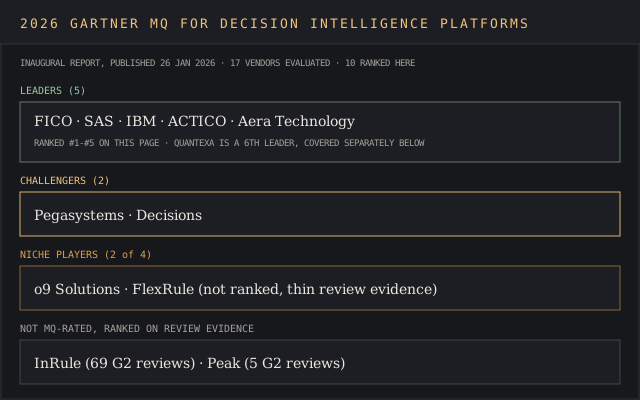
Decision intelligence platforms connect data, machine learning models, and decision automation logic into a single system that recommends or executes a decision, then tracks if the decision worked. Gartner published its first Magic Quadrant for decision intelligence software on January 26, 2026, evaluating 17 vendors and naming FICO, Aera Technology, SAS, IBM, ACTICO, and Quantexa as Leaders among the field of decision intelligence companies.
This page covers 10 of those platforms: the six Leaders (minus Quantexa, held out below for a documented reason), two Challengers, a Niche Player, and two established decision-management vendors that predate the category label but meet Gartner's own definition of a decision intelligence platform.
The list is built for buyers who already run a business intelligence stack and want the next layer up: a decision management system that turns a dashboard finding into an executed action: a credit approval, a fraud flag, a reorder, or a next-best-offer. It skips vendors with no independently verifiable customer feedback.
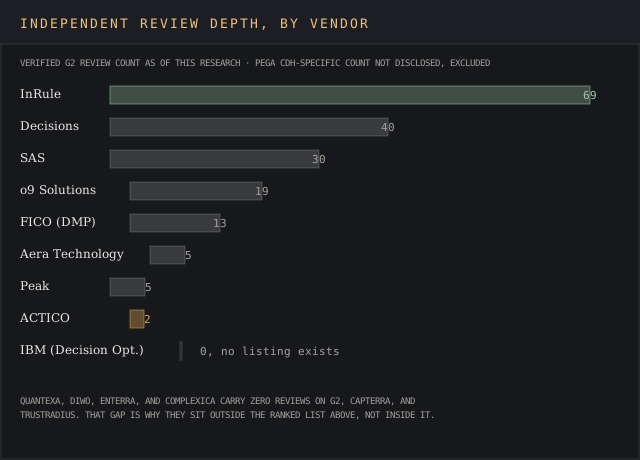
Quantexa is a $2.6 billion Gartner Leader with zero reviews on G2, Capterra, or TrustRadius; that gap is itself worth knowing before a procurement call. The market context section below covers Quantexa on the evidence that exists for it.
Pricing across this category runs from ACTICO's published €4,500 starter subscription to enterprise contracts that clear seven figures. Only one of the ten vendors below publishes a real number on its own site. The rest route every buyer to a sales call, which is itself a data point about who these platforms are built to serve.
Evaluation criteria for decision intelligence platforms
Five criteria decide the shortlist, and the ranking below applies them in this order: Gartner's own 2026 quadrant placement first, then four factors any buyer can check without a sales call. Every criterion ties back to one question: does this platform improve decision making a team can measure, or just add another dashboard on top of decision making that hasn't changed?
2026 Gartner Magic Quadrant standing
Gartner's inaugural Magic Quadrant for Decision Intelligence Platforms, published January 26, 2026, sorts 17 vendors into Leaders, Challengers, Visionaries, and Niche Players based on completeness of vision and ability to execute. A buyer can look up any vendor's quadrant position directly on that vendor's own press page, since every company named in the report links to it.
Decision execution speed
A platform that automates decisions at scale needs a published latency figure. InRule states its runtime executes rules in "the low tens of milliseconds." ACTICO advertises "millisecond decisions at scale." A vendor with no stated execution speed is describing a decision-support tool: it surfaces a recommendation and a person executes it. A decision-automation tool executes the action itself, and buyers should treat the two categories differently.
Governance and audit trail
Every rule change, model version, and decision outcome needs a log a regulator can read. InRule holds SOC 2 Type 2 and ISO/IEC 27001 certification. ACTICO's Model Hub keeps "audit-proof approval records." A platform without a named certification or a versioned audit trail fails this test outright in a regulated industry.
Pricing transparency
Does the vendor publish a real number, or does every page route to "request a demo"? Nine of the ten platforms below give no number at all. ACTICO is the exception, with a published €4,500 starter tier, which matters because it lets a buyer size a pilot before a sales conversation.
Independent review depth
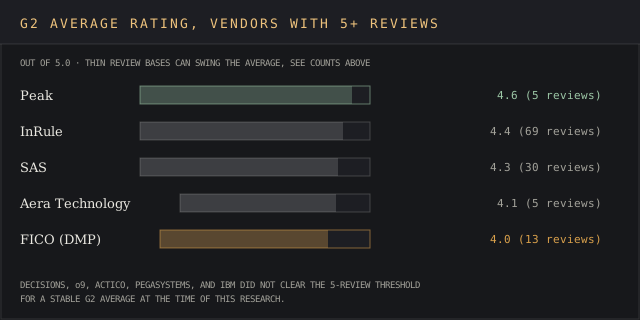
G2, Capterra, and TrustRadius review counts are the one signal a vendor can't script. InRule carries 69 G2 reviews at a 4.4 average. ACTICO carries two. Neither number proves quality on its own, but a buyer comparing platforms should know which vendors have a real, checkable user base behind their marketing claims.
Decision intelligence sits one layer above the data platforms most buyers already own. Our data intelligence tools ranking covers the catalog and governance layer underneath it, and our AI procurement software ranking covers a narrower, adjacent form of decision automation built specifically for sourcing.
Aera and o9 Solutions both show up again in our supply chain intelligence ranking, scored there on planning depth, which produces a different order than the decisioning criteria used here.
Top decision intelligence platforms, ranked
FICO
Best fit
Regulated lenders and insurers running credit, fraud, or claims decisions at the scale of a top-100 bank.
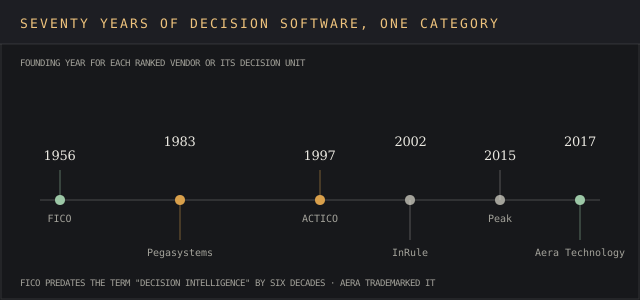
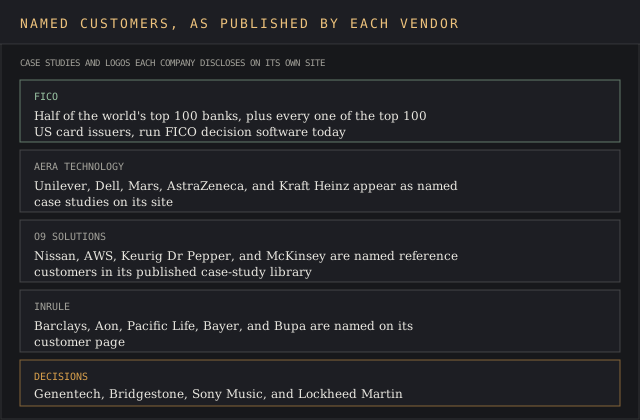
The FICO Platform unifies rules, machine learning, and optimization into what FICO calls a single decision layer spanning "originations and customer management to fraud and collections." FICO states its clients include more than half of the top 100 banks worldwide and all of the 100 largest U.S. credit card issuers, a customer base built over 70 years since the company's 1956 founding.
Those credit models run on records a bank already buys from financial data providers; FICO scores the inputs a bank already holds, and leaves sourcing them to that separate market.
FICO's production history since its 1956 founding, now covering more than half of the top 100 banks worldwide.
Key features
- FICO Blaze Advisor, the rules and decisioning engine at the platform's core.
- Contextual Profiles, real-time transactional profiling updated continuously per customer.
- FICO Xpress, a mathematical optimization solver for constrained decisions.
- FICO Marketplace, a hub of pre-built decision assets, models, and APIs customers deploy directly.
- Composable Workspaces for low-code orchestration of decision services.
- AI Guided Operations, a human-in-the-loop layer that lets business users direct the system themselves, freeing data scientists for harder problems.
Pricing
FICO publishes no list price for the Platform or for Blaze Advisor. G2 confirms pricing "isn't currently available," and FICO's Vendr marketplace page carries no tracked header stats, only descriptive text.
Reviewers on G2 praise the platform's decision speed but flag integration friction. One Blaze Advisor user wrote, "Very helpful for decision making and great responsive time for business decisions" (Viral D., Test Engineer, Mid-Market, G2, December 3, 2019). A second reviewer's complaint pointed at access control: "Not much security only one way security also easy to configure" (Verified User in Automotive, Small-Business, G2, May 31, 2018).
Pros
- Decades of production use across banking and insurance, with named Fortune 500 deployments.
- Blaze Advisor handles both simple and highly complex rule logic without custom code.
- Named a Leader in both the 2026 Gartner MQ and the Forrester Wave for AI Decisioning Platforms, Q2 2025.
- FICO Marketplace shortens time to deploy pre-built decision assets.
Cons
- No published pricing anywhere, vendor or third-party.
- Reviewers cite a learning curve for teams unfamiliar with rule-based systems.
- Legacy integration with third-party systems takes real implementation time.
- FICO's own about-us page states "80+ countries" in body copy and "90+ countries" in its meta description, an inconsistency worth a direct question in a sales call.
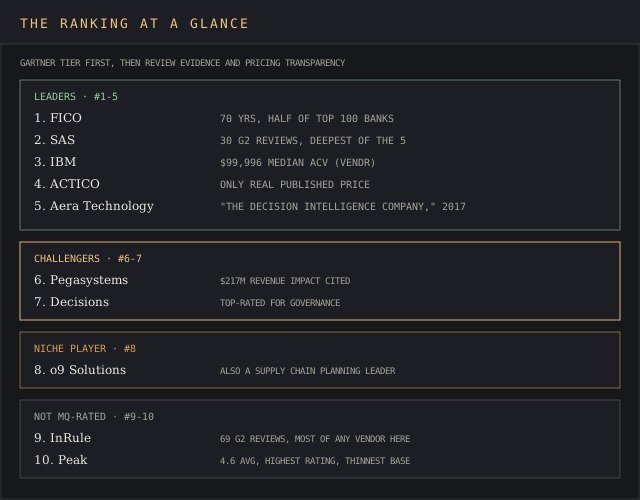
Why it's ranked #1. FICO clears every one of the five criteria and does it at a scale none of the other nine platforms can claim: half the top 100 banks on earth, 70 years of production history, and a named Gartner Leader position. SAS matches it on quadrant standing but trails on named customer scale, which is why FICO holds the top spot.
SAS
Best fit
Organizations already running SAS Viya that want governed, auditable decisioning layered on top of an existing analytics investment.
SAS Intelligent Decisioning is "cloud-based software that combines AI, machine learning, and business rules to automate thousands of operational decisions every day," according to SAS's own product page. It runs inside the broader SAS Viya platform and was named a Leader in the 2026 Gartner Magic Quadrant for Decision Intelligence Platforms.
Viya's data orchestration layer pulls from the same kind of records a company data provider sells; SAS positions Viya as the analytics engine that acts on those records once a customer already holds them.
Key features
- Visual decision authoring with a drag-and-drop interface or custom Python and SAS code.
- SAS Container Runtime, OCI-compliant containers publishable to Azure, AWS, or GCP registries.
- Centralized logic governance with full version control across the decision lifecycle.
- A Microsoft Power Platform connector linking SAS decisions to Power Apps and Power Automate.
- Integrated ML and model management bridging SAS and open-source Python models.
- Flexible data orchestration connecting disparate sources and third-party APIs in real time.
Pricing
Vendr's tracked header stats for SAS as a company (not scoped to Intelligent Decisioning specifically) list a median annual contract value of $14,352, a low of $6,546, and a high of $48,183. SAS sells dozens of separately priced modules, so this figure anchors SAS as a company; no separate number is scoped to Viya alone.
G2's 30 reviews of SAS Intelligent Decisioning average 4.3 out of 5. One reviewer described the rule-authoring depth directly: "logic can be created from an information architecture perspective rather than a software development perspective," which "greatly reduced the time required to construct new rule applications" (Connie B., Mid-Market, G2, October 1, 2023).
A critical reviewer disagreed on cost and scale: "Its pricing structure is expensive compared to some other decision management platforms, especially for smaller organizations with limited budgets" (Nikolce Z., Government Administration, Mid-Market, G2, December 2, 2023).
Pros
- 30 G2 reviews at 4.3 average, the deepest independent evidence base among the five Leaders.
- Real Vendr-tracked pricing data exists, unlike most of this list.
- Named a Leader in the 2026 Gartner MQ for Decision Intelligence Platforms.
- Deep integration with the broader SAS Viya analytics and ML stack.
Cons
- Multiple reviewers flag a steep learning curve and limited customization.
- Documentation is criticized as thin on real-world tuning examples.
- Pricing perceived as high for mid-market budgets against category alternatives.
- The $14,352 median Vendr figure covers SAS as a company; Viya's decisioning module carries no separate published number.
Why it's ranked #2. SAS carries the deepest independent review base of any Leader, 30 reviews against FICO's smaller published count, and it's the only Leader besides ACTICO with a real Vendr pricing anchor. It loses to FICO on named customer scale and gains on IBM below through review depth alone.
IBM
Best fit
Enterprises already standardizing on watsonx or Cloud Pak for Data that want optimization and decisioning delivered inside that existing stack.
IBM Decision Optimization delivers prescriptive analytics through products including ILOG CPLEX Optimization Studio and Decision Optimization for Watson Studio, run on IBM Cloud Pak for Data in the cloud or on-premises. IBM was named a Leader in the 2026 Gartner Magic Quadrant for Decision Intelligence Platforms.
Cloud Pak for Data's connectors read the same tech-stack signals a technographic data provider tracks, one layer removed: IBM builds from records already inside the customer's own systems.
Key features
- IBM ILOG CPLEX Optimization Studio, an IDE with multiple optimization solvers.
- Decision Optimization for Watson Studio, combining optimization and machine learning in one workspace.
- Decision Optimization Center, a GUI app builder supporting what-if analysis.
- CPLEX Optimizer for IBM z/OS, mainframe-native solving via a C/C++ API.
- Deployment on IBM Cloud Pak for Data, containerized across cloud or on-prem.
- Documented use cases across financial services, manufacturing, retail, and energy.
Pricing
IBM publishes no list price for Decision Optimization; licensing ties to broader watsonx and Cloud Pak capacity units. Vendr's IBM-wide header stats list a median annual contract value of $99,996 across 95 tracked purchases, ranging from $18,774 to $347,036. That figure spans IBM's full product line; no published figure isolates Decision Optimization specifically.
IBM's Decision Optimization product carries no distinct G2 listing; the closest independently reviewed adjacent product is watsonx.ai. One reviewer described a concrete workflow shift: "We replaced our previous multiple standalone scripts that didn't communicate as well with a centralized IBM watsonx.ai environment... I'd say IBM watsonx.ai is 90 percent there" (Kayla Brittney, Data Scientist, Lawson Freights, TrustRadius, October 10, 2025).
A critical reviewer flagged cost and support: "IBM watsonx.ai is expensive than other platforms... Community is not that strong to get any answer" (Nikhil Jaitak, Data Science Manager, Emids Technology, TrustRadius, October 3, 2025).
Pros
- Named a Leader in the 2026 Gartner MQ for Decision Intelligence Platforms.
- Mainframe-native optimization via CPLEX for z/OS, a capability none of the other nine vendors publish.
- Vendr-tracked pricing data exists at the company level.
- Broad watsonx/Cloud Pak ecosystem for buyers already on IBM infrastructure.
Cons
- No G2, Capterra, or TrustRadius listing exists for Decision Optimization specifically.
- The quotes above describe watsonx.ai, an adjacent IBM product; Decision Optimization itself carries no independent review text.
- TrustRadius's own synthesis of 31 recent watsonx.ai reviews cites integration challenges with external tools in 23% of feedback.
- The $99,996 median Vendr figure spans IBM's entire catalog, with no line item that isolates decisioning.
Why it's ranked #3. IBM matches FICO and SAS on Gartner Leader status and has real Vendr pricing data, ahead of Aera and Pegasystems below. It ranks behind SAS because no independent review exists for Decision Optimization by name, only for the adjacent watsonx.ai product.
ACTICO
Best fit
European banks, insurers, and investment firms that need governed, explainable decisioning and want a real price before the first sales call.
The ACTICO Decision Management Platform lets banks and insurers "model, test, run, and monitor decision logic built from business rules and machine-learning models, in real time and at scale," per ACTICO's own platform page. The Germany-based vendor was named a Leader in the 2026 Gartner Magic Quadrant, and in 2026 it introduced AI agents that draft decision logic for human sign-off.
ACTICO's compliance focus overlaps what an ESG data provider tracks for a bank's own disclosure obligations; ACTICO governs the lending decision itself, a separate scope from the sustainability rating behind it.
ACTICO's published monthly Starter price, the only self-serve number among all ten platforms in this ranking.
Key features
- Rule and Decision Modeling through a graphical editor plus AI-agent-assisted drafting.
- Predictive Models integrating Python and other ML frameworks into decision rules.
- Model Hub for versioning and audit-proof approval records across the decision lifecycle.
- A decision execution engine ACTICO states runs "millisecond decisions at scale."
- Open integrations supporting the Java stack and LLM/agent plug-ins.
- Deployment on-premise, as SaaS, or via Windows, Linux, and Docker containers.
Pricing
ACTICO publishes a Starter package at €4,500, plus a one-month free trial with the full tool stack, on its own pricing page. Enterprise tiers remain custom quotes. This is the only vendor on this list with a real, self-serve number; every other listing here ends at a "contact sales" wall.
ACTICO's G2 listing carries just two reviews. One reviewer praised onboarding: "ACTICO is the best and easy to use for the new joiner... provides one of the best customer support" (Waqar A., ORM, Small-Business, G2, October 1, 2023), while flagging that "the design could be improved with future updates."
A Capterra reviewer of ACTICO's compliance product raised implementation cost: "Customizing effort, especially individualizing components, is very high" (Dirk H., bank employee, Capterra, January 20, 2022, translated from German).
Pros
- Only vendor in this ranking with a published, self-serve starter price.
- Named a Leader in the 2026 Gartner MQ, tied with FICO, SAS, IBM, and Aera.
- 28 years of production history in regulated European banking since its 1997 founding.
- Model Hub gives regulators an audit-proof approval trail out of the box.
Cons
- Just two G2 reviews, the thinnest independent evidence base among the five Leaders.
- Reviewers flag customization effort and an interface that trails newer competitors.
- The 300-customer figure ACTICO cites spans the Group's five business lines together.
- Its regulated-banking customer base rarely posts public reviews, the same pattern that leaves Quantexa with none at all.
Why it's ranked #4. ACTICO is the only platform on this list that clears the pricing-transparency criterion outright, with a real €4,500 number where nine competitors offer none. It ranks behind IBM because its review base, two G2 entries, is the thinnest of any Leader, and ahead of Aera because Aera has no published price at all.
Aera Technology
Best fit
Large enterprises automating high-volume supply chain, procurement, or operations decisions across a global footprint.
Aera markets itself as "the Decision Intelligence company," running what it calls the Aera Decision Cloud, described on its own site as "the digital brain of your organization." Aera was named a Leader in the 2026 Gartner Magic Quadrant, and its named enterprise customers include Unilever, Dell, and Mars.
Procurement is one of five Aera Skills modules bundled inside the same platform, the main line dividing Aera from a dedicated procurement intelligence platform built around sourcing and supplier risk alone.
Key features
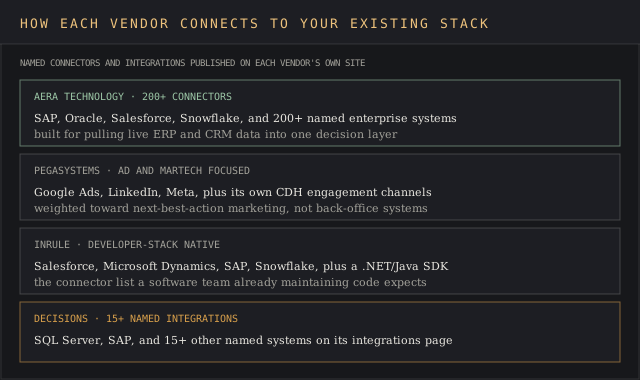
- Decision Data Model, unifying real-time data through more than 200 prebuilt connectors.
- Multi-Engine Orchestration across AI/ML, business rules, optimization, and learning engines.
- Agentic Ambient Intelligence, an always-on engine that reasons across data and executes on approval.
- Dynamic Engagement, a natural-language interface spanning chat, inbox, and a control room.
- Aera Skills, packaged capability modules for supply chain, procurement, sales, finance, and HR.
- Named supply chain skills including Touchless Demand Forecasting and Dynamic Inventory Management.
Pricing
Aera publishes no figure anywhere on its own domain. G2 confirms pricing "isn't currently available," and Aera's Vendr marketplace page renders as an empty page with no tracked header stats.
Aera's G2 profile carries five reviews at a 4.1 average. One enterprise reviewer credited the platform's execution speed: "It's real-time and intelligent at scale, fundamentally improving the speed, the quality and the impact of our decisions" (Verified User, IT Services, Enterprise, G2, November 22, 2021). A more recent reviewer disagreed on usability: "Features are limited, ease of use can be improved" (Rahul G., Product Analyst, Enterprise, G2, May 18, 2024).
Pros
- Named a Leader in the 2026 Gartner MQ alongside FICO, SAS, IBM, and ACTICO.
- More than 200 prebuilt connectors reduce integration lift for large enterprises.
- Enterprise customer roster includes Unilever, Dell, AstraZeneca, Mars, and Kraft Heinz.
- Documented case result: Aera reports up to a 20% inventory performance improvement for one customer.
Cons
- Just five G2 reviews despite a customer list that includes multiple Fortune 500 names.
- No public pricing figure exists on Aera's own site or on Vendr.
- Reviewers cite feature limits and an ease-of-use gap across two separate reviews.
- Founded in 2017, the youngest of the five Gartner Leaders on this list.
Why it's ranked #5. Aera closes out the Leader tier. It matches ACTICO on Gartner standing but has no published price at all, and its five-review evidence base is thinner even than ACTICO's two when weighed against its Fortune 500 customer list. Pegasystems below trades Leader status for a larger, better-documented platform.
Pegasystems
Best fit
Marketing and customer-engagement teams that need real-time next-best-action decisions across channels at high transaction volume.
Pega's Customer Decision Hub acts as, in Pega's own words, "the central 'brain' orchestrating billions of interactions across all your channels," evaluating "thousands of potential actions in milliseconds." Pega was named a Challenger in the 2026 Gartner Magic Quadrant for Decision Intelligence Platforms.
That's a different job from sales intelligence software: a sales-intelligence tool surfaces which account to call next, while Pega executes the next action itself once a channel decision is made.
Key features
- Next-Best-Action Designer, a single interface for configuring 1:1 decision strategies.
- Adaptive Decision Manager, self-learning models that detect behavior shifts in real time.
- Paid Media Manager, with direct integrations into Google, LinkedIn, and Meta's ad platforms.
- Customer Data Connectors for Adobe Experience Platform, Celebrus, Tealium, and Session AI.
- Customer Data Accelerators built for Snowflake and Google BigQuery.
- Always-On Outbound for building, launching, and measuring marketing programs continuously.
Pricing
Pega publishes no list price; its pricing page is a client-rendered shell with no accessible figures. Pega's Vendr marketplace page carries only descriptive company text, with no tracked header stats.
A Pega-commissioned Forrester Total Economic Impact study, cited on Pega's own product page, credits Customer Decision Hub with "$217M in incremental revenue" and "a 27% increase in online upsell and cross-sell" for the study's composite organization; a Wells Fargo case study on Pega's site separately cites "a 40% increase in channel revenue." Both figures come from Pega's own domain and should be read as a vendor-commissioned study, with no independent audit behind it.
Reviewers praise the platform's coherence over bolted-together alternatives: "The Pega decisioning hub does what it says on the tin; it is a truly integrated single platform that enables business to deliver personalisation at scale" (sadam r., Assistant Manager HR, Mid-Market, G2, April 21, 2022).
A TrustRadius reviewer flagged customization cost directly: "when unique business customization must occur, it is very expensive and time consuming. It forces the organization to address sunk cost" (Verified User, Director, 10,001+ employees, TrustRadius, April 21, 2022, review titled "cost over runs").
Pros
- Direct ad-platform integrations with Google, LinkedIn, and Meta, unmatched among the other nine vendors.
- Pega-commissioned Forrester TEI study cites $217M in incremental revenue for the composite customer.
- Reviewers describe the platform as a single integrated system built from one codebase.
- Initial implementations reportedly deliver value in 8 to 12 weeks, per Pega's own product FAQ.
Cons
- No public pricing anywhere, vendor or Vendr.
- TrustRadius review titled "cost over runs" documents high customization expense.
- A second reviewer flagged integration difficulty with third-party systems and longer implementation time.
- Challenger status in the 2026 Gartner MQ, one tier below the five Leaders above it.
Why it's ranked #6. Pegasystems is the strongest platform outside the Leader tier, with deeper named ad-platform integrations and a larger quantified case-study result than any Leader below Aera. It loses to Aera on Gartner standing, a Leader beats a Challenger, and beats Decisions below on documented revenue impact.
Decisions
Best fit
Mid-market IT and operations teams that want a no-code rules engine bundled with full process orchestration, beyond isolated decisioning alone.
Decisions combines an enterprise rules engine, workflow automation, AI agent orchestration, and dashboards in one low-code environment. Gartner named Decisions a Challenger in the 2026 Magic Quadrant and, in the accompanying Critical Capabilities report, ranked it the top vendor specifically for Decisions Governance.
The governance layer Decisions built its Critical Capabilities win on is the same discipline a data intelligence platform applies to a catalog, here turned toward a decision log.
Key features
- Agentic Orchestration, coordinating AI agents, models, people, and systems in real time.
- An Enterprise Rules Engine for centrally designing, testing, and running governing decision rules.
- Visual process automation that covers an entire workflow end to end.
- A low-code Design Studio with a "vibe coding" front-end builder, introduced in Decisions v10.
- Process Intelligence for real-time monitoring of how work flows in practice.
- 15-plus named integrations including SQL and SAP, per G2's feature listing.
Pricing
Pricing routes to a customized quote request on both the enterprise and mid-market page; no number is published. Decisions prices on usage and capability, a model it states plainly on its site but backs with no public figure.
Independent volume runs deep here: 27 reviews on Capterra and 40 on G2, a deeper combined base than every Challenger or Leader except SAS. One reviewer described building without code: "I'm able to build enterprise grade applications without writing a single line of code" (Chris M., Vice President, Computer Software, Capterra, August 21, 2025), while considering Pega and Appian as alternatives before choosing Decisions.
A different reviewer flagged a real operational gap: it "doesn't allow one to edit the running instance neither can restart the workflow from the failed step. You have to run the entire process again" (Neha B., Senior Manager, Computer Software, Capterra, September 7, 2022).
Pros
- Gartner's top-rated vendor for Decisions Governance in the 2026 Critical Capabilities report.
- 40 G2 reviews plus 27 on Capterra, a deeper combined base than every Leader except SAS.
- Named enterprise customers include Genentech, Bridgestone, Sony Music, and Lockheed Martin.
- Combines rules, workflow, and agent orchestration inside one environment.
Cons
- No published pricing figure exists anywhere on decisions.com.
- A failed workflow can't resume mid-process; the entire run must restart from the beginning.
- Multiple reviewers describe UI components as dated relative to newer low-code competitors.
- Challenger status places it below all five Gartner Leaders on this list.
Why it's ranked #7. Decisions carries a deeper combined review base, 67 across G2 and Capterra, than Pegasystems' Customer Decision Hub listing shows, plus a named Gartner distinction for governance. It ranks behind Pega because Pega's documented revenue-impact figures and ad-platform integrations outweigh Decisions' governance edge, and ahead of o9 Solutions below on Gartner tier: Challenger beats Niche Player.
o9 Solutions
Best fit
Supply chain planning teams that want decision intelligence built into an existing S&OP and integrated business planning workflow.
o9 Solutions' "Digital Brain" platform connects demand planning, supply planning, and integrated business planning on a single data model built around what o9 calls an Enterprise Knowledge Graph. Gartner named o9 a Niche Player in the 2026 Magic Quadrant for Decision Intelligence Platforms; o9 also holds a Leader position in Gartner's separate Magic Quadrant for Supply Chain Planning.
Key features
- Enterprise Knowledge Graph, the single data model underpinning the Digital Brain.
- APEX, a 2026-introduced self-learning layer that detects value leakage and adjusts algorithms automatically.
- Neuro-Symbolic AI powering the newest generation of the Digital Brain.
- Integrated Business Planning and S&OP modules connecting finance, sales, and supply chain data.
- Dedicated Price Planning and Optimization module.
- Demand, supply, and scenario planning modules built on the same underlying graph.
Pricing
o9 publishes no figure on its own site, and no Vendr marketplace listing exists for the company.
o9's 19 G2 reviews average a rating that reflects both real adoption and real friction.
One enterprise reviewer credited the platform's connective effect: "Their digital IBP... connects the planning processes and functions on a single, cloud-native platform, allowing global companies like us to make faster and better decisions" (Syed A., Data Engineer, Enterprise, G2, September 5, 2024), while noting in the same review that "the initial setup was complex and resource-heavy" and that cost "was a barrier for us."
A separate reviewer was harsher: "Cost, Customization limitation, Performance Issues... particularly when working with large datasets" (Verified User, Internet, Mid-Market, G2, March 28, 2024).
Pros
- Named customer roster includes Nissan, AWS, Keurig Dr Pepper, and McKinsey & Company.
- Dual Gartner recognition: Niche Player for Decision Intelligence Platforms, Leader for Supply Chain Planning.
- APEX's automatic algorithm adjustment is a documented capability none of the other nine vendors publish.
- 19 independently verified G2 reviews with named enterprise reviewers.
Cons
- High implementation cost and complexity is the single most repeated complaint across reviews.
- Just one Capterra review exists, and it offers no substantive con.
- No public pricing figure anywhere, vendor or Vendr.
- Niche Player standing in the Decision Intelligence Platforms MQ specifically, its lowest-tier placement of the five vendors reviewed here.
Why it's ranked #8. o9 is the only Niche Player in this ranking, one tier below Decisions and every Leader above it on Gartner's own scale, which is why it sits at #8 despite a strong named-customer list. It ranks ahead of InRule below because InRule carries no Gartner MQ recognition at all in this category.
InRule
Best fit
Insurance, healthcare, and financial services teams replacing hard-coded business logic with a governed, no-code rules engine.
InRule Technology, founded in Chicago in 2002, states on its own site that it's "trusted by hundreds of organizations in more than 40 countries."
InRule's Salesforce and Dynamics connectors put it in the same integration lane as a b2b data provider feeding a CRM; InRule's job starts where the enrichment ends, acting on the record already sitting inside it.
Its self-description: "InRule Technology provides explainable AI Decisioning," combining automated decisioning, explainable machine learning, and process automation without code. InRule doesn't appear in Gartner's 2026 Decision Intelligence Platforms Magic Quadrant, but it sits in G2's Decision Management Software category alongside every ranked vendor above it.
InRule's G2 review count at a 4.4 average, the deepest independent evidence base of any platform in this ranking.
Key features
- A runtime engine InRule states executes rules in "the low tens of milliseconds."
- A no-code modeling environment (irAuthor) for business users to author rules directly.
- Full rule traceability with version history, visual tracing, and programmatic audit APIs.
- SOC 2 Type 2 and ISO/IEC 27001 certification for security and compliance.
- API-first integration with Salesforce, Dynamics, SAP, and Snowflake without architectural rework.
- A JavaScript runtime that executes rules where data already lives, including inside Snowflake.
Pricing
InRule publishes no figure; G2's third-party estimate of roughly $9,500 per month for enterprise plans isn't vendor-confirmed and is excluded here. No Vendr marketplace listing exists for InRule.
InRule's 69 G2 reviews average 4.4, the deepest independent evidence base of any platform on this list.
One detailed review praised the engine's range: it has "a rich predefined tool pallet, with which the majority of business rules can be evaluated," from "simple ones" to "very complex" multi-dimensional calculations, letting teams "create logic, based on an information architecture perspective, rather than a software development perspective" (Sjoerd S., Information Architect, Mid-Market, G2, March 16, 2022).
A different customer, in Enterprise Insurance, described the opposite outcome: scalability limits forced the team "to move away fro Inrule to build our own business rules system in house," specifically because "the cost didn't outweight the benefit" at multi-million-user scale (Verified User, Insurance, Enterprise, G2, November 18, 2022).
Pros
- 69 G2 reviews at 4.4 average, more independent volume than any other platform in this ranking.
- Named enterprise customers include Barclays, Aon, Pacific Life, Bayer, and Bupa.
- SOC 2 Type 2 and ISO/IEC 27001 certification, both stated on InRule's own site.
- Runtime latency in the low tens of milliseconds, a published, checkable figure.
Cons
- Not recognized in Gartner's 2026 Decision Intelligence Platforms Magic Quadrant.
- At least one Enterprise reviewer abandoned InRule for an in-house system over cost and scalability at millions of users.
- Multiple reviewers cite thin official documentation, especially for new users.
- No public pricing figure on InRule's own domain.
Why it's ranked #9. InRule has the deepest independent review base of any platform on this entire list, 69 G2 reviews against o9's 19, but it carries no Gartner MQ recognition in this specific category, which is why Gartner-rated o9 ranks above it despite the thinner review count. It ranks ahead of Peak below on both review depth and company history: 2002 against Peak's 2015 founding.
Peak
Best fit
Mid-market retailers and consumer brands automating inventory, pricing, and markdown decisions without a data science team.
Peak brands itself directly as "The Decision Intelligence Company Using AI to Drive Growth," per its own site, running a platform of pre-built AI modules across inventory and pricing. Peak doesn't appear in Gartner's 2026 Decision Intelligence Platforms Magic Quadrant.
Peak's Markdown and Promotions modules execute the price change directly, which sets it apart from pricing intelligence tools that track a competitor's price without changing the retailer's own.
Key features
- Inventory AI modules: Dynamic Inventory, Production Planning, Reorder, and Service Level Predictor.
- Pricing AI modules: Markdown, Promotions, and List Price Optimizer.
- Co:Driver, an agentic assistant that surfaces recommendations and answers questions about AI outputs.
- Data Bridge, connecting directly to a customer's existing warehouse (AWS S3, Snowflake, Redshift) without migration.
- A Library of configurable, deployable AI modules including connectors and APIs.
- ISO 27001 and SOC 2 Type II certification, stated on Peak's own platform page.
Pricing
Peak publishes three named tiers, Essentials, Business, and Enterprise, with detailed technical quotas but no dollar figure for any of them; every tier routes to a demo request. No Vendr marketplace listing exists for Peak.
Peak's five G2 reviews average 4.6, the highest rating of any platform in this ranking, though on the thinnest review base alongside Aera. One reviewer named the specific modules that delivered value: "the pre-built applications of AI for inventory management and customer segmentation" (Aditya I., Senior Sales Strategist, Building Materials, Enterprise, G2, October 9, 2024).
The same reviewer flagged a limit on customization: "the automation of the algorithms is the biggest issue when it comes to making them as specific as our particular business requirements and data assets."
Pros
- Highest average G2 rating in this ranking, 4.6 out of 5.
- Data Bridge connects to an existing warehouse without a data migration project.
- $119 million in disclosed funding, per Peak's own site, backing continued product development.
- ISO 27001 and SOC 2 Type II certified, both stated on Peak's own platform page.
Cons
- Just five G2 reviews, the thinnest evidence base alongside Aera Technology.
- No Gartner MQ recognition in this category.
- A reviewer flagged constrained flexibility in customizing pre-built AI modules to specific data.
- No public pricing figure for any of its three named tiers.
Why it's ranked #10. Peak closes the list. It carries the same thin, five-review evidence base as Aera but none of Aera's Gartner Leader standing, and it's four years younger than InRule with a third of its review volume. Its 4.6 average rating and retail-specific modules earn it the #10 spot on review quality alone.
What decision intelligence platforms do
The category sits one layer above business intelligence. A BI dashboard shows that a metric moved. A decision intelligence platform connects that movement to a rule, a model, or a workflow that acts on it, automatically or after human approval.
Gartner's own definition, cited on every vendor page linked above, groups this into three functions: data integration, analytics and AI, and automated decision workflows. FICO, SAS, IBM, ACTICO, and Aera build toward full automation, executing thousands of decisions per hour with human oversight limited to exceptions.
Pegasystems and Decisions add heavier workflow and orchestration layers on top of the same core rules engine. InRule and Peak serve narrower, faster-to-deploy use cases: contract-level decision logic for InRule, retail inventory and pricing for Peak.
Vendors split decision making into two modes: advised, where the platform hands a recommendation to a human decision maker, and automated, where the system executes without review. Natural language processing lets business users query decision models in plain English, cutting the dependency on a dedicated data science team for every rule change.
FICO, SAS, and Decisions each publish decision flows that route standard cases straight to automate decision making logic and send edge cases to a queue for human sign-off, a split most vendors call business decision making versus operational decision making.
The underlying architecture separates data ingestion from decision logic. A platform pulls records from external data sources and internal systems, applies data quality and data governance checks, then routes clean records into the model.
Weak data governance is the most common reason a decisioning project stalls before an evaluation ever reaches business functions like finance or human resources, and it's why every Leader above publishes a named compliance certification alongside its feature list.
Pricing across the category
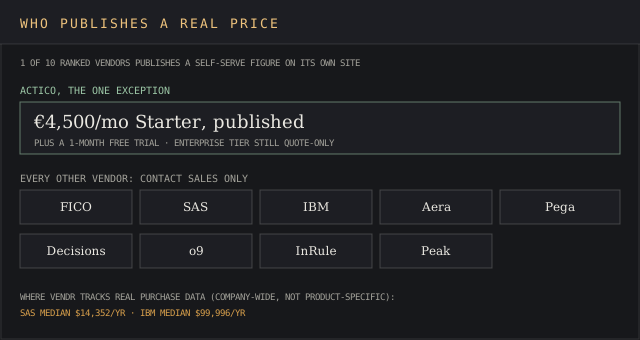
Nine of the ten platforms on this list publish no price. That's not an oversight; it reflects an enterprise sales motion built around implementation scope, data volume, and integration complexity that a flat price list can't capture. The one exception, ACTICO's €4,500 Starter tier, exists because ACTICO also serves smaller regional banks that need to size a pilot before committing to a full deployment.
Where Vendr tracks real purchase data, the numbers vary by more than 7x: SAS at a $14,352 median annual contract against IBM at $99,996. Both figures are company-wide, since none of the ten vendors sell decision intelligence as an isolated, separately Vendr-tracked line item. A buyer should treat every number in this article's comparison table as a starting point and confirm current pricing directly with the vendor before budgeting.
The spread between SAS's $14,352 median annual contract and IBM's $99,996 median, the two Vendr-tracked figures in this category.
How decision makers evaluate decision intelligence software
Procurement teams narrow a decision intelligence software platforms shortlist by testing a vendor's decision models against real transaction volume in a live pilot. FICO and SAS both publish figures tied to a named benchmark; a vendor without one is asking a buyer to accept better decision making as a marketing claim standing in for a measured result.
Regulatory compliance is the second filter. A bank evaluating decision automation for credit approvals or financial crime cases needs governance controls a regulator can audit line by line, since automated decision making without a trace is a finding waiting to happen at exam time.
ACTICO and FICO built their businesses inside exactly that constraint, which is why regulated banking makes up most of both vendors' disclosed customer base and why accurate decisions matter more than fast ones in that context. That same discipline extends to operational decisions on the factory floor and in the call center, where a wrong call compounds thousands of times before anyone reviews it.
Data silos kill more decisioning projects than any single vendor limitation does. A platform that promises real time insights but can't connect to the data warehouse, the CRM, and the ERP at once leaves analysts running the same manual joins a decision intelligence platform was supposed to remove. Strategic decisions about which systems to integrate first decide most implementation timelines, more than the platform purchase itself does.
Risk management teams weigh a fourth factor: scenario modeling support before a decision model goes live. A rule pushed straight to production without a sandboxed test run is the most common cause of an automated decisioning incident, and it's why InRule's audit trail and ACTICO's Model Hub exist as named, documented product features.
Competitive advantage in this category rarely comes from analytics tools alone. Buyers who already use business intelligence tools to analyze data and market data want a platform that turns those data points into informed decisions on customer engagement, the layer of work that sits above a dashboard. That business outcome is what every vendor in this ranking claims, and only a handful back it with a named case study tied to a real customer.
Decision intelligence as a discipline
Decision intelligence is a practical discipline. It asks a team to explicitly model decisions the way an engineer models a system: naming every input, every decision rule, and every owner before automation touches a live transaction.
The value shows up in uncovering hidden relationships between disparate data points that a static report never surfaces, and in turning locked-away records into transparent data and data driven insights decision makers can act on the same day. That pattern-finding step is the same ground data mining tools cover, extended one step further: a decision intelligence platform carries the result into an executed action, past the model output a data mining tool hands back.
Gartner splits the market by approach. Some decision intelligence software platforms lean toward decision centric solutions built around governance, and others lean toward raw execution speed. Every vendor above combines human intelligence with AI models trained on its own transaction history, since a model with no oversight is a liability in a regulated industry.
Artificial intelligence sits inside every platform on this list, but the label covers different things. FICO and SAS apply artificial intelligence to fraud scoring and credit models. Aera and Pegasystems apply artificial intelligence to real-time customer decisions. IBM applies artificial intelligence to optimization problems with thousands of constraints.
Decision making processes that once took a team days to document now run through decision models a business analyst can edit directly, which is the promise behind intelligent decision making: decision makers spend less time assembling the case and more time reviewing the recommendation.
Buyers adopt these platforms to move decision making off spreadsheets and into a system a regulator, a finance team, and an engineer can all read the same way. A gap plain data analytics tools can't close alone.
A business intelligence dashboard built from data analytics reports what happened; a decision intelligence platform decides what happens next, and the best ones do it while enabling organizations to keep a human in the loop on any decision above a defined dollar threshold.
InRule and Decisions both describe their platforms as enabling users to change decision logic in minutes, a change that used to route through a multi-week engineering ticket, and enabling organizations to retire hard-coded rules buried in decade-old application code.
That same logic shows up in Aera's Skills, in ACTICO's Model Hub, and in o9's APEX layer: each is a packaged way of enabling organizations to turn data into an executed action without a custom build.
Peak markets the same idea for retail teams enabling users to adjust pricing algorithms without a data science request queue, which is the accurate decisions equivalent of self-service business intelligence tools. InRule's irAuthor interface is built the same way, around enabling users without a coding background to edit rules directly.
Aera's engine can orchestrate decision flow across regions without a human touching each case, treating rules and models as reusable data assets built once and used across many projects.
Teams that still run separate data silos for pricing and inventory hand decision makers incomplete data points, which produces informed decisions in one system and guesswork in the next. Unifying both is what most decision makers ask for first, since disconnected decision flows are the most common reason a pilot fails.
Pricing conversations circle back to business outcomes and strategic outcomes finance can defend in a budget review, a harder bar to clear than a raw feature count. A platform that promises to serve more demanding customers needs decision flows that adjust in real time and decision support that doesn't stall under peak load; static data management alone won't get a team through a documented risk assessment before go-live.
Buyers should map their existing decision making processes before evaluating a platform, since a tool that automates the wrong decision making processes just adds speed to a bad outcome. Vendors that automate decision making processes end to end, and that automate decision making for routine cases while routing exceptions to a queue, cut the operational decisions backlog fastest.
DIPs enable enterprises to close the gap between a dashboard finding and an executed decision, backed by decision support workflows and a data analytics layer under every recommendation, which is the competitive advantage the category sells.
Common buying mistakes
Buyers frequently confuse decision automation with decision support, then discover mid-implementation that the platform they bought executes decisions when they needed one that surfaces recommendations for a human to approve. FICO, SAS, IBM, ACTICO, and Aera automate; Quantexa and the entity-resolution vendors described below support. Reading the executed-versus-recommended distinction on a vendor's own product page before a demo call saves a wasted sales cycle.
A second mistake is treating the absence of G2 reviews as a red flag. It's a market signal: Quantexa serves banks the size of HSBC, per its own case studies, and carries zero reviews on any of the platforms checked for this article. Enterprise buyers in regulated industries don't post software reviews as often as SMB buyers do, so review count correlates more with deal size and buyer type than with product quality.
Market context: the vendors this ranking left out
Quantexa is a Gartner Leader, valued at $2.6 billion with $175 million raised in a Series F round that closed around March 2025, according to its own press releases. It processes more than 60 billion records at scale and reports 99% data-matching accuracy in an independent test with Dun & Bradstreet, per its own FAQ page.
Quantexa carries no listing on G2, Capterra, or TrustRadius, and no relevant Reddit, Hacker News, or LinkedIn discussion turned up in research for this article, despite category leadership and a $2.6 billion valuation. That gap is why this section covers it separately from the ten platforms ranked above.
It has no listing on G2, Capterra, or TrustRadius, and no relevant Reddit, Hacker News, or LinkedIn discussion turned up in research for this article. That combination, category leadership with zero independent review coverage, sets Quantexa apart from every vendor ranked above it, and it's the reason this article covers Quantexa in this section, on the evidence that exists for it.
FlexRule, a Niche Player in the same 2026 Gartner MQ, publishes zero TrustRadius reviews (confirmed directly) and no independently verifiable G2 review text at the time of this research.
Diwo, Enterra Solutions, and Complexica, three vendors that explicitly brand themselves around decision intelligence, carry no listing on any of the seven review platforms checked for this article. All four are real, functioning vendors; none currently clears this article's bar for a verbatim, linked customer quote.
Decision intelligence platforms FAQ
What is a decision intelligence platform?
A decision intelligence platform combines data integration, analytics, machine learning, and automated decision workflows into one system that recommends or executes a business decision, then measures the outcome.
It replaces ad hoc decision making, spread across spreadsheets and tribal knowledge, with governed, repeatable decision making a team can audit. Gartner formalized the category with its first Magic Quadrant for Decision Intelligence Platforms on January 26, 2026.
How is decision intelligence different from business intelligence?
Business intelligence answers what happened, typically through dashboards and reports built on historical data. A decision intelligence platform goes further, connecting that analysis to a rule, model, or workflow that recommends or executes the next action, and then tracks if that action produced the expected result.
Which decision intelligence platforms does Gartner rank as Leaders?
FICO, Aera Technology, SAS, IBM, ACTICO, and Quantexa were named Leaders in Gartner's inaugural 2026 Magic Quadrant for Decision Intelligence Platforms, published January 26, 2026 and covering 17 vendors across four quadrants.
Do decision intelligence platforms replace business rules engines?
No. Every automation-focused Leader in this ranking, including FICO's Blaze Advisor and ACTICO's Decision Management Platform, runs on a rules engine as its foundation. Decision intelligence adds machine learning, orchestration, and governance layers on top of those rules, extending what the rules engine already does.
Does decision making get faster once a platform is in place?
Yes, for the cases the platform was configured to handle. The setup work front-loads the decision making a human previously did case by case, so routine decision making happens in milliseconds afterward, with human review reserved for exceptions and edge cases.
How much do decision intelligence platforms cost?
Nine of the ten platforms in this ranking publish no price and route every buyer to a sales call. ACTICO is the exception, with a published €4,500 monthly Starter tier. Where Vendr tracks purchase data, company-wide median annual contracts range from $14,352 (SAS) to $99,996 (IBM), though neither figure is scoped specifically to the decisioning product.
Sources
Figures and quotes above trace to these primary pages, read during research for this article. Pricing and review counts change; check the vendor's own page for the current number before budgeting.
- FICO's own release on its 2026 Gartner Magic Quadrant Leader placement
- FICO Blaze Advisor reviews on G2
- SAS Intelligent Decisioning reviews on G2
- SAS pricing data on Vendr
- IBM watsonx.ai reviews on TrustRadius
- IBM pricing data on Vendr
- ACTICO's published Starter pricing
- ACTICO Credit Decision Platform reviews on G2
- Aera Technology reviews on G2
- Pega Customer Decision Hub reviews on G2
- Decisions reviews on G2
- o9 Solutions reviews on G2
- InRule Technology reviews on G2
- Peak's own decision intelligence product page
- Quantexa's own Series F funding announcement
Bottom line
FICO wins this ranking on the combination every buyer should weigh first: Gartner Leader status, 70 years of production history, and a customer base covering half the top 100 banks worldwide, all of it built on decision making a regulator can trace line by line.
SAS and IBM are the right substitutes for teams already committed to those vendors' broader analytics product families. ACTICO is the one platform on this list a buyer can price without a sales call, which makes it worth a look even outside its core European banking base.
Teams that need workflow and orchestration layered on top of decisioning logic should start with Pegasystems or Decisions; the automation-first Leaders above them are built for raw decision making speed above all else. And any buyer evaluating Quantexa, a real Gartner Leader missing from this ranked list, should go in knowing that its enterprise customer base doesn't leave a public review trail, and ask for reference calls directly instead.