Pricefx review: what the $100,000-to-$3.5-million contract buys
 By Jan Suski. I go deep on every review, checking every number against its source and digging up details other coverage misses, a habit from six years of SEO and link building for tech companies. Bylines at Surfer, Brand24, and Senuto. How the scoring works.
· Prefer this source on Google
Best for
Manufacturers, distributors & industrial B2B businesses running rebate programs, tiered discount structures & CPQ-driven quoting, with enough revenue under management to clear a six-figure minimum contract.
Not for
A retailer or e-commerce team doing straightforward competitor price tracking. Pricefx's CPQ & rebate machinery is B2B pricing infrastructure that buyer never turns on.
What it costs
$100,000 to $3.5 million a year, priced against Revenue Under Management, per Pricefx's own pricing page. A separate implementation project runs $100,000 to $1.5 million.
- Price management
- Price list management, rebate calculation & margin analysis in one solution
- Price optimization
- AI-driven pricing models tuned per product line, channel & industry
- Native CPQ
- Configure-price-quote wired into the same system as the discount rules
- Pricefx Agents
- 125+ agents in the catalog as of the 2025 launch, watching for margin leakage
- Pricefx Copilot
- Natural-language layer over the same pricing data
- Rebate programs
- Customer-specific rebate & discount agreements, plus trade promotions
- Founded
- 2011, by Christian Tratz, Marcin Cichon & Martin Wricke
- CEO
- Ronak Sheth, since 2022
- Funding
- $130 million total, including a $65 million Series C in 2020
- Customers
- 190+ companies, managing $645 billion in customer revenue platform-wide
- 2026 recognition
- Named a Leader in the inaugural Gartner Magic Quadrant for B2B Pricing and Rebates Optimization Software
- Subscription
- $100,000 to $3.5 million a year, scaled to Revenue Under Management
- Implementation cost
- $100,000 to $1.5 million per project, per Pricefx's pricing page
- Time to go live
- Six months by G2's reviewer median; 4.5 months on Canidium's fastest documented case
- ROI, vendor's own figure
- 15X average first-year ROI & an 8.4% average margin gain
Reviews & ratings
- G2
- 4.4 out of 5, 133 reviews
- Capterra
- 4.1 out of 5, 10 verified reviews
- Gartner Peer Insights
- 4.1 out of 5, 21 reviews
- Most-cited complaint
- Table filtering across several million rows takes minutes; reviewers expected seconds
Competera
Not forA business that prices B2B contracts & pays rebates, since Competera's elasticity models target retail SKU catalogs. Quote-and-rebate logic sits outside that design.
Prisync
Not forAny business that needs a rebate engine or CPQ, since Prisync stops at competitor price tracking & rule-based repricing.
Pairs well with Pricefx
Where Pricefx's own published figures don't agree with each other
Pricefx's own homepage states 15X average first-year ROI and an 8.4% average margin gain, vendor-reported figures with no customer segment or sample size disclosed. An AI Search fact pulled from the same domain during drafting claimed a 7,000% average ROI within 12 months. The live page never states that figure, so this review leaves it out. Restating an unverified number here would only compound the error.
Pricefx sells one pricing platform that prices deals, generates quotes, and pays out rebates on business-to-business transactions directly. The company's own about-us page says it now manages $645 billion in customer revenue across everything running through it, a vendor-reported figure this review could not independently audit.
Founded in 2011 by Christian Tratz, Marcin Cichon & Martin Wricke, the company built its name on price optimization. It added native CPQ and a rebate program engine to the same system, then AI pricing agents on top of that in 2025.
This review works through what a Pricefx contract buys at each of its published price bands, and what implementation demands before a pricing intelligence team sees a return. It also covers what the 133 G2 reviews and 21 Gartner Peer Insights reviews say once the sales deck closes.
It also covers which alternatives fit a business that doesn't clear Pricefx's contract floor. Sourcing draws on the company's own pricing and case-study pages, the Gartner Magic Quadrant announcement, and G2, Capterra and Gartner Peer Insights reviews. It also draws on Canidium's implementation buyer's guide.
Pricefx fits a specific B2B business: a manufacturer, distributor or industrial seller across process industries with enough revenue under management to clear a six-figure contract. It also fits a business with discount and rebate rules complex enough that a spreadsheet has stopped working, and a pricing or revenue operations team that will own the Proof of Concept.
It doesn't fit a retailer doing competitor price tracking, or a company too small for the contract math to work in its favor.
Pricefx's customer roster reads like a cross-section of heavy industry: automotive parts, chemicals, building products, consumer durables & industrial distribution all show up in its published case studies. Those companies share one trait: a sales force that negotiates every deal with a named customer. There's no anonymous foot traffic to average against, so a documented pricing strategy protects margin better than a public price tag ever could.
Across 190+ companies, by Pricefx's own count, spanning industries from automotive to chemicals.
The timing matters too. Pricefx was named a Leader in Gartner's inaugural Magic Quadrant for B2B Pricing and Rebates Optimization Software on 16 April 2026. That same year, CEO Ronak Sheth pointed to market volatility, tariffs and supply chain shocks as the reason companies want AI-driven pricing systems. Those systems respond to market changes in real time. The old approach waited for the next quarterly review.
Price management: what a Pricefx contract replaces
Most Pricefx businesses arrive with the same problem: price lists, rebate calculations & margin analysis living in three different spreadsheets, reconciled by hand every quarter. Pricefx puts all three in one platform. An analyst turns pricing strategy into a set price, checks the margin it produces, and calculates the rebate a customer is owed, without exporting anything.
One G2 reviewer, michael l., a director of finance, put it plainly in a March 2026 review: "Ease of use. Ease of Implementation. Customer Support." Another reviewer, vikas k., a digital service architect, wrote in March 2026 that Pricefx "integrates seamlessly with systems like SAP, Oracle, and Salesforce." That's the point of the exercise: one pricing decision, propagated everywhere a deal touches it.
Configurability comes up often, and not always as praise. Vince H., a director of strategic pricing, wrote in a November 2024 G2 review: "Configure Pricefx to your heart's content!" A Food & Beverage mid-market reviewer, four stars in May 2025, called out its flexibility & scalability as the reason the tool survived past the pilot: "it's flexibility and scalability. It can adapt to your needs."
Pricing processes: rebate management & discount governance
Rebate management is the piece a retail pricing tool never builds, because retail doesn't run on customer-specific rebate agreements the way B2B distribution does. Pricefx's rebate engine handles tiered volume rebates, growth rebates, and trade promotions. It also handles the multi-party splits that show up when a distributor & a manufacturer both owe a customer money on the same deal.
Discount governance is the other half: pricing control that keeps an AI-suggested price, or a sales rep's negotiated discount, inside limits a finance team already approved. That lets commercial teams turn pricing rules into a documented policy & an approval workflow. It's not a spreadsheet macro somebody built in 2019 that nobody dares touch.
Its own listing on Gartner Peer Insights frames the problem in blunt terms: manual quotation errors, lengthy approval cycles and inconsistent pricing. Those are the three failure points its automated quoting workflow targets directly.
Discount controls vary by industry. An automotive supplier's rebate agreement runs on shipped-volume tiers; a chemicals distributor's discounts key off contract length instead. Pricefx's governance layer holds both sets of rules, factors and approval limits inside one control panel. Finance keeps a single view of profitability across every business unit that way. Reconciling five country spreadsheets by hand is no longer part of the job.
A rebate rule wrongly configured pays a customer the wrong amount. Nicole F., an enterprise reviewer, wrote in March 2026 that "technical documentation could be more up-to-date," worth confirming directly with an implementation partner before go-live.
None of this replaces judgment. A pricing analyst still reviews the factors behind an AI-suggested discount before it reaches a customer. The company's own documentation frames the platform as a layer that speeds up manual pricing processes. It doesn't remove the person running them. Market data & pricing data feed the model; a person still owns the call on a genuinely unusual deal.
Premium Certified Integrations: what the SAP badge promises
Pricefx signed its SAP partnership in 2019 and became an SAP Endorsed App in 2020. That followed the 2020 acquisition of Brennus Analytics, which added market-simulation modeling to the platform. The current badge, Premium Certified Integrations with SAP ERP and CX, means Pricefx builds and maintains the connectors itself, with no case-by-case middleware assembly required.
That doesn't make the integration free of effort. Stephanie K., a pricing director, wrote in a May 2025 G2 review that "integration has still been a big piece of work despite being SAP house." That held even with the certified connector in place. Rafi S., a cloud success creator, was blunter in an August 2024 review: "Integration to existing system is tough and takes many efforts."
Salesforce shops aren't locked out either. vikas k.'s March 2026 review lists Salesforce alongside SAP and Oracle as systems Pricefx already talks to. G2 carries a direct compare page against SAP's own CPQ module. Its partner network, Deloitte, PwC and Accenture among the professional-services firms, expanded specifically to run these heavier SAP-adjacent deployments.
Reviewers on Gartner Peer Insights describe using that connectivity to keep prices current online through API calls. Those calls run on a schedule, or get triggered on demand through a dashboard.
Pricing software cost: the Revenue Under Management ladder
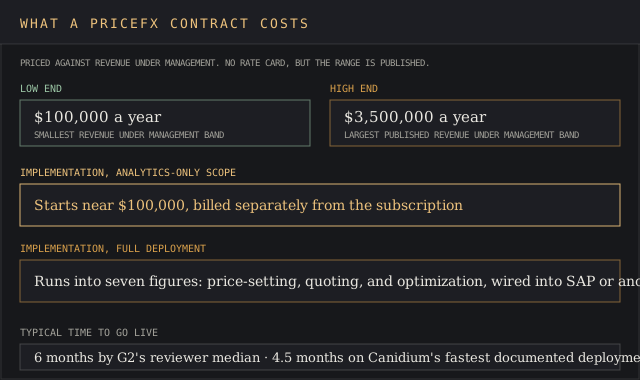
Pricefx publishes its pricing logic without publishing a rate card. Its own pricing page states the subscription runs $100,000 to $3.5 million a year, scaled to a customer's Revenue Under Management. Seat count plays no part in the formula. Implementation is billed separately, from $100,000 to $1.5 million per project.
Rafi S.'s August 2024 review captured the buyer-side version of that math: "It's expensive, resulting smaller business owners cannot afford it." A retail small-business reviewer, four and a half stars in February 2025, agreed on the mechanism, if not the tone. Her review read: "the cost is high and if we want development, we need to pay extra fees."
There's no self-serve tier and no published rate card. Every deal starts with a Proof of Concept and a sales conversation, so a buyer should budget weeks before a quote even arrives.
Some buyers ask for a lighter solution first, an analytics-only rollout, before committing to the full CPQ-and-rebate solution described above.
Pricing decisions: Pricefx Agents & the Copilot layer
Pricefx shipped its Agents product in July 2025: autonomous processes that watch pricing and transaction data for margin leakage. They catch margin leakage while the quarter is still open, before the books close. The company reported 26 Agents deals signed within the product's first six months, against a catalog that had grown past 125 agents by early 2026.
Copilot sits alongside it as a natural-language interface. A pricing analyst gets informed pricing decisions from a single question about a specific account. No report-building required first. bharath k., a software engineer, credited "Pricefx's flexibility in adapting to real-time business cases" in a March 2026 review. The same reviewer flagged that "UI/UX need more improvement and learning curve is steep."
Pricing strategies built on a static spreadsheet break down the moment market conditions shift. That's the argument behind the Agents launch. The ai optimization layer underneath reads live transaction and pricing data, giving commercial teams a pricing strategy that updates as conditions change. Deal profitability becomes visible before a rep submits the quote; finance doesn't have to reconcile it after the fact to find out.
CEO Ronak Sheth framed the ai pricing push as a response to external pressure. He wasn't pitching a feature checklist. He said to the press in April 2026: "Organizations are navigating constant disruption, from inflationary pressures, tariffs, and supply chain shocks, and need intelligent, AI-driven systems that enable real-time response. Pricefx was built for this."
Pricing teams: implementation time & the learning curve
Six months is the number G2 reviewers converge on for a typical implementation, and several describe why it runs that long. Ahmed Z., a business analyst, wrote in September 2024 that "initial setup and configuration can be complex and time-consuming." Anupama P. put it more bluntly. Her five-star June 2026 review, from a senior software engineer, still read: "Steep learning curve, implementation effort."
Some businesses tell the setup story differently, and commercial teams' experience tracks scope. vikas k. described "initial setup was nice and quick" in the same March 2026 review that praised the SAP, Oracle and Salesforce integrations. A verified small-business reviewer in April 2025 wrote that "initial setup involved nice easy steps." A narrow analytics rollout goes faster than a full price setting and CPQ build.
Every implementation replaces a set of manual processes with configured ones. Companies that map those processes in writing before kickoff report faster go-lives than the businesses that discover their own rules mid-project.
Once live, the complaint shifts from setup to scale instead. Philipp K., an enterprise reviewer, wrote in March 2026 that "simple filtering in tables with several million entries takes minutes." A verified consulting-industry reviewer echoed it in June 2026: "when processing large data sets, I need improvement in terms of performance."
Revenue management: what named customers report
Pricefx's published case studies name specific accounts. Most vendors publish only aggregate averages. That's the harder claim to fake, and stronger evidence of a durable edge; every figure here comes from Pricefx's own published case studies, without independent audit. Mabe, a consumer-durables manufacturer, reported a 2.5-point margin increase within 12 months after replacing spreadsheet quoting with Pricefx wired into SAP.
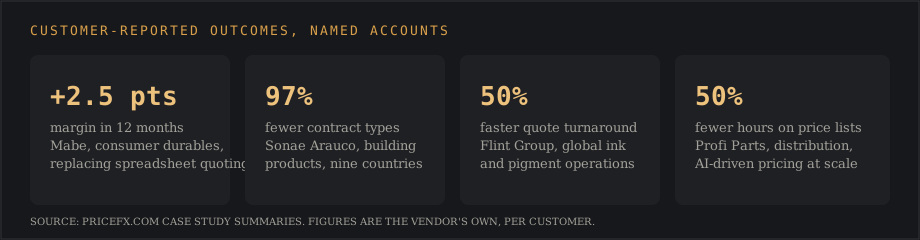
Sonae Arauco, a building-products manufacturer operating across nine countries, cut its contract types by 97% using Pricefx Agreements. That collapsed what had been country-by-country contract sprawl into one single structure, with one dynamic pricing strategy across the board.
Flint Group, a global ink and pigment supplier, reported a 50% reduction in quote turnaround time. Distributor Profi Parts reported 50% fewer hours spent maintaining price lists, after moving that work to Pricefx's AI-driven pricing.
A technology company with $1 billion a year in sales reported a 3% margin expansion after implementing Pricefx through partner Canidium. That's close to $30 million, given that scale of business.
Aaryan G., a senior BI manager, gave the reviewer-side version of the same claim in a July 2025 G2 review: turnaround "decreased from 3 weeks to days." He also praised support as "very good, they are very quick resolving issues." That's a customer satisfaction signal that shows up across several of the newer reviews.
What Pricefx users complain about most
Performance under load is the most-repeated complaint across the reviews this piece drew on, echoed by reviewers in back-to-back months. Sirisha T., a software engineer, wrote in an April 2026 five-star review, of all ratings, that "performance when handling large data sets can be improved." A verified small-business reviewer made the identical point the same month.
Cost is the second cluster, and it isn't only smaller businesses raising it. An automotive enterprise reviewer wrote in December 2024 that "configuration of new features can be time intensive and expensive." That matters for a platform priced on that same rising formula: growth pushes a company into a higher band, even before new features get added.
Older reviews carry a rougher edge that newer ones don't. Suzanne B., a sales reviewer in chemicals, gave the product two stars in November 2018. She described the interface as "very clunky...interface is very slow...frustrating and very amateurish," and said building a single quote took "many steps." No 2025 or 2026 review in this set repeats that specific complaint, which points to real product improvement in the years since.
What Pricefx users praise most
Support comes up unprompted across these reviews as the strength cited most often. Alex B., a pricing manager in the automotive sector, wrote in a January 2017 Capterra review that Pricefx's "tech support is very responsive and quick to resolve issues." Aaryan G.'s 2025 G2 review says the same thing in different words, eight years later, describing quick, direct resolution, with no ticket queue standing between them.
Flexibility is the second theme, showing up across company sizes, industries & review platforms. Paul R., a global pricing manager in mechanical and industrial manufacturing, called out "complete flexibility" in a January 2017 Capterra review. Marko F., a pricing manager, credited "rapid implementation of all data" in a November 2015 review, years before the SAP partnership existed.
A Gartner Peer Insights reviewer, Director of Product at a company between $1 billion and $10 billion in revenue, wrote in January 2026 that a cloud migration project "worked extremely well." That reviewer also said "the team at Pricefx was fantastic to work with." The rating held at four out of five stars, despite the technology and process risk a migration like that usually carries.
Company stability: funding, ownership & the 2026 Gartner nod
Pricefx has raised $130 million across five funding rounds since 2011. The most recent was a $65 million Series C in July 2020, led by the Apax Digital Fund, with existing investor Digital+ Partners participating.
Including a $65 million Series C in July 2020 led by the Apax Digital Fund, with existing investor Digital+ Partners participating.
That round funded the international expansion and product work that turned a pricing tool into a full platform, with rebate programs, CPQ and AI agents inside the same license. A 2023 partner-network expansion with Deloitte, PwC and Accenture now runs the larger deployments and onboarding processes as outside services. It's a funding history few companies in this category can match.
Ronak Sheth became CEO in 2022, after co-founder Marcin Cichon's earlier tenure in the role. The company reports more than 375 employees across roughly 30 nationalities and 190-plus customers, as of its most recent published figures.
Its one public litigation matter dates to December 2018, when Pricefx and competitor Vendavo filed competing patent claims against each other; the dispute ended in a September 2019 settlement, the only litigation history procurement teams will find on the company.
The Gartner nod in April 2026, a Leader placement in the inaugural Magic Quadrant for B2B Pricing and Rebates Optimization Software, is a first-time category placement: the Magic Quadrant itself launched in 2026, so Pricefx and its competitors are being scored against a Gartner framework built around exactly the CPQ-plus-rebate scope this review has documented.
Companies evaluating Pricefx against its own stated value are asking a direct question. Do 15 years of pricing strategies translate to their own industry's deals, beyond the named accounts already on the customer list? For most B2B businesses the honest answer depends on two things.
There's a pricing gap big enough to fund the platform that closes it, and leadership patient enough to let the numbers improve profitability over the following year. A single quarter won't show the same gains.
Pricefx vs alternatives
Competera is the nearest thing to a direct alternative on optimization depth, though it targets a different business: retailers running 10,000 or more SKUs and at least $500 million in revenue. It uses elasticity models trained on transaction history, mapping retail demand curves directly.
| Tool | Rating | Reviews | Built for | Not for |
|---|---|---|---|---|
| Pricefx | 4.4/5 on G2 | 133 | B2B contracts, quotes & rebates | Retail SKU-level pricing |
| Competera | 4.9/5 on G2 | 14 | Retail elasticity & dynamic pricing | B2B contracts & rebates |
| Prisync | 4.7/5 on G2, 4.8/5 on Capterra | not disclosed | SMB competitor price tracking | Rebates or CPQ at any scale |
Ratings and review counts, as published on each vendor's own G2 and Capterra listing page, vary by source.
Competera scores 4.9 on G2 against Pricefx's 4.4, but on just 14 reviews. Pricefx carries 133. It also has no CPQ or rebate module for a manufacturer to switch on. A retailer choosing between the two is choosing a category: Competera prices SKUs with a retail dynamic pricing strategy, Pricefx prices contracts.
Prisync sits at the opposite end of the market entirely: published tiers from $99 to $799 a month, a 14-day self-serve trial, and a feature set that stops at competitor price tracking & rule-based repricing. It rates higher on G2 (4.7) and Capterra (4.8) than Pricefx. That's largely because its buyer's job is smaller, and its software does exactly that job.
A Pricefx-sized manufacturer paying out complex customer agreements would find Prisync has no tools for the deal desk at all.
Vendavo and PROS Pricing are the two enterprise competitors businesses most often shortlist alongside Pricefx, both offering B2B price optimization with CPQ options of their own. Neither carries a published review on this site yet, so the comparison here rests on category positioning. A scored, sourced head-to-head isn't possible yet.
SAP's own CPQ module is the fourth name that comes up. It matters mostly for organizations already committed to SAP, that want a single vendor handling everything, skipping the certified integration between two systems.
The switching trigger runs in both directions. A retailer that outgrows simple price tracking moves toward Competera before it ever needs Pricefx's rebate engine. A B2B seller that outgrows spreadsheet rebate math moves toward Pricefx, Vendavo or PROS instead. It picks among those three mostly on existing ERP relationships and sales-cycle patience, weighing each vendor's pricing strategies against its own.
Every one of these alternatives forces the same choice: how much control a business wants over pricing, discounts & contracts, weighed against how much technology & implementation effort it can fund before value shows up on a P&L. Pricefx's answer is deep control at a deep price. Prisync's is shallow control at a fraction of the cost. Competera splits the difference for a different set of retail customers altogether.
None of the four is a universal solution. That's exactly why this comparison runs on buyer fit. A single ranking can't capture it. A platform this deep only pays off when a business stays focused on the pricing errors it was built to catch: tariffs, input costs and demand swings. A sales rep's Friday-afternoon discount request is a different problem entirely.
Customers who keep that focus report the clearest value; the ones who don't tend to blame the software. Their own process is usually the real culprit.
FAQ
How much does Pricefx cost?
Pricefx runs $100,000 to $3.5 million a year, scaled to a customer's Revenue Under Management, per its own pricing page. Implementation is billed separately, from $100,000 to $1.5 million per project. There's no published rate card and no self-serve tier; every deal is quoted after a Proof of Concept.
How long does a Pricefx implementation take?
Six months is the reviewer median on G2. Canidium's fastest documented case went live in 4.5 months, while several G2 reviewers describe setup and configuration as complex and time-consuming on a full price-setting and CPQ build.
What does Pricefx do?
Pricefx is a B2B pricing platform that handles price management, AI-driven price optimization, native configure-price-quote, and rebate and discount governance in one system, with Pricefx Agents and Copilot layered on top since 2025 for margin-leakage monitoring and natural-language queries.
Who owns Pricefx?
Pricefx was founded in 2011 by Christian Tratz, Marcin Cichon and Martin Wricke. Ronak Sheth has been CEO since 2022. The company has raised $130 million across five rounds, most recently a $65 million Series C in July 2020 led by the Apax Digital Fund.
What are the best Pricefx alternatives?
Competera is the closest match on optimization depth for retailers, and Prisync covers competitor price tracking at SMB scale. Vendavo and PROS Pricing are the enterprise B2B competitors most often shortlisted alongside Pricefx, though neither has a published review on this site yet.
Is Pricefx worth it?
For a manufacturer, distributor or industrial B2B seller with real revenue under management and rebate programs complex enough to have outgrown a spreadsheet, named customers report margin gains of 2.5 to 3 points within 12 months of go-live. A retailer needing only competitor price tracking, or a business below the contract floor, is buying the wrong pricing solution.
Verdict
Pricefx is for a manufacturer, distributor or industrial B2B seller with real revenue under management. It's for one with rebate programs complex enough to have outgrown a spreadsheet, and a pricing or revenue operations team willing to run a months-long implementation before the first quote ships through the new system.
It is not for a retailer or e-commerce team that only needs competitor price tracking, and not for any organization below the contract floor that pricing formula implies. Both the reviews and the published case studies point at large, complex B2B accounts across manufacturing, chemicals and industrial distribution.
It might suit a mid-market B2B company already running SAP, provided finance signs off on a six-figure implementation before the margin gains named in Pricefx's own case studies show up on a P&L. Mabe's 2.5-point margin increase, for instance, showed up 12 months after go-live. A business that can't wait that long, or fund that gap, is buying the wrong pricing solution at the wrong stage of its own growth.
Solution fit should drive the decision, weighed against brand preference or a slick demo. Businesses that already track discounts, contracts and rebate processes by hand are the ones whose pricing strategy pays for itself inside Pricefx. Companies without that complexity gain little beyond a bigger bill. Customers evaluating any of these platforms should run that same test before signing, ahead of a demo that only shows the happy path.