Competera review
 By Jan Suski. I go deep on every review, checking every number against its source and digging up details other coverage misses, a habit from six years of SEO and link building for tech companies. Bylines at Surfer, Brand24, and Senuto. How the scoring works.
·
Best for
Retailers and e-commerce businesses ready for an enterprise contract: dedicated pricing staff, historical transaction data, and time for a calibration pilot before go-live.
Not for
Small retailers outpriced by the enterprise contract level. Buyers wanting price intelligence without automated repricing can scope the monitoring module alone instead.
What it costs
No published list price. Every deal comes from a sales conversation, with a Proof of Concept pilot as the real entry cost before any contract.
- Competitor monitoring
- Over 10 million data points daily on competitors' prices, product availability and promotions
- Supplier monitoring
- Purchase-price changes land in the same pricing dashboard as competitor data
- Product matching
- Your assortment matched against rival listings inside the pricing platform
- Demand models
- 930 deep learning models behind the demand elasticity analysis
- Demand factors
- Over 20 factors influencing customer purchasing behaviour, from seasonality to cross-product effects
- Forecast accuracy
- Over 95%, on the company's own measurement
- Recommendations
- Optimal price per SKU against one stated goal: margin, revenue or price perception
- Pricing rules
- Margin floors, price-ending conventions, category relationships and key-value items
- Explainability
- Each recommendation carries an explanation a category manager can audit before it applies
- Repricing modes
- Fully automated, or review mode where staff approve recommendations in batches
- Dashboards
- Customizable, read at portfolio level and at SKU level from the same data
- Scenario simulation
- Real-time simulation of alternative pricing strategies, with outcomes scored by probability
- Impact forecasting
- Forecasts sales volume, revenue and margin 1 to 12 weeks ahead before a price change goes live
- Integrations
- ERP and storefront systems, wired up during implementation
- Data required
- Years of historical transaction data to calibrate the pricing models
- Implementation
- Proof of Concept model with progress reviews; weeks to months, with a dedicated Competera team
- Client base
- 49 clients across 18 countries
- Revenue optimized
- $60 billion, by the company's own count
- Reported results
- Around 6% gross margin lift; pricing decision time from 60 to 4 hours weekly
- Workload claim
- 50% to 70% reduction in pricing-related work through automation, per Competera
- List price
- None published; every deal is quoted
- What moves the quote
- Catalog size, module scope and market count
- Self-serve
- None; the pricing platform is sold with an implementation project attached
- Proof of concept
- The pricing pilot is the real price of admission, budgeted before the full contract
- Contract level
- Enterprise; quoted contracts and pilot projects price small retailers out entirely
- Narrower scope
- Buyers wanting price intelligence reporting without automated repricing can scope the monitoring module alone
Quicklizard
Not forA retailer with a few hundred SKUs: Quicklizard scopes by size, frequency and channels; no price published.
Wiser Solutions
Not forA team wanting elasticity-based pricing: Wiser tracks live SKU moves and MAP violations, short of optimization.
Pairs well with Competera
Which Competera numbers are the vendor's own, and which describe the machinery
Competera quotes every deal and publishes no rate card. The price column below explains what shapes each contract: catalog size, module scope and market count. No fixed number exists to show. The 6% gross margin lift, the drop from 60 to 4 hours of pricing decision time, the 50% to 70% workload reduction, the 95% forecasting accuracy and the $60 billion optimized are all Competera's own reported numbers, and no independent audit of them appears on the vendor's website.
The counts describing the engine, 930 demand models, 20-plus behaviour factors and 10 million data points a day, come from the same materials. This page was last updated 9 August 2026.
Competera is an AI-powered pricing platform for retailers and e-commerce businesses.
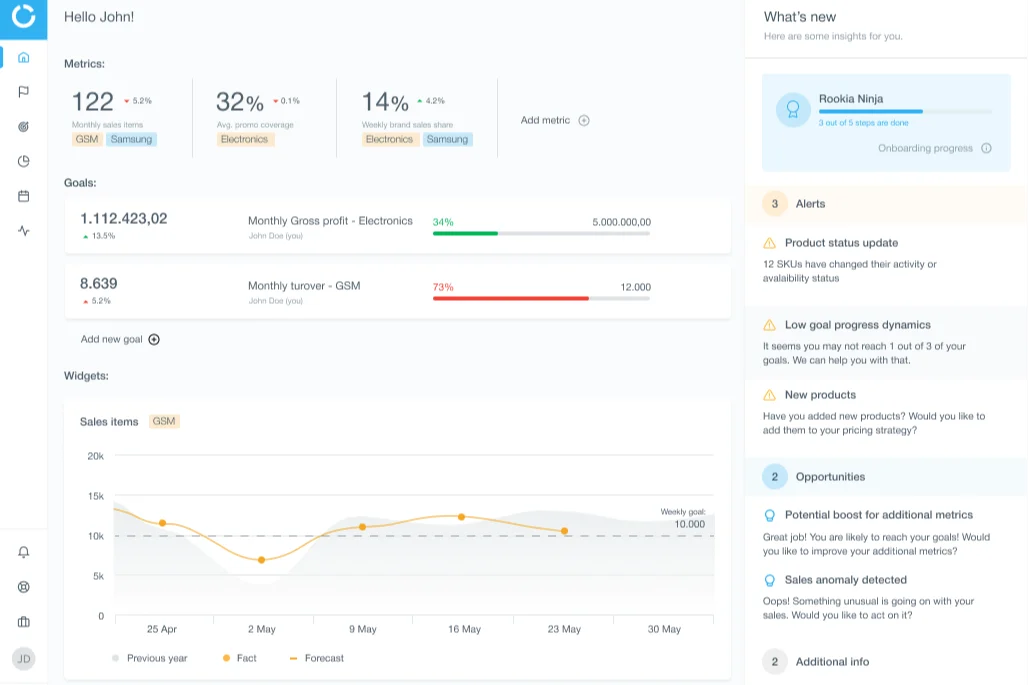
The Competera Pricing Platform monitors competitor prices, models demand, and produces optimal price recommendations per SKU, replacing spreadsheet pricing and static rules with machine learning.
It serves 49 clients across 18 countries, and its engine has optimized $60 billion in revenue, by the company's own count.
This Competera review covers how the platform works, what results retailers report, what implementation demands, and who should look elsewhere; it sits in our pricing intelligence ranking and in the top 10 of our market intelligence tools list.
What Is Competera?
Competera sells enterprise pricing software from a New York headquarters, and its client list leans toward large retailers with extensive product catalogs and multi-channel needs.
The pitch in one sentence: stop setting prices with rule based pricing and gut feel, and let a model trained on your own transaction history find optimal prices that protect margins and keep customers buying.
Competera pricing recommendations come from demand modeling and customer behavior analysis. That's the core difference between the Competera Pricing Platform and simple repricing tools, which set prices by copying competitors directly.
In practice the pricing platform does three jobs: competitor price monitoring, price optimization, and pricing governance, the rules that keep AI pricing inside business constraints.

↑ FACT SHEETHow the Competera Pricing Platform Works
Competitor Price Monitoring
The Competera Pricing Platform's monitoring layer collects over 10 million data points daily on competitors' prices, product availability, and promotions.
Price monitoring runs on schedules matched to how fast a market moves: daily for stable categories, more often where competitors reprice aggressively and customers price-check before they buy.
Competera provides accurate competitor price data for competitive positioning, with matching between your assortment and rival listings handled inside the pricing platform.
Supplier price monitoring rides alongside competitor monitoring, so purchase-price changes and market trends land in the same pricing dashboard, and the price intelligence feeds every downstream pricing decision.
The Price Optimization Engine
Price optimization is where the Competera Pricing Platform earns its keep. Competera uses 930 deep learning models for demand elasticity analysis, grounded in best econometric practices.
The system analyzes over 20 factors influencing customer purchasing behavior, from seasonality and promotion history to cross-product effects, and maintains over 95% forecasting accuracy by the company's measurement.
Out of that machine learning core come optimal price recommendations per SKU: optimal prices that achieve a stated pricing goal, margin, revenue, or price perception, within constraints the retailer controls.
Price elasticity is the load-bearing concept: the AI estimates how customers respond to price moves for each product, which is exactly what rule based pricing never sees.
Because the price elasticity curves come from your own data, the pricing engine can understand when a price increase will not cost demand, and recommend it; competitors following each other down never find that price.
Rules, Control, and Price Perception
The Competera Pricing Platform does not remove control. Pricing specialists bring their own constraints: margin floors, price-ending conventions, category relationships, and the key-value items customers watch, where price perception matters more than margin.
The AI optimizes inside those fences, and every pricing recommendation ships with an explanation a category manager can understand and audit before the system applies it.
Repricing can run fully automated or in review mode, where staff approve optimal price recommendations in batches; most clients start in review mode and expand pricing automation as trust in the AI builds.
↑ FACT SHEETWhat Results Do Retailers Report?
Competera reports that its AI pricing engine lifts enterprise clients' gross margin by around 6%, and that pricing decision time falls from 60 to 4 hours weekly.
The company also claims the Competera Pricing Platform reduces pricing-related workloads by 50% to 70% through automation, and customers on review sites do report a measurable impact: far fewer manual pricing adjustments and faster reaction to competitors' moves.
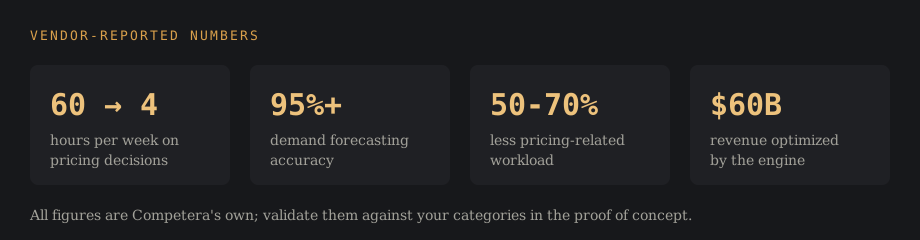
Treat every one of those figures as vendor-reported; no pricing page on the vendor's website publishes independent audits. The way to buy this category is to make Competera prove the remarkable results on your own product categories during the pricing pilot, against a control group, before the full contract.
↑ FACT SHEETImplementation: What It Takes
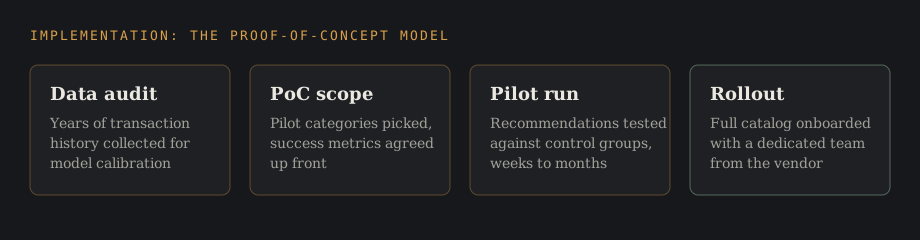
Initial setup is the hard part of ownership, and Competera is upfront that implementation follows a Proof of Concept model, with progress reviews built into the pilot.
The pricing models require years of historical transaction data for calibration; the accuracy of the AI depends directly on the quality of that data, and integrating with ERP and storefront systems is part of the work.
Implementation can take weeks to months, and clients receive a dedicated team from Competera through data integration, model calibration, and the pilot; buyers describe the engagement as working with an implementation partner more than installing a product.
Security review belongs in this stage too: the pricing platform touches transaction data, supplier data, and margins, so run your standard vendor security assessment before the data audit begins.
↑ FACT SHEETHow Much Does Competera Cost?
Competera pricing is quoted, never published, and scales with catalog size, module scope, and market count.
Expect a significant investment at enterprise level: the pricing platform is sold with an implementation project attached and no self-serve subscription, and the money conversation starts from the margin upside in your categories.
Companies evaluating it should budget the pricing pilot as the real price of admission; if the PoC pays for itself in margin, the business case writes itself.
Who Is the Competera Pricing Platform Best For?
The best-fit buyer is a large retailer with a big catalog, several sales channels, and a dedicated pricing team ready to work with AI recommendations.
Competera benefits retailers that already hold years of clean transaction history; grocery, electronics, and beauty are typical retail industry segments in its client base, and its customers typically achieve real volume before arriving.
It is not suitable for new businesses or those lacking data: without transaction history the pricing models have nothing to calibrate on, and a smaller shop gets more value from lightweight price monitoring tools than from enterprise price optimization.
Businesses outside retail, or buyers that only want price intelligence reporting without automated repricing, should scope the monitoring module alone or look downmarket.
Competera vs Other Pricing Tools
Shortlists in this market usually hold three or four names, and the differences are real.
- Quicklizard, the most common head-to-head, is an Israeli dynamic pricing platform focused on real-time repricing at high frequency; it answers "what should the price be right now," while Competera pricing leans harder on elasticity modeling and margin goals. Retailers with fast-moving assortments shortlist both pricing platforms.
- Wiser Solutions spans in-store and online retail intelligence, with pricing as one module among several.
- Prisync and similar entry tools cover competitor price monitoring for small and mid-size shops at published monthly prices, without the optimization engine.
- EDITED approaches the same retail decisions from assortment and merchandising data.
- DataWeave sells breadth over a repricing model: pricing plus digital shelf content plus availability data in one feed, built for a buyer who wants a single dashboard across those three data streams.
The pattern: Competera competes on modeling depth and pays for that depth with implementation weight; the lighter pricing tools win where speed to value matters more than optimization, and where customers reprice a few hundred products.
What Is Dynamic Pricing Software for E-commerce?
Dynamic pricing software changes prices automatically in response to market conditions: competitors' moves, demand trends, stock levels, and time.
The category runs from simple repricers, which follow competitors by rule, to price optimization platforms like the Competera Pricing Platform, which set optimal prices from modeled price elasticity to achieve a business goal.
The difference matters because rule-followers race each other to the bottom while customers pocket the discounts; optimization systems find the price that achieves the goal, which is sometimes higher than the competitor's price.
Support and User Ratings
Competera maintains high user ratings on platforms like Capterra and G2, and its customer support is frequently described as responsive and proactive.
Reviewers consistently credit the account managers through implementation, and the same account contacts stay on after rollout, which matches how the Competera Pricing Platform is sold. It's a partner engagement with a login attached.
Customizable pricing dashboards get positive mentions too, with flexibility for both portfolio and SKU-level analysis, so category managers and executives read the same data at different altitudes; customers who want business reporting out of the box get it without build work.

Weaknesses and Limitations
- Data hunger: the AI pricing models need years of quality transaction history, and thin or messy data degrades the recommendations.
- Implementation weight: weeks to months before full value, with real internal effort required on the buyer side.
- Enterprise-only economics: quoted contracts and pilot projects price out small retailers entirely.
- Vendor-reported benchmarks: the 6% margin figure and forecasting accuracy come from Competera's own materials and need validation per buyer.
- Scope: this is retail pricing tooling; businesses needing broader market intelligence pair the pricing platform with other tools.
Is Competera Worth It?
For a retailer with the data, the catalog, and a pricing function, yes, with the pilot as proof: a single point of improvement in gross margins across a large catalog dwarfs the platform fee, and the maturity jump from rules to elasticity-based optimal prices is not achievable with spreadsheet pricing at scale.
For everyone below that threshold, the answer is not yet: build transaction history, run lightweight price monitoring, and revisit when a pricing team exists to act on AI recommendations; that progression is how most Competera customers arrived.
FAQ
What is Competera?
The Competera Pricing Platform is enterprise pricing software: it monitors competitors, models demand elasticity with machine learning built on best econometric practices, and recommends optimal prices for retail catalogs.
What does Quicklizard do?
Quicklizard sells dynamic pricing software focused on real-time, rule-and-AI repricing for retailers; it is Competera's most frequent head-to-head, stronger on repricing speed, lighter on econometric modeling.
How much does Competera cost?
Quote-based, scaled to catalog and scope; buyers should expect enterprise contract levels and budget for a paid proof of concept first.
Is Competera a good company to buy from?
Its support reputation and retention among large clients say yes, provided you match its profile: real data history, catalog scale, and pricing specialists who will use the AI recommendations.
Does Competera work without historical data?
Not well; pricing model calibration needs transaction history, which is why new companies are pointed toward simpler price monitoring tools first.
Bottom Line
The Competera Pricing Platform is a mature, enterprise-grade price optimization system: 930 pricing models, 20+ demand factors, price monitoring at 10 million data points a day, and control frameworks that keep pricing specialists empowered.
Its demands are the flip side of its depth: data, time, money, and a buyer who can run a disciplined pricing pilot with progress checkpoints.
Retailers that clear those bars buy margins; retailers that don't should not buy the pricing platform yet.