Blue Yonder review: AI-driven supply chain planning and execution
 By Jan Suski. I go deep on every review, checking every number against its source and digging up details other coverage misses, a habit from six years of SEO and link building for tech companies. Bylines at Surfer, Brand24, and Senuto. How the scoring works.
· Prefer this source on Google
Best for
Large enterprises between $10 billion and $30 billion in revenue that need planning, warehouse and transportation management sharing one data model end to end.
Not for
Companies below the $10 billion revenue band, or any team that needs to go live fast; a comparable rollout takes six to eighteen months with a systems integrator.
What it costs
There's no number until a deal is scoped to specific modules. A comparable Kinaxis contract for similar functionality runs $200,000 to more than $2 million a year.
- Suite modules
- Planning, execution, warehouse management and transportation management sharing one data model end to end
- Control tower
- Luminate Control Tower gives one real-time view of orders, shipments and exceptions
- Inventory visibility
- Real-time inventory tracking and supplier visibility
- Order promising
- Checks inventory and capacity in real time before a delivery date is committed
- Warehouse management
- Picking, packing, reverse logistics and labor planning by day and shift
- Transportation management
- Route modeling through last-mile delivery
- Multi-enterprise network
- One Network, acquired August 2024 for about USD 839 million
- Returns capability
- Doddle signed October 2023; Optoro acquired August 2025, closing on 19 August
- External integrations
- SAP and Oracle
- AI predictions
- More than 20 billion daily
- Forecast model
- Cyclic Boosting, published with enough detail that researchers can inspect it
- Technical transparency
- 4.8 out of 10, held down by uneven documentation of how models reach a decision
- Supply chain score
- 5.8 out of 10, strong execution weighed against the deployment lift
- Hosting
- Microsoft Azure, per public evidence
- Customer base
- More than 3,000, including Nestle, DHL, Procter & Gamble, Tesco, Renault and Starbucks
- Best-fit revenue band
- Enterprises between USD 10 billion and USD 30 billion in revenue
- Deployment
- Complex and slow, with steep learning curves from the extent of the functionality
- 2024 outage
- Ransomware from around 21 November 2024 took scheduling and workforce systems down for days
- Published rate card
- None
- Pricing structure
- Module by module, each capability area carrying its own subscription price
- Contract growth
- Total value compounds as a company expands from planning into execution, warehouse or transportation
- Discount lever
- A documented competitive evaluation is worth roughly 8 to 12 additional percentage points against renewal
- Scale comparison
- Kinaxis contracts run about $200,000 to more than $2 million a year
- Implementation lift
- Kinaxis takes six to eighteen months and usually a systems integrator; Blue Yonder is comparably demanding
Alternatives to Blue Yonder
Kinaxis
Not forA buyer who needs warehouse and transportation execution in the same platform as the plan.
o9 Solutions
Not forA retailer or 3PL whose hardest problem is warehouse pick-and-ship.
Pairs well with Blue Yonder
Which Blue Yonder figures are the vendor's own, and where the deal prices come from
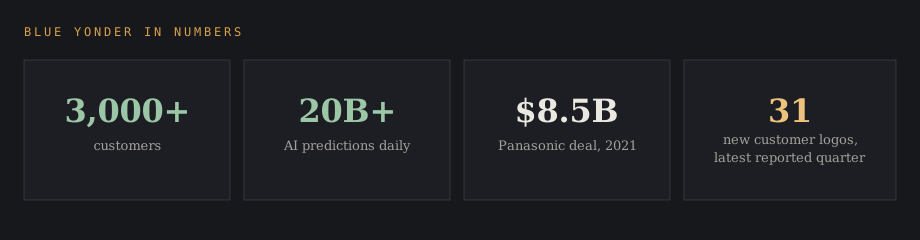
Blue Yonder publishes no rate card, so the module-by-module structure, the 8 to 12 point discount lever and the Kinaxis $200,000 to $2 million range stand in for a price list. The 20 billion daily predictions, the 3,000-plus customer count and the 31 new logos are Blue Yonder's own figures.
The USD 839 million One Network price comes from the acquisition announcement, the spin-off plan from Bloomberg, and the USD 7.7 billion valuation from analysts cited by Nikkei Asia. Glassdoor supplies the 3.6 rating across 1,549 India reviews and the $43,148 to $323,564 pay range. Figures as of the 7 August 2026 update.
This Blue Yonder review covers what the AI company builds, how it scores on technical transparency, what it costs, what happened in the November 2024 ransomware attack, and what it's like to work there. Blue Yonder is a major AI-driven supply chain provider with more than 3,000 customers, and its planning and execution software runs inside companies like Nestle, DHL and Procter & Gamble.
↑ FACT SHEETWhat is Blue Yonder
Blue Yonder builds supply chain planning, execution and fulfillment software for manufacturers, retailers and logistics service providers, and customers plan their work around it as one system. The company rebranded from JDA Software in 2020, and Panasonic acquired it for USD 8.5 billion in 2021.
Duncan Angove has been chief executive since July 2022, arriving with more than 25 years in enterprise software after senior roles at Infor, Oracle and Retek. With that background, he hit the ground running in the role.
The suite includes planning, execution and returns management in one place, and the platform supports omnichannel fulfillment across every channel, from a store to a mobile app. Order promising checks inventory and capacity in real time so a business can commit to a delivery date before an order ships.
AI and machine learning at the center of the platform
Blue Yonder is recognized for strong AI capabilities, and Luminate Planning uses AI for high-accuracy forecasts across a company's order book. Blue Yonder delivers over 20 billion AI predictions daily, run through Cyclic Boosting, published openly.
AI-driven planning improves forecast accuracy and inventory efficiency, cutting the kind of waste that comes from overstocking one location while another runs short, and cutting the waste of a planner re-entering the same data twice. The pitch is built to kill two birds with one stone: less overstock, less duplicate data entry.
Blue Yonder's AI sharpens decision-making in supply chains by scoring thousands of possible plans against real constraints, and the company has invested billions in supply chain AI innovation since the JDA Software rebrand.
Supply chain planning software lives or dies on how well forecasts hold up when demand changes, and Blue Yonder positions itself as a leader in AI-driven planning behind the 20 billion daily predictions.
↑ FACT SHEETTechnical transparency and how the AI works
Blue Yonder's technical transparency score is 4.8 out of 10, reflecting real breadth but uneven documentation of how models reach a decision.
Cyclic Boosting is a public machine-learning artifact, published with enough detail that researchers can inspect it, more transparent than vendors that treat every model as proprietary. Even so, the platform lacks a unified technical explanation, so a buyer evaluating one module's transparency can't assume the same disclosure applies to another.
Public evidence supports Azure-hosted delivery, meaning the platform runs on Microsoft's cloud, which matters for a procurement team that wants to understand exposure before signing, since cloud hosting shifts security and uptime risks onto Microsoft.
Supply chain planning and execution software
Luminate Control Tower provides real-time visibility across the supply chain, consolidating orders, shipments and exceptions into one view that replaces five separate systems. Blue Yonder offers real-time inventory tracking and supplier visibility, so a planner can act before a shortage reaches a store shelf.
Deployments are often complex and take real time, with steep learning curves from extensive functionality. A new team needs time to know the ropes before that functionality pays off. The platform suits global manufacturers and large retailers running planning, execution and fulfillment through one system. Blue Yonder excels for enterprises with revenues between USD 10 billion and USD 30 billion, where order volume justifies the work.
Many users appreciate the functionality once setup is done, and the suite supports multi-enterprise collaboration so a manufacturer and its logistics service providers can plan against the same numbers. Blue Yonder's supply chain score is 5.8 out of 10, reflecting strong execution weighed against the deployment lift to reach it.
Warehouse and transportation management
Warehouse Management System handles flexible warehouse operations, including labor management, so a center can plan headcount by day and shift against order volume. The system covers picking, packing and reverse logistics, moving returned goods through the supply chain, which matters more each year as returns climb.
Transportation Management System handles logistics from route modeling to last-mile delivery, giving a team one plan to execute across every leg of a shipment. Automation reduces manual tasks, adds speed to workflows, and shifts a team's time away from data entry and onto handling exceptions.
Cloud architecture provides scalable infrastructure at lower cost than a team running the same order management tools on its own servers, and manufacturers and logistics partners collaborate through the same screens, replacing spreadsheet handoffs between them. It's the best of both worlds, delivering enterprise scale without the capital outlay of running the servers in-house.
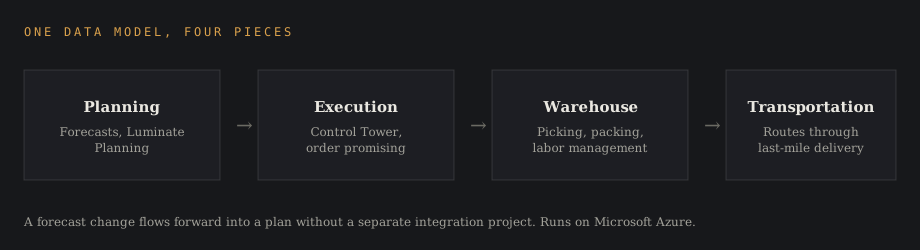
That order management layer covers a company's full path from forecast to delivered order.
↑ FACT SHEETBlue Yonder pricing and what drives the contract
Blue Yonder doesn't publish a rate card, and pricing runs module by module, with each capability area carrying its own subscription price. That means total contract value compounds as a company expands from planning into execution, warehouse or transportation.
The most effective discount lever is documented competitive evaluation. Buyers who bring evidence of a live alternative to the table routinely secure roughly 8 to 12 additional percentage points of discount against renewals negotiated without one, which makes a Kinaxis or o9 quote worth obtaining even for a company that intends to stay.
For scale, Kinaxis contracts run from about $200,000 to more than $2 million a year with six to eighteen months of implementation, usually requiring a systems integrator; Blue Yonder is comparably demanding to deploy. At that range, a comparable contract can cost an arm and a leg before a single module goes live.
↑ FACT SHEETCompany history: from JDA Software to Panasonic
Blue Yonder's history at its Scottsdale headquarters runs through several acquisitions. Blue Yonder closed its acquisition of One Network in August 2024 for about USD 839 million, adding a network where trading partners plan and execute, extending multi-enterprise collaboration. Blue Yonder signed for Doddle in October 2023, adding reverse logistics, and acquired flexis in 2024 for manufacturing capabilities that extend planning upstream.
In August 2025 Blue Yonder also acquired Optoro, closing on 19 August and pushing further into reverse logistics.
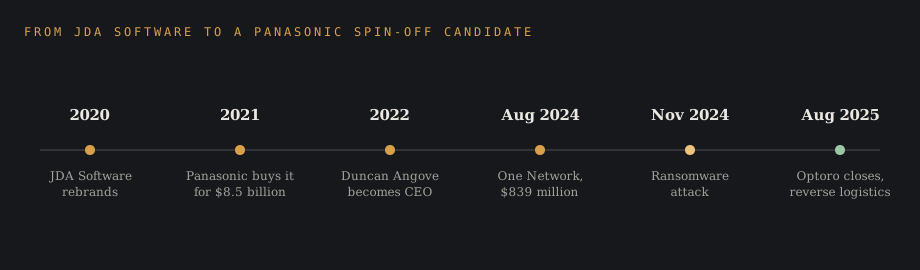
Panasonic has discussed spinning off the business built around Blue Yonder into a publicly listed company, though it has not finalized a listing or exchange decision, and the plan would leave Panasonic holding a majority stake regardless of how that decision lands (Bloomberg). Nikkei Asia has reported analysts valuing the resulting company at around USD 7.7 billion.
Quarterly highlights show growth behind that plan: the company added 31 new Blue Yonder customer logos, including Coca-Cola FEMSA, Morrisons, Royal Mail and Sainsbury's (blueyonder.com).
Product integration and the Azure cloud platform
Blue Yonder integrates with external platforms including SAP and Oracle, which matters for a company running accounting on one of those platforms without replacing it to add supply chain planning. The platform is built on Microsoft Azure, letting it run more than 20 billion AI predictions daily without every customer maintaining its own compute.
The suite's four pieces, planning, execution, warehouse management and transportation management, share one data model end to end, so a forecast change flows forward into a plan without a separate project. That keeps every module on the same page, all four drawing from one shared record.
Working at Blue Yonder: culture, pay and Glassdoor ratings
Blue Yonder earned Great Place to Work Certification in India in 2025 and was named a Best Company To Work For in India in 2024, a great place designation that shows up across employee feedback, and it's a claim job seekers can review on Glassdoor.
Employees rate Blue Yonder 3.6 out of 5 based on 1,549 reviews from India, and the pattern is a culture where people describe heavy workloads during major releases alongside real growth opportunities once a project ends.
Annual pay ranges from about $43,148 for a customer service role to $323,564 for a vice president, based on nearly 2,000 salaries on Glassdoor, and pay varies by location, team and job level.
Reviewers discuss a willingness among managers to support growth and a matrix structure that can leave a person reporting to more than one manager, which some read as a lack of ownership and others see as built-in collaboration. Reviewers don't always see eye to eye on which reading is correct.
Job listings describe an organization built around cross-functional teams, open jobs across planning and support work, and a culture that expects people to be ready to work across time zones since teams hand off work as each region's day ends.
Employees who collaborate well across the matrix report more opportunities to become a leader, and a manager who takes time to explain a decision earns a better review from their team, with a formal review once or twice a year.
New hires say it takes about a week for full system access, and Glassdoor's review volume suggests most employees end up glad they took the job, since the mix of praise and pointed critique reads like a working organization that puts real care into its people.
Customers should read more than one review before committing a multi-year budget, since one review can be an outlier. A number say the platform delivers real speed once integrated with existing systems, and reviewers who work in operations say automation frees up time that used to go to manual entry.
Other customers describe a steeper learning curve than expected, and a lack of guided onboarding forced their own team to learn the platform through trial and error, though Blue Yonder's jobs board and support documentation exist for teams that want to learn faster. Some teams bite the bullet, learning Blue Yonder step by step on their own.
Buyers who understand that tradeoff end up more satisfied, and that gap in expectations changes how a first-year review of the project reads.
People who work at Blue Yonder describe a culture that's ready to invest in AI innovation, and job seekers can review the Glassdoor page for a fuller view of daily life, day to day, before taking an offer.
The careers team lists jobs across every function, and reviewers say Blue Yonder is, on balance, a great place to build a career inside a larger organization, with real opportunities to learn on the job, learn new tools, and work alongside teams that also work hard to learn and ship on time.
↑ FACT SHEETThe 2024 ransomware attack and what happened
Blue Yonder disclosed a ransomware attack that began around November 21, 2024, disrupting its managed-services environment and, for several retail and grocery customers, scheduling and workforce systems for days. The incident became a case study in supply chain risk because affected companies discussed the outage publicly, and Blue Yonder worked to restore service with daily updates.
Who claimed it, and what they claimed to take
A group calling itself Termite claimed responsibility, listing Blue Yonder on its dark-web leak site on December 9, 2024. Researchers identify Termite as a variant built on the Babuk ransomware codebase.
Termite put the haul at roughly 680 GB, described as:
- About 16,000 email lists
- Some 200,000 insurance documents
- Internal communications and operational records
Blue Yonder said it was investigating the leak claim.
What it did to customers
The outage is more instructive than the intrusion, because it showed what happens when planning and workforce software goes dark at retail scale. Starbucks abandoned its automated scheduling system and reverted to manual processes to make sure staff were paid correctly. That was back to square one for scheduling until systems came back online.
Morrisons fell back to a slower backup process to keep fresh-produce warehouse operations moving. Sainsbury's ran the contingency plans it already had in place.
The companies that coped best were the ones that had a documented manual fallback before they needed it. A procurement conversation should nail down the vendor's recovery-time commitment and what the business does in the meantime.
Who Blue Yonder is built for
Blue Yonder is built for large manufacturers, retailers and logistics service providers that need supply chain planning, execution and fulfillment under one system. A smaller business with a handful of locations and light order volume is less likely to get value from that depth, since customers pay for scale that would overwhelm a lighter tool. That kind of team risks biting off more than it can chew if it signs on anyway.
SAP IBP, Oracle SCM Cloud, Kinaxis RapidResponse, o9 Solutions and Manhattan Associates are the main names Blue Yonder gets compared against. Kinaxis competes on rapid replanning and is comparably heavy to deploy; o9 leads on integrated business planning with a modern interface and a flexible data model spanning supply chain, finance and commercial teams; Manhattan Associates is the strongest direct rival on warehouse and transportation management specifically.
| Competitor | Where it competes |
|---|---|
| Kinaxis RapidResponse | Rapid replanning; contracts from ~$200K to $2M+ a year, comparably heavy to deploy |
| o9 Solutions | Integrated business planning across supply chain, finance and commercial teams |
| Manhattan Associates | Warehouse and transportation management specifically |
| SAP IBP | Planning for companies already running core business on SAP |
| Oracle SCM Cloud | Suite play inside the Oracle stack |
Blue Yonder's own claim against the field is coverage: it is the option when execution matters as much as planning, running from demand forecast through warehouse pick and ship in one platform. A person new to supply chain software has more to learn about Blue Yonder than someone from a competing tool, and Blue Yonder's onboarding tries to shorten that curve by tailoring training to each role.
A buyer weighing Blue Yonder against a smaller point tool should check at least one independent review, and a great place to find deployment stories is a site like Gartner Peer Insights or G2 over marketing pages. Independent reviews give a buyer something closer to a level playing field than marketing pages alone.
Blue Yonder's careers site lists open jobs day to day across engineering, delivery and customer success work, and reviewers who cover the space say Blue Yonder could do more to delight smaller customers, worth weighing alongside price when signing a final plan.
Frequently asked questions
What is the Blue Yonder controversy?
The most visible recent controversy is the November 2024 ransomware attack, claimed by the Termite group and disclosed on its leak site on December 9, 2024, which disrupted scheduling and operations for retail and grocery customers including Starbucks, Morrisons and Sainsbury's.
Who is the CEO of Blue Yonder?
Duncan Angove, chief executive since July 2022, previously a senior executive at Infor, Oracle and Retek.
What is the Blue Yonder software used for?
Blue Yonder software is used across sites run by Blue Yonder customers for supply chain planning, warehouse management, transportation management and order management, covering demand forecasting through last-mile delivery.
How much does Blue Yonder cost?
Blue Yonder doesn't publish pricing. Contracts are priced module by module, so cost compounds as a company adds capability areas, and bringing a competing quote to a renewal is worth roughly 8 to 12 additional percentage points of discount. At renewal, the ball is in your court to push that number down with a documented alternative.
Is Blue Yonder going public?
Panasonic has discussed spinning off the supply chain business centered on Blue Yonder through a public listing, but had not finalized a decision on the exchange or timeline as of the most recent reporting. Analysts cited by Nikkei Asia have valued the resulting company at around USD 7.7 billion.
What's the average salary at Blue Yonder?
Reported annual pay at Blue Yonder ranges from about $43,148 to $323,564 across roles, based on nearly 2,000 salaries submitted by employees on Glassdoor.
Is Blue Yonder legitimate?
Blue Yonder is a legitimate supply chain software company operating as a Panasonic subsidiary, with more than 3,000 customers and a multi-decade history as JDA Software.
What does Blue Yonder build?
The company builds AI-driven planning, warehouse management and transportation management software that helps large companies forecast demand, manage inventory and move orders through the supply chain.
Who is Blue Yonder owned by?
Panasonic owns Blue Yonder, having acquired the company for USD 8.5 billion in 2021 after rebranding it from JDA Software.
What happened to Blue Yonder?
Blue Yonder was rebranded from JDA Software in 2020, acquired by Panasonic in 2021, and hit by a ransomware attack in November 2024 that disrupted service for retail customers. The 2020 rebrand gave the company a clean slate, carrying the JDA-era product forward under a new name.
Is Blue Yonder a legit company?
Yes: Blue Yonder is a legit company with a documented history, a Panasonic ownership structure, and a customer base of more than 3,000 businesses worldwide.
Which companies use Blue Yonder?
Companies using Blue Yonder include large retailers and manufacturers such as Nestle, DHL and Procter & Gamble, alongside Tesco, Renault, Starbucks, Morrisons and Sainsbury's.
Is Blue Yonder better than SAP?
Neither is better across every case; Blue Yonder tends to lead on planning and execution depth, while SAP's strength is tighter integration for companies already running core business on SAP systems.