DataWeave review: pricing, digital shelf, and content data for one enterprise contract
 By Jan Suski. I go deep on every review, checking every number against its source and digging up details other coverage misses, a habit from six years of SEO and link building for tech companies. Bylines at Surfer, Brand24, and Senuto. How the scoring works.
· Prefer this source on Google
Best for
Enterprise retailers and CPG brands that want price, digital shelf content and availability data from one vendor relationship, and that can staff a sales-led onboarding; there's no self-serve signup. 51% of DataWeave's 88 G2 reviewers identify as enterprise buyers.
Not for
Teams that need a published rate card before a sales call, or buyers who need certainty on exact-match accuracy at high SKU counts; G2 reviewers document real matching gaps against DataWeave's 99%+ claim.
What it costs
Nothing published anywhere. DataWeave's own pricing page, the data marketplace Datarade, and G2's comparison tool all route buyers to a sales conversation.
- Founded
- 2011, Bangalore, now also with offices in San Francisco, Seattle, Baltimore, Boston and Singapore
- Co-founders
- Vikranth Ramanolla and Karthik Bettadapura; Bettadapura is CEO
- Headcount
- 125+ employees across all offices
- Last disclosed funding
- Series A, 6 April 2017, led by Japan's FreakOut Group
- Total funding on record
- Disputed: $1.13M per Tracxn, $28.6M per PitchBook
- Product modules
- Pricing Intelligence, Digital Shelf Analytics, Assortment Analytics, Content Analytics
- Data volume
- 500B+ data points aggregated, DataWeave's own 2021 figure
- Refresh rate
- Daily to several times a day, tuned per category
- Language coverage
- 25+ languages, extracted without manual translation
- Granularity
- Store-level and ZIP-code hyperlocal pricing on top of national feeds
- Fuel retailer
- Survey costs down 50 to 60 percent
- Home-improvement retailer
- Content quality and attribute health up 22 percent across 100,000 products
- Fashion e-commerce retailer
- 99%+ matching held across 200,000 SKUs
- Douglas Germany
- Online revenue up 2 percent over six months
- CPG snack brand
- Amazon sales up 8.5 percent year over year after a Digital Shelf Analytics rollout
- Overall
- 4.4 of 5 across 88 reviews
- Quality of support
- 9.0 of 10
- Retail pricing category
- 8.0 of 10 across 23 reviews
- Brand protection category
- 7.1 of 10 across 6 reviews, DataWeave's weakest scored category
Prisync
Not forA buyer who needs content, availability or sentiment data alongside price.
Competera
Not forA buyer who wants monitoring and insight without handing pricing decisions to a model.
Why DataWeave's total funding is reported two different ways
Tracxn lists $1.13 million raised across four rounds; PitchBook lists $28.6 million. Neither DataWeave nor its Series A backers have published a consolidated total, so this review states both figures side by side without picking one.
DataWeave sells four things under one contract: what a competitor charges, if a listing shows up and looks right, if the shelf is stocked, and how shoppers are reacting to it. Most of the category sells one of those. DataWeave built its pitch around selling all four from a single data pull, which is why Adidas, Costco, Home Depot, Zappos, Meijer, QVC, and Pernod Ricard show up on its customer list alongside consulting shop Bain & Company.
This review covers the Pricing Intelligence and Digital Shelf Analytics products, the two DataWeave sells hardest, using DataWeave's own product pages, its published case studies, its funding history, and 88 G2 reviews plus a TrustRadius review going back to 2022. It's built for a buyer comparing DataWeave against the other six tools in MarketIntelligenceTools' pricing-intelligence ranking, where DataWeave sits fourth.
DataWeave is not a fit for a five-person e-commerce team evaluating tools with a credit card. There's no free trial, no published tier, & no self-serve signup anywhere on its site. Every G2 review naming a company size skews toward enterprise, and the sales-led model shows up in the reviews themselves: reviewers praise account teams & onboarding calls.
DataWeave plainly collects a lot of data, more than 500 billion data points by its own 2021 count. The real test is if that data lands on a buyer's desk matched correctly, priced honestly, and fast enough to act on. The G2 record on that last part is more mixed than DataWeave's own marketing suggests.
Two unrelated products share the name DataWeave
A separate product carries the same name. DataWeave is also a data transformation language built into MuleSoft's Anypoint Platform, the integration and API-management suite Salesforce acquired for $6.5 billion in 2018. Developers use it to convert data between JSON, XML, and CSV inside Mule application flows. It shares nothing with retail pricing, digital shelf content, or the company covered in this review beyond the six letters of the name.
The collision runs deep enough to distort search results. A plain "DataWeave review" query pulls tutorials, syntax guides, and MuleSoft documentation for the transformation language far more often than anything about the digital-shelf-analytics company at dataweave.com, since MuleSoft's DataWeave is the more widely searched, developer-facing term.
Even the keyword research pulled for this article surfaced competitor pages and search terms built around the wrong DataWeave before a manual check caught it.
A search that landed here looking for MuleSoft's transform syntax, its map or filter functions, or the DataWeave Playground is in the wrong place; MuleSoft's own DataWeave documentation is the right one. Everything below covers DataWeave the company: pricing, digital shelf, and content analytics for retailers and CPG brands, reviewed against 88 G2 users and its own published case studies.
What DataWeave sells: four modules bundled into one contract
Pricing Intelligence tracks a named competitor set across list price, promotional price, and actual selling price, refreshed daily to several times a day depending on category speed. Digital Shelf Analytics layers on share of search, content completeness, ratings, reviews, and in-stock status across the same retailers.
Assortment Analytics does gap analysis against a client's own catalog. Content Analytics audits product titles, images, and descriptions with a language model.
The four modules share one data pipeline: DataWeave scrapes public retailer sites & apps, matches products across sellers with a mix of NLP and computer vision, and routes low-confidence matches through a human-review layer it calls Veracite. That pipeline is also the company's stated differentiator against single-purpose rivals like Prisync or Price2Spy, which track price alone.
Key features across the four modules pull from multiple data sources at once: retailer sites, delivery apps, and marketplace listings all feed the same matching layer before a result reaches a dashboard. DataWeave markets Content Analytics as one of its newer AI solutions, scoring product pages with a language model that runs a rich set of automated checks a manual audit team would take weeks to match.
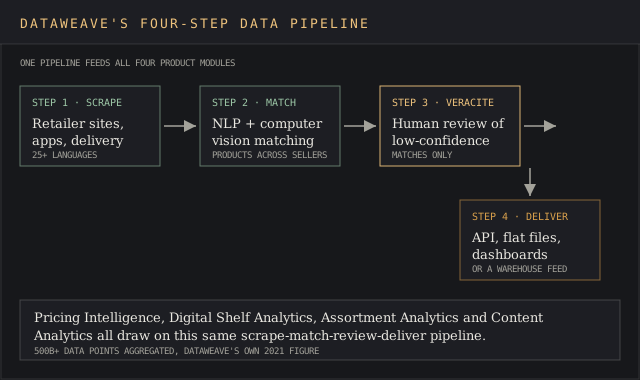
Vertical depth varies. DataWeave names grocery, fashion & apparel, home & furniture, consumer electronics, health & beauty, and fuel pricing as its core verticals, each with named clients: Meijer and HEB in grocery, Zappos in fashion, Northern Tool and Blain's Farm and Fleet in home & hardware. A fuel-pricing client isn't named, but the case study describing a 50 to 60 percent cut in manual survey costs sits under that vertical.
How the data gets collected and matched
DataWeave doesn't buy a panel or a syndicated feed. It scrapes retailer websites, delivery apps, and marketplaces directly, in more than 25 languages, transforming data collected across those sources and normalizing units of measure so a 500ml bottle in Berlin can sit next to a 16oz bottle in Boston in the same table. Multi-currency conversion runs on top of that.
That work counts as data integration in its own right, pulling input data from thousands of individual retailer pages that were never built to talk to each other. Retailer sites return different data formats: one lists sizes in a structured field, another buries the same detail in free text with no consistent tag.
A simple example: the same grocery SKU can show up in three different formats across three retailers, and each one needs its own mapping before DataWeave can combine data from all three into a single row a client can compare directly.
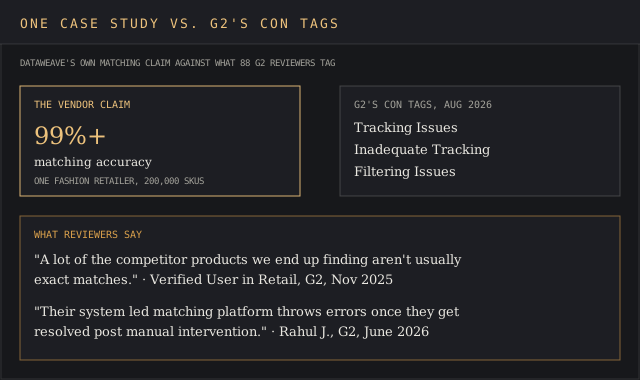
Matching is the harder problem, and DataWeave's marketing claims north of 99% accuracy on exact, similar, and private-label products, backed by one named case study: a fashion e-commerce retailer holding that rate across 200,000 SKUs. The company attributes the accuracy to a blend of machine matching and Veracite's human review layer. Our fast fashion statistics report sizes the apparel and footwear market those catalogs sell into at $1.8 trillion for 2025.
That claim doesn't fully survive contact with G2's review base. A Verified User in Retail wrote in November 2025:
"A lot of the competitor products we end up finding aren't usually exact matches. A lot of the time, the products are not the same, or there are not enough exactly-matched products across competitors to make a sufficient impact."
Verified User in Retail, enterprise (over 1,000 employees), G2 review, 3 November 2025.
That same reviewer scored DataWeave 3.5 out of 5, and still had praise for the drill-down workflow:
"Ease of use is a huge plus of this service. All of our product categories are available to select from with the ability to pivot by competitor to drill down and find opportunities quickly."
Verified User in Retail, enterprise (over 1,000 employees), G2 review, 3 November 2025.
The pattern across the reviews is consistent: the interface and the support team score well, the matching engine draws the most specific criticism.
The gap between DataWeave's matching claim and what G2 reviewers report
DataWeave's own case study documents 99%+ matching for one fashion retailer across 200,000 SKUs. G2's aggregated con tags for DataWeave include Tracking Issues, Inadequate Tracking, and Filtering Issues, each flagged by at least one reviewer as of August 2026.
Rahul J., an enterprise reviewer, gave DataWeave 5 of 5 in June 2026 and praised its reach:
"Dataweave's coverage of ecommerce platforms is extensive and offers solid depth when it comes to extracting information across the different layers."
Rahul J., enterprise (over 1,000 employees), G2 review, 15 June 2026.
That same review, from the same reviewer, still flagged the matching engine directly by name:
"At times, their system led matching platform throws errors once they get resolved post manual intervention, system adapts for future matching."
Rahul J., enterprise (over 1,000 employees), G2 review, 15 June 2026.
Read together with the November 2025 review above, the two accounts describe the same mechanism from different angles: matching errors that need a human to resolve them, after which the system adapts. That's a real capability. It also means the automated match alone doesn't finish the job.
A single vendor case study proving 99% accuracy on one retailer's catalog doesn't establish that rate holds everywhere. It establishes that it held once, under conditions DataWeave hasn't disclosed.
Two more reviewers back the same theme with a milder read. A Verified User in Retail at a small business (50 or fewer employees) praised "the data quality and consistency in all the delivery reports" in an August 2026 G2 review, then listed the dislike as "the occasional errors we face", plus a longer turnaround for new requirements.
On TrustRadius, Samantha, an Internet Marketing Coordinator at ROCG, a 1 to 10 employee firm, rated DataWeave 6 of 10 in a 2022 review. She wrote that the tool "does not function as well as it could with additional analytic data from prolonged research", in a non-retail use case DataWeave's core product wasn't built for.
Pricing: no rate card anywhere, and what that costs a buyer in time
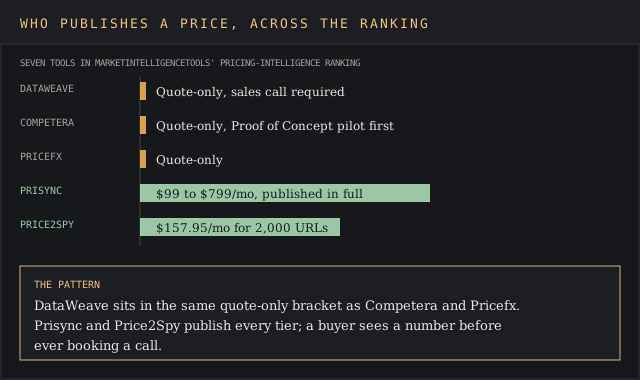
DataWeave publishes no tier, no starting price, & no usage-based calculator. Its own pricing intelligence page routes every visitor to a demo request. Datarade's data-marketplace listing carries the same line: DataWeave hasn't published pricing, and interested buyers contact the company directly. G2's head-to-head comparison tool marks DataWeave's pricing as "Custom", against Price2Spy's published $157.95 a month for 2,000 monitored URLs.
That puts DataWeave in the same bracket as Competera and Pricefx among the seven tools in MarketIntelligenceTools' pricing-intelligence ranking, all quote-only, versus Prisync and Price2Spy, both published in full. Unlike Competera, which discloses 49 clients across 18 countries as a scale signal, DataWeave discloses no client count at all, only named logos.
What it does disclose is an access model once a contract is signed: APIs, flat-file exports, or a direct feed into a buyer's own S3 bucket or Snowflake warehouse, alongside DataWeave-built dashboards. A buyer evaluating DataWeave should expect a sales cycle: an account team sets up a contract before access starts. They should ask for the per-SKU or per-retailer pricing mechanic directly, since no aggregator site has published one.
That API access enables developers on a buyer's data team to route the feed into various systems, a warehouse, a BI tool, a pricing engine, without waiting on DataWeave to build the connection.
Onboarding and turnaround: fast setup, slower change requests
One enterprise reviewer, writing in an August 2026 G2 review, described a smooth start: "the onboarding process was seamless; they are very organized", and credited the team with hitting every stated service deadline over a year of use. That reviewer's dislike section ran three words: "very little", with an occasional data-quality issue "resolved proactively".
Turnaround on new requests reads differently. The small-business reviewer cited above paired praise for delivery-report consistency with a complaint about "large TAT for any new requirement", using the industry shorthand for turnaround time. That's a distinct failure mode from onboarding: getting DataWeave running is fast; changing scope after go-live moves slower.
Neither complaint shows up as a formal SLA breach anywhere in the public record. DataWeave doesn't publish a support-response commitment, and no G2 review or case study names a specific number of days for either onboarding or a change request; the record here is what reviewers describe in their own words, an anecdotal account without a documented benchmark behind it.
What users complain about most
G2's own AI-generated pros & cons summary for DataWeave, current as of August 2026, tags three distinct cons: Tracking Issues, Inadequate Tracking, and Filtering Issues, each cited by at least one reviewer. Every specific complaint traced back to an individual review in this piece falls under one of those three tags: exact-match gaps, matching-engine errors needing manual resolution, and slow turnaround on new tracking requirements.
Cost draws a lighter touch than matching does. Only one reviewer in the sample raised it directly, a Mid-Market reviewer in Consumer Electronics who called the dislike "nothing much, maybe costing to a certain extent" in a 4.5-of-5 G2 review.
That's a weak signal alone, but it fits the structural fact that DataWeave publishes no price. A buyer who never sees a number until late in a sales cycle has less to compare it against, & is less likely to name cost as the complaint.
No reviewer in the sample raised outages, data security, or contract terms as a complaint. That's a gap in the public record. It doesn't amount to a clean bill of health. DataWeave doesn't publish a status page or a SOC 2 report on its marketing site.
A buyer with compliance requirements should ask directly. Missing complaints in 88 reviews don't confirm an answer either way.
What users praise most
Support quality is the strongest, most repeated theme in DataWeave's review base, & it's the one G2 subscore where DataWeave clears 9 of 10. A Verified User in Retail, an enterprise reviewer, put a number behind the feeling in an August 2026 review:
"DataWeave delivers excellent value, providing high-quality competitive intelligence data and responsive support at a cost that makes it easy to justify the investment."
Verified User in Retail, enterprise (over 1,000 employees), G2 review, 19 August 2026.
Reviewers credit account teams by role, describing fast resolution on queries, proactive fixes for data issues, and account managers who stay engaged after go-live and don't disappear once the contract closes.
Data consistency is the second theme. The small-business reviewer cited earlier called out "the data quality and consistency in all the delivery reports" as the single best thing about the product, and the enterprise reviewer from August 2026 described a year of "accurate and timely" competitive insight data with no gaps mentioned.
Ease of use scores 8.5 of 10 on G2, and the reviews back the number with specifics. The same November 2025 reviewer who flagged matching gaps still called ease of use "a huge plus of this service," crediting the ability to pivot by competitor and drill into categories without training first.
That matters for a tool sold through a sales team, where a confusing interface would add to the cost of the sales cycle.
Named customers and the results DataWeave will name
DataWeave names Costco, Home Depot, Adidas, Zappos, Meijer, QVC, Whirlpool, Pernod Ricard, Blain's Farm and Fleet, Northern Tool, Bush Brothers, Metro, TATA 1mg, Douglas, Delivery Hero, Spartan Nash, and HEB as customers across its marketing pages, plus Bain & Company as a consulting-side user of its data. Only a handful of those relationships come with a published, quantified result.
Douglas Germany is the most specific, in DataWeave's own published case studies: a 2 percent increase in online revenue over six months, tied directly to the retailer's name. A named home-improvement retailer reports a 22 percent uplift in content quality and attribute health across 100,000 products. A named fuel retailer reports survey costs down 50 to 60 percent after automating manual price checks.
An unnamed CPG snack brand reports an 8.5 percent year-over-year Amazon sales increase over an 11-month window, August 2022 to July 2023, tied to a Digital Shelf Analytics rollout.
The pattern across all four is consistent: DataWeave names either the client or the number, rarely both at once for the same relationship. That's a common enough practice in enterprise B2B marketing, & it doesn't invalidate the figures, but it does mean a prospective buyer can't independently verify which named logo produced which result without asking DataWeave directly.
Ownership and funding: independent since 2011, murky since 2017
Vikranth Ramanolla and Karthik Bettadapura founded DataWeave in Bangalore in 2011 or 2012, depending on the source; Bettadapura remains CEO. The company has stayed independently owned, with no acquisition on record, and has expanded to San Francisco, Seattle, Baltimore, Boston, and Singapore alongside its original Bangalore base.
Its last disclosed funding round closed on 6 April 2017: a Series A led by Japan's FreakOut Group, an ad-tech company, with existing investor Blume Ventures and WaterBridge Ventures also participating. The amount was never disclosed publicly. CEO Karthik Bettadapura said at the time that DataWeave would use the capital to expand sales, marketing, & customer success in North America.
Total funding raised is a genuine dispute between data providers. Tracxn records $1.13 million across four rounds. PitchBook records $28.6 million. Neither company has published a figure of its own to settle it.
Either reading puts DataWeave nine years past its last disclosed round as of this review, the least recently funded of the four venture-backed tools in MarketIntelligenceTools' pricing-intelligence ranking. One older marker still stands: in 2019, DataWeave ranked third in Southeast Asia and 121st across Asia-Pacific on the Deloitte Technology Fast 500, citing revenue growth over 660% across the prior three years, its most recent independently verified growth figure.
DataWeave against Prisync and Competera
DataWeave sits in a crowded field, and the two named alternatives solve a narrower problem in exchange for a number a buyer can see up front. Prisync is the tool for a retailer DataWeave won't take a meeting with: self-serve signup, a 14-day trial, and all three pricing models published at $99 to $799 a month.
The tradeoff is scope: Prisync tracks competitor price and stops there, while DataWeave layers in content, assortment and review-sentiment data most SMB buyers don't need at Prisync's price point anyway.
| Tool | Where it competes |
|---|---|
| Prisync | Self-serve competitor price tracking, 100 to 5,000 SKUs, published pricing |
| Competera | Enterprise automated repricing built from demand-elasticity models, quote-only |
Competera sits in the same quote-only bracket as DataWeave, and neither will name a starting price without a sales conversation. The difference is what the price buys: Competera's contract centers on automated repricing decisions built from demand-elasticity models across 49 clients in 18 countries, while DataWeave's centers on breadth, pricing plus content plus assortment plus sentiment, in one feed.
A buyer who wants a model to set the price belongs with Competera. A buyer who wants one dashboard covering price, content and availability belongs with DataWeave.
Both are scored against DataWeave in the pricing intelligence ranking.
FAQ
Is DataWeave the same as MuleSoft's DataWeave?
No. They share a name and nothing else. This review covers the digital-shelf-analytics and pricing-intelligence company at dataweave.com; MuleSoft's DataWeave is a data transformation language inside Salesforce's Anypoint Platform. See the section above for the full distinction.
How much does DataWeave cost?
DataWeave publishes no tier, no starting price and no usage-based calculator. Every path, its own pricing page, the Datarade marketplace listing and G2's comparison tool, routes a buyer to a sales conversation.
How accurate is DataWeave's product matching?
DataWeave's own case study claims 99%+ accuracy, documented for one fashion e-commerce retailer across 200,000 SKUs. G2's aggregated con tags (Tracking Issues, Inadequate Tracking, Filtering Issues) and multiple 2025 and 2026 reviewer quotes describe real gaps between that figure and daily use.
Who owns DataWeave, and is it well funded?
DataWeave has stayed independently owned since its 2011 founding in Bangalore by Vikranth Ramanolla and Karthik Bettadapura, with no acquisition on record. Its last disclosed funding round was a Series A on 6 April 2017; total funding raised is disputed between data providers, $1.13 million per Tracxn against $28.6 million per PitchBook.
What's the difference between DataWeave and Competera?
DataWeave sells breadth: pricing, digital shelf content, assortment and review-sentiment data from one feed. Competera sells depth on one job, automated repricing decisions built from demand-elasticity models. Both are quote-only.
Does DataWeave offer a free trial?
No. There's no free trial, no published tier and no self-serve signup anywhere on DataWeave's site. Every G2 review naming a company size skews toward enterprise, and the buying process runs through a sales-led onboarding.
Verdict
DataWeave suits an enterprise retailer or CPG brand that wants price, content, availability, and review-sentiment data from a single vendor relationship, and that has the internal headcount to run a sales-led onboarding; a self-serve trial isn't offered. Named customers like Costco, Home Depot, Adidas, and Douglas Germany, plus a documented 2 percent revenue lift for Douglas over six months, back that fit.
DataWeave isn't for a buyer who wants to see a price before booking a call, or one that needs certainty on exact-match accuracy at high SKU volume. Multiple G2 reviewers, including one from November 2025 and another from June 2026, describe real gaps between DataWeave's 99%+ matching claim and what shows up in daily use, gaps the company's own Veracite human-review layer exists specifically to catch.
A buyer sitting between those two groups, a mid-market retailer weighing DataWeave against Competera's pricing-only depth or Prisync's published self-serve tier, should ask DataWeave directly for its match rate on their specific category before signing, since the only public accuracy figure comes from one fashion retailer's case study covering 200,000 SKUs.