Visual Intelligence Platforms: 10 Tools Ranked & Priced (2026)
 By Jan Suski. I go deep on every review, checking every number against its source and digging up details other coverage misses, a habit from six years of SEO and link building for tech companies. Bylines at Surfer, Brand24, and Senuto. How the scoring works.
· Prefer this source on Google
Visual intelligence tools compared
Ten platforms with the recognition figure each vendor publishes, the lowest price a buyer can check before a sales call, and the buyer each fits. Rows link to the full entry below.
| # | Platform | Recognition scope (vendor figure) | Entry price | Best fit |
|---|---|---|---|---|
| 1 | Google Cloud Vision AI | 12 billable detectors incl. logos | $1.50 per 1,000 logo units after 1,000 free | One API for logos, labels and text |
| 2 | Microsoft Azure Image Analysis | 14 Group 1 detectors incl. Brand | $1 per 1,000 after 5,000 free a month | Microsoft shops |
| 3 | Hive | 11,000+ logos | $5 per 1,000 logo requests | Sponsorship and brand-safety teams |
| 4 | Roboflow | Custom models, 30 GPU minutes per credit | Free 15 credits, Core $79 a month | Products no catalogue covers |
| 5 | Amazon Rekognition | Labels and faces, logos via Custom Labels | $1 per 1,000 photos | AWS teams |
| 6 | Clarifai | 72 logo concepts | Free 1,000 calls, Essential $30 a month | Existing Clarifai deployments |
| 7 | Brandwatch | Logos, objects, actions, scenes | $50,000 a year median* | Consumer Research customers |
| 8 | Attention Insight | 657,000+ designs tested | $31 a month after a 14-day trial | Design and packaging tests |
| 9 | Talkwalker | 30,000 brands, scenes, objects, products | $13,298 a year median* | Hootsuite customers |
| 10 | Trax (FORM) | 11B+ items analyzed a year | Quote only | CPG shelf audits |
Medians marked * are anonymized buyer-reported contract values published by Vendr. Every other price is the list price the vendor publishes itself, and recognition figures are each vendor's own counts, measured differently from one vendor to the next.
Where these figures come from
Detector counts, logo catalogues and list prices come from each vendor's own pricing pages and documentation, read between 25 and 27 September 2026, and G2 ratings are G2's aggregates on the same dates. The two medians marked * are the header stats on Vendr's Brandwatch and Talkwalker pages. Trax publishes no rate card and has no Vendr median, so its row reads quote only.
Brandwatch and Talkwalker also sit on our social listening ranking, at first and fourth, and our media monitoring tools ranking, at first and fifth. Those pages score text coverage and alerts. This page scores image and logo recognition, where both need an annual contract, so they land at #7 and #9.
A picture is worth a thousand words, and visual intelligence software turns pictures into data a spreadsheet can count: logos in social posts, products on a store shelf, the spot on a pack where shoppers look first. Trax alone reports analyzing 11 billion items a year from shelf photos.
Search results for "visual intelligence platform" mix three meanings. Apple's iPhone feature, part of Apple Intelligence, takes several slots, Gartner's Peer Insights market groups 13 products from Domo to IBM Maximo Visual Inspection, and the rest are vendors that analyze visual data for brands. Those vendors promise actionable insights from pictures, and this ranking tests that business meaning with prices and counts.
It's written for brand, insights and retail teams that use visual intelligence to track logos, shelves or creative, and are choosing between a raw computer vision API and finished dashboard software. Teams already paying for social listening tools can add logo detection from Brandwatch or Talkwalker, ranked here on that feature alone.
Contracts signed this year carry new risk. FORM and Trax merged in February 2026, Nebius hired Clarifai's core team on 12 May 2026, and Microsoft has dated the retirement of the API behind Azure's brand detection.
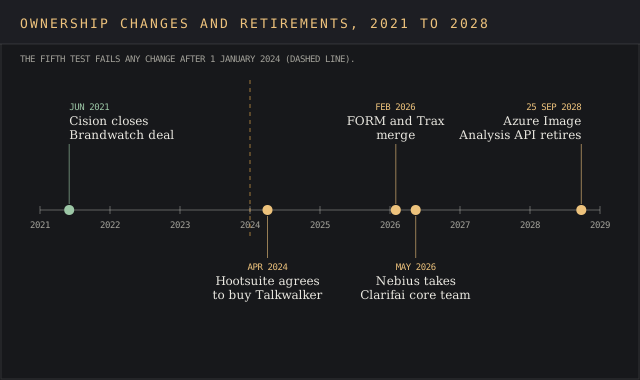
Evaluation criteria for visual intelligence software
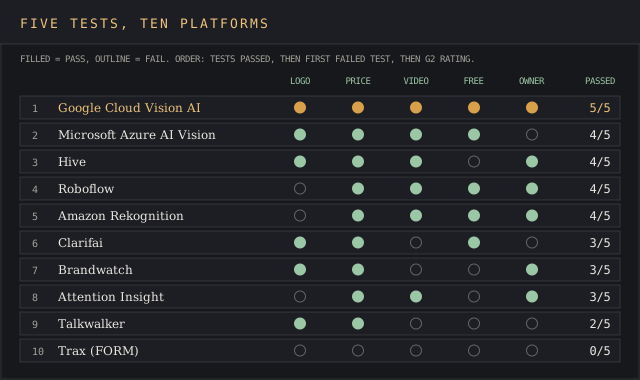
Five criteria decide which visual intelligence software makes the shortlist, and the ranking below applies them in this order. Features listed on vendor sites read alike, so each criterion is a yes or no a buyer can check. Tools rank by tests passed. A tie goes to the tool whose first failed test sits lower on this list, then to the higher G2 rating.
Pretrained brand or logo recognition
Passes when the tool finds logos with no custom training. Hive publishes 11,000+ logos. Rekognition sends brand work to Custom Labels at $4 per inference hour, after the buyer labels photos.
Share of images showing a brand's logo that carry no written mention of the brand, per Brandwatch's logo recognition guide. It's a vendor figure, so test it on 200 of your own tagged posts before it goes in a business case.
A price visible before a sales call
A list price on the vendor's website or a Vendr median counts as a pass. Seven of the ten publish a rate card, Brandwatch and Talkwalker pass on Vendr data, and Trax fails.
Footage analysis with a published rate
Clips need a per-minute, per-second or per-credit price to pass. Rates run from $0.05 a minute for Azure ingestion to $0.50 a minute for Hive's logo model.
A recurring free allowance
A monthly free tier with no sales call passes. Azure's 5,000 transactions a month is five times the 1,000 free units at #1. Hive's $50 credit is a one-time grant, and so is Attention Insight's 14-day trial, so both fail. The devil's in the details, since Rekognition's 1,000 free pictures a month stop after 12 months.
No retirement or ownership change since January 2024
The product passes with no dated retirement and no new owner since 1 January 2024. Azure, Clarifai, Talkwalker and Trax fail it.
Run the same 1,000 of your own photos through the two or three APIs on your shortlist before you sign. The unit count each one bills, and the logos each one misses, show up in the pilot invoice before they show up in a contract.
The 10 best visual intelligence platforms, ranked
Google Cloud Vision AI
Best fit
Teams that want logo, label and text detection from one API with no training step.
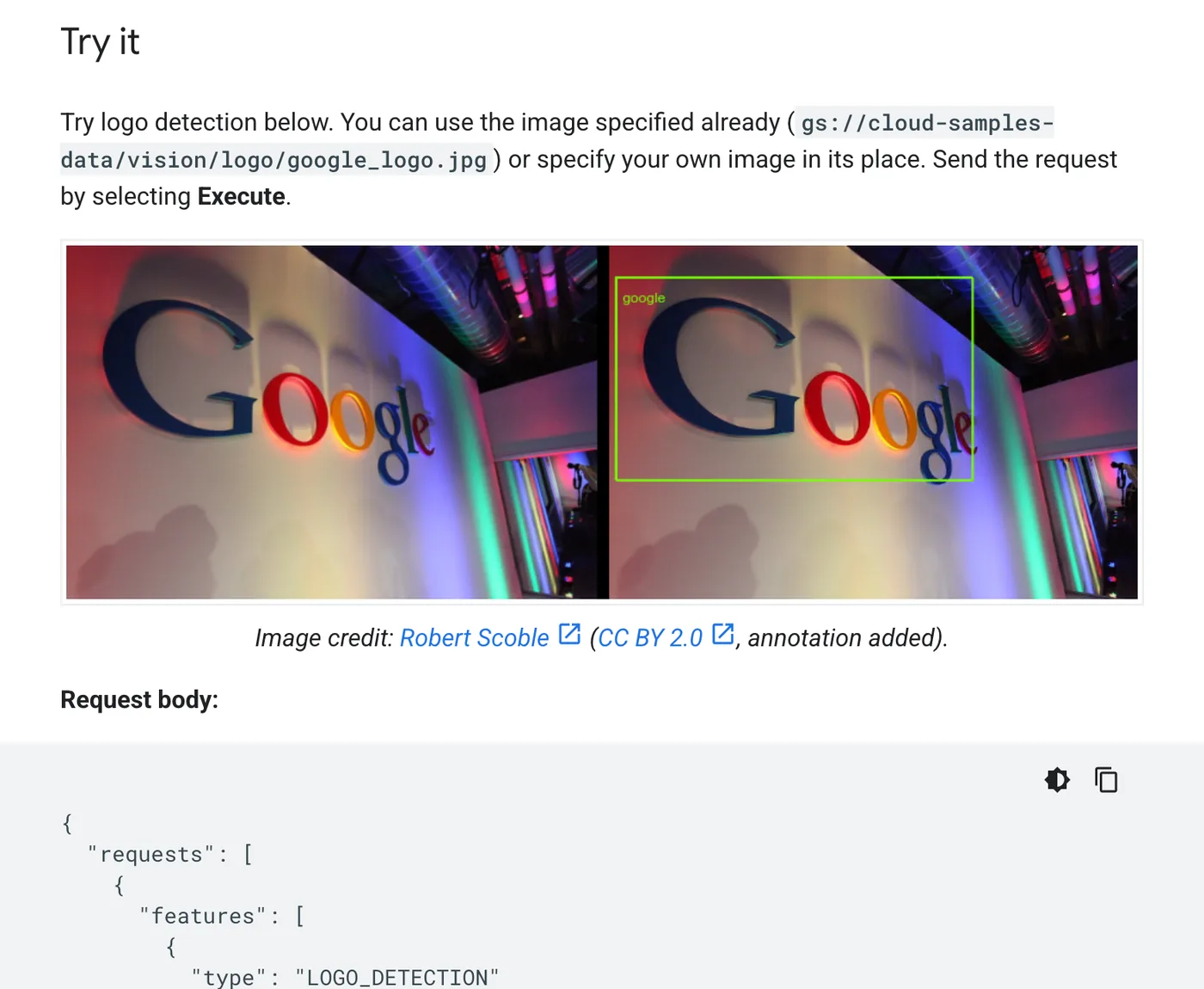
Cloud Vision runs pretrained machine learning models behind 12 separate detectors, each billed per picture. Its docs say logo detection "detects popular product logos within an image", such as the Google sign in the sample photo below. Offline batch requests process up to 2,000 files at once.
Key features
- Logo, label, landmark and celebrity detection on one endpoint
- Object localization at $2.25 per 1,000 units
- Async batch annotation of 2,000 files per request
- Logo recognition in video at $0.15 a minute after 1,000 free minutes
Pricing
The first 1,000 units a month are free. Logo detection then bills $1.50 per 1,000 units up to 5 million and $0.60 above that. One detector on one picture is one unit, so logos plus labels on 100,000 pictures bill 200,000 units.
Pros
- Passes all five tests
- Logo rate drops 60% past 5 million units
- Same account prices video at $0.15 a minute for logos
Cons
- Each extra detector on a picture is a separate billable unit
- Logo catalogue size is undisclosed
- Localization runs 50% above the logo rate
"it gives generous free allowance every month through which one can experiment real photos without worrying about getting a surprise bill"
G2 review, teacher, small business, 28 August 2026. The same reviewer wrote that "the bill can be unpredictable sometimes".
Why it's ranked #1. Cloud Vision passes all five tests. It beats Azure on the fifth, since Microsoft retires its Image Analysis API on 25 September 2028 and the $1.50 logo rate here carries no end date.
Microsoft Azure Image Analysis
Best fit
Microsoft shops that want the lowest brand-detection rate and can migrate before September 2028.
Azure's Image Analysis groups 14 detectors, Brand among them, under one $1 per 1,000 rate. Its migration page retires Image Analysis v3.2 and v4.0 on 25 September 2028 and lists successors for OCR, faces, embeddings and custom models, with Brand missing. Teams building on it go back to the drawing board in 2028.
Key features
- Brand, tag, OCR and landmark detection in Group 1
- Custom classifiers at $20 per training hour
- Clip ingestion for retrieval at $0.05 a minute
- Spatial Analysis on edge cameras at $0.0108 an hour
Pricing
The free F0 tier gives 5,000 transactions a month at 20 per minute. S1 bills Group 1 at $1 per 1,000 up to 1 million, falling to $0.40 past 100 million.
Pros
- $1 per 1,000 sits a third below the $1.50 logo rate at #1
- 5,000 free transactions a month
- OCR commitment tiers from $375 per 500,000 transactions
Cons
- Image Analysis API retires 25 September 2028
- F0 caps throughput at 20 transactions a minute
- Brand detection is missing from the migration table
"Costs can increase quickly with high-volume image processing, and fine-tuning models for domain-specific images is not always straightforward."
G2 review, telecommunications, mid-market, 16 December 2025
Why it's ranked #2. Azure passes four tests at the lowest logo-capable rate here, $1 per 1,000. It beats Hive, which fails the free-allowance test, and loses to the #1 pick on continuity because of the 2028 retirement.
Hive
Best fit
Brand-safety and sponsorship teams that need visual intelligence with a large logo catalogue on pay-as-you-go billing.
Hive's logo model recognizes 11,000+ logos and returns a bounding box, brand class and clarity score per detection. Each detection turns the visual data in an untagged photo into meaningful information a team can analyze. For video, Hive splits the file into frames and recombines the results, and the same artificial intelligence capabilities sell as content moderation at $3 per 1,000 requests.
Key features
- Logo recognition across 11,000+ brands
- Logo and location model at $7 per 1,000 requests
- Logo detection in footage at $0.50 a minute
- Visual content moderation at $3 per 1,000 requests
Pricing
Logo recognition bills $5 per 1,000 requests. The $50+ developer credit comes with strings attached, since it unlocks only after a card goes on file. Moderation stops at 100 requests a day until sales lifts the cap.
Pros
- Largest published logo catalogue among the API vendors
- Clarity score adds the ability to separate a clear logo from a partial one
- Usage billing with no platform fee
Cons
- $5 per 1,000 is 3.3 times the $1.50 logo rate at #1
- Free credit is one-time and needs a card
- Developer moderation throttled at 100 requests a day
Answering a Hacker News thread on detecting abusive pictures on 7 May 2024, user mmcclure reported "quite a bit of success" with Hive: "It's what we use for automated moderation of stream.new."
Why it's ranked #3. Hive passes four tests and publishes the largest logo count here, 11,000+. It beats Roboflow, which ships no pretrained logo model, and trails Azure, whose $1 rate and 5,000 free monthly calls Hive can't match.
Roboflow
Best fit
Teams with their own labeled photos that need a detector for a product or pack no catalogue covers.
Roboflow sells visual intelligence software to create datasets, label, train and deploy a model from scratch. One credit buys 30 minutes of GPU training or 1,000 AI-labeled photos, and self-hosted inference in the buyer's own managed environment is free.
Key features
- Auto labeling at 1,000 photos per credit
- GPU training at 30 minutes per credit
- Serverless CPU streams at 10 hours of footage per credit
- Dataset versions at 20,000 generated files per credit
Pricing
The Public plan is free with 15 credits a month. Core runs $79 a month billed annually or $99 monthly with 50 credits, and extra credits start at $4.
Pros
- 160 G2 reviews at 4.7, the largest sample among API vendors
- 15 free credits and 2 users every month
- Self-hosted inference bills $0
Cons
- Every logo model is trained by the buyer
- Free-plan projects are public on Roboflow Universe
- Credit burn is hard to forecast
"it was not always easy to understand how credits were being consumed across labeling, training, and other operations."
G2 review, business supplies and equipment, mid-market, 15 August 2026
Why it's ranked #4. Roboflow ties Rekognition on four tests and wins the tie on G2 rating, 4.7 against 4.3. It trails Hive because it fails the first test, pretrained logo recognition.
Amazon Rekognition
Best fit
AWS teams that need visual intelligence for labels and faces at scale and will train their own logo model.
Rekognition bills $0.001 per image for the first million and $0.10 a minute for stored clips. For logos, AWS points to Custom Labels, where agencies "can create a custom model specifically trained to detect their client logos and products". Amazon announced a moratorium on police use of its facial recognition on 10 June 2020.
Key features
- Label, face and text detection per photo
- Stored video label detection at $0.10 a minute
- Streaming events at $0.00817 a minute
- Custom Labels for logos and shelf products
Pricing
The 12-month free tier covers 1,000 pictures and 60 minutes a month. Past 35 million images the rate falls to $0.00025. Custom Labels bills $1 per training hour and $4 per inference hour, or $2,920 for a model left running through a 730-hour month.
Pros
- $1 per 1,000 photos matches Azure's entry rate
- 60 free minutes of footage a month in year one
- Volume tiers fall to $0.00025 a photo
Cons
- Logos need a trained Custom Labels model
- Inference bills $4 an hour, idle or busy
- Free tier expires after 12 months
A DevOps engineer on G2 described the generic labels in June 2019: "if given water bottle and soda bottle, it will predict it as a bottle."
Why it's ranked #5. Rekognition passes four tests and loses the tie with Roboflow on G2 rating, 4.3 to 4.7. It beats Clarifai by passing the footage and continuity tests Clarifai fails.
Clarifai
Best fit
Existing Clarifai customers with models in production, reviewing the contract after May 2026.
Clarifai's Logo Detector v2 recognizes 72 logo concepts across automotive, beverages and fashion. On 12 May 2026 Nebius hired Clarifai's core team, founder Matthew Zeiler included, and licensed its inference IP, with the legacy recognition models left out. That's a red flag for anyone signing a multi-year term.
Key features
- Logo Detector v2 with 72 logo concepts
- Pretrained classifiers at $0.0012 per request
- Custom classification models at $0.0032 per request
- Local Runners from the $1 Developer plan
Pricing
Community is free with 1,000 API calls a month at 1 request per second. Essential starts at $30 a month for 30,000 calls, Professional at $300 for 100,000.
Pros
- Pretrained logo model with no training step
- 1,000 free calls every month
- Per-request rates for pretrained and custom models
Cons
- 72 logo concepts against Hive's 11,000+
- Core team moved to Nebius in May 2026
- Footage pricing is missing from the rate card
A developer at an enterprise software company wrote on G2 in August 2026 that "the pricing can become expensive as usage grows, especially for smaller teams or individual developers".
Why it's ranked #6. Clarifai passes three tests and keeps a free 1,000-call tier that Brandwatch lacks. It trails Rekognition, which passes four, after Nebius took Clarifai's core team in May 2026.
Brandwatch
Best fit
Insights teams already on Brandwatch Consumer Research who need logos and scenes found in social images.
Brandwatch launched Image Insights, its visual intelligence feature, on 28 June 2017, and a 2019 update added objects, actions and scenes, classified by machine learning models. Cision has owned it since 1 June 2021.
The full review covers the suite past images, and Brandwatch vs Sprinklr sets its contract terms against its nearest enterprise rival.
Key features
- Logo detection in photos with no text mention of the brand
- Object, action and scene classification since 2019
- Photo results next to text mentions in one dashboard
- Share-of-eye comparison of competitor logos
Pricing
Vendr's anonymized buyer data puts the median at $50,000 a year across 40 purchases, ranging $19,542 to $81,200, with buyers saving 15.29% on average. For logo counts alone, that would cost an arm and a leg next to $148.50 a month for 100,000 photos at the #1 pick.
Pros
- Visual results arrive in the dashboard with zero API code
- 728 G2 reviews at 4.4, the largest sample here
- Same owner since 2021
Cons
- $50,000 Vendr median
- Access starts with an annual contract
- Its "3x more accurate" claim dates from the 2017 launch
"Get your budget ready, but it is worth it. As a market research company, we find in Brandwatch an ally."
G2 review, insights analyst, small business, 26 May 2020
Why it's ranked #7. Brandwatch passes three tests at a $50,000 Vendr median. It loses to Clarifai, which passes the free-tier test, and beats Attention Insight, which has no pretrained brand recognition.
Attention Insight
Best fit
Design and packaging teams testing creative before launch on a monthly card payment.
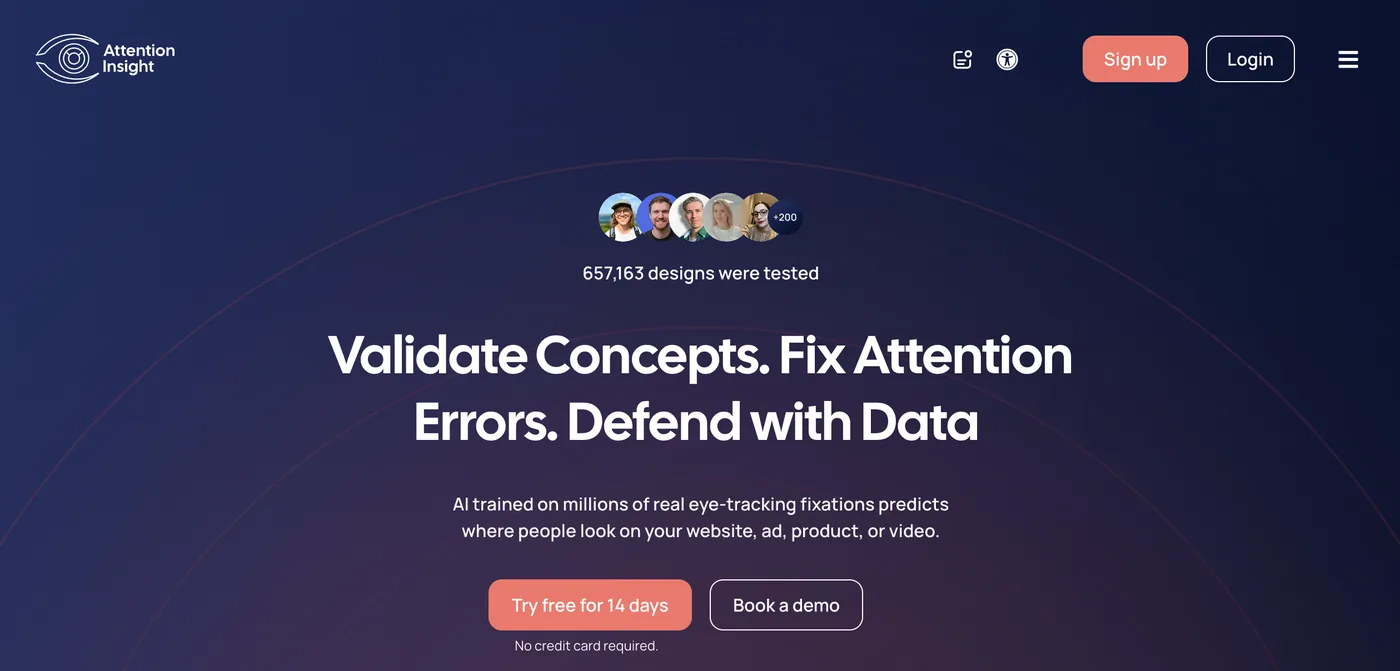
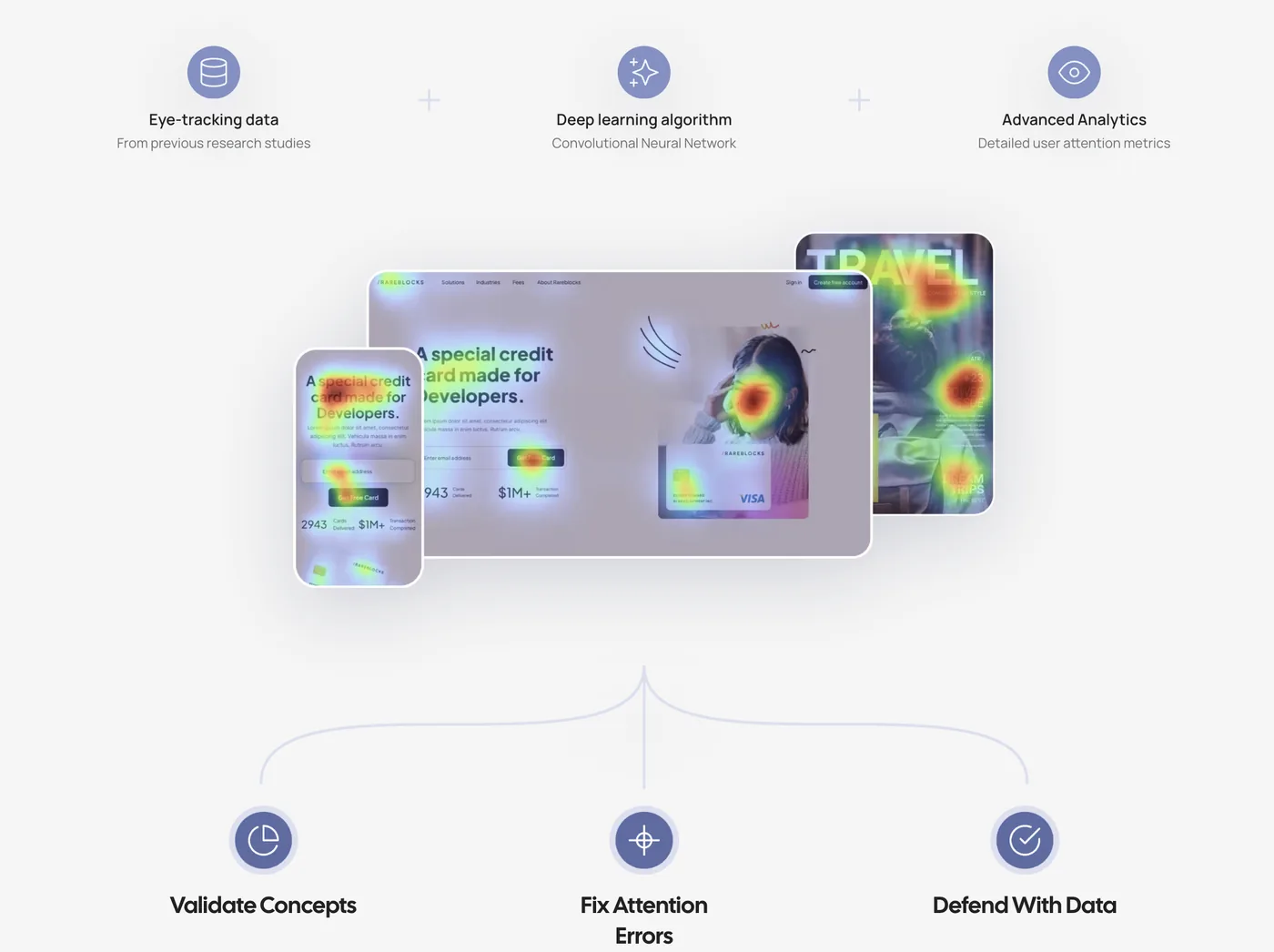
Attention Insight predicts where people look in a picture, clip or web page, using a model its homepage says was "trained on millions of real eye-tracking fixations". The same page claims heatmaps "up to 96% accurate" without human participants, and its counter read 657,163 designs tested on 27 September 2026. It's a different branch of visual intelligence, and competitors' live ads belong in ad intelligence software.
Key features
- Attention heatmaps, Clarity Score and Focus Score
- Clip testing billed per second
- Figma, Chrome, Photoshop and InDesign plugins
- API access at 4 transactions per credit
Pricing
Basic runs $31 a month for 40 credits, Pro $129 for 200 and Hero $324 with fair-use caps of 30 minutes of footage and 3,000 API transactions. One credit covers one design test, annual billing cuts Basic to $24 a month, and a 14-day trial needs no card.
Pros
- 4.8 on G2 from 31 reviews, the highest average here
- Monthly plans from $31 with published credit math
- Plugins run tests inside the design apps where teams create work, such as Figma
Cons
- Predicts attention and leaves logo recognition to other apps
- Free use ends after the 14-day trial
- Prediction stands in for live eye tracking
"As an AI prediction tool, it approximates attention based on visual and cognitive models, so it might not replace actual user testing entirely for nuanced UX challenges."
G2 review, business consultant, marketing and advertising, 22 August 2025
Why it's ranked #8. Attention Insight passes three tests, with published plans from $31 a month. It loses to Brandwatch on pretrained recognition and beats Talkwalker, which passes two tests after its 2024 sale to Hootsuite.
Talkwalker
Best fit
Hootsuite customers and sponsorship teams that need logos found in photos and clips next to social listening.
Talkwalker says the visual database behind its visual intelligence covers 30,000 brands, scenes, objects and products, with 50,000,000+ videos analyzed every day. That catches logos flying under the radar of text-only listening, in photos posted with no caption.
Hootsuite agreed to buy it on 8 April 2024, and it now sells as Lumen by Talkwalker.
Key features
- Logo, packaging and object recognition in photos and video
- Speech-to-text for podcast monitoring
- Sponsorship ROI measured from logo impressions
- Hootsuite Social OS integration
Pricing
Vendr's anonymized buyer data shows a $13,298 median, ranging $12,260 to $15,860 a year. The listing shows no purchase count, and our report on what social listening tools cost reads it as standalone Talkwalker contracts from before the Hootsuite deal.
Pros
- 30,000-item visual database, the largest stated here
- Vendr median at 27% of Brandwatch's
- Photo, footage and audio recognition in one product
Cons
- New owner in April 2024, then a rebrand
- Access starts with a sales-quoted contract
- Monthly and annual data caps
"I use Talkwalker by Hootsuite for landscape and cluster analysis, and brand visibility in earned media."
G2 review, strategic insights manager, 14 April 2026
A public relations reviewer on the same page listed "Limiting monthly/annual data caps" in September 2025.
Why it's ranked #9. Talkwalker passes 2 of 5 tests, pretrained recognition and a $13,298 Vendr median. It loses to Attention Insight's three and beats Trax, which passes none because its models and prices sit behind a sales call.
Trax (FORM)
Best fit
CPG manufacturers auditing shelf execution across hundreds of stores who can fund a trained SKU catalogue.
Trax applies visual intelligence to shelf photos taken by field reps and reports stockouts, pricing compliance and competitor placement, so reps can analyze a store visit before leaving. It lists 80+ markets and 1,000+ customers. FORM and Trax merged under Gemspring Capital in February 2026, and FORM counts 30 of the world's top 50 CPG companies as customers.
Category sales data comes from NielsenIQ or Circana, both in our retail analytics ranking.
Key features
- Shelf photo recognition for SKU verification
- Stockout and distribution-gap detection
- Price and promotion compliance by store location
- AR-guided photo capture in field apps
Pricing
Quote only. Trax prices each contract individually and publishes no rate card.
Pros
- 11B+ items analyzed a year, the largest reported volume here
- 30 of the top 50 CPG companies on the combined customer list
- Field apps cut manual effort on photo upload and sorting
Cons
- Every SKU needs training before recognition works
- Merger integration under way since February 2026
- Puzzle mode can double count shelves
Training the catalogue is easier said than done, per an information systems manager at an enterprise company on G2:
"All the long way to train the AI and set up all the categories and SKUs, it's a long journey"
G2 review, 23 April 2025
A trade marketing director added on 2 May 2025 that "Puzzle mode may double count twice some shelves, creating biases in the dashboard."
Why it's ranked #10. Trax passes none of the five tests, since its models need SKU training and its prices are quoted. It trails Talkwalker, which passes two, and holds a place for its 11B+ items a year.
Types of visual intelligence technology and when each fits
Visual intelligence technology splits five ways, and each type turns unstructured data from photos and clips into structured data a team can query.
- Image recognition APIs (Cloud Vision, Azure, Hive, Rekognition, Clarifai) return labels, logos and coordinates per call for object detection, the key features buyers compare first.
- Custom training platforms (Roboflow) classify objects no catalogue covers, using image classification on a team's own photos.
- Listening suites (Brandwatch, Talkwalker) find logos in social visual content and chart them next to text mentions.
- Attention prediction (Attention Insight, Dragonfly AI) scores the visual elements of a design before it meets the real world.
- Retail execution (Trax) lets CPG teams use visual intelligence to process store audits in large volumes.
Finding a logo in millions of untagged posts is a needle in a haystack for keyword search, and the 80% figure from Brandwatch's guide is the size of that gap by the vendor's own count.
Dragonfly AI says visual intelligence software "uses AI to analyze and predict how people will interact visually with your content", and cites a toothpaste client with "a 7% increase in segment sales". Its explainer names healthcare, retail and e-commerce among the industries using such software. Its plans page is quote-only and its G2 listing has no reviews yet, so it sits outside the ranking.
Emotional, physical and digital signals in research
Outset, an AI-moderated interview platform, applies the term to qualitative research and splits it three ways. Each part reads a different kind of visual input from a study participant:
- Emotional Intelligence reads "facial expressions, tone, and reactions".
- Physical Intelligence observes how people "interact with products, environments, or physical spaces".
- Digital Intelligence analyzes "on-screen behavior, navigation patterns, and digital experiences".
Outset's case against surveys is that traditional methods "rely on what people say", while visual data "captures real behavior and reactions" and "reveals emotional signals that influence decision-making". It runs AI powered analysis on "video responses, screen recordings, and images" in 40+ languages, and its pricing page quotes every plan after a demo.
Read between the lines of that pitch. A facial expression is a signal, and the reading of it is a model's inference, the same limit the G2 reviewer flagged for Attention Insight's heatmaps. That work sits with market research tools and consumer intelligence, where visual inputs serve as a check on self-reported answers in business decision making.
Healthcare, manufacturing, retail and transportation
Intel's computer vision explainer groups its use cases by industry, and four of the groups map to retail, manufacturing, healthcare and transportation buyers.
- Manufacturing: production-line cameras running "AI models for defect classification and anomaly detection" for automated quality control.
- Healthcare: CT scanners, X-ray systems and endoscopy cameras with vision models for "accurate and efficient image evaluation" and "streamlined workflows".
- Retail: store cameras and self-checkout kiosks that send loss-prevention alerts to managers in real time.
- Transportation: city systems that "detect and track vehicles and pedestrians" at intersections, and autonomous driving that tracks pedestrians "as they cross the road".
Hospitals also run anomaly detection on patients. Intel describes remote monitoring cameras that track gait or body position "to identify deviations from established norms" and alert the care team.
Artificial intelligence sold for diagnosis goes through the FDA, which keeps an AI-Enabled Medical Device List of products authorized for US marketing, drawn from radiology, cardiovascular, neurology and pathology panels, among others. Our healthcare market intelligence guide covers the sector's data side.
Gartner's list also carries IBM Maximo Visual Inspection, rated 4.7 from 3 reviews, for quality control on production lines.
Cameras on Waymo's sixth-generation Driver, paired with 4 lidar and 6 radar units that see up to 500 meters, per its August 2024 announcement. Waymo reported nearly 200 million fully autonomous miles in February 2026.
Traffic management and self-driving cars run on live camera feeds, and live feeds bill more per minute than stored files. The Video Intelligence API, Cloud Vision's sister product, charges $0.12 a minute for streaming video labels against $0.10 stored, and Azure prices Spatial Analysis, its people-counting service for security and crowd cameras, at $0.0108 an hour. Real-time market intelligence covers when that premium pays for business data.
Visual analytics features in BI suites
Gartner's visual intelligence list also carries BI suites such as Domo, which sell charts under the same label. A BI suite reads rows from a database, where the ranked tools read pixels, and the split is covered in market intelligence vs business intelligence. Three BI features get marketed as visual intelligence, and each has a price or a date attached.
Anomaly detection on charts
Power BI flags anomalies on line charts with time-series data, needs at least 4 data points, and returns "a natural language explanation of the anomaly" with the contributing factors sorted by strength. Power BI Pro costs $14 per user a month, paid yearly.
ThoughtSpot includes "Automated KPI monitoring, anomaly detection & alerts" in its Essentials plan at $25 per user a month for 5 to 50 users and 25 million rows. Domo's guide describes the mechanism as "Machine learning algorithms continuously monitor data streams and flag unusual patterns that warrant investigation".
Natural language querying
Domo's visual analytics guide gives the example query "show me sales by region for Q3", typed as a sentence and answered as a chart, with natural language processing turning the sentence into a database query. ThoughtSpot lists natural language search on every plan, with published prices of $25 and $50 per user a month for Essentials and Pro.
Microsoft is retiring Power BI Q&A, its older natural language tool, in December 2026, when existing Q&A visuals stop working. Copilot in Power BI replaces it, so a report built on Q&A needs rework before then.
Embedded analytics inside other apps
Microsoft's Power BI Embedded lets developers place "fully interactive reports and dashboards into apps". Its smallest A1 node, 1 virtual core and 3 GB of RAM, bills $1.0081 an hour in Azure's East US region, about $736 for a 730-hour month.
ThoughtSpot's embedded Developer tier is free for a year for up to 10 users, and Domo sells embedding "with full white-labeling and granular access controls". Our business intelligence market report sizes the category these vendors sell into.
Visual intelligence pricing at 100,000 photos a month
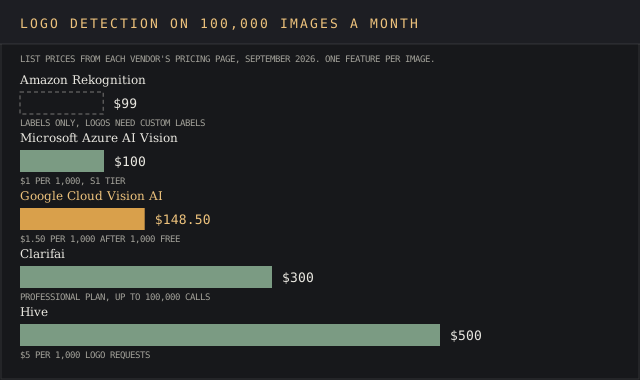
List prices put visual intelligence software for logo detection on 100,000 photos a month between $100 and $500. Azure bills $100 on S1, the #1 pick $148.50 after its free units, Clarifai needs the $300 Professional plan, and Hive charges $500. Rekognition's $99 buys labels only.
Enterprise suites price by contract. Vendr's buyer data shows medians of $13,298 a year for Talkwalker and $50,000 for Brandwatch before the photos to analyze enter the quote.
Billing complaints are par for the course. G2 reviewers of four API vendors ranked here each named price or credit clarity as a main dislike in 2025 and 2026. For example, a pilot that can process 1,000 of your own photos shows the unit count before a contract does and grounds budget decision making.
How to use Visual Intelligence on iPhone
Apple's Visual Intelligence is one of the Apple Intelligence features for the iPhone 15 Pro, iPhone 15 Pro Max and iPhone 16 models or later on iOS 27. Users point the iPhone camera at the real world and get search results, detailed information about a business and actions on text. It exports no business data, so it sits outside the ranking.
Visual Intelligence needs Apple Intelligence, which runs with Siri and the device set to one of 16 supported languages, and Apple says usage limits may apply. Apple lists four ways to use Visual Intelligence from the camera, plus one for anything on screen:
- Camera Control: click and hold the Camera Control on supported models
- Action button: assign Visual Intelligence to the Action button on the left side
- Lock Screen: add the Visual Intelligence control to the Lock Screen
- Control Center: swipe down from the top-right corner and tap the on-screen icon
- Screen: press the side button and volume up together for a screenshot, then use visual intelligence on it
With the camera open, the visual intelligence experience can identify plants and animals, search for similar items, show a restaurant's hours, menu or delivery ordering with a click of the Camera Control, pass a question to ChatGPT through its extension, and create a calendar event from a flyer. Text actions depend on what the camera reads, with options to translate text, summarize a paragraph or act on phone numbers.
The screen mode reads whatever is on the iPhone screen, in any of your apps. After a screenshot, users can create a calendar event, go to the relevant website, tap Read Aloud to hear text read aloud, or swipe a finger over one item to search for it.
Per MBS Direct, the Camera Control button works on every iPhone 16 model except the iPhone 16e, every iPhone 17 model and the iPhone Air. On a 16e, assign Visual Intelligence to the Action button.
The search button runs a Google image search for similar items, a quick product search. The same visual intelligence feature can translate text on a sign, call or message phone numbers, email other contact info in the frame, and read text aloud for users with low vision.
Visual intelligence platforms FAQ
What is a visual intelligence platform?
A visual intelligence platform is software that runs computer vision models on photos and video and returns structured data, such as logos found, objects labeled, shelf products counted or predicted attention, that a team can count and chart.
Which visual intelligence platform is best?
Google Cloud Vision AI ranks first here because it passes all five tests, with logo detection at $1.50 per 1,000 units after 1,000 free a month. Azure is cheaper at $1 per 1,000 until its API retires on 25 September 2028, and Hive has the largest logo catalogue at 11,000+.
How much does visual intelligence software cost?
Logo detection on 100,000 photos a month costs $100 on Azure, $148.50 on Google Cloud Vision, $300 on Clarifai and $500 on Hive at list price. Suites cost more, with Vendr medians of $13,298 a year for Talkwalker and $50,000 for Brandwatch, and Trax quotes every contract.
Which industries use visual intelligence?
Retail, manufacturing, healthcare and transportation all have documented uses, including shelf audits and loss prevention in stores, defect detection on production lines, medical image evaluation and patient monitoring in hospitals, and vehicle and pedestrian tracking for traffic systems and self-driving cars.
What does Visual Intelligence do on iPhone?
Visual Intelligence is an Apple Intelligence feature for the iPhone 15 Pro and iPhone 16 models or later. It identifies plants and animals, searches for similar items, translates and reads text aloud, and creates calendar events from flyers, from the camera or from a screenshot.
How is visual intelligence different from BI visual analytics?
Visual intelligence reads pixels in photos and video. BI visual analytics charts rows from a database and adds anomaly detection, natural language querying and embedded dashboards, as in Power BI from $14 per user a month and ThoughtSpot from $25.
Bottom line
Google Cloud Vision is the default visual intelligence platform for teams that want logos, labels and text from one API, at $1.50 per 1,000 logo units. Azure is cheaper at $1 per 1,000 and carries a 2028 retirement date. Hive wins when catalogue size decides it, at 11,000+ logos.
Custom products go to Roboflow, and AWS teams take Rekognition and train logos themselves. Brandwatch and Talkwalker suit insights teams that use visual intelligence next to social mentions and can sign five-figure contracts. Attention Insight serves designers testing creative, and Trax serves CPG field reps auditing shelves.