ThoughtSpot review: natural language search against the data modeling tax
 By Jan Suski. I go deep on every review, checking every number against its source and digging up details other coverage misses, a habit from six years of SEO and link building for tech companies. Bylines at Surfer, Brand24, and Senuto. How the scoring works.
· Prefer this source on Google
Best for
Teams that already run a governed warehouse (Snowflake, Databricks, BigQuery, Redshift) and have a data engineer to build the model underneath the search bar. G2’s review summary counts 68 mentions of ease of use.
Not for
A small team with no warehouse and no time to model data. G2 reviewers log 24 mentions of a steep learning curve, and one enterprise reviewer reports embedded deployments past $500,000 a year.
What it costs
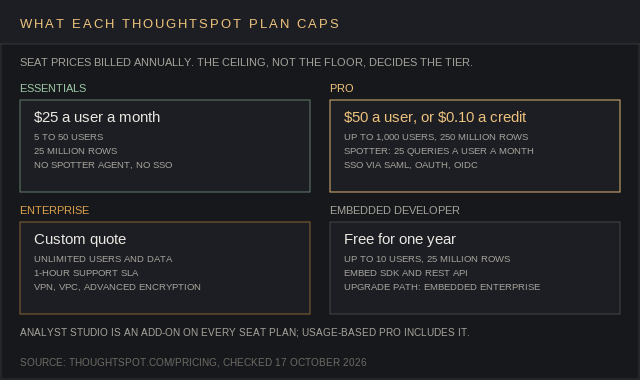
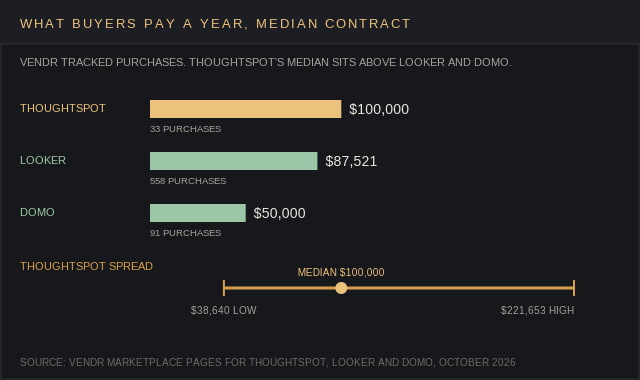
$25 a user a month for Essentials (5 to 50 users), $50 for Pro or $0.10 a credit, and a custom quote for Enterprise, all billed annually. The median buyer pays $100,000 a year across 33 Vendr-tracked purchases.
- Essentials
- $25 a user a month, billed annually; 5 to 50 users, 25 million rows, no Spotter
- Pro
- $50 a user a month; up to 1,000 users, 250 million rows, 25 Spotter queries a user a month
- Pro, usage-based
- From $0.10 a credit, Analyst Studio and unlimited LLM tokens included
- Enterprise
- Custom quote, unlimited users and data; from $3,000 a month for 30 users on AWS Marketplace
- Embedded Developer
- Free for one year, 10 users, 25 million rows
- Vendr median
- $100,000 a year across 33 purchases; range $38,640 to $221,653
- Spotter
- AI analyst on Pro and Enterprise; no metering of LLM tokens
- SpotIQ
- Anomaly detection and alerts on every tier; its runs count as queries on credit plans
- Liveboards
- Dashboards that query the warehouse live on each load
- Analyst Studio
- SQL, Python and R with 70+ spreadsheet formulas; add-on on seat plans
- Free trial
- 14 days
- Founded
- 2012, by Ajeet Singh and Amit Prakash
- Headquarters
- Mountain View, California
- CEO
- Ketan Karkhanis, since September 2024
- Last disclosed round
- $100 million Series F at $4.2 billion, November 2021; $674 million raised in total
- Acquisition
- Mode Analytics, $200 million in cash and equity, June 2023
- G2
- 4.4 out of 5 across 343 reviews
- SoftwareReviews
- 94% positive, +90 Net Emotional Footprint, 40 reviews
- Gartner
- Leader, 2026 Magic Quadrant for Analytics and BI Platforms
- Enterprise accounts
- 35+ customers above $1 million in annual recurring revenue
Tableau
Not forA team of business users who want answers by typing a question, which ThoughtSpot gives once the model exists.
Microsoft Power BI
Not forA buyer who wants search-first exploration without learning DAX, the gap a TrustRadius switcher named.
Pairs well with ThoughtSpot
What ThoughtSpot publishes about itself, and which figures are its own
Plan prices, caps and feature gates come from thoughtspot.com/pricing, read on 17 October 2026; credit rules from the 26.10 consumption pricing documentation; the Enterprise floor from ThoughtSpot’s own AWS Marketplace listing. The Spotter adoption and benchmark figures, the 35+ seven-figure customers and the Gartner placement are ThoughtSpot’s own claims, from its product page and its 1 July 2026 release.
The contract median and range are Vendr’s anonymised buyer data. G2 and SoftwareReviews figures describe those platforms’ own review sets, read in October 2026.
ThoughtSpot is a search driven analytics platform: type a question in plain English, and it runs a live query against your warehouse and draws the chart. This review covers search, data modeling, Spotter, pricing, embedding and four alternatives, so a buyer can price the setup before the first sales call. Its G2 listing now calls the company an agentic analytics platform that lets everyone "ask data questions, get answers, and take action."
ThoughtSpot put all its eggs in one basket in 2012: most business users would type "revenue by region last quarter" before they'd open a report builder, and that bet now ships with an AI agent called Spotter. ThoughtSpot's own comparison pages pitch it against Microsoft, Tableau, Sigma and Domo.
This ThoughtSpot review reads the platform against its own pricing page, its product documentation, its subscription agreement, and quotes from 16 reviewers on G2 and TrustRadius. Vendor case studies are left out: a case study with a customer's name attached is marketing.
It's written for data teams pricing the setup cost of search driven analytics or the embedded analytics track, or ready to analyze data without a ticket queue, and for business leaders reading past the AI claims on the homepage. ThoughtSpot was named a Leader in Gartner's 2026 Magic Quadrant for Analytics and BI Platforms on 1 July 2026, which is why procurement teams sizing up the business intelligence market keep asking about it.
Natural language search: what "ask like Google" means in practice
Type a question and ThoughtSpot returns a chart in seconds. Small teams feel that first: natural language questions replace the ticket queue. For a defined set of natural language queries against a well-modeled dataset, the pitch holds up, and natural language search ships on every tier from Essentials up.
James L., an FP&A manager at a mid-market company, gave the product 3.5 out of 5 on G2 in January 2026 and led with the search bar:
"I love ThoughtSpot for its simple self-serve interface and AI natural language queries, which make it quick and easy for users to get to the right data. It's great because it empowers non-technical users to explore our data, solve problems, and answer their own questions without relying on the BI team."
James L., FP&A manager, G2, 14 January 2026
The same reviewer flagged the cost of that freedom: because users build their own answers and Liveboards, many users end up with "a number of duplicated, inefficient reports."
The limits show up the moment a question needs a custom calculation. Isabelle N., an associate data engineer, wrote on G2 in January 2026: "The formulas don't use SQL or Excel-style formatting, so they're difficult to build, understand, and troubleshoot." A data analyst who already knows SQL learns a second syntax, a bitter pill to swallow for a team fluent in the first.
Spotter keeps corrections across follow up questions, per its product page, but every follow-up still runs against whatever the model exposes.
Data modeling and data teams: the setup tax before self service works
Search driven analytics only searches what's been modeled. A verified user in financial services described the trade on G2 in May 2026: "Much of the functionality is dependent on a good understanding of dimensional modeling of the data without the possibility of doing ad-hoc reporting."
Isabelle N. hit the same wall from the dashboard side: for a Liveboard to carry filters, "the data has to be created as a model." That puts data modeling first on the project plan. The financial services reviewer added that the product's ease of use is "dependent on the quality of the setup."
An engineering employee at a 51 to 200-person IT services firm put the query-time cost bluntly on TrustRadius in August 2025:
"While search is great for simple questions but handling complex calcultions [sic] and joins can be hard and requires backend work. Dashboards and searches can be very slow when working with large databases."
Verified user, engineering, TrustRadius, 29 August 2025
Analyst Studio is ThoughtSpot's answer: a SQL, Python and R workspace with 70+ spreadsheet-style formulas that connects to Snowflake, Databricks, BigQuery, Redshift, PostgreSQL, Excel, Google Sheets and SaaS apps. ThoughtSpot bought Mode Analytics for $200 million in cash and equity in June 2023, citing Mode's "code-first experience." Analyst Studio speeds up the modeling. It doesn't remove it, and there's no cutting corners on the model when every search depends on it.
The setup time lands on data engineering and on the data specialists who know the tables.
Spotter and SpotIQ generate insights from the raw data where it sits in the warehouse without copying it, so access rules set in the model carry through to every answer. ThoughtSpot's homepage headline promises "Trusted Data, Wherever Decisions Get Made"; in practice trusted data means a governed model, built once, that every data question runs against, across all connected data sources.
Spotter, agentic analytics, and where the AI powered claims hold up
Spotter is ThoughtSpot's AI analyst. The product page says it handles multi-step work such as drill-downs, forecasting, change analysis and regression, shows each step, and enforces row- and column-level security at the query engine with audit logs. It runs inside Slack, Microsoft Teams, ThoughtSpot Mobile, Liveboards, Claude and ChatGPT, so the business apps people already have open become the front end.
The same page carries the marketing numbers: "200x" Spotter adoption in a year, a 24-point lead over frontier models on the BIRD benchmark, live queries across "30+ sources." Those are ThoughtSpot's own figures, and no third party has audited them, so the jury's still out.
The pricing page sells the stack as AI powered analytics: AI-powered dashboards, automated change analysis and "Personalized and actionable insights" on every tier. The AWS Marketplace listing names the product ThoughtSpot AI-Powered Analytics outright. Strip the branding and the AI powered insights come from two engines: Spotter, which needs Pro, and SpotIQ, the anomaly detection engine that ships on Essentials as "Automated KPI monitoring, anomaly detection & alerts."
SpotIQ hasn't disappeared under the Spotter brand. ThoughtSpot's 26.10 documentation lists scheduled Liveboards, Monitor and SpotIQ among the jobs that "also trigger queries," and on a credit plan the devil's in the details: every scheduled job spends credits. Microsoft and Domo ship comparable alerting, as the visual intelligence platforms ranking lays out.
What sets ThoughtSpot apart from both on price is one line: it "does not meter or charge for LLM tokens." Bring your own LLM provider, through the Enterprise-only flexible LLM selection, and that provider's fees apply on top.
Liveboards and the end user experience
Liveboards are real time dashboards in the literal sense: every load sends queries to the warehouse, and a Liveboard with several charts "may generate multiple queries." Drilldowns need no pre-defined drill path, allowing users to click from a regional total into a store without an analyst building the path first.
G2's review summary counts 24 mentions of an intuitive interface and 45 of real time insights.
Jai K. described a user friendly interface that still needs training on G2 in September 2023: "ThoughtSpot is designed to be user-friendly, however non-data professionals might need some training."
Every tier ships dynamic, interactive dashboards, and the Visual Embed SDK enables users of a host app to explore data in the same view. The end user who asks the same five questions every week gets the most out of it. The end user who wants a pixel-perfect board for a board meeting gets the least, and that complaint lands next.
Business intelligence and business users: self service analytics in practice
The core promise is fewer tickets to the BI team. A verified user at an enterprise entertainment company documented the number on G2 in November 2025:
"Since deploying ThoughtSpot, the number of analysis requests has dropped by 800%, now averaging just 10 to 15 requests per month. This shift has enabled us to reclaim 70-75% of our business intelligence engineering team's time for more valuable work."
Verified user, entertainment, enterprise, G2, 27 November 2025
A director at a 51 to 200-person IT services firm framed the fit on TrustRadius in September 2025: "ThoughtSpot is extremely well-positioned for any organization willing to drive self-service analytics and empower business users to interact with the reporting or build their own reports."
The word doing the work there is "willing," and the ball is in the data team's court before any business user types a query. Self service analytics here sits on top of a data engineer's finished model, and the 800% drop above came after that model shipped.
A fraud team shows what it looks like when non technical users explore data on their own. A verified user in travel and tourism wrote on G2 in June 2026: "It makes finding data as easy as searching on Google, which means fraud specialists don't have to wait days for data teams to build reports." The same reviewer said new hires hit the ground running, searching for suspicious activity "on day one."
Retail teams follow the same pattern, which is why ThoughtSpot holds the fourth spot in the retail analytics software ranking for teams with a warehouse and a report backlog. For where business intelligence ends and market intelligence begins, the market intelligence vs business intelligence guide draws the line.
Data analysts and data scientists: who still needs SQL
Business users get natural language search. Data analysts and data scientists still do the modeling, the formula work and the troubleshooting, and the learning curve is the elephant in the room: the most cited complaint on G2.
Karli B., a business development manager at an enterprise account, rated it 4 out of 5 on G2 in January 2026 and still wrote:
"I think it's very difficult to learn how to use ThoughtSpot. It takes a long time to really learn it, and I'm still not even close to where I want to be proficiency-wise. The initial setup was confusing, though manageable."
Karli B., business development manager, G2, 27 January 2026
Louis J. rated the product 2.5 out of 5 on G2 in May 2026 and pointed at a specific gap:
"I find the flexibility to transform data very limited and there's no way to stipulate what type of join to use. It would be useful to have more flexibility in visual types and data transformations, similar to a Power Query type layer in Power BI."
Louis J., mid-market, G2, 14 May 2026
That's a data-engineering complaint, and it falls on the team that keeps the models current. The data analysis itself gets faster once the model exists. Building it is the part no search bar shortens.
Pricing: Essentials, Pro, usage-based credits, and Enterprise custom quotes
Two seat prices are published. Essentials costs $25 a user a month, billed annually, for 5 to 50 users and 25 million rows, and it leaves out Spotter and single sign-on. Pro costs $50 a user a month for up to 1,000 users and 250 million rows, with Spotter capped at 25 queries a user a month. Power users who ask more buy the Unlimited Spotter add-on.
Usage based pricing is the second Pro route: from $0.10 a credit, with Analyst Studio and unlimited LLM tokens bundled. ThoughtSpot's documentation says one credit is "usually" consumed per query, and a Liveboard load can fire several.
Small teams on seat plans can model a bill on paper, as with other analytics tools that bill per seat; credit plans need a usage log. Whoever budgets it should count Liveboard loads, scheduled jobs and SpotIQ runs, since all of them spend credits.
Enterprise is where the list stops. Unlimited seats and data, a 1-hour support SLA, VPN and VPC, and advanced data encryption all sit there, at a custom quote. ThoughtSpot's own AWS Marketplace listing shows the floor: Enterprise from $3,000 a month for 30 users on an annual contract.
Vendr's tracked buyers paid a median of $100,000 a year, the top of the business intelligence row in the market intelligence platform pricing report. The ThoughtSpot pricing report breaks down every tier, add-on and contract clause.
The enterprise entertainment reviewer who logged the 800% drop also described what the quote felt like:
"ThoughtSpot's custom-quoted pricing model can be a shock to BI budgets, particularly for those looking to embed or scale the platform, with costs exceeding $500K annually for large-scale deployments. In contrast to Power BI's affordable per-user tiers or Tableau's transparent licensing, ThoughtSpot's pricing can feel unpredictable and may pose a significant barrier for smaller startups and SMBs."
Verified user, entertainment, enterprise, G2, 27 November 2025
Mirza H., a team lead at an enterprise account, kept it shorter on G2 in April 2026: "i believe costly BI tool compared to other BI tools." The same reviewer said the tool was helping them "analyze the spootter [sic] credits utilization." Read between the lines: credits get watched.
To add insult to injury, there's a second bill. Murugan M., a senior data architect, warned on G2 in June 2026 that "heavy ad-hoc querying from business users can quickly scale up cloud compute costs," since every search runs on your Snowflake or BigQuery meter.
Vendr tracks 33 ThoughtSpot purchases at a $100,000 median, with a low of $38,640 and a high of $221,653.
Embedded analytics, integrations, and the data stack
ThoughtSpot Embedded puts Liveboards, charts and Spotter inside another product's interface as embedded dashboards, through the Visual Embed SDK and REST APIs. The Developer plan is free for one year for up to 10 users and 25 million rows. For embedded analytics in production, Embedded Enterprise adds what a SaaS product needs: single sign-on for user authentication via SAML, OAuth and OIDC, a custom company URL, multi-tenancy by organization, and unlimited users.
A principal product manager at a SaaS marketing automation vendor summed it up on TrustRadius in July 2024: "Easy to use for the average business user. Easy to embed into a 3rd party app." Embedded dashboards inherit the host app's styling through custom styles, themes and actions, both listed on the Embedded tiers.
Internal bi and customer-facing embedded analytics share one engine but run on two bills. Embedding Liveboards in internal enterprise applications is an Enterprise add-on on the Analytics side, while customer-facing embedded apps price on the Embedded track by use case. ThoughtSpot's developer docs split the two licences the same way. Internal analytics teams on Pro can't embed at all without moving up.
Underneath, ThoughtSpot runs live data connections to Snowflake, Databricks and Redshift on every tier, and queries run against that warehouse without duplicating it into a separate store. Teams that analyze data across several warehouses connect each of those data sources separately; Spotter reaches 30+ sources, per its product page.
For a SaaS product team, the decision comes down to who signs in. ThoughtSpot Embedded on the free Developer plan has no single sign-on, so embedded dashboards behind a customer login need Embedded Enterprise from day one, and that tier carries a custom quote, like every embedded analytics deal past the free plan. Product teams can't cross that bridge when they come to it; price it before writing a line of embed code.
What users complain about most, and what they praise most
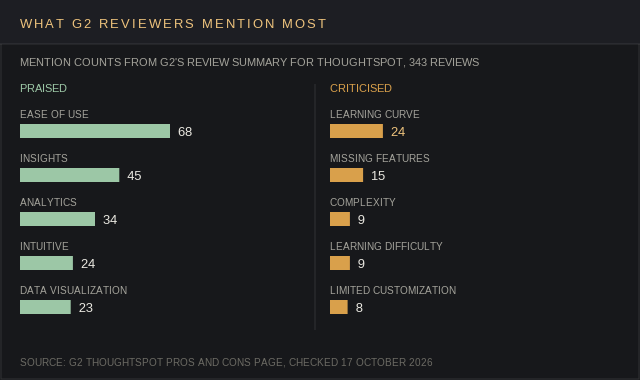
G2's summary of 343 reviews puts numbers on the split: 68 mentions of ease of use and 45 of insights on the praise side; 24 of the learning curve, 15 of missing features and 8 of limited customization on the other. ThoughtSpot users on G2 rate it 4.4 out of 5, and SoftwareReviews reports 94% positive sentiment across 40 reviews, a +90 Net Emotional Footprint.
ThoughtSpot's visualizations draw the sharpest criticism. The entertainment reviewer wrote on G2: "The dashboards lack the refinement and variety found in Tableau's or Power BI's advanced charting capabilities. ThoughtSpot's auto-generated visuals often appear basic and can feel sluggish during in-depth analysis." Dashboard customization limits come up again in the TrustRadius review quoted above, and performance complaints cluster around large datasets in both places.
This ThoughtSpot review reads both lists as one design choice. ThoughtSpot moved the complexity from the query interface into the data model, and which side of that line a reviewer sits on decides which review they write. People who maintain the model write about formulas, joins and setup; the people searching against it write about ease of use.
ThoughtSpot vs. Tableau, Power BI, Looker, and Domo
All four alternatives below price differently and connect to similar data sources, and the business intelligence cost report prices 11 vendors against the same 50-user scenario.
Tableau
Tableau wins on visualization depth and dashboard flexibility, the gap the entertainment reviewer named above, and it ranks in the data analysis tools ranking. It loses on speed to a first answer for a non-analyst. Tableau Cloud Standard lists Creator seats at $75 a user a month, Explorer at $42 and Viewer at $15, billed annually, and every deployment needs at least one Creator.
Prashast Vaish, a decision scientist who chose ThoughtSpot, wrote on TrustRadius's comparison page: "Tableau is indeed better than ThoughtSpot (as of now), but the license for Tableau is expensive. ThoughtSpot integrates BI with AI, which kind of looks like the future."
Microsoft Power BI
Microsoft Power BI wins for a Microsoft shop already on Excel and Azure, at $14 a user a month for Pro and $24 for Premium Per User, paid yearly. That's the cheapest seat here, $11 below ThoughtSpot Essentials. It loses when buyers want search-first exploration without learning DAX.
A verified user who switched wrote on TrustRadius: "I think PBI was terribly slow and clunky. UI was outdated. Solution was expensive for what we needed. ThoughtSpot was worlds different (in a better way)."
Looker
Looker wins on a governed semantic layer for teams already modeling in LookML, at a Vendr median of $87,521 a year across 558 purchases. It loses on time-to-value for non technical staff. A verified user who chose ThoughtSpot wrote on TrustRadius: "ThoughtSpot was much easier from an end-user perspective. Looker and Tableau allowed for more customization and detailed dashboards."
Domo
Domo wins as an all-in-one platform that bundles ETL, visualization and collaboration, at a Vendr median of $50,000 a year, half ThoughtSpot's $100,000. It loses for teams whose data already lives in Snowflake or Databricks, who would pay for ETL and storage they already run; ThoughtSpot queries the warehouse in place. G2 lists Domo at 4.3 out of 5 against ThoughtSpot's 4.4, and Domo and Power BI both sit in the data dashboard tools ranking.
On self service search, the two TrustRadius reviewers who picked ThoughtSpot over Microsoft's BI tool and Looker both put the end user's experience first. Compared with traditional bi tools, ThoughtSpot's trade stays the same across all four: faster answers for the person asking, more modeling for the person building.
G2's ThoughtSpot listing puts Tableau at 4.4 across 4,234 reviews, Power BI at 4.5 across 1,661 and Looker at 4.4 across 1,652, so ratings barely separate the four. The other tools in this group either push that work onto the analyst at query time or bundle it into their own pipeline.
Frequently asked questions
This ThoughtSpot review closes with the questions procurement teams in enterprise environments ask most often.
Is ThoughtSpot better than Tableau?
Neither wins outright. Tableau has deeper visualization and dashboard control; ThoughtSpot answers a plain-English question faster once the data is modeled.
How much does ThoughtSpot cost?
$25 a user a month for Essentials, $50 for Pro or $0.10 a credit, and a custom quote for Enterprise, billed annually. The Embedded Developer plan is free for one year for up to 10 users. The median buyer pays $100,000 a year.
Is ThoughtSpot an AI tool?
It's an analytics platform with an AI driven agent, Spotter, on Pro and Enterprise, and SpotIQ alerts on every tier. The pricing page pitches "search & AI-driven insights on your company data," and the AI driven layer is what Pro adds over Essentials; underneath sits a business intelligence engine querying your warehouse.
Is ThoughtSpot legit?
Yes. It has operated since 2012, holds a Leader spot in Gartner's 2026 Magic Quadrant for Analytics and BI Platforms, reports 35+ customers above $1 million in annual recurring revenue, and holds 4.4 out of 5 on G2 across 343 reviews.
Who competes with ThoughtSpot?
Tableau, Microsoft's BI suite, Looker and Domo among bi tools for internal BI; ThoughtSpot's own comparison pages add Sigma, Omni and Sisense.
Is ThoughtSpot a unicorn?
Yes. Its last disclosed round valued it at $4.2 billion in November 2021, on a $100 million Series F led by March Capital. Contrary Research estimates a $4.4 billion post-money valuation after a July 2023 extension.
Will ThoughtSpot go public?
ThoughtSpot remains privately held, with $674 million raised through its 2021 Series F and no announced listing date.
Is ThoughtSpot an Indian company?
No. ThoughtSpot Inc. was founded in 2012 by Ajeet Singh and Amit Prakash, per Contrary Research, and is headquartered in Mountain View, California. Ketan Karkhanis, formerly head of Salesforce Sales Cloud, became CEO in September 2024, per the dateline on its September 2024 CEO announcement.
How secure is ThoughtSpot?
Its Trust Center lists SOC 1, SOC 2 and SOC 3 reports, ISO 27001, CSA STAR, HIPAA, GDPR and CCPA. Row level security, data encryption and data isolation ship on every Analytics tier; advanced data encryption, VPN and VPC need Enterprise.
What is ThoughtSpot used for?
Self service search over a warehouse: an end user types a question and gets a chart, Liveboards track KPIs, and SaaS vendors embed the same engine in their product. An end user on Essentials gets the same search experience as one on Pro; the seat, row and Spotter limits change.
Verdict
This ThoughtSpot review lands on one buyer for internal BI: a data team that already has a warehouse, the engineering time to model it, and business users who ask the same handful of questions every week. Once that structure exists, the 800% drop in analysis requests one G2 reviewer documented is a realistic target.
It isn't for a team without warehouse infrastructure, or one that needs Tableau-level dashboard polish out of the box. The lowest-rated reviews come from people who skipped the modeling step or needed visual customization the platform doesn't prioritize, and 24 G2 complaints about ramp-up time back them up.
It might suit a mid-sized team on the fence, provided the buyer treats Essentials or the 14-day trial as the real test. At $25 to $50 a user a month, finding out costs little; a stitch in time saves nine. The risk sits in Enterprise and Embedded, where the median Vendr contract is $100,000, one reviewer reports quotes past $500,000, and the subscription agreement lets renewal pricing change on notice with no cap.