Ad intelligence software: 9 platforms ranked for 2026
 By Jan Suski. I go deep on every review, checking every number against its source and digging up details other coverage misses, a habit from six years of SEO and link building for tech companies. Bylines at Surfer, Brand24, and Senuto. How the scoring works.
· Prefer this source on Google
Quick comparison: pricing and coverage across nine ad intelligence platforms
Coverage and price come from each vendor's own pricing page as cited in the entries below; rank reflects the six criteria in the next section.
| Rank | Provider | Coverage figure | Entry price | Best fit |
|---|---|---|---|---|
| 1 | AdClarity | 4 ad channels, 52 geos on Enterprise | $129/mo | Agencies tracking rivals across display, social, video and TV |
| 2 | SocialPeta | 1.7B+ creatives, 80+ countries | Demo only | Teams that need the largest global creative database |
| 3 | Foreplay | 200M+ community ad library | $59/mo | Agencies building competitor swipe files fast |
| 4 | Madgicx | 200,000+ advertisers | In-app spend calculator | Meta and Google advertisers wanting automated fatigue alerts |
| 5 | Motion | Element-level tagging, $50k spend cap on Starter | $250/mo | Teams tying creative elements directly to cost data |
| 6 | MagicBrief | 3,432 creative teams claimed | $99/mo | Small teams wanting a cheap ad-inspiration library |
| 7 | Triple Whale | 482 G2 reviews, 60+ integrations | Free / $179/mo | Ecommerce brands centralizing attribution and creative in one view |
| 8 | BigSpy | 1B+ creatives, 10 ad networks | Free / $69/mo | Agencies wanting the widest network coverage on a flat published price |
| 9 | AdCreative.ai | 793 G2 reviews | $39/mo | Solo marketers generating ad creative without a designer |
Every price above is the vendor's own published starting rate, read 15 August 2026, except SocialPeta and Madgicx, which publish no flat entry price.
Where these figures come from
Pricing and coverage figures are each vendor's own published pricing or product page, or a dated G2 listing, as cited at the point each is used, read 15 August 2026. Madgicx and SocialPeta publish no flat entry price. Madgicx routes every visitor to an in-app spend calculator and SocialPeta to a demo request, so neither row above claims a number those two vendors don't publish themselves.
Ad intelligence platforms pull competitor ad networks, ad placements and creative variations into one dashboard so a marketing team can react before a rival's test finishes running.
Advertising intelligence splits two ways: platforms built to monitor competitors' ad spend and ad creatives across public ad networks, and platforms built to analyze a brand's own creative performance against its own budget. Digital advertising intelligence covers both halves, which is why the eight tools below sit on opposite sides of the category.
This guide ranks eight advertising intelligence tools against six testable criteria, from published pricing to how many ad networks each vendor tracks. Every price, review count and database figure below comes from the vendor's own site or a dated G2 listing, linked at the point it's used. Advertising intelligence tools that gate pricing behind a demo call rank lower on that criterion alone, regardless of database size.
Marketing teams doing both jobs, tracking competitor ads and analyzing their own creative strategies and creative direction, will need separate tools: no vendor in this set does both natively. A media buyer building weekly competitive intelligence reports wants AdClarity or SocialPeta. A creative team optimizing its own creative performance wants Motion, MagicBrief or Triple Whale.
Ad intelligence overlaps two adjacent categories on this site. Competitive intelligence tools cover battlecards and broader competitor tracking beyond ad spend, and social listening tools cover brand mentions and audience sentiment. Buy from whichever framing matches the actual job.
Evaluation criteria for ad intelligence tools
Six criteria decide the shortlist, and the ranking below applies them in this order.
Advertising intelligence matters here because a media buyer's competitor strategy shifts weekly, and strategic thinking about targeting strategies, ad copy and creative themes only pays off if it happens before a rival's flight ends.
Performance marketers watching digital channels for market shifts need competitive awareness and competitor activity data as much as they need raw ad copy examples; competitive monitoring without a plan for budget optimization is just archiving.
Ad network breadth
Channel count shapes creative strategies as much as it shapes tracking depth. A buyer can count how many ad networks a platform tracks live: display, social, video, search, connected TV. AdClarity covers four of those on its Advanced tier; Motion and Madgicx cover two, Meta and one other network, which limits competitive visibility outside those platforms.
Ad network types AdClarity tracks: display, social, video and TV. Motion and Madgicx each cover two, Meta and one other network.
Published entry pricing
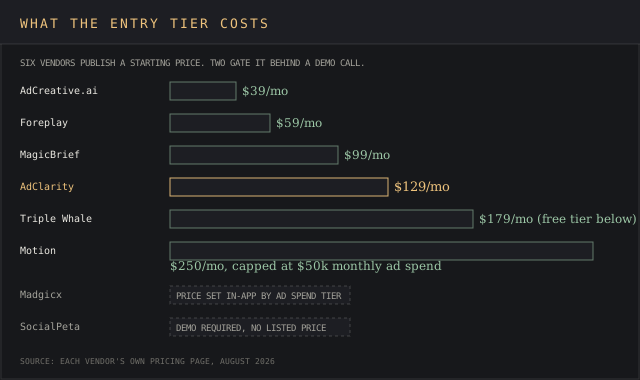
A published starting price beats a number that only appears after a demo call or an in-app spend calculator. Seven of the nine vendors publish one; Madgicx and SocialPeta do not, a gap that shapes budget allocation decisions before a team ever tests the product. Sensor Tower, which sells mobile ad tracking as App Advertising Insights, publishes no price either, per our Sensor Tower pricing report.
Database depth and global markets covered
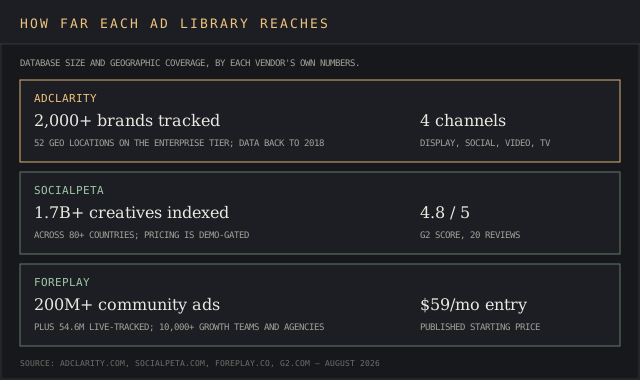
Total creatives indexed and global markets covered are numbers the vendor states outright. SocialPeta's 1.7 billion creatives across 80-plus countries is the largest claim here; Foreplay's 200 million-ad library is second.
Creatives SocialPeta claims across 80-plus countries, the largest indexed database among the nine platforms in this ranking. Foreplay's 200 million-ad library ranks second.
Creative-tagging granularity
Creative analysis is where platforms separate from each other. Some platforms log an ad as one unit. Others tag the headline, the call to action and the hook separately, which is what surfaces top performing creatives by element. Motion's tagging depth is checkable in its own feature list.
Performance tie-in
A platform earns credit here if performance metrics, spend or ROAS live inside the same view as the creative. Triple Whale and Motion both do this natively; MagicBrief's Lite tier does not.
Independent review volume
G2 review count is a number anyone can pull from the public listing, the weakest of the six criteria on its own, since a high count can sit on a generation tool with weak tracking depth. That's exactly what keeps AdCreative.ai at #8 despite carrying the most reviews.
The 9 best ad intelligence platforms, ranked
Ranked on ad network breadth, published pricing, database depth, creative-tagging granularity, performance tie-in and independent review volume, in that order.
AdClarity
Best fit
Agencies and media buyers tracking competitor ad spend across display, social, video and TV in one dashboard.
AdClarity is an ad intelligence platform built for competitive tracking. The Enterprise tier covers 52 geo locations and pulls data back to 2018, with daily updates across every channel tracked, giving a media buyer weekly competitive insights without rebuilding a spreadsheet.
The vendor states it is "trusted by more than 2,000 of the world's leading brands", and the Team plan allows up to 150 custom reports and 10 exports a month.
Key features
- Display, Social and Video ad network tracking from one dashboard, plus a TV Intelligence Suite on Enterprise.
- Historical archive back to 2018 on Enterprise; 3 to 12 months on Basic through Team.
- Up to 150 custom reports and 10 exports a month on the Team plan.
- Daily data refresh across every market and channel tracked.
- Audience insights and CTR analysis bundled into the Enterprise tier.
Pricing
Basic starts at $129 a month for one geo and one channel. Advanced runs $289 for three channels and six months of history. Team is $349 with 12 months of history. Enterprise is custom, adding 52 geos and the TV suite. A 7-day trial covers the core features.
Pros
- Only vendor here tracking four ad network types, including TV, from one account.
- Published pricing at every tier except Enterprise.
- 2,000-plus brands cited as customers, plus daily refresh.
Cons
- Basic limits a buyer to one channel and one geo, short of the platform's real depth.
- Team at $349 is more than 2.5 times Basic for the same single geo.
- One G2 reviewer, a Digital Account Manager, called the data inaccurate for a low-spend sector, writing "a lot of competitors in our sector don't spend apparently", and Heather M., a VP of Strategic Insights, said "the only thing I can even complain about with it is the cost".
"I make no strategic decisions without checking AdClarity."Daniel M., SEM-PPC Specialist, G2, July 27, 2025
Why it's ranked #1. AdClarity tops the list because it's the only platform here publishing a starting price, $129 a month, while tracking four channel types across up to 52 geos; #2 SocialPeta indexes more raw creatives but withholds pricing entirely.
SocialPeta
Best fit
Teams that need the largest global creative database and don't mind a demo call for pricing.
SocialPeta describes itself as an ad intelligence platform with a database of 1.7 billion-plus creatives across 80-plus countries, the largest coverage claim among the nine vendors ranked here, with clients including Tencent, ByteDance, Baidu and miHoYo.
The platform holds a 4.8 out of 5 rating on G2 from 20 reviews, thin next to Foreplay's 126.
Key features
- 1.7 billion-plus indexed creatives spanning mobile, social and display ad platforms.
- Coverage across more than 80 countries and global markets, including major Asian markets.
- No published pricing; every plan requires booking a demo.
Pricing
SocialPeta does not publish tiered pricing; every visitor is routed to "Book A Demo," the gap that keeps it below AdClarity despite the larger database.
Pros
- Largest indexed creative database among the eight platforms compared.
- Strongest global reach at 80-plus countries.
- 4.8/5 G2 rating, tied for the highest here.
Cons
- No published price, unlike six of the seven other vendors here.
- Only 20 G2 reviews, the thinnest base among platforms with any G2 presence.
- One reviewer flagged "the pricing structure could be more unclouded" and occasional lag in data updates.
"It removes a lot of guesswork in creative strategy...which has improved my ad CTR and conversions."Skye A., Marketing Manager, G2, April 7, 2026
Why it's ranked #2. SocialPeta's 1.7 billion indexed creatives across 80-plus countries beat every other archive here, but a 20-review G2 base and demo-gated pricing put it behind AdClarity and ahead of Foreplay's smaller, cheaper library.
Foreplay
Best fit
Agencies building competitor swipe files and creative briefs on a published, mid-market budget.
Foreplay centers on creative analysis. The ad library holds more than 200 million community-curated ads, with live tracking showing 54.6 million-plus monitored, and the vendor says it serves over 10,000 growth teams and agencies.
Reviews put Foreplay at 4.8 out of 5 on G2 across 126 reviews.
Key features
- Swipe File and Discovery tools for pulling competitor ad creatives into one workspace.
- Briefs module for turning saved ads into a creative brief, plus custom reports on tracked spend.
- Spyder tracking on up to 15 brands on the Workflow tier, API access from the entry tier.
Pricing
Basic runs $59 a month ($49 billed annually), plus $20 per added seat. Workflow is $175 for up to 5 users. Agency runs $459 for up to 10 users. Enterprise is custom. A 7-day trial requires a card, with a 14-day money-back guarantee.
Pros
- Published pricing at every tier, unlike SocialPeta or Madgicx.
- 200 million-plus ad library, second largest here behind SocialPeta.
- 4.8/5 G2 score across 126 reviews, API access included from the entry tier.
Cons
- Coverage skews toward Meta and TikTok. AdClarity's tracking spans more channels, including TV.
- Per-seat overage adds $20 a month per user past the included count.
- A Chief Executive Officer reviewer reported a billing dispute, writing the company "double charge[s] you and don't want to pay back, offering to credit the amount instead".
"We've tried many 'alternatives', but nothing reaches the potential that Foreplay offers to us."Kai K., Small-Business, Performance Marketing Agency, G2, May 18, 2024
"They double charge you and don't want to pay back, offering to credit the amount instead."Tobias T., Chief Executive Officer, G2, February 13, 2026
Why it's ranked #3. Foreplay undercuts SocialPeta on published price, $59 a month against a demo-only quote, and serves 10,000-plus teams, but its 200 million-ad library skews toward Meta and TikTok. AdClarity tracks four channels, including TV.
Madgicx
Best fit
Meta and Google advertisers who want automated creative fatigue detection layered on their own ad accounts.
Madgicx automates a brand's own Meta and Google campaigns, closer to a performance-marketing suite with ad intelligence tools layered in than a pure competitive-tracking platform. The vendor says it serves "200,000-plus successful advertisers" globally, the largest customer count claimed by any vendor here.
G2 shows Madgicx at 4.6 out of 5 across 219 reviews.
Key features
- Automated creative-fatigue detection across connected ad accounts.
- Tracking Pro add-on for server-to-server attribution and first party data, priced at $49 a month.
- Pricing calculator scaled to seven ad-spend bands, from under $1,000 to over $30,000 monthly.
Pricing
No flat rate is listed; a buyer enters a spend tier in-app to see the price. A 7-day, no-cost trial is available. Tracking Pro is a separate $49-a-month add-on.
Pros
- 200,000-plus advertisers, the largest customer base among the eight vendors compared.
- Free 7-day trial with a stated results-based extension policy.
- 4.6/5 G2 score across 219 reviews, second-highest review count here.
Cons
- No published flat price; the rate only appears after entering a spend tier in-app, the same gap that dropped SocialPeta two spots.
- Limited to Meta and Google. AdClarity and Foreplay track a wider ad network mix.
- One reviewer described the cancellation process as feeling "like a scam" after an unexpected charge, and another flagged recurring reauthentication issues.
"The creative insights are excellent, making it easy to identify winning ads, spot creative fatigue."Robin B., Director, Enterprise, G2, July 20, 2026
Why it's ranked #4. Madgicx claims the largest customer base of the nine, 200,000-plus advertisers, well ahead of Motion's smaller reported footprint, but it hides pricing behind an in-app spend calculator, the same gap that keeps Foreplay's published $59 rate ranked above it.
Motion
Best fit
Paid social teams that want creative elements, individual ads and not whole campaigns, tied directly to spend and results.
Motion tags creative at the element level, so a headline, a hook or a product shot gets its own performance record. One G2 reviewer, a Senior Marketing Data Analyst, called out "the ability to see the creative file with the results and cost" as the platform's core value.
G2 puts Motion at 4.5 out of 5 across 111 reviews.
Key features
- Element-level tagging that breaks a creative into hooks, formats and other components.
- Native attribution integration with Northbeam and Google Analytics on the Pro plan.
- Unlimited seats and ad accounts on every tier, plus an ad leaderboard ranked by measured performance.
Pricing
Starter runs $250 a month, capped at $50,000 in monthly ad spend. Pro, Growth and Agency are custom-quoted, scaling past $50,000, then $250,000, in spend.
Pros
- Element-level tagging most competitors here don't offer.
- Native Northbeam and Google Analytics attribution links on Pro.
- Unlimited seats at every tier, including Starter.
Cons
- Starter's $50,000 monthly spend cap forces a custom quote once a brand outgrows it.
- Every tier above Starter requires a sales conversation for pricing.
- A Client Services reviewer said the platform "doesn't really help for platforms other than Meta and TikTok", citing gaps on Snapchat, Reddit and Pinterest.
"Quickly surfaces creative insights that would otherwise take a lot of manual analysis."Luke F., Digital Media Strategist, Mid-Market, G2, December 23, 2025
Why it's ranked #5. Motion charges $250 a month, capped at $50,000 in monthly ad spend, and ties element-level creative tags to cost data through native Northbeam and GA links, a feature MagicBrief's $99 Lite tier skips; Madgicx's bigger user base still outranks it.
MagicBrief
Best fit
Small teams that want a cheap ad-inspiration library and a basic brief workflow.
MagicBrief centers on an AI-powered ad-inspiration library and a shared brief editor. The vendor claims it's "used by the best 3,432 creative teams in the world", though only two reviews back that figure on G2.
The Inspire section drew praise from one reviewer for making it "easy to find high performing ad references", while another called the brief tool comparable to a shared document.
Key features
- AI-powered ad-inspiration library sourced from tracked brand activity and creative approaches.
- Modular brief editor, co-pilot dashboard and AI script generation on the Team tier.
- Slack integration and custom attribution windows on Team.
Pricing
Lite runs $99 a month billed yearly, capped at 1 seat, 2 tracked brands, 1 ad account and $25,000 in tracked spend. Team and Creative Intelligence are custom-quoted with the caps removed. A 14-day trial covers the Lite plan only.
Pros
- Cheapest published entry price among the creative-analytics tools compared.
- AI-generated ad-inspiration library plus a Chrome extension for saving ads on the fly.
- 14-day free trial on the entry tier.
Cons
- Only two G2 reviews back the 3,432-team claim, the thinnest evidence base of the eight.
- Lite tier caps out at 2 tracked brands and $25,000 in spend, short of what an agency needs.
- Creative Intelligence, the platform's top tier, is still in beta with limited onboarding spots.
"Inspire section makes it easy to find high performing ad references."Verified User, Furniture Industry, Small-Business, G2, April 16, 2026
Why it's ranked #6. MagicBrief opens at $99 a month for 3,432 claimed creative teams, but only two reviews back that number on G2, the thinnest base of the nine; Motion's $250 tier still beats it on tying spend data directly to the creative.
Triple Whale
Best fit
Ecommerce brands that want attribution, revenue reporting and creative performance inside a single dashboard.
Triple Whale is built first as an ecommerce attribution platform, with creative analytics added as one module. It carries the largest G2 review base of any tool here, 482 reviews at 4.5 out of 5.
The Free plan requires no card and includes Triple Pixel tracking with a 12-month lookback; creative analytics only appears on the $259-a-month Advanced tier.
Key features
- Free tier with Triple Pixel tracking, first and last-click attribution, and a 12-month lookback.
- Creative analytics, cohort analysis and a no-code dashboard builder on Advanced.
- Moby AI assistant and 60-plus integrations bundled into every paid plan.
Pricing
Free costs $0 with 10 users. Starter is $179 a month ($1,790 annually). Advanced, the tier that adds creative analytics, runs $259 a month. Custom starts at $539 a month for brands over $20 million in GMV.
Pros
- Free tier with a full year of data lookback and no card required.
- Largest G2 review base here at 482 reviews.
- 60-plus native integrations and unlimited users on every paid plan.
Cons
- Creative analytics, the feature this ranking is built around, only unlocks on the third-highest tier at $259 a month.
- Custom tier starts at $539 a month, gated to brands over $20 million in GMV.
- An Email Marketing Manager flagged data variance requiring benchmark performance checks against other platforms.
"Triple Whale centralizes all my data in one place and gives me a clear view of performance across different platforms."Nicolas Mauricio A., Customer Acquisition Leader, Small-Business, G2, September 16, 2025
"I dislike that they disregard my cancellation request, overbilling me and threatening me."Laurent P., Small-Business CEO, G2, May 9, 2026
Why it's ranked #7. Triple Whale carries the largest G2 base here, 482 reviews, but its creative-tagging feature sits behind the $259 Advanced tier as an add-on, the reason MagicBrief's dedicated tool still outranks it despite far fewer reviews.
BigSpy
Best fit
Media buyers and agencies who want a wide ad-creative library across ten networks at a flat, published price.
BigSpy tracks competitor ad creative across Facebook, Instagram, TikTok, YouTube, Google Ads, X, Pinterest, Yahoo, Unity and Pangle, with a claimed database of 1 billion ad creatives across 80-plus countries. It holds 652 G2 reviews at 4.6 out of 5, the highest rating of any tool in this ranking.
A Founder on G2 pointed to the research time it saves, saying it "saves me a lot of time when I need inspiration for new campaigns."
Key features
- Creative search and filtering across ten ad networks in 80-plus countries and 26 languages.
- Daily download quotas by tier, from 20 a day on Free up to 3,000 a day on Ultimate.
- Niche and product-research tools built for ecommerce sellers alongside the core ad library.
Pricing
Free costs $0 with 5 searches and 20 downloads a day on Facebook only. Starter is $69 a month for unlimited searches, 50 downloads a day and two platforms. Growth runs $159 a month for 300 downloads a day across seven platforms. Ultimate is $499 a month for 3,000 downloads a day and all ten platforms.
Pros
- Ten named ad platforms tracked, including Facebook, TikTok, YouTube and Google Ads.
- Highest G2 rating here, 4.6 out of 5 across 652 reviews.
- Published, flat pricing starting at $69 a month, plus a usable free tier.
Cons
- Download caps scale with price. Starter buyers get 50 a day and 2 of the 10 platforms.
- A Director on G2 called the interface hard to learn and said it burns through credits fast.
- It has no spend or ROAS estimate tied to any tracked ad, only the creative itself.
"Saves me a lot of time when I need inspiration for new campaigns."Gizem Ece, Founder, Small-Business, G2, May 10, 2026
"I don't find it very intuitive to use and, moreover, it consumes credits quickly."Nicolás S., Director, Small-Business, G2, January 15, 2026
Why it's ranked #8. BigSpy names ten ad platforms in its coverage, from Facebook and TikTok to Unity and Pangle, and posts the highest G2 rating in the set at 4.6. Its 1 billion-creative database still trails SocialPeta's claimed 1.7 billion, and every paid tier caps daily downloads, the reason it sits below the two largest ad libraries in this ranking despite starting at little more than half AdClarity's $129 entry price.
AdCreative.ai
Best fit
Solo marketers and small brands generating ad creative variations without hiring a designer.
AdCreative.ai generates ad creative, placing it furthest from this category's competitive-intelligence core. It carries the most G2 reviews of any platform ranked here, 793 reviews at 4.3 out of 5, and the cheapest published entry price at $39 a month.
One Agency Owner credited the tool with measurable growth opportunities, saying clients using it "often get twice as many clicks as with manually created creatives."
Key features
- AI-generated ad creative variations across image and copy formats.
- Credit-based generation, from 10 monthly credits on Starter to 100 on Ultimate.
- Brand and user limits scaling by tier, plus a custom Enterprise tier for agencies.
Pricing
Starter is $39 a month for 10 credits, 1 brand and 1 user. Professional runs $249 for 50 credits and 10 brands. Ultimate is $999 for 100 credits and 25 brands. All tiers offer 50 percent off annual billing and a 7-day trial with 10 trial credits.
Pros
- Cheapest entry price among all nine platforms, at $39 a month.
- 793 G2 reviews, the highest review count of any tool compared here.
- 50 percent annual discount at every tier, plus a custom Enterprise plan.
Cons
- Doesn't track competitor ad spend, the core job this category is built around.
- One reviewer reported only 30 percent of generated creatives were usable in practice.
- A Small-Business Owner described a billing dispute after a trial conversion, citing two same-day charges totaling roughly €388.
"I don't have to think about my creative process...and I save a lot of money. I also use it for my customers and we often get twice as many clicks as with manually created creatives."Sonja G., Agency Owner, G2, December 19, 2024
Why it's ranked #9. AdCreative.ai starts cheapest at $39 a month and carries the most G2 reviews of the nine, 793, but one reviewer found only 30 percent of its generated creatives usable, the accuracy gap that keeps Triple Whale's tracking-first platform ranked above it.
What an ad intelligence solution delivers
An ad intelligence solution collects competitor ad data across ad networks, then turns it into actionable insights a marketing team can use the same week: which creative formats are gaining share, where ad budgets are concentrating, and which of a brand's own ad creatives are fatiguing.
AdClarity and SocialPeta build competitive intelligence from scraped ad networks like the Meta Ad Library. Motion, MagicBrief and Triple Whale build creative intelligence from a brand's own connected ad platforms instead.
Key benefits split the same way. Competitive-tracking tools deliver competitor activity and trend analysis: what a rival's ad creative performance looks like this week. Creative-analytics tools deliver campaign performance and creative performance tied to a brand's own spend, the primary concern for a growth team optimizing its own budget.
Advertising intelligence sits inside the broader field of marketing intelligence, but narrows the scope to paid media: competitor ads, ad copy and market trends. Digital advertising intelligence tools built for creative analysis feed marketing strategies directly, since a hook that wins on one platform usually informs the next campaign's brief.
The advertising intelligence tools ranked here differ mainly in if that feed starts from a rival's competitor ads or from a brand's own performance data. Advertising intelligence buyers should pick based on which feed their team needs.
Data collection methods and specific platform coverage
Ad intelligence platforms gather data three ways.
- Crawling public ad networks such as the Meta Ad Library and Google Ads.
- Connecting directly to a brand's own ad accounts through the platform's API.
- Scraping publisher and app-store placements.
AdClarity and SocialPeta rely mainly on the first method to monitor competitors' ad spend and analyze competitor ads at scale. Motion, Madgicx and Triple Whale rely on the second, which is why a brand must connect its own accounts before creative performance metrics or performance data appear.
AdClarity's Advanced tier covers three ad network types: Display, Social and Video. The TV Intelligence Suite only unlocks on Enterprise, the fourth channel this ranking counts toward its network-breadth criterion.
Coverage differs by specific platform as much as by method. Foreplay and SocialPeta lean toward Meta and TikTok-heavy social channels. A buyer running Google Ads alongside social should confirm search coverage before signing, since half the platforms in this ranking don't monitor competitors on search at all.
Half the platforms in this ranking don't monitor competitors on search at all. A buyer running Google Ads alongside social needs to confirm search coverage before signing.
Creative formats, ad budgets and campaign planning
Creative analysis, done well, tags formats down to the element. Motion, MagicBrief and Foreplay tag creative formats down to the element: static image, video, carousel, then headline, call to action and hook within each. That granularity surfaces top performing creatives by component, and it's the direct reason one creative rotation outperforms another once ad budgets get reallocated toward it during campaign planning.
AdClarity and SocialPeta instead catalog format and ad placements without connecting to a brand's own performance metrics or user acquisition data. A team that wants both, its own creative approaches tied to spend and a competitive-monitoring view of what rivals run, needs a single ad platform that does both, and none of the eight here does.
Choosing the right ad intelligence tools for a marketing team
Start from what the team does each week. A media buyer building weekly reports on competitor ads and ad placements needs AdClarity or SocialPeta's tracking depth more than Motion's element tagging; a creative team optimizing its own hooks needs the reverse.
Campaign performance tracking only works if the underlying data updates fast enough to matter. Confirm three things before signing.
- If pricing is published, since five of the eight vendors gate it behind a call.
- If the historical archive covers a competitor's seasonal window, given AdClarity's own history runs from 3 months on Basic to 2018 on Enterprise.
- If the channel list covers every network the team buys on, since Motion and Madgicx track Meta and one other network while AdClarity tracks four.
How far back AdClarity's Enterprise tier holds ad history. Basic covers just 3 months, the gap a buyer should confirm before signing if a competitor's seasonal window matters.
Ad intelligence software FAQ
What is advertising intelligence?
Advertising intelligence is the practice of collecting and analyzing competitor ad data, ad spend estimates, marketing intelligence signals and ad creatives across ad platforms to inform a brand's own budget allocation, creative strategies and marketing strategies. The software in this ranking automates that collection and turns it into performance data a team can act on.
Why is advertising intelligence important for digital marketers?
Advertising intelligence replaces guesswork with a documented view of market trends. A team that can monitor competitors shifting spend toward video, or watch its own creative fatigue in a dashboard, adjusts marketing strategies the same week. Teams that wait for the next quarterly review catch the same shift months later.
What is a consumer intelligence platform?
A consumer intelligence platform studies audience behavior across the full scope of marketing intelligence. Ad intelligence tools narrow that scope to advertising specifically, which is what every tool in this ranking covers.
Bottom line
AdClarity wins for any team whose core job is advertising intelligence built from tracking what competitors are spending and running across display, social, video and TV; it's the only platform here that pairs published pricing with four-channel breadth. SocialPeta is the pick when raw database scale, 1.7 billion creatives across 80-plus countries, matters over a published rate for the same advertising intelligence job.
For teams optimizing their own creative, Motion's element-level tagging and Triple Whale's bundled attribution both tie spend to creative more directly than MagicBrief's cheaper, thinner-evidenced tool, and both count as advertising intelligence in the creative-analysis sense even without a competitor database.
AdCreative.ai fits a narrower job, generating creative variations for campaign performance goals fast and cheap, and shouldn't be mistaken for a competitive-tracking replacement despite its review count.