Triple Whale review: the AI operating system for modern ecommerce in 2026
 By Jan Suski. I go deep on every review, checking every number against its source and digging up details other coverage misses, a habit from six years of SEO and link building for tech companies. Bylines at Surfer, Brand24, and Senuto. How the scoring works.
· Prefer this source on Google
Best for
Shopify-primary ecommerce brands that want ad spend, attribution and profit-per-order in one dashboard, and can absorb pricing that rises automatically with GMV.
Not for
Sellers on Etsy, Magento, TikTok Shop, Squarespace or Wix, none of which Triple Whale supports; Putler starts at $20 a month without a GMV penalty.
What it costs
Free covers Triple Pixel and basic attribution. Foundation starts at $219 a month, Automate at $749, both rising with GMV; Enterprise and warehouse sync are quoted.
- Commerce platforms
- Shopify, Amazon, Walmart and Stripe supported; BigCommerce and WooCommerce still labelled beta
- Platform gaps
- No Etsy, Magento, TikTok Shop, Squarespace or Wix; 8 BigCommerce metrics don't match its own definitions
- Integrations
- More than 60 in total, covering ad networks, email and SMS tools and ops software
- Triple Pixel
- First-party cross-device tracking, the measurement base every attribution model builds on
- Attribution models
- Multi-touch, with first-click and last-click comparable side by side on the same spend
- Moby
- Plain-language querying; launched 23 July 2025, Moby 2 generally available 19 May 2026
- Moby Specialists
- Media Buyer, Creative Director and Conversion Optimizer agents still marked Coming Soon
- Cohort analysis
- Groups customers by acquisition date or channel to track order value and repeat purchase over time
- Compass
- Marketing mix modeling, incrementality testing and multi-touch attribution, Enterprise tier only
- Sonar Optimize
- Pushes enriched conversion signals to Meta, Google, TikTok, Reddit and X, on every paid plan
- Sonar Send
- Links anonymous onsite activity to known Klaviyo, Attentive and Omnisend contacts
- Free
- $0: Triple Pixel, first and last-click attribution, Moby Chat, a 12-month lookback and 10 users
- Foundation
- From $219 a month at the lowest GMV band
- Automate
- From $749 a month at the lowest GMV band
- Enterprise
- Quoted by sales, and the only tier carrying Compass
- What moves price
- Gross merchandise volume, keyed to trailing 365-day Shopify order revenue; growth moves a tier automatically
- Higher bands
- Not published as static text on the pricing page
- Retention add-on
- $19 a month, included above Foundation
- Conversion add-on
- $79 a month, included above Foundation
- Data warehouse sync
- Quoted by sales, and not included even on Enterprise
- Stale figure
- The $149 entry price in older articles refers to a retired tier
- Free trial
- None separate; the free plan is the trial and runs indefinitely
- Contract
- 12-month subscriptions billed monthly or annually, two months free on annual, no pausing
- Cancellation
- Fees run until 30 days advance notice; Triple Whale may terminate access immediately
- Attribution export
- Manual CSV only, with the documentation stating no automations are supported
- API
- Public REST API covering data in and out, custom SQL and customer journey attribution
- Warehouse sync
- BigQuery, Snowflake, S3 or GCS; appends without deduplication, history backfilled month by month
- Table exports
- Query results export cleanly; if attribution history ships with them isn't published
- Event volume
- Over 9 billion daily, self-reported; the homepage carries both 9 billion and 9.2 billion
- Security posture
- SOC 2 Type 2 and Type 1, SOC 3, CCPA and GDPR alignment, 24-hour recovery time objective
- Security gaps
- ISO 27001 absent, single sign-on still listed as coming soon on the Enterprise tier
- Data licence
- Perpetual, irrevocable licence over user content including model training, with no published opt-out
- Refunds
- No refund policy published, and liability is capped at $200
- Billing dispute
- A BBB complaint filed 9 May 2026 alleges roughly $9,421 across 12 charges; the BBB rating sits at C+
- Cheaper alternative
- Putler from $20 a month with no revenue penalties
- Review scores
- G2 4.5 from 482, TrustRadius 9.2 from 11, Shopify App Store 4.1 from about 85, Trustpilot 2.7 from 35
Northbeam
Not forA brand under roughly $1.5M a year in ad spend, where the $1,500 monthly floor costs more than the media it is grading.
Polar Analytics
Not forA brand that needs to compare prices without booking a demo, since the GMV bands are not published anywhere.
Pairs well with Triple Whale
Which prices are published, and which figures Triple Whale reports about itself
Plan prices, add-on rates and contract terms above come from Triple Whale's own pricing page, help centre and public terms, read for the 6 August 2026 update to this page.
The 9 billion daily events, the 42% average increase in new customer revenue and the two disagreeing Sonar lift claims are Triple Whale's own numbers, published without sample size or methodology. Review scores come from G2, TrustRadius, the Shopify App Store, Capterra and Trustpilot; the billing figures come from a Better Business Bureau complaint filed on 9 May 2026 that remains listed as unanswered.
Triple Whale is an AI operating system built for modern ecommerce brands that centralizes store data, ad spend and profit metrics into one platform. This Triple Whale review covers what it does, what it costs and where users report friction.
It's written for ecommerce founders, marketers and data teams running paid ads across multiple platforms. One dashboard replaces the ten browser tabs they'd otherwise keep open.
Getting attribution and margin tracking wrong costs real money, and understanding what Triple Whale measures, against what it estimates, matters before a business builds its ad spend decisions around the numbers.
The entry price is no longer $149, and the platform is no longer Shopify-only. Both are corrected in full below.
↑ FACT SHEETWhat Triple Whale's AI operating system is built for
Triple Whale centralizes store data and ad spend for ecommerce brands, pulling revenue, orders and marketing channels into a single command center.
It ties ad spend directly to the customer behavior it produces. Users check the unified dashboard daily, replacing the weekly report they used to wait on.
Founded in May 2021 by AJ Orbach, Ivan Chernykh and Maxx Blank, the company is headquartered at 266 N 5th Street in Columbus, Ohio, with Israeli operations running through a subsidiary.
It raised roughly $52.7 million across three rounds, the last a $25 million Series B announced on 2 February 2023 led by NFX and Elephant with strategic participation from Shopify. No round has been announced since, and no valuation has ever been published.
In January 2026 it moved from raising to buying, acquiring Anteater, an LLM-visibility measurement company, on 20 January for an undisclosed price.
Which ecommerce platforms Triple Whale supports
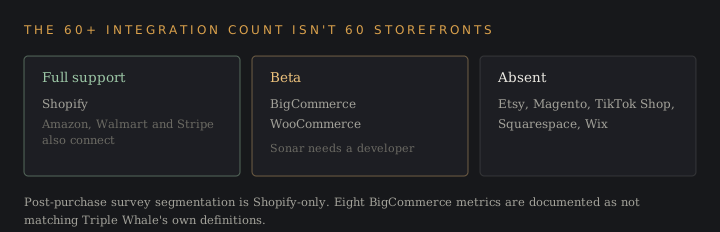
Triple Whale integrates with more than 60 ecommerce and retail platforms, along with ad networks like Meta, Google and TikTok and email tools like Klaviyo and Omnisend.
Read that count carefully. The 60-plus figure covers integrations of every kind: ad platforms, email and SMS tools, and ops software. The list of commerce platforms is much shorter.
Reviewers frequently describe Triple Whale as exclusively designed for Shopify stores and state that it lacks support for platforms like WooCommerce and Etsy. Half of that is now out of date.
Triple Whale announced a beta WooCommerce integration in November 2025 and a BigCommerce integration alongside it, and the onboarding documentation lists all three. Etsy is genuinely absent, as are Magento, TikTok Shop, Squarespace and Wix. Amazon, Walmart and Stripe are present.
The accurate version of the criticism is about depth. Both non-Shopify integrations remain labelled beta in the help centre today, and Sonar setup on BigCommerce and WooCommerce requires developer implementation.
Post-purchase survey segmentation is documented for Shopify stores only, and eight BigCommerce metrics are documented as not matching Triple Whale's own definitions. The marketing pages claim the pixel works on all commerce platforms; the help centre never repeats that claim, which tells you which one to plan around.
Triple Pixel and attribution models
Triple Pixel handles cross-device tracking for customer interactions, acting as the first-party tracking pixel and the measurement foundation the rest of the platform's attribution work builds on.
The platform supports multi-touch attribution and several attribution models, letting a marketer compare first-click and last-click side by side on the same spend. That matters when a business runs ads across Meta, Google and TikTok at once and needs to know which channel drove the order.
Some users report discrepancies against native platform metrics, a complaint common to every attribution tool in this category.
The direction of that discrepancy is contested, which is worth knowing before a demo. A widely shared LinkedIn post from the digitalnoah account argues that "TripleWhale preys on the fact that nobody trusts Meta to grade its own homework," implying inflated credit.
Third-party testing points the other way: Angler AI documents Triple Whale's multi-touch ROAS running lower than Meta's 7-day-click figure. In the actual review corpus the accuracy complaints are narrower than either position, clustering on marketplace orders being counted as tracked conversions.
Attribution tools are best treated as directional aids, since no model perfectly reconstructs a customer's real path to purchase. Teams that want the qualitative half of that picture pair them with a behavior tool like Hotjar.
Triple Whale processes over 9 billion events daily across its connected ad accounts and ecommerce platforms. That figure is self-reported with no published methodology, and the homepage carries it as both 9 billion and 9.2 billion in two places.
Moby agents and AI-driven insights
Moby, Triple Whale's AI layer, lets a marketer query data in plain language, skipping the custom-report step entirely, and surfaces recommendations across creative performance, media spend and customer behavior.
Public launch landed on 23 July 2025, with Moby 2 reaching general availability on 19 May 2026. Its agents can flag when a specific ad set is losing money before a human notices the trend, surfacing the alert directly.
Moby Specialists, the named Media Buyer, Creative Director and Conversion Optimizer agents, are still marked Coming Soon on Triple Whale's own blog. The Moby 2 FAQ page continues to advertise early access more than two months after general availability.
Cohort analysis and marketing mix modeling
Cohort analysis groups customers by acquisition date or channel, so a brand can watch how average order value and repeat purchase rates shift over time. It's the tool for separating one-time discount hunters from customers worth real long-term investment.
Marketing mix modeling adds a layer on top of channel-level attribution, using historical data to estimate how spend in one channel affects sales in another, something single-touch models can't capture. That sits close to the customer intelligence work a growth team already runs.
Compass, the product bundling marketing mix modeling with incrementality testing and multi-touch attribution, sits on the Enterprise tier only.
Sonar Optimize enriches pixel events and pushes conversion signals to Meta, Google, TikTok, Reddit and X. Sonar Send links anonymous onsite activity to known email and SMS contacts so more Klaviyo, Attentive and Omnisend flows fire. Both are included on every paid plan.
Their published lift claims disagree with each other: up to 11% higher ROAS on one page, a 17% average increase in the first 30 days on another.
↑ FACT SHEETTriple Whale pricing
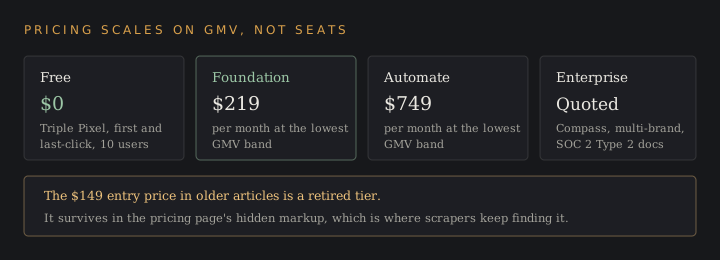
Third-party articles widely state that Triple Whale's pricing starts around $149 per month. That figure is stale, and it keeps circulating because the retired Starter, Growth, Pro and Founders Dash tiers still sit in the pricing page's hidden markup where scrapers find them.
The current structure is Free, Foundation, Automate and Enterprise. Pricing scales on gross merchandise volume, keyed to trailing 365-day Shopify order revenue, and growth moves an account up a tier automatically.
Foundation and Automate start at $219 and $749 per month at the lowest GMV band. Those are entry prices, and higher band prices aren't published as static text.
The free plan, called Founders Dash in the help centre and just Free on the pricing page, covers Triple Pixel, first and last-click attribution, Moby Chat, a 12-month lookback and 10 users, with no card required.
Add-ons price separately: Retention at $19 a month, Conversion at $79, both included above Foundation. Data Warehouse Sync to BigQuery, Snowflake, S3 or GCS is quoted by sales and is not included even on Enterprise.
Putler starts at $20 per month with no revenue penalties, a meaningfully lower entry point for a business wanting basic reporting without the attribution depth. Worth noting that the comparison circulating most widely on this point is published by Putler itself.
↑ FACT SHEETContract, billing and what cancelling involves
Paid plans are 12-month subscriptions billed monthly or annually, with two months free for paying annually. The public terms describe a month-to-month default, then note that separately signed customer terms override it, so the operative contract is the one in the signature file.
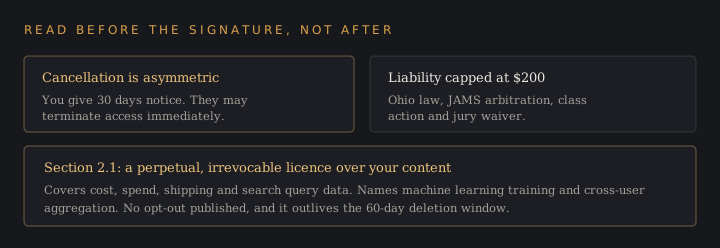
The cancellation clause is asymmetric. Fees continue to be due until the customer gives 30 days advance notice of termination or non-renewal, while Triple Whale may immediately terminate access at any time. Annual contracts cannot be paused.
No refund policy is published. The only refund language in the data processing addendum runs the other way, stating that after termination a customer has no further claims including requests for refunds. Liability is capped at $200.
Billing complaints are the sharpest thing in the review corpus. A Better Business Bureau complaint filed on 9 May 2026 remains listed as unanswered, which is why the BBB rating sits at C+.
It alleges roughly $9,421 across 12 recurring charges, a written cancellation in March 2025 answered with a retention discount, billing restored to $1,379 a month in October 2025 when a representative later put the correct rate at $699, and a duplicate charge of $795.19 never refunded. Triple Whale's response on the record is that the matter was escalated to its legal team.
Ratings and what the low reviews cluster on
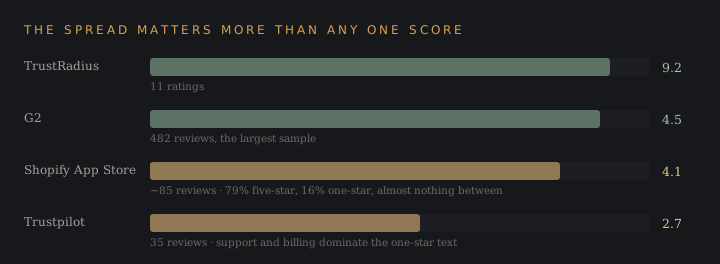
The aggregate scores diverge unusually widely, so the spread carries more signal than any single number. G2 rates Triple Whale 4.5 from 482 reviews, TrustRadius 9.2 from 11 ratings, the Shopify App Store 4.1 from about 85, Capterra 5.0 from a single review with Value for Money at 3.0, and Trustpilot 2.7 from 35.
The Shopify distribution explains the gap: 79% of reviews are five-star and 16% are one-star, with almost nothing in between.
Across all 14 one-star reviews there, the dominant theme is support being unreachable or unhelpful, in eight or nine of them, followed by install and integration failures.
On G2 only six reviews sit at or below 1.5 out of 482, split between attribution accuracy and support. Trustpilot's nine one-star reviews with text follow the same shape, with two naming external marketplace orders showing up as tracked conversions.
Support quality is the most frequent complaint. Billing and contract handling is the one that most often ends in someone leaving.
↑ FACT SHEETWhat the terms let Triple Whale do with your data
This is the clause most buyers never read, and in this category it's unusually broad. Section 2.1 of the terms grants Triple Whale a royalty-free, sublicensable, transferable, perpetual and irrevocable worldwide licence to create derivatives of user content for its own business purposes.
It names the aggregation of data across users, the training of machine learning algorithms, and the development of new products. User content is defined to include cost data, spend data, shipping information and search query inputs.
Two consequences follow. The licence is perpetual, so it outlives the 60-day delete-or-return window the data processing addendum grants on termination, and that window covers personal data processed on a customer's behalf. It doesn't cover derived or aggregated datasets.
And no opt-out from model training, derivative creation or benchmark contribution is published anywhere.
The reassurance Triple Whale does publish points at a different party. Its help centre states that OpenAI does not use Triple Whale customer data to train its models. That commitment binds OpenAI. It does not bind Triple Whale itself.
On security the trust centre lists SOC 2 Type 2, SOC 2 Type 1, SOC 3, CCPA and GDPR alignment, Data Privacy Framework participation, Google Cloud infrastructure and a 24-hour recovery time objective.
ISO 27001 is absent, and single sign-on is still listed as coming soon on the Enterprise tier. Nine sub-processors are published, including the OpenAI and Anthropic APIs, with a 10-day objection window that grants no termination right.
Who Triple Whale is built for
Triple Whale suits businesses with significant paid advertising budgets, since the attribution models, cohort analysis and marketing mix modeling all pay off most when a business is actively testing spend across multiple ad platforms.
Pressed Juicery is one named customer; its director of ecommerce, Daniel Washburn, appears in Triple Whale's own attribution write-ups.
Mid-market brands running several ad accounts get more from it than a small store running one Meta campaign. A business losing money on ad spend it can't explain is exactly the problem the attribution and profit dashboards are built to surface.
Triple Whale reports a 42% average increase in new customer revenue in the 90 days after signup, a self-reported aggregate published without sample size, date range or methodology.
Smaller brands with a single sales channel may find the pricing and depth more than they need. Triple Whale's analytics are limited to ad-driven performance, so a brand whose main question is merchandising is paying for the wrong depth.
Triple Whale for performance marketing teams
Performance marketing teams run ads across several channels at once, and reconciling numbers from each platform against Google Analytics 4 used to mean exporting reports into a spreadsheet by hand.
Triple Whale removes most of that, pulling ad data, conversion rate and revenue from every connected channel into one platform automatically. Consolidation is the practical draw: one login showing spend, revenue and profit for the entire business in place of five.
It also connects to email and SMS tools, so a team can see how a Klaviyo campaign affects the same revenue numbers the ad dashboards report. That breadth is why it positions itself as a command center.
A business running ads on Meta, Google and TikTok at once needs reports that treat all three as one system. The channels view replaces three separate exports with one: paid, organic and email sit side by side, which is the same job the wider digital marketing intelligence category exists to do.
↑ FACT SHEETReports, dashboards and getting data back out
The dashboards are built around a small set of numbers a growth team checks daily: revenue, ad spend, blended ROAS and profit after fees. Building a custom report on top of them takes minutes.
Getting the data out is where expectations need setting. Attribution exports are manual CSV only, with the documentation stating that no automations are supported.
A public REST API covers data in and out, including custom SQL and customer journey attribution. Warehouse sync to BigQuery, Snowflake, S3 or GCS is a paid add-on quoted separately, it appends without deduplication so the customer dedupes, and history has to be backfilled month by month.
Query results over tables export cleanly. Which of the identity graph and computed attribution history comes with them isn't published, and the derivation is described as proprietary.
First-party tracking through Triple Pixel keeps customer data attached to the business as new channels open, and Sonar pushes recommendations back to ad platforms automatically, so nobody rebuilds the same dashboards each time a channel gets added.
Frequently asked questions
Does Triple Whale offer a free trial?
Triple Whale doesn't offer a traditional free trial. It offers a free plan that gives early-stage teams ongoing access to core reporting before upgrading. The help centre still calls it Founders Dash; the pricing page calls it Free.
What is Triple Whale software?
Triple Whale is an AI operating system built for ecommerce brands that centralizes store data, spend, attribution and profit metrics into one platform, with AI agents like Moby for querying data.
What does Triple Whale do on Shopify?
On Shopify it pulls store, order and revenue data into its dashboard, tracks ad spend and attribution across connected platforms, and calculates profit metrics for each order including shipping and transaction fees, so a business can see how its ads perform down to the order level.
Is Triple Whale free?
Not fully, though it offers a free plan with limited features. Paid plans start at $219 per month at the lowest GMV band and scale from there.
How much does Triple Whale cost per month?
Foundation starts at $219 a month and Automate at $749 a month, both at the lowest GMV band, with prices rising as gross merchandise volume grows and Enterprise quoted by sales. The $149 figure in older articles refers to a retired tier.
Is Triple Whale an Israeli company?
Triple Whale has Israeli roots and runs Israeli operations through a subsidiary, though the company is headquartered in Columbus, Ohio.
Did Shopify invest in Triple Whale?
Shopify participated as a strategic investor in the $25 million Series B announced on 2 February 2023, alongside lead investors NFX and Elephant.
Who owns Triple Whale?
Triple Whale is privately held, co-founded by AJ Orbach, Ivan Chernykh and Maxx Blank, backed by investors including NFX, Elephant and Shopify, having raised roughly $53 million in total.
Does Triple Whale train AI models on my data?
Its terms grant a perpetual, irrevocable licence to create derivatives of user content, expressly including training machine learning algorithms and aggregating data across users, covering cost, spend, shipping and search query data. No opt-out is published. Its statement that OpenAI does not train on customer data binds OpenAI. It does not bind Triple Whale itself.
What are the alternatives to Triple Whale?
Alternatives include Putler, which starts at $20 per month with no revenue penalties, along with other ecommerce analytics and attribution tools that trade some of Triple Whale's AI depth for simpler, lower-cost reporting. Shopify Analytics covers the basics at no extra cost for stores already on the platform.