Zoho CRM review: $14 to $52 a seat, free Zia agents, and support that costs 20% more
 By Jan Suski. I go deep on every review, checking every number against its source and digging up details other coverage misses, a habit from six years of SEO and link building for tech companies. Bylines at Surfer, Brand24, and Senuto. How the scoring works.
Best for
Small businesses and sales teams wanting deep customization at $14 to $23 per user per month billed annually, plus founders who fit inside the free edition's 3 users and 5,000 records.
Not for
Teams that need fast human help on the default plan, since Classic support's first response target is 8 hours on weekdays, and buyers who want a CRM that runs on day one without someone who knows the ropes configuring modules, fields and workflow rules.
What it costs
$0 for up to three users. Standard $14, Professional $23, Enterprise $40 and Ultimate $52 per user per month billed annually ($20, $35, $50 and $65 month-to-month), with Premium support adding 20% of the subscription fee.
- Free
- $0 for 3 users
- Standard
- $14 per user per month billed annually, $20 monthly
- Professional
- $23 billed annually, $35 monthly
- Enterprise
- $40 billed annually, $50 monthly
- Ultimate
- $52 billed annually, $65 monthly
- Free trial
- 15 days, no credit card
- Records
- 5,000 on Free, 100,000 on Standard, about 5 million from Professional up
- Custom modules
- 10, 25, 200 and 500 from Standard to Ultimate
- Deal pipelines
- 5, 10, 20 and 50
- API credits a day
- 5,000 on Free, a 50,000 base plus 250 to 2,000 per license on paid editions
- Mass email
- 250, 500, 1,000 and 2,000 a day per org
- Classic support first response
- 8 hours
- Premium support
- 20% of the subscription fee, 3-hour response
- G2
- 4.1 out of 5 from 2,951 ratings
- Capterra
- 4.3 out of 5 from 7,002 ratings
- Headquarters
- Austin, US, with international headquarters in Chennai, India
- Zia Agents, Ask Zia and the writing assistant
- Professional and up
- Zia Agents platform fee
- $0
- Free tokens on Zoho-hosted models
- 30 million a month, then $1 per million
- Zia LLM sizes
- 1.3, 2.6 and 7 billion parameters
Capsule CRM
Not forA team that wants inventory management and CPQ, which Zoho Professional bundles at $23.
Attio
Not forA team scaling past Plus, since Attio Pro at $79 a seat costs more than Zoho Ultimate at $52.
Pairs well with Zoho CRM
Zoho CRM is the sales and customer relationships database from a company called Zoho, which started in 1996 as AdventNet and now sells 55+ business apps. The CRM runs from a free edition for up to three users to an Ultimate edition at $52 per user per month, and Zoho's pricing page says 250,000+ businesses use it.
This review of Zoho CRM covers the key features and the limit that binds each of the five editions, the costs outside the seat price, Zia (the AI sales assistant built into the platform), setup time, customization, integrations, support tiers and five competitors. Every price comes from Zoho's US pages as of October 2026, and every user quote links to the review it came from.
It's written for small businesses and mid-sized sales teams picking the right CRM software, and for current customers weighing an upgrade from Standard to Professional for Zia. Reviews of Zoho on G2, Capterra and TrustRadius describe the same trade. Reviewers credit a lower price per user than most CRMs for a long list of features, and they pay for it with setup time.
The timing matters because Zoho changed its AI stack within 15 months. It launched its own Zia LLM in July 2025, made Zia Agents free with metered tokens, and published four MCP servers for outside AI tools. Customer stories and zoho.com reviews are vendor-published, so every quote here comes from G2 and TrustRadius.
↑ FACT SHEETZoho CRM editions, prices and the limit that binds each one
Zoho CRM offers four paid editions plus a free one, and monthly billing costs 25% to 52% more than annual. The figures below come from Zoho's US pricing page and its edition comparison, last updated 12 May 2026, with local taxes added on top. Annual billing follows the rule that a penny saved is a penny earned, cutting 20% to 34% off the monthly rate.
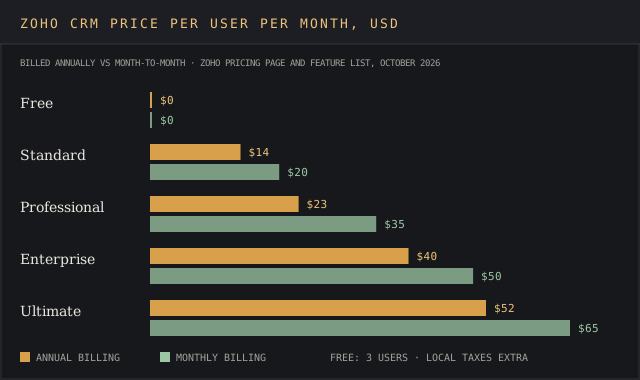
- Free, $0 for up to three users. 5,000 records (10 MB), 1GB of file storage, standard reports and 10 custom email templates, with the default pipeline only.
- Standard, $14 per user billed annually ($20 monthly). 100,000 records, 10 custom modules for data unique to the business, 5 deal pipelines, 100 custom reports, unlimited custom dashboards, sales forecasting and 250 mass emails a day.
- Professional, $23 billed annually ($35 monthly). Brings about 5 million records (10GB), 25 custom modules, 10 pipelines, unlimited reports, 3 Blueprints, inventory management with quotes and invoices, CPQ, customer portals that give customers access to their own records, web-to-case forms that resolve customer issues as support tickets, and the Zia features.
- Enterprise, $40 billed annually ($50 monthly). 200 custom modules, 20 pipelines, 50 Blueprints, the ability to create custom buttons and functions, extended field types such as file uploads and date ranges, a reporting hierarchy that shows each manager only their team's pipeline, a developer sandbox and field-level encryption on 10 fields per module.
- Ultimate, $52 billed annually ($65 monthly). 500 custom modules, 50 pipelines, 100 Blueprints, unlimited API credits and 2,000 mass emails a day.
The record cap binds first on Standard, the plan starting at $14. 100,000 records includes leads, contacts, accounts and deals combined, so a team that imports a purchased list of 60,000 contacts has spent 60% of it in one afternoon. Professional's 10GB holds roughly 50 times as much data as Standard's 200 MB.
Ultimate is the exception. The pricing page's main grid shows Free, Standard, Professional, Enterprise and Bigin Express at $7, and Ultimate appears in the FAQ as an edition "tailored for large-scale, bespoke deployments," with expert consultation and migration assistance, priced at $52 in the edition comparison. Zoho offers Bigin on its own as a lighter CRM suited to teams moving off a spreadsheet.
For a 10-person team, the Zoho CRM cost per year billed annually is $1,680 on Standard, $2,760 on Professional, $4,800 on Enterprise and $6,240 on Ultimate. That sits near the bottom of this site's CRM software cost comparison, where Zoho CRM Standard and Pipedrive Lite tie at $14 as the fourth-cheapest paid seat.
↑ FACT SHEETHow Zoho CRM works for a small business sales team
Zoho CRM works as a set of linked modules. Leads come in through web forms or imports, convert into contacts, accounts and deals, and every call, meeting, email and note lands on the record's timeline, so customer relationships and their history sit in one place. Contact management, deal tracking, tasks and the task list are basic features every edition of the CRM system shares, so the free edition already works as a small business CRM for three people.
A typical day for a rep looks like this:
- Capture leads directly from a web form into the Leads module
- Work the task list, where reps receive reminders for follow ups, tasks, calls and meetings
- Create deals from converted leads and move them across a kanban view of the pipeline, 5 views per module from Standard
- Send emails from Gmail or Outlook inside the CRM, from Standard up
- Merge duplicate contacts with the find-and-merge tool, available on every edition
Accounts hold the companies, contacts hold the people at those companies and clients, and deals hold the money. Each record, from account to contact profile, keeps its notes, emails, calls, deals and next actions on a single timeline, which lets a manager open an account and view every interaction with its clients in one place.
Most CRM software shares that loop. The difference sits in how far you can bend it, and Zoho CRM offers custom fields, modules, layouts and rules so an admin can tailor the system to the way the business sells. Picking the best CRM for a small business usually comes down to that trade between flexibility and setup time. OnePageCRM sits at the low-setup end: each contact carries one dated Next Action, and plans start at $9.95 per user a month.
Standard also includes cadences, which send a scheduled run of follow ups by email, task, call or WhatsApp, with 20 cadences per module and up to 18 follow-ups each, per the edition comparison. Scoring rules rank leads by activity on up to 20 criteria per module on Professional, and data enrichment fills in company size, industry and revenue so reps can keep an eye on the accounts and contacts most likely to close.
Field reps get the same records on the move. Zoho CRM Mobile Edition is included on all five editions and runs on Android and iOS, so contacts, deals and activity history travel with the phone. Zoho CRM supports 28 languages, and multi-currency support grows from 5 currencies on Standard to 50 on Ultimate, which matters for small businesses selling to customers in several countries.
The mobile app is also where some buyers decide. A financial services owner on Capterra, who considered Capsule, HubSpot, Pipedrive and Salesforce before picking Zoho in July 2025, wrote:
"The amount of functionality retained in the mobile app is amazing. It is by far the most useful mobile app out of the many CRMs I have tried."
Capterra, Ron F., Owner, Financial Services, 30 July 2025, 5 out of 5, on the Capterra Zoho CRM reviews page
↑ FACT SHEETWhat Zoho CRM costs beyond the seat price
The seat price is the floor for small businesses and enterprise buyers alike, and six charges can sit on top of it. All six are published on Zoho's own pages, which makes the math easy to check.
- Monthly billing. Teams that prefer it pay 43% more on Standard ($20 against $14) and 52% more on Professional ($35 against $23).
- Extra storage. $4.60 a month per 5GB of file storage and $4 a month per 100MB of data storage, per the edition comparison.
- Data backups. Two a month are free on paid editions, and each extra backup costs $12 a request.
- Support. Premium support costs 20% of the subscription fee and Enterprise support 25% with a 50-license minimum, per the support plans page.
- Lite users. $12 per user billed annually on Enterprise and Ultimate, with a minimum of 25 regular licenses.
- AI tokens. Zia Agents running on Zoho-hosted models cost $1 per million tokens past the free 30 million a month.
A $12 backup is a drop in the bucket next to the billing cycle. A 10-person Professional team on monthly billing with Premium support pays $5,040 a year against $2,760 on annual billing with Classic support. The devil's in the details, since $1,440 of that gap is the monthly premium and $840 is the 20% support fee on the higher base.
Zoho One is the bundle question. It combines 50+ apps, and it changes the math for companies with many users across departments. The all-employee plan costs $37 per employee per month billed annually if the company licenses every employee on payroll, or $90 per user per month on the flexible plan, per Zoho One pricing. A 10-person firm licensing all 10 staff pays $4,440 a year for 50+ apps, less than Zoho CRM Enterprise alone at $4,800.
Price increases and promotional pricing are the sore spot in the low-star reviews on Zoho CRM's G2 page. A consulting firm writing in August 2024 opened with the price changes:
"Where do I start, inflation busting increases, apps that are great on paper but unusable, 3rd grade support."
G2, verified user in consulting, small business, 27 August 2024, 0.5 out of 5
A marketing consultant titled his January 2024 G2 review "Bait and switch pricing" and named a billing dispute as the reason his firm was leaving other Zoho products too:
"Lack of customer support and failure to honor promotional price is why we are winding down use of any other Zoho products as well."
G2, Richard K., Marketing Consultant, small business, 11 January 2024, 0 out of 5
Before you decide on a billing cycle, note that Zoho's pricing FAQ calls the CRM pay-as-you-go, monthly or yearly, with no binding contract, and the two reviews above show the risk when a promised discount goes unhonored.
↑ FACT SHEETIs Zoho CRM free? The free edition and the 15-day trial
Yes, three people get a working CRM with no time limit and no credit card. Zoho CRM offers the free edition with these limits, from the pricing page and the edition comparison:
- 5,000 records across all modules, 10 MB of data
- 1GB of file storage for the organization
- 10 custom email templates and standard reports
- Imports of 1,000 records or contacts per batch, exports up to 10 times a day
- 10 workflow rules per module, 5 of them active
- 5,000 API credits a day
- One kanban view, for the Deals and Activities modules
A founder managing relationships with 400 clients, with follow ups and tasks for each, fits comfortably in the system. A three-person sales team working 8,000 leads hits the record cap in the first month. Email integration, multiple pipelines and custom modules all start on the first paid plan, which makes Standard the minimum for a team that needs email inside the CRM. Those limitations end at $14 per user on Standard.
Paid editions carry a 15-day free trial with no credit card, one day more than the 14 days on Pipedrive's pricing page. A stitch in time saves nine here. Use the trial to import 1,000 real contacts, build one simple pipeline and run one workflow rule end to end, since that's the test that shows how long setup will take.
↑ FACT SHEETZia AI in Zoho CRM: what Zia does, which edition unlocks it, and what it costs
Zia is Zoho's AI assistant across its apps, searched as both Zoho Zia and Zia Zoho, and in Zoho CRM it does three jobs as an AI sales assistant.
It predicts with predictive analytics (lead scores, deal win odds, churn risk, forecasts), it writes (emails, summaries of records and calls), and since 2025 it runs agents that act on CRM data and complete tasks on the platform. Zia can also create modules, workflows and reports from a plain-language prompt on Professional and up, and it can create email drafts and record summaries for tasks and contacts.
Zia features by edition
Zoho CRM's features for generative AI start on Professional, and the key features of Zia sit there too. The edition comparison marks each one:
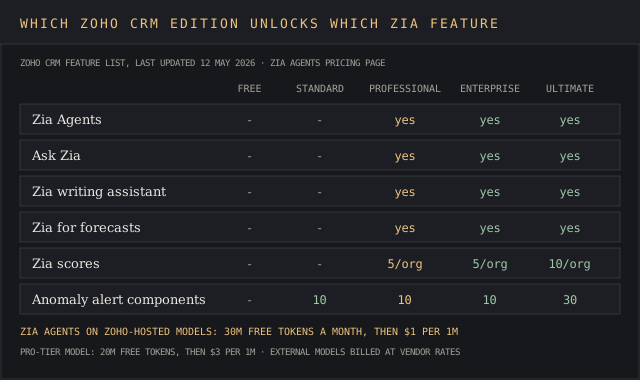
- Zia Agents, Ask Zia (help, actions, insights), Zia module creation and Zia workflow creation: Professional, Enterprise and Ultimate
- Zia writing assistant and Zia presentation: Professional and up
- Zia for forecasts and Zia notifications: Professional and up
- Zia scores: 5 per org on Professional and Enterprise, 10 on Ultimate
- Anomaly alert subscriptions: 10 components on Standard to Enterprise, 30 on Ultimate
Older Zia capabilities sit alongside the generative ones. Zoho's Zia page lists call transcription with sentiment and emotion analysis, Vision AI for image validation and duplicate detection, Voice of the Customer monitoring across channels, data enrichment for missing information, and custom machine learning models through QuickML.
The pricing page adds "extended AI capabilities" on Enterprise, on top of the predictive intelligence in Professional. Small businesses on the fence between the two lower paid tiers should price the step from Standard at $14 to Professional at $23, which is $9 per user per month, or $1,080 a year for 10 users.
Praise from users on Professional tends to focus on the summaries. A key account manager at an IT services firm wrote on G2 in September 2026:
"I really like Zoho CRM's AI feature that summarizes tasks and events, which helps me manage customer and lead data effectively."
G2, Anshul J., Key Account Manager, mid-market, 18 September 2026, 4.5 out of 5
A program and product lead at a small business wrote in May 2026, "I also appreciate their built-in AI tool in the email feature" (G2, Kristina Y., 6 May 2026).
Zia Agents, Zia LLM and the token bill
Zia Agents are free to build and run, and the cost sits in the language model underneath, billed on a usage-based token meter. Zoho's Zia Agents pricing page lists the routes:
- Zoho-hosted models, Standard tier (Qwen 14B, Qwen 3.5 35B MoE, GLM 4.7 Flash): 30 million free tokens a month, then $1 per million
- Zoho-hosted models, Pro tier (GLM 5, on request in the US and India data centers): 20 million free tokens, then $3 per million
- External models: choose OpenAI, Gemini or Claude and bring your own API key, or connect OpenAI through the Zoho Key System, billed at the vendor's token rates
New sign-ups get $5 in credits, and free token limits reset on the 1st of every month. At 1,000 tokens per drafted email, 30 million tokens covers 30,000 follow-up emails a month. An agent that summarizes every inbound call is the case to watch.
The Zia Agents page for Zoho CRM names seven ready-made agents: a sales development rep that qualifies new leads, handles objections and books meetings, a sales coach, a follow-up scheduler, a deal analyzer, a quote generator, a revenue growth specialist that uncovers upsell and cross-sell opportunities, and a deal closure reminder that summarizes a deal three days before its expected close.
Zia LLM is Zoho's own model family. The July 2025 announcement describes three models of 1.3 billion, 2.6 billion and 7 billion parameters, built in-house on NVIDIA hardware, trained for Zoho product use cases such as summarization and code generation, and planned for Zoho's US, India and Europe data centers. The same release says Zoho's AI models are "not trained on consumer data and do not retain customer information."
Admins can audit agents provisioned as digital employees, per the same release, and teams can create their own agents in Agent Studio, which Zoho describes as a no-code builder, and create custom AI buttons that generate content from their own prompts.
That release also listed 25+ prebuilt agents in an Agent Marketplace and 700+ actions in Agent Studio, with general availability expected toward the end of 2025. The agents pricing page, with figures dated September 2026, shows what customers get today.
↑ FACT SHEETSetup, learning curve and the modules-based interface
Zoho CRM organizes everything into modules (Leads, Contacts, Accounts, Deals, Activities, plus up to 500 custom modules), and the learning curve comes from the settings each module carries. Every module includes its own layouts, fields, validation rules, workflow rules and assignment rules, and the edition sets how many of each you get.
The setup process is the main hurdle. New users find the customization options, settings and UI crowded, since reporting tools, automation and every module carry their own configuration screens on the platform. A project manager at an IT services firm wrote on G2 in July 2026:
"While Zoho CRM is feature-rich, the user interface can occasionally feel overwhelming due to the sheer number of settings and options."
G2, Pallavi C., Project Manager, small business, 31 July 2026, 5 out of 5
A maintenance executive at a logistics firm gave Zoho CRM 5 stars on G2 in August 2026 and still named the same problem:
"There are many features and customization options, so it can take some time to understand and set everything up properly. The user interface could also be more intuitive and easier to navigate."
G2, Kartik S., Maintenance executive, small business, 14 August 2026, 5 out of 5
For one human resources team, setup ended the trial. A verified G2 reviewer wrote in June 2026, "The initial setup was very complicated, leading us to cancel it" (G2, 24 June 2026, 1 out of 5). A team that imports contacts into the default modules out of the box can hit the ground running. Teams wanting Blueprints to enforce a sales process and custom modules for their own data should plan a longer build, since that's easier said than done.
Speed is the other recurring complaint. An assistant manager at a financial services firm wrote on G2 in September 2026 that "it takes a lot of time to load and to move to other tabs. Sometimes it becomes very frustrating to message customers in bulk" (G2, Tushar B., 6 September 2026, 4 out of 5).
Zoho sells guidance and training for that. Its Jumpstart and EBS programs cover requirements gathering, system setup and onboarding, the Premium and Enterprise support plans add four 60-minute onboarding sessions, and the pricing page advertises free onboarding plus a migration service for teams that migrate from other CRMs.
↑ FACT SHEETCustomization, workflow automation and reporting
Zoho CRM's features for customization scale with the edition, from 10 custom modules to 500, and they're the main reason customers upgrade to Enterprise. The table below comes from the edition comparison.
| Limit | Standard | Professional | Enterprise | Ultimate |
|---|---|---|---|---|
| Custom modules | 10 | 25 | 200 | 500 |
| Custom fields per team module | 25 | 50 | 300 | 500 |
| Workflow rules per module (active) | 30 (15) | 80 (40) | 125 (75) | 150 |
| Blueprints | none | 3 | 50 | 100 |
| Page layouts per module | none | 1 | 3 | 6 |
| Sandboxes | none | none | 5 | 10 |
Blueprint is Zoho's process builder, and admins create one per process to keep reps on the same page. It forces a deal or lead through defined stages and tracks its progress, with required fields at each transition, and reviewers credit it for keeping a sales process consistent. A co-founder at a small business wrote on G2 in December 2025:
"The Blueprint feature has been especially helpful for standardizing our sales process and making sure leads move through the right stages."
G2, Deepak K., Co-Founder, small business, 29 December 2025, 5 out of 5
Canvas lets an admin customize and design how a record looks, and Zia can build a Canvas view from an uploaded image of the layout you want, per Zoho's generative AI page. Imports run 20,000 records per batch on Standard and 50,000 on Professional, and exports reach 200,000 records per module, so a team that wants to migrate from a spreadsheet or another CRM software system can create its records in bulk.
Workflow automation covers field updates, email alerts, tasks and webhooks from Standard, and Zia suggests automation for repetitive tasks it spots in the system, with webhooks capped at 25,000 calls a day or 100 per user license.
The complexity climbs with the build. A vice president of sales and operations at a small information services firm wrote on G2 in April 2026:
"Once you start building more complex workflows, automation rules, or integrations, the platform can feel a bit fragmented and requires more time and experience to manage properly."
G2, Bill L., Vice President of Sales and Operations, small business, 24 April 2026
Custom buttons, approval processes and custom functions are listed as Enterprise additions on the pricing page, and the daily function-credit pool grows from 15,000 on Standard to 400,000 on Enterprise. Teams that automate repetitive tasks across several apps rely heavily on those functions, and developers write them. Those custom functions are the advanced tools of the platform, and they need someone who can code.
Sandboxes start on Enterprise, with 3 configuration and 2 configuration-and-data sandboxes where changes get tested away from live data. A team on Professional tests every automation and reporting change in the live organization.
Reporting follows the same ladder. Managers can create reports, analytics dashboards and up to 100 report schedules on every paid plan, Standard caps custom reports at 100 and allows unlimited custom dashboards, and Professional lifts reports to unlimited.
Advanced reporting sits on higher tier plans. A technical project manager wrote on G2 in July 2026 that "certain premium capabilities are only available in higher-tier plans" (G2, Muhammed A., 24 July 2026), and a TrustRadius reviewer named the cost: "The advanced reporting features require larger plans, which are costly for small businesses" (TrustRadius, Gerald Coetze, Finance Manager, 28 April 2026).
The same reviewer, on an Enterprise license, praised what the dashboards show once they're built:
"The reporting and sales pipeline dashboards provides clear visibility to deal stages, team performance and helping the managers to take better decisions."
TrustRadius, Gerald Coetze, Finance Manager, Leads Paradise, 28 April 2026, 8 out of 10
For analytics past CRM reporting, Zoho Analytics is a separate product with native CRM sync, built for teams that need charts past the CRM's own dashboards. It ranks ninth in this site's self-service BI tools ranking as the pick for Zoho CRM customers, and its free plan covers 2 users and 10,000 rows, per the business intelligence cost report.
↑ FACT SHEETIntegrations, API calls and the Zoho business tools around the CRM
Zoho lists 1,100+ ready-to-use integrations on its integrations page, across marketing, finance, booking, telephony and document tools. Zoho's own business tools and analytics tools connect on top of that, so the CRM integrates with finance, help desk and analytics apps from the same vendor. The edition decides which:
- Email and calendar: Gmail, Outlook and Zoho Mail, plus Google Calendar and Contacts sync, from Standard
- Calling and messaging: built-in calling with call logging, WhatsApp messaging (credits required), Slack, Zoom and Teams from Standard
- Social: the Social tab for Facebook and X, from Standard
- Finance: Zoho Books, Invoice, Expense, Inventory and Billing from Professional, and QuickBooks on Enterprise to create quotes and invoices from synced records
- Ads: Google Ads from Professional
- Marketing: Zoho Campaigns, a separate product, for campaigns past the CRM's mass-email cap
Telephony tools draw praise from customers who manage deals by phone. A director of business development at a small business wrote on G2 in August 2026:
"The phone API with 3cx integration has been a game changer for us. It automatically syncs our calls, logs customer data and keeps our operations running in one central dashboard."
G2, Tyler Q., Director of Business Development, small business, 27 August 2026, 4.5 out of 5
The ad side gets the opposite verdict. A performance marketing consultant gave Zoho CRM 1 star on G2 in December 2025 and wrote, "The workflow automations often don't make sense and override attribution. It also doesn't intagrate well with relevant platforms like Google Ads" (G2, Efrat S., 17 December 2025).
The API runs on daily credits. Zoho's API limits documentation sets the pool per 24 hours:
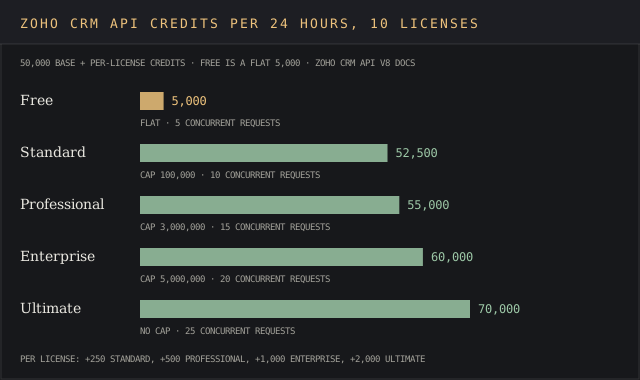
For example, Free gets a flat 5,000 credits. Paid editions start from a 50,000 base and add 250 per license on Standard (hard cap 100,000), 500 on Professional (3,000,000), 1,000 on Enterprise and Zoho One (5,000,000) and 2,000 on Ultimate with no cap. Concurrency runs from 5 simultaneous requests on Free to 25 on Ultimate.
Third party tools and third party services that sync often, such as enrichment and calling tools, take the lion's share of those credits, since every sync of contacts or accounts spends them. This site's data enrichment tools ranking lists several with native pushes to Zoho, and the conversation intelligence software ranking names Zoho among the CRM connections for call recorders.
For AI tools outside Zoho, the Zoho CRM MCP page describes four MCP servers (Data Insights, Data Operations, Modules, and Workflow and Automation) for Cursor, Claude Desktop, VS Code or Windsurf, and an agent "inherits your permissions and nothing beyond that," so API access stays inside the user's role in the organization. The MCP tools list on this site tracks Zoho CRM's server.
↑ FACT SHEETCustomer support: four tiers and what reviewers report
Zoho CRM's customer support depends on the tier you pay for, and the default tier is slow. The support plans page lists four:
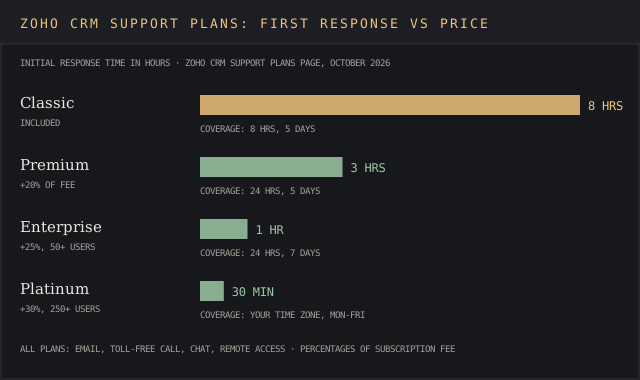
- Classic: included with paid editions, 8 hours a day, 5 days a week, 8-hour first response
- Premium: 20% of the subscription fee, 24 hours a day, 5 days a week, 3-hour first response
- Enterprise: 25% of the annual fee with a 50-license minimum, 24x7, 1-hour first response
- Platinum: 30% of the annual fee with a 250-license minimum, the customer's time zone Monday to Friday, 30-minute first response
Read between the lines of that list, and 24/7 cover appears on the Enterprise plan alone. Every tier offers email, toll-free calls, chat and remote access for support tickets, and sales live chat runs 24x5 per the pricing FAQ. With its 50-license minimum, a 10-person team on the platform can't buy 24/7 support at any price.
Self-serve help sits in the Zoho CRM knowledge base, with articles from Getting Started to Troubleshooting and separate categories for Zia and the mobile app, plus Zoho's community forums.
Support complaints are found in 6 of the 10 most recent critical (1- and 2-star) reviews on G2's filtered list, and several describe generic answers to complex issues. Even a 5-star reviewer, a support engineer, wrote in May 2026 that "Customer support response time can also occasionally be slower than expected" (G2, Suraj B., 15 May 2026). A consulting firm wrote in March 2024:
"Customer support is abysmal and requires significant clarification to the point of diagnosing the solution for them."
G2, verified user in consulting, small business, 19 March 2024, 1.5 out of 5
Capterra's 7,002 ratings average 4.1 for customer service and 4.2 for ease of use, both below the 4.3 overall on the Capterra listing. An 8-hour first response is a red flag for small businesses that close deals by phone, and this site's report on how Capterra collects and moderates reviews explains how far those averages can be read.
↑ FACT SHEETZoho CRM pros and cons from 10,984 ratings
Zoho CRM reviews across three sites add up to 10,984 ratings, with 4.1 out of 5 on G2 from 2,951, 4.3 on Capterra from 7,002, and 8.4 out of 10 on TrustRadius from 1,038. This site's G2 moderation report covers what G2's star averages can and can't show.
Zoho is a jack of all trades across 55+ apps, and the CRM inherits that functionality. The Zoho CRM pros, each tied to a published figure, explain why 250,000+ businesses, by Zoho's count, pick it at a lower price than Salesforce or HubSpot Professional:
- Price per user: $14 on Standard, $11 less than Salesforce Starter Suite's $25, or $1,320 a year at 10 seats
- Customization options: up to 500 custom modules and 500 custom fields per team module
- Contact management, deals and tasks on every edition, the free one included
- Integrations: 1,100+ ready-made, plus Zoho's own 55+ apps
- Inventory management, price books, quotes and invoices inside the CRM from Professional
The cons side of those pros and cons, each also tied to a source:
- Learning curve and crowded settings with many features to configure, named in 2026 G2 reviews
- Classic support's 8-hour first response
- AI, CPQ and Blueprint gated to Professional at $23, the second paid plan
- Switching cost once modules and Blueprints are built
Switching cost is the bitter pill to swallow. A small software company on G2 described staying for one reason in December 2025:
"Honestly, we only still use it because of inertia. If it were not for the large investment of time and money to switch, we would not use Zoho CRM"
G2, verified user in computer software, small business, 16 December 2025, 1.5 out of 5
On value, reviewers who compared Zoho with Google and Microsoft bundles land on Zoho's side, which matters for small businesses buying several tools at once. A go-to-market lead at a market research firm wrote on TrustRadius in December 2025, "I have checked Google Workspace and Microsoft 365. Zoho is the best value for money" (TrustRadius, Nisarg Sutaria, 8 December 2025).
↑ FACT SHEETSecurity, compliance and who owns Zoho
Zoho holds ISO/IEC 27001, 27017, 27018 and 27701 certifications valid through 21 August 2028, plus SOC 2 Type 2, SOC 1 Type 2 and PCI DSS, and lists GDPR, CCPA and HIPAA compliance on its compliance page. HIPAA compliance for health data starts on Standard, and Enterprise adds field-level encryption for extra security on sensitive fields.
The company started as AdventNet in New Jersey in 1996 and took the Zoho name in 2009, and its July 2025 release lists headquarters in Austin, with international headquarters in Chennai, India. The same release describes Zoho as privately held and profitable, with 18,000+ employees and 130 million+ users, and names Mani Vembu as CEO. Those company figures come straight from the horse's mouth, so read them as Zoho's own claims.
Zoho says it has never taken investor money and runs no ad-revenue business on any of its tools, free ones included. It owns the data centers its system runs on, including EU sites in Amsterdam and Dublin listed on the compliance page.
↑ FACT SHEETWhat changed in Zoho CRM in the last 12 months
Most of the change sits in AI and in how the pricing page is laid out. In order:
- 17 July 2025: Zoho announced Zia LLM, Zia Agents with 25+ prebuilt agents, the no-code Agent Studio, an Agent Marketplace and an MCP server, with general availability expected toward the end of 2025.
- 12 May 2026: the last update to the edition comparison, which lists Zia Agents on Professional and up.
- 2 September 2026: the date on the Zia Agents pricing page's cost calculator, which sets agents at $0 and bills Zoho-hosted tokens past 30 million a month at $1 per million.
- October 2026: the CRM pricing grid shows three paid editions plus Bigin Express at $7, with Ultimate in the FAQ and the edition comparison at $52.
↑ FACT SHEETZoho CRM vs alternatives: Capsule, Attio, Pipedrive, HubSpot and Salesforce
Teams that evaluate and review Zoho CRM against other CRM software can pick from the five below, each built for a different buying situation. Compare them on the tier you would buy, starting with the free plans and the information each vendor publishes.
Capsule CRM
Capsule wins for a solo consultant or a team of 2 to 10, which our Capsule CRM review scores 82, since its Free and Starter plans cover one pipeline, tagging and email sync without add-ons. Its free plan is limited to 2 users and 250 contacts, and Starter raises that to 30,000 contacts, per Capsule's pricing page. It loses on breadth, because Zoho Professional bundles inventory management and CPQ, and Zoho Free holds 5,000 records against Capsule Free's 250 contacts.
Attio
Attio wins on free-plan size for startups. It gives 3 seats and 50,000 records, ten times Zoho Free's 5,000, and Plus costs $35 per user billed annually, per Attio's pricing page. It loses on price at scale, since Attio Pro at $79 per user billed annually costs more than Zoho Ultimate at $52. The Attio review covers its seat and object limits.
Pipedrive
Pipedrive matches Zoho at entry and wins on switching cost for teams already on it. Lite costs $14 per seat billed annually, the same as Zoho Standard, and Growth costs $39, per Pipedrive's pricing page. It loses at the middle tier, where Zoho Professional adds AI, inventory and CPQ for $16 less than Pipedrive Growth. One G2 reviewer still on Pipedrive put the deciding factor plainly:
"If the pricing was lower, it would really help us switch from our current service, Pipedrive, to Zoho CRM."
G2, Anshul J., Key Account Manager, mid-market, 18 September 2026, 4.5 out of 5
HubSpot
HubSpot wins on entry price for startups. Starter costs $7 per seat billed annually ($20 monthly), and the free plan covers 2 users, per HubSpot's sales pricing. It loses at the next step, the expensive one, where Professional costs $90 per seat plus a $1,500 onboarding fee, against Zoho Professional at $23, with free onboarding advertised on Zoho's pricing page.
For small businesses that want a lighter tool than either, the folk CRM review covers a CRM with a 14-day trial and no permanent free plan.
Salesforce
Salesforce wins on edition range for large companies, with five published editions from Starter Suite at $25 per user per month to Max at $550, per Salesforce's pricing page. Max costs an arm and a leg next to Zoho Ultimate at $52. Even an unhappy Zoho user ranks Salesforce lower. The 0.5-star G2 reviewer quoted above still wrote, "The CRM is better than Salesforce (just)" (G2, August 2024).
For an overview of per-seat prices across 14 vendors, including sales engagement add-ons on top of a CRM seat, see this site's sales engagement pricing report.
↑ FACT SHEETCommon questions about Zoho CRM
Is Zoho CRM any good?
As a small business CRM, yes, for teams that need customization at an affordable price per user compared with other CRMs. Among the CRM software on this page it's the best CRM on mid-tier price, with Professional at $23 against $35 to $100 for the mid-tier plans of Attio, Pipedrive, HubSpot and Salesforce.
On the three CRM review sites quoted here it scores 4.1 on G2, 4.3 on Capterra and 8.4 out of 10 on TrustRadius, and the recurring complaints are setup complexity and Classic support's 8-hour first response.
How much does Zoho CRM cost per month?
Billed annually, Standard costs $14 per user per month, Professional $23, Enterprise $40 and Ultimate $52. Month-to-month, the same editions cost $20, $35, $50 and $65, and the free edition costs $0 for up to three users.
What AI does Zoho use?
Zoho runs its own Zia LLM (1.3B, 2.6B and 7B parameters) and hosts Qwen and GLM models for Zia Agents. Customers can also connect OpenAI, Gemini or Claude with their own API key, and older Zia tools run predictive analytics for lead scores and forecasts.
Is Zoho a Chinese company?
Zoho Corporation, the software company behind the Zoho CRM platform, is headquartered in Austin, Texas, with international headquarters in Chennai, India, and is privately held.
Is Zia part of Zoho One?
Zoho's API documentation groups Zoho One with Enterprise, and Enterprise includes Ask Zia, Zia Agents and the writing assistant.
Which CRM is better, Zoho or Salesforce?
Zoho is the choice on price, since Zoho's Enterprise plan at $40 costs less than half of Salesforce Pro Suite at $100. Salesforce is the choice on edition range, from Starter Suite at $25 to Max at $550 per user.
↑ FACT SHEETVerdict
Zoho CRM is a good fit for small businesses and sales teams wanting a customizable CRM system and platform at $14 to $23 per user, and for founders who fit inside 3 users and 5,000 records for free. The 78 for a solo founder rests on that free edition, and the 84 for integration depth rests on 1,100+ integrations, four MCP servers and API pools that reach 5,000,000 credits a day on Enterprise.
It's a poor fit for teams that need fast human support without paying extra. Classic support's 8-hour first response earns the 38, and 24x7 cover starts at a 50-license minimum. Teams with no admin time should look elsewhere too. The 42 for learning curve rests on the 2026 G2 reviews quoted above that name crowded settings and setup complexity, and on the team that cancelled.
It might suit a mid-sized team weighing Enterprise at $40 that's willing to bite the bullet on setup, with caveats. The 64 for enterprise fit reflects 200 custom modules, sandboxes and ISO 27001 against a support model that needs Premium at 20% extra for a 3-hour response. The 86 for price transparency holds because Zoho publishes every edition, storage rate and support percentage.