CRM statistics for 2026: a $128 billion software market used by 28.51% of EU firms
 By Jan Suski. I go deep on every review, checking every number against its source and digging up details other coverage misses, a habit from six years of SEO and link building for tech companies. Bylines at Surfer, Brand24, and Senuto. How the scoring works.
The numbers CRM software market, checked 14 October 2026
CRM is the biggest single slice of business software sold as a service: 51.4% of 2024 SaaS application revenue, against 20.2% for ERP.
The number-one vendor holds a fifth of the crm market, and its share slipped from 20.7% in 2024 to 20.0% in 2025.
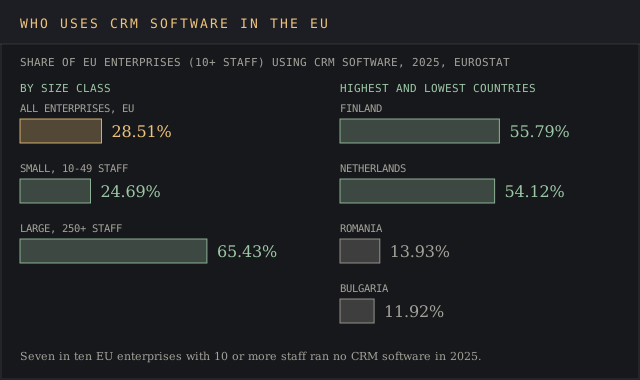
Seven in ten EU enterprises with 10 or more staff ran no CRM software in 2025, so the growth runway sits with smaller companies.
CRM vendors and consultancies quote the $128 billion market in every deck. Send the segment or the country and I'll source a version you own.
CRM software earned its vendors $128 billion in 2024, up 13.4% in a year, according to Gartner's market share study published 11 June 2025. On the buying side, Eurostat counted 28.51% of EU enterprises with 10 or more staff using customer relationship management software in 2025. Large firms run their customer relationships through it at 65.43%, and small firms at 24.69%.
This report collects CRM statistics on market size, adoption by company size and country, vendor scale, AI agents, data quality and return on investment. Every figure links to the body that published it: Gartner, IDC, Eurostat, the vendors' own filings and named research houses. One section names where the market-size houses disagree, and another traces the recycled numbers that fill most CRM stats roundups back to the year they were first printed.
It's written for sales and revenue operations leads, analysts sizing the crm industry, and buyers who want CRM facts and customer relationship management facts they can cite in a budget memo. Pricing per seat lives on our separate CRM software cost report; this page covers how big the market is, who uses it and what the evidence says it returns.
Customer relationship management market size: $79.6 billion to $128 billion, depending on the house
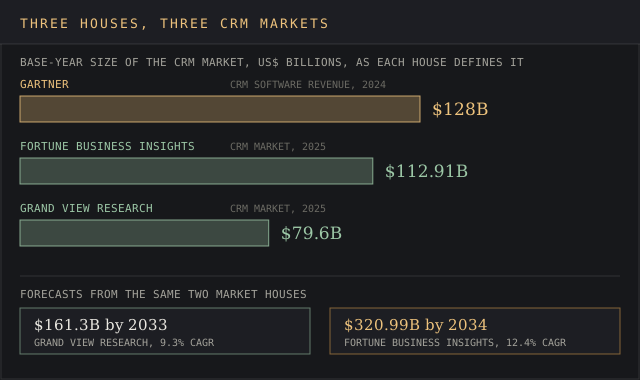
Three houses publish a base-year figure for the global crm market, and their CRM statistics land $48.4 billion apart. Gartner's number is vendor software revenue for calendar 2024. Fortune Business Insights and Grand View Research both size calendar 2025 and project it forward.
Copy these lines into an email, fill them in and send. I reply with scope and a price within 2 to 3 business days.
Open the email| House | Base-year size | Forecast | Growth rate | Published |
|---|---|---|---|---|
| Gartner | $128B (2024) | None in the abstract | 13.4% (2023 to 2024) | 11 June 2025 |
| Fortune Business Insights | $112.91B (2025) | $320.99B by 2034 | 12.4% CAGR, 2026 to 2034 | Updated 28 Sep 2026 |
| Grand View Research | $79.6B (2025) | $161.3B by 2033 | 9.3% CAGR, 2026 to 2033 | June 2026, updated Sep 2026 |
| Market.us (AI in CRM only) | $4.1B (2023) | $48.4B by 2033 | 28% CAGR, 2024 to 2033 | May 2024 |
Fortune Business Insights puts the 2026 market at $126.17 billion, which is where the "$126.2 billion in 2026" line on most roundups comes from. Grand View's own 2026 estimate is $86.4 billion. Same year, $39.8 billion apart, which is par for the course when two houses draw the market's edges differently.
Gartner's 2025 edition, published 12 May 2026, carries no headline number in its public abstract. It says the CRM software market "grew strongly in 2025 but remained highly fragmented," which squares with IDC's tracker showing the top vendor losing 0.7 points of share that year. In a fragmented crm market, the other 80% is split across the rest of the crm platforms IDC tracks.
Why the published CRM market estimates diverge
Each house measures a different slice, and the devil's in the details of each scope note. The gaps come from four places:
- What counts as revenue. Fortune Business Insights splits its market into components and gives software 63.84% of 2026, so roughly a third of its total is services. Gartner's figure is software revenue.
- Which products count as CRM. Gartner's study is titled Customer Experience and Relationship Management and reports a cross-CRM segment growing 17.7%, so its scope runs past the sales pipeline.
- Base year. Gartner reports 2024 vendor revenue. Both market-research houses size 2025.
- Growth assumptions. A 12.4% compound annual growth rate doubles a market in about six years; 9.3% takes about eight. Stack that on a $39.8 billion gap in the 2026 starting point, and the two forecasts, a year apart in horizon, end $159.69 billion apart.
Treat any single global crm market figure as one house's market sizing definition, and every forecast here as a model output, far from set in stone. When a roundup quotes $126.2 billion for 2026 next to $79.6 billion for 2025, it has stitched two houses together, and the implied 58% one-year jump is an artifact of the stitching.
CRM adoption statistics: how many businesses use a CRM system
The cleanest measure of businesses using CRM comes from a statistics office. Eurostat's survey of ICT usage in enterprises tracks CRM software across all 27 member states, and in 2025 it counted 28.51% of enterprises with 10 or more staff using a CRM system to manage customer relationships.
Want an adoption-by-size chart like this for your market? Send the country and the software category.
Email a briefCRM adoption by size class and country, from the same Eurostat data:
- Small enterprises, 10 to 49 staff: 24.69% in 2025, up from 22% in 2023 per Eurostat's May 2024 release.
- Large enterprises, 250 or more staff: 65.43% in 2025, up from 61% in 2023.
- Highest countries: Finland at 55.79% and the Netherlands at 54.12%.
- Lowest: Romania at 13.93% and Bulgaria at 11.92%.
The size gap widened from 38 points in 2023 to 41 in 2025, per Eurostat's 20 May 2026 release. ERP shows the same split, used by 41% of small and 89% of large enterprises.
For crm popularity among smaller buyers, Capterra's buyer insights report, built from about 1,500 calls with small and midsize businesses between 9 January 2025 and 9 January 2026, shows what a first CRM replaces:
- 46% of buyers were running on non-specialized tools.
- 23% had no particular system at all.
- 14% tracked customer relationships by hand, in spreadsheets and email.
- 37% of current users rate contact management as the most important feature, so basic contact management is still the entry point.
- The average budget was $78 per user per month, with real estate buyers at $155 and health and medicine at $53.
Vendor list prices behind that $78 are broken down per seat in the same CRM software cost report. A buyer moving off a spreadsheet is the most common crm adoption story, and it explains why the SME segment is where Grand View expects the fastest growth, a 16.2% CAGR against a market average of 9.3%.
On these CRM statistics, crm adoption among small firms is the variable that moves the global crm market most, even though large enterprises still take the lion's share of revenue, 59.2% in 2025 per Grand View.
What businesses use CRM software for
Customer service is the largest single use by revenue. Grand View's segment data gives customer service solutions 22.5% of 2025 CRM revenue, ahead of any other solution segment, which puts customer service teams at the center of crm usage alongside sales. The main jobs, with the figure behind each:
- Contact and lead management. The first of the sales processes a CRM takes over. 37% of Capterra's surveyed users rate contact management as the most important feature, and nearly all buyers look for sales automation.
- Automating repetitive tasks. Sales reps spend 60% of the week on nonselling work in Salesforce's survey; a CRM that can automate tasks such as activity logging attacks that share directly.
- Sales forecasting. Grand View names predictive sales forecasting and lead scoring as the AI-powered uses driving new crm solution purchases.
- Customer engagement. Marketing and commerce suites, $5.428 billion of Salesforce's fiscal 2026 subscription revenue, run marketing campaigns and personalized customer experiences off the same customer data.
- Service. Customer service is Salesforce's largest single line at $9.818 billion, and the segment Grand View sizes biggest.
Mapping the customer journey across those teams is the planning step most crm strategies start with; our customer journey map template is built for it. On the evidence above, CRM technology pays off where it removes typing. Customer engagement figures for the support side sit in our customer experience statistics report.
Major CRM platforms and their scale
The vendor CRM statistics in this section come from filings and company releases. Salesforce has been the largest CRM vendor by revenue for 13 consecutive years in IDC's tracker. Its fiscal 2026 filing breaks subscription revenue out by product line: the Sales and Service lines alone brought in $18.85 billion, 48% of $39.39 billion in subscription and support revenue. That's the most detailed public view of crm usage at enterprise scale.
| Vendor | Latest figure | Period | Source |
|---|---|---|---|
| Salesforce | $41.5B revenue, up 10% | Fiscal year to 31 Jan 2026 | 8-K, 25 Feb 2026 |
| Salesforce | $9.818B Service, $9.028B Sales subscription revenue | Fiscal 2026 | 8-K, 25 Feb 2026 |
| HubSpot | $3.13B revenue, up 19%; 288,706 customers | Calendar 2025 | Release, 11 Feb 2026 |
| HubSpot | 306,446 customers; $11,800 average subscription revenue per customer | Q2 2026 | 8-K, 5 Aug 2026 |
| Microsoft Dynamics 365 | Revenue up 13%, 12% in constant currency | Quarter to 30 Jun 2026 | 8-K, 29 Jul 2026 |
| Zoho | 1 million+ paying customers, 150 million+ users, customers up 32% in 2025 | All Zoho products | Zoho, 18 Feb 2026 |
| Pipedrive | 100,000 customers in 170 countries | February 2022 | Pipedrive newsroom |
- The CRM segment, region or buyer size to cover
- Regions, years and segments
- Where it runs: blog, white-label, gated or lead magnet
- Whose byline goes on it
- Deadline
- 2,500+ words, human-written
- Every figure linked to its source
- Yours to publish, under your name or none
- Hosting here for +$200, with your sponsored links
Salesforce's Marketing & Commerce line, its customer engagement suite, brought in $5.428 billion. HubSpot added 17,740 customers in the first half of 2026, and its average customer pays $11,800 a year. That's the mid-market profile: hundreds of thousands of accounts at five-figure contracts, against Salesforce's enterprise book of $72.4 billion in remaining performance obligations.
Zoho's count covers its whole catalogue, which runs past CRM into accounting and human resources apps for wider business operations, so it isn't a CRM-only number. We've reviewed the Zoho CRM product line separately, along with smaller crm solutions built for small teams managing customer relationships without an administrator: Capsule CRM, OnePageCRM, Insightly, Attio and Folk CRM.
Revenue growth by vendor
Growth rates at the top of the market run from 10% to 19%. Salesforce guided fiscal 2027 revenue to $45.8 billion to $46.2 billion, up 10% to 11%. HubSpot guided 2026 to $3.678 billion to $3.686 billion, up 18% as reported. Dynamics 365 grew 13% in Microsoft's June quarter. The fastest crm growth among large vendors is HubSpot's, from a base one-thirteenth the size of Salesforce's.
AI in CRM: agents, adoption and the data underneath
The seventh edition of Salesforce's State of Sales, a survey of 4,050 sales professionals in 22 countries fielded in August and September 2025, is the largest primary dataset on how sales teams use AI capabilities inside their customer relationship management stack, and on how sales professionals rate the CRM system underneath them. Its headline: 54% of sales teams use AI agents now, and another 34% expect to within two years.
- High performers on sales performance are 1.7 times as likely as underperformers to use prospecting agents.
- They're 1.3 times as likely to consolidate sales processes on a single platform, and 1.5 times as likely to prioritize data hygiene.
- Only 34% of teams run on one platform; the rest juggle standalone tools, eight per team on average.
- Sales reps spend about 40% of the week selling and 60% on nonselling work such as data entry and prospecting, the sales productivity gap AI agents are sold to close.
- 46% of sales professionals with agents say data quality issues hurt their sales.
Salesforce's own numbers show what AI-powered selling is worth to the vendor so far. Agentforce annual recurring revenue reached $800 million in fiscal 2026, up 169%, from more than 29,000 deals closed since launch. Set against $41.5 billion of revenue, $800 million of ARR is under 2%: real money, and still a drop in the bucket.
Other vendors are shipping ai powered features on the same cadence, and Grand View describes them integrating generative AI capabilities to automate customer interactions. Grand View's development log lists Insightly's generative AI assistant, CRM Copilot, in December 2025, and Freshworks' Freddy AI Agent Studio in May 2026.
Grand View also names AI-powered crm platforms as the engine for predictive sales forecasting and lead scoring, two uses where predictive analytics depends on clean history in the CRM system. Agents read the customer relationships recorded there, record by record.
The specialist forecast for AI inside CRM comes from Market.us: $4.1 billion in 2023, rising to $48.4 billion by 2033 at a 28% CAGR. It's one house's estimate, published in May 2024, so it carries the house's name wherever it's quoted. For how sales teams apply predictive analytics in practice, see our predictive sales analytics software ranking.
Market.us forecasts AI inside CRM to grow from $4.1 billion in 2023 to $48.4 billion by 2033, a 28% CAGR, in an estimate published in May 2024.
AI-in-CRM market forecast for 2033
Source: Market.use.g. AI adoption in your software category
Source: linked, checked, datedCRM statistics on data quality
AI agents read whatever the CRM holds, and the most recent survey of what it holds puts the error rate in the majority. Validity polled 602 CRM users and administrators in the US, UK and Australia for its State of CRM Data Management in 2025 report, released 10 July 2025:
- 76% said less than half of their organization's CRM data is accurate and complete.
- 37% of CRM users lose revenue as a direct result of poor data quality, and one in four companies reports a drop of 20% or more in annual revenue.
- Companies lose an average of 16 sales deals per quarter to bad data.
- Workers spend 13 hours a week hunting for basic information in the CRM system, hours taken straight out of sales productivity.
- 45% say their CRM data isn't prepared for AI, while 54% already deploy generative AI tools.
- 37% of staff regularly fabricate data to tell leaders what they want to hear.
That last figure is the red flag. Staff who cut corners to please a manager leave a field worse than empty, because a forecast built on those customer relationships looks complete. Accurate data is the prerequisite every AI feature in this report assumes, and 57% of Validity's respondents still clean their customer data by hand. Pooling customer data across systems is its own purchase; see our customer data platform pricing report.
Manual data entry is where most of the damage starts. Salesforce's survey names manual errors first among the data issues reported by teams with agents, ahead of duplicate, incomplete and corrupt records. Workflow automation and process automation that log emails and meetings without a rep typing them in is the fix most vendors sell, and Validity's 13 hours a week is the cost it's meant to recover.
CRM ROI: where the $8.71 figure comes from
"$8.71 for every $1 spent" is the most repeated crm roi number on the web, and it's straight from the horse's mouth: Nucleus Research published it in research note O128, CRM pays back $8.71 for every dollar spent, on 21 June 2014.
The note averaged every CRM case study Nucleus had published since November 2011, across small organizations and large enterprises. It gave no sample size. The same analysis in 2011 had found $5.60 per dollar, and Nucleus credited the rise to cheaper cloud deployment, vendor competition and embedded analytics. It's a twelve-year-old average of Nucleus's own published case studies, and roundups quote it as a current benchmark.
Nucleus's later work is narrower and more useful. Its 27 February 2019 note, The CRM Integration Challenge, found that 60% of companies had invested in some CRM integration, fewer than one in three extended it beyond CRM, and the average company spent 3.5 times its annual license cost on extended integration. It tied integration to business growth of 20% to 30%, which is the origin of the "21-30% sales revenue" line on several roundups.
Recycled CRM statistics traced to their origin
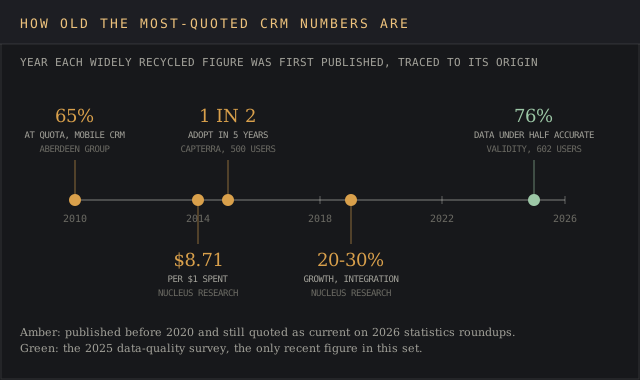
The CRM SERP runs on a dime-a-dozen set of figures that appear on every roundup with no date attached. Each one is traced here to the first page that published it. Figures with no named study behind them sit in the last row and appear nowhere else on this page.
| Figure as quoted on roundups | Origin | Year | What the origin says |
|---|---|---|---|
| $8.71 return per $1 spent | Nucleus Research, note O128 | 2014 | Average across Nucleus CRM case studies, no sample size |
| 65% of reps using mobile CRM meet quota | Aberdeen Group, Sales Mobility: Quotas Untethered | 2010 | 65% of sales representatives at top-performing companies that deploy mobile CRM hit annual sales quotas; 269 organizations |
| 65% of SMBs adopt CRM within five years | Capterra survey of 500 US users | 2015 | Half adopted CRM within the company's first five years |
| CRM raises customer retention 27% or 47% | Capterra survey of 500 US users | 2015 | Customer retention and customer satisfaction named as CRM's biggest impact, with no percentage published; 71% of users satisfied with their CRM |
| CRM increases sales up to 29% | Salesforce marketing page | Undated | Vendor claim with no survey, sample or date |
| 21% to 30% sales revenue lift | Nucleus Research, The CRM Integration Challenge | 2019 | 20% to 30% growth in business, tied to integration |
| 91% of companies with 10+ employees use CRM; 245% revenue lift; sales cycles 8 to 14 days shorter; AI users 83% more likely to exceed sales goals | No named study | None | Pages quoting these cite only other roundups |
Read between the lines of that last row and the share of businesses using CRM changes by a factor of three. The 91% figure has no traceable survey behind it; Eurostat's 28.51% has a questionnaire, a sample frame and a release date.
The Aberdeen number also lost its context in transit. Aberdeen tied mobile CRM to sales performance by comparing reps at top performers that deploy mobile CRM, 65% at quota, against sales teams at other companies at 42%. The roundup pairing of 65% against 22% for reps who don't use mobile CRM matches neither group.
Mobile and cloud CRM statistics
Cloud-based CRM platforms held 59.4% of crm software market revenue in 2025, per Grand View, which also names mobile CRM solutions as a growth factor in the US market. The 87% cloud CRM usage figure on roundups cites no survey; the 59.4% is a revenue share from a named report.
Field reps update customer relationships from their phones, and the 2010 Aberdeen study is still the primary source behind every mobile crm and quota claim in circulation, which makes it 16 years old. Mobile access from phones and other mobile devices is the use case those figures describe; the Folk CRM review linked above covers that vendor's mobile app plan by plan.
What drives CRM growth and what holds it back
Grand View lists the drivers in plain terms: demand to deliver personalized customer experiences, generative AI that automates customer interactions, a shift from on-premise systems to cloud services, and mobile CRM. Its restraint list, the reasons crm adoption stalls at smaller firms, is shorter and more concrete:
- Upfront licensing, customization, data migration and integration costs.
- Ongoing costs for training, upgrades, subscriptions and maintenance.
- Budget-constrained SMEs delaying purchases because of both.
Nucleus's 3.5-times-license integration spend is the hard number behind that restraint, and it hits CRM tools sold on a low seat price hardest. A company paying $50,000 a year for CRM tools and integrating them with finance, support and marketing tools should plan for integration costing several times the subscription, and bite the bullet on that budget before signing.
Regionally, North America held 40.4% of the crm market in 2025 in Grand View's model and 31.70% in Fortune Business Insights' model. Asia Pacific is the fastest-growing region at a 16.3% CAGR per Grand View. By industry, banking, financial services and insurance led end-use revenue at 22.2%, and customer service led solution revenue at 22.5%.
How customer relationship management is tracked, and what the numbers leave out
Four kinds of source cover this market, and each answers a different question:
- Vendor revenue trackers, Gartner and IDC, measure what CRM vendors sell. They're the sources for vendor market share.
- Market-research houses, Grand View and Fortune Business Insights among them, model total market size and forecasts, each with its own scope.
- Statistics offices, Eurostat in Europe, measure how many firms use software to manage customer relationships, independent of what they paid.
- Vendor filings and surveys, Salesforce's 8-K and State of Sales, HubSpot's earnings releases, measure scale and buyer behavior at one company.
Capterra's 2015 survey did measure customer satisfaction with the software itself: 71% of 500 users gave their CRM one of the two top satisfaction ratings.
Outcome data is the thin spot. Vendors pitch CRM as a way to improve customer loyalty and to run customer retention strategies, yet the retention claims on roundups trace to a 2015 survey that published no retention percentage, and the ROI figure to 2014 case studies. For primary customer retention and customer satisfaction benchmarks by industry, see our customer retention statistics report.
What the CRM statistics prove, taken together: the software is the largest SaaS category, a fifth of it belongs to one vendor, a minority of firms use it, and the data inside it is mostly incomplete. Related figures on reps and quota sit in our sales statistics report.
Delivered for your site and your byline. Hosting here is optional.
Frequently asked questions
How big is the CRM industry?
Gartner put worldwide CRM software revenue at $128 billion in 2024, up 13.4%. Fortune Business Insights sizes the wider market, services included, at $112.91 billion for 2025, and Grand View Research at $79.6 billion.
Who is the number one CRM provider in the world?
Salesforce, with a 20.0% share in 2025 according to IDC's Worldwide Semiannual Software Tracker. It has ranked first for 13 consecutive years overall, 14 in sales and 13 in customer service.
What are the top 3 CRM platforms?
By revenue, Salesforce ($41.5 billion in fiscal 2026), Microsoft Dynamics 365 and HubSpot ($3.13 billion in 2025, 306,446 customers by June 2026). Zoho reports more than 1 million paying customers across all its products, with its CRM solution one of dozens of apps.
What does CRM stand for?
Customer relationship management (CRM): software that holds a company's customer relationships and records its customer interactions with existing customers and prospects, from contact details and deals to support tickets and marketing campaigns, in one database shared by sales, service and marketing teams.
Is Excel a CRM software?
Excel is a spreadsheet. It stores contact lists, while a CRM system adds pipeline stages, activity logging and tools to automate tasks on top of the same records. Capterra's 2026 buyer data found 14% of small and midsize CRM buyers were tracking customers in spreadsheets and email before they bought one.
Will CRM be replaced by AI?
The data points the other way so far. AI agents run inside CRM systems and read the customer relationships stored there: 54% of sales teams use agents in Salesforce's 2025 survey, and Salesforce's Agentforce product sits on top of its CRM. Validity's finding that 45% of companies' CRM data isn't prepared for AI is the constraint to keep an eye on.
Why is CRM stock falling?
CRM is Salesforce's ticker on the New York Stock Exchange. The figures investors watch are in its filings: fiscal 2026 revenue growth of 10%, fiscal 2027 guidance of 10% to 11%, and an IDC market share that slipped from 20.7% in 2024 to 20.0% in 2025.
What are examples of CRM metrics?
Win rate, the length of sales cycles, pipeline coverage, sales forecasting accuracy, customer acquisition cost, customer retention rate, customer satisfaction score, customer engagement rate, average revenue per customer and data completeness. HubSpot reports one of them publicly: $11,800 average subscription revenue per customer in Q2 2026.
Bottom line
The CRM market is somewhere between $79.6 billion and $128 billion depending on whose scope you accept, and the gap is a definition problem. Gartner's 2024 software revenue is the most defensible single figure, and IDC's 20.0% Salesforce share is the most defensible concentration measure.
Adoption is lower than the roundups claim, and the CRM statistics with the best sourcing are the least quoted. Eurostat's 28.51% of EU firms, with large companies at 65.43% and small ones at 24.69%, is a measured number; the 91% that circulates beside it has no named study behind it. The ROI and retention figures most pages lead with date from 2010 to 2015.
The most recent primary data points at one constraint: 76% of CRM users say most of their data is incomplete, while 54% of sales teams already hand that data to AI agents. Any team building strong customer relationships on a CRM system should fix the records before buying the next layer of automation, because the AI reads the customer relationship management data exactly as it was typed.
CRM vendors, implementation partners and sales consultancies publish reports like this one as lead magnets and analyst-style briefs.
A report on your topic for a blog page, gated content or a lead magnet.
Written for your client and published under their brand, with my name left off.
Your report on marketintelligencetools.com, with 2 to 3 CTAs carrying your sponsored links.
Default terms: the report is yours to publish, and I keep the right to republish it on this site behind a gate, outside Google's index.
Where each CRM figure was published, and the adoption number no survey stands behind
Market trackers and research houses: gartner.com (CRM market share study, 11 June 2025; enterprise application SaaS study, 27 May 2025), salesforce.com (IDC Worldwide Semiannual Software Tracker ranking, April 2026), fortunebusinessinsights.com (CRM market, updated 28 September 2026), grandviewresearch.com (CRM market report, June 2026) and market.us (AI in CRM market, May 2024).
ROI notes: nucleusresearch.com (note O128, 21 June 2014; The CRM Integration Challenge, 27 February 2019).
Adoption and surveys: ec.europa.eu (Eurostat ICT usage in enterprises; releases of 16 May 2024 and 20 May 2026), capterra.com (CRM software buyer insights, January 2025 to January 2026), salesforce.com (State of Sales, 7th edition), salestechstar.com (Validity State of CRM Data Management in 2025 release, 10 July 2025), venturebeat.com (Capterra survey, 2015) and msdynamicsworld.com (Aberdeen Group, 2010).
Vendor filings and releases: sec.gov (Salesforce 8-K, 25 February 2026; HubSpot 8-K, 5 August 2026; Microsoft 8-K, 29 July 2026), businesswire.com (HubSpot full-year 2025 results, 11 February 2026), prezohoweb.zoho.com (Zoho customer milestone, 18 February 2026) and pipedrive.com (100,000 customers, February 2022).
Every figure was checked against its source on 14 October 2026. The 91% CRM adoption figure has no survey behind it on any page that quotes it, and Gartner's 2025 market share edition carries no headline revenue figure in its public abstract.