Demandbase review: what enterprise ABM teams get for a $68,591 median contract
 By Jan Suski. I go deep on every review, checking every number against its source and digging up details other coverage misses, a habit from six years of SEO and link building for tech companies. Bylines at Surfer, Brand24, and Senuto. How the scoring works.
· Prefer this source on Google
Best for
Mid-market to enterprise marketing teams with a defined account list, a budget above $50,000 a year, and bandwidth to run the full intent, advertising and sales-intelligence suite as one contract.
Not for
Solo marketers, startups without a defined ICP, or any team whose primary need is person-level contact data; Demandbase skips person-level identification entirely.
What it costs
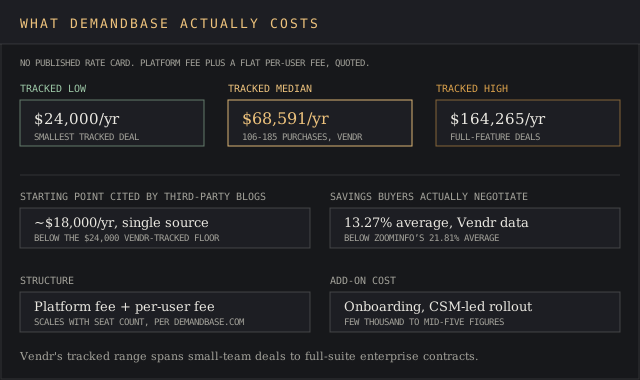
No published rate card. Vendr's tracked median is $68,591 a year across 106 to 185 purchases, range $24,000 to $164,265.
- Core use case
- Account-based marketing: identify, score, and engage target accounts
- Intent data
- First-party site-visit signals plus third-party signals, AI-scored
- Advertising
- Native B2B demand-side platform, account-targeted display
- Website personalization
- Rule-based content swaps by visitor account
- Sales intelligence
- Account activity feeds and buying-group visibility, no person-level ID
- CRM integration
- Salesforce native sync; also Marketo, Slack, LinkedIn, Google Ads
- Published rate card
- None; custom quote only
- Pricing structure
- Platform fee plus a flat per-user fee
- Vendr tracked low
- $24,000 a year
- Vendr tracked median
- $68,591 a year, 106 to 185 purchases
- Vendr tracked high
- $164,265 a year
- Average negotiated savings
- 13.27%, per Vendr
- Onboarding and services
- A few thousand dollars to mid-five figures
Ratings
- G2
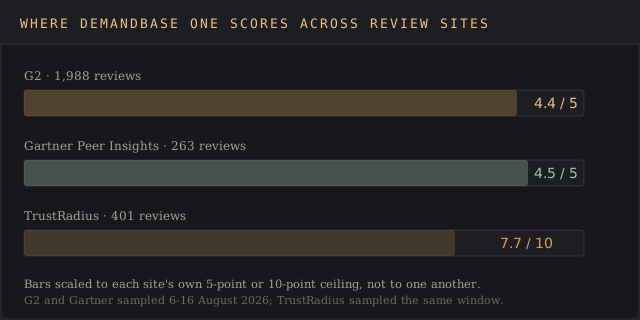
- 4.4/5 from 1,988 reviews
- Gartner Peer Insights
- 4.5/5 from 263 reviews, named a Leader in the ABM Platforms Magic Quadrant, 6 Nov 2025
- TrustRadius
- 7.7/10 from 401 reviews
- Learning-curve tag
- 86 G2 reviews, 77 call it steep
- Data-accuracy tag
- 45 G2 reviews flag it by name
Company record
- Founded
- 2006 by Chris Golec
- CEO
- Gabe Rogol, since November 2019
- Employees
- 750-plus, per Demandbase's own site
- Customers
- 1,000-plus, per Demandbase's own site
- Acquisitions
- Spiderbook (2016), Engagio (2020), InsideView and DemandMatrix (2021)
6sense
Not forA team that shortlisted Demandbase specifically for continuous, same-day intent scoring, since that refresh cadence is 6sense's own strongest claim over Demandbase's engine.
ZoomInfo
Not forA team buying for account-level intent and orchestration, because ZoomInfo's contact database is a different job from the scoring engine Demandbase is built around.
Pairs well with Demandbase
What Demandbase publishes about itself, and where third-party figures disagree
The founding date, acquisitions, employee and customer counts come from Demandbase's own company page, accessed 16 August 2026. Pricing figures come from Vendr's anonymized tracked purchase data, because Demandbase publishes no rate card; a handful of third-party blogs cite an unverified ~$18,000 entry price that sits below Vendr's own $24,000 tracked floor. Ratings are G2's, Gartner Peer Insights' and TrustRadius's own aggregates.
This review covers Demandbase One, the account-based marketing platform Demandbase sells to mid-market and enterprise B2B go-to-market teams. It's evaluated on intent data, account scoring, advertising, integrations, pricing and what its own users say.
It draws on G2, TrustRadius, Gartner Peer Insights, a Reddit thread of practitioners, Vendr's tracked contract data and Demandbase's own site. It's for a buyer building a shortlist, before any contract is signed. Demandbase also appears in our own intent data providers and B2B data providers rankings, scored against every rival on the same pillars.
Vendr's anonymized purchase data puts the median annual Demandbase contract at $68,591, across 106 to 185 tracked deals. Demandbase itself publishes no rate card.
Evaluating Demandbase starts with one question: does it help go-to-market teams focus on high value accounts fast enough to shorten the sales cycle, or does it just add another dashboard? The pitch is built around helping marketers narrow in on specific accounts already showing intent.
Demandbase has been selling account-based marketing software since 2006, when it started as a way to give B2B marketers better intelligence about which companies were in the market to buy. Three acquisitions since then, Engagio in 2020 and both InsideView and DemandMatrix in 2021, folded contact enrichment and firmographic data into what the company now calls Demandbase One.
That product is positioned less as a marketing point tool and more as what its own materials describe as a "Pipeline AI platform."
That repositioning matters for anyone evaluating it in 2026. The product bundles four things: an intent engine, an advertising DSP, a website personalization layer, and a sales intelligence dashboard, all sold as one contract.
Buyers comparing it against narrower tools need to know which of those four pieces they'd use, because the tracked median contract of $68,591 a year assumes most of them are switched on.
This review pulls from 1,988 G2 reviews, 401 TrustRadius reviews, Gartner Peer Insights, a Reddit thread of practitioners discussing the advertising product specifically, and Demandbase's own pricing and company pages. Where a claim comes from Demandbase's marketing, it's labeled as such; where it comes from a user or a competitor's own comparison page, that's labeled too.
Who this is for: teams that already run account-based marketing with a defined target account list and a budget north of $50,000 a year. Who it isn't for: solo marketers, seed-stage startups, or anyone whose primary need is person-level contact data.
What Demandbase does
Demandbase One bundles four things that used to be sold separately by different vendors. It scores accounts using AI against firmographic, technographic, and behavioral data, combining CRM data with website engagement and advertising metrics into what the platform calls a unified view of each account.
It also runs a native B2B demand-side platform so marketers can target display ads at specific companies, personalizes website content based on which account a visitor belongs to, and feeds account-level activity into a sales intelligence layer that reps use to prioritize outreach.
The pitch is that a marketing team stops guessing which companies to chase and starts acting on accounts that are already showing buying signals. If that pitch survives contact with a real deployment is the rest of this review.
The platform is built for enterprise companies that want to consolidate scattered signals into one platform, so gtm teams stop toggling between five logins to answer one question about an account. Personalized outreach follows from that consolidation: once a rep sees what an account viewed, the follow-up message can reference the exact page the account read. It skips the generic template pulled from a standard sequence.
Intent data: signals, sources, and reliability
Demandbase blends first-party intent, meaning visits to your own website and content, with third-party intent signals licensed from cooperative data networks, then runs both through an AI model to flag accounts that are actively researching relevant topics. The company's own materials describe this as identifying "in-market accounts for targeted outreach" and continuously re-evaluating account performance.
The credibility problem is that intent data quality is nearly impossible to verify independently; no vendor publishes raw signal volume in a way a buyer can audit.
6sense, a direct competitor, claims on its own comparison page to process "1+ trillion signals daily" through what it calls Signalverse and to identify "25% more website visitors than entirely IP-based solutions" than Demandbase in head-to-head tests.
Treat that specific number as a competitor's own marketing claim, unverified by any third party. The general concern behind it, that IP-based visitor identification undercounts against tools built for cookieless tracking, is a fair question to put to Demandbase directly in a demo.
"Precision targeting, down to a buying group at one account. Good support, creative and optimization services. Effective at reaching intended target."
A Reddit user active in B2B marketing, r/b2bmarketing, describing Demandbase's advertising and intent product
That same user's dislikes, in the same post, cut the other way:
"It's more expensive than other display ads and the reason is lost on many. Native media reporting is pretty basic and won't satisfy hardcore programmatic marketing folks."
The same Reddit user, r/b2bmarketing thread on Demandbase Advertising
A second commenter on the same thread was blunter about what the intent signal is built from:
"Sooooo expensive, and the 'insights' you are getting (bidstream run off data) can be purchased for a fraction of the cost other places."
A different commenter, r/b2bmarketing, on Demandbase's intent pricing
Right accounts: scoring, prioritization, and the buying group
Account scoring is the feature Demandbase users cite most often as the reason they bought the platform. G2's ease-of-use tag, at 225 mentions, is the single most common positive tag across 1,988 reviews. A small-business G2 reviewer described the mechanic directly:
"The most practical function for me to use was the account prioritization feature through the use of engagement metrics. This approach allowed me to tailor my efforts towards companies that exhibited high levels of interaction with materials or advertisements instead of giving the same amount of attention to each lead."
Nijat I., Full-stack Developer, small-business, G2 review, May 2026
The scoring model pulls from firmographic fit against an ideal customer profile, technographic signals about the target's existing stack, and behavioral engagement across web visits, ad impressions, and content downloads. All three roll into a single account score that surfaces in the sales dashboard.
Where it gets harder is the buying group layer: Demandbase can flag which named accounts are active, but multiple reviewers note it stops short of identifying which specific people within that account are doing the researching.
"Can be hard to navigate sometimes - i can't always find the view I am looking for but after sifting around I will."
Verified User, Account Manager in Sales, 5,001-10,000 employees, TrustRadius review, April 2025
Sales intelligence: visibility without person-level ID
The sales-facing side of Demandbase One surfaces account activity feeds, buying-group indicators, and CRM-synced dashboards so reps know which accounts are heating up before they call. Reviewers who use it for outreach describe it as a genuine improvement over cold, unranked lead lists. Demandbase also appears in our sales intelligence ranking, scored against ZoomInfo and other rivals on the same buying-group visibility criteria.
"Demandbase One is essential for making my outreach smarter and more effective."
Verified User, Contributor in Sales, 10,001+ employees, TrustRadius review, December 2025
"Cant imagine [operating] without this at this point. These insights are invaluable and largely effective in helping us target accounts we may have otherwise missed because they aren't top tier or aren't in a current sprint."
Verified User, Account Manager in Sales, 5,001-10,000 employees, TrustRadius review, April 2025
The limitation that shows up repeatedly across G2 and TrustRadius alike is that Demandbase identifies accounts but stops short of naming the people inside them. Sales teams that need a specific contact's direct line or verified email still need a person-level enrichment tool alongside it; that's the gap ZoomInfo fills for teams already running both.
Tech stack: integrations and data flow
Demandbase's Salesforce integration is the deepest of its native connections, syncing account scores, engagement data, and intent signals directly into Salesforce objects. It also connects to Marketo, Slack, and the major ad platforms so intent signals can trigger workflows outside Demandbase itself. A G2 reviewer running the platform at mid-market scale summarized the appeal:
"What I like best about Demandbase One is that it brings account data, intent signals, and engagement insights into one place. The UI is pretty easy to navigate, integrations work well with our existing tools, and performance has been reliable."
Roy S., Campaign Manager, mid-market, G2 review, June 2026
The same reviewer's complaint points at where the integration work lands: on the buyer's own team.
"Some parts of Demandbase One can feel a bit overwhelming, especially when you're first getting started. The reporting and dashboards have a learning curve, and some integrations require extra setup."
Roy S., Campaign Manager, mid-market, G2 review, June 2026
Before signing, ask for the specific field mappings Demandbase pushes into Salesforce and if custom objects require professional services time; that's where the "extra setup" reviewers describe tends to hide.
Right time: intent alerts and activation
The platform's real-time value depends on how fast an intent spike turns into an action a rep or marketer can take. Demandbase surfaces alerts when an account crosses a scoring threshold, and users on faster-moving teams describe using Slack notifications to catch those spikes without living inside the dashboard.
"I use the Slack notifications to keep me on track during the week and to remind me of which additional accounts I should be contacting outside of my normal sprint process."
Verified User, Account Manager in Sales, 5,001-10,000 employees, TrustRadius review, April 2025
The risk on the other side is alert fatigue: without tuning the threshold, a large target account list generates enough intent spikes that reps start ignoring them, which is the same failure mode every intent-data tool eventually runs into. Set the threshold conservatively for the first 60 days and widen it only once the team trusts what a flagged account means.
Pricing, contracts, and what buyers pay
Demandbase publishes no rate card; its own pricing page describes "a clear platform fee that covers all the essential software and services," plus "a flat fee per user," and directs every prospect to a custom quote. That's consistent with how enterprise ABM platforms typically sell, but it means the numbers below come from third-party tracked contract data.
Vendr's tracked purchase data, last updated February 2026 across 106 to 185 closed deals, puts the median annual contract at $68,591, with a tracked low of $24,000 and a tracked high of $164,265.
Average negotiated savings run 13.27%, below the 21.81% average savings ZoomInfo buyers negotiate on the same tracked-data platform, per the site's own Demandbase vs ZoomInfo comparison. Demandbase's sales team appears to hold its list price more firmly than ZoomInfo's does.
A handful of third-party pricing blogs cite an entry point around $18,000 a year. That figure sits $6,000 below Vendr's own tracked floor of $24,000, from a single unverified source.
Onboarding and professional services add a few thousand dollars to mid-five figures on top of the platform fee, scaling with how much CRM and ad-platform integration work the rollout needs. None of this is disclosed on Demandbase's own site; it comes from Vendr's anonymized buyer data and should be confirmed directly with a sales rep before budgeting.
Demandbase's own sales pitch is to maximize revenue from accounts already showing intent, minimize waste on outreach that goes nowhere, and align sales and marketing around one target list. If that pitch justifies the investment depends on usage: a team that invests in the full suite but only turns on account scoring is paying for growth features that sit idle, and that gap is the real cost of the platform's four-in-one structure.
Implementation, learning curve, and support
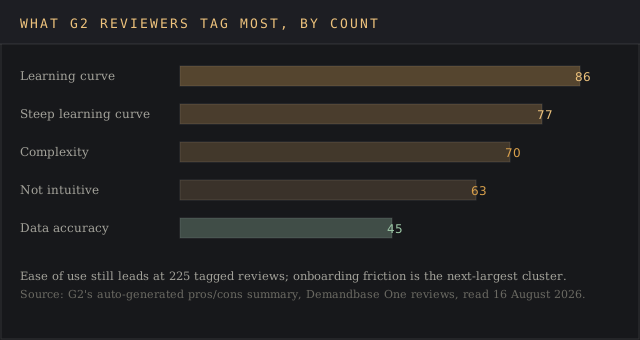
The steepest complaint across every review site sampled is onboarding time and the learning curve. 86 G2 reviews tag "learning curve" directly and 77 tag it as specifically "steep," ahead of complexity (70 mentions) and unintuitive navigation (63 mentions). A G2 reviewer put a number on the setup cost in practice:
"Setup requires significant time, especially with CRM integration."
Senior Client Manager, enterprise, G2 review, June 2026
Every fact linked to demandbase.com in this review is the vendor's own claim. Everything else traces to G2, TrustRadius, Gartner Peer Insights, Vendr, or a named Reddit thread, none of which Demandbase controls.
Demandbase assigns a dedicated Customer Success Manager on paid contracts, and that support relationship is consistently the part of the experience users rate highest; G2's quality-of-support score sits at 8.8 from 1,341 responses, ahead of the platform's own ease-of-setup score of 8.3 from 745 responses. The gap between those two numbers is the honest summary of what onboarding looks like: the people are good, the product takes real time to learn regardless.
What users complain about most
Beyond the learning curve, data accuracy is the next-largest complaint cluster: 45 G2 reviewers tag data inaccuracy by name, and stale or bounced contact records lead the platform's lowest-starred reviews. Because Demandbase doesn't do person-level identification, its contact layer depends more on the enrichment data behind it than on its own core intent engine, which is a different failure mode than the account-scoring complaints above.
"Being able to hone in more on who at the company may be looking into our company."
Verified User, Contributor in Sales, 10,001+ employees, TrustRadius review, December 2025, listed as a con
"Pricing can be high for smaller teams, and AI recommendations aren't always as accurate."
Roy S., Campaign Manager, mid-market, G2 review, June 2026
What users praise most
Ease of use tops G2's own auto-generated pros summary at 225 tagged reviews, ahead of "comprehensive datasets" (201), "unified data and integrations" (173), and intent data quality specifically (170). The ordering says something concrete: users act on the workflow the data produces more readily than they praise the raw data itself.
"It's one of the best tools for display ads. Account based targeting is amazing."
Executive, Marketing, 501-1,000 employees, TrustRadius review, August 2025
Company stability
Demandbase was founded in 2006 by Chris Golec and has been through three acquisitions that shaped the current product: Spiderbook in 2016, Engagio in 2020, and both InsideView and DemandMatrix in 2021, the pair that brought contact enrichment and firmographic data in-house. The company reports 750-plus employees and more than 1,000 customers on its own site. Gabe Rogol joined Demandbase in 2012 and became CEO in November 2019, when Golec moved to Chief Strategy Officer.
The company launched what it calls Pipeline AI in 2023-2024 and now describes itself as a "Pipeline AI platform," a repositioning that tracks the broader market's shift toward AI-branded go-to-market software.
For context on how volatile this category can get: Terminus, once a direct Demandbase competitor, merged into DemandScience in November 2024 and no longer operates as a standalone product. Check vendor stability before signing a multi-year ABM contract in this category.
Demandbase vs alternatives
6sense is the comparison every Demandbase buyer runs first, and the two are close enough on paper that the deciding factor is usually visitor identification method. 6sense claims to identify 25% more website visitors than IP-based approaches, a claim worth pressure-testing in a bake-off; 6sense's own pricing follows a similarly quote-only model.
Third-party buyer reports put 6sense's tracked median contract near $55,000 against Demandbase's $68,591, and its G2 score sits a touch lower too, 4.2 from 1,482 reviews against Demandbase's 4.4 from 1,988.
Where Demandbase wins is the native advertising DSP; 6sense leans more heavily on partner ad integrations. Read the full 6sense review for its own pricing and complaint patterns before choosing between the two.
ZoomInfo solves a different problem: person-level contact data at scale. Its G2 score is higher, 4.5 from 9,105 reviews against Demandbase's 4.4 from 1,988, and its tracked median contract is roughly half Demandbase's, $33,500 against $68,591.
The common enterprise setup runs both: ZoomInfo enriches the contact record, and Demandbase decides which accounts are worth enriching in the first place.
RollWorks targets the same account-based advertising use case at a lower price point, pitched at mid-market teams that don't need Demandbase's full sales-intelligence layer. RollWorks' own marketing claims "over 5x the ROI compared to other ABM vendors," a figure with no independent benchmark behind it and worth treating the same way as 6sense's visitor-ID claim above: an unverified number to confirm on a sales call.
Bombora operates one layer down from Demandbase: an intent-data cooperative that several ABM platforms license data from. Its Data Cooperative spans more than 5,000 B2B sites and 4.7 million unique domains, tracking roughly 15.8 billion monthly interactions across a taxonomy of 21,600-plus B2B topics.
Teams that want intent signals without the account-scoring and advertising overhead sometimes run Bombora standalone and route it into a lighter CRM workflow, skipping the cost of Demandbase's full suite. Neither RollWorks nor Bombora has a full published review on this site yet; treat their vendor-sourced figures with the same caution applied to Demandbase's own marketing claims throughout this review.
FAQ
What does Demandbase do?
Demandbase One bundles four things: an AI account-scoring engine built on firmographic, technographic and behavioral data, a native B2B advertising DSP, website personalization by visitor account, and a sales intelligence layer that surfaces account activity for reps.
How much does Demandbase cost?
Demandbase publishes no rate card. Vendr's tracked purchase data puts the median annual contract at $68,591, with a range of $24,000 to $164,265 across 106 to 185 deals, plus onboarding fees of a few thousand dollars to mid-five figures.
Who is the CEO of Demandbase?
Gabe Rogol has been CEO of Demandbase since November 2019, when Demandbase promoted him from chief revenue officer; he joined the company in 2012.
Is Demandbase worth the investment?
For a mid-market to enterprise marketing team with a defined account list and a budget above $50,000 a year, the account scoring and advertising DSP combination justifies the spend for the 225 G2 reviewers who cite ease of use as the top strength. For a solo marketer or a team needing person-level contact data, the platform isn't built for that job.
What companies use Demandbase?
Demandbase doesn't publish a named customer list in the material this review draws on. Its own site states more than 1,000 customers, concentrated in mid-market to enterprise B2B companies running account-based marketing programs.
Verdict
Demandbase is for a mid-market to enterprise marketing team that already has a defined target account list, a budget comfortably above $50,000 a year, and internal bandwidth for a multi-week rollout with a dedicated Customer Success Manager. The account scoring and advertising DSP combination is the reason 225 G2 reviewers cite ease of use as the top strength, and the Salesforce integration depth holds up across those same reviews.
The job Demandbase does well is turning a raw signal into an action a rep has the confidence to execute, but that execution depends on sales and marketing agreeing on what a qualified account looks like before anyone has to join a call to argue about it. A team in a fast-moving industry with the ability to convert an alert into a call within a day gets the most out of the platform; a team still debating definitions doesn't.
A solo marketer, a startup without a defined ICP, or any team whose primary need is person-level contact data should look elsewhere. The platform skips person-level identification entirely, and 45 G2 reviewers already flag data accuracy issues on the contact layer it does have.
A smaller marketing team might still suit the advertising product specifically, per the Reddit thread quoted above, if it accepts a steeper learning curve than a point-solution DSP would require and a higher per-account media cost than LinkedIn ads.