Visitor intelligence software: rankings and buying guide (2026)
 By Jan Suski. I go deep on every review, checking every number against its source and digging up details other coverage misses, a habit from six years of SEO and link building for tech companies. Bylines at Surfer, Brand24, and Senuto. How the scoring works.
· Prefer this source on Google
Visitor intelligence software matches the IP address or device signal behind an anonymous website visit to a company record, then pushes that match to Slack, a CRM, or an ad platform before the visitor leaves the page. Most website visitors never identify themselves through a form, and visitor intelligence exists to close that gap.
Warmly's own materials put the share of B2B buyers who never fill out a form at 97%, and industry visitor data cited on the same page puts the number who leave without converting at 97% to 98%.
This guide ranks ten tools that identify website visitors at the company or person level, prices each one against its own published tiers, and separates the vendors that show a number from the ones that show a sales calendar. Visitor intelligence and website visitor tracking get used almost interchangeably in vendor marketing; this guide treats them as the same category.
Between them, these ten tools cover website visitor tracking software built for lean sales teams, mid-market marketing teams running account-based programs, and enterprise buyers who want a dedicated rep.
Three of the ten changed owners or names since 2023, which matters more here than in most categories: the tool a colleague recommended last year may now sit behind a different visitor tracking tool entirely.
It's written for marketing and sales teams evaluating website visitor identification for the first time, and for sales operations buyers re-pricing an existing visitor tracking software contract against what's on the market in August 2026. Read the criteria section before the ranking, since a ranked list without a stated rule for the order is just a list of opinions.
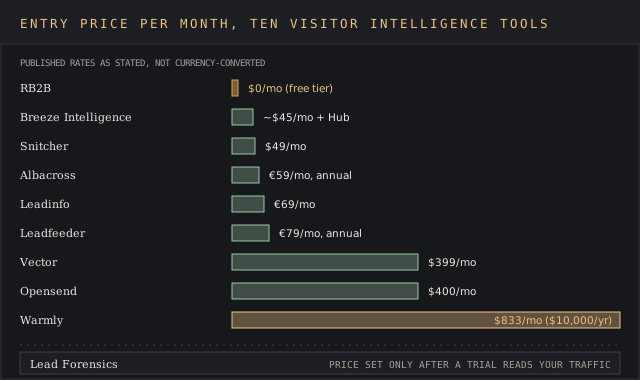
Quick comparison: ten visitor identification tools
Ten providers with the coverage figure each one publishes, the entry price a buyer can act on today, and the profile each tool fits best. Every price below comes from the vendor's own pricing page, read in August 2026, except Lead Forensics, which publishes none.
| # | Provider | Coverage figure | Entry price | Best fit |
|---|---|---|---|---|
| 1 | RB2B | 150 free monthly company resolutions | $0 (paid tiers from $79/mo) | Lean sales teams testing the category before they spend |
| 2 | Leadinfo | 220M companies, 45 data points, 70+ integrations | €69/mo (Starter) | Teams that want the widest native integration list |
| 3 | Snitcher | Company and individual identity layer in one plan | $49/mo (0-50 IDs) | Buyers who want person-level detail without an add-on |
| 4 | Albacross | 0-100 identified companies plus 10 verified email credits | €59/mo (billed annually) | European B2B teams running ABM sequences |
| 5 | Leadfeeder | Last 100 identified companies free; 2% to 45% ID rate spread | €79/mo (Discover, annual) | Teams that want an established brand with wide CRM support |
| 6 | Warmly | 10,000 identification credits/mo minimum | $833/mo (billed $10,000/yr) | Revenue teams that want AI chat and outbound bundled in |
| 7 | Vector | 2,500 identified visitors at the entry tier | $399/mo | Teams that want ad retargeting synced to identification |
| 8 | Opensend | 2,000+ verified person-level emails/mo | $400/mo | Ecommerce and DTC brands chasing cart abandoners by name |
| 9 | Breeze Intelligence | Credits drawn from HubSpot's shared credit pool | ~$45/mo, plus a paid Hub subscription | Teams already running HubSpot as their CRM |
| 10 | Lead Forensics | Price set only after a trial reads your traffic | Not published | Enterprise buyers who want a dedicated CSM from day one |
Coverage figures and prices are each vendor's own published claim, read on its pricing pages in August 2026. Lead Forensics is the only one of the ten that publishes neither.
Where these figures come from
Coverage counts, entry prices, and per-band figures are each vendor's own published claim, read from its pricing and product pages in August 2026. Snitcher's and Leadinfo's volume-band prices come from their own tiered pricing tables. Lead Forensics is the only vendor in this ranking that publishes no price, no band, and no rate card anywhere on its own site.
RB2B also appears on our lead intelligence software ranking, and Breeze Intelligence appears on our intent data providers ranking, each judging these vendors from a different framing. Read those pages for the wider lead-gen and intent-signal comparison; read this one for company- and person-level visitor identification specifically.
Evaluation criteria for visitor intelligence software
Five criteria decide the shortlist, and the ranking below applies them in this order: entry price, trial-provable identification volume, contract structure, integration depth, and documented privacy posture. A team weighing this against a straight sales intelligence buy should run every finalist through all five before signing.
Entry price you can read without a sales call
A published number on a pricing page beats a "request a demo" button. Six of the ten vendors here publish a self-serve monthly rate for their visitor intelligence software, so a buyer can price website visitor tracking without booking a call; Lead Forensics does not, telling prospects instead that "the cost of Lead Forensics is based on how much traffic you're generating to your website."
Share of B2B buyers who never fill out a form, per Warmly's own materials, the gap every tool in this ranking exists to close.
Company-identification volume the trial proves
Every vendor in this category advertises a match-rate claim on its marketing pages. The number worth trusting is the one a 14-day trial confirms against site visitors you already know. Leadinfo tells new trials to expect "around 30% of your total traffic" to resolve to a company, a useful baseline for the rest of this list.
Contract structure and cancellation terms
Some of these tools bill month to month with no lock-in; others require an annual commitment or auto-renew on a fixed clock. A Lead Forensics reviewer flagged exactly this: "I would warn others about the auto-renew policy that kicks in 3 months before the end of the contract."
Native CRM and real-time alert integrations
Identifying website visitors is only useful if the match reaches a rep before the individual visitor leaves the site. Count native Salesforce, HubSpot, and Slack integrations against the vendor's own published list; Leadinfo publishes 70+ native integrations, and RB2B's lower tiers cut off at Slack and Teams only.
Count a vendor's native integrations against its own current list on its site today. RB2B's lower tiers still cut off at Slack and Teams only.
Documented privacy posture, not a compliance badge
GDPR requires explicit consent for non-essential tracking, and CCPA requires clear disclosure of what's collected. A vendor that explains its consent mechanism, IP handling, and data retention in writing has cleared a higher bar than one that lists "GDPR-compliant" as a footer badge.
Ranked: the 10 best visitor intelligence tools
Ranked on entry price, trial-provable identification volume, contract structure, integration depth, and documented privacy posture, applied in that order.
RB2B
Best fit
Lean sales teams that want to try company-level visitor identification before committing budget.
RB2B pushes identified website visitors' LinkedIn profiles straight to Slack or Teams, and its free tier resolves up to 150 companies a month at $0, the only genuinely free published tier among the ten tools here. Paid plans start at $79/mo for 300 resolutions and climb to $199/mo (Pro+) for volume up to 2.5 million.
Key features
- Slack and Microsoft Teams push of identified LinkedIn profiles.
- Business email addresses on Pro tiers and above.
- Additional tracked domains at $99/mo for up to five.
- Overage billing at $0.25 to $0.45 per extra resolution depending on plan.
Pricing
Free for 150 resolutions/mo. Starter is $79/mo for 300; Pro is $149/mo for 600 to 2,500; Pro+ runs $199/mo up to 2.5 million, per rb2b.com/pricing.
Pros
- Live in minutes; the setup is a single script tag.
- Free tier makes it the cheapest way to test the category.
- Users report closed six-figure deals tied directly to identified visitors.
Cons
- Multiple G2 reviewers report bounced emails and dead LinkedIn URLs.
- One reviewer compared it unfavorably to Clearbit, Leadfeeder, and Apollo on coverage.
- Credits run out fast once a trial ends.
"We have run a few tests and done a few outreaches that indicate the people identified in the platform are not the actual people visiting the site." Nate T., Director of Marketing, Small-Business, G2 review, June 6, 2024
Why it's ranked #1. The only tool of the ten with a live $0 tier, RB2B beats every paid competitor on entry price and beats #2 on that specific criterion, though Leadinfo's 70+ integrations run deeper than RB2B's Slack-and-Teams push.
Leadinfo (formerly Visitor Queue)
Best fit
Teams that want the broadest native integration list without stitching together Zapier workflows.
The visitorqueue.com domain now redirects straight to leadinfo.com; Visitor Queue no longer exists as an independent product or pricing page. Leadinfo replaced it with a database of over 220 million companies across 195 countries and 45 data points per match, plus 70+ native integrations.
Key features
- Database covering 220M companies and 45 data points per company.
- Screen recording of visitor sessions, retained 7 days on Scale and 14 on Pro.
- Native GA4, Looker Studio, Salesforce, and Marketo integrations on higher tiers.
- Autopilot add-on for automated LinkedIn and email outreach, from €39/seat.
Pricing
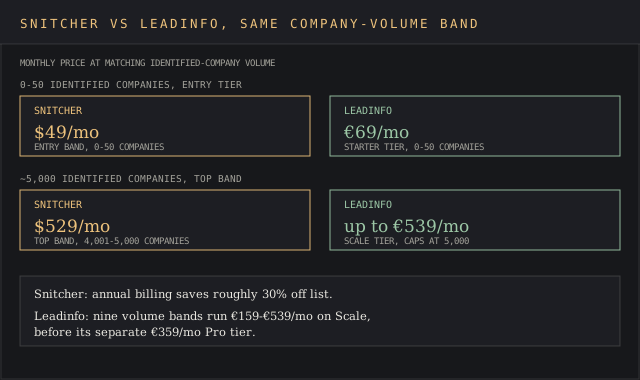
Starter is €69/mo for 0-50 companies; Scale runs €159 to €539/mo across nine volume bands up to 5,000 companies; Pro starts at €359/mo, per leadinfo.com/en/pricing.
Pros
- Reviewers highlight a clean, intuitive interface that integrates smoothly with other tools.
- Trial tells buyers their real match rate before they pay.
- Widest integration catalog of any tool in this ranking.
Cons
- Some reviewers call the premium too high given what the base plan promises.
- A manufacturing-sector reviewer reported two-day support response times.
- Buyers who signed up under the Visitor Queue name inherited a different pricing table after the merge.
"The interface is clean and intuitive, and it integrates smoothly with other tools." Rafael A., Sales Manager, G2 review, April 2026
Why it's ranked #2. Leadinfo's 220M-company database and 70+ integrations outscore RB2B on depth, but its €69/mo Starter tier still costs more than RB2B's $0 tier, the gap that keeps it out of first.
Snitcher
Best fit
Teams that want person-level identity resolution bundled with company matching in one plan.
Snitcher's visitor identification software prices in ten volume bands from $49/mo at 0-50 company IDs up to $529/mo at 4,001-5,000, and every tier includes what it calls an "Identity Layer" for individual-level resolution alongside company detection.
Key features
- Company identification and individual-level Identity Layer in one plan.
- Real-time Slack and email alerts on every tier.
- REST API access without an enterprise add-on.
- Unlimited team members regardless of plan.
Pricing
$49/mo for 0-50 identified companies, scaling through ten bands to $529/mo at 4,001-5,000; annual billing saves roughly 30%, per snitcher.com/pricing.
Pros
- Reviewers highlight accurate visitor tracking, reliable contact and company data, real-time alerts, and responsive support.
- Flat feature set across every tier, no gated Identity Layer upsell.
- 14-day free trial with no credit card required.
Cons
- Reviewers describe the price as steep once volume climbs past the entry bands.
- Fewer filtering options than competitors for suppressing unwanted traffic.
- No published enterprise contract structure beyond "custom pricing available."
"Accurate visitor tracking, reliable contact/company information, real-time alerts, and fantastic support." Shane C., MarCom Manager, G2 review, August 2026
Why it's ranked #3. Snitcher's $49/mo entry undercuts Leadinfo's €69/mo Starter on price, but Leadinfo's 220M-record database and 70+ integrations still beat Snitcher on the coverage criterion, holding it to third.
Albacross
Best fit
European B2B teams that want identification, verified contact credits, and outbound sequencing in one Euro-priced plan.
Albacross bundles verified email and phone credits with visitor identification from its Starter tier up, at €59/mo for 0-100 identified companies. One G2 reviewer flagged a real regional gap: "They don't have support for North America at all, this solution is made for Europe apparently."
Key features
- 10 verified email credits and 5 verified phone credits included at Starter.
- AI-powered email and LinkedIn sequencing ships as a core feature.
- LinkedIn Ads sync and Salesforce bi-directional integration at the Organisation tier.
- CSV and Google Sheets export on Professional and above.
Pricing
Starter is €59/mo billed annually (€84 monthly) for 0-100 identified companies; Professional runs €149/mo for up to 500; Organisation is custom for 501 and above, per albacross.com/pricing.
Pros
- Reviewers call it easy to integrate, easy to use, and easy to get help from support.
- One reviewer singles out Albacross's human support as dedicated and genuine.
- Outbound sequencing removes a step other vendors leave to a separate tool.
Cons
- No North America support, by the company's own reviewers' account.
- IP-based matches are occasionally off; one reviewer estimates roughly 95% accuracy.
- Match rate skews toward mid-size and larger organizations, per one reviewer.
"Easy to integrate, easy to use and easy to get help when you need it." Barry D., Marketing Expert & Founder, G2 review, February 2024
Why it's ranked #4. Albacross bundles outbound sequencing that Snitcher charges nothing extra for either, but its confirmed lack of North America support is the gap that drops it behind Snitcher's global reach.
Leadfeeder
Best fit
Teams with 50 to 4,000 identified companies a month and a HubSpot, Salesforce or Pipedrive CRM to push them into, who want EU-hosted data and unlimited users at a published price.
Leadfeeder rebranded from Dealfront back to its original name on March 24, 2026; the company states "your subscription, pricing, features, data, and access will remain the same." The free Lite tier keeps a 7-day visitor history and identifies the last 100 companies a month, with unlimited users.
Key features
- Free Lite tier with 7-day history, the last 100 identified companies a month and 20 credits.
- Custom feeds with 100+ filters and lead scoring by ICP fit and page depth on every paid plan.
- Verified email and phone enrichment, intent-signal filters and B2B display campaigns on Activate.
- Two-way sync with Salesforce, HubSpot, Pipedrive, Zoho and Microsoft Dynamics.
Pricing
Lite is free; Discover runs €79 to €309/mo billed annually (€113 monthly at entry) for up to 1,000 identified companies; Activate is €369 to €729/mo for up to 4,000; Scale is €599 to €2,089/mo for up to 10,000, annual or quarterly billing only, per leadfeeder.com/pricing. Enrichment and CRM sync draw on a credit pool: 0.2 credits for an email, 1 for email plus phone, 1 per exported record.
Pros
- 56 Activate and Scale price points are published, so a buyer can price a 10,000-company month without a call.
- Unlimited users on every tier, the free one included.
- AWS Ireland hosting with ISO 27001 and ISO 27701, the most documented privacy posture on this list.
Cons
- The help center declines to publish an identification rate; one Capterra reviewer measured 2%, against a homepage claim of up to 45% and Leadinfo's stated 30%.
- Annual contracts renew for 12 months unless cancelled 30 days before the date, and no reminder is sent.
- Plan credits expire at period end; one reviewer lost 700+ when her subscription lapsed.
"Customer support is nonexistent, they just want to make money off of you." Verified User, Consulting, Small-Business, G2 review, January 2026
Why it's ranked #5. Leadfeeder's free Lite tier and 56 published price points beat Albacross on price transparency, but Albacross's €59 entry undercuts Discover's €79 and bundles 10 verified email credits that Leadfeeder gates behind Activate at €369, which keeps it one spot back. Warmly's $10,000/yr floor holds it below.
Try it yourself
Start a Leadfeeder trial
14 day free trial on every paid plan, no card; Lite stays free at 100 identified companies a month.
 Visit Leadfeeder →
May earn a commission if you sign up through this link, at no extra cost to you. Full affiliate disclosure.
Warmly
Best fit
Revenue teams that want AI-driven inbound chat and outbound automation bundled with identification in one contract.
Warmly's cheapest published plan is $10,000/year ($833/mo), 17 times RB2B's $79/mo Starter tier, for a minimum of 10,000 identification credits a month covering both website visitor identification and intent data.
Key features
- AI Web-Deanonymization with ICP filtering and real-time Slack alerts.
- AI Chatbot and live chat bundled from the Inbound Chat tier up.
- Unlimited AI agents and autopilot agent generation on the top tier.
- CRM sync and retargeting integrations included at every tier.
Pricing
AI Web-Deanonymization is $10,000/yr ($4,875/quarter); Inbound Chat is $20,000/yr; AI Inbound Autopilot is $30,000/yr, per warmly.ai/pricing.
Pros
- Warmly's own site claims 65% company-level de-anonymization on tracked domains.
- One reviewer credits the implementation team with a smooth, well-supported setup.
- Bundles chat, chatbot, and identification into one contract, replacing three separate ones.
Cons
- One reviewer calls it too costly, with limited functionality on the free trial.
- Another reviewer says data quality needs work, often pulling the wrong name or company.
- A reviewer reported only 30-40% of visitors resolved against a 100-visitor sample.
"What used to be anonymous traffic is now a real-time view of exactly who's in our pipeline." Clint W., VP of Sales, G2 review, April 2026
Why it's ranked #6. Warmly bundles AI chat that Leadfeeder doesn't offer at all, but its $10,000/yr floor is more than 100 times Leadfeeder's free tier, the price gap that holds it below Leadfeeder in this order.
Vector
Best fit
Teams that want identification synced directly into ad retargeting audiences, beyond a CRM or Slack channel.
Vector's Reveal plan starts at $399/mo for 2,500 identified website visitors, the highest per-identity cost of any tool in this ranking at roughly $0.16 per identity, and its Target plan adds signal-driven ad audiences starting at $3,000/mo for 25 active audiences.
Key features
- Ad Reveal: identifies who clicked an ad even without a conversion.
- Signal-driven audiences that refresh automatically as buyers visit pages.
- Native Salesforce and HubSpot CRM sync.
- Webhook and CSV export on the Target plan.
Pricing
Reveal starts at $399/mo for 2,500 identified website visitors, scaling to $999/mo for 10,000; Target starts at $3,000/mo for 25 active audiences, per vector.co/pricing.
Pros
- Real-time contact reveal information syncs to a buyer's MAP and CRM systems, per one reviewer.
- One reviewer says Slack notifications about new site visitors started within minutes of setup.
- Ad-platform sync is a genuine differentiator among these ten tools.
Cons
- One reviewer found the HubSpot integration confusing, limited to a single list.
- Unlimited site visitor identification is a US-only feature, per one enterprise reviewer.
- Highest published cost per identified visitor in this ranking.
"Vector gives real-time contact reveal information about my website visitors, and that information is synced to my MAP and CRM systems." Ben C., Sr. Demand Generation Manager, G2 review, July 2026
Why it's ranked #7. Vector's ad-retargeting sync is a real feature none of the six tools above it offer, but its $399/mo floor for 2,500 identities costs roughly eight times Snitcher's per-identity rate, the gap that keeps it seventh.
Opensend
Best fit
Ecommerce and DTC brands that need a verified person-level email, beyond a company name.
Opensend resolves individual website visitors to verified email addresses, starting at $400/mo for 2,000-plus identities in the 10,000-50,000 monthly visitor range, and scaling down to $0.168 per identity at its top published tier.
Key features
- Person-level email identification, resolved down to a named individual.
- Unused identity credits roll over and don't expire.
- $1 two-week trial before the full subscription begins.
- Tiered per-identity pricing that drops as visitor volume rises.
Pricing
Tier 1 is $400/mo for 2,000+ identities (10-50k monthly visitors); Tier 2 is $800/mo for 4,300+; Tier 3 is $1,600/mo for 9,500+ at $0.168 per identity, per opensend.com/pricing.
Pros
- One co-founder says Opensend resolves real people whose emails convert.
- Buyers report a strong monthly return on investment.
- Rollover credits mean a slow month doesn't waste the spend.
Cons
- The same reviewer calls it pricier per email address than competitors.
- Getting the collection-rule balance right takes tuning after signup, per one reviewer.
- Built for consumer traffic volume, a poor fit for low-traffic B2B sites.
"We see a massive return on our investment each and every month." Tyler H., Enterprise Account Manager, G2 review, September 2024
Why it's ranked #8. Opensend is the only tool here resolving individual shoppers to verified emails, a real differentiator from Vector, but its $400/mo floor buys fewer identities than Vector's $399/mo Reveal tier, the trade that puts it eighth.
Breeze Intelligence (formerly Clearbit)
Best fit
Teams already paying for Marketing Hub, Sales Hub, or another HubSpot product who want identification without adding a new vendor.
HubSpot bought Clearbit in December 2023 and folded its standalone website visitor identification credits into the shared HubSpot Credits pool between June 2 and June 15, 2025: 100 old Breeze Intelligence Credits converted to 3,000 HubSpot Credits, per HubSpot's own knowledge base. HubSpot's review page covers the wider Breeze suite.
Key features
- Company and contact enrichment drawn from the same credit pool as other Breeze actions.
- Available starting on Marketing Hub, Sales Hub, Service Hub, Data Hub, and Content Hub Starter tiers.
- Credits reset monthly and do not roll over.
- Auto-upgrade or pay-as-you-go overage billing once included credits run out.
Pricing
No standalone price; credits draw from the HubSpot Credits pool tied to a paid Hub subscription, with the former 100-credit Breeze tier now worth 3,000 HubSpot Credits, per knowledge.hubspot.com.
Pros
- Reviewers cite data accuracy as strong enough to act on without a second source.
- No separate vendor contract for teams already committed to HubSpot.
- Filtering by company size, location, and revenue works inside the same interface as the CRM.
Cons
- One reviewer says smaller teams find it expensive once advanced features require a higher-tier plan.
- Credits draw from the same shared pool as every other Breeze action.
- Locked to a paid HubSpot Hub subscription; there's no standalone plan.
"Data accuracy: at the end of the day if you want a reliable data source and be able to action the intel there is not another provider out there that does it better." Noah T., Director of Demand Generation, G2 review, February 2023
Why it's ranked #9. Breeze Intelligence's identification runs inside a tool teams may already own, unlike Opensend's dedicated stack, but its credits share a single pool with every other Breeze feature, the constraint that pushes it below Opensend's purpose-built pricing.
Lead Forensics
Best fit
Enterprise buyers who want a dedicated customer success manager and a guided sales process.
Lead Forensics publishes no price; the company states plainly that "the cost of Lead Forensics is based on how much traffic you're generating to your website," setting the number only after a trial measures it.
One reviewer flagged a contract trap: "I would warn others about the auto-renew policy that kicks in 3 months before the end of the contract" (Emily P., Marketing Project Strategist, July 2026).
Key features
- Full firmographic insight, beyond company name and industry.
- Decision-maker contact data included at both published tiers.
- Dedicated customer success manager and a customer training academy.
- ABM account matching and automated lead routing.
Pricing
Not published; determined by a trial that measures site traffic volume, per leadforensics.com/pricing.
Pros
- Implementation into a daily work routine runs uncomplicated, with intuitive navigation, per one reviewer.
- Two named tiers, Essentials and Automate, structure the conversation before a quote arrives.
- Training academy and certifications go further than most competitors' onboarding.
Cons
- One reviewer says pages load slowly enough to become a persistent annoyance.
- Auto-renewal clock starts three months before contract end, catching reviewers off guard.
- Integration setup carries an extra cost on top of the base contract, per one reviewer.
"The implementation into our daily work routine was uncomplicated. The navigation is very intuitive." Diana A., Chief Sales Officer, G2 review, June 2026
Why it's ranked #10. Lead Forensics is the only tool of the ten with zero published pricing anywhere on its site, the entry-price criterion every tool above it clears in at least some form, which is why it closes the list.
How to identify anonymous website visitors
To identify anonymous website visitors, these tools match a request's IP address against a database of known company IP addresses, a technique called reverse IP or DNS matching, then enrich that match with firmographic data from a separate database.
This is website visitor identification at the company level: it names the business behind the visit, and it's the method every tool in this ranking uses as its baseline. Person-level identification, covered next, names the individual behind the keyboard too.
A smaller subset, including Snitcher and Opensend, layer in person-level identification on top of the same company data, resolving a specific visitor to a name and email using consented first-party data, pixel-based matching, or a co-op data network.
Person-level tools generally require a stricter consent and disclosure setup than company-level matching alone, since they handle identifiable individual data. Traditional web analytics tools like Google Analytics report anonymized session counts; visitor identification software is built to close that gap by naming the company or person behind the session.
Behavioral data, intent signals, and turning website visitors into pipeline
Company identification only answers who visited. Behavioral data (which pages a company's website visitors read, how long they stayed, if they returned) and intent signals (third-party signals from ad co-ops, or first-party intent read straight off a company's own site) tell a sales team if that visit is worth a rep's time.
Most of the tools ranked above layer basic behavioral tracking into every plan; fewer combine it with real-time alerts that fire the moment a target account crosses a page-view threshold. That combination is what turns anonymous traffic into named contacts a rep can call the same day.
Sales teams chasing high-value prospects want a tool that pushes an alert to Slack or a CRM the moment a target account shows up.
Marketing teams building personalized or cold outreach sequences want the same visitor signals routed into their sales workflows automatically, which is why integration depth is one of the five criteria above and overlaps with intent data providers.
Conversion tracking closes the loop: connecting an identified visitor back to a closed deal is how a buyer proves business impact from the contract. Visitor count alone doesn't prove value..
Several vendors here, including Leadinfo and Warmly, publish a Google Analytics or GA4 integration so visitor identification data lines up with the conversion tracking a marketing team already trusts. Leadfeeder, which names the company behind each visit, ranks #3 in our website traffic analysis tools list of eleven.
Three ownership changes worth checking before you buy

Ownership or brand changes in this category since 2023: Clearbit to Breeze Intelligence, Visitor Queue to Leadinfo, and Dealfront back to Leadfeeder.
Buying decisions in this category get complicated by brand churn. Clearbit's identification credits, folded into Breeze Intelligence, merged fully into HubSpot's shared credit pool in June 2025. Visitor Queue's redirect means the standalone product a reviewer might describe from 2023 no longer exists on its own pricing page.
Dealfront reverted to the Leadfeeder name on March 24, 2026, pricing and contracts carried over unchanged, per the company. A buyer researching "Visitor Queue pricing" or "Dealfront Target" in 2026 lands on a different company page than the one that name pointed to two years earlier. Check the current owner before signing.
GDPR, CCPA, and identifying anonymous website visitors
Major browsers are restricting third-party cookies, which is why most vendors here lean on server-side IP matching. GDPR requires explicit consent for non-essential tracking, and CCPA requires clear disclosure of what data collection happens and why.
Company-level identification, which names a business, generally sits on firmer legal ground than person-level identification, which resolves to an individual's name and email; get that distinction in writing before signing.
Ask each vendor for its consent trigger, IP retention window, and DPA before signing. A vendor that can't answer in writing hasn't earned the data it's asking a buyer to hand over.
Ask each vendor three specific questions before signing:
- What triggers consent under their implementation.
- How long raw IP addresses are retained before they're discarded or pseudonymized.
- If a signed DPA is available on request.
Common mistakes when buying visitor intelligence software
The most common mistake is buying on the marketing-page match-rate claim. Weigh the trial result instead. A vendor's homepage might advertise identifying 65% of the companies visiting a site; the number that matters is what the same vendor resolves against a buyer's own traffic during a 14-day trial, which several reviewers here report running well below that.
Automated lead scoring built on an inflated match rate produces noisy lead data in practice. Three more mistakes show up across reviews and case studies:
- Signing an annual contract before checking cancellation and auto-renewal terms, the trap one Lead Forensics reviewer flagged in a G2 review.
- Treating "GDPR-compliant" as a checkbox. Ask what consent mechanism, retention window, and DPA the vendor has in writing.
- Judging on-site behavior from a demo dashboard, without ever watching the tool identify companies on a domain you already control.
Run every finalist's match-rate claim against your own 14-day trial before signing. The homepage number and your own traffic number are rarely the same.
Frequently asked questions
Can I check who visited my website?
Yes, with a script tag from any of the ten tools ranked above; each vendor resolves a share of website visitors to a company or, in some cases, an individual, though the resolved share varies by tool and by traffic source.
What is website visitor identification software?
Software that matches anonymous website traffic to a company or person record using IP-based reverse lookup, first-party consented data, intent data, or a combination of the three, then routes that match to a CRM, Slack channel, or ad platform.
What is the best website visitor identification software?
There's no single best tool; RB2B fits a team testing the category on no budget, Leadinfo fits a team that wants the widest integration list, and Lead Forensics fits an enterprise buyer who wants a dedicated account team from day one.
Is website visitor tracking GDPR-compliant?
It can be, when the vendor documents its consent trigger, IP retention window, and DPA in writing; company-level identification without person-level data generally clears a lower compliance bar than tools that resolve to an individual's name and email.
Can visitor tracking tools identify individual people as well as companies?
A subset can. Snitcher bundles person-level identity resolution into its core plan, and Opensend is built specifically to resolve shoppers to verified email addresses, while most of the other eight tools here stop at the company level.
What happened to Clearbit, Visitor Queue, and Dealfront?
All three changed hands. HubSpot bought Clearbit in December 2023 and rebranded it Breeze Intelligence; Visitor Queue's domain now redirects to Leadinfo; and Dealfront reverted to the Leadfeeder name on 24 March 2026, with pricing and contracts carried over unchanged.
Bottom line
RB2B wins on price for any sales team that wants to try visitor intelligence software before spending a dollar, and its free 150-resolution tier has no real equivalent among the other nine tools ranked here. Leadinfo is the stronger buy for marketing teams that already know they want deep CRM integration and a larger underlying database of website visitors, even at a higher entry price.
Teams that want person-level identification, beyond company names, should look at Snitcher or Opensend before the company-only tools, since bolting person-level resolution onto a company-only visitor tracking platform later usually costs more than choosing correctly the first time.
Enterprise buyers who want a dedicated success manager, deeper intent data, and don't mind skipping the self-serve signup are the only real fit for Lead Forensics, given that it's the one tool here targeting large accounts that still won't publish a price.