ICP tools: 10 platforms that build and score an ideal customer profile (2026)
 By Jan Suski. I go deep on every review, checking every number against its source and digging up details other coverage misses, a habit from six years of SEO and link building for tech companies. Bylines at Surfer, Brand24, and Senuto. How the scoring works.
· Prefer this source on Google
ICP tools compared: quick table
The third column is the one that separates this category. Tools 1 to 5 read your won deals and tell you what your best customers share; tools 6 to 10 score accounts against an ideal customer profile you've already written down. The second group suits a business with too few won customers to train a model.
| # | ICP tool | Learns the ICP from | Entry price on record | Best fit |
|---|---|---|---|---|
| 1 | 6sense | Your closed-won opportunities, 0-100 fit score, daily | $62,220 Vendr median*, 386 purchases | Enterprise ABM teams |
| 2 | Demandbase | Opportunities at 50+ accounts, nightly scores | $68,591 Vendr median* | Mid-market and enterprise marketing |
| 3 | ZoomInfo | An uploaded won/lost CSV, 300+ company attributes | $33,500 Vendr median*, 1,576 purchases | Outbound teams in North America |
| 4 | HG Insights | Win and loss records, technographics, IT spend | $90,000 Vendr median*, two-year term | Tech vendors selling into IT |
| 5 | Ocean.io | Won and lost deals (Revenue Navigator), 85M+ companies | $250 a month, billed annually | Lookalike account discovery |
| 6 | Clay | Scoring formulas you write over 150+ providers | $0, then $167 a month billed annually | GTM engineers |
| 7 | Apollo.io | Your website, account data and activity | $0, then $49 a seat a month | Small sales teams |
| 8 | Factors.ai | Website and ad engagement, predictive on Enterprise | $199 a month (Lite) | LinkedIn-heavy demand gen |
| 9 | HubSpot (Breeze Intelligence) | An ICP tier you set by hand or workflow | $90 a seat a month plus $1,500 onboarding | Teams already on HubSpot |
| 10 | Leadfeeder | Firmographic filters on website visitors | €0, then €79* a month billed annually | Inbound-led small teams |
Medians marked * are anonymized buyer-reported contract values published by Vendr. Everything else is the price the vendor publishes itself.
* Leadfeeder lists its prices in euros. At the European Central Bank reference rate of 1 EUR = 1.1195 USD, published 14 October 2026 and refreshed weekly, EUR 79 is about $88.44, EUR 369 is about $413 and EUR 599 is about $671.
Where these figures come from
Training inputs, minimum record counts and refresh cadences come from each vendor's own support documentation and pricing pages, linked in each entry below. Medians marked * are Vendr's anonymized buyer-reported contract values, used for the four vendors that print no plan price on their own sites: 6sense, Demandbase, ZoomInfo and HG Insights.
Ocean.io's Revenue Navigator, the plan that learns from won deals, is custom-priced, and ZoomInfo documents no refresh schedule for its AI-Generated ICP, so no row claims either one.
ICP scoring is one job inside a wider buying decision, and two sibling rankings judge several of these vendors on a different one. The B2B data providers ranking scores 6sense, Demandbase, ZoomInfo, Apollo.io and Breeze Intelligence as data vendors, and the sales intelligence ranking judges 6sense, Demandbase and Apollo as rep workflow tools. Both produce a different order from this one.
An ideal customer profile (ICP) is a written description of the company that gets the most value from your product or service and gives you the most revenue back: its industry, company size, location, technology stack and the buying triggers that put it in market. ICP tools turn that description into a score on every account in your market and across your existing customers, so your sales team calls the potential customers that look like your best customers first.
The best ICP tools learn the profile from your own closed-won deals. 6sense does it with an account profile fit score from 0 to 100 that it recalculates daily, and Demandbase won't train its model on fewer than 50 distinct accounts. The cheapest ICP tools on this list start at $0 and ask you to write the scoring rules yourself.
This complete guide ranks ten ICP tools on five tests a buyer can run, then covers what an ideal customer profile is, how it differs from buyer personas, and how to create an ideal customer profile step by step with the data each step needs. It's written for sales and marketing teams, RevOps leads and founders deciding where their next 500 target accounts come from, and it answers the ideal customer profile questions buyers ask most at the end.
The timing matters for one reason. 6sense closed its free Sales Intelligence plan on 12 August 2026, HG Insights bought MadKudu in August 2025, and Keyplay merged into Inflection. Three of the names a 2024 shortlist carried have changed hands or shape.
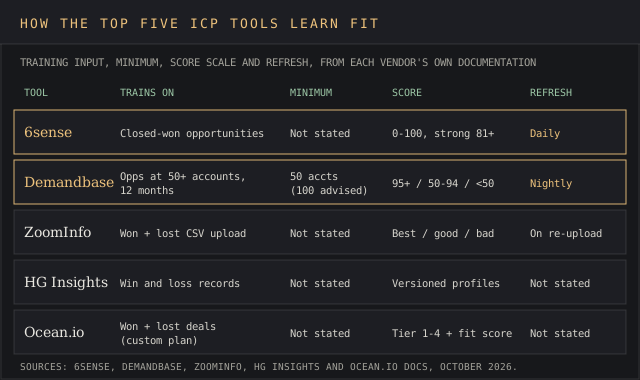
Evaluation criteria for ICP tools
Five criteria decide the shortlist, and the ranking below applies them in this order. Each one gives a yes, a no or a number you can check on the vendor's own documentation.
Learns fit from your own closed-won deals
The test: does the vendor document a model trained on the customers you've won (and ideally the deals you lost), and does it state a minimum? Demandbase states 50 accounts. 6sense states the model compares each account "to that customer's historical won deals." A tool that only scores against filters you type in fails this test.
Refreshes the score and writes it back to the CRM
Count the days between a change in the market and a change in the score. 6sense recalculates daily and Demandbase every night. A score that only updates when someone uploads a new CSV goes stale the quarter you stop uploading.
Attribute depth behind the score
Count the named inputs. ZoomInfo documents 300+ company attributes and 30,000+ technologies; 6sense names eight firmographic fields plus technographics and custom fields. More named inputs means the model can find the pattern your sales team never wrote down.
Size of the company universe it scores
An ideal customer profile is only as useful as the list of customers it produces. Published counts run from 30 million companies at Apollo to 122 million at ZoomInfo.
Price on record
A published price or a Vendr median, with the purchase count. Quote-only vendors are ranked on Vendr's anonymised buyer data; tools with a free tier get credit for letting you test fit on your own accounts before a contract.
The 10 best ICP tools, ranked
6sense
Best fit
An enterprise ABM team with two years of clean opportunity history in Salesforce, a few hundred customers to learn from, and a budget above $60,000.
6sense trains an account profile fit model on your own closed-won opportunities, compares every account to the customers you've already won, and scores every account from 0 to 100: 81 to 100 is strong, 50 to 80 moderate, 0 to 49 weak. Its support documentation says a strong or moderate fit "is what 6sense considers as your ICP," and the score is updated daily. Our 6sense review covers the intent side of the platform.
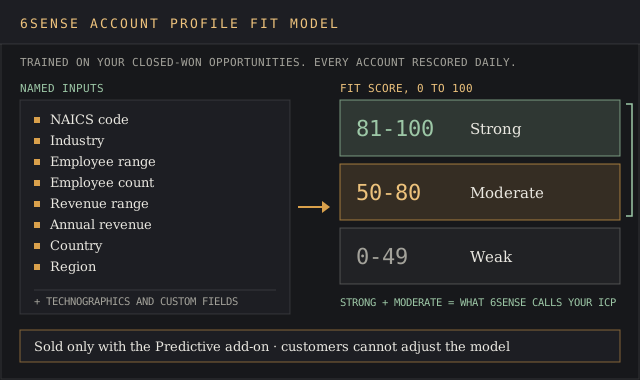
The catch is packaging. Profile fit scores are "only available for customers who have purchased the Predictive add-on," and the 6sense pricing page lists three bundles with no dollar figure on any of them.
Key features
- Account Profile Fit model built on NAICS, industry, employee range, country, revenue range, employee count, annual revenue and region
- Contact Profile Fit model scoring individual buyers against past buyers
- 6sense Qualified Accounts (6QA) combining fit, intent and buying stage
- Keyword-level intent and website visitor identification
- Native CRM, MAP and sales engagement integrations
Pricing
Quote-only. Vendr's buyer data puts the median 6sense contract at $62,220 a year across 386 purchases, from $11,234 to $176,511, with buyers saving 16.77% off the first quote. Our 6sense pricing report breaks down the bundles.
Pros
- Fit model trained per customer on its own won deals, refreshed daily
- 6sense reports a 13% higher win rate on 6QA accounts in its 2025 customer data set
- Named a Leader in the Forrester Wave for B2B revenue marketing platforms, Q1 2026, per 6sense
Cons
- The fit model is set in stone: the FAQ answers "Can we adjust the profile fit?" with "No."
- Predictive scoring is a paid add-on on top of Sales Intelligence
- The free plan that let reps test the data ended 12 August 2026
- G2 rates it 4.2 out of 5 across 1,568 reviews, with 142 mentions of a steep learning curve
A mid-market G2 reviewer titled their 3.5-star review "Great Intent Data for Targeting, but with a Blackbox Algorithm," which is the profile-fit FAQ restated by a customer. A second user points at reporting:
"Reporting is clunky. Getting a clean view of influenced pipeline requires more setup than it should. Most teams end up exporting to a BI tool anyway."
Deepak K., Senior Performance Marketing Specialist, enterprise, G2 review, 24 July 2026
Why it's ranked #1. It passes the first two criteria with a per-customer model and a daily refresh, then beats Demandbase on criterion 5: a $62,220 Vendr median against $68,591. It names eight firmographic inputs where Demandbase's Pipeline Predict names five.
Demandbase
Best fit
A mid-market or enterprise marketing team with at least 50 customers won in the last year that wants account scoring, intent and its own B2B ad network on one contract.
Demandbase publishes the clearest training rules in the category, and the devil's in the details. Its Qualification Scores need at least 50 distinct accounts and work better with 100 or more, and its Pipeline Predict model uses new-business opportunities opened in the last 12 months. Scores update every night. The Demandbase review goes deeper on the ad side.
Key features
- Qualification Scores for ICP fit, trained on recent customers
- Pipeline Predict bands: 95 and above "Highly Likely," 50 to 94 "Likely," below 50 "Unlikely"
- Intent signals with up to one year of history before an opportunity's created date
- Native B2B demand-side platform for account-targeted ads
- Firmographic, technographic and buying group data from the InsideView and DemandMatrix acquisitions
Pricing
Demandbase's pricing page describes a platform fee plus a flat fee per user and prints no figure. Vendr tracks a $68,591 median, from $24,000 to $164,037, with 13.27% average savings.
Pros
- A stated 50-account training minimum you can check against your CRM before signing
- Auto Retrain is on by default when engagement or intent settings change
- Scores, intent and ads share one account record
Cons
- The $24,000 floor on Vendr is the highest entry price in this top five after HG Insights
- Marketing and sales can't be bought as separate products
- The initial model build and every retrain take 24 hours
"Some of the intent I receive is inaccurate. When I call the appropriate prospects, more often than not they were not researching what Demandbase said they were."
Matt P., BDR, enterprise, G2 review, 18 September 2026
Why it's ranked #2. Its nightly refresh and 50-account minimum beat ZoomInfo on criterion 2, where ZoomInfo regenerates on upload. It loses #1 to 6sense on price: a $68,591 median, $6,371 above 6sense's. See the full Demandbase vs ZoomInfo comparison for how the two handle account scoring.
ZoomInfo
Best fit
A North American outbound team that wants to kill two birds with one stone: the ICP and the contact list from the same vendor.
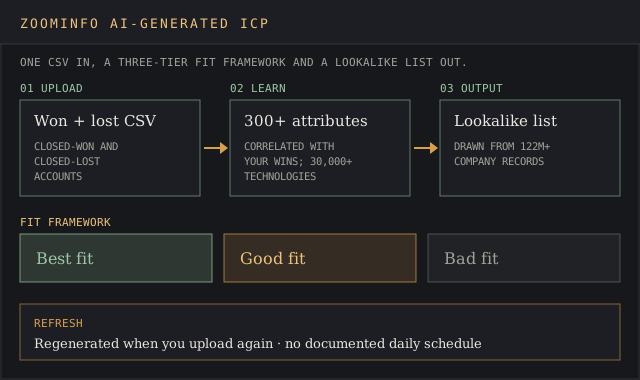
ZoomInfo's AI-Generated ICP takes a CSV of closed-won and closed-lost accounts, learns which of its 300+ company attributes correlate with your wins, and outputs a best-fit, good-fit and bad-fit framework plus a lookalike list. Its ICP builder guide says it tracks 30,000+ technologies across 200+ categories. Read the ZoomInfo review for the contact data.
Key features
- AI-Generated ICP from a won/lost upload, regenerated on demand
- 122M+ company records and 500M+ professional profiles
- 4,500+ intent topics and 210M IP-to-organization pairings
- GTM Studio and Agent Teams to route scored accounts into plays
- Advanced Search for firmographic and technographic list building
Pricing
Vendr's median is $33,500 a year across 1,576 purchases, from $7,233 to $156,053. The ZoomInfo pricing report covers the credit rate card and the auto-renewal clause.
Pros
- Trains on lost deals as well as won customers, which most tools skip
- The largest published company universe on this list
- Half the Vendr median of 6sense
Cons
- The ICP refreshes when you upload again, with no documented daily schedule
- Contracts auto-renew, a complaint that recurs on TrustRadius and Capterra
- Quote-only; the one printed rate card is $0.45 down to $0.25 per credit
"our renewal came up and zoominfo wants 36k for 3 seats. thats more than our entire martech stack combined"
Reddit user, r/DigitalMarketing, June 2026
A healthcare marketer on G2 wrote that the "Audience Builder tool allowed us to target the right prospects in the HCP space with precision" (June 2024). The 6sense vs ZoomInfo comparison sets the two head to head.
Why it's ranked #3. 122M+ companies and a $33,500 median beat HG Insights' 70M+ and $90,000. It sits below Demandbase because its model refreshes only when you upload a new CSV, against a nightly rebuild.
HG Insights
Best fit
A software or IT services vendor whose ideal customer profile turns on what technology a company runs and what it spends on it.
HG Insights sells ICP design as a named feature. Its pricing guide lists Market Analyzer for "ICP Design, TAM/SAM/SOM analysis, whitespace analysis and competitive analysis," and Data Studio for account scoring with predictive modelling. Market Analyzer accepts your win and loss records and pushes scored lists to Salesforce and HubSpot. The HG Insights review page is in progress.
Key features
- Technographics, IT spend, contract timelines and intent mapped to 70M+ companies
- First-party buyer intent from TrustRadius, which HG owns
- MadKudu's predictive lead scoring, acquired in August 2025
- Scoring profiles with version history on every save
- SOC 2 Type II, GDPR and CCPA
Pricing
Starter, Growth and Enterprise plans run on Intelligence Credits: 0.1 credit for a firmographic record, 3 credits for a buyer intent data point, and at most 20% of unused monthly credits roll over. The standard term is two years, and "there is no pilot or free trial plan." Next to Ocean.io's $250 a month, it costs an arm and a leg. Vendr's median is $90,000 a year across 46 purchases, from $31,498 to $173,119.
Pros
- The deepest technographic and IT spend data on this list
- ICP design, TAM sizing and scoring in one module
- Builds the market model without a CRM connection
Cons
- The highest Vendr median here, $90,000
- A two-year default term; one year costs more
- No free trial to test fit on your own accounts
An enterprise reviewer on G2, where HG rates 4.3 across 438 reviews, wrote: "My favourite part of HG Insights is being able to see which products each company has installed." Another, Somya S., gave it 2.5 stars and opened the cons with "The main drawback is the pricing."
Why it's ranked #4. Technographics plus IT spend across 70M+ companies beat Ocean.io on criterion 3. It sits below ZoomInfo on universe size and price: 70M against 122M companies, and $90,000 against $33,500.
Ocean.io
Best fit
A RevOps team that wants lookalikes of its best customers and a ranked list of accounts it already owns but never worked.
Ocean.io reads company websites to describe what each business sells and to whom, then finds lookalikes across an 85M+ company index. Its Revenue Navigator plan is built "around your won and lost deals," turns them into segments, and recommends accounts in tiers 1 to 4 with a fit score and a reason. It writes segment scores back to the CRM, which surfaces the diamond in the rough: accounts already in your CRM that nobody has worked.
Key features
- Lookalike search from the domains of one or more customers
- Segmentation of closed deals by win rate, deal size and cycle time
- Waterfall contact enrichment across 16+ data sources
- REST API and an MCP server
- Integrations with Salesforce, HubSpot, Pipedrive, Attio and Clay
Pricing
A free trial, then Growth from $250 a month billed annually with 60,000 credits a year that expire after 12 months. Revenue Navigator, the plan that learns from won deals, is custom-priced.
Pros
- The cheapest published price among tools that model fit from your deals
- Explains every recommendation with a segment and a reason, so reps can see which customers an account resembles
- Free trial on your own market
Cons
- The won-deal model sits on the custom plan, above the $250 tier
- Thin review base: 13 reviews from customers on G2, averaging 4 out of 5
- Growth credits expire 12 months after purchase
On G2, Jason S., a small-business user, named "Precision in B2B lead generation with the Lookalike Search feature" as the best part and "Limited customization options for data exports" as the worst.
Why it's ranked #5. It learns from your won deals, which Clay doesn't, so it beats Clay on criterion 1. It loses to HG Insights on attribute depth: website-derived company descriptions across 85M+ companies, against HG's technographics and IT spend.
Clay
Best fit
A GTM engineer who wants to define the ideal customer profile in formulas and pull the inputs from dozens of data providers.
Clay scores fit with a formula column you write yourself: points for company size, industry or technology stack, letter grades, or a yes/no fit flag. It's a jack of all trades for data, with enrichment from 150+ providers on every plan, so you can test your own ideal customer profile against data no single vendor holds. See our Clay review.
Key features
- Multi-provider waterfalls across 150+ data providers
- Claygent, an AI web-research agent that fills custom fields
- Formula Generator for number, grade or yes/no fit scores
- CRM auto-sync on the Growth plan
- Job change, hiring and web intent signals
Pricing
The Free plan gives 1,200 data credits and 6,000 actions a year on tables of up to 200 rows. Launch runs $167 a month billed annually ($185 monthly) and Growth $446 ($495 monthly). Only Growth syncs scores back to the CRM. The Clay pricing report explains the credit math.
Pros
- The widest data coverage per account of any tool here
- A real free plan for testing an ICP hypothesis on 200 of your customers
- Scoring logic you can read line by line
Cons
- No model learns from your won deals; you supply the weights
- CRM sync starts at $446 a month
- Credit burn is hard to predict on large tables
"The UI looks like a friendly spreadsheet, but when you need conditional logic and formula chains, it's basically programming."
Chris J., PMM, mid-market, G2 review, 4 May 2026
Justin Ashby, VP of Marketing at Glyphic, put the upside in one line on TrustRadius in September 2025: "It's a spreadsheet with every column is an integration."
Why it's ranked #6. 150+ providers beat Apollo's single 30M-company database on criterion 3. It loses to Ocean.io on criterion 1: Clay scores against rules you write, Ocean learns them from your won deals.
Apollo.io
Best fit
A sales team of one to ten reps that wants the best of both worlds, ICP scoring plus contacts and sequences, for under $100 a seat.
Apollo scores prospects against your ideal customer profile in four bands: Excellent, Good, Fair and Not a fit. Its scoring engine builds AI scores from "your company website, account information, and prospecting activity," and custom scores let you pick the filters by hand. The Apollo.io review covers the contact data.
Key features
- 240M contacts and 30M companies
- AI lead scoring and unlimited custom scores on Professional
- Website visitor identification, 100 companies a month on paid plans
- Up to 12 intent topics on Organization
- Sequences, dialer and CRM enrichment in the same seat
Pricing
Free is $0 with 900 credits a seat a year and two lead scores. Basic is $49 a seat a month billed annually, Professional $79, and Organization $119 with a three-seat minimum. The Apollo pricing report tracks the credit changes.
Pros
- ICP scoring and contact data from $0
- Annual billing saves 24% over monthly
- A 14-day trial on Basic and Professional
Cons
- The AI score reads your website, with no documented use of the customers you've won
- Credits don't roll over
- The universe is a quarter of ZoomInfo's
"They charge you $99 for a thousand credits a month, 1 email is 1 credit. The credits don't roll over and they are expensive as hell."
Thymen Van Volsem, Belgium, Trustpilot review, 2 October 2026
A sales specialist on Capterra saw the price the other way in May 2026: "We were previously paying $15,000 a year for ZoomInfo, but with Apollo, we are paying less than $100 a month for the credits we actually need."
Why it's ranked #7. AI scoring on every paid seat from $49 beats Factors.ai, which reserves predictive scoring for its $30,000 Enterprise tier. It loses to Clay on attribute depth: one 30M-company database against 150+ providers.
Factors.ai
Best fit
A demand gen team running LinkedIn ads to a defined target audience that wants account scores built from website and ad engagement.
Factors.ai catches the accounts researching you under the radar: it identifies the companies visiting your site, segments them with firmographic and behavioral filters, and scores accounts. The pricing page puts custom account scoring on Growth and "predictive account scoring" only on Enterprise, from $30,000 a year.
Key features
- Company-level website visitor identification
- Custom account scoring and engagement tracking
- LinkedIn and Google Ads audience sync
- G2 buyer intent in the account timeline
- CRM sync from the Basic plan
Pricing
Lite is $199 a month after a free trial, Basic $6,000 a year, Growth $20,000 and Enterprise from $30,000.
Pros
- Published prices on all four tiers
- Ad engagement and site visits in the same account score
- G2 rates it 4.5 out of 5 across 244 reviews
Cons
- Predictive scoring starts at $30,000 a year
- Identifies companies, with no named visitor
- Setup takes time, per reviewers
Prakash S., an enterprise reviewer on G2, wrote that "The learning curve is relatively steep, and setting up tracking, integrations, and custom reports can take time and careful configuration."
Why it's ranked #8. Engagement-based account scoring at $20,000 a year beats HubSpot's three-tier ICP property, which you set by hand. It loses to Apollo, which puts AI scoring on a $49 seat.
HubSpot (Breeze Intelligence)
Best fit
A team already paying for HubSpot Professional that wants ICP tiers on company records without another vendor. If it ain't broke, don't fix it.
HubSpot ships an "Ideal customer profile tier" property with three tiers on Marketing Hub and Sales Hub Professional and Enterprise: Tier 1 is a great fit, Tier 3 acceptable but low priority. You set it manually or with a workflow. Breeze Intelligence, built on the Clearbit data HubSpot bought in 2023, fills the firmographic fields the tier depends on. The Breeze Intelligence review page is in progress.
Key features
- ICP tier and target account properties out of the box
- Data enrichment that consumes no HubSpot Credits
- Website visitor intent at 10 credits per company per month
- Custom score properties for fit and engagement
- Workflows that assign tiers automatically
Pricing
Sales Hub Professional is $90 a seat a month plus a one-time $1,500 onboarding fee, which the Clearbit pricing report works through for a 10-seat team.
Pros
- No extra vendor if HubSpot is already the CRM
- Enrichment free of credits
- Tier logic lives in workflows anyone can audit
Cons
- No model learns fit from your customers; the tier is your call
- The ICP tier needs Professional or Enterprise
- Credit-based intent can run past budget
"Might have just cost my company $11k this year because the credit system just lets you blow past what you've paid for."
u/TreeCalledPaul, r/hubspot, June 2025
Why it's ranked #9. A three-tier ICP property plus enrichment beats Leadfeeder, which only filters visitors. It loses to Factors.ai on criterion 1: HubSpot's tier is assigned by rule, Factors scores engagement.
Leadfeeder
Best fit
A small inbound business that wants to see which ICP-fit companies and existing customers visit the site before buying anything bigger.
Leadfeeder matches website traffic to companies and lets you build custom feeds filtered by industry, size and location, which is an ideal customer profile applied to inbound. It says 15,000+ companies use it. Dealfront rebranded back to Leadfeeder on 24 March 2026. Our Leadfeeder review tests the identification rate.
Key features
- Company-level website visitor identification
- Custom feeds filtered by firmographic criteria
- Real-time account alerts
- CRM push on Discover and above
- Unlimited users on every plan
Pricing
Lite is €0 for the last 100 companies a month and 7 days of history. Discover starts at €79* a month billed annually, Activate at €369* and Scale at €599*.
Pros
- A free-forever tier
- Unlimited seats
- A 14-day free trial on every paid plan
Cons
- No fit model or score
- Covers only companies that visit your site
- Renewal terms draw one-star reviews
"Out of nearly 20,000 contacts from 2,000 companies that visited our website in a year, less than 100 were from the purchasing department I really need."
Marketing specialist, medical devices, Capterra review, 9 April 2024
Less than 100 out of 20,000 is a drop in the bucket for a buyer targeting purchasing teams. A senior account manager on the same Capterra page in November 2023 found the reverse: seeing "who is on the website, what pages they've been looking at and their keyword searches helps me to do everything from understand intent leads better to helping to plan ABM campaigns based on behaviours."
Why it's ranked #10. A €0 tier and €79* entry make it the cheapest ICP check here. It loses to HubSpot on criterion 1: no fit score of any kind, only filters on the companies already visiting.
Try it yourself
Start a Leadfeeder trial
14 day free trial on every paid plan, no card; Lite stays free at 100 identified companies a month.
 Visit Leadfeeder →
May earn a commission if you sign up through this link, at no extra cost to you. Full affiliate disclosure.
What is an ideal customer profile?
An ICP is a detailed description of the company that is a perfect fit for your product or service. Salesforce defines it as "a detailed description of a buyer who's a perfect fit," and Cognism as "a description of the perfect company or customer you want to target." Both describe a company, its traits and its buying triggers.
In practice, the ideal customer profile icp is a filter for prioritisation. Your sales team can work 50 accounts well or 800 badly, and the ideal customer profile decides which 50. Customers that match close faster, buy more and stay loyal longer, so the sales process spends its hours where the deals are. Sales strategies built on that list stop treating every inbound lead as equal.
An ideal customer profile describes the perfect company, the account that would get the most value from what you sell, and by extension the perfect customer for your service. It's a different document from the customer profiles your support or product team keeps on current customers, which record who already bought. The ICP acts as the rule; customer profiles are the evidence you derive it from, and the more customer profiles you analyse, the sharper the rule.
Why an ideal customer profile is important
Every downstream number depends on the ICP, which is what makes the ideal customer profile important to finance as much as to sales: the target audience for ads, the accounts in a rep's territory, the leads marketing hands over. Get it wrong and you're barking up the wrong tree at scale.
The 68% figure in nearly every ICP guide is old. HubSpot's account based marketing stats page attributes "68% higher account win rates" for companies with a strong ICP to TOPO's 2019 account-based benchmark report. The newer number is 6sense's own: a 13% higher win rate and 15% higher average deal value on accounts its models qualified, from a 2025 customer data set.
Higher quality leads and shorter sales cycles
An ideal customer profile helps sales and marketing efforts land on high-value accounts, and it's the base of every successful sales strategy. Reps waste time on unqualified leads when the target customer is vague; with a scored ICP, routing sends higher quality leads to the sales team and parks the rest. Demandbase's Pipeline Predict, for example, splits accounts at 95 and 50 so reps know which ones to call this week.
Less wasted ad spend
An ad impression served to a company outside the ICP is budget spent on a wild goose chase. ICP tools sync scored audiences to LinkedIn and Google Ads (Factors.ai, Demandbase, 6sense), so marketing efforts reach the best fit audience and skip companies that will never buy.
Personalized outreach on the same pain points
Customers in the same ICP segment tend to share the same pain points, and their customer profiles read alike, which makes personalised messaging cheaper to write. McKinsey found in November 2021 that "companies that grow faster drive 40 percent more of their revenue from personalization." That's a personalization figure, and an ideal customer profile is the first step toward it, because you can't personalize for a target audience you haven't defined.
Timing from intent data
Fit says who could buy; behavioral tracking says who's in market now. Intent data platforms inform marketers when target accounts research a topic, and the ICP tools ranked above combine both into one score so the buyer's journey stage sits next to the fit grade.
What an ideal customer profile should include
A useful ideal customer profile names four layers of data, each testable against your CRM and your current customers:
- Firmographic data: industry, company size, annual revenue and geographic location. See the firmographic data providers ranking.
- Technographic data: the technology stack a company runs. The technographic data providers ranking compares coverage.
- Behavioral and intent signals: research activity, website visits and buying triggers such as funding or a new executive. See the intent data providers ranking.
- Commercial outcomes: deal size, sales cycles, churn and customer lifetime value for the customers that already match.
Ideal customer profile example
A B2B SaaS business selling sales analytics might write: software or financial services companies in North America, 200 to 2,000 employees, $20M to $500M annual revenue, running Salesforce and Outreach, with a RevOps team of three or more and a VP of Sales hired in the last 12 months. Every clause is a filter a tool can apply and a field you can check in the customer profiles of your current customers.
Those are the important characteristics. Leave out anything a tool can't filter on, such as company culture or brand affinity, because a rule nobody can test is all bark and no bite.
Ideal customer profile vs buyer personas
An ideal customer profile describes a company; buyer personas describe the individual decision maker inside it. HG Insights puts it as an ICP for the ideal company and a buyer persona for "an individual decision-maker within that company," and Cognism adds that you'll work with "many different buyer personas" but "only one ICP."
The key differences come down to three things:
- Unit: the ICP describes a company; a buyer persona describes one individual decision maker
- Count: one core ICP, several buyer personas per account
- Data: firmographic and technographic data for the ICP; role, goals, pain points and purchase decision criteria for each persona
Both work in sequence. The ideal customer profile picks the target accounts; several buyer personas per account (a CFO, a RevOps director, an IT lead) shape the messaging and the channels you use through the buying process. ZoomInfo's guide makes the same split: ICP at account level, lead scoring at person level, personas at role level.
Our user persona template covers the persona half. Customer motivations, budget constraints and purchasing habits belong there; company size and technology stack belong in the ICP. Your product team and customer success teams usually hold the persona interviews, while RevOps holds the ICP data.
How to create an ideal customer profile
Six steps take you from a CRM export to a scored target list. Each one names the data it needs and the ICP tool that does it. The ICP process is identical in a spreadsheet and in 6sense; the tool changes the speed. For a team with under 100 customers, it's not rocket science.

Step 1: Pull your best customers from the CRM
Export closed-won accounts from the last 12 to 24 months with deal size, sales cycle length, renewal status and expansion revenue. Rank customers by revenue, retention and referrals, then keep the top quartile: these are your best customers, the ones that bring the most revenue and stay loyal. Include closed-lost accounts too; ZoomInfo and Ocean.io both train on losses. The win-loss analysis template structures the export.
Ask your customer success team which customers renew without a fight and which customers expand. Customer success data catches the customers that look perfect on paper and churn in month seven, and it gives you valuable insights into which customer segments expand.
Step 2: Enrich the list with external data
Your CRM holds deal data on customers. It rarely holds employee count, revenue, technology stack or funding stage, and you need both internal and external data to see the pattern. Run those customer profiles through an enrichment tool; the data enrichment tools ranking compares Clay, ZoomInfo and Apollo on fill rate.
Step 3: Find what your best customers share
Lay the enriched customer profiles side by side and look for shared characteristics across the top quartile: the industries that repeat, the company size band, the technologies they all run, the buying triggers that preceded each deal. This is analyzing data, and it's where 6sense, Demandbase, ZoomInfo, HG Insights and Ocean.io save weeks by doing it on every account at once.
Effective ICP tools run predictive analytics across millions of companies to find patterns among your top customers that a human reading 40 rows would miss.
Group the results into customer segments. If two clusters of customers share the same pain points but differ on company size, you may have two tiers inside one ideal customer profile. Those clusters are your market segments. The market segmentation guide and its pages on demographic and behavioral segmentation cover the methods.
Step 4: Write the ICP down
Turn the pattern in those customer profiles into five to eight criteria, each with a threshold. An ideal customer profile template keeps the format consistent: one row per criterion, the threshold, the CRM field it maps to and the share of best customers that pass it. Use the customer segmentation template if you segment by more than one ICP tier. Then map two or three buyer personas onto it.
Write your own ICP from your own customers' data. Copying a competitor's profile means competing for the same accounts with weaker context, a point ZoomInfo's ICP guide makes too.
Step 5: Score your market and size it
Apply the criteria to your whole market to find companies that match your best customers. The count is your serviceable market; the total addressable market template shows the math, and the go-to-market plan template turns the scored list into a marketing strategy and territory plan. Push the scores into the CRM so reps see them on every record.
Step 6: Validate and refresh
Track win rate, deal size and sales cycles for ICP-fit customers against everyone else for one or two quarters. Salesforce's guide says crafting an ICP "isn't a 'one-and-done' task" and that it "should evolve as your business grows, new markets emerge, and customer behavior changes."
Industry trends and market trends shift the profile too. Models that retrain daily or nightly do this step automatically; a spreadsheet ideal customer profile needs a quarterly review, and a stale one is a red flag in any pipeline review.
Which ICP tool covers which step
No single ICP tool owns all six steps at the same depth. Here's where each one earns its place:
- Step 1, best customers: your CRM; HG Insights' Market Analyzer and ZoomInfo accept the export directly
- Step 2, enrichment: Clay, ZoomInfo, Apollo, Breeze Intelligence
- Step 3, pattern finding: 6sense, Demandbase, ZoomInfo, Ocean.io
- Step 4, written ICP: any of them, plus a template
- Step 5, scoring and sizing: HG Insights for TAM sizing, 6sense and Demandbase for live scores
- Step 6, refresh: 6sense (daily), Demandbase (nightly)
Sales and marketing alignment is where an ideal customer profile succeeds or stalls, and a shared score is how you align sales with marketing, so put the score inside the CRM, where both teams see it. When sales and marketing teams read the same 0-to-100 number, the argument over lead quality gets shorter and everyone's on the same page. For the account based marketing side, the ABM platforms ranking covers activation.
ICP tool pricing compared
The price spread across these ten ICP tools runs from €0 at Leadfeeder to a $90,000 median at HG Insights. Four vendors print no plan price on their own sites.

The hidden costs sit in three places. Credits: Clay, Apollo, HubSpot and HG Insights all meter usage, and HG charges 30 times more for an intent data point than for a firmographic record. Add-ons: 6sense sells predictive scoring separately. Terms: HG Insights defaults to two years and ZoomInfo auto-renews. A stitch in time saves nine here; read the renewal clause before the pilot.
Free ICP generators and templates
AI tools now write a first draft of the ideal customer profile icp for free. Generators from M1-Project and Waalaxy ask you to describe your business and return a written profile. M1-Project claims "95% proven accuracy across 2000+ audited profiles." Neither reads your CRM, so the output describes the customer you think you have. They add little for a business with hundreds of customer profiles to learn from.
They fit a startup business with fewer than 20 customers, which ZoomInfo's own FAQ concedes has too little data for a model. Pair it with an ideal customer profile template, then move to a model-based tool once you have 50 closed-won accounts, Demandbase's stated minimum.
Changes in the ICP tool market since 2024
Four ownership and packaging changes reshape the shortlist:
- HubSpot bought Clearbit in December 2023 and folded it into Breeze Intelligence
- HG Insights acquired MadKudu on 19 August 2025, after four years as partners
- 6sense ended its free plan on 12 August 2026
- Keyplay merged with Inflection, and keyplay.io now points to inflection.io
The pattern is consolidation into data platforms. Standalone fit-scoring tools are getting bought by the companies that own the firmographic and technographic data underneath them, and the data owners now hold the lion's share of the category.
Ideal customer profile FAQs
What does ICP stand for?
Ideal customer profile. In marketing, sales and software, it's the description of the company most likely to buy, succeed and renew.
What is an ICP tool?
Software that turns an ideal customer profile into a score or a list of potential customers. The strongest ones, 6sense and Demandbase, learn the profile from your won deals and rescore accounts every day or night.
How much does an ICP tool cost?
From $0 (Apollo, Clay and Leadfeeder free tiers) to Vendr medians of $62,220 at 6sense and $90,000 at HG Insights.
How do you create an ideal customer profile?
Pull your best customers from the CRM, enrich them with firmographic and technographic data, find what they share, write five to eight testable criteria, score your market against them and review the results each quarter. The six steps above cover the data each one needs.
What does a customer profile look like?
Customer profiles for B2B usually run to one page: industry, company size, annual revenue, location, technology stack, buying triggers, and the deal size and churn rate of current customers who match. Good customer profiles also record the pain points your service solves for each segment, so marketing can write to them.
What are the four types of customer profile?
Most guides group customer profiles into firmographic, technographic, behavioral and commercial data, the same four layers listed above. An ideal customer profile combines all four into one rule.
What is ICP in software and CRM?
In a CRM the ICP is usually a property or score on the company record, such as HubSpot's three-tier "Ideal customer profile tier" or 6sense's 0-to-100 profile fit. Sales software uses it to route leads and build target customer lists.
How many ICPs should a company have?
One core ideal customer profile, with tiers inside it, and several buyer personas mapped onto it.
How often should an ICP be updated?
Quarterly for a written ideal customer profile. Model-based tools retrain on their own schedule: 6sense daily, Demandbase nightly.
Bottom line
Enterprise teams with 50 or more won accounts in the CRM should cut to the chase and shortlist 6sense and Demandbase, the only two ICP tools here that both learn fit from your deals and rescore it every day or night. 6sense wins on Vendr median; Demandbase wins if you want ads on the same contract. Both need enough customers in the CRM to learn from.
Outbound teams wanting the ideal customer profile and the contacts together should price ZoomInfo against Apollo. Technology vendors whose customers are defined by their stack belong on HG Insights. Teams with under $5,000 a year and fewer than 50 customers should start on Ocean.io, Clay or Apollo, write the ideal customer profile down, and graduate to a model once the closed-won list is long enough to train one.