
The numbers List price and contract data, checked 30 July 2026
One tier out of four carries a published price. The rest arrive as quotes.
Vendr's median contract lands above the Business plan rate, putting the real ceiling well past $35,000.
Deployments with several add-on modules and a larger user count push toward the $96,000 end of Vendr's range.
Ask for every add-on module as its own line, and hold the $37,800 median against any quote above it.
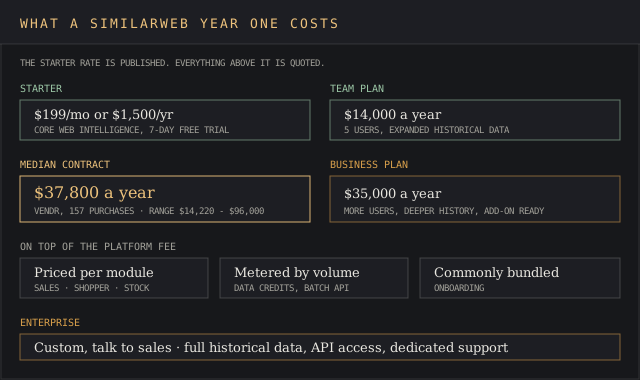
Similarweb pricing starts at $199 a month for the self-serve Starter plan, or $1,500 a year on annual billing. Above that, similarweb pricing moves to quoted tiers: the Team plan runs $14,000 a year, the Business plan runs $35,000 a year, and Enterprise pricing is custom and requires sales contact.
Similarweb is a digital intelligence platform built for market research, competitive intelligence, and web intelligence across websites, apps, and digital channels. Vendr's marketplace records a median Similarweb contract of $37,800 a year across 157 purchases, with observed deals running from $14,220 to $96,000, and buyers saved 12.27 percent on average.
This page covers what each paid plan includes, the add-on modules, the free trial limits, what drives similarweb pricing up, and how similarweb pricing compares to Semrush and Ahrefs. Figures were checked on 30 July 2026.
Similarweb pricing compared to the alternatives
One of the three platforms below publishes a full rate card. The other two price on the same job at different points, so the table reads as a spread.
| Platform | Entry price | Model | Strength | Our review |
|---|---|---|---|---|
| Similarweb | $199/mo, quoted above Starter | Modular tiers plus add-ons | Digital intelligence across web, app, and stock data | Similarweb review |
| Semrush | $139.95/mo Pro | Published tiers, Adobe-owned | SEO and content marketing tools | Semrush review |
| Ahrefs | $29/mo Starter, $129 Lite | Published tiers | Backlink analysis and organic search | Not reviewed |
Our Semrush pricing report has the full tier breakdown: its Pro plan starts at $139.95 monthly, cheaper than Similarweb's $199 Starter plan. Semrush leans toward SEO tools and content workflows; Similarweb leans toward broader market intelligence tools and competitive analysis across web, app, and financial data.
One difference sits outside the feature list. Adobe closed its $1.9 billion acquisition of Semrush on 28 April 2026, so a buyer signing a multi-year Semrush contract is contracting with an Adobe-owned product; Similarweb remains independent and publicly traded.
Similarweb vs Ahrefs
Ahrefs is the cheapest of the three and the most SEO-specific. Its Starter tier runs $29 a month, with Lite at $129, Standard at $249 and Advanced at $449, and it delivers better value for pure backlink work.
It has no equivalent to App Intelligence, Stock Intelligence, or Sales Intelligence. A buyer who needs app-store data, alternative data for equity research, or B2B prospecting signals is not choosing between these two tools at all.
Similarweb pricing at a glance
| Tier | Cost | Covers |
|---|---|---|
| Starter | $199/mo or $1,500/yr | Core web intelligence, 7-day free trial |
| Team plan | $14,000 a year | 5 users, expanded historical data |
| Business plan | $35,000 a year | More users, deeper historical data, add-on eligibility |
| Enterprise | Custom, talk to sales | Full historical data, API access, dedicated support |
The Starter-to-Team jump is the widest in the ladder. Multiple pricing tiers exist above it because data volume, user count, and historical data depth move independently.
How much does Similarweb cost
Similarweb runs a tiered modular pricing structure. The base fee buys web intelligence; more users, more historical data, or an add-on module all price separately.
The Starter plan
The Starter plan costs $199 a month, or $1,500 a year on annual billing, which works out to $125 a month. It's the only tier with a published rate and the only one a buyer can activate directly.
The Team plan
At $14,000 a year for around 5 users, the Team plan adds deeper historical data and higher usage limits than Starter; it's the entry point for add-on modules.
The Business plan
The Business plan costs $35,000 annually, extending user counts, historical data depth, and data credits past the Team plan; it's where mid-market marketing teams and sales teams land once they outgrow self-serve.
The Enterprise plan
Enterprise plan pricing is custom, and talk to sales is the only path to an actual number. Business and enterprise tiers both unlock API access, but Enterprise adds batch API calls, enterprise grade security commitments, advanced features like custom dashboards, and dedicated account management.
$37,800 across 157 recorded purchases, with $14,220 at the bottom and $96,000 at the top of Vendr's range. That spread is the only comparable-company evidence available once a quote moves past the published Starter rate.
What the median contract looks like
Vendr's dataset puts the median Similarweb contract at $37,800 a year across 157 purchases, with a range of $14,220 to $96,000 and average savings of 12.27 percent.
Small teams on the Team plan land near the bottom of that range. A mid-market deployment with several add-on modules and a larger user count pushes toward the $96,000 top of Vendr's observed range, and nothing in that dataset is evidence for what sits above it.
Similarweb's free trial and free plan
What the free trial includes
Similarweb offers a 7-day free trial for the Starter plan. A credit card is required to activate the similarweb free trial, and it allows 15 actions per day. Users can explore core web intelligence features during the trial: traffic data, competitive analysis, and basic market insights.
What free plan users don't get
The free plan and free version, run through the Chrome extension, offer only limited access to web data. The trial excludes premium modules like API access, and there's no free version of Team, Business, or Enterprise data.
Similarweb's add-on modules
Similarweb offers three premium add-ons on top of Web Intelligence: App Intelligence, Market Intelligence, and Conversion Analysis. Three further products sit outside that bundle, each priced on its own: Sales Intelligence, Shopper Intelligence, and Stock Intelligence. Add-ons are available for Team plans and above.
App Intelligence
App Intelligence provides insights into daily app performance, user engagement, and app data across iOS and Android. It covers android insights and store rankings alongside store downloads, so a mobile team tracking mobile growth against a rival's app gets the same store-level view Web Intelligence gives for desktop traffic.
Market Intelligence
Market Intelligence offers an overview of market trends and consumer behavior. It's often bought alongside the Business plan by teams needing market research on a whole category.
Conversion Analysis
Conversion Analysis tracks competitor performance and incoming traffic quality, turning traffic sources into a funnel view: where visitors came from and how many converted once they landed.
Sales Intelligence
Sales Intelligence is designed for sales-related analysis and B2B prospecting. It layers contact data onto firmographic profiles, and sales teams use it to increase sales by prioritizing accounts already showing digital signals of buying intent.
Shopper Intelligence
Shopper Intelligence is the standalone product built for retail and ecommerce, pairing traffic data with purchase-intent signals. It's a narrower buy than the other add-ons, aimed at category managers.
Stock Intelligence
Stock Intelligence covers premium stocks and public-company data: stock performance, stock feeds, and digital signals used as an alternative-data layer for equity research. Investors use it alongside expert research.
Web Intelligence features included in every paid plan
Traffic data and digital insights
Every paid tier includes web intelligence features: traffic data across desktop and mobile, digital insights on where visitors come from, and channel-level breakdowns by source. The underlying panel and clickstream data gives granular engagement data down to time-on-site and page depth beyond simple visit totals.
Competitive benchmarking and competitive analysis
Competitive benchmarking sits at the center of the product. Competitive intelligence tools like Similarweb exist specifically to make competitive analysis fast: pick a rival, see its traffic, and see how the two compare on the same digital channels.
Organic search and paid search
Organic search and paid search data cover keyword rankings, estimated traffic value, and ad spend patterns, overlapping with dedicated SEO tools, which is why some buyers run Similarweb alongside a keyword-focused tool.
Backlink analysis and subdomain analysis
Backlink analysis in Similarweb reports referring sites and the referral traffic they send, so it answers which partners drive visits. Link counts don't factor into that view. Subdomain analysis splits a domain's traffic by subdomain, showing if a competitor's blog, store, or help centre carries the volume.
That pairing rounds out the web intelligence set, giving a fuller picture of a domain's structure than traffic numbers alone. Both sit shallower than a dedicated link tool and deeper on traffic attribution.
Audience insights
Audience insights break down a site's visitors by demographic and interest category, giving marketing teams deeper insights into a competitor's audience beyond its size.
API access and batch API pricing
API access is priced separately from the base subscription. Similarweb API pricing depends on call volume and on the choice between the batch API for bulk queries and a lighter single-lookup tier, and API pricing scales up sharply at enterprise call volumes.
Data credits meter API and bulk-export usage; higher tiers include more before overage charges apply. The batch API increasingly feeds AI agents that pull bulk similarweb data programmatically.
What drives Similarweb pricing
Historical data depth
Historical data is the single biggest lever in a quote. Starter caps historical data at a few months back; Team, Business, and Enterprise each unlock progressively more historical data, and a research team asking for years of history pays for it.
Number of users
User count multiplies the base fee at every tier above Starter. Team plans commonly cover around 5 users; Business and Enterprise scale seat counts up from there, with per-seat rates improving at volume.
Add-on modules
Each add-on, App Intelligence, Market Intelligence, Conversion Analysis, Sales Intelligence, Shopper Intelligence, and Stock Intelligence, adds its own line to the quote. Buying two or three at once is common among enterprise plans and rare among Team-tier buyers, and it's the fastest way a similarweb plan doubles in price year over year.
Contract length and billing
Monthly billing typically adds a 20-25 percent premium compared to annual contracts, and multi-year contracts can yield 10-25 percent lower annual pricing. Similarweb pricing is typically annual once a buyer moves past Starter.
Hidden costs to budget for
Add-on modules for Similarweb, such as Sales Intelligence and Shopper Intelligence, carry separate pricing that rarely shows up in the first quote. Data credit overages on the API side are the second trap: a team that underestimates batch API volume gets billed for the gap. Enterprise plans commonly bundle onboarding, but confirm it in writing before signing.
A non-US buyer can pay in USD through Wise Business at real exchange rates, skipping a card network's markup.
How to negotiate Similarweb pricing
Choose the right plan for actual needs, and audit usage regularly to avoid paying for unused features. Multi-year contracts can yield 10-25 percent lower annual pricing, and negotiating volume-based pricing brings down the cost of each incremental seat or module.
Bringing a competing Semrush or Ahrefs quote to the table is standard practice and gives real pricing power on the final number.
Who buys Similarweb
Marketing teams
Marketing teams buy Similarweb for competitive benchmarking and market research: traffic against named rivals, brand visibility across digital channels, digital marketing spend allocation, and market insights that inform where budget shifts next quarter. Protecting brand visibility against a fast-moving rival is often the line item that gets the purchase approved.
Sales teams
Sales teams buy the Sales Intelligence add-on to increase sales through account prioritization, layering contact data and traffic signals onto an existing CRM.
Category managers and small teams
Retail buyers use Shopper Intelligence and App Intelligence together to track a category across web and app, led by category managers. Small teams on the Starter or Team plan skip the add-ons and stay ahead of one or two named competitors at a cost-effective price.
Common questions about Similarweb pricing
How much does Similarweb cost?
Similarweb pricing starts at $199 a month for the Starter plan, or $1,500 a year on annual billing. The Team plan costs $14,000 a year, the Business plan costs $35,000 a year, and Enterprise pricing is custom. Vendr's median across 157 purchases is $37,800.
What does Similarweb cost?
Total cost depends entirely on tier and add-ons. A single Starter seat is $199 a month. Past that, Vendr's observed range of $14,220 to $96,000 across 157 purchases is the only public evidence of what real contracts settle at.
Can I use Similarweb for free?
Similarweb offers a free plan and a Chrome extension with limited access to web data, plus a 7-day free trial on the Starter plan that requires a credit card. Neither includes API access or the premium add-ons.
Is there a free alternative to Similarweb?
Google Search Console and Google Analytics give a site's own traffic data for free, but neither shows a competitor's numbers, which is the reason most buyers pay for Similarweb, Semrush, or Ahrefs in the first place.
Is Similarweb legit?
Yes. It's a publicly traded digital intelligence platform (NYSE: SMWB) used by marketing teams, sales teams, and investors for market research and competitive analysis, with similarweb data behind its web intelligence products drawn from panels, ISPs, and public sources.
Does Similarweb cost money?
Past the free trial and free plan, yes. Every paid plan, Team, Business, and Enterprise, runs on typically annual billing with the pricing structure described above.
Which is better, Semrush or Similarweb?
Neither is universally better. Semrush is the more cost effective pick for SEO tools and content work; Similarweb is the broader market intelligence tool for competitive intelligence and brand visibility across web, app, and financial data.
What is the limit of Similarweb?
Limits scale by tier: the free trial allows 15 actions per day, Starter caps historical data at a few months, and higher tiers raise data credits, user counts, and historical data depth up to Enterprise, which removes most caps.
Is Similarweb a good stock to buy?
That's a financial decision outside the scope of a pricing guide and isn't investment advice. Similarweb's own Stock Intelligence module covers premium stocks and stock performance data for other public companies; it says nothing about Similarweb as an investment.
Can I cancel a Similarweb subscription?
Team, Business, and Enterprise contracts run on annual terms, so cancellation depends on the signed agreement. The Starter plan, billed monthly or annually, is the only tier with straightforward self-serve cancellation.
How trustworthy is Similarweb?
Reviewers generally trust the platform's directional data and market trends over time more than its exact traffic numbers for a single small site, where modeled estimates carry wider error bars.
Is Similarweb better than Semrush?
For market research and competitive intelligence spanning web, app, and stock data, yes. For SEO tools and content workflows, Semrush's lower paid plan pricing usually wins out.
What to budget
Anchor Similarweb pricing expectations on $199 a month for a single Starter seat, $14,000 a year for a small team on the Team plan, and $35,000 a year for a Business plan with room for one add-on. Vendr's median of $37,800 across 157 purchases is the number to push back against on any quote above it.
Budget separately for add-on modules if Sales Intelligence, Stock Intelligence, or App Intelligence will see real use, since those carry separate pricing that rarely appears in the first conversation, and ask for each as its own line.
Audit usage every renewal, since paid plan sprawl across unused seats and modules is the most common way costs drift upward, and annual billing delivers better value than monthly on every tier above Starter. Competitive intelligence and brand visibility are the reason the budget gets approved in the first place; treat them as the return that justifies the cost.