Placer AI pricing in 2026: what 9 public contracts show it costs
 By Jan Suski. I go deep on every review, checking every number against its source and digging up details other coverage misses, a habit from six years of SEO and link building for tech companies. Bylines at Surfer, Brand24, and Senuto. How the scoring works.
Placer.ai keeps its rate card behind a sales form. The pricing page offers "customized subscription packages", a form promising "a personalized solution that best fits your business" and a banner calling Placer "Loved & trusted by thousands of industry leaders."
The only figures on that page come from a case study. The prices live in council packets: nine Placer Labs order forms and contract memos filed by US cities, counties and districts put one year of the platform at $12,000 to $34,000, and a three-year Utah deal reaches $37,485 in its final year.
This report reads those forms: what each fee buys, how the 104-credit and 260-credit allowances split the price, the add-ons billed outside the platform fee, and a renewal clause that moved from a 5% floor to an 8% cap. It's written for retail real estate teams, restaurant operators, brands with physical stores, economic development offices and anyone searching for a Placer.ai cost per month before the first sales call.
Most civic forms limit coverage to one state. Bloomington, Indiana paid $31,000 for "all major US venues", the widest scope in any public form. Fees checked on 6 October 2026.
The numbers Placer.ai public contracts, checked 6 October 2026
Every 260-credit contract costs at least $30,400 a year, and every 104-credit contract sits at or below $20,900.
Multi-year terms fix the step in advance: Haltom and Greater Salt Lake pay 5.0% more each year, and Madeira Beach pays 12.5% more in year two.
Renewal language moved from a 5% floor in the 2023 and 2024 forms to an 8% cap in the newer ones.
How much does Placer AI cost per year and per month
Placer.ai costs $12,000 to $34,000 a year in year one across the nine public order forms, or $1,000 to $2,833 a month. Every form that states billing terms invoices the annual fee in one payment, so the monthly figure is a budgeting unit.
| Buyer | Year-one fee | Term | Xtra credits a year | Uplift clause |
|---|---|---|---|---|
| Huerfano County, CO | $12,000 | 12 months | 104 | CPI or 5% |
| Madeira Beach, FL | $12,000 | 36 months | 104 | Up to 8% or CPI |
| Fruita, CO | $13,800 | 24 months | 104 | Up to 8% or CPI |
| St. Francis, MN | $14,750 | 12 months | 104 | CPI or 5% |
| Haltom City, TX | $20,685 | 24 months | Unstated | Up to 8% or CPI |
| Cartersville, GA | $20,900 | 24 months | 104 | Up to 8% or CPI |
| Sapulpa, OK | $30,400 | 12 months | 260 | CPI or 5% |
| Bloomington, IN | $31,000 | 12 months | 260 | CPI or 5% |
| Greater Salt Lake MSD, UT | $34,000 | 36 months | 260 | CPI or 5% |
Fees are the year-one figures printed in each buyer's order form or council memo, linked in the first column, and the table carries no Vendr medians.
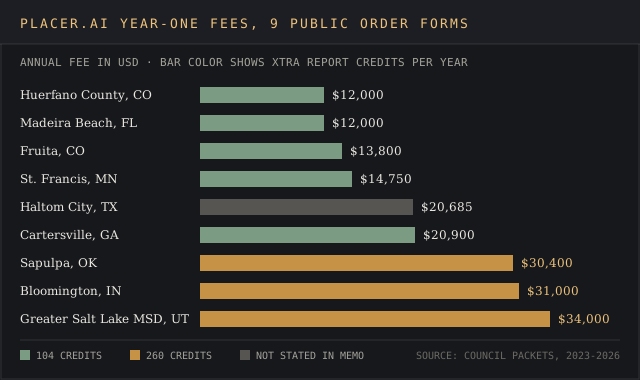
A Charles City, Iowa agenda summary listed Placer.ai at $15,000 a year, inside the 104-credit band, with no order form attached.
Madeira Beach owes $40,500 over 36 months. Greater Salt Lake owes $107,185 over the same 36 months.
Placer.ai plans as the order forms define them
Placer names no plans in public, though its pricing page says the packages are "designed to provide you with valuable insights." The forms sort into four shapes.
Free edition
Placer runs a freemium version. Its own FAQ calls it "just a small display of the full platform" and says Placer doesn't offer free trials "of our full suite of features." Educational users get pointed to it and invited to "take advantage of the no-cost insights we offer." The free account is the right place to explore chains and start searching venues before a demo, since it costs nothing to see how the dashboard draws a trade area map.
104-credit platform tier, $12,000 to $20,900 a year
The devil's in the details. Five of the nine forms carry a "Quarterly Maximum of 26 credits; Annual Maximum of 104" on Xtra reports. Huerfano County and St. Francis list $12,000 and $14,750 for one-state access with the STI Demographics Bundle, the Mosaic data set and AGS CrimeRisk included. Cartersville lists $20,900 for the same 104 credits plus 1,040 POI requests a year, four times the 260 that Fruita and Madeira Beach get.
260-credit platform tier, $30,400 to $34,000 a year
The upper band carries 2.5 times the report allowance: 65 credits a quarter, 260 a year. Sapulpa's form lists $30,400 and Bloomington paid $31,000 for 12 months. Bloomington's form adds "unlimited users", unlimited points of interest, premier support and "Unlimited exports to PDF, CSV, JPEG, SHP and KMZ."
Enterprise-wide licenses and API access
Placer's FAQ answers "Yes" to enterprise-wide licenses. The API sits outside the dashboard license: Placer's API documentation says it needs "a paying Placer account" with "the Placer API add-on enabled," and each account gets its own usage plan with a maximum weekly quota. The API key comes from your success manager.
What each Placer.ai subscription includes, and what it caps
The data caps sit in places a demo skips. Read between the lines of the reports list and the order form tells you which questions the data answers each quarter.
- Users and venues: Placer's FAQ says "You can analyze an unlimited number of properties, as well as chains and industries." Greater Salt Lake's September 2024 analysis lists "Unlimited Users within Economic Development."
- Standard reports: visits, trade areas, journey, audience insights, dwell times and traffic by hour and day.
- Xtra reports: 104 or 260 credits a year, released quarterly, so unused credits can't be pulled forward.
- POI requests: 260 a year in Fruita's and Madeira Beach's forms and 1,040 in Cartersville's. The Utah review lists indexing trails, POIs and regions at no added cost.
- Geography: one state in most civic forms; Bloomington's covers all major US venues.
- Support: Placer assigns customers a dedicated Customer Success Manager, and the FAQ says that service "is included in the subscription price and does not require an additional fee."
- Data sharing: Fruita's form lets the buyer cite Placer data in reports and marketing, and bars resale and use "to train third-party artificial intelligence."
Placer sells no one-time data reports, and its FAQ says why: "Placer.ai is a subscription service that combines unlimited dashboard access with a Customer Success service." A team that needs one trade area study for one new location pays for a full year.
Add-ons priced outside the platform fee
Cartersville's form shows the add-on structure in plain dollars. Platform Access costs $39,520 over 24 months, Esri Infographics adds $3,952, and four more lines are listed at $0: Esri Basemaps, Chains Report Expanded, Void Analysis and the Advanced Market Report. Fruita's form zeroes out the same four lines on a $28,800 two-year platform fee. Esri Infographics is a drop in the bucket next to the platform line, at a tenth of its price.
Those $0 lines are the cheapest ask in a negotiation, because Placer already prints them as free in other buyers' contracts. Void Analysis matters to any shopping center owner chasing tenants for empty space, and Chains Report Expanded is how a retail team benchmarks its stores against every rival chain in the trade area.
The data API is the other priced add-on, quoted per account. Placer's API page describes it as a way to "extract Placer's aggregated data for use in any 3rd party application", covering foot traffic trends, True Trade Area mapping, demographics and rankings.
The geospatial data guide adds a Marketplace of "more than 20 geospatial datasets" that plug into the platform, each a candidate for its own line item. Ask for the ability to export to your BI tool in writing, since the API and feed products are the routes Placer lists for it.
What the foot traffic data behind the fee measures
Every tier sells the same foot traffic data, built from location data on phones. Placer's data page says its panel "is comprised of tens of millions of mobile devices" sourced through mobile applications from vetted providers. Its methodology strips device IDs, aggregates the data points and extrapolates traffic estimates for US locations from a single store to a shopping center or downtown, which shows how consumers move between them.
Privacy sets the floor on coverage. The panel has to capture a site before Placer shows anything: data appears only "for locations with more than 50 unique devices," so a rural convenience store can come back thin while a mall reports visitors by the hour. That count feeds the metrics buyers pay for, and a chain can analyze competitor stores the same way it reads its own: dwell time, loyalty, true trade areas and where a chain's customer base lives.
Retailers get a second use from the same feed. Placer's guide says retailers "can utilize their physical footprints to generate advertising revenue" through retail media networks, that advertisers can use retail foot traffic data to "track visitation patterns at different chains," and that retailers can "identify peak visitation times for different audience segments."
What drives a Placer.ai quote
Seats and venue counts sit outside the meter. The order forms price on five things:
- Report credits: 104 a year keeps a one-state contract between $12,000 and $20,900; 260 a year starts at $30,400.
- Geography: one state for most civic buyers, all major US venues for Bloomington at $31,000.
- POI requests: Cartersville's 1,040 requests sit on a $20,900 year one, against Fruita's 260 at $13,800.
- Term: 12, 24 or 36 months, each with its own step schedule.
- Industry and add-ons: the sales form asks for one of 14 industries, from CRE to entertainment, and Esri Infographics or the API stack on top.
A food brand in the restaurant industry comparing dining traffic at 40 locations needs a different set of chain reports from a landlord tracking occupancy rates across a portfolio of retail space.
Hidden costs: renewal uplift, auto-renewal and non-refundable fees
The year-one fee is the number on the council agenda. The anniversary clause compounds, and its importance grows with every renewal because it changed between contract generations.
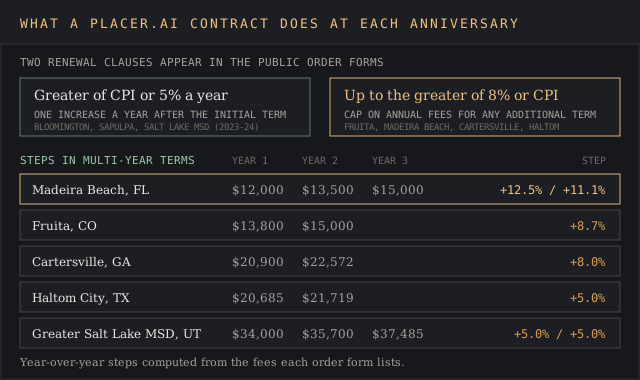
After the initial term, Bloomington's 2023 form lets Placer raise fees once a year by "the greater of CPI or five percent (5%) per annum." That's a floor: 5% is the minimum increase. Sapulpa, St. Francis and Huerfano County carry the same clause, and their 12-month terms auto-renew unless the buyer sends written notice at least 30 days before expiry.
The newer forms in Fruita, Madeira Beach, Cartersville and Haltom cap fees for an additional term at "up to the greater of eight percent (8%) or CPI." Fruita's renews only "if mutually agreed in writing by both parties." Madeira Beach's lets Placer send notice of different pricing 30 days ahead, so the 8% figure is a ceiling with an exit for the vendor.
Three more lines deserve a red flag:
- Fruita's form says "All Fees are non-refundable" and the buyer pays in full on any termination.
- Sapulpa and St. Francis carry a finance charge of 1.5% a month on overdue balances, with payment due in 30 days.
- Bloomington's form allowed 60 days to pay; Fruita's and Madeira Beach's allow 30.
Implementation is the one cost that comes in at zero. The Greater Salt Lake review lists "No implementation costs", so onboarding sits inside the subscription fee.
What buyers pay in practice
Placer Labs has a listing on Vendr's marketplace with no contract-value data on it. Similarweb's Vendr listing carries a $37,800 median across 157 purchases, per our Similarweb pricing report, so the public order forms are the only Placer benchmark. Start searching your own state's council agendas for Placer Labs order forms before you shop for a quote.
Haltom City's September 2026 memo is straight from the horse's mouth on how a renewal negotiation lands: $20,685 for year one and $21,719 for year two, a 5.0% step, which the memo estimates saves "approximately $3,000 to $6,000 over the two-year period" against two annual renewals.
On G2, where Placer.ai has 12 reviews, a program manager at an enterprise of 1,000+ employees listed "Relatively expensive." as a con in February 2023, and a business specialist at an IT services firm wrote "Comparably pricey" in April 2023. A consulting director at a small business went further:
"Cost: Placer.ai is a powerful tool, but it can be expensive depending on the size of your business and the level of insights you need. This may make it less accessible for smaller businesses or those with limited budgets."
Sumit M., Director, Consulting, small business (50 or fewer employees), G2, 4 April 2023
The same reviewer credited the platform with letting the firm "optimize our staffing levels and improve our customer service" by watching store traffic. A small apparel and fashion business reviewing on G2 in December 2022 framed the price as the deciding factor:
"Pricing is always one of the critical aspects while deciding and finalizing the product, and Placer.ai is placed a bit on a premium side."
Verified User in Apparel & Fashion, small business (50 or fewer employees), G2, 1 December 2022
Civic buyers agree. A parks and recreation director in government administration wrote on Capterra in March 2025: "Cost was the only factor that was a con. It is expensive but worth the cost".
How to negotiate a Placer.ai contract
Each clause below appears in another buyer's order form. Haltom's 5.0% two-year lock points in the right direction for any buyer. Get the ball rolling with the free account, then bring these asks to the table:
- Ask for a multi-year lock at 5.0% steps, the rate Haltom and Greater Salt Lake got, and refuse the 8.7% and 12.5% steps in Fruita's and Madeira Beach's forms.
- Strike "greater of CPI or 5%" and replace it with a cap. An uncapped floor compounds every year after the initial term.
- Size the credits to the work, and analyze last year's report count before picking a tier. 104 credits works out to 26 a quarter, and 260 credits cost at least $9,500 more a year.
- Request the four $0 lines by name: Esri Basemaps, Chains Report Expanded, Void Analysis, Advanced Market Report.
- Put the 30-day non-renewal deadline in a calendar the day the form is signed, and send the notice to the addresses the form lists.
- Comparison shop with the forms in this report. A quote above $20,900 for 104 credits in one state sits above every public contract.
Who Placer.ai is priced for: site selection buyers
Placer.ai is priced for buyers making real estate decisions in the physical world: landlords pricing leases across several locations, retailers and restaurants picking a site, towns chasing retail growth. The pricing page's own case study has Alpine Income Property Trust using Placer to bid on a store asset it later sold at a 6.5 cap rate for a risk-adjusted return above 20%, a vendor-published claim.
RestaurantSiteFinder, a free tool aimed at restaurants and food brands, says it plainly in a June 2026 post: "For massive commercial real estate trusts or national retail conglomerates, the ROI makes sense." The same post argues that specialized tools suit niche needs better, that emerging brands look for alternatives on price, and that an inaccurate POI database "might attribute foot traffic from a neighboring bustling grocery store to your quiet restaurant site."
A coffee shop owner or a two-location sandwich shop reads that as a sign Placer would cost an arm and a leg, and a reason to shop around before signing.
Every Placer price point in this report comes from a civic buyer using the same data and technology retailers use to optimize store hours. The public sector market intelligence guide covers what else those offices buy.
Placer also gives a slice of its data away. The Anchor, which Placer calls "a hub for critical market insights," publishes free articles on retail trends, dining, entertainment and the macroeconomic pressures on retail corridors, which lets small shops read how consumers move without a contract.
Its Super Bowl LX Bay Area study found a 479.1% traffic surge at the Ferry Building projection show as tourism lifted the Bay Area, and its World Cup opener report recorded a 264.0% Friday spike at a nearby Pollo Campero, with Sizzler up 185.9% among other nearby restaurants as consumers poured in for the match.
Placer.ai against other location intelligence platforms
Location intelligence platforms mostly quote. The ones that publish a number sell a narrower slice of the market, so the table compares the lowest published price with what it buys.
| Vendor | Lowest published price | What that price buys | Built for |
|---|---|---|---|
| Placer.ai | $0 freemium; paid plans quoted, $12,000 a year in public forms | Dashboard, trade areas, 104 Xtra credits | Retail, CRE, civic, restaurants |
| Growth | $5,000 one-time Discovery; Enterprise quoted | A 30-day read of what drives your stores | Retail site selection teams |
| BestTime | $29 a month minimum, metered at $0.04 per API credit | Venue foot traffic forecasts, sold as API technology | Developers embedding venue data |
| Dewey | $3,600 a year, Researcher plan | 30+ premium data providers, 3 active projects | Academic researchers |
| Esri ArcGIS Business Analyst | Quoted; Advanced Bundle carries 6,000 credits | Demographics, site reports, map layers | GIS and market analysts |
| Restaurant | $0, free tool | Restaurant-focused location analysis | Restaurant operators |
Placer.ai's $12,000 is the lowest year-one fee in the public order forms. The other prices are each vendor's own published figures, and the table carries no Vendr medians.
For teams searching for a cheaper entry point, BestTime.app sells per-venue foot traffic metrics from $29 a month. GrowthFactor is the closest like-for-like for a chain: its $5,000 one-time read lets a team zero in on its own stores. For location intelligence at the scale of a national retailer, the quoted options here are Placer, Esri and GrowthFactor's Enterprise plan.
Our alternative data providers ranking puts Placer.ai fifth, the real estate data providers ranking eighth, and the retail analytics software ranking scores it against seven other retail tools. The data providers guide maps the wider field. Landlords who want to join Placer feeds with ownership records should read the Cherre review; consumer goods teams pairing store traffic with sales data should start with the NielsenIQ review.
What to budget for Placer.ai
Budget in three steps: the band, the term and the anniversary. Then keep an eye on the credit counter, since Xtra credits release quarterly and a team that runs dry in month two waits for the next quarter. A team that wants to hit the ground running should map its first two quarters of store and site questions before picking 104 or 260 credits.
- One state, 104 credits: $12,000 to $15,000 a year, or $1,000 to $1,250 a month, enough for a team that wants to explore a few dozen locations and restaurants per quarter.
- One state, 104 credits plus 1,040 POI requests or Esri Infographics: about $21,000 a year.
- 260 credits or coverage of all major US locations: $30,400 to $34,000 a year, or $2,533 to $2,833 a month.
- Three-year 260-credit deal at 5.0% steps: $107,185 in total, as Greater Salt Lake signed.
Add 5% to 8% for every year past the initial term, and add the API if anyone plans to pull Placer data into other technology the team runs. The market intelligence platform pricing report sets these figures against five spending tiers, and the retail real estate market report sizes the market these contracts serve.
Frequently asked questions
How much does Placer.ai cost per month?
Buyers searching for a monthly price get $1,000 to $2,833 a month in year one, from $12,000 to $34,000 a year in public order forms.
Is there a free version of Placer.ai?
Yes. Placer runs a freemium edition, which its FAQ describes as "just a small display of the full platform." Free trials of the full suite aren't offered.
How reliable is Placer.ai data?
Placer says on its accuracy page that it tests its estimates against first-party data from Placer clients and public counts such as Major League Baseball attendance, and adjusts its algorithms "usually no more than once a year."
What are panel visits in Placer.ai?
Panel visits are the raw counts Placer's device panel records at a site before Placer extrapolates them into estimates.
Is Placer.ai legal to use?
Placer removes device identifiers and pools panel data before anyone sees it, and its order forms bar buyers from reselling the data or training third-party AI on it.
What is Placer.ai's current valuation?
SiliconANGLE reported in August 2024 that Placer raised $75 million at a valuation of "almost $1.5 billion," and that Placer forecast 60% growth for 2024.
Bottom line
Placer.ai costs $12,000 to $34,000 a year in the nine public contracts, with the 104-credit and 260-credit allowances setting which band a buyer lands in.
The anniversary clause sets what years two and three cost. Lock a 5.0% step for two or three years, ask for the four $0 lines by name, and calendar the 30-day notice before signing.
Where the Placer.ai figures come from, and what Placer keeps off its site
Fees, terms, credit allowances, add-on lines and renewal clauses come from Placer Labs order forms and council papers filed by Huerfano County and Fruita in Colorado, Madeira Beach in Florida, St. Francis in Minnesota, Haltom City in Texas, Cartersville in Georgia, Sapulpa in Oklahoma, Bloomington in Indiana and the Greater Salt Lake Municipal Services District in Utah, dated 2023 to 2026, plus a Charles City, Iowa agenda summary.
Product scope, the free edition, the 50-device threshold and API terms were read off placer.ai and docs.placer.ai. Reviewer quotes are from g2.com and capterra.com, dated where quoted. Rival prices come from growthfactor.ai, besttime.app, deweydata.io, esri.com and restaurantsitefinder.com, and the valuation from siliconangle.com, August 2024. Fees were checked on 6 October 2026.
Placer.ai prints no rate card, no plan names and no API price. Vendr's Placer Labs listing at vendr.com carries no contract values, so the public order forms are the only benchmark for a Placer quote.