S&P Global Mobility review: the automotive data business, now Mobility Global
 By Jan Suski. I go deep on every review, checking every number against its source and digging up details other coverage misses, a habit from six years of SEO and link building for tech companies. Bylines at Surfer, Brand24, and Senuto. How the scoring works.
· Prefer this source on Google
Best for
Automakers and dealer groups that want vehicle-lifecycle breadth, from history to forecasting, in one vendor that replaces separate point tools for each piece.
Not for
Buyers who want deep specialization over breadth: JATO Dynamics goes deeper on cross-market specs and pricing, MarkLines on supplier and production data.
What it costs
No published rate card. CARFAX averages about $17,100 a year per dealer; B2B products and Lenders plans are quoted and negotiated deal by deal.
- Segments
- Two: CARFAX and B2B
- Brands
- CARFAX, automotiveMastermind, Polk Automotive Solutions and Market Scan
- CARFAX
- Vehicle history reports, dealer listings, lender products and consumer subscriptions; 81% subscription revenue in fiscal 2025
- B2B
- Marketing & Sales at 74% of fiscal 2025 segment revenue, Strategy & Planning at 26%; 82% subscription revenue
- Dealer customers
- More than 40,000 as of December 31, 2025
- Contributory network
- More than 92,000 dealers and service shops, 6,300 police agencies and 36 OEMs
- Connected vehicle data
- Operational and behavioral data from in-car technology feeding the analytics products
- AI
- Integrated across product planning and sales optimization
- Revenue base
- $1,750 million in fiscal 2025: CARFAX $1,142 million, B2B $608 million
- Latest quarter
- $468 million in Q2 2026, of which $383 million was subscription revenue
- First standalone results
- Q2 2026 reported August 7, 2026: $468 million revenue, CARFAX $312 million and B2B $156 million
- Full-year 2026 guidance
- Cut to $1.87 billion to $1.885 billion on a CARFAX go-to-market miss and softer automotive activity outside the US
- Dividend
- $0.06 a share quarterly, initiated after the separation
- Long-term debt
- $1,981 million at June 30, 2026 against zero at December 31, 2025
- New in 2026
- CARFAX live in Germany, plus two new products, Homegrown and Showroom
- Rate card
- Not published for either segment; every figure arrives in a sales conversation
- CARFAX per dealer
- Roughly $17,100 a year, about $1,430 a month: $685.2 million of Advantage and Listings revenue over 40,000+ dealer customers, an average across the base
- One dealer’s quote
- $1,089 a month for unlimited Reports plus Car Listings, posted by a Los Angeles used-car dealer on the DealerRefresh forum, August 1, 2024
- CARFAX for Police
- $0 for partner agencies, against a report CARFAX values at up to $39, in exchange for crash and records data
- CARFAX for Lenders
- Three published plan shapes, Everywhere, Everywhere Plus and Pay Per VIN, with no prices attached to any of them
- B2B products
- Quote only; no automotiveMastermind, Polk or Market Scan rate is published anywhere
- Electrification outlook
- Roughly half of all new vehicles produced globally electric by 2031
- Buyer and supplier shifts
- 80% of shoppers consider buying online, 75% of suppliers adopting green manufacturing, 70% reworking supply chains
- Closest competitors
- JATO Dynamics on specifications and pricing across 50 countries, MarkLines on supplier and production data
- Existing agreements
- Carry over to Mobility Global Inc. after the separation
- Renewals
- Negotiated with a company that cut full-year guidance in its first standalone quarter
- Contract length
- Multi-year, which is why the vendor’s own risk profile matters at signing
- Vendor disclosure
- Quarterly results and EDGAR filings, from the August 7, 2026 release onward
- Listing
- NYSE ticker MBGL since July 1, 2026
- Share distribution
- One Mobility Global share per S&P Global share held at the June 15, 2026 record date
- Leadership
- William W. Eager as chief executive and Matt Calderone as chief financial officer, from July 1, 2026
- Segment presidents
- Scott Fredericks at CARFAX, Joseph S. LaFeir at Mobility Business Solutions
- Public filings
- Quarterly and annual reports on EDGAR, earnings releases on the investor relations page
- Named risk factors
- Customer cost cutting, competitors, economic conditions, currency rates, trade restrictions, supply chain disruption
Alternatives to S&P Global Mobility
JATO Dynamics
Not forA dealer group, lender or insurer buying vehicle history, listings or CRM software, none of which JATO sells.
MarkLines
Not forA CARFAX or Polk buyer who needs US vehicle history, dealer marketing or lender data, none of which MarkLines carries.
Pairs well with S&P Global Mobility
What the separation paperwork supports, and what it leaves to a quote
Segment revenue, the product mix, the dealer and network counts, the Q2 2026 numbers, the guidance cut, the dividend and the debt are Mobility Global’s own published figures, taken from the 12 May 2026 investor day deck, the Form 10 information statement filed 27 May 2026 and the 7 August 2026 earnings release.
The $0 police program and the three lender plan shapes are CARFAX’s own published terms; the police page is copyright 2022 and carries no later date. The roughly $17,100 per dealer figure is arithmetic on two of those published numbers, an average across the dealer base, and the $1,089 a month is what one Los Angeles dealer said a CARFAX rep quoted him on a public forum in August 2024.
No published public contract and no anonymised buyer contract data exists for this vendor, and no rate card exists either. The electrification, online shopping and supplier percentages are Mobility’s own research.
This S&P Global Mobility review covers what the automotive data business sells, what it costs, what changed when it left S&P Global, who runs it now, and what buyers should check now that the vendor is a standalone public company. The short version of the news: S&P Global completed the separation, and Mobility Global Inc. trades on the NYSE under the ticker MBGL as of July 1, 2026.
↑ FACT SHEETWhat is S&P Global Mobility
S&P Global Mobility is the automotive arm of S&P Global's data business, built around vehicle data, analytics and software sold across the car industry. Mobility provides automotive data and technology solutions through two reported segments, CARFAX and B2B, which is how the company splits itself in both the Form 10 and its quarterly releases.
Mobility generated $1,750 million in revenue in fiscal year 2025, the last full year before the separation put its numbers on their own public line. CARFAX brought in $1,142 million of it and B2B $608 million.
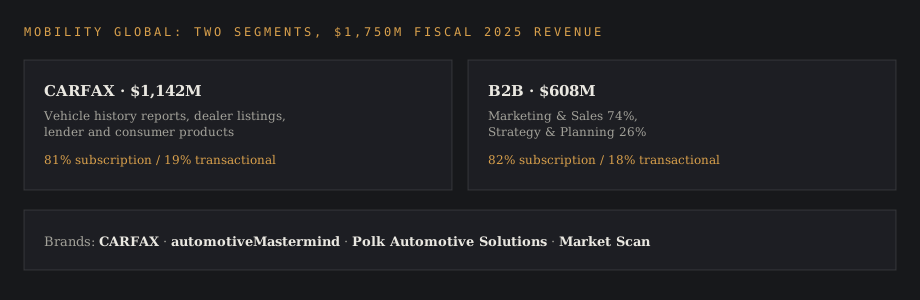
The brands are better known than the segment name. CARFAX, automotiveMastermind, Polk Automotive Solutions and Market Scan all sit inside the business, which is why a dealer, an automaker's planning team and a car shopper checking a vehicle history report can all be customers of the same company without knowing it.
The customer-facing side keeps growing because consumer demand for vehicle information is growing. Approximately 80% of car shoppers now consider purchasing vehicles online, and the services are built to feed that growing consumer demand: vehicle histories, dealer software and marketing data for a sales process that increasingly starts on a screen.
↑ FACT SHEETThe separation from S&P Global
S&P Global announced its plan to separate Mobility into a standalone company, with completion expected within 12 to 18 months of the announcement, and framed the move as a way to drive long-term value creation. Two publicly traded companies, each with focused management teams, would replace one conglomerate.
The announcement leaned on familiar S&P Global vocabulary along the way: highly synergistic core businesses, a growth strategy aimed at driving profitable growth, long-term value creation.
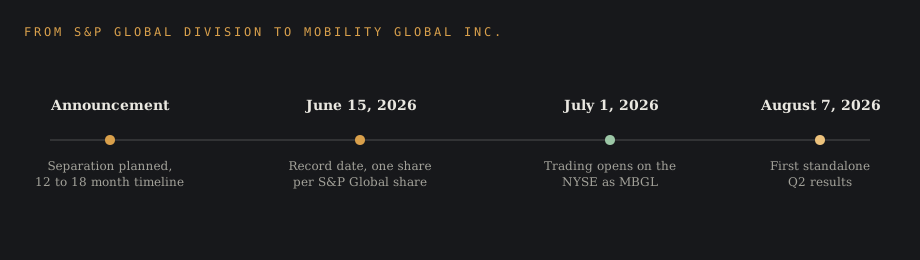
The timeline held. Mobility Global Inc. began trading on the NYSE under the ticker MBGL on July 1, 2026, with S&P Global shareholders receiving one Mobility Global share for each S&P Global share held at the June 15, 2026 record date.
S&P Global keeps the rest of the house:
- Credit ratings, still provided under its own name
- Global market intelligence for financial and commodity markets, through Market Intelligence and Global Commodity Insights, which covers commodity markets through the energy transition
- The index business behind global capital benchmarks for global equities, used by market participants across public and private markets worldwide
S&P Global brands itself as a leader providing essential intelligence to accelerate progress, language built to enable governments and large multinational organizations to plan; the ratings and indices franchises are why that line lands. Mobility takes the automotive data and runs as its own business, with its own management and its own investors.
Who runs Mobility Global
The leadership took effect with the listing. William W. Eager has been chief executive and a director since July 1, 2026, with Matt Calderone as chief financial officer. Scott Fredericks was appointed president of CARFAX on the same date, and Joseph S. LaFeir president of Mobility Business Solutions, so the two segments have named owners.
The first test came and went. Mobility Global reported $468 million of second quarter 2026 revenue on August 7, 2026, split $312 million at CARFAX, up 8%, and $156 million at B2B, up 4%. Subscriptions accounted for $383 million of the $468 million. Adjusted EBITDA margin ran 49% at CARFAX and 34% at B2B.
Guidance went the other way in the same release. The company cut its full-year 2026 outlook to a range of $1.87 billion to $1.885 billion, citing a CARFAX go-to-market approach that hadn't produced the anticipated benefits and softer automotive activity outside the United States. CARFAX also went live in Germany, and two new products, Homegrown and Showroom, reached the market.
What the separation means for buyers
A standalone vendor prices, contracts and reports on its own. Customers assess Mobility Global on its own numbers now: the $1,750 million fiscal 2025 revenue base is public, quarterly results follow as a listed company, and product investment decisions no longer compete with the rest of S&P Global's portfolio for budget.
Contract-wise, existing agreements carry over to the new entity, but renewal conversations now happen with a company whose entire income depends on automotive data. That cuts both ways: more focus on the product line, and no diversified parent absorbing a bad year in automotive markets. The first standalone quarter put a number on the second half of that, with the full-year range coming down inside six weeks of the listing.
The balance sheet changed shape in the same stretch. Long-term debt stood at $1,981 million on June 30, 2026, against zero at December 31, 2025, after $1,986 million of Senior Notes were issued to fund the separation. The company initiated a quarterly dividend of $0.06 a share at the same time, so a buyer signing a multi-year contract is now signing with a vendor that carries interest expense and a payout commitment it didn't carry a year ago.
The deal also lands in a wider stretch of merger and acquisition activity among data vendors, so a shortlist drawn up today can look different within a year.
↑ FACT SHEETReading the filings as market intelligence
The separation paperwork is itself a market intelligence source. The announcement, headlined S&P Global Announces Intent to separate the business, named Citigroup Global Markets Inc. as financial advisor, and S&P Global expects the distribution to be tax-free to shareholders for federal income tax purposes.
Its framing runs through strengthen market leadership, drive continued profitable growth, and profitable growth opportunities, and the release calls S&P Global strongly positioned around its remaining franchises after the split.
The risk factors section is the sharper read, because the company cautions readers about the exact pressures an automotive data buyer should price in: customer cost cutting pressures, new or existing competitors, worldwide economic conditions, foreign currency exchange rates, import and export restrictions, and supply chain disruptions related to trade policy.
The same list covers the ability to retain key employees, pressure on the company's cost structure, the company's effective tax rates, and the company's future cash flows, all exposed from now on to one industry's cycle in a competitive business environment and what the filings call a dynamic business environment inside a continuously evolving regulatory environment.
Ongoing diligence is public from here. The company's investor relations page carries the company's earnings release each quarter, the most recently filed quarterly report and annual report sit on EDGAR, and the company's senior management goes on the record with every result. Holders of the company's common stock and data buyers now read the same documents, which is the quiet benefit of the whole exercise.
What the data covers
The data spans the vehicle lifecycle across both segments. CARFAX sits on vehicle history reports and the dealer listings, lender products and consumer subscriptions built on top of them. B2B covers marketing and sales software sold to dealers and automakers, through automotiveMastermind, Polk Automotive Solutions and Market Scan, plus the forecasting and program planning that carmakers and suppliers buy under Strategy & Planning.
Connected vehicles push the pipeline wider, since connected technology in the car generates large volumes of operational and behavioral data that flow into analytics products, and artificial intelligence is integrated across product planning and sales optimization. The result reads less like a report library and more like workflow solutions plugged into how vehicles get planned, marketed and resold.
↑ FACT SHEETThe market the data describes
Mobility's own research sketches the conditions its customers are buying data to manage. Roughly half of all new vehicles produced globally will be electric by 2031, while automakers shift to flexible powertrain strategies. High vehicle prices and elevated interest rates affect consumer purchasing behavior at the same time.
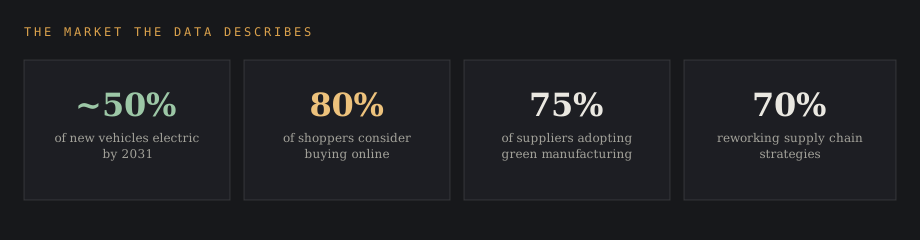
The supply side is moving too. 75% of suppliers are adopting green manufacturing practices, 70% are strengthening supply chain strategies to manage volatility in the automotive sector, and supply chain localization influences where vehicles are built and sold. Supply chain risk sits underneath both numbers.
Each of those shifts is a forecasting problem, and forecasting problems are what the Strategy & Planning side of B2B sells against: data to solve challenges the industry can already see coming.
↑ FACT SHEETS&P Global Mobility pricing
Mobility Global publishes no rate card for either segment. What the separation did produce is a revenue breakdown detailed enough to work backwards from. The company's own investor day deck of May 12, 2026 puts fiscal 2025 CARFAX revenue at $1,142 million and B2B at $608 million, with CARFAX running 81% subscription and 19% transactional, and B2B 82% and 18%.
What CARFAX charges dealers
The same deck splits fiscal 2025 CARFAX revenue by product: 38% Advantage, 22% Listings, 26% financial, consumer and other, and 15% international. Advantage is the base dealer subscription, unlimited Reports plus Auction Quick Check. Listings and CARFAX For Life are upgrades a dealer buys on top of it.
Those two lines are the dealer-billed part, and the Form 10 supplies the divisor. Advantage plus Listings is 60% of $1,142 million, or $685.2 million; the Form 10 information statement filed May 27, 2026 counts more than 40,000 dealer customers as of December 31, 2025.
Divide one by the other and you get roughly $17,100 a year per dealer customer, about $1,430 a month. Read that as an average across the whole dealer base. The other 40% of the segment stays out of the sum because it's consumer, lender, insurer and international revenue that no dealer pays for.
The error runs one way. Both inputs are floors or rounded numbers, so the true average sits above $17,100, and running the same $685.2 million against the more-than-30,000 dealership count CARFAX markets on its own dealer site gives $22,840 a year instead. Showroom, one of the two products launched this year, is described by the company as intended to support higher revenue per dealer.
One dealer quote brackets that average from below. On August 1, 2024 an independent Los Angeles used-car dealer selling 5 to 10 cars a month posted on the DealerRefresh dealer forum what CARFAX had quoted him:
- $1,089 a month for unlimited Reports plus Car Listings
- A four-month introductory rate around $850
- Against the $400 a month he was then paying for 50 reports and no listings
Annualized, $1,089 a month is $13,068, which lands under the $17,100 average.
One dealer, one market, one rep's quote, two years old: treat it as a data point about a single rooftop and not as a rate, which is exactly what you'd expect at the bottom of an average that also contains franchise groups.
The police and lender programs
A whole customer class pays $0 and pays in data instead. CARFAX's police program page, copyright 2022, states the terms directly:
"The VHR is valued at up to $39 per report, but partner agencies have unlimited access at no cost to your agency."
The agency pays in crash and records data, and that barter is how the contributory network gets built. The Form 10 counts more than 92,000 dealers and service shops, 6,300 police agencies and 36 OEMs feeding it, plus more than 53 million CARFAX Car Care consumer audience members. What the police hand over free is part of what dealers and lenders pay a subscription to read back.
CARFAX for Lenders publishes plan shapes and stops short of the numbers. Three structures sit on the vendor's own page: CARFAX Everywhere, a flat monthly fee for unlimited reports, up to 50 VINs monitored and unlimited user licenses; Everywhere Plus, which raises monitoring to 2,500 VINs and adds a free annual portfolio analysis; and Pay Per VIN, a fixed cost per data product with a minimum monthly fee. Every one of those descriptions ends where the price would start.
What the B2B products cost
Nothing on the B2B side is published, and that needs saying plainly. No price for automotiveMastermind, Polk Automotive Solutions or Market Scan appears in the Form 10, the investor day deck, the vendor's own product sites or any public contract record, and the $500 to $1,000 a month figure that circulates on comparison sites carries no stated origin. Every B2B number arrives in a sales conversation.
The deck does publish who is already buying, which is the one thing a new buyer can carry into a negotiation. B2B revenue in fiscal 2025 ran 74% Marketing & Sales and 26% Strategy & Planning, sold into 100% of the top 30 North American OEMs, 100% of the top 40 global carmakers, 98% of the top 40 suppliers and 100% of the top 10 investment banks.
A vendor with that penetration is renewing more often than it's prospecting, which is worth knowing before the first call.
S&P Global Mobility competitors
The closest competitors are JATO Dynamics, the UK specialist in standardized vehicle specifications and pricing across 50 countries, and MarkLines, the Japanese portal for supplier and production data. Mobility Global is the broadest of the three: vehicle history, dealer software, marketing data and forecasting under one roof, against JATO's pricing depth and MarkLines' supplier mapping.
Ownership now separates them as much as coverage does. Mobility Global answers to public shareholders and reports quarterly, which gives buyers visibility into the vendor's health but ties product investment to an investor cycle. JATO Dynamics is privately held with no listed parent, so its roadmap is insulated from that pressure and opaque in the same measure.
Neither position is better; they fail differently, and a buyer signing a multi-year contract should know which risk they are taking. Beyond that, a shortlist follows the job: version-level pricing and monthly payment data points to JATO, supplier and production research to MarkLines, and lifecycle breadth, from planning through resale, to Mobility Global.
Bottom line
The product a buyer evaluates today is the same automotive data stack that ran inside S&P Global, now sold by Mobility Global Inc. under the MBGL ticker. The brands are established, the revenue base is public at $1,750 million for fiscal 2025, and the two-segment structure, CARFAX and B2B, maps cleanly onto the jobs automotive customers hire data for.
The separation is the thing to watch. A focused management team with one product line to fund is the bull case; a vendor newly exposed to the automotive cycle without a diversified parent is the caution, and the August 7 results gave that caution its first number when full-year guidance came down to a range of $1.87 billion to $1.885 billion.
Buyers now get that read every quarter, which is more visibility than they had when Mobility was a line item inside S&P Global's earnings.
FAQ
What is S&P Global Mobility?
S&P Global Mobility was the automotive data division of S&P Global, selling vehicle data, analytics and software through brands including CARFAX, automotiveMastermind, Polk Automotive Solutions and Market Scan. It generated $1,750 million in revenue in fiscal 2025 and separated from S&P Global in 2026, and it now reports as two segments, CARFAX and B2B.
What is the new name for S&P Global Mobility?
Mobility Global Inc. The company completed its separation from S&P Global and began trading on the NYSE under the ticker MBGL on July 1, 2026.
Who is the CEO of Mobility Global?
William W. Eager has been chief executive since July 1, 2026, with Matt Calderone as chief financial officer, Scott Fredericks as president of CARFAX and Joseph S. LaFeir as president of Mobility Business Solutions.
Is S&P Global Mobility profitable?
The business generated $1,750 million in revenue in fiscal year 2025. Its first standalone quarter, reported on August 7, 2026, showed $468 million of revenue and adjusted EBITDA margins of 49% at CARFAX and 34% at B2B, alongside a cut to full-year guidance and $1,981 million of long-term debt taken on to fund the separation.
Is S&P Global a reputable company?
S&P Global is one of the established names in financial data, running credit ratings, global market intelligence, commodity insights and the S&P indices, and large multinational organizations use its ratings and benchmarks. The Mobility separation doesn't change that standing; it narrows S&P Global back to those core businesses.
Who competes with S&P Global Mobility?
JATO Dynamics and MarkLines are the closest competitors in automotive market intelligence. JATO leads on standardized specifications and pricing data; MarkLines leads on supplier and production coverage; Mobility Global competes on breadth across the whole vehicle lifecycle.