D&B Hoovers pricing: Essentials, Enterprise tiers and hidden costs
 By Jan Suski. I go deep on every review, checking every number against its source and digging up details other coverage misses, a habit from six years of SEO and link building for tech companies. Bylines at Surfer, Brand24, and Senuto. How the scoring works.
· Prefer this source on Google
D&B Hoovers' median contract, per Vendr, runs 78 times the Essentials annual list price. Essentials costs $529 a year, the only rate Dun & Bradstreet publishes anywhere on dnb.com. Above it sit three Enterprise tiers, Explore, Focus and Predict, none carrying a public rate card, and Vendr's tracked data puts the median D&B Hoovers contract at $41,069 a year across 108 purchases, ranging from $6,883 to $147,552.
This report walks through what Essentials buys, what the Enterprise tiers gate behind a sales call, and where the real cost lands once credits, intent data and renewal terms enter a negotiation. It's for sales and marketing teams weighing D&B Hoovers against ZoomInfo, Lusha or Cognism, on a first Essentials purchase or an Enterprise renewal. A range that wide, for one product line, means the sales call decides the real price far more than the plan name does.
The numbers D&B Hoovers pricing, checked 14 August 2026
D&B Hoovers Essentials is the only tier with a public number; every Enterprise quote starts from a sales conversation.
The Vendr-tracked median sits roughly 78 times the Essentials annual list price.
Credits reset on a three-month clock, so the real unit cost resets four times a year.
What D&B Hoovers costs today
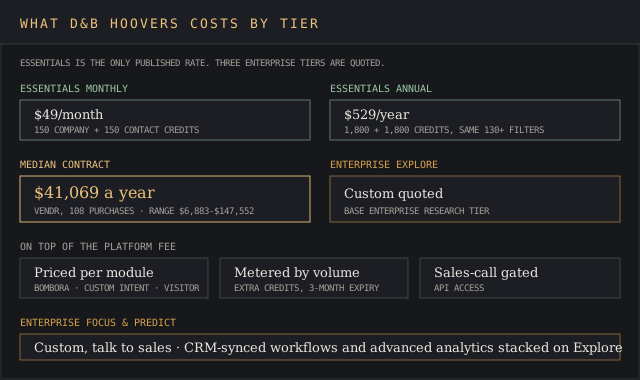
Two numbers cover the entire published D&B Hoovers pricing structure. Hoovers Essentials costs $49 a month, billed monthly, or $529 a year on annual billing, the only self-serve entry point into the product. Above Essentials sit Enterprise Explore, Enterprise Focus and Enterprise Predict, and none of the three carries a rate card anywhere on dnb.com.
That split, a public self-serve smb plan below an opaque enterprise pricing tier, isn't unusual in this category. ZoomInfo and Cognism both route their upper tiers to a sales call, so D&B Hoovers pricing sits in familiar company on that front. What sets it apart is the size of the jump: a $49 monthly plan next to Vendr's $41,069 median contract is a wider gap than most vendors in this space run between their cheapest and most common deal.
D&B Hoovers' own pricing plans reduce to two real choices: the published Essentials pricing tier and a custom Enterprise quote, and both pricing plans share the same key features on the company data side.
There's no professional plan sitting between them, and no free plan the way Lusha's free plan or Seamless.AI's free plan work; D&B Hoovers' free trial waives the first month on Essentials instead, still capped at the same monthly credits. Small businesses comparing D&B Hoovers pricing tiers against those free-plan competitors are comparing a paid-from-day-one product against ones with a genuine no-cost floor.
Reviewers describe the Essentials sticker as inexpensive right up until they need more than 150 monthly credits. One flagged the tradeoff directly on G2:
"The one thing I'd flag is the pricing: it felt a bit high, especially for a startup where every cost gets scrutinized closely... it's worth knowing going in that it's not the cheapest option out there."
Muhammed A., Technical Project Manager, Information Technology and Services, G2 review, July 21, 2026.
Hoovers Essentials pricing and what it buys
Hoovers Essentials is the self-serve smb plan: no card required to start, cancel anytime, billed month to month or annually. The monthly plan grants 150 company credits and 150 contact credits every cycle; the annual plan front-loads 1,800 of each across the year, the same 130+ search filters either way.
D&B Hoovers Essentials includes native CRM integration with Salesforce and Microsoft Dynamics, so contact records, phone numbers and corporate family tree data sync into existing pipelines.
Full API access is not part of Essentials; API access is gated to higher tiers and priced on top of the base subscription, extending that same data access programmatically once a rep pays for it, a detail buried well below the plan comparison on dnb.com.
Data accuracy is where Essentials buyers hit friction fastest. Gartner-cited figures put contact data accuracy at roughly 70%, well under ZoomInfo's own claimed up-to-95% first-party figure, and that accuracy drops further on contacts outside North America, where D&B's own sourcing network thins out.
BookYourData, a competing data vendor, markets a 97% data accuracy guarantee against that same 70% figure, a claim worth reading as marketing copy since neither number comes from the same methodology. Reviewers describe the credit-pricing structure eating into D&B Hoovers' own number further:
"The customer support is terrible... With how the credits work, you're really only getting about 75 leads per month, not actually 150."
Sonny L., VP of Sales/Marketing, Small-Business, G2 review, May 26, 2026.
At $49 for roughly 75 usable contacts a month by that reviewer's math, the effective cost per contact runs closer to $0.65 than the sticker suggests, before any additional credit purchase or intent data add-on enters the bill.
Enterprise Explore, Focus and Predict: custom pricing
D&B Hoovers pricing above Essentials splits into three Enterprise tiers, and none publishes a number. Enterprise Explore is the base research tier; Enterprise Focus stacks CRM-synced workflows on top of Explore; Enterprise Predict adds advanced analytics and buyer intent signals on top of Focus's CRM integration work. Capability stacks upward through the three tiers. On Essentials, only credit volume scales.
Getting an Enterprise quote means a sales call. There's no published self-serve path, no listed starting price and no public Enterprise trial, a contrast with the Essentials trial available without talking to anyone.
Some third-party pricing pages describe that trial as a 7-day window. D&B's own SMB page states the first month is free, and D&B's wording governs the sign-up flow over the third-party estimate. A buyer moving from Essentials to Enterprise trades a transparent monthly plan for a negotiated annual contract with no visibility into the number until a rep provides one.
Third-party estimates commonly cite an Enterprise entry point near $25,000 a year, a figure that circulates across pricing blogs. It doesn't appear on dnb.com itself. D&B itself describes Enterprise pricing only in general terms, as a flexible pricing model that varies with seat count, data volume and market, which is another way of saying no two Enterprise quotes are guaranteed to match.
Vendr's tracked procurement data covers the Dun & Bradstreet vendor relationship and puts the median contract at $41,069 a year across 108 purchases, with a range running from $6,883 to $147,552 and average savings of 13.51% off the initial ask.
Company data, contact data and corporate hierarchies
The company data behind every D&B Hoovers pricing tier covers more than 330 million companies, with contact data spanning over 520 million people, including more than 190 million flagged as decision makers.
D&B's own free-trial page quotes a slightly lower 327 million companies and 500 million contacts, a rounding gap between two of D&B's own pages. Each company profile carries corporate family tree mapping built off the D-U-N-S Number, D&B's own identifier for linking a subsidiary back to its parent and its affiliates, and that hierarchy layer is what separates D&B Hoovers from a flat contact list.
The Data Cloud behind all of it refreshes roughly 5 million times a day from more than 30,000 sources, the real-time data updates that back every trigger alert on funding rounds, leadership changes and acquisitions.
Contact search on Essentials runs through the same 130+ filters as company search, letting a team build a target accounts list by industry, size, location or corporate hierarchy before a single contact record gets pulled and its contact details verified. Enterprise tiers expand that toward the 175 to 200+ filters some third-party listings describe, though dnb.com's own Essentials page states 130+.
Reviewers rate the corporate hierarchies feature as the standout relative to pure contact databases:
"One of the most valuable features is its corporate hierarchy and family tree view, which I find far more comprehensive than what's available in ZoomInfo or Lusha."
annpurna S., Marketing Data Ops Lead, Computer Software, Enterprise, G2 review, July 3, 2025.
Complex organizations doing account based strategies get more from that hierarchy depth than a solo rep chasing volume outbound ever will, and D&B Hoovers pricing implicitly reflects that split: Essentials serves the volume case badly, Enterprise serves the hierarchy case well.
D&B Hoovers' key features run past contact search.
- SmartSearch AI: natural-language prospecting on top of the standard filter set.
- Advanced search filters: combine firmographic, hierarchy and signal criteria into one query.
- Database access: covers phone numbers and contact info alongside the standard contact details a sales team pulls before outreach.
- Data exports: built around list building, so a target accounts list assembled through those filters moves into a CRM as a batch, feeding lead generation workflows without a manual export step.
That company intelligence layer, sourced from the Data Cloud, is what backs the detailed business data behind every corporate family tree mapping profile: spend capacity, firmographic detail and deep insights most contact-only databases skip.
Data coverage and accurate data track together on the company side; data quality is the weaker half, concentrated in decision makers' contact info, and that data quality gap is the one Gartner-cited figures above quantify directly.
Buyer intent data and other add-ons priced outside the platform fee
D&B Hoovers pricing treats buyer intent data as a separate purchase at every tier. The Audience Builder module ships three distinct intent products: Bombora Intent, drawing on a taxonomy of more than 16,000 keywords; D&B Custom Intent, which lets a team build its own buying-signal model; and Visitor Intelligence, which unmasks companies visiting a website. None of the three ships free on Essentials or on any Enterprise tier.
That add-on structure means a buyer comparing sticker prices across vendors is comparing incomplete numbers. A team that wants buying signals alongside company intelligence needs to price the intent module on top of the base subscription, the same layered structure Cognism and ZoomInfo run for their own intent and enrichment add-ons.
Marketing automation platforms and CRM integration cover the delivery side once buying signals exist: trigger alerts on funding rounds and leadership changes sync through the same Salesforce and Microsoft Dynamics connectors that handle company data and contact data, so a marketing team doesn't need a separate integration budget once the intent module is purchased.
Enterprise Predict layers advanced analytics on top of those buying signals, scoring accounts by fit.
Hidden costs: credit expiration, overage and renewal uplift
The credit structure is where D&B Hoovers pricing stops matching what a team spends. Company credits and contact credits expire after three months and don't roll over, so a slow quarter loses unused credits. That dual credit system, separate pools for company data and contact data, is public on Essentials and undocumented on Enterprise.
Running out of credits mid-cycle means buying more at an undisclosed rate, with per-contact download fees reported as high as $0.50 each once the monthly pool is gone.
Adding a user seat, on Essentials or on an Enterprise tier, typically carries its own additional monthly charge on top of the base subscription, so a five-person rollout costs more than five times the per-seat headline once every login is billed. Reviewers flag the pricing structure around partial data pulls specifically:
"I dislike their minimum pricing format when trying to get a certain type of data. For example if i try to target a company that has 87 contacts they'll charge a minimum to pull the data for me."
Lauren A., Small-Business, G2 review, February 18, 2020.
Renewal terms compound the credit math. Vendr's negotiation data on the Dun & Bradstreet account cites a standard 6% annual price increase at renewal, with buyers reporting uplift as high as 10% before pushing back, and a documented $50,000 overage on one account that got folded into a renegotiated renewal. Total cost on a multi-year D&B Hoovers pricing agreement tracks the renewal uplift clause more than the initial quote.
Add the intent data add-on and the extra credit purchases together, and the effective monthly cost on a team that uses D&B Hoovers runs well past the $49 sticker on Essentials, or well past the initial Enterprise quote once a renewal cycle applies its uplift.
What buyers pay: the Vendr spread against list
Vendr's tracked data on D&B Hoovers separates D&B Hoovers pricing rhetoric from what closed deals cost. The header stats, low, median and high, come from 108 purchases that closed; the $25,000 figure that circulates across third-party pricing blogs is an estimate.
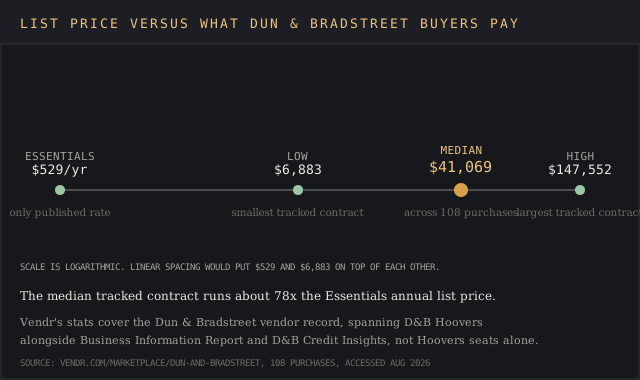
That spread matters for budgeting because the $6,883 low end is closer to what a smaller enterprise team pays than the $41,069 median, and the $147,552 high end reflects complex organizations buying multiple D&B products under one contract. A buyer requesting a quote should anchor expectations to the low-to-median range unless the deal includes credit insights, compliance data or other D&B products bundled in.
How to negotiate D&B Hoovers pricing
Vendr's community-sourced negotiation notes on the Dun & Bradstreet account point to a few repeatable levers: buyers who committed to multi-year terms reported discounts as high as 20%, and one buyer switching from an incumbent provider secured a 50% reduction against the initial quote by presenting a competing bid. Others report holding firm on a flat renewal by citing existing spend across other D&B products.
Reviewers who evaluated D&B Hoovers pricing against alternatives before buying describe the tradeoff directly:
"Although D&B was somewhat more expensive than ZoomInfo, after evaluation it seemed that the data in D&B was more accurate and up-to date... Sometimes the info is outdated. I will try to reach a person and find that they left the company several years earlier."
Perry R., National Sales Director, Machinery, Capterra review, April 12, 2024.
Removing the auto-renewal clause is a recurring ask in Vendr's negotiation notes on the Dun & Bradstreet account, since the standard renewal carries an uplift by default, a pattern that applies to D&B Hoovers contracts bundled under the same vendor relationship.
A buyer citing budget constraints from finance, referencing a competing quote from ZoomInfo or Lusha, and asking specifically about the uplift percentage before signing walks into the negotiation with more documented standing than one who accepts the first number offered. Our pricing verification methodology covers how we separate a vendor's list price from what Vendr's tracked contracts show.
Who D&B Hoovers pricing is built for
Small businesses on Essentials get a genuinely cheap entry point for lead generation at $49 a month, but the credit cap and three-month expiration punish a team running high-volume outbound more than D&B Hoovers rewards them. Reviewers with steep learning curves on the filter set and modules describe the tool as powerful but not simple:
"Hoovers is a highly powerful tool, though it does come with a steep and complex learning curve at first."
Korek L., Sales Director, Small-Business, G2 review, November 10, 2025.
Enterprise teams buying for corporate hierarchy research, credit insights or compliance verification get more out of the custom quote than a sales-only buyer would, because that's the layer no pure contact database competes on, a fit covered further on our company data providers ranking.
A mid-market team that already owns Salesforce or Microsoft Dynamics and wants trigger alerts, buying signals and corporate family trees synced into existing pipelines through native CRM integration fits the Enterprise tiers better than a solo rep chasing targeted leads ever will, and sales teams running account based strategies get more from that CRM integration than from the credit pool alone.
D&B Hoovers pricing against ZoomInfo, Lusha, Cognism and Seamless.AI
| Vendor | List price | Procurement data | What stands out |
|---|---|---|---|
| D&B Hoovers | $49/mo or $529/yr Essentials; Enterprise custom | $41,069 median*, $6,883-$147,552 range (Vendr, 108 purchases) | Corporate hierarchies via D-U-N-S; 330M+ companies |
| ZoomInfo | No published rate card | $33,500 median*, $7,200-$155,280 range (Vendr, 1,569 purchases) | Up to 95% claimed contact accuracy |
| Lusha | Free (40 credits/mo); Starter $49.90/mo | Not comparably tracked on Vendr | Chrome extension pulls contacts off LinkedIn |
| Cognism | No published rate card | $1,500-$25,000/yr, third-party estimate | Phone-verified European contact data |
| Seamless.AI | Free (50 credits/mo, 10 exports); Pro custom | Not published | Real-time scraping; 10,000 annual credits at Pro |
Prices marked * are Vendr median annual contract values from anonymized buyer data. D&B Hoovers' figure spans the Dun & Bradstreet vendor relationship, wider than the Hoovers product alone.
Free tier, no card
Sign up for Seamless.AI
50 credits a month free. Pro and Enterprise are both quote-only, "Contact sales."
 Visit Seamless.AI →
May earn a commission if you sign up through this link, at no extra cost to you. Full affiliate disclosure.
ZoomInfo's own free tier grants 10 export credits a month, and Apollo.io, which pairs its own database with built-in engagement tools in one interface, is a fifth name buyers commonly weigh alongside these four. D&B Hoovers pricing undercuts ZoomInfo at the entry level and roughly matches it at the tracked median, but the two products aren't solving the same problem.
ZoomInfo wins on data accuracy and interface simplicity; D&B Hoovers wins where corporate hierarchies and credit-risk context matter more than contact freshness. Read the full D&B Hoovers vs ZoomInfo comparison for the feature-by-feature detail. Lusha undercuts both at the entry tier without the hierarchy depth, and Cognism trades D&B's corporate-family focus for phone-verified European coverage.
Try it yourself
Sign up for Lusha
Free plan available, credit-based pricing after that.
 Visit Lusha →
May earn a commission if you sign up through this link, at no extra cost to you. Full affiliate disclosure.
What to budget for D&B Hoovers pricing
Small businesses and solo users testing the water should budget $49 a month and plan around the 150 monthly credits running out before the three-month expiration resets them; buying additional credits mid-cycle at an undisclosed rate is the realistic second line item. Data Axle's Salesgenie Basic lists at $99 a month on a 12-month term, double the $49 Essentials monthly rate (see our Data Axle pricing report).
Annual D&B Hoovers Essentials at $529 removes the monthly billing friction but doesn't change the underlying credit math, and the data exports and database access D&B Hoovers unlocks stay identical to the monthly plan.
An enterprise team should budget toward Vendr's tracked median of $41,069 a year as a starting anchor, understanding that figure spans the full Dun & Bradstreet relationship, and should add a line item for the intent data add-on and expect a 6% annual uplift at renewal unless that clause gets negotiated out.
Full support coverage, deeper data access and full API access all sit behind the Enterprise tiers, so a buyer pricing only the base subscription is pricing an incomplete number.
Frequently asked questions
How much does D&B Hoovers cost per month?
Hoovers Essentials costs $49 a month for 150 company credits and 150 contact credits, the only entry among D&B Hoovers pricing plans billed on a public monthly plan. Enterprise Explore, Focus and Predict carry no monthly figure; each requires a custom quote.
How much does a D-U-N-S number cost?
Getting a D-U-N-S Number is free, according to Dun & Bradstreet's own D-U-N-S page. It's a separate product from D&B Hoovers pricing entirely, an identifier, though D&B Hoovers profiles use the same D-U-N-S Number to build corporate family trees.
Is D&B Hoovers worth it?
For enterprise teams doing account based strategies on corporate hierarchies and credit insights, reviewers who evaluated D&B Hoovers against ZoomInfo report the higher price paired with more accurate, up-to-date business data. For a small team chasing high-volume outbound, the three-month credit expiration and roughly 70% reported contact data accuracy make D&B Hoovers a harder case against cheaper, contact-focused alternatives.
What is the D&B Hoovers database?
D&B Hoovers runs on the Dun & Bradstreet Data Cloud, covering more than 330 million company profiles and more than 520 million contacts, refreshed from tens of thousands of sources. The database backs both the sales-prospecting product and D&B's separate credit-risk and compliance tools, and the same detailed business data feeds every corporate hierarchy and data coverage claim on dnb.com.
Is D&B Hoovers reliable?
Company data and corporate hierarchy data get consistently strong marks from reviewers; contact data accuracy is the weaker layer, reported at roughly 70% against ZoomInfo's claimed up-to-95% first-party figure. Deceased or outdated contacts are the most common complaint on G2 and Capterra, concentrated in contact records.
Bottom line
D&B Hoovers pricing looks simple at the entry point and gets complicated fast above it. Hoovers Essentials at $49 a month is a real, published, self-serve smb plan; everything past 150 monthly credits or past the SMB tier entirely runs through a sales call with no list price attached, and Vendr's tracked $41,069 median shows how far that custom pricing runs past the sticker.
The credit structure, three-month expiration, no rollover, a dual credit system splitting company data from contact data, is the detail most likely to surprise a buyer who priced only the $49 headline. Add buyer intent data as a mandatory separate purchase and a documented 6% renewal uplift, and the total cost of ownership on D&B Hoovers looks less like a $49 tool and more like a five-figure enterprise contract with a cheap trial attached.
Buyers get the most from D&B Hoovers pricing when the corporate hierarchy and credit-risk data justify the premium over a pure contact database, and the least when volume outbound is the only job the tool needs to do.
Sources, and what D&B publishes nowhere on its own domain
Every figure above names where it was read.
- Pricing, credit and filter figures: dnb.com's Essentials/SMB page, its free-trial page and its D-U-N-S page.
- Contract and negotiation figures: Vendr's tracked header stats and community notes for the Dun & Bradstreet vendor record (vendr.com/marketplace/dun-and-bradstreet); the equivalent ZoomInfo contract figures are Vendr's tracked data as reported on our D&B Hoovers vs ZoomInfo comparison.
- Contact-accuracy figures: Gartner-cited, read via G2's product listing (g2.com/products/dun-bradstreet-d-b-hoovers); BookYourData's 97% accuracy claim is that vendor's own marketing copy.
- User quotes: verbatim from named G2 and Capterra reviewers, dated individually.
All D&B and Vendr pages accessed 14 August 2026. D&B publishes no per-seat rate, no per-contact overage rate and no Enterprise list price anywhere on its own domain.
Disclaimer
This page includes one or more affiliate links. If you sign up for a product through one of them, this site may earn a commission at no extra cost to you.