D&B Hoovers vs ZoomInfo: Data Provider or GTM Workspace, Compared
 By Jan Suski. I go deep on every review, checking every number against its source and digging up details other coverage misses, a habit from six years of SEO and link building for tech companies. Bylines at Surfer, Brand24, and Senuto. How the scoring works.
· Prefer this source on Google
| WHAT EACH ONE DOES | D&B HOOVERS | ZOOMINFO |
|---|---|---|
| Core job | Credit-risk research | Outbound contact data |
| Query model | Conceptual + filters | Contact/company search |
| Corporate hierarchy | 65 million+ links | No equivalent |
| Contact-first data | Add-on only | Native, 500 million+ |
| Intent data | Add-on, Audience Bldr | Add-on, Streaming |
| Compliance / KYB | Risk Analytics suite | None |
| Outreach & sequencing | None | Copilot + Engage |
| AI agent access | MCP, compliance only | MCP + Copilot agent |
| Skip it if | Need outbound cadence | Need KYB/credit risk |
| WHAT YOU GET | D&B HOOVERS | ZOOMINFO |
|---|---|---|
| Entry price | $49/mo, 300 credits | Free, Lite, 10 credits |
| Contract term | Monthly, cancel any | Annual only, paid |
| Median contract (Vendr) | Not tracked | $33,500 a year |
| Contract range (Vendr) | N/A, credit-based | $7,200 to $155,280 |
| Free trial | 1st month free | Lite, 10 signup credits |
| Ownership | Private (Clearlake) | Public (Nasdaq GTM) |
| Legal history | None disclosed | $29.55M settlement |
| Status transparency | No incident log | Public status page |
| Skip it if | Need enterprise scale | Need monthly billing |
StrongerWeakerNo edge
Thirty-six further documented limits sit behind the button below: coverage counts, compliance certifications, and both vendors’ API rate ceilings. Test scenario: a buyer choosing between a compliance/credit-risk research tool and an outbound sales-execution platform for the same monthly budget.
D&B Hoovers figures come from dnb.com's Essentials, main Hoovers and Compliance Intelligence pages; ZoomInfo contract figures come from Vendr's tracked marketplace header stats and pipeline.zoominfo.com.
Ownership dates from each company's own press releases. Legal settlement figure from the Ramos v. ZoomInfo Technologies official settlement site, final approval 21 November 2024. Every figure is sourced in the section its row links to.
| D&B Hoovers | WHAT IT DOCUMENTS |
|---|---|
| Companies covered | 330M+* companies |
| Contacts covered | 520M+ contacts |
| Countries and territories | 190+ countries |
| Chrome extension coverage | 250M companies, 300M* contacts |
| Trigger-event categories | 70+ categories |
| Annual Essentials pricing | $529/year, 1,800+1,800 credits |
| Free trial terms | No credit card required |
| Audience Builder intent | Bombora, D&B Custom, Visitor Intel |
| Corporate family tree depth | 65M+ mapped relationships |
| Data quality checks | 60B+ checks a month, Data Cloud-wide |
| DUNS Number | Free 9-digit identifier, credit file |
| Compliance product | Risk Analytics: KYB, UBO, sanctions, PEP |
| Compliance recognition | Chartis 2025 RiskTech leader, KYC Data |
| AI agent integration | MCP support, Compliance Intelligence only |
| Security certifications | ISO 27701, ISO 27001, EU-U.S. DPF |
| Responsible AI certification | TRUSTe Responsible AI, 2024 |
| Global CBPR certification | Certified 2025 |
| Salesforce integration | Lightning Data, successor to Data.com |
| ZoomInfo | WHAT IT DOCUMENTS |
|---|---|
| Companies covered (pricing blog) | 100M+* companies |
| Companies covered (coverage page) | 122.9M distinct, 158.5M locations |
| Verified business emails | 200M+ |
| Direct-dial phone numbers | 120M+ |
| Intent data scale | 210M+ IP-to-org pairings |
| Intent keyword pairings | 6 trillion+ tracked monthly |
| Intent device coverage | ~90% of accessible U.S. devices |
| Free tier credits | 10 at signup, Lite |
| CRM integrations list | Salesforce, HubSpot, Marketo, Dynamics, Pardot, Eloqua |
| Chrome extension name | "ReachOut," free on Lite |
| GTM Studio | RevOps orchestration canvas, early access |
| GTM Context Graph | Fuses CRM, Chorus, behavioral data |
| Security certifications | ISO 27001, ISO 27017, ISO 27701, SOC 2 |
| Privacy/compliance seals | CSA STAR Level 1, TRUSTe/TrustArc |
| Ticker change | ZI to GTM, 13 May 2025 |
| Product relaunch | Copilot Workspace, 6 Oct 2025 |
| Texas data broker registration | Disclosed on Trust Center |
| Status incident disclosure | 2 same-day-resolved incidents, late July 2026 |
*A marked figure is one the vendor states two ways on its own domain. D&B's Essentials and main product pages cite 330 million-plus companies and 520 million-plus contacts, while its Chrome extension page cites 250 million companies and 300 million contacts; the Essentials figure is used above because it's attached to a plan a buyer can purchase.
ZoomInfo's pricing blog cites 100 million-plus companies while its own coverage page cites 122.9 million distinct companies; the pricing-blog figure is used above because it repeats across two dated posts; the coverage page is undated.
Sources, and the counts each vendor states two different ways
Every row comes from a vendor property: dnb.com's Essentials, main Hoovers, Compliance Intelligence, Audience Builder, DUNS, why-dnb and partnerships pages, plus community.dnb.com; zoominfo.com's data, pricing, global-coverage, trust-center and features pages, plus ir.zoominfo.com press releases and status.zoominfo.com.
Neither vendor publishes a records-updated-per-day figure, an independently audited uptime percentage, or a search-filter count that appears anywhere on its own domain; the "5 million records daily," "256 countries" and "200+ filters" figures that circulate on comparison blogs trace to third-party sites, never to dnb.com. ZoomInfo publishes no list pricing and no country-coverage count anywhere on zoominfo.com.
D&B Hoovers and ZoomInfo both sell company data and contacts to sales, marketing & compliance teams, but they were built to answer different questions. D&B Hoovers exists to tell you who a company is: its D-U-N-S identifier, its parent and subsidiaries, its credit risk. ZoomInfo exists to help a rep reach that company's buyers and prospects, inside what it now calls GTM Workspace.
This comparison covers what each platform costs, what its database contains (including where each vendor's own pages disagree with each other), who owns each company after 2025's ownership changes, and where the two overlap.
It's built for anyone choosing between a research-and-credit-risk tool and a sales execution platform. Both vendors restructured within five months of each other in 2025, changing who sits behind each database of company and contact records buyers use to find prospects.
↑ COMPARISOND&B Hoovers and ZoomInfo Solve Different Business Development Problems
D&B Hoovers is a research tool first. Its own product pages describe it around firmographic data, corporate family trees & credit risk scoring, the same data Dun & Bradstreet has sold to lenders and procurement teams for decades. D&B Hoovers stops at research and list-building: there's no built-in sequencing, no native outbound cadence tool, no email-send tracking inside the product itself.
ZoomInfo, whose platform relaunched as GTM Workspace in October 2025, is built the opposite direction. It starts where D&B Hoovers stops: contact discovery feeds directly into ZoomInfo Copilot and its Engage sequencing layer, so a rep can move from a target list to a sent email without leaving the platform.
That's the real fork in this business development decision. A compliance team screening vendors against sanctions lists doesn't need outreach automation. A sales org carrying a pipeline number does, and D&B Hoovers was never built to give it to them. Buyers who try to force one tool to do both jobs usually end up running two separate tools within a year.
Buyers researching this pair search for it under a handful of names: D&B Hoovers vs ZoomInfo, Dun & Bradstreet vs ZoomInfo, or just ZoomInfo vs Hoovers. Every version of the question lands on the same fork: research tools against sales tools, split by which side of business development the buyer sits on.
Both sell into the sales-intelligence industry broadly. D&B leans toward the compliance side of it, ZoomInfo leans toward outbound tooling, and each company's own tools reflect that split down to the pricing page.
ZoomInfo markets itself around a single platform framing: prospecting, enrichment, intent & outreach inside one workspace, replacing stitched-together point tools.
D&B Hoovers makes no such claim. Its own site treats D&B Connect (data-quality and CRM cleansing) and D&B Hoovers Audience Builder (intent and visitor tracking) as separate, individually priced products.
Users moving between the two products still need two logins and two contracts: one platform for research, one for outreach.
↑ COMPARISOND&B Hoovers Pricing vs ZoomInfo's GTM Workspace Contracts
D&B Hoovers publishes its entry price. The Essentials plan runs $49 a month for 150 company credits plus 150 contact credits, 300 credits total, or $529 a year for 1,800 of each. D&B's own Essentials page lists a free first month and states plainly: no credit card required to start.
That makes it one of the few small business options in this category with a public price at all. Above Essentials, D&B Hoovers' enterprise pricing has no listed number; every enterprise-facing page ends in a demo request instead.
Vendr's tracked data for the Dun & Bradstreet vendor relationship puts the median contract at $41,069 a year across 108 purchases, ranging from $6,883 to $147,552; that figure spans D&B Hoovers alongside other Dun & Bradstreet products. The full negotiation detail is in our D&B Hoovers pricing report.
ZoomInfo publishes no dollar figure anywhere on its own site, and it addresses that gap directly in its FAQ: "No, despite claims from Cognism, Demandbase, Lusha, Apollo, and others, ZoomInfo's pricing does not start at $15,000." That's ZoomInfo pushing back, in writing, on a number several of its own competitors repeat on their comparison pages, and on the $15,000 to $25,000 range that circulates across most of this search result page.
The figure that holds up is Vendr's tracked contract data: a $33,500 median annual contract value across 1,569 purchases, ranging from $7,200 to $155,280, with an average discount of 21.81% off list. ZoomInfo's paid plans are annual subscriptions only; its own FAQ states there's no standard monthly billing option.
The exception is ZoomInfo Lite, which grants 10 reveal credits at signup. Further monthly credits are conditional on joining the ZoomInfo Community and contributing data, and ZoomInfo doesn't publish the monthly figure.
| Metric | D&B Hoovers | ZoomInfo |
|---|---|---|
| Entry price | $49/month (Essentials) | Free (Lite, 10 signup credits) |
| Annual entry price | $529/year (Essentials) | Not published |
| Median contract (Vendr) | $41,069/year* | $33,500/year |
| Contract range (Vendr) | $6,883 to $147,552/year* | $7,200 to $155,280/year |
| Contract term | Monthly or annual, cancel anytime | Annual only on paid tiers |
| Free trial | First month free, no credit card | 7 days, plus the Lite plan |
| Enterprise pricing | Contact sales | Contact sales |
*Vendr's D&B figures track the overall Dun & Bradstreet vendor relationship, which can bundle other D&B services in alongside Hoovers seats.
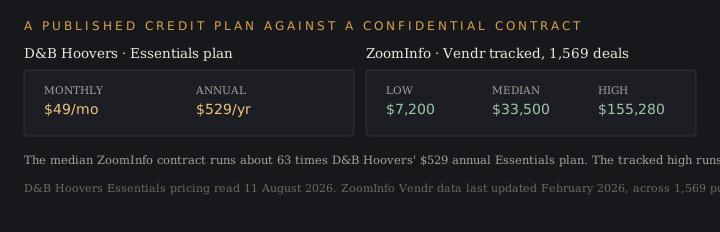
Neither company is the cheaper option by default; it depends on volume. D&B Hoovers is the cheaper entry point for a self serve buyer running occasional lookups, and its credit-based model is one of the more affordable options among sales-intelligence tools that publish a price at all.
ZoomInfo's pricing only makes sense once a team is chasing enough prospects to justify a five-figure annual contract. Below that volume, the per-contact cost runs higher than D&B's pay-as-you-go credits.
New users on D&B Hoovers Essentials start with a 300-credit allotment in the first month and can top up without renegotiating a contract, useful for a small business testing if the records fit before committing further.
New users on ZoomInfo start on Lite, then move to a sales-led quote once the signup credits run out; there's no self serve path from Lite into a paid tier without a call. Both vendors count paying users differently: D&B bills per credit regardless of seat count, while ZoomInfo's contract pricing scales with the number of users on the account.
↑ COMPARISONCompany Data, Contact Data, and Data Accuracy: Coverage Compared
Both vendors publish company and contact totals, business data meant to reassure a buyer before purchase, and both contradict themselves across their own pages.
D&B Hoovers' own pages cite three different sets of coverage numbers, and none references the other two:
- Essentials and main product pages: 330 million-plus companies, 520 million-plus contacts
- Free-trial page: 500 million-plus contacts for the same product
- Chrome extension page (D&B Hoovers Everywhere): 250 million-plus companies, 300 million-plus contacts, plus 70-plus trigger-event categories for account alerts
None of them explains why the contact counts differ from one product page to the next.
ZoomInfo shows the same pattern:
- Pricing and global-coverage blog posts: 500 million-plus contacts, 100 million-plus companies, 200 million-plus verified business emails, 120 million-plus direct-dial phone numbers, plus tens of millions more mobile numbers outside North America
- Global Coverage landing page: "158.5 million company locations across 122.9 million distinct companies," a different company count on the same domain, published without a date
ZoomInfo's company profiles carry more contact detail per record; D&B Hoovers' carry more ownership and hierarchy detail per record.
On countries, D&B's verified figure, repeated on two separate product pages, is 190-plus countries and territories. ZoomInfo doesn't publish a country count on its own site at all, despite a 195-countries figure that circulates on comparison blogs citing this exact pair.
Data accuracy claims follow the same shape: both vendors describe continuous verification, and neither publishes an error rate a buyer could check independently.
Dun & Bradstreet's Data Cloud page cites more than 60 billion data quality checks run across its network each month, pulling from more sources than a single-vendor crawl would and feeding results back into every record.
ZoomInfo describes a contributory network model instead, where customer CRM data feeds back into the database. It publishes no comparable monthly check count and no matching accuracy guarantee.
Both companies market their own record count as the largest database in the category. Given the self-contradicting totals on each vendor's own pages, treat those claims as marketing language. Buyers weighing coverage size against the wider field should check our company data providers ranking.
↑ COMPARISONKey Features Side by Side
D&B Hoovers' searchable database runs on firmographic data, plus a conceptual search filter that accepts plain-language descriptions of a target company. The record fields include:
- Employee count
- Industry codes
- Corporate hierarchy
- The D-U-N-S identifier tying a record to Dun & Bradstreet's credit file
Conceptual search sits alongside standard field filters on the same results page, so a compliance analyst without a target company name can still narrow a search by industry and headcount.
ZoomInfo's database is contact-first: direct dials, verified emails & LinkedIn profile matches, layered with ZoomInfo Copilot for account research inside GTM Workspace. Both offer a Chrome extension; D&B's ships even on the free trial, ZoomInfo's ships even on the free Lite tier.
Advanced features split along the same line as everything else in this comparison. D&B Hoovers' research tools sit on the compliance side: trigger alerts, corporate hierarchy mapping & compliance workflows for risk teams, plus access to a status page and a documented trust center for buyers who need to verify certifications before signing.
ZoomInfo's tools sit on the activation side: Copilot-drafted outreach, Chorus conversation intelligence & workflow automation once a contact record leaves the database. Neither vendor's other tools, D&B Connect on one side, GTM Studio on the other, ship in the base product; both are separate line items on an invoice.
↑ COMPARISONIntent Data, Corporate Family Trees, and the DUNS Number
Intent data works the same way structurally on both platforms, and this is the one place where the wider market gets ZoomInfo's setup wrong: intent isn't bundled into its base plans.
ZoomInfo's own pricing page lists "Intent data (Streaming Intent)" as an add-on, powered by more than 210 million IP-to-organization pairings and over 6 trillion keyword-to-device pairings tracked monthly across roughly 90% of accessible U.S. devices, then surfaced through intent signals on each account record.
D&B Hoovers runs the same structure: intent arrives through a separate Audience Builder add-on, offering a choice of Bombora Intent, D&B's own custom intent models, or Visitor Intelligence, which de-anonymizes site visitors and turns anonymous website traffic into named accounts and, where matched, named contacts.
Where the two diverge is what intent data sits next to. D&B Hoovers pairs intent with corporate family trees. Dun & Bradstreet's Data Cloud maps more than 65 million parent, subsidiary & affiliate relationships, built on top of the DUNS Number, a unique nine-digit identifier D&B assigns to a business credit file, separate from any personal identity.
Lenders, government contract officers & procurement teams request it by name. It's the identifier those workflows already run on.
ZoomInfo has no equivalent credit-file identifier. Its buyer-signal layer plugs into what it calls the GTM Context Graph, a term for the intelligence layer fusing CRM records, conversation data from Chorus & behavioral signals across a deal. That graph answers a different question than D&B's family tree does: who at this company is showing buyer intent right now.
D&B's Visitor Intelligence add-on de-anonymizes website traffic and reports page views and bounce rate alongside company info for each identified visitor, extending website functionality beyond a static record lookup.
It answers a narrower question than ZoomInfo's intent stack does, tied to a single website: who showed up on your own website today.
Both add-ons still need accurate contact information layered on top before a rep can act on the signal. Neither vendor treats intent data as a replacement for its core contact records.
↑ COMPARISONAPIs, CRM Integrations, and AI Agents
D&B's general-purpose enterprise API, D&B Direct+, streams Data Cloud records into a customer's own systems; there's no separate Hoovers-specific API distinct from it. On the compliance side, D&B's Risk Analytics – Compliance Intelligence product now advertises Model Context Protocol integration for AI agent workflows, letting an AI agent query sanctions and KYB screening data directly.
ZoomInfo runs its own MCP connector, plus GTM Studio, a RevOps orchestration canvas still in early access, and ZoomInfo Copilot, its AI sales agent. Both vendors are building toward the same idea: AI agents querying prospects and accounts directly, replacing the human search step. Neither publishes usage numbers, and neither shares insights into what those agents can and can't query today.
CRM integrations favor ZoomInfo's breadth. Its own FAQ lists six supported CRMs, giving revenue teams direct access to enriched contacts without leaving their CRM:
- Salesforce
- HubSpot
- Marketo
- Microsoft Dynamics
- Pardot
- Eloqua
D&B Hoovers integrates with Salesforce through Lightning Data (the successor to the discontinued Data.com feed) and with Microsoft Dynamics through a documented connector. A HubSpot connector is referenced in D&B's community documentation, but its full integration scope isn't published.
Buyers who need more than one of these integrations should confirm current support directly with each vendor, since neither company's own pages agree on database size, let alone integration scope.
How Each Platform Organizes Accounts, Contacts, and Prospects
Both tools organize records around the same three ideas: accounts, contacts, and prospects. An account is the company record. A contact is a named person tied to that account. A prospect is a contact nobody on the revenue team has reached out to yet.
D&B Hoovers surfaces accounts first. Its research workflow opens on an account, then drills into the contacts under that account; a credit analyst checking one account rarely needs a list of prospects at all. ZoomInfo surfaces contacts and prospects first. Its outbound workflow opens on a filtered list of prospects, pulled from records covering hundreds of millions of contacts, then rolls those contacts up into accounts once a CRM sync runs.
Both platforms let users export records in bulk. D&B Hoovers exports accounts and contacts against a credit balance; ZoomInfo exports contacts and prospects against a seat-based license, and users on higher tiers get higher export caps. Users managing dozens of accounts at once tend to prefer whichever tool matches how their own team already talks about the funnel: accounts and contacts for a finance or compliance team, prospects and accounts for a revenue team.
Neither platform treats a prospect as separate from a contact. A prospect is a contact without a logged interaction yet; once a rep reaches out, that same record updates across accounts, contacts and prospects views alike.
Users switching between D&B Hoovers and ZoomInfo mid-deal, checking an account's credit risk in one tool while working its contacts as prospects in the other, are more common in practice than either vendor's marketing admits. Both companies count these users differently on their invoices.
↑ COMPARISONWhich Fits Your Sales Team: Compliance and Credit Risk vs Outbound Sales Intelligence
ZoomInfo pitches itself as a sales intelligence platform built for volume outbound work. A compliance analyst would never open it first. D&B Hoovers pitches the opposite: a research platform that happens to support prospecting.
D&B Hoovers' natural buyer is one of the smaller companies in its industry, or a team inside a larger company running due diligence.
D&B's Risk Analytics – Compliance Intelligence line handles KYB and UBO screening, sanctions and PEP list checks & continuous third-party risk monitoring. Chartis Research named it a category leader in its 2025 RiskTech Quadrant for KYC data. None of that exists inside ZoomInfo, and none of ZoomInfo's other tools replace it.
ZoomInfo's natural buyer is a revenue team running volume: outbound SDRs, RevOps building segmented target lists, or marketing teams syncing enriched accounts into a CRM daily, the same buyer our sales intelligence ranking covers in full.
Its wider CRM integration list, plus a Chrome extension bundled even into the free Lite tier, is built for a team that touches contacts and prospects constantly.
Company Size: Who D&B Hoovers Fits
D&B Hoovers Essentials is priced for smaller companies buying data one credit block at a time, without a sales call. Professional services firms, accounting, legal & insurance practices running vendor and client due diligence show up often in D&B's own case material, because credit-risk checks sit closer to their daily workflow than cold outreach does.
A small business researching a single new supplier gets more value from one D&B Hoovers report than from a ZoomInfo contract sized for volume prospects. D&B Hoovers rarely shows up in a search for prospects on its own. That's by design.
Company Size: Who ZoomInfo Fits
ZoomInfo's Vendr-tracked contracts start around $7,200 and average $33,500 a year, a floor that puts it out of reach for a two-person team chasing prospects on a self serve budget. It's built for a company with a dedicated sales team & a CRM that needs volume enrichment on a recurring basis.
Buyers here are usually building targeted lists by industry and headcount before a rep ever picks up a phone, so the contact database and its direct dials & mobile numbers matter more than the compliance layer D&B Hoovers leads with.
↑ COMPARISONOwnership Risk: Dun & Bradstreet's Clearlake Buyout and ZoomInfo's Ticker Change
Both companies restructured within five months of each other in 2025, and neither restructuring is cosmetic.
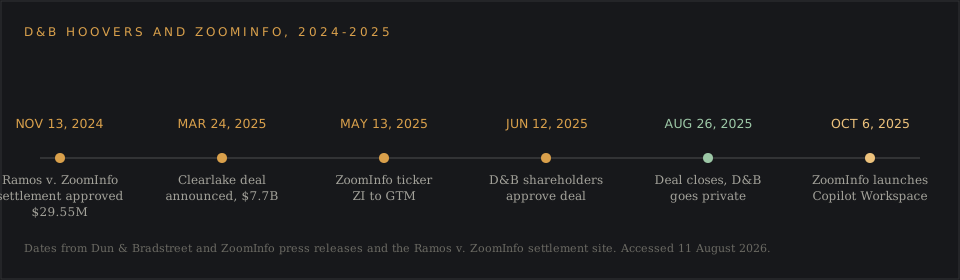
Dun & Bradstreet agreed to be acquired by Clearlake Capital Group on March 24, 2025, a deal valuing the company at $7.7 billion including debt, with an equity value of $4.1 billion and $9.15 in cash per share. Shareholders approved the deal on June 12, 2025, and it closed on August 26, 2025.
Dun & Bradstreet is now company private, delisted from the NYSE. D&B's own announcement quoted CEO Anthony Jabbour on "partnering with Clearlake on this new leg of that journey," language that stays at the corporate level and never names Hoovers or the sales-intelligence product line specifically.
ZoomInfo's change is smaller but still structural. It switched its Nasdaq ticker from ZI to GTM on May 13, 2025, and followed that on October 6, 2025 with the launch of what it originally called ZoomInfo Copilot Workspace, later presented on the live site as GTM Workspace. ZoomInfo remains publicly traded; it hasn't gone private, unlike Dun & Bradstreet.
ZoomInfo also carries a disclosed legal settlement D&B has no equivalent for: Ramos v. ZoomInfo Technologies, a right-of-publicity class action over consumer names, job titles & work history used on preview pages without consent. The settlement totaled $29.55 million across California, Illinois, Indiana & Nevada classes, approved November 13, 2024.
| Date | Event |
|---|---|
| November 13, 2024 | Ramos v. ZoomInfo settlement receives final court approval ($29.55M) |
| March 24, 2025 | Dun & Bradstreet agrees to Clearlake Capital acquisition ($7.7B) |
| May 13, 2025 | ZoomInfo switches Nasdaq ticker from ZI to GTM |
| June 12, 2025 | D&B shareholders approve the Clearlake deal |
| August 26, 2025 | Clearlake completes the D&B acquisition; D&B goes private |
| October 6, 2025 | ZoomInfo launches Copilot Workspace, later presented as GTM Workspace |
Neither vendor's status page shows a history of extended outages. D&B's page reports current operational status without a published uptime figure or incident archive.
ZoomInfo's page discloses more: "all systems operational" at the time of writing, plus two same-day-resolved incidents in the prior weeks, a Chorus latency issue and a degraded Intent Search window. Its record can be checked by a method D&B doesn't offer.
Where the Two Vendors Contradict Themselves and Each Other
Beyond the database-count mismatches above, a few claims that circulate about this pair don't hold up against either vendor's own site.
The idea that ZoomInfo includes intent data in its standard subscriptions is the most common one repeated across comparison content. It's wrong: ZoomInfo's own pricing documentation lists Streaming Intent as an add-on to base plans, the same structure D&B Hoovers uses for its Audience Builder intent options. Neither vendor bundles intent data into its entry tier, whatever the marketing pages of third-party sites claim.
Two other figures worth dropping: D&B Hoovers' claimed 200-plus search filters and its claimed 5-million-records-daily update rate. Both circulate across comparison sites, and neither appears on any page D&B controls. Use the coverage numbers above instead.
On review sites, PeerSpot and TrustRadius both track a Sales Intelligence category where ZoomInfo holds 11.6% mindshare against D&B Hoovers' 6.1%, and where D&B Hoovers users report a 100% recommendation rate against ZoomInfo's 89%, drawn from far fewer users overall.
Those are review-site figures, distinct from vendor claims, and they measure different things: market share against satisfaction among the smaller group of people who filled out a review in the first place.
Frequently Asked Questions About D&B Hoovers vs ZoomInfo
How much do D&B Hoovers cost?
D&B Hoovers Essentials starts at $49 a month, or $529 a year, for 150 company credits and 150 contact credits. Above Essentials, D&B Hoovers' enterprise pricing is quote-only, based on credit volume and add-on modules like Audience Builder.
What did ZoomInfo used to be called?
ZoomInfo hasn't changed its corporate name, but its product surface has. The company switched its Nasdaq ticker from ZI to GTM on May 13, 2025, then launched what it originally called ZoomInfo Copilot Workspace on October 6, 2025. That product now sits on zoominfo.com under the GTM Workspace name.
What is the lawsuit against ZoomInfo?
The most recent disclosed case is Ramos v. ZoomInfo Technologies, a right-of-publicity class action covering California, Illinois, Indiana & Nevada residents whose names and job details appeared on ZoomInfo preview pages without consent. The settlement totaled $29.55 million and received final court approval on November 13, 2024.
Is D&B Hoovers reliable?
D&B Hoovers holds ISO 27701 and ISO 27001 certification, takes part in the EU-U.S. and Swiss-U.S. Data Privacy Frameworks & earned TRUSTe's Responsible AI Certification in 2024. Its data isn't internally consistent, though: company and contact totals differ across its own Essentials, free-trial & Chrome-extension pages, so treat any single figure as directional, and treat marketing insights from either vendor's users the same way.
Who competes against ZoomInfo?
D&B Hoovers is one option, alongside Apollo, Cognism, 6sense, Lusha & LinkedIn Sales Navigator, names that come up in the same business development conversations as D&B Hoovers vs ZoomInfo and rank together on our ZoomInfo alternatives page. Most of those compete on contact data and outbound tooling; D&B Hoovers is the one built around credit risk and compliance instead.
Try it yourself
Sign up for Lusha
Free plan available, credit-based pricing after that.
 Visit Lusha →
May earn a commission if you sign up through this link, at no extra cost to you. Full affiliate disclosure.
Is there an alternative to Dun & Bradstreet for sales teams that don't need compliance data?
Yes. If a sales team never touches KYB screening, sanctions lists, or the DUNS Number system, ZoomInfo's GTM Workspace covers contact discovery and outreach without D&B's credit-risk layer attached. Teams that need compliance data alongside sales data tend to run both tools.
Are DUNS and Bradstreet worth it?
For a company that files for government contracts, applies for trade credit, or needs a verifiable business credit file, a DUNS Number and the Dun & Bradstreet data behind it are close to mandatory. For a revenue team whose only goal is finding prospects' direct dials, D&B Hoovers' credit-risk layer is overhead they're paying for and not using; ZoomInfo's contact-first records fit that job better.
Is ZoomInfo outdated?
No. ZoomInfo relaunched its core product as GTM Workspace in October 2025, added an MCP connector for AI agent access & continues to disclose incidents on a public status page. What's changed is the name and the AI layer on top; the underlying contact database and annual-contract pricing model are the same structure the company has sold for years.
Sources: dnb.com Essentials, main Hoovers, Compliance Intelligence and Trust Centre pages; zoominfo.com, pipeline.zoominfo.com, ir.zoominfo.com investor filings, status.zoominfo.com and Vendr's tracked marketplace header stats; the Ramos v. ZoomInfo settlement site, approved November 13, 2024. Accessed August 11, 2026.
Disclaimer
This page includes one or more affiliate links. If you sign up for a product through one of them, this site may earn a commission at no extra cost to you.