Woodpecker pricing in 2026: $35 to $10,312 a month, billed per contacted prospect
 By Jan Suski. I go deep on every review, checking every number against its source and digging up details other coverage misses, a habit from six years of SEO and link building for tech companies. Bylines at Surfer, Brand24, and Senuto. How the scoring works.
The numbers Woodpecker pricing, checked 16 October 2026
The per-prospect rate drops 85% between the smallest and largest tiers, so volume is the lever that moves the price.
Headcount never moves it: a five-person team pays the same $159 as a solo founder for 8,000 prospects.
Annual billing is a third cheaper than monthly billing, the deepest discount among the five cold email tools compared below.
Woodpecker sells cold email and LinkedIn outreach on one meter: contacted prospects. The live pricing calculator starts at $35 a month for 500 of them and climbs through 21 more steps to $10,312 for 1,000,000, with the rate per 100 prospects falling from $7.00 to $1.03 on the way.
Seats and connected email accounts cost $0 at every tier, and the calculator's tiers differ in allowances, with the same features in each. The bill grows with prospect volume, add-ons and sending infrastructure, and this report prices every one of those lines from Woodpecker's own pages, checked on 16 October 2026.
The meter matters before a team signs: one 2,000-prospect list reused across three campaigns counts as 6,000 contacted prospects and moves the bill from $67 to $159 a month.
It's written for founders, small sales teams and lead-gen agencies comparing Woodpecker pricing against seat-priced tools. The sections below cover the tier ladder, the add-ons billed outside it, the billing rules, four rivals and three worked monthly bills. Our Woodpecker review covers the product itself; this page covers the invoice.
How much Woodpecker costs
Woodpecker costs $35 a month at the bottom of the calculator and $9,999 a month for the Unlimited option at the top. Every price on the page excludes VAT, and the currency selector offers 12 options, from USD and EUR to PLN and INR. The EUR and USD figures carry the same digits: 8,000 prospects read $159 in dollars and 159 € in euros.
The company behind it is Woodpecker.co S.A., based in Wrocław, Poland. Its shares moved to the Warsaw Stock Exchange's Main Market on 19 April 2024 after three years on NewConnect, and PAP reported almost 4,400 clients in 93 countries at the end of 2023.
The calculator prices every tier up to Unlimited in public view, so a buyer can model a full year of spend before the first sales call.
How contacted prospects are counted
The billing metrics article defines contacted prospects as people "processed by the system in a single campaign." A prospect counts the moment the first campaign step acts on them: email validation, a sent email, a LinkedIn action, an IF condition or a manual task.
The devil's in the details on duplicates. Add the same person to two campaigns and the meter counts two; the pricing page FAQ confirms that five campaigns count as five. Teams that run parallel campaigns against one list pay for each copy.
- Follow ups don't count toward the limit, so a five-step sequence costs the same as a one-step send.
- The limit resets each month when the billing cycle renews, on annual plans too.
- Unused prospects don't roll over to the next month.
- Reaching the limit stops new prospects from getting emails; Woodpecker never upgrades the plan automatically.
That last rule cuts both ways. Nobody gets a surprise bill, and a campaign stalls mid-month until someone upgrades or waits out the cycle.
Woodpecker pricing tiers by prospect volume
The calculator is built around 23 prospect steps between 500 and Unlimited. Twelve of them appear below, with the monthly price, the yearly price at the 12-for-8 annual rate, and the allowances each step unlocks. Every number comes from the pricing page in its USD view.
| Contacted prospects | Monthly | Yearly (annual) | Per 100 | Emails/mo | Warm-ups | Lead Finder credits |
|---|---|---|---|---|---|---|
| 500 | $35 | $280 | $7.00 | 8,000 | 2 | 100 |
| 2,000 | $67 | $536 | $3.35 | 32,000 | 6 | 200 |
| 4,000 | $99 | $792 | $2.48 | 64,000 | 10 | 250 |
| 8,000 | $159 | $1,272 | $1.99 | 128,000 | 16 | 300 |
| 10,000 | $188 | $1,504 | $1.88 | 160,000 | 20 | 350 |
| 20,000 | $329 | $2,632 | $1.65 | 320,000 | 40 | 550 |
| 40,000 | $587 | $4,696 | $1.47 | 640,000 | 75 | 900 |
| 60,000 | $876 | $7,008 | $1.46 | 960,000 | 96 | 1,200 |
| 100,000 | $1,354 | $10,832 | $1.35 | 1,600,000 | 135 | 1,700 |
| 250,000 | $2,932 | $23,456 | $1.17 | 4,000,000 | 270 | 2,700 |
| 1,000,000 | $10,312 | $82,496 | $1.03 | 16,000,000 | 800 | 5,000 |
| Unlimited | $9,999 | $79,992 | n/a | Unlimited | Unlimited | Unlimited |
All figures are Woodpecker list prices in USD, excluding VAT, read off the vendor's pricing calculator on 16 October 2026. Yearly prices apply the 12-for-8 annual rate.

500 contacted prospects for $35
The entry step buys 500 prospects, 8,000 emails, 2 warm-up slots and 100 Lead Finder credits. At $7.00 per 100 it's the most expensive rate on the ladder, and the cheapest bill. A founder testing one offer against one list lands here.
2,000 to 8,000 prospects, $67 to $159
This band holds the lion's share of the discount. Quadrupling volume from 500 to 2,000 costs $32 more and cuts the rate by 52%, to $3.35. At 8,000 the rate sits at $1.99, and Woodpecker's own upgrade example prices a mid-cycle move from the $67 tier to the $99 tier at $32 plus tax.
10,000 to 100,000 prospects, $188 to $1,354
Gains flatten here. The rate goes from $1.88 to $1.35 across a tenfold jump in volume, a 28% cut. Warm-up slots scale from 20 to 135, which matters for agencies running dozens of inboxes across client domains.
250,000 prospects to Unlimited
The top of the ladder holds an oddity worth reading twice. The 1,000,000 step costs $10,312 a month, and the Unlimited option below it in the selector costs $9,999, $313 less, with uncapped emails, warm-ups and Lead Finder credits. Any team sending at that volume should pick Unlimited.
What every tier includes: seats, unlimited email accounts, warm up slots
Five items carry a free label on the calculator at every tier. They're the reason the model reads cheap for growing teams, since none of them scales with headcount, and each user gets a separate login and in-app view.
- Unlimited email verification, including catch-all addresses.
- Warm-up slots, 2 at the entry tier and rising with volume.
- Lead Finder credits, 100 at the entry tier.
- Unlimited team members; the billing glossary lists users as free, with no cap.
- Unlimited email accounts, priced on the calculator at a struck-through $20.
The billing metrics table adds three more free lines: mailboxes, A/B tests and manual tasks such as calls and SMS. Those manual tasks sit inside the same sequence as cold emails and LinkedIn steps.
The warm up allowance is the line to keep an eye on. Two slots cover two inboxes, and a team connecting ten inboxes at the 500 tier pays for eight extra slots at $5 each, $40 a month on a $35 plan.
Add-ons billed outside the prospect fee
Everything below sits outside the tier price; the billing glossary defines add-ons as features bought separately from the base fee, and the calculator adds them line by line. Each one can be switched on or off at any time from the Add-ons tab. Prices are monthly unless noted, from the pricing page.
- LinkedIn outreach: $29 per connected LinkedIn account, up to 20 accounts.
- Integrations, API, webhooks, MCP server and CLI: $20 flat.
- Extra warm-ups: $5 per email account.
- Google or Microsoft email addresses: $6 each.
- Maildoso, Mailforge, Infraforge or Azure addresses: $4 each.
- New domains: about $1 per domain, billed annually; domain transfers $1, billed annually.
- Dedicated Infraforge server: $59 per server.
- Azure domain hosting: $20 per domain.
- Lead Finder credits: 500 for $10, up to 70,000 for $1,400.
- Agency Panel, designed as one dashboard view across many clients: $27 per active client, plus $5 per client for White Label.
- Outbound workshops: $2,000 for four two-hour sessions, $500 per extra session, booked through chat.
The billing metrics article lists integrations as an add-on next to API access. A team syncing replies into HubSpot or Pipedrive deals should treat that $20 as part of its base price.
Lead Finder credits price at two cents each at every pack size, from 500 to 70,000, with no volume break. That flat rate sits apart from the falling prospect ladder.
Annual billing, upgrades, pauses and refunds
Billing options are monthly or annual, and the Billing FAQ states the annual discount at 33%, or 12 months for the price of 8, so annual billing costs a third less than paying month to month. The Subscription view in the Billing tab shows the next payment and any discount applied. On the 500 tier that's $280 a year against $420 monthly; on the 8,000 tier it's $1,272 against $1,908.
Every payment is prepaid. An upgrade mid-cycle charges the price difference at once, regardless of the time left in the cycle, while a downgrade or a removed add-on takes effect from the next cycle. Payment options are card or PayPal, and Woodpecker posts invoices under Payment history within 7 days.
Two rules shape what leaving costs. There's no contract, and a team can "pay as you go and cancel anytime." The FAQ also says "Discounts can not proceed into refunds," which ties the 33% discount to a full year paid up front.
Pausing costs $10 a month per account. Sending stops, reply tracking and stats keep running, and domains or mailboxes bought through Woodpecker keep billing unless removed before the pause. The billing glossary adds that a cancelled account is deleted at the end of its billing cycle, with all data lost.
Hidden costs: duplicates, follow ups and email deliverability infrastructure
Three costs stay under the radar on a first read of the calculator.
Duplicate counting comes first. An agency that reuses one list of 2,000 prospects across three client campaigns burns 6,000 contacted prospects, which moves it from the $67 tier to the $159 tier.
Sending infrastructure is the second. Email deliverability depends on spreading volume across domains and inboxes, and Woodpecker sells both: $6 per Google mailbox, about $1 per domain, $5 per extra warm-up. Ten new inboxes on ten new domains with ten extra warm-ups add roughly $120 a month before a single prospect is contacted.
Inbox capacity is the third. Google's Workspace sending limit is 2,000 messages a day per paid user, and the 100,000 tier allows 1,600,000 emails a month. Using that allowance takes at least 27 Workspace inboxes sending at Google's cap every day, or $162 a month in $6 mailboxes. Teams that cut corners here put all their eggs in one basket, with a handful of inboxes carrying the whole sending load.
Follow ups, by contrast, cost nothing extra. A sequence that adds a second and third touch to every prospect stays inside the same contacted-prospect count.
What users say about the price
Woodpecker's Capterra reviews hold the clearest record of buyer views on the bill. These quotes predate the current calculator, so they describe the old plan structure, and none of the dollar figures above come from them.
The cost complaint runs back years. A manager in marketing and advertising, reviewing on Capterra in May 2020, wrote:
The pricing was quite steep if You are a small company - with not that big of an e-mail subscriber list.
Dairis D., Manager, Marketing and Advertising, Capterra, 14 May 2020.
A CEO with two years on the tool said the same thing in September 2022:
It's a bit expensive right now, if you just starting up a business, it can be out of your range.
Mateusz W., CEO, Marketing and Advertising, Capterra, 14 September 2022.
An owner who left for another tool in August 2022 tied price to reliability:
The cost wasn't as good as the alternatives I found. The 2nd thing I didn't like was the fact it kept freezing up when sending emails.
Heath H., Owner, Marketing and Advertising, Capterra, 23 August 2022.
Others viewed the same rate card as a bargain. A PPC specialist titled a May 2021 review "Great tool with flexible pricing," and a partner at an internet company, writing in March 2018, singled out the agency setup:
The pricepoint is really reasonable and their agency feature makes it REALLY easy for agencies to switch between accounts.
Verified Reviewer, Partner, Internet, Capterra, 29 March 2018.
The sharpest warning is about refunds. A software director gave Woodpecker one star in October 2023 and wrote "No refund policy. Once trapped and you are trapped" (Umang A., Director, Computer Software, Capterra, 27 October 2023). The Billing FAQ's no-refund line on discounts matches that experience, which makes the 14-day trial the place to test before prepaying a year.
Who Woodpecker pricing suits
The model suits teams whose headcount grows faster than their prospect lists. A ten-person sales team contacting 2,000 people a month pays $67, the same as a solo founder at that volume.
It also suits agencies. Woodpecker's multi-client architecture runs through the Agency Panel, one dashboard across every client account, which agencies have praised since at least 2018 in the Capterra quote above.
There's one catch. The Agency Panel charges $27 per active client, the billing metrics article counts the prospect limit across all active and inactive clients, and an inactive client's stored prospects are deleted six months after deactivation. Five clients sharing a 25,000-prospect pool cost $395 plus $135 in panel fees, plus $25 if all five run White Label.
It suits a cold-email-only team less well once that team needs contact data at volume. The 100 Lead Finder credits at the entry tier are a drop in the bucket next to a database seller like Apollo, and our Apollo.io pricing report shows what that data costs per seat. A team pairing Woodpecker with a separate data tool can price that side in the email finder pricing report and shortlist vendors from our email finder tools ranking.
Woodpecker sits fifth in our lead intelligence software ranking, where its published calculator scores well on price transparency against demo-gated rivals.
Woodpecker against Instantly, Smartlead, lemlist and Reply.io
All five tools publish prices, and they meter five different things. The table compares the cheapest self-serve plan on each vendor's own pricing page, checked 16 October 2026.
| Tool | Entry plan, monthly | Billing unit | Entry allowance | Emails per contact | Annual discount |
|---|---|---|---|---|---|
| Woodpecker | $35 | Contacted prospects | 500 prospects, 8,000 emails | 16 | 33% |
| Smartlead Base | $39 | Active leads | 2,000 leads, 6,000 emails | 3 | 17% |
| Instantly Growth | $47 | Uploaded contacts and emails | 1,000 contacts, 5,000 emails | 5 | 20% |
| Reply.io Email Volume | $59 | Active contacts | 1,000 contacts, unlimited emails | Unlimited | 17% |
| lemlist Email | $69 | Plan, sending volume | 50,000 emails | n/a | 20% |
All figures are vendor list prices for the cheapest self-serve plan on each pricing page, read 16 October 2026.
Woodpecker's $35 entry is the lowest of the five, and Smartlead wins at 2,000 contacts: its $39 Base plan covers 2,000 active leads where Woodpecker charges $67. Woodpecker pulls back ahead on emails per contact, 16 against Smartlead's 3, which matters for long sequences with several follow ups.
Instantly's Growth plan caps uploads at 1,000 contacts, so a team at 2,000 needs the $97 Hypergrowth plan. Our lemlist review and the sales engagement pricing report cover the seat-priced end of the market.
Heavier platforms sit a tier above all five. Amplemarket bundles data, AI and sequencing on annual contracts, broken down in the Amplemarket pricing report, and LinkedIn's own seat runs separately, as the LinkedIn Sales Navigator pricing report shows.
What to budget: three worked bills
Three setups show where the money goes. All prices are monthly billing from the pricing page.
Solo founder, one inbox, 500 prospects
The bill is $35 a month, or $280 a year on annual billing, enough to hit the ground running. Two free warm-up slots cover the inbox, and 8,000 emails leave room for 16 cold emails to every prospect in a month.
Three-rep team on email and LinkedIn outreach
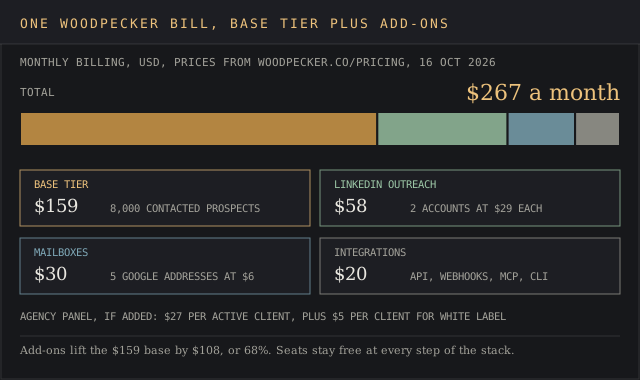
A team contacting 8,000 prospects a month with two LinkedIn accounts, five new Google mailboxes and a HubSpot sync pays $159 + $58 + $30 + $20, or $267 a month. The three reps cost nothing. Add-ons raise the base by $108, a 68% increase, and that's par for the course for any sender building its own infrastructure.
Agency with five active clients
Five clients sharing 25,000 prospects run $395 for the tier, $135 for five Agency Panel seats and $25 for White Label, or $555 a month. Duplicate counting is the red flag here: a list reused across two clients counts twice against the shared pool.
On annual billing, the 25,000 tier costs $3,160 a year against $4,740 paid monthly. Budget add-ons at their monthly rate until Woodpecker's billing page confirms otherwise, and price multi-year deals one renewal at a time.
Frequently asked questions
Is Woodpecker free?
Woodpecker sells paid tiers from $35 a month. Its trial runs 14 days or 100 cold emails, whichever comes first, with no credit card and all features included except LinkedIn slots, a time limit and a volume limit in one. Support can extend the trial through chat, and after it ends, campaigns pause while data stays available.
Who owns Woodpecker?
Woodpecker.co S.A., a Wrocław company listed on the Warsaw Stock Exchange's Main Market since 19 April 2024, per PAP.
What is the cheapest cold email platform?
Of the five tools compared here, Woodpecker has the lowest entry price at $35 for 500 prospects. At 2,000 contacts, Smartlead's $39 Base plan undercuts Woodpecker's $67.
Can I send 200 emails daily with Gmail?
Yes. Google's Workspace limits allow 2,000 messages a day per paid user and 500 on trial accounts, so 200 a day sits well inside both.
How much does a single cold email cost on Woodpecker?
About 0.44 cents at the 500 tier ($35 for 8,000 emails) and about 0.064 cents at the 1,000,000 tier ($10,312 for 16,000,000 emails), before add-ons.
Are cold email reply rates falling?
Woodpecker's own cold email statistics page, updated 23 June 2026, puts the platform-wide reply rate at 3.43% in 2026, down from 5.1% in 2024, citing Instantly's 2026 report for the newer figure. Our email marketing statistics report covers the wider channel.
Bottom line
Woodpecker pricing comes straight from the horse's mouth: one public calculator, $35 to $10,312 a month, metered on contacted prospects with seats and email accounts free. The rate per 100 falls from $7.00 to $1.03, and the Unlimited option at $9,999 undercuts the 1,000,000 tier.
The real bill sits in the add-ons. LinkedIn accounts, mailboxes, domains and the $20 integrations line lifted the worked team example by 68%, and duplicate counting can force an agency up a tier.
Bite the bullet on annual billing only after the trial proves deliverability, since discounts don't convert into refunds. For the product side, read the full Woodpecker review.
Where every Woodpecker figure came from, and what the calculator leaves out
Tier prices, allowances, add-on prices, the trial terms and the currency list from woodpecker.co/pricing in its USD view. The contacted-prospect definition, the 33% annual discount, the pause fee, the refund wording and the Agency Panel fee from three Woodpecker Help Center articles: Billing FAQ, Billing metrics and the billing glossary. Reply rates from woodpecker.co/blog/cold-email-statistics, updated 23 June 2026.
Listing date and client count from PAP's mediaroom release on the Warsaw Stock Exchange move, published April 2024. Gmail sending limits from knowledge.workspace.google.com. Rival entry plans from smartlead.ai, instantly.ai, reply.io and lemlist.com pricing pages. Reviewer quotes from capterra.com, dated individually in the text. All URLs accessed 16 October 2026.
Woodpecker publishes no annual rate for any add-on and no multi-year contract price, so the worked bills price add-ons at their monthly rate.