ZoomInfo vs LeadIQ
 By Jan Suski. I go deep on every review, checking every number against its source and digging up details other coverage misses, a habit from six years of SEO and link building for tech companies. Bylines at Surfer, Brand24, and Senuto. How the scoring works.
· Prefer this source on Google
| WHAT EACH ONE DOES | LEADIQ | ZOOMINFO |
|---|---|---|
| Core job | Capture to sequence | Full GTM data platform |
| Contact records | 750M profiles | 500M contacts |
| Company records | None published | 100M+ companies |
| Intent data | None sold | 4,500+ topics |
| Job-change alerts | Free tier upward | Copilot tiers |
| Mobile accuracy | 85%, method pub | 87%, no method |
| Chrome extension | Free, 30k sellers | ReachOut, free |
| API rate limit | 60 req/min | 25 req/sec |
| Skip it if | You need intent | Under 5 reps |
| WHAT YOU GET | LEADIQ | ZOOMINFO |
|---|---|---|
| Published list price | 13-stop slider | None |
| Entry paid price | $15/mo annual | Quote only |
| Top self-serve | $217.69/mo | No self-serve |
| Seat cap | 5 on Pro | None published |
| Vendr median | $26,400/yr | $33,500/yr |
| Vendr avg discount | 21.56%, 86 deals | 21.81% |
| Credit expiry | Month or year end | Monthly, 1st |
| Certifications | SOC 2 II claimed | ISO 27001 + SOC |
| Ownership | Private, no filings | Nasdaq: GTM |
StrongerWeakerNo edge
Test scenario: a five-seat outbound team buying twelve months of contact data and mobile numbers in the United States. LeadIQ column from leadiq.com/pricing, leadiq.com/legal/terms-of-use and leadiqhelp.zendesk.com; ZoomInfo column from zoominfo.com/pricing, zoominfo.com/data, help.zoominfo.com and ir.zoominfo.com. Both median contract figures come from Vendr's marketplace header stat block; the prose tier bands weren't the source. Accessed 11 August 2026.
| LeadIQ | WHAT IT DOCUMENTS |
|---|---|
| Monthly entry tier | 200 credits/mo at $20.00 |
| Monthly top tier | 6,750 credits/mo at $290.25 |
| Annual discount | Exactly 25%, holds at every slider stop |
| Free trial | 30 days, any plan |
| API profile lookup | 0.1 credits per profile |
| GraphQL pagination | skip + limit may not exceed 10,000 |
| Second API surface | Prospector REST at prospector.leadiq.com |
| API auth | Basic base64 on GraphQL, X-API-Key on REST |
| Scribe languages | 5: English, Spanish, French, German, Italian |
| Scribe output | 3 personalised messages per prospect |
| Data Community grant | 100 standard + 10 premium credits/month |
| MCP gate | Active paid subscription required |
| Lando Agent access | Current customers only, limited spots per wave |
| Breach notification | Within 48 hours |
| Sub-processor objection | 14 days |
| Sub-processors named | 7, including OpenAI and Databricks* |
| DSR limits | Confirmed in 10 days; 2 access requests per 12 months |
| 2025 deletion requests | 2,895 complied, 0 denied, median 3 days |
| ZoomInfo | WHAT IT DOCUMENTS |
|---|---|
| Engage send cap | 500 emails/day per user, rest queued |
| Dialer coverage | US numbers only, user picks area code |
| Chorus transcription unit | An "utterance," 5 to 15 seconds of audio |
| Chorus patents | 14 |
| Chorus roles | 4: admin, enablement, manager, rep |
| Meeting import | Zoom, Google Meet, Microsoft Teams |
| Gong integration gate | Copilot customers only |
| Marketing credits | 75,000 on Demand, 150,000 on ABM Enterprise |
| Display Network caps | 10 campaigns, 10,000 accounts on ABM Lite |
| Waterfall sources | "25+ vendors" and "40+ data providers"† |
| Keyword pairings | 6 trillion |
| Data processed daily | 1.5B+ data points |
| ZI Community | 100M+ opted-in users |
| Location records | 158M+ in the hero, 100M+ in the stat band† |
| Customer count | 35,000+ in the logo band, "over 30,000" in the FAQ† |
| G2 category wins | No. 1 in 133 categories, G2 Summer 2025 |
| MCP server | Published and listed in site nav |
*A LeadIQ figure the vendor states two ways on its own domain: leadiq.com/legal/sub-processors names 7 sub-processors while the DPA's Annex III lists 4. †A ZoomInfo figure stated two ways on the same page, zoominfo.com/data (locations, customers) or zoominfo.com/products/waterfall-enrichment (waterfall sources). Neither vendor has corrected either page.
Where every figure on this page came from, and the eleven things neither vendor will print
Pricing for LeadIQ came off the thirteen-stop slider on leadiq.com/pricing, stepped one position at a time and cross-checked against the annual and monthly billing toggles; ZoomInfo publishes no price, so its contract figures come from the Vendr marketplace header stat block. The prose tier bands underneath it are Vendr's own estimate and contradict the tracked numbers above them.
Coverage counts, accuracy percentages, credit costs and plan gates are quoted from each vendor's pricing, product, legal, help-centre and API-reference pages, with both figures shown wherever a vendor states one measure two ways on its own domain. Review scores were pulled from G2, Gartner Peer Insights and Capterra on 11 August 2026 with their sample sizes attached, because a 3.8 built on five ratings and a 4.5 built on 9,106 are not the same kind of number.
ZoomInfo's financial figures come from its Q2 2026 results and the 8-K filed 11 May 2026; the class-action figure comes from the federal court record in case 1:21-cv-02032.
Everything else was left out. Neither vendor publishes a seat price, a contract minimum, a cancellation-notice window, a credit overage rate, an audited accuracy figure or a bounce guarantee; LeadIQ additionally publishes no company count, no mobile-number count, no retention period, no uptime SLA and no funding history, and ZoomInfo publishes no DNC country count.
LeadIQ publishes a price and ZoomInfo doesn't. That one difference drives almost everything written about ZoomInfo and LeadIQ, and it holds for about five seats. LeadIQ's Pro plan stops at $217.69 a month and five users; above that ceiling both ZoomInfo and LeadIQ quote.
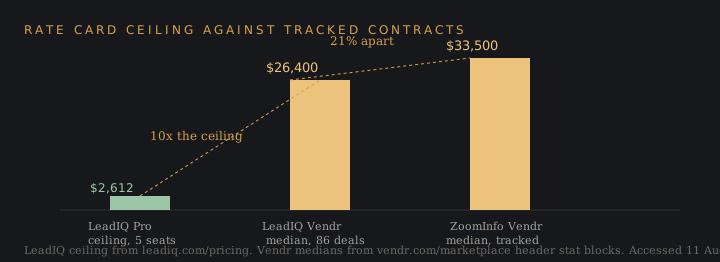
Procurement data closes the gap the rate card opens. Vendr's tracked contracts put the median LeadIQ deal at $26,400 a year against ZoomInfo's $33,500, 21% apart (vendr.com/marketplace, accessed 11 August 2026). A buyer reading LeadIQ's slider expects a 90% saving. The buyers who signed got 21%.
This ZoomInfo vs LeadIQ comparison is for sales teams choosing between two sales intelligence platforms with a real seat count in mind. ZoomInfo and LeadIQ price on different units, so the pricing model of each has to be converted before the two can be compared at all.
Where ZoomInfo and LeadIQ each state a number two ways on their own sites, both versions appear.
↑ COMPARISONZoomInfo vs LeadIQ pricing: a published rate card against a quote
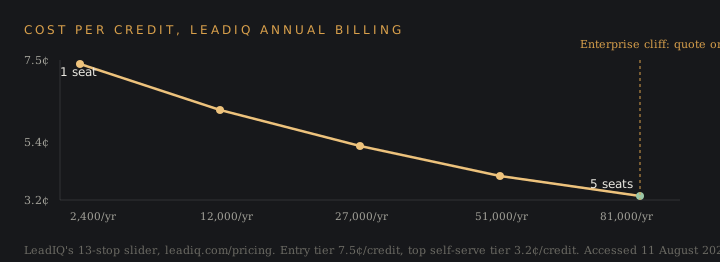
LeadIQ's pricing page is a credit slider with thirteen stops. On annual billing the ladder runs from 2,400 credits a year at $15 a month with one user included, through 12,000 credits at $37.50 with three users, to 81,000 credits at $217.69 with five (leadiq.com/pricing, 11 August 2026). Monthly billing costs exactly a third more.
Seats come bundled with credits. LeadIQ doesn't sell credits as a separate line item, which inverts how most sales intelligence tools price, so the useful unit is cost per credit. The top Pro tier works out at $2,612.28 a year for 81,000 credits, or 3.2 cents each. The entry tier costs 7.5 cents. Buying small costs 2.3x per unit.
Credits are not equal. An email costs 1 credit, a phone number costs 10, both together cost 11, and account enrichment costs 3. Spend the entire top tier on mobile numbers and you get 8,100 across five reps, roughly 1,620 each a year.
ZoomInfo publishes no dollar figure anywhere. Its pricing page lists six packages, Professional, Copilot Advanced, Copilot Enterprise, Marketing Demand, ABM Lite and ABM Enterprise, and routes every one to a quote form (zoominfo.com/pricing). The $14,995 Professional floor that circulates in comparison posts appears on no ZoomInfo page.
| Item | LeadIQ | ZoomInfo |
|---|---|---|
| Published list price | Yes, 13-stop slider | None |
| Entry paid price | $15/mo annual, 2,400 credits/yr | Quote only |
| Top self-serve price | $217.69/mo annual, 81,000 credits/yr | No self-serve tier |
| Seats at top self-serve tier | 5 | Not published |
| Free tier | 1 user, 50 credits, expire in 1 yr | 10 reveal credits at signup |
| Vendr median contract | $26,400/yr, 86 deals | $33,500/yr |
| Vendr average discount | 21.56% | 21.81% |
Both ZoomInfo and LeadIQ run a free plan and both cap it hard. LeadIQ gives one user 50 credits, enough for 50 emails or five phone numbers, expiring after a year. ZoomInfo Lite grants 10 reveal credits at signup, plus a 365-day window to re-export any record already pulled, which it calls Records Under Management. Further monthly credits require joining the ZoomInfo Community and contributing data, and the monthly figure isn't published.
Below five seats LeadIQ is an order of magnitude cheaper and its rate card lets you read the number yourself. At five seats the ladder ends, pricing becomes a quote on both sides, and the two land within a quarter of each other.
UpLead is not tracked on Vendr at all, which is itself informative for the wider field; see the sales intelligence tools ranking for how LeadIQ and ZoomInfo compare against the rest of the category.
↑ COMPARISONContract terms, seat caps and credit expiry
LeadIQ's Pro plan carries a maximum and no minimum. Its comparison table reads "Up to 5 users" for Pro against "Custom" for Enterprise, and nothing on the pricing page, the enterprise page or the terms of use states a minimum spend, seat count or term for the paid plans below Enterprise. Enterprise is marked "Annual plan only".
Credits vanish on schedule. Monthly subscribers lose unspent credits at month end and annual subscribers at year end, all fees are non-refundable, and legacy unlimited plans run under a fair use cap of 10,000 credits per user per month (leadiq.com/legal/terms-of-use, updated 16 September 2025). No overage rate, rollover policy or top-up price appears on the domain.
One quiet term favours the buyer: LeadIQ doesn't recharge for the same record twice inside a year, and that applies across the whole team. Five reps working the same account list pay once, which matters most to teams running a shared territory.
ZoomInfo sells annual contracts with no published minimum term and no cancellation-notice window. Its credit system runs three types, monthly, bulk and AI action; an export costs one credit per record, monthly credits are gated to the Advanced and Copilot tiers, they reset on the first at midnight PST, and workflows pause when a user hits the limit (help.zoominfo.com).
Chorus email data is deleted within 30 days of contract end, the only post-cancellation retention figure ZoomInfo publishes.
ZoomInfo also carries a settled right-of-publicity class action, Ramos et al. v. ZoomInfo Technologies, case 1:21-cv-02032, N.D. Ill., resolved 21 November 2024 for $29,557,612.50. It concerned the use of names and profiles in marketing previews. It wasn't a breach.
↑ COMPARISONLeadIQ vs ZoomInfo: the claims LeadIQ publishes, and the scores behind them
LeadIQ runs a dedicated attack page and ZoomInfo doesn't answer it. The case is argued entirely by one side. ZoomInfo writes about LeadIQ only as a third party inside its own Apollo comparison (pipeline.zoominfo.com/sales/apollo-vs-leadiq).
Read the attack page closely and it concedes more than it claims. Nine rows sit in its table and six mark both vendors green: B2B contact data, real-time data verification, AI email writer, automated prospect research, Salesforce and other CRM integrations, and job-change notifications.
| LeadIQ's claim, verbatim | What it rests on |
|---|---|
| "Zoom over to LeadIQ for better data quality at a better price" | Headline, no figure attached |
| "Don't settle for a legacy contact database" | Positioning, no figure attached |
| Capture to sequence and CRM with one click: LeadIQ yes, ZoomInfo no | Product claim |
| Universal access to all data & tools: LeadIQ yes, ZoomInfo no | Plan-gating claim |
| Return on investment: LeadIQ 6 months, ZoomInfo 14 months | G2, cited by LeadIQ |
| Ease of Use 9.0 vs 8.7, Setup 9.1 vs 8.6, Admin 8.9 vs 8.6 | G2 sub-scores, cited by LeadIQ |
LeadIQ publishes that same payback metric against seven rivals on one hub page: LeadIQ 6 months, Cognism 8, Lusha 9, Apollo.ai 10, Clearbit 10, Seamless.ai 12, ZoomInfo 14 (leadiq.com/compare/overview). Every rival is slower than LeadIQ and ZoomInfo is slowest of all. Clearbit is the odd one out on that list, sold only inside a paid HubSpot seat since 30 April 2025, per our Clearbit pricing report.
The aggregate scores for ZoomInfo and LeadIQ run the other way. G2 shows LeadIQ at 4.2 from 1,179 reviews and ZoomInfo at 4.5 from 9,106, the latter now listed as "GTM Workspace - Powered by ZoomInfo" after the old zoominfo-sales page was folded into it (g2.com, 11 August 2026).
| Source | LeadIQ | ZoomInfo | Sample |
|---|---|---|---|
| G2 | 4.2* | 4.5 | 1,179 vs 9,106 |
| Gartner Peer Insights | 3.8 | 4.2 | 5 vs 439 ratings |
| Capterra | 4.4 | 4.1, as ZoomInfo Sales | 25 vs 321 reviews, 20 July 2026 |
*LeadIQ's own site can't agree on its G2 number either: the prospecting hub says 4.2 and six other product pages say 4.3. G2 itself currently reads 4.2, so that's the figure used above; the six 4.3 pages are stale.
Capterra splits ZoomInfo into six listings with no combined score. The one comparable to a standalone LeadIQ entry is ZoomInfo Sales, at 4.1 from 321 reviews against LeadIQ's 4.4 from 25 (capterra.com, both last updated 20 July 2026).
G2, Capterra and Gartner disagree on which vendor wins, and their sample sizes run from 9,106 down to 321 down to 5, which is most of the reason the three scores don't line up.
Gartner's LeadIQ entry rests on five ratings, so a 3.8 there tells you almost nothing. The attack page also carries no publication date, names Sigma with a stated 5x increase in outreach efforts, and misattributes the accompanying quote twice on one page, as Byron Green in the alt text and Byron Scott in the byline.
↑ COMPARISONData coverage and the contact data counts each vendor states twice
Both ZoomInfo and LeadIQ state their headline data coverage two different ways on their own domains, which is the single most useful thing to know before either sales rep quotes a number at you.
| Metric | LeadIQ | ZoomInfo |
|---|---|---|
| Contacts or profiles | 750M+* (pricing, lando-agent) vs 749M (enterprise) | 500M+† (data) vs 420M+ (products/sales) vs 300M+ (copilot) |
| Companies | Not published | 100M+ and 122M+† on the same page (data) |
| Verified emails | Not published as a count | 300M+ vs 174M vs 200M+ |
| Verified phones | Not published as a count | 135M+ (data) vs 70M (products/sales) |
| Refresh cadence | Monthly, up to 200M re-verified (pricing) vs 60% in six months (enterprise) | Technographics on a 60-day cycle; no full-database cadence |
| Company attributes | 40+ firmographics written to Salesforce | 300+ search attributes |
*LeadIQ publishes 750M+ on its pricing and Lando Agent pages, and 749 million on its enterprise page. Published: 750M+, the figure on the page a buyer transacts from; enterprise is quote-only and carries an unfilled placeholder elsewhere on it.
†ZoomInfo publishes 500M+ on zoominfo.com/data, the page its own sales material cites, against 420M+ and 300M+ elsewhere, and both 122M+ and 100M+ companies on the data page itself.
LeadIQ's enterprise page ships an unfilled placeholder where the account count should be. The live text reads "Over X contacts and X accounts across US, EMEA, and APAC," a fair summary of how much company data LeadIQ discloses.
ZoomInfo's database extends past contacts into material LeadIQ has no equivalent for: 281 million job postings going back 6.5 years, 210 million IP-to-organisation pairings built on the Clickagy acquisition, and technographic coverage of 20,000+ products on one page and 30,000+ on another. Its EU lead data, 66 million contacts and 20.5 million companies, appears only on its Cognism comparison page.
That extra layer of signals is what buyers pay the difference for, and it is why a like-for-like contact count understates the gap. The lead data underneath each ZoomInfo record carries more fields than LeadIQ's.
↑ COMPARISONIntent data, buyer signals and data collection methods
LeadIQ sells no intent data product, the cleanest capability gap between these two sales intelligence tools. LeadIQ focuses on the contact record where ZoomInfo focuses on the account signal. It sells event triggers instead: 10-K mentions, podcast mentions, hiring activity and job changes, bundled into Signals and available on every tier including the free plan.
Contact tracking is the one LeadIQ pushes hardest, watching champions across job moves and flagging them when they land somewhere new.
ZoomInfo's intent layer is a separate data collection operation. It runs 4,500+ intent topics, processes 85 million intent signals a week, scans 28 million site domains daily and resolves 50% to 60% of US business web traffic through WebSights, which is US-only (zoominfo.com/data).
- Pulse feeds push up to 1,000 alerts a day per feed
- Earnings-call signals draw on 250,000+ calls, gated to Copilot Enterprise
- WebSights resolves 50% to 60% of US business web traffic
Lead behavior tracking is where the two stop being comparable. One infers purchase timing from third-party web activity at scale; the other tells you when a known contact changed jobs. Teams relying on account-level timing to prioritise a territory need the first. Teams working a named list need the second, and the two build different sales strategies on top of each.
↑ COMPARISONData accuracy and data quality: a published method against a published number
ZoomInfo and LeadIQ both publish accuracy percentages and only one publishes the method.
LeadIQ gives both the number and how it got there: an 85% global mobile match rate falling to 70% in EMEA, accuracy above 90% on numbers passing its AI-driven carrier checks, a 2.5% bounce rate on Verified emails against 14% on Verified-Likely, and connect rates averaging 5% to 10% across all numbers and up to 15% filtered to Verified phones (leadiq.com/pricing FAQ and leadiq.com/faq).
Its help centre documents the method in five steps, one of which is a research team that cold calls numbers to confirm them. Real-time verification also runs at the moment of sync, re-verifying every email before it writes to Outreach unless that address passed a check within the previous 48 hours.
ZoomInfo publishes numbers without the method. Its data page states 96% email deliverability and 87% mobile number accuracy, its Seamless.AI comparison page states "up to 95%" first-party accuracy, and the supporting detail is a headcount of 300+ human researchers. No independently audited figure exists for either vendor.
Mobile phone numbers and where the two differ
ZoomInfo claims 87% accuracy on mobile phone numbers and LeadIQ claims an 85% match rate. A match rate and an accuracy rate measure different quantities, so those two figures aren't comparable, and any vendor setting them side by side is doing arithmetic across two different measures.
Teams that need accurate contact information at volume should test both against the same 200-record sample before signing. Buying data on a published match rate with a documented method beats buying data on a percentage with none. Bad records cost more at the top of the sales process than anywhere further down it.
↑ COMPARISONChrome extension, integration capabilities and data enrichment in the CRM
Both vendors ship a browser extension on the free tier. LeadIQ's is the product's centre of gravity, claiming 30,000 sellers, letting users capture leads directly from a profile into a sequence and the CRM in one action. ZoomInfo's ReachOut extension is free even on Lite.
LinkedIn Sales Navigator is where LeadIQ's Chrome extension is designed to live, and also where its documentation thins out. LeadIQ names nine sales tools it integrates with on a single overview page, Salesforce, HubSpot, Salesloft, Gong, Outreach, Clay, Groove by Clari, Nooks and Chili Piper, and publishes a dedicated page for exactly one of them.
| Integration capabilities | LeadIQ | ZoomInfo |
|---|---|---|
| Native integrations claimed | 9 named on one page | 120+ |
| API type | GraphQL, plus a separate REST list API | REST |
| Rate limit | 60 requests/minute | 25 requests/second, 35 on Scaling |
| Free API allowance | 50 one-off test calls, any plan | Credit-metered, no published cap |
| Published uptime target | None | 99% platform, 99.9% API |
| Status page | status.leadiq.com, set to noindex | status.zoominfo.com |
| CRM write depth | 40+ firmographics, OAuth 2.0 | Bidirectional sync, named CRMs |
The API gap is 25x and it is a design choice. Past 50 test calls LeadIQ routes API access into an enterprise sales conversation, and its own reference at developer.leadiq.com documents no rate limit at all; the 60-per-minute figure lives only in a help-centre article.
Data enrichment runs in opposite directions. LeadIQ enriches on capture and on CRM write, keeping CRM data current while a rep prospects, with an OAuth 2.0 connection that mirrors rules already set in the CRM. ZoomInfo runs scheduled mass enrichment at one credit per record and pauses workflows when a limit is reached.
Neither product is a sequencer. Both sales intelligence tools feed sales engagement platforms. Neither one replaces Outreach, Salesloft or Gong, which is why all three sit on both integration lists. A team standardising on one of those platforms should confirm field mappings first, because custom mappings are gated on LeadIQ.
Key features gated behind enterprise plans
LeadIQ's Enterprise tier holds back eight things a growing team wants: AI account prospecting, governance controls for prospect data, CSV file enrichment, advanced admin settings for integrations, Salesforce duplicate detection, team analytics dashboarding and reporting, custom field mappings, and single sign-on.
Advanced search against the full database is marked "Limited Access" on both Free and Pro, so the features that turn a prospecting tool into a lead generation engine sit behind the quote. Advanced search on ZoomInfo spans 300+ company attributes at every paid tier.
A five-person team can live without team analytics; a company with an identity provider generally can't onboard a tool without SSO, which pushes it into the same quote process ZoomInfo uses.
Setup, admin overhead and the learning curve
LeadIQ sells speed of adoption and puts a number on it. Its free plan card reads "Setup takes less than 5 minutes," every plan carries a 30-day trial, and its Greenhouse case study claims 90% of reps endorsed the tool during that trial (leadiq.com/pricing, leadiq.com/universal-credits). The G2 sub-scores LeadIQ cites run the same way: Ease of Setup 9.1 against 8.6, Ease of Use 9.0 against 8.7.
ZoomInfo's steep learning curve lives in the admin surface. Three credit types run at once, per-user credit limits pause workflows mid-run, Engage enforces send quotas by day, by minute and by domain, and Chorus ships a four-role permission model with a dedicated enablement role (help.zoominfo.com).
Every one of those is a setting somebody has to own, and small teams rarely have that somebody.
ZoomInfo answers that with training. Its knowledge base documents the credit model, Records Under Management, workflow administration and meeting import in separate articles, and ZoomInfo Lite hands a prospective buyer 10 reveal credits to learn the interface before any contract exists.
LeadIQ's documentation is where its onboarding story weakens. It publishes a dedicated page for one of the nine integrations it names, its API reference at developer.leadiq.com is linked from nowhere on leadiq.com, and its security policies are request-only through support@leadiq.com. A tool that installs in five minutes still has to be wired into a CRM by somebody reading docs that mostly aren't there.
↑ COMPARISONSeat floors, and the third option teams weigh against both
Seat structure separates sales intelligence platforms more cleanly than price does, and it is the term buyers check last. Cognism includes five seats in both packages, Apollo applies a three-seat minimum on Organization, Lusha sends teams above five users to sales, LeadIQ caps Pro at five, and ZoomInfo publishes no seat count or seat minimum at all.
Try it yourself
Sign up for Lusha
Free plan available, credit-based pricing after that.
 Visit Lusha →
May earn a commission if you sign up through this link, at no extra cost to you. Full affiliate disclosure.
Apollo is the option that keeps appearing alongside ZoomInfo and LeadIQ in these evaluations and draws the highest search volume of any ZoomInfo pairing. Cognism turns up when compliance drives the decision, and it offers to buy out an existing ZoomInfo contract for switchers (cognism.com/cognism-vs-zoominfo).
Neither Apollo's nor Cognism's pricing is re-verified in this piece; treat both as names worth adding to a shortlist here.
Compliance splits the pair unusually. LeadIQ screens against do-not-call registries in 13 countries with the US registry in beta, and ZoomInfo publishes no country count for DNC coverage.
ZoomInfo holds ISO 27001, 27701 and 27017 plus an AICPA SOC report on a public trust centre. LeadIQ claims SOC 2 Type II in image alt text and one prose line, names no auditor and no report period, and operates no trust page. LeadIQ also states plainly that it sells personal data under US state law.
↑ COMPARISONOwnership, financial condition and product renaming
ZoomInfo's condition is public because it has to be. It changed its Nasdaq ticker from ZI to GTM in May 2025 alongside the GTM Studio launch, reported Q2 2026 revenue of $310.4 million, up 1.2% year on year, and booked a $651 million non-cash goodwill impairment plus a $35 million restructuring charge in the same quarter.
An 8-K filed 11 May 2026 disclosed a restructuring cutting roughly 600 positions, about 20% of Q1 headcount. Market capitalisation sat near $1.2 billion on 7 August 2026, down roughly 63% in a year.
LeadIQ discloses none of this, and the fairness note matters: it is private, files nothing, and its condition can't be checked by the same method. It publishes a founding year of 2015, 100+ teammates, a fully remote structure, 10,000+ users, a Singapore support subsidiary, and Mei Siauw as co-founder and CEO.
No funding round appears anywhere on leadiq.com; there is no about page, no newsroom, and /press redirects to the homepage.
Product renaming has hit ZoomInfo and LeadIQ both. ZoomInfo now positions itself as an AI go-to-market intelligence platform. It no longer markets itself as a plain data provider, and G2 has already merged its Sales and Copilot listings into GTM Workspace. LeadIQ's Scribe still has a live product page and has been removed from the site navigation.
↑ COMPARISONWhich sales intelligence platform fits which sales team
LeadIQ excels in a narrow, well-defined shape: one to five reps, an outbound motion built on LinkedIn Sales Navigator, a named account list, and a finance team that wants a number on a page before signing. The prospecting process it improves is capture-to-sequence, a single point in the sales process, and the credit ladder lets smaller teams size prospecting to the month.
LeadIQ's design works against itself once the team grows. Past five seats the ladder disappears, SSO and admin controls sit behind a quote, and the Vendr median for the contracts that follow is $26,400, close enough to $33,500 that the decision turns on data breadth. Price alone won't decide it. Teams that outgrow five seats lose the reason LeadIQ was picked, and sales efforts rarely shrink back.
ZoomInfo suits complex sales processes where account timing, territory planning and marketing teams share one intelligence platform. Its intent layer, job-postings history, technographics and IP resolution have no LeadIQ counterpart, and sales leaders running multi-segment plays get more usable data from it. The trade is a steep learning curve, no published price, and a vendor in visible financial repair.
Teams aiming to consolidate multiple tools should price ZoomInfo, since one platform covering prospect data, intent and enrichment removes work a focused tool leaves behind. Teams aiming to replace one expensive contract with a cheaper focused one should price LeadIQ Pro first and find out fast if five seats is enough.
ZoomInfo vs LeadIQ FAQ
Is LeadIQ cheaper than ZoomInfo?
Below five seats, by roughly an order of magnitude: LeadIQ's top self-serve tier costs $2,612.28 a year against a $33,500 ZoomInfo median. Above five seats both are quoted, and Vendr's tracked medians sit 21% apart at $26,400 and $33,500.
Does ZoomInfo publish exact pricing?
No. Six packages, every one routed to a quote form. The $14,995 Professional figure repeated online appears on no ZoomInfo page. LeadIQ's pricing runs to a thirteen-stop slider.
Which has better data accuracy?
Neither has an independently audited figure. ZoomInfo states 96% email deliverability and 87% mobile accuracy with no published method; LeadIQ states an 85% mobile match rate, a 2.5% bounce rate on Verified emails, and a five-step process including manual calling. Real-time verification at sync is LeadIQ's differentiator on data accuracy.
Does LeadIQ have intent data?
No. It sells event signals such as job changes, hiring and 10-K mentions. ZoomInfo runs 4,500+ intent topics and 85 million signals a week.
Is ZoomInfo outdated?
Its product line was renamed and repositioned around AI go-to-market workflows across 2025 and 2026, and it publishes the largest intent and technographic datasets of any sales intelligence platform. The pressure on it is commercial, a $651 million impairment and a 600-position restructuring.
Who competes against ZoomInfo besides LeadIQ?
Apollo draws the highest search volume of any ZoomInfo pairing, Cognism competes on European coverage and DNC screening, and Lusha, UpLead and Seamless.AI compete on price. All four publish a rate card, which is what makes them easy to check a ZoomInfo quote against, and all four appear on the fuller list of ZoomInfo alternatives ranked by demand.
Can both platforms manage leads inside a CRM?
ZoomInfo and LeadIQ both write to Salesforce and HubSpot. LeadIQ enriches 40+ firmographics on write; ZoomInfo runs bidirectional sync and mass enrichment at one credit per record. Neither owns pipeline stages, so lead management stays in the CRM, and neither vendor sells a lead management product.
What does LeadIQ's free plan include?
One user, 50 credits expiring after a year, plus API access, Chrome extension prospecting, job-change tracking, CRM enrichment, company search and the AI message writer. Fifty credits buys 50 emails or five phone numbers, enough to test data accuracy and not enough to run outreach on.
Is LeadIQ credible?
Founded in 2015, it claims 100+ staff and 10,000+ users and names Gong, Optimizely and WalkMe as customers on its own site. It publishes no funding history, no audited accuracy figure and no SOC 2 report request process, so its claims rest on its own documentation, with no outside verification behind them.
What kind of companies use LeadIQ?
Outbound teams at software companies, on its own customer list: Gong, Optimizely, WalkMe, Clari, Greenhouse, Smartly.io and Sigma. The plan shape points the same way, since Pro caps at five users and anything past that goes to an Enterprise quote.
Which supports a bigger lead generation program?
ZoomInfo, on volume and signal breadth. LeadIQ's ceiling of 81,000 credits converts to 8,100 phone numbers a year, and anything past that moves into its Enterprise quote. Teams running lead generation across several segments tend to end up with ZoomInfo or Apollo.
Sources: leadiq.com/pricing, leadiq.com/legal/terms-of-use, leadiq.com/legal/sub-processors, leadiq.com/legal/data-processing-agreement, leadiq.com/faq, leadiq.com/compare/overview, leadiqhelp.zendesk.com, developer.leadiq.com; zoominfo.com/pricing, zoominfo.com/data, zoominfo.com/products/waterfall-enrichment, help.zoominfo.com, ir.zoominfo.com, pipeline.zoominfo.com/sales/apollo-vs-leadiq.
Also: g2.com, capterra.com and Gartner Peer Insights listings for both products; vendr.com/marketplace header stat blocks; ZoomInfo Q2 2026 results and 8-K filed 11 May 2026; courtlistener.com docket for case 1:21-cv-02032. Accessed 11 August 2026.
Disclaimer
This page includes one or more affiliate links. If you sign up for a product through one of them, this site may earn a commission at no extra cost to you.