FullEnrich review: what a credit buys once the waterfall verifies it
 By Jan Suski. I go deep on every review, checking every number against its source and digging up details other coverage misses, a habit from six years of SEO and link building for tech companies. Bylines at Surfer, Brand24, and Senuto. How the scoring works.
· Prefer this source on Google
Best for
Sales teams, agencies and RevOps builders already paying one or two data vendors who want one waterfall over 20-plus providers, charged per verified hit, with unlimited users on every plan.
Not for
Reps who prospect inside LinkedIn and want a one-click extension, because the Sales Navigator export died in June 2024 and a March 2026 G2 reviewer still names the missing extension as his top complaint. Also a poor fit for anyone planning to cancel with credits in hand, since remaining credits expire at the end of the billing cycle.
What it costs
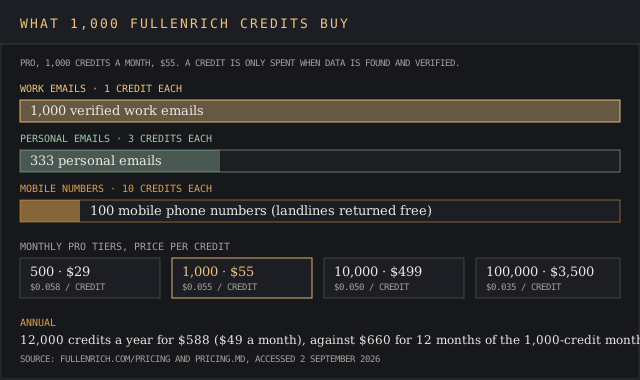
The free trial gives 50 credits on an email signup alone. Pro runs from $29 a month for 500 credits to $3,500 for 100,000, so $0.058 down to $0.035 a credit. A work email is 1 credit, a personal email 3, a mobile phone number 10. Enterprise is quoted.
- Free trial
- 50 credits, no credit card required; 50 more per teammate invited
- Pro monthly
- $29 for 500 credits, $55 for 1,000, $3,500 for 100,000
- Annual billing
- 12,000 credits a year for $588, against $660 paid monthly
- Credit costs
- Work email 1, personal 3, mobile 10, reverse lookup 1, export 0.25
- Failed lookups and landlines
- 0 credits
- Credit rollover
- 3 months on monthly plans, 12 on annual; unused credits expire at cycle end on cancellation
- Providers in the waterfall
- 20+ (the pricing table says 25+), including Hunter, RocketReach & ContactOut per the changelog
- Published email find rate
- 89% US and Canada, 84% EMEA, 78%+ LATAM and APAC
- Published mobile find rate
- 86% US and Canada, 71% EMEA
- Bounce rate by email status
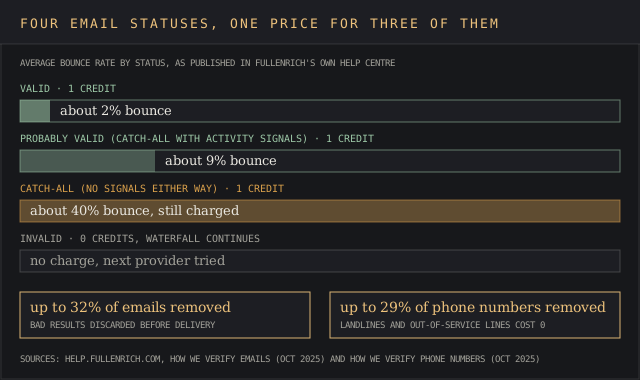
- Valid about 2%, probably valid about 9%, catch-all about 40%
- Discarded before delivery
- Up to 32% of emails, up to 29% of phone numbers
- Search database
- 800M people and 50M companies, 15+ filters each, separate from the waterfall's live data
- Processing time
- Emails 1 to 2 minutes a contact, phone numbers 40 to 80 seconds, 100 concurrent tasks a workspace
- Bulk enrichment input
- Name plus company name or domain, or a LinkedIn profile URL; CSV, Excel, API or manual entry
- Live CRM integration
- HubSpot live; Salesforce, Pipedrive, Folk and Zendesk "Soon"
- Chrome extension
- Sales Navigator export discontinued June 2024; none listed in the help centre as of September 2026
- MCP server
- mcp.fullenrich.com, documented 7 May 2026
- Company
- Started in Paris, headquartered in California; CEO Benjamin Douablin; $2M seed in February 2025 from Flex Capital and five others
- Ratings
- G2 4.8 across 231 reviews as of 1 September 2026; Capterra lists 0 reviews
- Uptime
- 99.948% over the 90 days to 1 September 2026, seven incidents totalling 62 minutes
- Compliance
- SOC 2 Type II, GDPR, CCPA, pentest report and CAIQ published; enriched contacts deleted after 3 months
Clay
Not forA team that wants a finished CSV back in minutes, straight from an upload.
Apollo.io
Not forA team holding contacts from another source that only needs emails and phone numbers filled in.
Pairs well with FullEnrich
What FullEnrich publishes about itself, and where its own numbers disagree
Pricing, credit costs and match rates come from fullenrich.com/pricing, pricing.md and the help centre, accessed 2 September 2026. The help centre says 20-plus providers while the pricing table says 25-plus. The LinkedIn enrichment guide claims annual billing saves about 30%, while the rate card's 12,000-credit annual plan at $588 against $660 monthly is a 10.9% saving. Ratings are G2's own aggregate as of 1 September 2026.
FullEnrich is a waterfall enrichment service. Give it a name and a company, or a LinkedIn profile URL, and FullEnrich queries 20-plus data vendors in sequence until one returns a work email or a mobile phone number that passes verification. The FullEnrich help centre says each lookup runs live against those vendors at query time, and the waterfall itself stores zero contact records.
That pitch has carried a Paris-born startup whose changelog starts in November 2023 to 4.8 on G2 across 231 reviews.
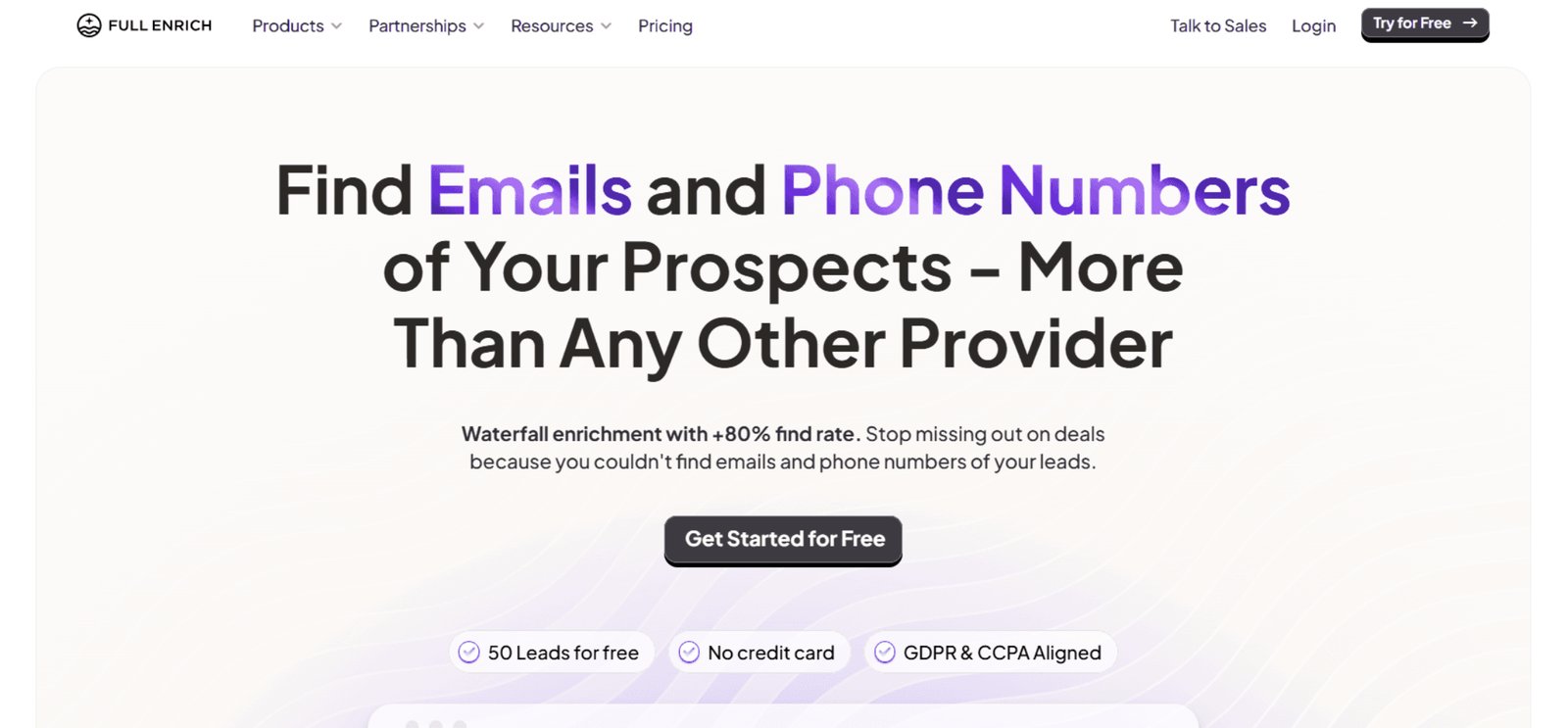
This FullEnrich review covers the credit system and every published tier, the triple email verification and what it does to catch-all addresses, phone enrichment, the FullEnrich Chrome extension story, which integrations are live and which nine are marked "Soon", and what 231 G2 reviewers plus a Reddit thread say went right or wrong.
Every figure links to its source page and every quote links to where it was posted. Where other enrichment tools get compared, the figures come from their own rate cards.
The buyer this suits is a sales team or agency already running Apollo, Lusha or Hunter and tired of the 40% of contacts that come back without emails and phone numbers. FullEnrich sells separately to SDR teams, marketing teams, RevOps and recruiters, and the two jobs it does for all four are lead generation from a cold list and CRM enrichment of records that already exist.
A rep who prospects one profile at a time on LinkedIn will spend the trial copying URLs by hand, and a Salesforce shop that needs a native sync this quarter is on the waitlist.
Timing matters because the rate card moved. Older reviews still quote a $26 basic plan with 6,000 credits, a $49 Pro plan with 12,000 credits & a $500 Scale plan. On the FullEnrich pricing page as of 2 September 2026, those are annual tiers with 6,000 and 12,000 credits a year, Scale has become a custom Enterprise plan, and the card as of that date lists Free, Pro and Enterprise.
Try it yourself
Sign up for FullEnrich
Free trial: 50 credits on an email signup, plus 50 more per teammate invited.
 Visit FullEnrich →
May earn a commission if you sign up through this link, at no extra cost to you. Full affiliate disclosure.
How FullEnrich works as waterfall enrichment across 20-plus providers
Most enrichment tools query one database and stop, so single source tools return whatever that database holds, and the rest of the contact details stay blank. FullEnrich queries a chain of them in turn, the sequence the waterfall label describes. The Introducing FullEnrich article describes trying one provider, then the next, until a hit comes back, each query in real time.
The chain grows over time, and the changelog names three of the multiple providers added: ContactOut in December 2023, Hunter in March 2024 and RocketReach in July 2024, each on every plan.
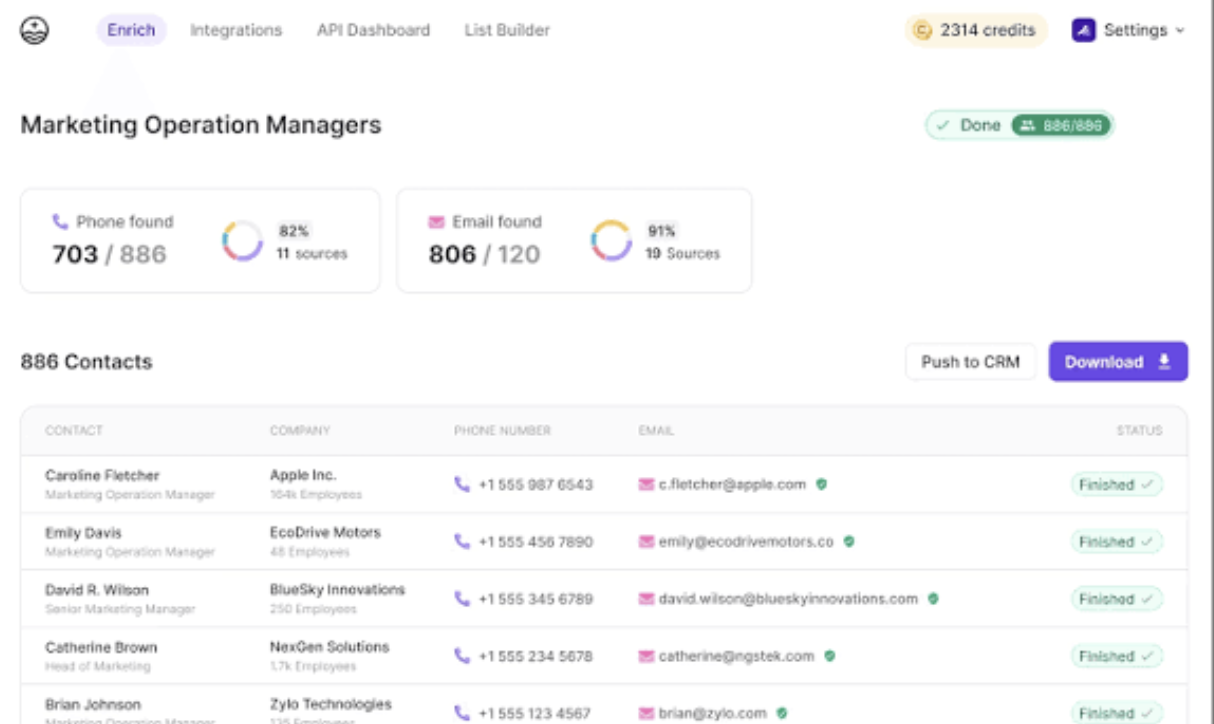
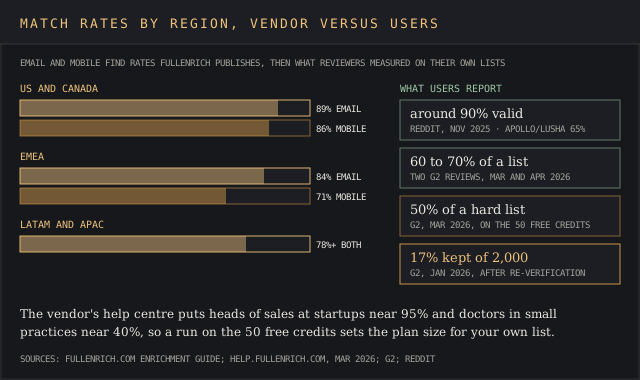
The waterfall advantage is coverage from multiple data sources, and a multiple sources model only pays off if the providers overlap less than they agree. The FullEnrich LinkedIn enrichment guide claims single source enrichment tools return usable contact data for 40 to 60% of contacts, while waterfall enrichment returns 80% or more: 89% email and 86% phone in the US and Canada, 84% email and 71% phone across EMEA, 78% or above in LATAM and APAC.
A Reddit user in r/EmailProspecting, posting in November 2025 after several thousand enrichments, measured something close:
The difference in accuracy was pretty striking I went from that ~65% with Apollo/Lusha up to around 90% with FullEnrich. Plus, you only get charged when it actually finds a valid result, so even though it sounds like it'd be pricier, the cost per usable contact ended up being roughly the same.
Reddit, r/EmailProspecting, November 2025
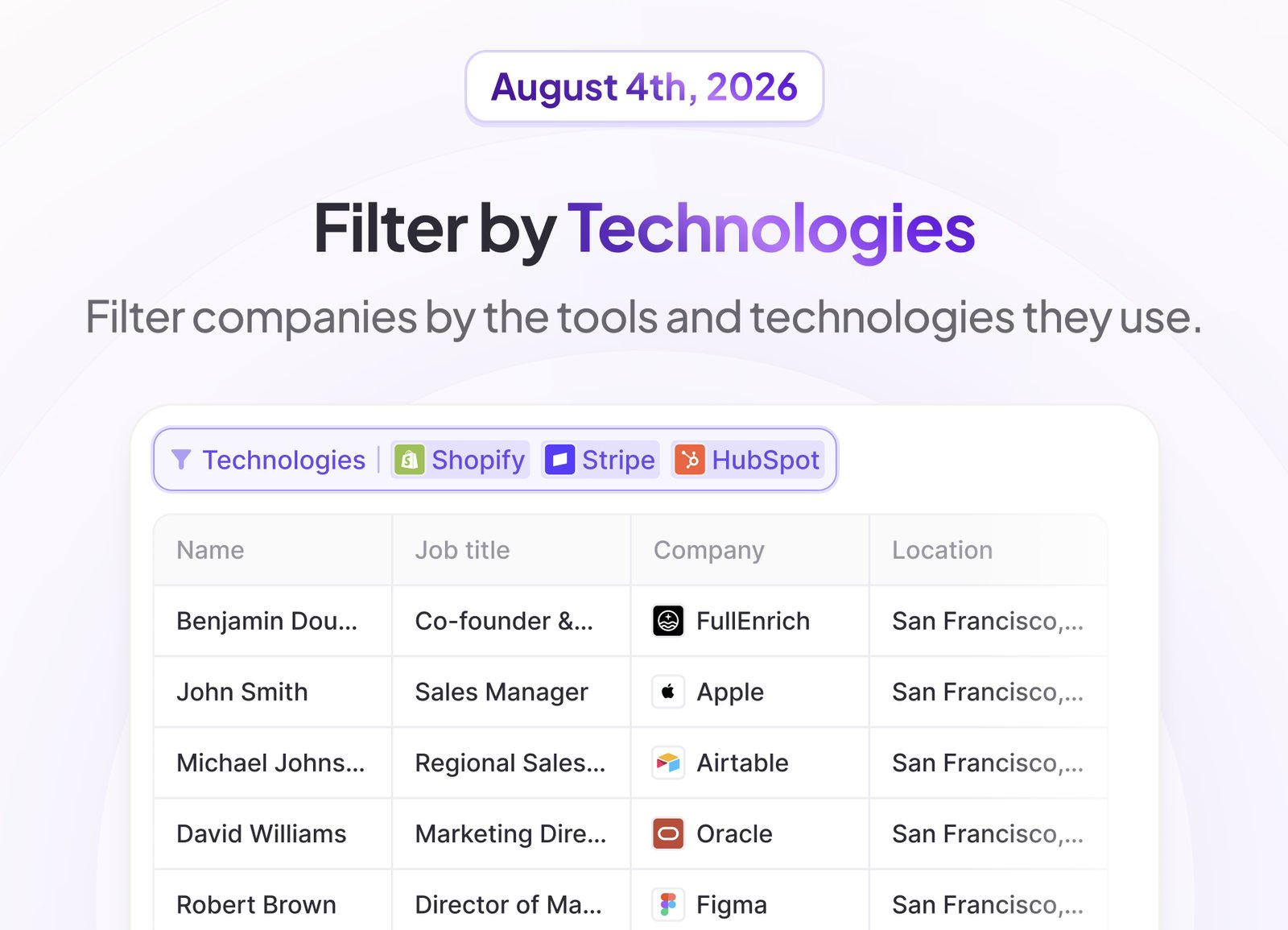
There is one database in the product. People & Company Search runs on 800M people and 50M companies with 15+ filters each, and the trust centre's FAQ separates it from the waterfall on exactly that point. Exporting new contacts from search costs 0.25 credit a record, and you then enrich contacts from that export with emails and phone numbers at the normal credit rates.
The filter set covers person and company attributes and stops there, so a team that wants buying signals on top pairs it with Clay or SyncGTM.
A hit returns more than contact details. Supply a LinkedIn profile URL and FullEnrich adds contact info and company data free: job title, company domain, industry, headcount, founding date & address, per the data-provided article, which also says the URL lifts match accuracy by up to 35%.
↑ FACT SHEETFullEnrich pricing and the credit system, tier by tier
FullEnrich's machine-readable pricing.md, updated 14 July 2026, lists eleven monthly Pro tiers: 500 credits for $29, 750 for $42.75, 1,000 for $55, 1,500 for $79.50, 2,000 for $104, 5,000 for $255, 10,000 for $499, 15,000 for $720, 25,000 for $1,150, 50,000 for $1,950 and 100,000 for $3,500. Above 100,000 a month you talk to sales.
Every credit buys the same thing on every tier: a work email is 1 credit, a personal email 3, a mobile phone number 10, a reverse email lookup 1. Failed lookups, landlines and invalid addresses all cost 0 credits at FullEnrich, because the waterfall keeps going until it finds verified emails or runs out of providers. Person and company data rides along free, so a contact record carries contact info and firmographics on the same 1 credit.
Unlimited users come with every plan, the free trial included, and credits sit in one shared pool, and Pro adds per-user credit limits & low-credit alerts. The card prices credits alone, the biggest structural difference from Lusha or Apollo, where a 10-rep team pays ten seats.
Annual billing restates the ladder per year: the 12,000-credit annual plan is $588 against $660 for twelve months at 1,000 a month, a 10.9% saving. FullEnrich's LinkedIn guide claims annual plans save "approximately 30%", close to three times what its own rate card produces.
Fifty free credits on an email signup buy 50 verified emails or five mobile phone numbers, enough to test data quality on one segment before sizing a plan. The vendor's own audience-level rates spread from 40% to 95%, so the match rate on your own list decides the plan size.
↑ FACT SHEETCredit rollover, cancellation and the three-month deletion rule
FullEnrich credits stay valid 3 months on monthly plans and 12 on annual, per the How Do Credits Work article updated 10 July 2026. A founder on G2 in March 2026 called credit rollover the reason he switched:
The credits carry over month to month, so if you have a big job after not using the service for a while, all those unused credits are still available.
G2, founder at a small business, March 2026
Cancelling changes the arithmetic, since the same article says that once the billing cycle ends, "any unused credits will expire and cannot be used further". Monthly subscribers can pause for up to two months, with access restricted during the pause. A sales director paying out of his own pocket gave FullEnrich 4.5 stars on G2 in April 2026 and still wrote:
I'm also displeased that I lose ALL my credits if I cancel, when I am paying for this out of my pocket (not company funded). This is bad enough, but when I tried to pause it I couldn't even access it or use my credits at ALL.
G2, sales director at a small business, April 2026
Enriched contacts are deleted after 3 months, irreversibly, and the duplicate-contacts article spells out the consequence, that deduplication only works inside that window, so re-enriching the same list of contacts in month four consumes credits again. Duplicate contacts inside one file are charged twice.
500 credits for $29
Start on the Pro plan
Unlimited users on every tier, 1 credit a verified work email and 10 a mobile number.
Visit FullEnrich →
May earn a commission if you sign up through this link, at no extra cost to you. Full affiliate disclosure.
↑ FACT SHEETTriple email verification and what catch all resolution costs
The FullEnrich email verification article, dated 29 October 2025, describes three verification methods plus a provider score and publishes the bounce rates it expects for each status. Valid addresses bounce at about 2%. "Probably valid" addresses, meaning catch-all domains with activity signals, bounce at about 9%. Plain catch-all addresses bounce at about 40%.
Invalid addresses cost 0 credits and send the waterfall on to the next provider, and that retry keeps sender reputation intact on the deliverable tier. Every address comes from one of the providers and then passes through the checks, which rules out pattern-guessed addresses from a company domain.
The catch-all method matters before trusting FullEnrich's "probably valid" label. FullEnrich tests hundreds of sites such as Notion, Spotify and Google Drive by attempting a login with the email and a fake password, and a "wrong password" response proves an account exists. The article adds its own caveat, that the check proves an account existed at some point and the mailbox can still be dead today.
All three chargeable statuses cost 1 credit, and that charge sits behind the sharpest criticism on G2, a one-star review from a verified user in staffing and recruiting, posted 1 January 2026:
I uploaded list of 2000 leads - Fullenrich found 473 "valid" emails, 259 "perhaps" emails, 273 catch all emails - so 1005 emails in total. Out of that after veryfying catch all with another tool, as well as removing emails from companies that are not current ones I was left with 347 valid emails out of 2000 leads. Considering I paid $104 for 2000 credits - this means I paid around $50 for getting 347 valid emails.
G2, verified user in staffing and recruiting, January 2026
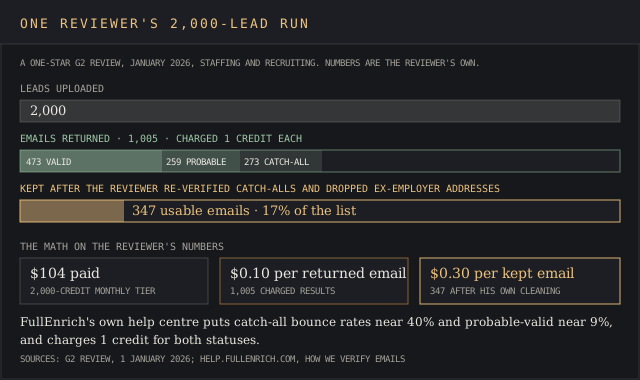
The documentation confirms both halves. Catch-all results are charged at upload, and the one control FullEnrich offers is the download filter added in November 2023, which removes them after the credits are spent. Stale employer addresses are the second half, and a global commercial manager reported the same in March 2026:
When someone has joined a new company, I often get their old data, so I have to use Apollo when this happens because it seems to have new data more quickly.
G2, global commercial manager at a small business, March 2026
Bounce rates in practice sit inside the bands. A G2 reviewer in March 2026 wrote that "my bounce rates have been below 2% consistently", and a sales executive in May 2026 put his at "2-3% though its good than other apps". Both are under the 5% FullEnrich said clients saw before the April 2024 triple email verification launch.
Phone enrichment for mobile numbers, landlines and the owner-name check
A mobile phone number costs 10 FullEnrich credits, and the phone verification article explains the charge. Landlines are flagged and returned free while the waterfall keeps going for a mobile, out-of-service lines cost 0 credits where detectable, and format-based mobile detection covers 40-plus countries. Up to 29% of returned numbers are removed before delivery.
The US & Canada get a deeper check. Since November 2024, telecom partners identify the line's owner, the name is matched against the lead, and matches are flagged "verified", which FullEnrich calls "almost 100%" accurate and recommends dialling first.
Mobile coverage thins by audience. FullEnrich publishes 71% in EMEA, 76% in the US and 81% in APAC, with its own caveat that heads of sales at startups sit near 95% and doctors in small practices near 40%, and phone data runs short in niche industries and for senior executives at small firms. Five reps wanting 100 mobiles a week each need 20,000 credits a month before a single email, the $1,150 tier.
The FullEnrich phone article covers landlines, dead lines and formats, and G2 reviewers report a fourth case, a live number that belongs to someone else, which costs a call where a wrong email costs a bounce. A G2 reviewer in March 2026 wrote:
I called a bunch of numbers, and some were not the person I thought I was calling.
G2, March 2026
G2's dislike tally puts incorrect numbers first, in 11 reviews, ahead of price at 8.
The FullEnrich Chrome extension and the LinkedIn workflow now
The FullEnrich Chrome extension launched on 5 January 2024 as a Sales Navigator exporter: filter, click "Export to FullEnrich", pick the enrichment type, and the contacts arrived enriched, unlimited on the $55 Pro plan. That ended within six months. The FullEnrich LinkedIn guide says LinkedIn discontinued third-party Chrome extension access to Sales Navigator in June 2024 and that "the current recommended workflow is the CSV export route".
A second Chrome extension followed on 26 August 2024, working from the profile page. As of September 2026 the extension is absent from the help centre's 14-article "How FullEnrich works" collection and from the integrations page, and a senior BDR wrote on G2 in March 2026:
I find the lack of a Chrome/LinkedIn extension inconvenient. Currently, I have to manually add each contact to FullEnrich to enrich them and then export.
G2, senior BDR, March 2026
Enriching straight from a profile ended with that extension. The LinkedIn functionality today is manually copying LinkedIn URLs one at a time, or LinkedIn profile URLs in bulk from a Sales Navigator CSV, then uploading. Competitor posts call this "FullEnrich discontinued" its extension, while FullEnrich says LinkedIn closed the door.
The upside FullEnrich claims is that matching a URL against external providers keeps every request off LinkedIn's servers. A technology sales recruiter agreed on G2 in April 2026:
FullEnrich works offline and isn't plugged into LinkedIn, which is important for avoiding sanctions I might get with other plug-in tools like Apollo.
G2, technology sales recruiter, April 2026
Failed lookups cost 0 credits
Test FullEnrich on your worst segment
50 free credits buys 50 verified work emails or five mobile numbers.
Visit FullEnrich →
May earn a commission if you sign up through this link, at no extra cost to you. Full affiliate disclosure.
↑ FACT SHEETIntegrations, API and the MCP server
FullEnrich integrates natively with HubSpot today, and the rest of the CRM column is a waitlist. The integrations page shows HubSpot live for pushing contacts & companies, while Salesforce, Pipedrive, Folk & Zendesk carry a "Soon" badge. Smartlead, Instantly, HeyReach, Lemlist, Gong, Outreach and Salesloft carry the same badge.
In the meantime, a folk team can run folk’s own MCP server, covered in our folk CRM MCP review, in the same Claude session as FullEnrich’s, the pairing folk’s enrichment guide suggests for filling firmographics.
So a team launching campaigns with fresh emails and phone numbers routes that data through Zapier, Make, n8n or Clay, all live. FullEnrich integrates with each of the four through an API key.
The "1,000+ apps" figure in older reviews came from Zapier's catalogue, which FullEnrich now states as 6,000+. FullEnrich integrates with Clay in both directions: Clay lists FullEnrich as a provider inside a Clay table, and FullEnrich lists Clay as a no-code route out.
For engineers, the API is the mature path, and the v2 docs expose Enrich, Reverse Email Lookup and Search endpoints, bulk requests of up to 100 contacts, and results by webhook or polling. Each workspace runs 100 concurrent tasks, and beyond that jobs queue, which the help centre names as the main cause of delays. Enterprise buyers get three custom-integration levers: raised concurrency, a priority queue and bring-your-own provider keys.
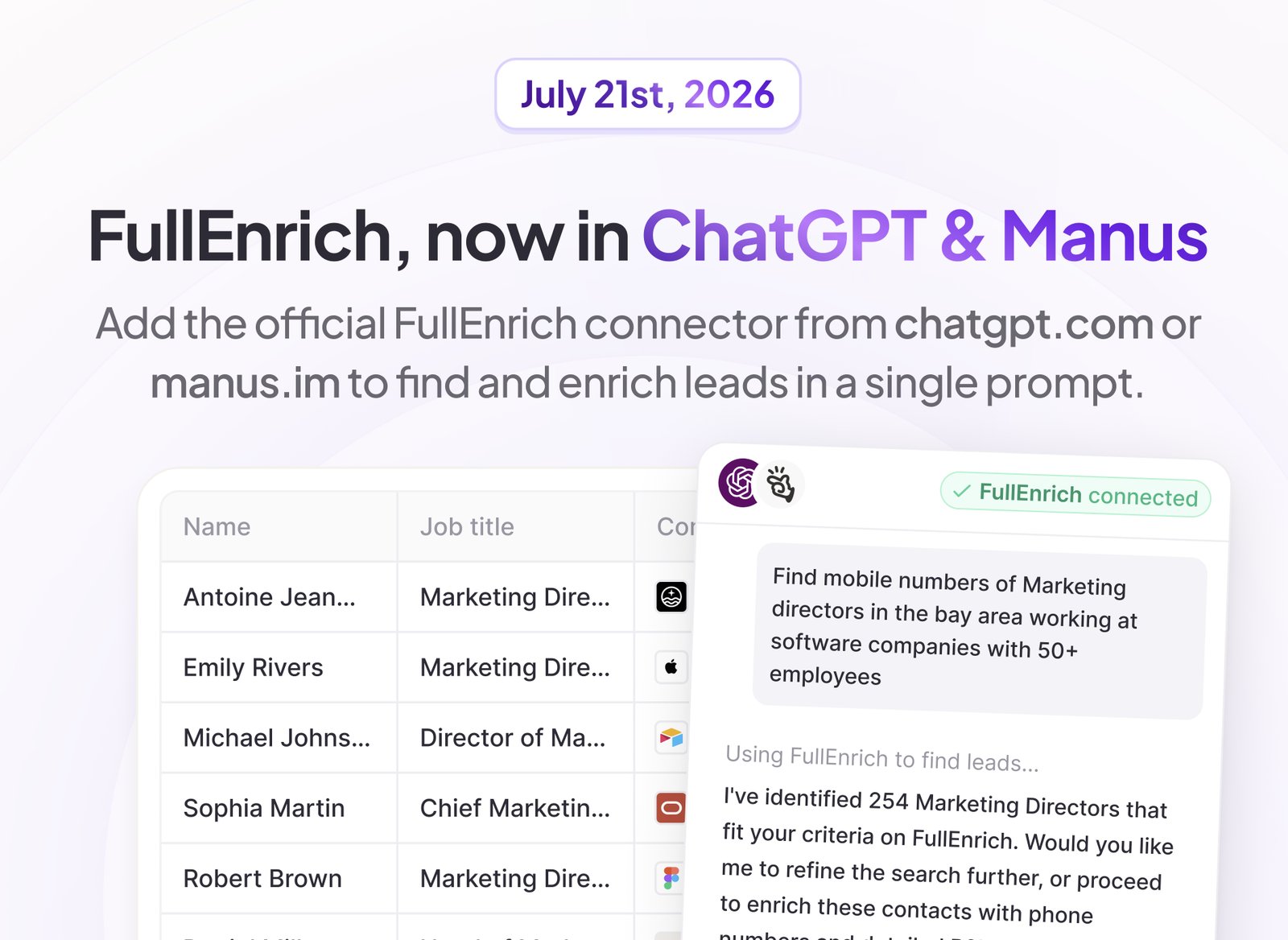
The newest route is the MCP server at mcp.fullenrich.com, documented in a 7 May 2026 help article, through which Claude, ChatGPT, Manus or an IDE can search, enrich contacts and export from a chat. Search previews are free for the first 10 results, export costs 0.25 credit a record, and FullEnrich handles the confirmation step before any enrichment credits are spent.
User complaints and praise across 231 G2 reviews
G2's compiled dislikes across 231 reviews rank incorrect numbers first (11 reviews), expense second (8), CRM and API integration issues third (7), then missing emails (5) and slow loading (5). Cost hits people enriching hundreds of contacts at a time. A verified user in computer software wrote in April 2026:
The biggest drawback for me is that credits can run out quickly when I'm processing large lists, and the pricing feels a bit on the expensive side.
G2, verified user in computer software, April 2026
The one-star reviewer added that 71% of his hits came through Wiza, so he "might actually move to Wiza".
Coverage thins outside the big markets too. A pharmaceuticals reviewer, 4.5 stars on 31 August 2026, wrote that coverage:
can be thinner on some smaller markets and very small companies, so a few contacts still come back empty
G2, pharmaceuticals reviewer, August 2026
The same reviewer asked for "more detailed analytics on hit rate per provider and per list", because a waterfall invoices 20 providers as one bill and the per-provider hit rate stays inside FullEnrich.
Outdated contact data sits underneath several of those, since an address that resolves cleanly at a company the person left is still a bounce. Speed complaints trace to the queue. Emails take 1 to 2 minutes a contact and phones 40 to 80 seconds, per the processing-time article, and a 5,000-row file runs 100 contacts at a time in the background.
Reviewers praise one thing most often, that FullEnrich finds contacts the other tools miss, and they name the other tools. A CEO running daily prospecting wrote on G2 in July 2026:
I run B2B prospecting daily on Hunter and Apollo, and I added FullEnrich as a third waterfall layer. It consistently pulls emails and mobile numbers the other two miss, so contactability of my lists went up, not just record count.
G2, CEO at a small business, July 2026
A founder in March 2026 said FullEnrich "seems to do a better job than the other tools we have purchased in the past (LeadIQ, Hunter)". A French founder, in a review G2 machine-translated, called it "more effective than Kaspr and Lusha". A private manager in April 2026 measured throughput:
processing a database of 200 to 300 profiles in just 5 minutes with a very interesting conversion rate of about 60 to 70%
G2, private manager, April 2026
The third theme is higher accuracy on emails and phone numbers than the previous vendor, from sales teams that came off Apollo, Lusha, LeadIQ and Hunter. They cite verified emails that bounce under 3% ahead of the volume of contacts found, the multiple data sources argument made from the user's side.
↑ FACT SHEETCompany stability across funding, uptime and compliance
FullEnrich started in Paris and raised a $2M seed in February 2025 from Flex Capital, M-Fund, Kima Ventures, First Degree, Offord Ventures and Duro Ventures, per Tech.eu's report by Lucy Adams, which puts the headquarters in California and names Mastercard & Docusign as customers. Benjamin Douablin is CEO and co-founder.
The 2026 manifesto counts over 3,000 customer companies and repositions FullEnrich as one platform for AI agents, "MCP-native, API-first, usage-based". status.fullenrich.com reports 99.948% uptime over the 90 days to 1 September 2026, seven incidents totalling 62 minutes, the longest 20 minutes on 10 June.
Support splits by plan, with email & chat on Free and Pro, and priority support, an account manager & a shared Slack channel on Enterprise. The support pages list channels by tier and stop there, so a buyer who needs a response-time figure has to get it from sales in writing. The trust centre lists SOC 2 Type II, GDPR & CCPA statements, a DPA, a sub-processor list, a CAIQ Lite questionnaire & a pentest report, with security documents last updated 29 April 2025.
One bill covers 20-plus providers
Run the free trial
Credits stay valid 3 months on monthly plans, 12 on annual.
Visit FullEnrich →
May earn a commission if you sign up through this link, at no extra cost to you. Full affiliate disclosure.
↑ FACT SHEETFullEnrich vs Clay, Apollo.io, Lusha and Wiza
Clay is the closest competitor, because it also runs waterfall enrichment across other people's providers, and FullEnrich is one of them. Clay wins when the team wants a spreadsheet-style data builder with 100-plus sources, AI columns & buying signals in the same table. Its tiers run from $0 to $495 a month before Enterprise, native HubSpot or Salesforce sync starts at that $495 Growth tier, and Clay sits at 4.6 on G2 across 230 reviews.
FullEnrich wins on unit price for a team that uploads a CSV and wants the same file back with emails and phone numbers filled in.
Apollo.io is the tool reviewers most often run alongside. It's a complete solution for outbound, with a 240M-contact database, sequencing & a dialler, at $79 a user a month on Professional billed annually, and the Apollo vs ZoomInfo comparison covers what that seat buys. Apollo wins when one rep needs prospecting, sequencing and calling in one login. FullEnrich wins when Apollo's database comes back empty, so the July 2026 CEO keeps both.
Lusha is the extension-first alternative, selling a $0 plan with 40 credits a month, $49.90 Starter or $69.90 Pro per seat, and phone reveals at 5 credits, per the Lusha pricing teardown. Lusha wins for a rep who wants the number in the LinkedIn sidebar. FullEnrich wins on bulk enrichment, unlimited users and coverage outside North America, and the reviewer who called it "more effective than Kaspr and Lusha" was prospecting in France.
The one-star reviewer threatened to move to Wiza, which by his count supplied 71% of his hits inside FullEnrich's waterfall. Wiza sells Email at $99 a user a month and Email + Phone at $199, with overages of $0.15 an email and $0.35 a phone number, per the Wiza pricing report. Wiza wins for a rep living in Sales Navigator, while FullEnrich wins when five reps would otherwise pay five seats for the same contacts.
Three tools push themselves as FullEnrich alternatives on their own blogs, and all three are selling something adjacent. Salesforge argues its Chrome extension still works on LinkedIn and Sales Navigator, which FullEnrich's lost in June 2024. SalesRobot positions itself as a complement for LinkedIn outreach on top of FullEnrich's contact data. SyncGTM sells enrichment and outreach in one platform, with buying signals, a filter type outside FullEnrich's search.
All three argue from feature lists, so the match-rate test against FullEnrich that would settle it is one the buyer has to run on the 50 free credits.
Cognism is the other name in "FullEnrich or Cognism" searches: phone-verified mobile data across 15 European countries, quoted pricing only, with annual packages third parties put at $1,500 to $25,000. The B2B data providers ranking sets both against ZoomInfo and the rest.
Verdict
The short version of this FullEnrich review is that FullEnrich suits sales teams treating enrichment as a supply chain, where a list source exists, one or two vendors are already paid for, and 30 to 40% of contacts still return empty. On the published numbers FullEnrich lifts email match rates into the 80s, charges 1 credit a verified work email, 10 a mobile phone number and nothing for failed lookups, with unlimited users from $29 a month.
The sales intelligence ranking and lead intelligence software ranking put its neighbours in context. The rep who prospects inside LinkedIn one profile at a time is better served by Lusha, Kaspr or Wiza, which reach prospects from the sidebar, since the Sales Navigator extension ended in June 2024 and the September 2026 help centre documents the CSV upload route in its place. Teams expecting to cancel with a balance lose it, since credits expire with the cycle.
It suits, with caveats, anyone sending cold email to contacts at catch-all domains. The triple email verification is documented, and reviewers report 2 to 3% bounce rates on verified emails. But probably-valid and catch-all results cost the same 1 credit, and the reviewer who kept 347 of 1,005 charged contacts shows what that costs on a hard list.
Run the 50 free FullEnrich credits on your worst segment, read the status column on the export, and size the plan on the data that survived.
Unlimited users from $29 a month
Put FullEnrich on your hardest list
Eleven Pro tiers run from 500 credits at $29 to 100,000 at $3,500, and every tier charges 0 credits for a failed lookup.
Visit FullEnrich →
May earn a commission if you sign up through this link, at no extra cost to you. Full affiliate disclosure.