Crunchbase pricing: Pro, Business, and API costs for 2026
 By Jan Suski, six years working in digital. How the scoring works.
·
Business costs about twice what Pro does. The upgrade only buys 2.5 times the export ceiling: Pro caps monthly exports at 2,000 rows for $99 a month, Business raises the cap to 5,000 for $199. Custom Data Access, the tier bundling API and MCP access, skips a list price altogether and routes straight to a sales call, where Vendr's tracked data puts the median Crunchbase contract at $20,000 a year across 73 purchases.
This report breaks down what each tier costs, what pushes a quote past list price, and how the numbers compare against ZoomInfo, PitchBook, and LinkedIn Sales Navigator. It's for a buyer sizing up private company data tools before signing. Crunchbase publishes a sticker price for only two of its three products, leaving Business's real ceiling and Custom Data Access's floor for the buyer to negotiate blind.
The numbers Crunchbase pricing, checked 11 August 2026
Two Crunchbase plans now carry a sticker price. Custom Data Access buyers, and anyone above Business's floor, negotiate against Vendr's $20,000 median instead of any number Crunchbase publishes itself.
The gap between Pro's $99 monthly seat and Custom Data Access's fully custom quote is wide enough that a team has to know which product it's buying before it can budget at all.
An export cap 2.5 times larger is one of the only concrete reasons Crunchbase gives a buyer to pay for Business over Pro.
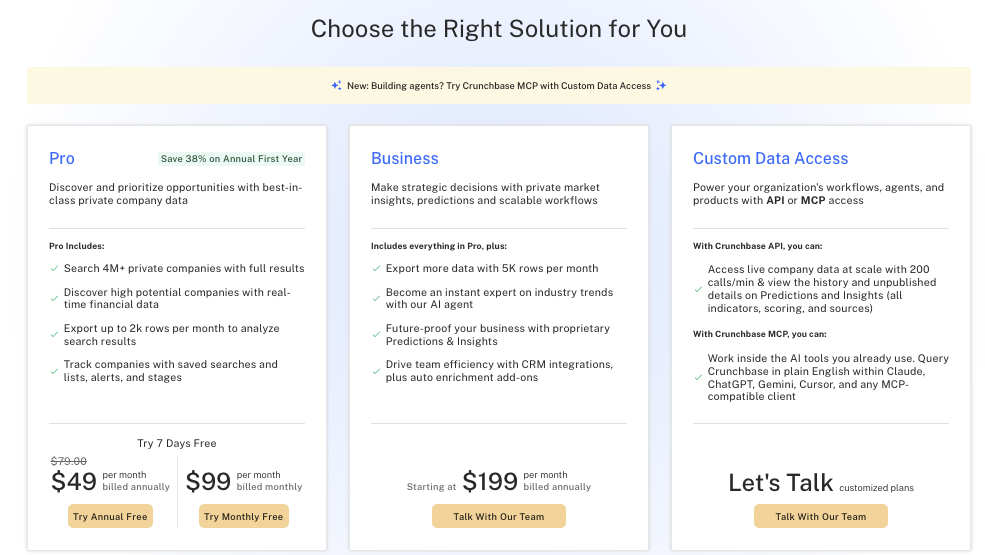
Crunchbase's pricing page, crunchbase.com/buy/select-product, screenshotted 11 August 2026.
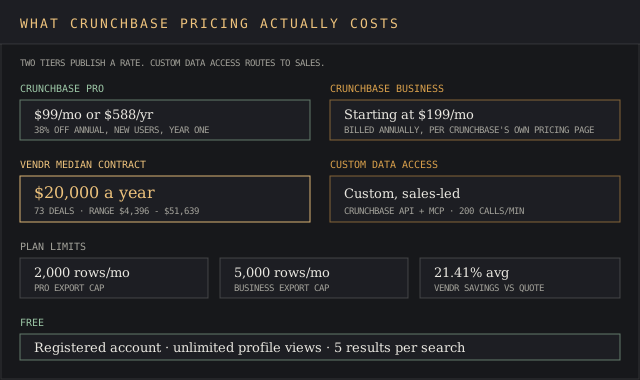
How Crunchbase pricing breaks down by plan
Crunchbase sells three products under one brand: Pro for individual researchers, Business for teams that need exports and CRM integrations, and Custom Data Access for companies building Crunchbase data into their own tools or AI workflows. Each has a different pricing model, and mixing them up is the fastest way to budget wrong.
Four buyer personas span every one of Crunchbase's tiers: investors, GTM teams, analysts, and founders. Investors use it for due diligence and market research; analysts use it to track competitors and the competitive landscape; founders use it to find investors of their own.
Crunchbase Pro
Crunchbase Pro runs $99 a month on the standard monthly plan, per Crunchbase's own support documentation, updated 28 August 2025, and its own pricing page, checked 11 August 2026. New users get an introductory offer of 38 percent off the $79 annual rate in year one, bringing it to $49 a month; G2's pricing page separately lists the ongoing annual rate at $588 a year, close to a 50 percent discount against paying month to month.
Crunchbase backs both the monthly and annual plan with a 7-day free trial.
Pro unlocks full search results across Crunchbase's 4 million-plus private companies, instead of the capped view free accounts get. Free accounts are limited to 5 results per search; Pro and Business both raise that ceiling to 1,000 results, per Crunchbase's own comparison of free and paid accounts.
Crunchbase Scout and the AI Search Builder are the two AI agents built into Pro, both drawing on artificial intelligence to search the database and summarize company profiles, surfacing high-growth companies before competitors notice them. The plan caps exports at 2,000 rows a month, drawn from company profiles, funding data, and investor records. Company profile pages show total funding, investor names, revenue signals, and funding rounds by stage.
Heat Scores, one of Pro's AI-powered insights alongside Growth Scores, track live signals from Crunchbase's 80 million registered users to help GTM teams and investors stay ahead of the market by flagging companies gaining momentum. Notes and tags let a team add its own context directly to a company profile, a small workflow improvement that adds up across a full pipeline, and a Kanban-style Stages board moves prospects through that same workflow.
Crunchbase Business
Crunchbase Business starts at $199 a month, billed annually, per Crunchbase's own pricing page, checked 11 August 2026. That's a starting price: reaching an exact number for a specific team still means a "Talk With Our Team" conversation. G2's separate pricing listing shows a "Contact Us" placeholder; it doesn't list the $199 floor.
Some third-party pricing trackers had already estimated Business "starting near $199 a month" before Crunchbase's own page confirmed it.
Business builds on everything in Pro and adds a full AI agent (Pro's version is gated to "limited"), all of Crunchbase's Predictions and Insights, and private market predictions on funding, growth, acquisitions, and IPOs: Crunchbase says its models deliver 84 percent accuracy predicting real funding rounds and another 73 percent on acquisitions, both correctly called before they were announced.
Those funding predictions are a large part of why Business costs more than Pro.
Business raises the export cap to 5,000 rows monthly (Pro's cap is 2,000) and adds a run of workflow features Pro doesn't include at any price, according to Crunchbase's own plan-comparison table and G2's plan breakdown:
- CRM integrations for Salesforce and HubSpot.
- CRM enrichment for Salesforce and Monday Sales, as an add-on.
- Zapier and Outreach integrations.
- Consolidated billing and team admin features.
- Contact data with single sign-on.
Verified contact data doesn't ship with Pro at any price; reaching it means buying into Business.
Crunchbase's own claims for the underlying dataset: 30 million verified data updates processed annually across those 4 million-plus private companies, sourced through 4,000-plus direct venture partnerships and more than 1,000 news outlets and government filings its analysts review.
The pitch to investors and analysts is a market view that updates as companies raise, acquire, and go public, not a static snapshot; deeper integrations push that same Crunchbase data, including the revenue and firmographic fields covered below, straight into a rep's CRM pipeline.
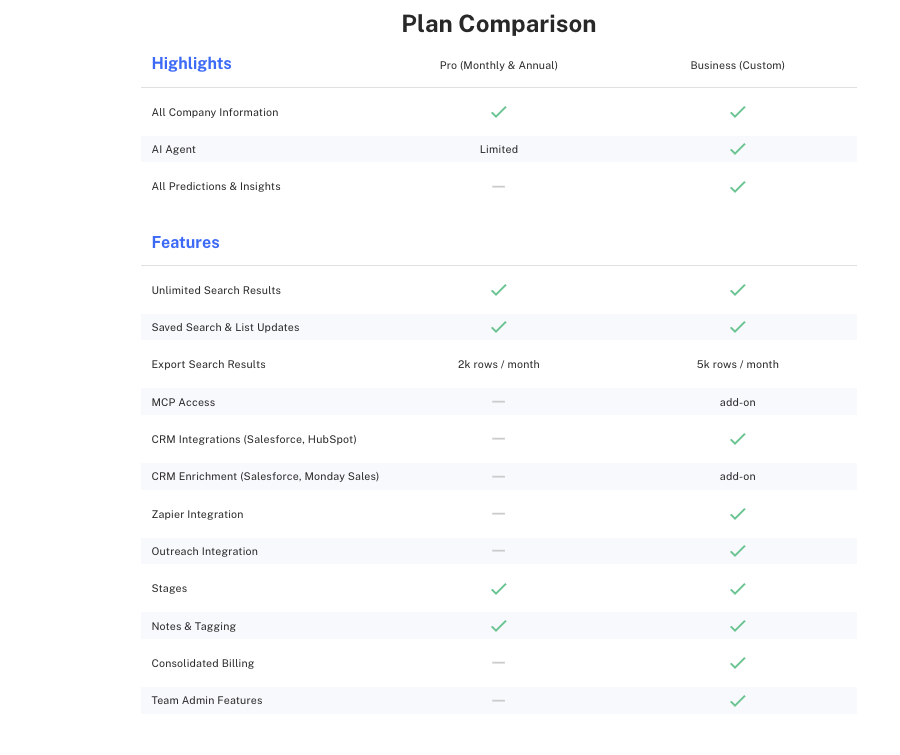
Crunchbase's plan comparison table, crunchbase.com/buy/select-product, screenshotted 11 August 2026.
Custom Data Access: API and Crunchbase MCP
The tier Crunchbase used to sell as "API" is now packaged as Custom Data Access, and it's entirely sales-led. Crunchbase's own pricing page and its support docs confirm pricing is custom, and access splits into four data packages:
- Firmographics: company size, industry classification spanning everything from energy to biotech, and revenue.
- Basic Financials: a brief overview of financial metrics, funding rounds, and investor profiles.
- Advanced Financials: funding history depth and revenue-linked financial metrics beyond what Firmographics covers.
- Predictions and Insights, the most complete package, covering funding predictions, growth signals, layoff signals, and executive-change alerts.
Custom Data Access now covers two separate integration paths. The API path pitches three promises: actionable insights, flexible access, and the ability to scale as usage grows, accessing live company data at up to 200 calls a minute with visibility into the full history and unpublished detail behind Predictions and Insights.
The newer path is Crunchbase MCP, which Crunchbase markets as a way to query Crunchbase data in plain English from inside AI tools a team already uses, including Claude, ChatGPT, Gemini, Cursor, and any other MCP-compatible client, instead of building a custom integration against the API. MCP access is also sold as a Business add-on, separate from a full Custom Data Access contract.
Named use cases for the API path include investment research, GTM strategy, and market research; a firm running investment-research workloads, for example, integrates growth and risk predictions directly into its own models instead of researching companies by hand. A Custom Data Access contract is priced around which of these workflows and integration paths a buyer is automating, not a flat per-seat rate.
Every tier of the Crunchbase API shares the same rate limit: 200 calls a minute, per Crunchbase's own documentation, and every request authenticates with a token-based key tied to the account. The Basic API, once a free entry point for developers, is no longer offered to new users; Crunchbase's docs confirm existing keys still work, but nobody can generate a new one.
What drives a Crunchbase quote higher
Crunchbase publishes a starting price for Business and no rate card at all for Custom Data Access, so the exact number a buyer lands on past that floor depends on a handful of variables sales reps control. Vendr's negotiation data, drawn from anonymized Crunchbase contracts, names the same drivers repeatedly.
| Driver | What it means for the quote |
|---|---|
| Seat count | Adding Pro seats to a Business or Custom Data Access contract scales the quote directly; volume pricing typically starts once a team asks for seats beyond a handful of licenses. |
| Data package selection | Choosing Advanced Financials or the full Predictions and Insights package over base Firmographics adds cost to a Custom Data Access deal. |
| Contract term | Annual prepayment is standard across Crunchbase's plans; multi-year terms are where Vendr's data shows the deepest additional discounts. |
| Export and API call volume | Business's 5,000-row cap and the API's 200-calls-a-minute limit are the baseline; higher throughput requires a custom conversation. |
| Competitive evaluation | Vendr's dataset shows buyers who can credibly point to ZoomInfo or LinkedIn Sales Navigator as an alternative negotiate meaningfully better terms than those who don't. |
Renewal terms deserve the same scrutiny as the first quote. Crunchbase's contracts, like most sales-led SaaS deals, tend toward an annual escalation clause, so locking in a cap on renewal increases during the initial negotiation avoids a second-year surprise on the bill, even with no change in seats or usage.
What Crunchbase buyers pay in practice
List price and negotiated price aren't the same thing once a deal moves past Pro's fixed $99 seat. Vendr's marketplace tracked 73 Crunchbase purchases with a median annual contract of $20,000, buyers saving 21.41 percent on average, and observed deals ranging from $4,396 to $51,639.
That spread is wide enough to cover a single Pro seat's worth of Business access at one end and a mid-size deployment for a team of analysts at the other, which is the reason a published rate card would help buyers, and Crunchbase hasn't shipped one for its higher tiers.
Reviewers describe the same tension in public feedback. One G2 reviewer's comment on the pricing page reads:
"They seem to have changed [their] pricing lately."G2 reviewer, Crunchbase pricing page
Another reviewer, rating the product 3 out of 5, pointed to a data-quality gap:
"Sometimes the data isn't entirely accurate, or perhaps it's just not the most current."G2 reviewer, 3/5
One independent review raised a more specific structural complaint: in that reviewer's account, Crunchbase has no automated crawler continuously refreshing records, so updates depend on user submissions and periodic ingestion. That's one reviewer's characterization, not a figure Crunchbase itself has confirmed.
A Reddit user in r/venturecapital put the alternative-evaluation habit plainly:
"Many VC and financial firms use B2B platforms like Uplead, Clay or Zoominfo to get their data instead of CB."u/Merrygoround-, r/venturecapital
Tom Veysey, founder of Perch, posted on LinkedIn under the title "Crunchbase Pro is $588/year I replaced it in Clay," describing a switch away from the subscription over cost.
How to negotiate Crunchbase pricing
Vendr's negotiation data, built from anonymized buyer contracts, points to a short list of levers that consistently move a quote.
- Engage 60 to 90 days before a renewal or purchase deadline. Last-minute negotiations give a sales rep no reason to move.
- Time the conversation to Crunchbase's quarter-end (31 March, 30 June, 30 September, 31 December), when reps have quota pressure to close.
- Anchor to an approved budget figure instead of negotiating down from the first quote Crunchbase offers.
- Name ZoomInfo, PitchBook, or LinkedIn Sales Navigator as alternatives under active evaluation.
- Negotiate a cap on the renewal price increase before signing the first contract, not after the second one arrives.
- For Custom Data Access buyers, get the 200-calls-a-minute limit and any overage rate written into the contract before submitting a scale-up request.
Payment terms are one detail worth confirming upfront, too. Crunchbase's own plan comparison lists credit card payments as the only option on Pro; invoice billing is a Business and Custom Data Access feature reserved for negotiated contracts.
Crunchbase pricing vs the alternatives
Crunchbase competes with tools built for a similar job at different price points. The table below lines up published list prices where they exist and Vendr's median contract value where they don't.
| Platform | Entry price | Vendr median | Focus |
|---|---|---|---|
| Crunchbase | $99/mo (Pro) | $20,000/yr* | Company, funding, and investor data |
| ZoomInfo | Not published | $33,500/yr* | Contact data, sales engagement |
| PitchBook | Not published | $31,875/yr* | Private equity, VC, and M&A data |
| LinkedIn Sales Navigator | $99.99/mo (Core) | Not tracked | Contact-level prospecting and social selling |
*Vendr median across tracked deals, not a vendor-published list price.
Crunchbase and LinkedIn Sales Navigator are the only two with a published entry price, and they land within a dollar of each other at the individual-seat level: $99 against $99.99 a month.
ZoomInfo's Vendr median runs 68 percent higher than Crunchbase's, and PitchBook's runs 59 percent higher, which tracks with how each platform approaches the market: Crunchbase and LinkedIn price an individual seat first, while ZoomInfo and PitchBook, which markets itself to private equity, venture capital, and investment-banking teams doing deal work, build a procurement process around every deal.
None of the three data platforms overlap completely. Crunchbase focuses on private company, funding, and investor data. ZoomInfo adds direct contact data, emails and phone numbers, that Crunchbase doesn't sell. PitchBook goes deeper into private equity, M&A, and acquisitions data than either. A buyer choosing between them is usually choosing a data focus first and a price second; funding and acquisitions predictions stay unique to Crunchbase Business among the four.
Who Crunchbase pricing fits
Pro's $99 monthly seat suits an individual investor, founder, or small sales team doing occasional research on private companies and light prospecting. G2's reviewer base skews toward small businesses in sales, recruiting, and venture capital, using Pro as a lower-cost alternative to PitchBook, whose buyer base still leans toward investment-bank and private equity deal teams.
Business, starting at $199 a month, fits a team of analysts that needs the exports, CRM integrations, and workflow automation Pro doesn't offer, at the 5,000-row monthly cap; the key question to answer before that sales call is how many seats and how much export volume the workflow needs.
Custom Data Access is for a company building Crunchbase data and firmographic records into its own product or its own AI tooling, where the 200-calls-a-minute limit, the four data packages, and the choice between the API and Crunchbase MCP matter more than the seat price ever will.
Frequently asked questions
How much does Crunchbase cost?
Crunchbase Pro costs $99 a month, or $588 a year on the discounted annual rate G2 lists. Business starts at $199 a month billed annually, per Crunchbase's own pricing page. A full Business quote past that floor, and any Custom Data Access contract, is negotiated; Vendr's dataset puts the median Crunchbase contract at $20,000 a year across the deals it tracks.
Is Crunchbase free or paid?
Both. A free, registered account gets unlimited profile views and basic access to a capped search experience. Pro, Business, and Custom Data Access are paid tiers layered on top.
Is there a free alternative to Crunchbase?
LinkedIn is free and covers company and people lookups, though it isn't built as a funding database. Crunchbase's own free tier is the closest no-cost option to its actual dataset, with search results and exports capped until a buyer upgrades.
Is Crunchbase worth it?
It depends on the use case and industry focus. G2 reviewers position Pro as cheaper than PitchBook for startup and VC prospecting and market research, and the platform's average G2 rating sits at 4.5 out of 5. The same reviews flag data-accuracy gaps often enough that a buyer doing high-stakes diligence should cross-reference a critical number before acting on it.
Is Crunchbase Pro free?
No. Pro costs $99 a month or the discounted annual rate. Crunchbase offers a free trial of the paid tier.
What are the benefits of Crunchbase Pro?
Full search results across 4 million-plus private companies, two AI agents (Scout and the AI Search Builder), AI-powered insights including Growth and Heat Scores, flexible saved searches with alerts, and a Kanban-style Stages board for tracking prospects and investors across an industry or a deal focus.
What are Crunchbase's limitations?
A 2,000-row monthly export cap on Pro, a 200-calls-a-minute API rate limit across every tier, a Basic API that's closed to new signups, and data-accuracy complaints that show up repeatedly in G2 reviews and independent write-ups about the companies and funding rounds it tracks.
Bottom line
Crunchbase's pricing is transparent for two of its three tiers now: the $99 Pro seat and Business's $199 starting price. Everything past those floors, a full Business quote, Custom Data Access, and any seat count that pushes past the base plan, runs through a sales conversation Vendr's $20,000 median is the best public benchmark for. A buyer who needs company data, company profiles, and basic research tools can plan around Pro's fixed rate.
A team evaluating a larger Business deployment or Custom Data Access for market research or investment research should walk into that sales conversation with Vendr's numbers, a competitive alternative named, and a cap on renewal increases already decided, because Crunchbase isn't going to volunteer any of the three.
Sources
Plan features, export caps, API rate limits, the $99/$588 Pro rate, and the $199 Business starting price are Crunchbase's own published figures, read off crunchbase.com's pricing, product, and support pages, checked and screenshotted 11 August 2026. Median, low, and high contract figures for Crunchbase, ZoomInfo, and PitchBook are Vendr's, read off each platform's Vendr marketplace page.
Reviewer quotes are verbatim from G2's Crunchbase pricing page, a public LinkedIn post by Tom Veysey, and a Reddit comment in r/venturecapital.