Best software engineering intelligence platforms in 2026: top 10 ranked
 By Jan Suski. I go deep on every review, checking every number against its source and digging up details other coverage misses, a habit from six years of SEO and link building for tech companies. Bylines at Surfer, Brand24, and Senuto. How the scoring works.
· Prefer this source on Google
Quick comparison of the top 10 SEI platforms
The table puts each platform's annual cost for 50 developers next to its entry price, so the per-seat models and the contract-only vendors can be read side by side.
| # | Platform | Cost for 50 developers, one year | Entry price | Best fit |
|---|---|---|---|---|
| 1 | DX | $55,104 Vendr median*, 122 purchases | Quote only, 1-year minimum term | Enterprises pairing surveys with system data |
| 2 | Jellyfish | $57,536 Vendr median*, 36 purchases | Quote only | R&D allocation and finance reporting |
| 3 | LinearB | $17,400 at list | $29 per user a month, annual | Teams of 50+ that want PR automation |
| 4 | Swarmia | $27,000 at list | Free under 10 developers, then $45 | Startups and mid-size teams on GitHub |
| 5 | Allstacks | $20,000 at list | $400 per contributor a year | Delivery risk forecasting |
| 6 | Faros AI | $186,478 Vendr median* | Quote only, free desktop app | Large orgs that want an open data model |
| 7 | Typo | $12,000 at list | $20 per developer a month, annual | Small GitHub teams that want AI PR review |
| 8 | Haystack | $12,000 at list | $20 per member a month | Delivery managers living in Jira |
| 9 | Waydev | Quote only | Quote, 90-day refund window | Multi-repo shops wanting an AI agent |
| 10 | Span | Quote only | Quote, viewers free | AI code impact measurement |
Medians marked * are anonymized buyer-reported contract values published by Vendr. Everything else is the price the vendor publishes itself.
Where these figures come from
List-price costs multiply each vendor's published annual-billing rate by 50 developers and 12 months, read for this page's October 2026 publication. Medians marked * are Vendr's anonymized buyer-reported contract values, and rating counts come from Gartner Peer Insights. Waydev and Span publish no price and Vendr tracks no median for either, so their rows read quote only.
Observability platforms that watch production systems, Datadog, Dynatrace and New Relic among them, are ranked on the operational intelligence platforms ranking. This page ranks tools that read Git, Jira and CI/CD data on how the software gets built.
Software engineering intelligence (SEI) platforms read the trail engineering teams already leave in version control systems, project management tools and CI/CD pipelines, then turn it into cycle time, deployment frequency and resource allocation reports.
A software engineering intelligence platform answers two questions for engineering leaders: where engineering effort goes, and how fast quality software reaches production. Gartner predicts that 50% of software engineering organizations will use these platforms by 2027, up from 5% in 2024.
This ranking covers ten software engineering intelligence tools and engineering intelligence platforms, from Atlassian-owned DX to two $20-per-developer options with 14-day trials. Every price links to the vendor's own page or to Vendr's anonymised buyer data.
It's written for engineering leaders, engineering managers, team leads and the finance partners who sign the renewal. Two ownership changes make 2026 the year to look again: Atlassian agreed to buy DX in September 2025, and Appfire is retiring Flow, formerly Pluralsight Flow, on 31 December 2027.
Evaluation criteria for software engineering intelligence platforms
Five criteria decide the shortlist, and the ranking below applies them in this order. Each one returns a number or a yes/no a buyer can check before the first demo of any software engineering intelligence platform.
Verified user rating volume
Count the ratings on Gartner Peer Insights and read the score next to the count. A 4.6 across 114 ratings carries more weight than a 4.5 across 2.
Proof of purchase at scale
Check how many contracts Vendr tracks for the vendor, or how many organizations sit in its benchmark dataset. A platform with 122 tracked purchases has a price history you can negotiate against.
Published price per developer
A dollar figure on the vendor's pricing page passes. "Contact sales" fails, and the Vendr median becomes the stand-in figure. The test also checks the billing unit, since "active contributor" and "team member" count different people.
Entry floor
Record the free tier, the trial length in days and the minimum seat count or contract term. Swarmia's free plan for fewer than 10 developers and Allstacks' 100-contributor Enterprise minimum sit at opposite ends.
Data history on the entry tier
Months of historical data decide what a quarter-over-quarter trend line in team performance or delivery performance can show. Haystack keeps 12 months on its Growth plan, Typo keeps 6 months on Starter.
The 10 best software engineering intelligence platforms ranked
DX
Best fit
Enterprises whose engineering teams want developer survey data and system metrics read through one framework.
DX built its product around the DX Core 4 framework, which groups developer productivity into speed, effectiveness, quality and business impact, and which DX says has been implemented at over 300 companies.
Atlassian announced on 18 September 2025 that it would buy DX for approximately $1 billion in cash and restricted stock; its own announcement put DX's base at more than 350 enterprises. Jira shops get the best of both worlds, with tickets and the metrics built on them from one vendor.
Key features
- DX Core 4 scorecards across 4 dimensions, with Core 4 benchmarks
- Quarterly developer experience surveys answered in Slack or Teams
- Data connectors across version control systems, project management tools and CI/CD
- DX AI Assistant, plus MCP server access priced in usage tiers
- Planning and capacity reports for resource allocation decisions, built for Jira users
Pricing
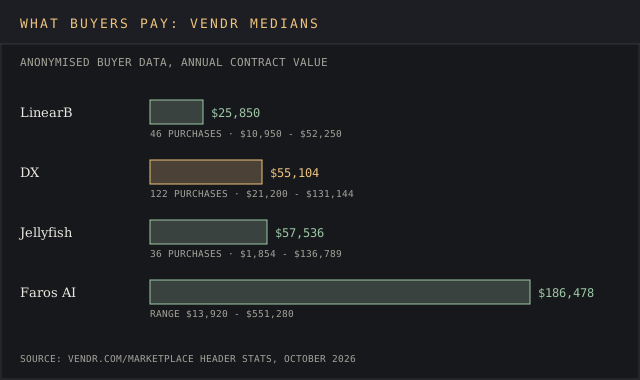
DX doesn't publish a rate card. Its pricing page says licenses are per developer and contracts start at a 1-year term. Vendr's anonymised buyer data puts the median at $55,104 a year across 122 purchases, from $21,200 to $131,144.
Pros
- 4.6 out of 5 across 114 ratings on Gartner Peer Insights
- Survey and telemetry data share one model, so team health sits next to cycle time
- Atlassian ownership puts Jira and DX under one contract
Cons
- No published price; every deal starts with a sales call
- Vendr's range tops out at $131,144 a year
- Surveys ask developers for time every quarter
A director of enterprise agility at an education organization of 5,000 to 50,000 staff gave DX 3 stars on Gartner Peer Insights in July 2026 and named the cost model as the blocker: "The per-developer licensing model became a real showstopper."
Why it's ranked #1. DX beats Jellyfish on the first two criteria: 114 Gartner ratings at 4.6 against 109 at 4.5, and 122 Vendr purchases against 36, at a median $2,432 lower. It has no tool above it to lose to.
Jellyfish
Best fit
VPs of engineering who report R&D spend to a CFO and need software capitalization numbers.
Jellyfish built its name on allocation: it maps every Jira issue and pull request to an investment category, so a leader can show how much engineering effort went to new features, bugs and maintenance, and tie engineering investments to business goals. Its benchmark pool covers 1,000+ engineering organizations and 100M+ pull requests. The integrations page names 17 integrations, from Jira and Azure DevOps to Claude Code, Cursor and GitHub Copilot.
Key features
- Investment allocation across features, bugs, keep-the-lights-on and unplanned work
- DevFinOps module that automates R&D cost capitalization reports for business alignment with finance
- AI Impact dashboards for coding assistants, including Codex and Amazon Q Developer
- SOC 1 Type II and SOC 2 Type II reports
Pricing
Quote only. Vendr's anonymised buyer data shows a median of $57,536 a year across 36 purchases, with a low of $1,854 and a high of $136,789. A spread that wide means the devil's in the details of seat count and modules.
Pros
- Allocation reporting finance teams accept without manual timesheets
- 4.5 across 109 ratings on Gartner Peer Insights
Cons
- Output depends on Jira hygiene in your project management tools: labels, epics and workflow states
- Data refresh runs on a schedule, so dashboards lag a live sprint
- Activity counts invite stack-ranking if leadership doesn't set rules first
A director at a finance company with $50M to $250M in revenue wrote on Gartner Peer Insights in June 2026:
"it's too easy for Jellyfish to nudge an org toward micromanagement and stack-ranking, especially if you don't consciously guard against that."
Director, Finance (non-banking), 3 out of 5, 10 June 2026
Why it's ranked #2. Jellyfish carries 109 Gartner ratings to LinearB's 23 and the deeper finance module. It loses to DX on purchase volume, 36 Vendr deals against 122, at a median $2,432 higher.
LinearB
Best fit
Engineering teams of 50+ developers on GitHub Cloud who want automation inside the pull request.
LinearB splits cycle time into coding, pickup, review and deploy time, then acts on it: its WorkerB bot pings reviewers in Slack or Teams when a PR sits idle, nipping a stale review in the bud.
Its 2026 benchmarks report draws on 8.1+ million pull requests from 4,800+ organizations, a larger organization count than any other benchmark cited here.
Key features
- Cycle time broken into 4 phases per pull request
- Programmable workflows for workflow automation on pull requests
- AI code reviews and auto-generated PR descriptions
- R&D cost capitalization and project forecasting on Enterprise
Pricing
The pricing page lists Essentials at $29 per user a month and Enterprise at $59, both billed annually, with extra AI credits from $0.015. Essentials supports GitHub Cloud only. Vendr's anonymised buyer data shows a median of $25,850 a year across 46 purchases, from $10,950 to $52,250.
Pros
- Lowest published price among the top three
- Automation inside the PR shortens pickup time, enabling proactive intervention without a dashboard visit
- Unlimited viewer seats at no added cost
Cons
- Essentials excludes GitLab, Bitbucket and self-hosted Git
- Alert volume is high until thresholds are tuned
- Ticket-to-branch mapping breaks when teams skip issue IDs
An IT manager at an IT services firm rated LinearB 4 stars on Gartner Peer Insights in August 2026 and flagged the dependency:
"If your team is sloppy about updating tickets or if your branching conventions don't perfectly match your ticket ids the data mapping completely falls apart"
IT Manager, IT Services, 4 out of 5, 31 August 2026
On Hacker News, an engineer describing giant PRs and PRs merged with minimal review wrote: "We use LinearB to point this sort of thing out automatically." (ericjohannsen, October 2023)
Why it's ranked #3. LinearB publishes a $29 rate and backs it with 46 Vendr purchases, which Swarmia can't match. It trails Jellyfish's 109 Gartner ratings with 23.
Swarmia
Best fit
Teams under 10 developers who want the full product free, and mid-size teams that buy modules one at a time.
Swarmia, founded in Helsinki in 2019, sells its platform as six priced modules and was named a Leader in Gartner's 2026 Magic Quadrant for Developer Productivity Insight Platforms, the name Gartner now uses for this category. The free plan covers companies with up to 9 developers and includes everything in Standard except HRIS integrations and Swarmia AI.
Key features
- DORA metrics and SPACE metrics, with industry benchmarks
- Working agreements that teams set and track in Slack
- Developer experience surveys at $9 per developer a month
- AI adoption and cost tracking at $5 per developer a month
Pricing
Swarmia's pricing page lists Standard at $45 and Enterprise at $55 per developer a month, billed annually. Modules from $5 let a team get the ball rolling with AI cost tracking before paying for the $45 bundle.
Billing counts only people placed on teams, so product managers outside a team aren't charged.
Pros
- Free tier with Standard features for teams under 10
- Modules from $5 let a buyer start with one problem
- Team-level engineering metrics by design, with no individual leaderboard
Cons
- $45 Standard rate is $16 above LinearB's Essentials
- On-premise integrations only on Enterprise
- 25 Gartner ratings, a thin sample next to DX's 114
A software developer at a consumer goods company with $10B+ in revenue gave Swarmia 4 stars on Gartner Peer Insights in September 2026:
"Swarmia is outstanding for tracking development progress & highlighting project bottlenecks across multiple teams with stuck PRs & slow testing and release cycles."
Software Developer, Consumer Goods, 4 out of 5, 18 September 2026
Why it's ranked #4. Swarmia beats Allstacks on entry floor with a free plan for 9 developers against pricing bands that start at 50 contributors. It loses to LinearB on published price, $45 against $29.
Allstacks
Best fit
Program and delivery leaders at companies with 50 to 500 contributors who need forecast dates for committed work.
Allstacks, founded in 2018 in Raleigh, North Carolina, correlates time, cost and activity across Jira, Git and CI/CD to raise a red flag before a release date slips. It publishes an annual rate card, which few vendors at its contract size do: Growth costs $400 per contributor a year, roughly $33 a month.
Key features
- Predictive analytics that forecast delivery risk on epics and project progress
- Standalone cost capitalization at $200 per contributor a year
- Role-based access control across teams
Pricing
Growth runs $400 per contributor a year up to 500 contributors, with a customer success manager at 10% of contract value. Enterprise is $600 with a 100-contributor minimum and drops to $500 for 1,501 to 2,000 contributors. Every plan carries a 1-year term and no self-serve trial.
Pros
- Volume discounts printed on the page, from $600 down to $500
- 4.5 across 59 Gartner ratings
- Forecasting goes past backward-looking metrics
Cons
- No free tier and no self-serve trial
- Enterprise requires at least 100 contributors
- Setup takes configuration work before benchmarks are usable
A project manager at an IT services firm with $10B+ in revenue wrote on Gartner Peer Insights in June 2026 that "its benchmarking metrics framework is highly valuable offering standardize performance indicators such as cycle time and delivery risk".
Why it's ranked #5. Allstacks prints a $400 contributor rate where Faros AI's Vendr median runs $186,478. It loses to Swarmia's free plan for 9 developers.
Faros AI
Best fit
Large engineering organizations with a data team that wants to own the schema.
Faros started as an open data platform, and its Community Edition is still on GitHub under the Apache License 2.0, with a schema of 50+ entities and preconfigured DORA dashboards. The commercial product adds AI engineering analytics; its customer logos include Autodesk, Coursera and Discord.
Key features
- Open-source Community Edition built on Airbyte connectors
- Data model of 50+ entities, from tasks to deployments
- Free Faros Desktop app for Mac that keeps data on the machine
- Survey collection combined with telemetry from existing tools
Pricing
No public rates; the pricing page routes to sales. Vendr's anonymised buyer data shows a median of $186,478 a year, from $13,920 to $551,280. At that median it costs an arm and a leg next to the $12,000 Typo charges for 50 developers.
Pros
- Open schema you can query outside the vendor UI, the deepest integration depth here
- 4.6 across 17 Gartner ratings
Cons
- Highest Vendr median in this ranking, 3.4 times DX's
- Value depends on a data team to model the schema
- 17 ratings is a small review base
An IT services associate rated Faros AI 4 stars on Gartner Peer Insights in September 2026:
"the survey Collection features add another useful dimension by combining quantitative engineering metrics with direct feedback from employees and teams"
IT Services Associate, IT Services, 4 out of 5, 1 September 2026
Why it's ranked #6. Faros AI's 50+ entity open schema goes further than Typo's 6-month Starter history. It loses to Allstacks on price transparency, a $186,478 median against a printed $400 rate.
Typo
Best fit
Small and mid-size GitHub teams that want delivery metrics and AI PR review in one subscription.
Typo pairs SEI dashboards with code quality tracking and review automation. Starter costs $20 per active developer a month billed annually, where an active developer has committed in the past 30 days, and includes 6 months of data history. A Gartner reviewer had dashboards populated the same day, so a small team can hit the ground running.
Key features
- DORA, flow, quality and throughput graphs
- Ask AI assistant plus an MCP server for Claude Code and Cursor
- Automated PR reviews and AI code fixes on Pro at $28
- Investment distribution and developer experience surveys
Pricing
Starter $20, Pro $28 per developer a month on annual billing, Enterprise custom, with a 14-day trial and no card required.
Pros
- $20 entry price, tied lowest in this ranking
- 4.4 across 63 Gartner ratings
- Code quality checks and review automation bundled with DORA metrics
Cons
- 6 months of history on Starter
- Signup requires a GitHub Organization
- The pricing page gives Pro history as both unlimited and 12 months
An AI engineer at a software company under $50M gave Typo 5 stars on Gartner Peer Insights in August 2026 but noted that "signup requires a GitHub Organization - personal accounts are rejected, which adds friction for smaller teams evaluating the product."
Why it's ranked #7. Typo's 63 Gartner ratings beat Haystack's 18 at the same $20 rate. It loses to Faros AI's 50+ entity schema on data depth.
Haystack
Best fit
Delivery managers under 100 engineers who want risk alerts in Slack more than dashboards.
Haystack sits on top of Git and Jira and pushes status, risks and weekly insights into Slack. Denali Lumma of Box told Haystack her team cut cycle time from 40 days to 3 days, a vendor-published customer claim, so read between the lines before treating it as typical.
Haystack also ran the 2021 study, fielded by Survation, that found 83% of developers report burnout, with high workload cited by 47%.
Key features
- Pulse status updates delivered in Slack
- Automated risk alerts, unlimited on Growth
- Epic progress, investment and capacity views for team leads
- AI-generated release notes
Pricing
Growth is $20 per member a month with an annual commitment and 12 months of history. Enterprise is custom and the only plan that supports GitHub Enterprise and GitLab Enterprise self-hosted.
Pros
- 12 months of history at $20, double Typo's Starter window
- 14-day trial with no credit card
- 4.4 across 18 Gartner ratings
Cons
- Self-hosted Git only on Enterprise
- Custom dashboards take time to configure
- Small review base of 18 ratings
An engineer at a services firm with $50M to $250M in revenue rated Haystack 4 stars on Gartner Peer Insights in July 2026: "Some of the advanced reporting and customization options have a learning curve, particularly for first time users."
Why it's ranked #8. Haystack publishes a $20 rate where Waydev quotes every deal. It loses to Typo on rating volume, 18 against 63.
Waydev
Best fit
Multi-repo engineering orgs that want a natural-language agent over their Git and ticket data.
Waydev's homepage claims 300+ customer companies and places it as a Niche Player in Gartner's Magic Quadrant. The Pro plan caps at 100 repositories and 6 months of data; Premium raises that to 150 repositories, 24 months and 200 Waydev Agent queries a month.
Key features
- Waydev Agent for natural-language questions over engineering data
- AI Adoption, AI Impact and AI ROI modules on Premium
- On-premise Git and ticketing integrations on Enterprise
Pricing
The pricing page shows Pro and Premium as quotes per active contributor, billed annually, with a 90-day money-back guarantee. Managers and executives count as free operational users: 5 on Pro, 20 on Premium.
The refund window is the closest thing in this ranking to a contract with no strings attached.
Pros
- 90-day refund window, the longest exit in this ranking
- Free seats for managers and executives
- 24 months of history on Premium
Cons
- No public price on any tier
- Pro caps at 100 repositories
- 2 Gartner ratings
A project management manager at a software company under $50M rated Waydev 5 stars on Gartner Peer Insights in June 2026: "The platform is easy to adopt and provided valuable visibility into engineering performance from the start."
Why it's ranked #9. Waydev publishes plan limits, 100 repositories and 6 months on Pro, plus a 90-day refund, which Span doesn't. It loses to Haystack's printed $20 rate.
Span
Best fit
Companies that want to measure what share of merged code came from AI tools and what it costs per PR.
Span prices per code contributor, and dashboard-only viewers such as PMs and executives are free. Its homepage cites benchmarks from 103 teams, SOC 2 Type II and customers including Ramp and Carvana.
Key features
- AI session and cost-per-merged-PR tracking
- MCP, API and CLI access, with Monday briefs in Slack
- Form 6765 Section G reporting for R&D tax credits
Pricing
Every module reads "request pricing", with no minimums or trial terms published.
Pros
- Free viewer seats
- Cost per merged PR as a first-class metric
- SOC 2 Type II
Cons
- No price, trial or contract term on the page
- Benchmark pool of 103 teams against LinearB's 4,800+ organizations
- Developers tie it to output policing
A Hacker News commenter in March 2026 described how managers use the category: "managers are on the look out for any kind of perceived inefficiency in tools like GetDX and Span" (serial_dev).
Why it's ranked #10. Span earns the last slot by naming its billing unit, free viewer seats and a 103-team benchmark. It loses to Waydev, which publishes plan limits of 100 repositories and a 90-day refund.
What a software intelligence platform measures
The phrase covers two product families. Older software intelligence tools analyzed code health, technical debt and application performance. The software engineering intelligence (SEI) platforms ranked here aggregate data from every stage of the software development lifecycle: version control, issue tracking, CI/CD, incident management and communication tools like Slack.
Each platform aggregates data through APIs and webhooks from existing tools, so developers don't change how they work.
Engineering intelligence platforms differ most in that integration layer. A connector that misses half your repositories or misreads Jira states corrupts every chart above it, so integration quality decides the accuracy of the engineering metrics across all software development processes, and relevant data has to arrive before any analyzing data starts.
The common core of software delivery measurement is DORA metrics, where deployment frequency and change lead time anchor delivery performance.
DORA now tracks five delivery metrics: change lead time, deployment frequency, failed deployment recovery time, change fail rate and deployment rework rate. Recovery time replaced the old mean time to recover (MTTR).
Cycle time is the metric engineering managers open first, because it maps onto the software development life cycle phase by phase.
LinearB and Swarmia split it into coding, pickup, review and deploy phases, which is how these engineering intelligence tools identify bottlenecks before they stall software delivery: a 3-day review queue reads differently from a 3-day coding phase. On top of that sit team health surveys, investment allocation, AI adoption figures and customizable dashboards for each role.
Key capabilities of software engineering intelligence tools
Six key capabilities separate the software engineering intelligence tools in this ranking from a Git plugin with charts:
- DORA metrics computed from deployment events, with industry benchmarks for comparison
- Cycle time broken into coding, pickup, review and deploy phases to identify bottlenecks
- Resource allocation reports that map work to features, bugs and technical debt in software development
- Developer surveys that measure team health next to system data
- Code quality signals such as review depth, PR size and rework, for enhanced code quality and fewer incidents
- Customizable dashboards for engineering managers, team leads and finance
Data-driven insights only pay off when a team acts on them. The platforms that ship actionable insights into Slack or the pull request itself, as LinearB, Haystack and Swarmia do, improve team performance faster than ones that wait for a monthly review.
Those nudges are where continuous improvement and team productivity gains show up first across the software development lifecycle, and they let engineering intelligence platforms identify bottlenecks while a sprint is still running.
Why software engineering organizations buy SEI platforms
Engineering leaders get asked to prove the return on software development spend. Software engineering intelligence (SEI) platforms connect software development data to business outcomes: which software projects shipped, what they cost and how delivery performance moved after a process change in software development. That evidence turns a headcount request into a resourcing decision.
The second reason is engineering efficiency inside software development teams. Haystack's 2021 burnout study listed inefficient processes as a cause for 31% of developers.
Engineering analytics that show where development processes stall give engineering managers a fix to make, and the same data backs positive business outcomes like fewer missed release dates. Engineering organizations that deliver quality software efficiently use these platforms to keep engineering processes honest.
Software engineering intelligence platforms also give a CTO one view of engineering effectiveness across many teams, and engineering productivity trends quarter by quarter.
Teams that deliver quality software on a predictable cadence across software projects earn operational efficiency gains elsewhere, and their engineering efficiency compounds: fewer status meetings, faster planning, cleaner engineering insights for the board. Any software engineering intelligence platform worth buying should show that link to business goals within its first quarter.
Pricing across SEI platforms
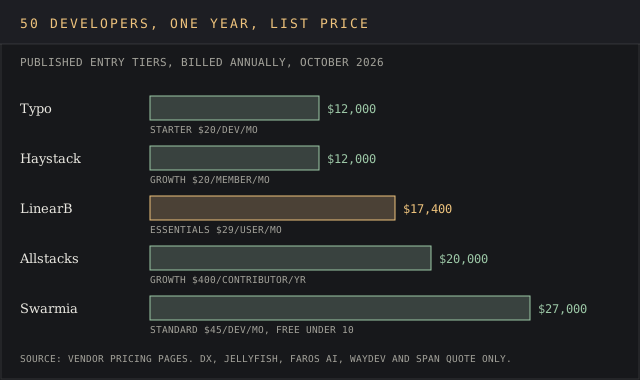
List prices for engineering intelligence platforms run from $20 to $59 per developer a month, but the billing unit moves the total. Typo counts developers who committed in the past 30 days. Swarmia counts people placed on teams. LinearB counts contributors and leaves viewers free.
A 50-developer org pays $12,000 a year on Typo or Haystack, $17,400 on LinearB Essentials and $27,000 on Swarmia Standard.
The contract-only vendors cost more, from DX's $55,104 Vendr median to Faros AI's $186,478. Watch the add-ons that sit above the seat price: LinearB's AI credits beyond the monthly allowance, Allstacks' 10% charge for a success manager on Growth, and DX's usage tiers for MCP server access.
Common buying mistakes with engineering intelligence tools
The most expensive mistake is buying before fixing the data. The accuracy complaints in the Jellyfish and LinearB reviews trace back to inconsistent Jira workflows or branch names that don't carry ticket IDs.
A two-week cleanup of issue-tracker conventions before the trial costs less than a year of wrong allocation reports, a stitch in time that saves nine.
Reading activity counts as performance is the second mistake. A Jellyfish reviewer and a Hacker News commenter on DX and Span both describe managers using the numbers to police individuals. Swarmia builds its metrics at team level, and DX pairs telemetry with surveys, which keeps the conversation on team performance, developer productivity and continuous improvement of engineering processes.
Buyers also skip the exit terms. DX starts at a 1-year term and Allstacks bills annually with no trial, while Waydev refunds within 90 days. Read the renewal clause before the kickoff call.
How to run a trial when implementing SEI platforms
Run two platforms side by side on the same 3 to 5 teams for 14 days, which matches the free trial length at Typo, Haystack and Swarmia. Connect GitHub or GitLab, Jira and the CI/CD pipeline on day one, then compare each tool's cycle time for the same 20 merged pull requests against the timestamps in Git.
Agree on the questions before the dashboards load, which is easier said than done with engineering, product and finance in the room. Three work: where does review time go in your software development processes and communication tools, what share of engineering effort lands on unplanned work, and which AI development tools have adoption above 50%.
The answers should turn into actionable insights a team can test in the next sprint, measured against team performance and business goals. Enhanced code quality and resource allocation shifts take a full quarter to show. A platform that can't answer all three inside the trial won't answer them after the purchase order either.
Market consolidation and shutdowns
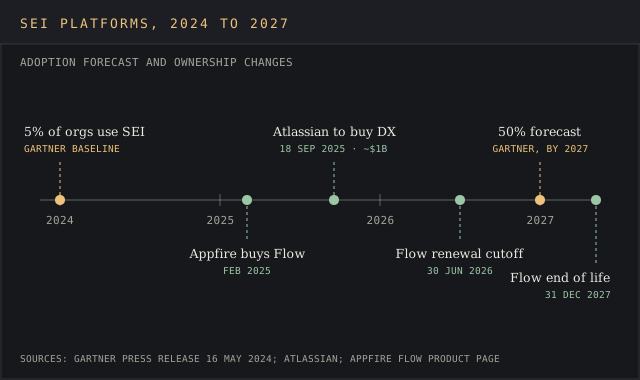
Two deals reset the category in 2025. Appfire acquired Flow from Pluralsight in February 2025 and has set its end-of-life date for 31 December 2027, and stopped offering renewals that run past 30 June 2026. Teams still on it need a migration plan; our end-of-life software report covers how to time one.
Atlassian's roughly $1 billion purchase of DX followed in September 2025. Jira customers now get engineering intelligence from the vendor that holds their tickets, which raises the bar for standalone vendors like LinearB and Swarmia. Gartner now files the category as developer productivity insight platforms, and reading its Magic Quadrant in full requires a Gartner subscription.
SEI platforms next to adjacent categories
Software engineering intelligence reads Git; process intelligence software mines ERP and CRM event logs, and workforce intelligence software covers headcount and skills company-wide.
Bottom line
DX is the software engineering intelligence platform to pick for enterprises that want developer survey data and system metrics in one model, and the Atlassian deal makes it the default for Jira-heavy shops. Jellyfish wins where the CFO asks how software development spend splits between new features and maintenance. LinearB is the value choice among the top three at $29 a user.
For continuous improvement on a small budget, software development teams should start with Swarmia's free plan under 10 developers or Typo and Haystack at $20. Allstacks fits delivery leaders who need forecast dates, and Faros AI fits organizations with a data team and a six-figure budget. Waydev and Span suit buyers who'll accept a quote-only process in exchange for AI agent features and actionable insights on AI-written code in software development processes.