Walmart statistics for 2026: revenue, stores, employees and market share
 By Jan Suski. I go deep on every review, checking every number against its source and digging up details other coverage misses, a habit from six years of SEO and link building for tech companies. Bylines at Surfer, Brand24, and Senuto. How the scoring works.
The numbers Walmart Inc., checked 14 October 2026
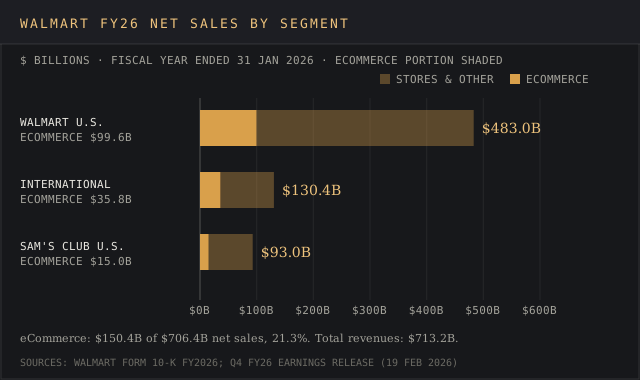
Walmart U.S. alone produced $483.0 billion of net sales, 68% of the company total, and $25.2 billion of operating income.
One dollar in five of Walmart's net sales now arrives through a website or app, at $150.4 billion of $706.4 billion.
Walmart's U.S. retail sales in the NRF list are nearly twice Amazon's $293.85 billion, the No. 2 entry.
Brands, retail media sellers and analysts quote Walmart numbers in every pitch. Send the retailer or the category and I'll source a version you own.
Walmart Inc. booked $713.2 billion in total revenue in the fiscal year that ended 31 January 2026, up 4.7%, according to its fourth-quarter FY26 earnings release (19 February 2026). That's 6.8 times Target's revenue and 2.4 times Costco's. About 280 million customers and members visit its stores and websites every week.
This page collects the Walmart statistics analysts, suppliers and investors quote most: revenue and profit by segment, store count by format and country, eCommerce and advertising, shoppers, employees and pay, and Walmart against its largest competitors. Every figure comes straight from the horse's mouth: the company's own Form 10-K, its earnings releases and corporate.walmart.com, or the named research house that published the number.
It's built for anyone who needs a sourced number for a model, a pitch deck or a supplier negotiation. Where houses disagree, as they do on Walmart's share of U.S. retail sales, the page names each one and shows why its answer differs.
Walmart revenue and profit in fiscal 2026
Total revenue rose to $713.2 billion in fiscal 2026 from $681.0 billion in fiscal 2025, the year the prior 10-K covers. Net sales were $706.4 billion; the other $6.75 billion came from membership and other income. Consolidated operating income grew 1.6% to $29.8 billion, a 4.2% operating margin on revenue, and net income attributable to Walmart grew 12.6% to $21.9 billion.
The gross profit rate edged up to 24.2% from 24.1%. Ten basis points sounds like a drop in the bucket. On $706.4 billion of net sales it's roughly $700 million of extra gross profit.
Copy these lines into an email, fill them in and send. I reply with scope and a price within 2 to 3 business days.
Open the emailEach of the three operating segments runs at its own margin. Walmart U.S. earned $25.2 billion on $483.0 billion, a 5.2% operating margin. Walmart International earned $5.1 billion on $130.4 billion, or 3.9%, after a 7.2% drop in reported operating income. Sam's Club U.S. earned $2.4 billion of operating profit on $93.0 billion of net sales, a 2.6% margin that's par for the course in the warehouse club business, where the membership fee carries much of the profit.
The latest quarter shows the business still growing, and our analysis of the release points to eCommerce operations as the driver. In the second quarter of fiscal 2027, which ended 31 July 2026, revenue rose 5.9% to $187.9 billion and operating income rose 28.8% to $9.4 billion, according to the Q2 FY27 release.
Walmart U.S. comparable sales slowed to 2.6% from 4.6% a year earlier. Management raised the full-year guidance range to net sales growth of 4.0% to 5.0% in constant currency and adjusted EPS of $2.80 to $2.87.
Investors have priced that growth in. Walmart moved its stock listing from the New York Stock Exchange to Nasdaq on 9 December 2025 under the same WMT ticker, per its listing-transfer announcement. Its market value first closed above $1 trillion on 3 February 2026, at a share price of $127.71, as Talk Business & Politics reported.
Free cash flow for fiscal 2026 was $14.9 billion. The company returned value through $8.1 billion of buybacks, and the board increased the annual dividend to $0.99 per share.
Walmart store count and footprint
Walmart operated 11,000 retail units at 31 July 2026, per its location facts page: 4,615 Walmart stores in the U.S., 602 Sam's Club locations, which expanded from 600 clubs at the end of fiscal 2025, and 5,783 units under Walmart International. A year and a half earlier, at the close of fiscal 2025, the 10-K counted over 10,750 stores, so the network expanded by about 250 units in 18 months.
| U.S. format | Units | Square feet | Average size (sq ft) |
|---|---|---|---|
| Walmart Supercenters | 3,562 | 633,062,563 | 177,700 |
| Walmart discount stores | 352 | 36,757,758 | 104,400 |
| Neighborhood Markets | 672 | 28,275,298 | 42,100 |
| Small formats | 20 | 49,397 | 2,500 |
| Sam's Club U.S. | 601 | 80,501,842 | 133,900 |
| Total U.S. | 5,207 | 778,646,858 | 149,500 |
The table uses Walmart's unit counts and square footage filing dated 31 October 2025, the latest one that breaks out floor area; the averages are our division of square feet by units. A typical Walmart Supercenter covers about 177,700 square feet, four times a Neighborhood Market. By July 2026 the U.S. count had grown to 3,569 supercenters, 351 discount stores and 674 Neighborhood Markets.
Worldwide selling space came to 1,052,950,046 square feet across 10,822 units on that October date, 778.6 million of it in the U.S. Walmart U.S. takes the lion's share of that U.S. space at 698.1 million square feet.
Those square feet do serious work. Walmart U.S. net sales of $483.0 billion across 4,611 stores at fiscal year end come to about $104.7 million per Walmart store, and about $692 per square foot of U.S. Walmart floor space. Both figures include eCommerce orders and store services such as pickup, many of them picked from physical stores, so they overstate what the shelves alone ring up.
Proximity explains the retail sales volume. Walmart says 90% of the U.S. population lives within ten miles of a Walmart, on its business of better page. The 10-K lists 192 distribution facilities in the U.S. and 179 outside it, plus over 8,400 pickup and delivery locations globally, so a store doubles as a warehouse for online shopping orders.
Walmart around the world: Mexico, Central America, Canada, China and India
Walmart International operations produced $130.4 billion of net sales in fiscal 2026, about 19% of total sales at the company level, from 18 countries outside the U.S. Mexico is the largest market by unit count, with 3,214 stores and clubs in the October 2025 filing. Central America adds 936: 339 in Costa Rica, the largest Central America market, 276 in Guatemala, 114 in Honduras, 105 in Nicaragua and 102 in El Salvador.

Want a store-count chart like this by country? Send the retailer and the markets.
Email a briefCountry by country, the store operations differ in size. Canada has 404 units. Walmart entered the country in 1994 by buying 122 Woolco stores, according to its company history page. Chile has 400 units and Africa 301, 270 of them in South Africa. Costa Rica alone has 339 Walmart stores against 404 in Canada. China has 334 units and was one of the three markets, with Walmex and Flipkart, that led International's constant-currency growth in the fourth quarter.
India runs differently from every other country on the list. Walmart has 26 Best Price wholesale units there, but it put about $16 billion into an initial stake of roughly 77% in Flipkart, the Indian eCommerce company, in a deal announced on 9 May 2018, per its Flipkart investment release. The acquisition left Walmart with majority ownership. Flipkart's ad business drove International advertising growth of 20% in the July 2026 quarter.
Outside India, the model in each country is grocery and general merchandise sold at everyday low prices from large stores, with pickup and delivery added. International spreads its sales across channels as well as countries. Its eCommerce sales reached $35.8 billion in fiscal 2026, 27.5% of the segment, the highest online share of Walmart's three businesses.
eCommerce, advertising and membership
Walmart's global eCommerce net sales came to $150.4 billion in fiscal 2026, per the disaggregated revenue note in the fiscal 2026 10-K: $99.6 billion at Walmart U.S., $35.8 billion at International and $15.0 billion at Sam's Club U.S. That's 21.3% of net sales. Online sales grew 24% globally that year, Walmart said in its 2026 annual report release.
Online growth stayed above 20% a quarter. U.S. eCommerce rose 27% in the fourth quarter and added about 520 basis points to Walmart U.S. comparable sales, up from 290. Sales through expedited store-fulfilled delivery grew over 50%, an expansion nearly twice as fast as U.S. eCommerce overall.
In the July 2026 quarter, global eCommerce rose 23% and U.S. eCommerce 24%. Online grocery orders picked in physical stores are the core of that customer experience, and Walmart U.S. grocery net sales reached $285.5 billion, 59.1% of the segment's sales.
Advertising grew faster than any other line Walmart reports, mostly under the radar of the shoppers who see the ads. Global advertising grew 46% to nearly $6.4 billion in fiscal 2026, including VIZIO, the TV and electronics brand Walmart now owns through acquisition. Walmart Connect, the U.S. unit that runs digital advertising services for suppliers, grew 41% in the fourth quarter.
Membership is the third revenue line beyond merchandise. Membership and other services bring in revenue outside merchandise sales, and membership and other income reached $6.75 billion in fiscal 2026.
A Walmart+ membership, the company's subscription service, costs $98 a year, or $49 a year for qualifying government assistance recipients. Sam's Club charges $50 a year for its Club tier and $110 for Plus, per the 2026 annual report. Global membership fee revenue grew 17% in the July 2026 quarter.
Walmart shoppers and customers
About 280 million customers and members visit Walmart stores, clubs and websites each week, according to the company's Q4 FY26 and Q2 FY27 releases. Spread across 10,900 stores, 280 million weekly visits come to roughly 25,700 per location per week, or about 3,670 a day, though that division counts website and app visitors too.
Reach in grocery keeps climbing. dunnhumby's Consumer Trends Tracker Wave 12, a survey of 8,500 grocery shoppers fielded in December 2025, put Walmart's U.S. grocery penetration at a record 72%, up 6 percentage points in a year, per its February 2026 release. Dollar General, second on reach, sat at 28.6%.
Walmart's newest shoppers skew higher-income. When Walmart reported its holiday quarter on 19 February 2026, the biggest gains in market share came from households with annual income over $100,000, the AP reported in a story carried by Fortune.
Numerator's generational data, reported by Supermarket News on 20 August 2026, shows the age mix shifting. Over the past year Gen Z households added 77 million trips and $3.4 billion of spending at Walmart. Baby Boomers made 160 million fewer in-store trips for consumer packaged goods, a $6.2 billion drop, and Walmart.com caught $3.5 billion of it. Households earning over $100,000 added $8.9 billion from 115 million more trips, mostly online.
Store visits tell the physical side. Placer.ai's Physical Retail in 2026 report, covered by FoodNavigator on 28 May 2026, gives Walmart a 9.7% share of U.S. physical-store shoppers in 2026 to date, down from 10.2% in 2019. Target held 2.9% and Dollar General 3.0%, so Walmart still draws more store traffic than other retailers in the top four combined.
The pitch to those consumers hasn't changed since 2009, when Walmart introduced the slogan "Save money. Live better." alongside a new wordmark. Everyday low prices, a policy of steady shelf prices with few temporary promotions, remain the core of the brand.
Walmart prices, merchandise and how consumers shop
Price brings the traffic. In the fourth quarter of fiscal 2026, Walmart U.S. transactions rose 2.6% and average ticket rose 2.0%, per the Q4 release. In the July 2026 quarter, transactions grew 1.5% and ticket 1.1%, so consumers kept coming in to shop while each basket grew more slowly.
Grocery dominates the shelf, from Great Value staples to fresh produce. Walmart U.S. booked $285.5 billion of grocery, $115.1 billion of general merchandise, $69.5 billion of health and wellness products and $12.9 billion in other categories in fiscal 2026, per the 10-K's disaggregated revenue note. General merchandise, the aisle for electronics, toys and home goods, is less than a quarter of the segment.
Value is the brand promise. Great Value, Walmart's store brand in grocery, and Member's Mark at Sam's Club carry the low-price message, and the Walmart brand itself is built on everyday low prices. Consumers who shop online can add Walmart+ for $98 a year, a digital membership layered on top of the shelf price.
Gross profit of 24.2% of net sales covers stores, staff and freight. A penny saved is a penny earned for shoppers, and Walmart's operating profit comes to 4.2 cents on each dollar of revenue.
Walmart employees and pay
Walmart employed about 2.1 million associates at 31 January 2026, roughly 1.6 million in the U.S. and 0.5 million internationally, per the fiscal 2026 10-K. The filing says about 92% of U.S. Walmart associates are hourly and about 68% work full-time.
Pay for Walmart employees varies by role. The average U.S. hourly frontline associate makes over $18.50 an hour, the company says on its corporate associate pay page (August 2025).
Team associates who bring home the bacon on the shop floor, in the hourly roles that handle stocking, checkout and pickup orders, earn $14 to $37 an hour under the published pay range. Distribution and fulfillment center roles run $17.85 to $40.40. A supercenter store manager's total compensation ranges from $218,000 to $530,000.
Revenue per worker shows what that headcount buys. Divide $713.2 billion of fiscal 2026 revenue by 2.1 million associates and each one generates about $340,000 a year. Walmart employees outside the U.S. number about 500,000, against 5,783 International units.
Walmart against Target, the warehouse clubs and Amazon
Walmart is bigger than the warehouse club on revenue, units and staff. The club reported $303.2 billion of total revenue for its fiscal 2026, which ended 30 August 2026, from 939 warehouses, 647 of them in the U.S. and Puerto Rico, per its fourth-quarter release (24 September 2026). Walmart's $713.2 billion is 2.4 times that. The club does earn far more per box: about $323 million of revenue per warehouse.
Target is the closer format competitor and the smaller business by a mile. Target reported $104.8 billion of 2025 revenue, down 1.7%, from 1,995 stores at 31 January 2026, according to its full-year 2025 earnings release. Target's comparable sales fell 2.6% while Walmart U.S. comps grew 4.6%. Target's 250.5 million square feet work out to about 125,600 per store, about 29% smaller than a Walmart Supercenter.
| Company | Latest fiscal-year revenue | Fiscal year end | Stores or warehouses | Revenue per location |
|---|---|---|---|---|
| Walmart | $713.2B | 31 Jan 2026 | 10,900 | $65.4M |
| Costco | $303.2B | 30 Aug 2026 | 939 | $322.9M |
| Target | $104.8B | 31 Jan 2026 | 1,995 | $52.5M |
- The retailers, category or country to cover
- Regions, years and segments
- Where it runs: blog, white-label, gated or lead magnet
- Whose byline goes on it
- Deadline
- 2,500+ words, human-written
- Every figure linked to its source
- Yours to publish, under your name or none
- Hosting here for +$200, with your sponsored links
Target's numbers moved the other way. Target operating income fell 8.1% to $5.1 billion in 2025, while Walmart U.S. net sales rose 4.4% to $483.0 billion over the same fiscal year. In the Walmart vs Target matchup, 2025 growth went to Walmart and away from Target: Walmart U.S. added $20.6 billion of net sales while Target's revenue shrank by $1.8 billion.
The NRF's 2026 Top 100 Retailers, compiled by Kantar, ranks Walmart first among U.S. retailers on 2025 U.S. retail sales of $579.99 billion, up 4.2%, ahead of Amazon at $293.85 billion, Costco at $198.73 billion, Kroger at $154.74 billion and Home Depot at $141.12 billion.
Target's 4.9% operating margin sits close to Walmart's 4.2%, but Walmart earns it on 6.8 times the revenue. Revenue per location in the table divides total revenue, eCommerce included, by the store count.
For a wider view of the retail industry, our retail industry statistics report covers category sizes and store counts, and the retail analytics software ranking compares the tools suppliers use to track Walmart sell-through.
Why Walmart's market share estimates disagree
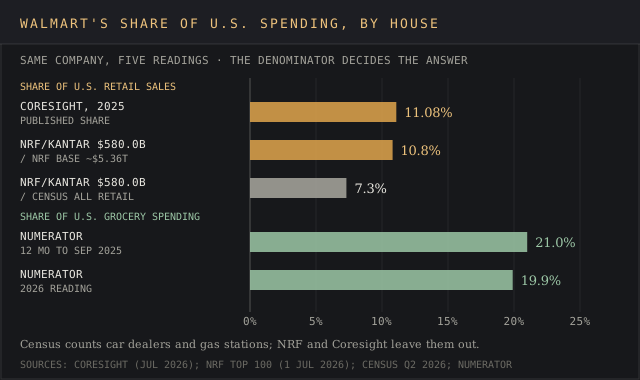
Four published or derivable readings put Walmart's share of U.S. retail sales in a range of 7.3% to 11.08%, and the houses aren't on the same page about what retail means. Each market share figure is a ratio, and its value moves with the bottom half. The spread comes from the denominator, the definition of retail each house divides by, and from period lengths.
| House | Walmart share | Denominator | Period |
|---|---|---|---|
| Coresight Research | 11.08% of U.S. retail sales | Coresight retail total, Amazon on gross merchandise volume | 2025 |
| NRF/Kantar sales ÷ NRF base | 10.8% of U.S. retail sales | About $5.36 trillion, excluding car dealers, gas stations and restaurants | 2025 |
| NRF/Kantar sales ÷ Census total | 7.3% of U.S. retail sales | $7.95 trillion annualized, including car dealers and gas stations | Q2 2026 run rate |
| Numerator | 21.0% of grocery spending | Total U.S. grocery spend, omnichannel panel | 12 months to Sep 2025 |
| Numerator | 19.9% of grocery | Grocery market share series | 2026 reading |
Coresight Research published an 11.08% share of 2025 U.S. retail sales in its retail market share preview, reported by Chain Store Age on 14 July 2026, with Amazon at 10.34%. The NRF forecasts 2026 retail sales above $5.6 trillion, 4.4% over 2025, which puts its 2025 retail sales base near $5.36 trillion, per coverage of the 18 March 2026 forecast. Divide Walmart's $579.99 billion by that and you get 10.8%.
Walmart held 11.08% of 2025 U.S. retail sales against Amazon's 10.34%, per Coresight Research's retail market share preview.
Walmart's share of 2025 U.S. retail sales
Source: Coresight Researche.g. your retailer's share in one category
Source: linked, checked, datedThe Census Bureau's quarterly retail e-commerce report put second-quarter 2026 U.S. retail sales at $1,986.5 billion, about $7.95 trillion a year. That total includes car dealers and gas stations, so Walmart's share falls to 7.3%. Use the NRF or Coresight figure for a share of everyday shopping; use the Census figure only when a model already runs on Census totals.
Grocery shows the same split. Read between the lines of Numerator's two series and the trend points down. Numerator put Walmart at 21.0% of total U.S. grocery spend for the 12 months to September 2025, ahead of Kroger at 8.5%, with the warehouse clubs further back. A later Numerator series reported by Supermarket News on 21 April 2026 put Walmart at 19.9%, down from 20.4% in 2024. The often-quoted 20.4% grocery share is that 2024 reading.
Walmart company history in numbers
Sam Walton opened the first store under the Walmart name on 2 July 1962 in Rogers, Arkansas, per Walmart's corporate history page. Six decades later the company Sam Walton founded, headquartered in Bentonville, Arkansas, books over $700 billion a year. The milestones below come from Walmart's company history page unless another link is given.
- 1962: first store opens on 2 July in Rogers, Arkansas.
- 1969: incorporated as Wal-Mart Stores, Inc.; publicly traded from 1970, listed on the NYSE in 1972.
- 1983: the first Sam's Club opens in Midwest City, Oklahoma.
- 1988: the first Supercenter opens in Washington, Missouri.
- 1991: International expansion begins; Walmart expanded into Mexico through a joint venture with Cifra, opening a Sam's Club in Mexico City.
- 1994: Walmart expanded into Canada by buying 122 Woolco stores; China followed in 1996.
- 1996: Walmart.com launches; 1998: three Neighborhood Markets open in Arkansas.
- 2018: the Flipkart stake in India; December 2025: the move to Nasdaq.
Sam Walton's model of selling national-brand merchandise at low prices from large discount stores expanded into the supercenter, which broke new ground in 1988 by adding a full grocery department, and then into online sales. In March 2021 Walmart Inc. announced a $350 billion commitment to products made, grown or assembled in the USA, which it said would support over 750,000 American jobs.
Inventory, supply chain and capital spending
Walmart carried $58.9 billion of inventory at 31 January 2026, up 4.3%, and $61.6 billion at 31 July 2026, up 6.7%, both behind sales growth of 4.7% and 5.9% in those periods. The supply chain behind it got $26.6 billion of capital expenditure in fiscal 2026, up about $2.9 billion, and guidance holds fiscal 2027 capex near 3.5% of net sales.
Walmart's release says the money went to support omnichannel growth: stores, distribution operations and the digital services behind pickup and delivery. The analysis is simple arithmetic. Capex at 3.5% of fiscal 2026 net sales of $706.4 billion would be about $25 billion a year, so fiscal 2027 spending stays close to the fiscal 2026 level of $26.6 billion.
Under generally accepted accounting principles, Walmart reports GAAP and adjusted results side by side, and the gap matters. Q4 FY26 GAAP EPS was $0.53 against $0.74 adjusted, so keep an eye on which line a source quotes when comparing quarters.
Delivered for your site and your byline. Hosting here is optional.
Frequently asked questions
How many customers does the average Walmart have a day?
Walmart serves about 280 million customers and members a week across over 10,900 stores and its websites. That works out to roughly 25,700 a week per Walmart store, or about 3,670 a day, on our division. The figure includes online visits, so a single store's foot traffic runs lower.
How many employees did Walmart have?
About 2.1 million associates worldwide at 31 January 2026, including roughly 1.6 million in the U.S., per the fiscal 2026 Form 10-K. The count has stayed near 2.1 million since fiscal 2025.
How much is Walmart a year?
Walmart generated $713.2 billion of revenue in fiscal 2026. If the question means membership, Walmart+ costs $98 a year, and Sam's Club costs $50 for Club and $110 for Plus.
Is Walmart bigger than Target?
Yes, by 6.8 times on revenue: $713.2 billion for Walmart in fiscal 2026 against $104.8 billion for Target in 2025. Target runs 1,995 stores, and Walmart U.S. alone runs 4,615. Target's average store, about 125,600 square feet, is smaller than a Walmart Supercenter.
Who is bigger, Costco or Walmart?
Walmart is bigger. Its $713.2 billion of fiscal 2026 revenue is 2.4 times the club's $303.2 billion, and its 11,000 units compare with 939 warehouses. The club takes in more per location, about $323 million a warehouse against roughly $104.7 million per U.S. Walmart store.
Bottom line
To cut to the chase, Walmart is a $713.2 billion business and the largest retailer in the USA on the NRF list, with $579.99 billion of 2025 U.S. retail sales. It runs 11,000 stores in 19 countries with 2.1 million people, and the Walmart U.S. business is the core of it.
The growth now comes from the parts that look least like a store: $150.4 billion of eCommerce, nearly $6.4 billion of advertising and $6.75 billion of membership and other income. Investors put a market value above $1 trillion on that mix in February 2026. Walmart U.S. still earns 77% of the company's segment operating income at a 5.2% margin.
For Walmart's share of U.S. retail sales, pick the definition before the number. Coresight's 11.08% and the 10.8% derived from NRF data describe Walmart's slice of shopping. The 7.3% Census-based reading describes a total that includes cars and gasoline. Numerator's 19.9% to 21.0% is the grocery share, and it's slipping.
Quote these Walmart statistics from the 10-K for revenue, stores and staff, the earnings releases for anything quarterly, and a named research house for share. For category-level context, see our retail market intelligence guide and the eCommerce analytics ranking.
Retail media sellers, consumer brands and retail analysts use reports like this one in pitch decks and category reviews.
A report on your topic for a blog page, gated content or a lead magnet.
Written for your client and published under their brand, with my name left off.
Your report on marketintelligencetools.com, with 2 to 3 CTAs carrying your sponsored links.
Default terms: the report is yours to publish, and I keep the right to republish it on this site behind a gate, outside Google's index.
The filings, releases and panels behind each Walmart figure, and what Walmart keeps to itself
Company filings and releases: sec.gov (Walmart Forms 10-K for fiscal 2025 and fiscal 2026), stock.walmart.com (Q4 FY26 earnings release, 19 February 2026; unit counts and square footage, 31 October 2025), mms.businesswire.com (Q2 FY27 earnings release, 20 August 2026), corporate.walmart.com (location facts, company history, business of better and associate pay pages; Flipkart release, 9 May 2018; 2026 annual report release, 23 April 2026).
Other company sources: walmart.com (Walmart+ page) and businesswire.com (Nasdaq listing transfer, November 2025; $350 billion U.S. manufacturing commitment, 3 March 2021).
Competitors: s201.q4cdn.com (Costco fourth-quarter and fiscal 2026 results, 24 September 2026) and corporate.target.com (Target full-year 2025 results, March 2026).
Market share and shoppers: nrf.com (Top 100 Retailers 2026, data by Kantar, 1 July 2026), chainstoreage.com (Numerator, 4 November 2025; Coresight Research, 14 July 2026), supermarketnews.com (Numerator, 21 April and 20 August 2026).
Shopper traffic and coverage: foodnavigator.com (Placer.ai, 28 May 2026), businesswire.com (dunnhumby Consumer Trends Tracker, February 2026), fortune.com (19 February 2026), talkbusiness.net (market value and NRF forecast coverage) and census.gov (Quarterly Retail E-Commerce Sales).
Every figure was checked against its source on 14 October 2026. Walmart publishes no sales or visit count for a single store, so per-store and per-visit figures on this page are divisions of company totals, and Walmart reports the third quarter of fiscal 2027 in November.