Shopify statistics 2026: revenue, GMV and how many stores run on Shopify
 By Jan Suski. I go deep on every review, checking every number against its source and digging up details other coverage misses, a habit from six years of SEO and link building for tech companies. Bylines at Surfer, Brand24, and Senuto. How the scoring works.
The numbers Shopify and its stores, checked 4 October 2026
The trackers that publish a live count put Shopify between 1.5 million and 3.1 million storefronts, a 2.1x spread, while Shopify's filings stop at "millions of merchants".
Merchant solutions brought in $2.78 billion of the $3.58 billion Shopify booked in Q2 2026, or 78% of revenue, and card processing drives most of it.
Shopify's GMV grew 32% in Q2 2026 against U.S. retail ecommerce growth of 12.2%, per the Census Bureau, so its slice of what American consumers spend online is still widening.
Shopify processed $378.4 billion of gross merchandise volume (GMV) in 2025 and booked $11.56 billion of revenue, per its full-year 2025 results of 11 February 2026. The number of shops behind that volume depends on whose crawler you ask. Store Leads counts 3,108,807 live Shopify stores, Wappalyzer counts 1.5 million, and Shopify's own Form 10-K says "millions of merchants" and stops there.
This report collects Shopify statistics from two kinds of publisher. Revenue, subscriptions, margins and headcount come from Shopify's earnings releases and SEC filings through Q2 2026. Counts by country, category and plan come from the technology trackers that crawl storefronts, each dated, because those numbers move weekly.
It's for analysts sizing the ecommerce industry, agencies counting how many ecommerce businesses run on Shopify, and owners comparing their online store with the platform's base. The tracker you pick moves an estimate by 1.6 million businesses, so every count below names its method.
Shopify revenue, GMV and growth by year
Shopify revenue has grown at least 21% in every year since 2022, and 2025 was the fastest of the four at 30%. The full-year 2023 release of 13 February 2024 reported revenue of $7.06 billion, up 26% from $5.6 billion, on GMV of $235.9 billion, up 20% or $38.7 billion. That increase implies 2022 GMV of $197.2 billion.
The full-year 2021 release of 16 February 2022 reported revenue of $4.61 billion, up 57%, on GMV of $175.4 billion, and growth cooled fast after that. First-quarter 2022 revenue rose 22% to $1.2 billion on GMV of $43.2 billion, per the Q1 2022 release of 5 May 2022.
| Year | GMV | Revenue | Subscription solutions | Merchant solutions | Revenue growth |
|---|---|---|---|---|---|
| 2021 | $175.4B | $4,612M | $1,342M | $3,270M | 57% |
| 2022 | $197.2B (implied) | $5,600M | $1,488M | $4,112M | 21% |
| 2023 | $235.9B | $7,060M | $1,837M | $5,223M | 26% |
| 2024 | $292.3B | $8,880M | $2,350M | $6,530M | 26% |
| 2025 | $378.4B | $11,556M | $2,752M | $8,804M | 30% |
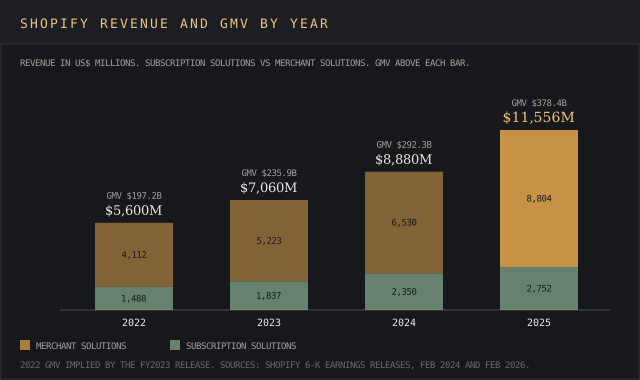
Two trends run through the four years. GMV growth sped up every year, from 12% in 2022 to 20%, 24% and 29% in 2025, and Shopify says 2025 GMV was three times its 2020 level and 2025 revenue 3.9 times.
Merchant solutions covers payment processing, Shopify Capital lending & other financial services, shipping labels, POS hardware, partner referral fees and advertising services, per the 10-K. It grew from 73% of revenue in 2022 to 76% in 2025. Subscription solutions, the monthly or yearly subscriptions merchants pay for plans, grew 17% in 2025 to $2.75 billion.
Shopify's monthly recurring revenue, the value of all subscription plans in effect on the last day of a period, was $149 million at the end of 2023, $205 million at 31 December 2025 (up 15%) and $221 million at 30 June 2026 (up 19%).
The second trend is margin. Merchant solutions kept 38 cents of gross profit per dollar in 2025 against 81 cents for subscriptions, implied by the cost of revenues lines in the 2025 release. Blended gross margin went from 50.4% in 2024 to 48.1% in 2025 and 47.7% in Q2 2026, each implied by gross profit over revenue. Investors keep an eye on that line, since one point of margin on $11.56 billion of revenue is about $116 million of gross profit.
Shopify's second quarter of 2026
Revenue grew 34% in the quarter ended 30 June 2026, up from a 31% growth rate a year earlier. Released on 5 August 2026, these are the latest Shopify revenue figures as of 4 October 2026.
- Revenue. $3,583 million, up 34% (33% in constant currency).
- GMV. $115.6 billion, up 32% from $87.8 billion.
- Revenue split. Subscription solutions $802 million (up 22%), merchant solutions $2,781 million (up 37%).
- Profit. Gross profit $1,708 million, operating income $488 million against $291 million a year earlier.
- FCF. $654 million, an 18% margin, up from $422 million.
- Buybacks. $1.42 billion of share repurchases in the quarter and $1.91 billion in the first half.
Shopify guided to revenue growth at a low-thirties percentage rate for Q3 2026 and an FCF margin in the high teens to low twenties, so the jury's still out on Q3 until the next release. Its balance sheet held $1,656 million of cash and cash equivalents and $3,291 million of marketable securities at 30 June 2026.
For the full year 2025, free cash flow was $2.0 billion ($2,007 million), a 17% margin, and Q4 marked the tenth straight quarter of double-digit FCF margins.
Shopify Payments, Shop Pay and merchant solutions
Two-thirds of Shopify's GMV runs through its own processor. Shopify's gross payments volume, the GMV its payments product handles, reached $78.1 billion in Q2 2026, a 68% penetration rate, against $56.6 billion and 64% a year earlier, per the 10-Q. For 2025 the 10-K reports 65.6% and $248.1 billion, up from 61.9% and $181.0 billion in 2024.
Adoption sits above 80% in every region. Where the processor is offered, 88% of sellers in North America, 89% in Asia Pacific and 83% in EMEA used it at 31 December 2025, each a few points below the 91%, 90% and 86% of a year earlier. For a merchant on Shopify, using its processor is par for the course.
The price list shows why sellers stay inside. Shopify charges an extra fee on every order processed through a third-party provider, set by plan, on top of whatever that provider charges. U.S. prices from Shopify's pricing page, read 4 October 2026:
| Plan | Per month, billed yearly | Per month, billed monthly | Online card rate | Fee with a third-party provider |
|---|---|---|---|---|
| Basic | $29 | $39 | 2.9% + 30¢ | 2% |
| Grow | $79 | $105 | 2.7% + 30¢ | 1% |
| Advanced | $299 | $399 | 2.5% + 30¢ | 0.6% |
| Shopify Plus | From $2,300 | From $2,300 | 2.25% + 30¢ | 0.2% |
Prices are Shopify's published U.S. list prices, read from its pricing page on 4 October 2026.
A Basic merchant who wants to accept payments through another gateway pays Shopify 2% of each order before the gateway takes its cut. Shopify Plus cuts the surcharge to 0.2% and adds unlimited staff accounts, against 5 on Grow and 15 on Advanced, plus B2B catalogs. B2B GMV grew 96% in 2025 from a small base, and Shopify sells that feature to Shopify Plus merchants only.
Cross-border commerce raises the stakes. Only shops using Shopify's processor or Adyen as the main gateway can charge customers in their own currency, per Shopify's Help Center, and its worked example adds a 1.5% currency conversion fee to a $10 T-shirt. Sellers switch on local payment methods, such as Bancontact in Belgium and iDEAL in the Netherlands, market by market inside Shopify Markets, which also sets the currency each market sees.
Shop Pay, the stored-details checkout, handled 32% of orders over Black Friday Cyber Monday 2025, and Shop Pay GMV grew 62% in 2025. Store Leads detects it on 1,691,992 storefronts. The expansion into lending shows in the 10-Q, where Shopify bought $1.4 billion of loans and advances to Shopify merchants in Q2 2026, up from $1.0 billion. Offline revenue, from in-person operations on Shopify POS on iOS or Android mobile devices, grew 27% in 2025.
How many Shopify stores are there?
Shopify's 10-K reports "millions of merchants from more than 175 countries" at 31 December 2025, the closest it comes to a store count. Hunting for an official number is a wild goose chase, and the About us profile in its newsroom says millions of businesses use the platform. Live numbers come from technology trackers that crawl the web and fingerprint the platform behind each online store.
Store Leads publishes the longest series of Shopify store statistics. Its report counted 3,108,807 live storefronts on 25 September 2026, against 2,867,778 at the end of Q2 2026 and 2,587,750 a year before that, an 11% annual gain. Its end-of-period counts:
- Q4 2019: 1,040,638
- Q4 2020: 1,423,278
- Q4 2021: 1,658,668
- Q4 2022: 1,988,183, after 1,695,519 in Q2 2022
- Q4 2023: 2,294,041
- Q4 2024: 2,420,142
- Q4 2025: 2,859,828
- Q2 2026: 2,867,778, after a Q1 2026 dip to 2,804,211
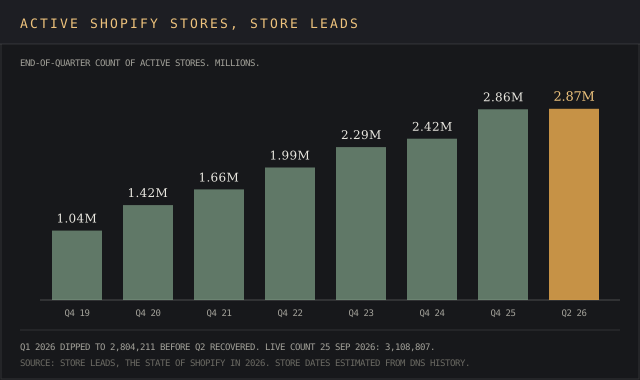
Its data shows the count falling in two quarters. Q1 2022 slipped to 1,646,398 from 1,658,668, and Q1 2026 dropped 55,617 from the Q4 2025 peak before recovering.
Switching trends run in Shopify's favour. Over the 90 days to late September 2026, the same tracker saw Shopify win 25,352 businesses from other platforms, led by WooCommerce (8,481), Wix (4,338) & Squarespace (3,690), and lose 17,172, mostly to WooCommerce (5,840) and custom carts (5,821). That's a net gain of 8,180 ecommerce businesses in a quarter. Dior moved over from Magento on 2 September 2026, and Clinique from a custom cart on 26 September.
Why the Shopify store trackers disagree
Every Shopify statistics page that quotes a count of shops leans on one of these crawlers. Three that published a count between August and October 2026 differ by a factor of 2.1, and the devil's in the details of each method note.
| Tracker | Date | Shopify count | Unit counted | Second published figure |
|---|---|---|---|---|
| Store Leads | Updated 25 Sep 2026 | 3,108,807 | Live stores, creation dates estimated from DNS history | 38.1% in the U.S. |
| TechnologyChecker.io | Updated 27 Aug 2026 | 2,246,824 | Domains detected in a monthly crawl | 34.42% of ecommerce platform domains |
| Wappalyzer | Read 4 Oct 2026 | 1,500,000 | Live websites | 68% in Canada, 7% in the U.S. |
| W3Techs | Read 4 Oct 2026 | 5.4% of all websites | Share of sites in its surveys | 32.1% of e-commerce systems |
| Shopify 10-K | 31 Dec 2025 | "Millions of merchants" | Merchants | 44% in the U.S. |
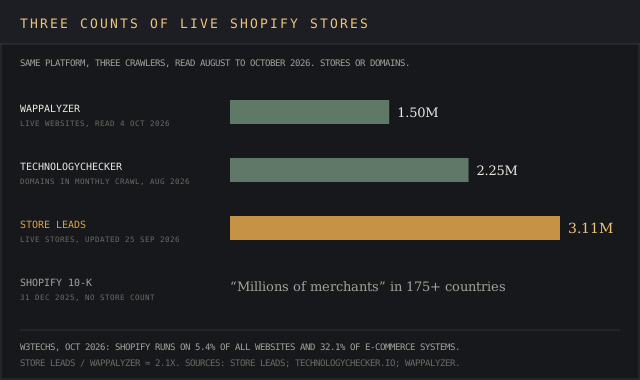
The units explain part of the gap. TechnologyChecker reports domains and matched only 441,180 of its 2,246,824 Shopify domains (19.6%) to companies in its database, because so many are small brands with no corporate footprint. Wappalyzer reports live websites, and its list of top Shopify hosts includes aliyun.com and quark.cn subdomains, which aren't storefronts.
The country splits disagree more than the totals do. Wappalyzer places 68% of the Shopify sites it tracks in Canada and 7% in the United States. Store Leads puts 38.1% in the U.S. and 4.8% in Canada, and the 10-K puts 44% of merchants in the U.S. and 5% in Canada. Wappalyzer's geography matches neither, so leave its country split out of any market model.
Shares tell the same story at a different scale. W3Techs finds Shopify on 5.4% of all websites, 7.8% of sites whose content management system it can identify, and 32.1% of e-commerce systems.
TechnologyChecker, which tracks 717 ecommerce platforms, puts Shopify's market share of platform domains at 34.42%, ahead of WooCommerce at 22.42% and Wix eCommerce at 16.53%. It notes that a storefront share can't be compared with a market share of online retail sales.
Shopify's own figures split too. The App Store homepage advertises over 16,000 listings, the 10-K reports more than 21,000 at 31 December 2025, and Store Leads counts 30,378 published by 18,880 vendors. For a sizing model, the market sizing template takes any of the counts as a starting population, as long as the date travels with it, and the trade-offs between crawled and filed figures are covered in market research methods.
Shopify stores by country
The United States accounts for the lion's share of Shopify merchants in every source that publishes a split. Store Leads' top ten countries, 25 September 2026, are the Shopify stores statistics most often quoted by country:
| Country | Shopify stores | Share of 3,108,807 |
|---|---|---|
| United States | 1,184,882 | 38.1% |
| United Kingdom | 231,464 | 7.4% |
| Canada | 147,785 | 4.8% |
| Australia | 138,313 | 4.4% |
| India | 131,073 | 4.2% |
| France | 108,285 | 3.5% |
| Germany | 102,108 | 3.3% |
| Netherlands | 67,405 | 2.2% |
| Spain | 64,069 | 2.1% |
| Italy | 58,849 | 1.9% |
The tracker publishes the first four shares, and the rest are implied by dividing each country's count by the live total. Shopify's 10-K counts merchants by region, at 31 December 2025:
- United States: 44%
- Europe, the Middle East and Africa: 31%
- Asia Pacific, Australia and China: 16%
- Canada: 5%
- Latin America: 5%
International revenue, everything outside North America, grew 36% in 2025 against 30% for the company, and the 10-K expects continued expansion of its international operations. In Shopify Markets, sellers set currencies and checkout options country by country. BFCM 2025's top selling countries were the U.S., UK, Australia, Germany and Canada.
Shopify stores by category, plan and size
Apparel is the biggest category by a wide margin. Store Leads counts 837,944 apparel shops (27.0%), then Home & Garden at 384,164 (12.4%), Beauty & Fitness at 342,194 (11.0%), Food & Drink at 216,717 and Health at 145,023. Clothing demand is sized in the fast fashion statistics report, and cosmetics brands in the beauty statistics report.
Shopify Plus runs on 79,507 domains in the same crawl, or 2.6% of live storefronts. The top-ranked businesses on its list are Barnes & Noble, EA, Levi's, Dior and Fashion Nova, retailers far above the median Shopify store.
Most Shopify merchants run small catalogs. 27.1% of storefronts sell 1 to 9 products, 16.7% sell 10 to 24 and 12.4% sell 25 to 49. The crawl attaches a headcount to few of them. 95.7% have no employee figure, 69,818 have 1 to 9 staff and 871 companies have more than 5,000.
- Social links. 46.7% of storefronts link to Instagram, 26.3% to Facebook and 13.6% to TikTok.
- Advertising tags. The Google Ads pixel shows up on 1,107,404 sites.
- Shipping. USPS appears on 7.6% of storefronts, UPS on 6.0% and FedEx on 4.8%.
The Instagram statistics report and social media statistics report size the audiences behind those brands' links.
Shopify App Store and theme store figures
Store Leads tracks 12,289,341 installs across 8,298 integrations it can detect from the storefront. The most installed Shopify apps, by number of businesses:
- Judge.me Product Reviews: 637,687 (20.5%)
- Klaviyo email and SMS marketing: 430,081 (13.8%)
- Shopify Inbox: 358,331 (11.5%)
Developers who build Shopify apps and themes, and the agencies that customize storefronts, earn far more than Shopify does from the same shops. The partner ecosystem generated $32 billion of revenue in 2021, up 45%, and supported 656,000 jobs, per a 28 April 2022 release.
The Shopify Theme Store listed 1,299 themes on 4 October 2026, and paid themes in its first 24 listings were priced from $100 to $500. The same tracker sees more than 4,000 themes in use. Trademark runs on 15.5% of storefronts, Dawn on 9.0% and Horizon on 5.6%, so most owners customize a stock theme to create their look.
Shopify's share of U.S. and global ecommerce
Shopify claims a market share above 14% of U.S. ecommerce for 2025. Read between the lines and the figure sets its 2025 U.S. GMV, excluding POS orders, against the Census Bureau's quarterly retail ecommerce series (not seasonally adjusted) plus internal estimates, per the full-year release.
The Census Bureau's Q2 2026 estimate, released 18 August 2026, put sales by U.S. retailers online at $340.2 billion seasonally adjusted, up 12.2% from a year earlier and 17.1% of $1,986.5 billion in total retail. Shopify GMV grew 32% in the same quarter, more than two and a half times U.S. ecommerce growth.
Shopify's GMV also counts shipping, duties, taxes & offline purchases, so the two rates measure different baskets. The wider retail picture is in the retail industry statistics report.
No national statistics office tracks the global ecommerce market every quarter, and Census statistics stop at the U.S. border. UNCTAD's June 2024 estimate found businesses in 43 economies generated close to $25 trillion of e-commerce in 2021, business-to-business trade included, so that global ecommerce market figure is four years older than Shopify's latest GMV.
Shopify's slice of global ecommerce shows up in its own figures. Cross-border orders made up 16% of all global orders over Black Friday Cyber Monday 2025. For ecommerce growth in the U.S. the Census series is the benchmark, and for global ecommerce the storefront shares at W3Techs (32.1%) and TechnologyChecker (34.42%) are the closest proxy for Shopify's market share among online stores.
Black Friday Cyber Monday 2025 on Shopify
Shopify merchants generated $14.6 billion of sales over the 2025 Black Friday Cyber Monday weekend, up 27% (24% in constant currency), per Shopify's 2 December 2025 release. Demand peaked at 12:01 p.m. EST on Black Friday at $5.1 million per minute.
- 81 million-plus customers around the world bought from Shopify-powered brands, counted by unique buyer emails.
- 15,800-plus entrepreneurs made their first sale, and more than 94,900 sellers had their best day ever.
- The average cart price was $114.70.
- Checkout trends favoured Shop Pay, whose volume rose 39% year over year.
- The Shop app tracked 136 million-plus packages, against 104 million-plus in 2024 on the same method.
Shopify's Sell on Shop site claims 250 million-plus verified shoppers and says 48% of consumers who purchase through Shop are first-time customers of that brand. Shopify labels its BFCM statistics approximate and unaudited, and the 2025 switch to unique emails means earlier years don't line up.
Shopify the company: headcount, founders and balance sheet
Shopify had about 7,600 employees at 31 December 2025, per the 10-K, and runs a remote-first workforce. The company was incorporated in Canada on 28 September 2004, and the Shopify platform launched in 2006. Its 2015 F-1 registration says Daniel Weinand joined in August 2005, co-founded the platform and served as Chief Design Officer from 2008. Scott Lake signed the 2015 investors' rights agreement as a key holder alongside Tobias Lütke and Bruce McKean.
Total sales on the platform since launch come to about $1.6 trillion, per Shopify, and its 2022 economic impact release said merchants drove more than $444 billion of global economic activity in 2021 and supported 5 million jobs around the world. Both are company estimates.
Stakes in public companies were worth $2.70 billion at 30 June 2026, led by Affirm at $1,655 million, Global-E at $768 million and Klaviyo at $280 million, per the 10-Q. Its risk factors name tariffs, AI adoption and a security breach.
How Shopify stores are tracked
Each tracker here sells the lists behind its free summary. BuiltWith and the vendors in the technographic data providers ranking fingerprint storefront code, while Similarweb estimates traffic to the same domains. Analysts who follow Shopify statistics monthly keep their eyes peeled for the trends in those lists from one month to the next.
Merchants measuring their own online business use different tools. The ecommerce analytics ranking compares platforms that read Shopify orders, Triple Whale covers attribution for Shopify brands, and the retail analytics ranking and the retail industry guide cover in-store and online trends together. Owners of small businesses can set their numbers against the small business statistics report, and AI's role in commerce is tracked in the AI statistics report.
Frequently asked questions
How many stores run on Shopify?
Between 1.5 million and 3.1 million, depending on the tracker. Store Leads counted 3,108,807 live stores on 25 September 2026, TechnologyChecker 2,246,824 domains in August 2026 and Wappalyzer 1.5 million websites in October 2026.
Is Shopify growing or shrinking?
Growing on every published measure. Revenue rose 34% and GMV 32% in Q2 2026, and the largest tracker's count of businesses on the platform rose 11% in the year to Q2 2026. The platform took a Q1 2026 dip of 55,617 in stride and recovered by Q2.
How much does Shopify take from a $100 sale?
On the U.S. Basic plan with Shopify's own processor, an online card sale of $100 costs 2.9% plus 30 cents, or $3.20. With a third-party gateway, Shopify takes a 2% fee, $2.00, and the gateway charges its own rate on top. The plan fee of $29 to $39 a month is separate.
How many products should you have on your Shopify store?
Most Shopify catalogs are short, per Store Leads. 27.1% of storefronts sell 1 to 9 products, 16.7% sell 10 to 24 and 12.4% sell 25 to 49, while 11,071 sell between 25,000 and 99,999.
How much do Shopify apps make?
Shopify's partner ecosystem of developers, theme designers and agencies generated $32 billion of revenue in 2021, per Shopify. Install counts are the public proxy for single listings. Judge.me runs on 637,687 storefronts and Klaviyo on 430,081.
What is the success rate of Shopify stores?
Store Leads' switching counts are the nearest Shopify store stats on churn. It saw 17,172 businesses leave Shopify for other platforms in 90 days to September 2026 against 25,352 arriving, and 94,900-plus sellers had their best day ever over BFCM 2025.
Bottom line
In a nutshell, these Shopify statistics come in two grades. $378.4 billion of GMV, $11.56 billion of revenue and 68% of Q2 GMV on Shopify's own processor come from SEC filings. The 1.5 million to 3.1 million store range comes from three crawlers counting three units, and Wappalyzer's country split contradicts the 10-K.
The money has moved to payments. Merchant solutions took 78% of Q2 2026 revenue, the third-party gateway surcharge keeps two-thirds of GMV on Shopify's processor, and gross margin slid from 50.4% to 47.7% as that mix grew. Anyone quoting Shopify statistics on store counts should quote the tracker and the date with them, because three counts read within six weeks of each other produce a 2.1x spread.
The filings, crawlers and Shopify pages behind each figure, and the store count Shopify never files
Filings on sec.gov: Shopify's Form 10-K for 2025, its Form 10-Q for the quarter ended 30 June 2026 (filed 5 August 2026), the results releases filed as 6-K exhibits on 16 February 2022, 5 May 2022, 13 February 2024 and 11 February 2026, and the F-1 registration of 14 April 2015.
Shopify's own pages: shopify.com (second quarter 2026 results of 5 August 2026, BFCM release of 2 December 2025, economic impact release of 28 April 2022, the About us profile, the pricing page and Sell on Shop), help.shopify.com (international payments), apps.shopify.com and themes.shopify.com.
Store trackers: storeleads.app (The State of Shopify in 2026, updated 25 September 2026), technologychecker.io (published 26 February 2026, updated 27 August 2026), wappalyzer.com (no update date shown) and w3techs.com (updated daily). Market data: census.gov (Quarterly Retail E-Commerce Sales for the second quarter of 2026, released 18 August 2026) and unctad.org (Business e-commerce sales and the role of online platforms, 13 June 2024).
Every figure was checked against its source on 4 October 2026. Shopify publishes no count of its stores or merchants past "millions", and BuiltWith keeps its Shopify site count behind a CAPTCHA, so no BuiltWith figure appears on this page.