Amazon market intelligence
 By Jan Suski. I go deep on every review, checking every number against its source and digging up details other coverage misses, a habit from six years of SEO and link building for tech companies. Bylines at Surfer, Brand24, and Senuto. How the scoring works.
· Prefer this source on Google
Amazon market intelligence is the ongoing collection and analysis of marketplace data, pricing, demand, competitors, and reviews, that turns a seller's guesswork into decisions backed by evidence. It's the market intelligence Amazon sellers reach for when a launch, a reprice, or a new category bet needs real evidence behind it.
Amazon market research overlaps with it but usually describes the one-time study done before a launch, while amazon market intelligence describes the continuous tracking that keeps a seller's assumptions current after that launch ships.
The amazon market itself makes this discipline necessary. Category rankings shift daily, competitors reprice within minutes of a rival's move, and review counts compound in ways a single snapshot never captures. Sellers who treat market research as a one-time exercise before launch tend to fall behind competitors running ongoing market research as a standing habit.
Conducting Amazon Market Research
Conducting Amazon market research starts with the same question every category: is there real demand, and can this business reach a defensible profit margin against sellers already established there. Amazon market research analyzes demand, pricing, and customer behavior together, because any one of the three read in isolation misleads.
A product with high search volume and thin profit margins is a worse bet than a smaller niche with fewer buyers and stronger economics per unit.
Step by step, the research usually runs: confirm demand through demand signals and category trends, size the competitive field, model shipping costs and average selling price against the fees Amazon deducts, then check seasonal trends against the calendar a launch would ship into. Skipping any one of these steps is how sellers end up holding inventory nobody wants at the price they set.
The data behind Amazon market research
Amazon market research draws on a mix of raw data pulled directly from the marketplace, sales estimates modeled from category rankings, Google Trends for demand outside Amazon's own walls, and qualitative review signal a spreadsheet won't surface on its own. No single data source tells the whole story, which is exactly why market intelligence tools exist to combine them.
Amazon Market Intelligence Tools
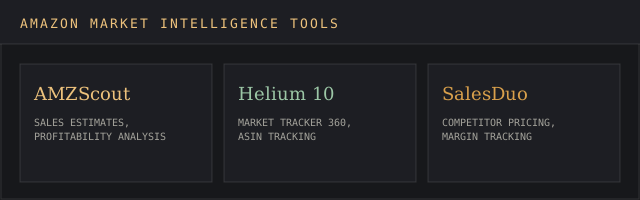
Amazon market intelligence tools analyze sales data and competition, per SalesDuo and AMZScout, pulling category-level and listing-level detail a seller could never assemble by hand at the same speed.
AI tools can analyze millions of data points instantly, a claim both SalesDuo and a widely cited Medium guide on Amazon market intelligence make about the current generation of intelligence tools, and the practical effect is that a seller can check pricing trends and market share shifts across an entire category before their morning coffee finishes.
Sellers can track competitors' pricing and advertising strategies with these tools, a capability AMZScout and SalesDuo both build directly into their dashboards. The Wall Street Journal has reported that Amazon itself runs an internal operation tracking rival sellers' pricing and strategy, which confirms a plain fact independent of any one vendor: competitor-level intelligence is now table stakes.
Helium 10's Market Tracker tool provides insights into keywords and trends at the category level, and its Market Tracker 360 tier extends that into ASIN tracking, keyword positions, and inventory management signals for entire competitor sets.
Choosing among intelligence tools comes down to what a seller's business needs: a solo seller running a handful of SKUs needs less than a brand managing hundreds of amazon listings across multiple categories. More value tends to come from depth in the categories a seller competes in than from breadth across categories nobody on the team touches.
Keyword Research and Search Volume
Keyword research decides where a listing shows up when a shopper searches, and it's usually the first real market intelligence task a new seller runs. New keywords worth targeting combine decent demand with competition a seller can realistically outrank, and category trends matter here too: a keyword trending upward inside a growing niche is worth more than the same demand in a category already in decline.
Google Trends supplements Amazon's own search data by showing if demand for a product is rising or falling in the wider world as well as inside Amazon's marketplace, which matters because Amazon search volume alone can lag a broader shift in consumer interest by weeks. Sellers who check both before committing ad spend to a keyword tend to avoid chasing a trend that already peaked.
Competitor Analysis and Pricing Trends
Competitor analysis reveals pricing trends and advertising strategies, according to both SalesDuo and AMZScout, and the practical use case is straightforward: watch what competitors charge, when they run promotions, and how their ad spend shifts around those promotions.
Tools track competitors' product performance and inventory management too, per AMZScout and Helium 10's Market Tracker, which lets a seller spot a competitor running low on stock before that competitor's listing goes out of stock, a window where a well-timed ad spend increase can capture units sold that would otherwise go to the rival.
Competitor analysis helps identify market gaps for new opportunities, a use case SalesDuo and the Medium guide on Amazon market intelligence both describe as one of the highest-value applications of ongoing market research. A gap shows up as a category with real search volume, several trending products, and no single seller holding a dominant market share, which top sellers watch for as an entry point before it closes.
Product Research and Product Viability
Product research narrows a wide category down to the specific products worth listing, checking product viability against shipping costs, likely average selling price, and the profit margins left over once Amazon's fees are subtracted. A product can show strong units sold and still fail this test if the true landed cost eats the margin down to nothing once bulk freight and returns are priced in.
Sellers evaluating multiple products at once benefit from a consistent data driven insights framework, since a framework applied evenly across a shortlist of individual products surfaces which one deserves the investment. Brand owners in particular tend to run this comparison across an entire planned catalog before committing to inventory.
Listing Optimization and ASIN Tracking
Listing optimization uses the keyword research and review analysis already gathered to rewrite titles, bullet points, and images so a listing converts more of the traffic it already receives, which is usually cheaper than buying more traffic through ad spend alone. Bullet points that answer a buyer's actual purchasing behavior questions, fit, materials, compatibility, tend to outperform ones written purely for keyword stuffing.
ASIN tracking follows a specific listing's category rankings, review velocity, and pricing changes over time. It matters most for sellers defending live Amazon listings, more so than for sellers still trying to break into a category. A sudden pricing change on a tracked ASIN, up or down, is usually the first visible sign that a competitor has changed strategy, well before that strategy shows up anywhere else.
Review Analysis and Review Velocity
Review analysis helps improve product quality and customer satisfaction, per AMZScout and the Medium guide on Amazon market intelligence, by surfacing the specific complaints buyers repeat across dozens or hundreds of reviews.
Tracking review velocity indicates product performance against competitors, since a listing gaining reviews faster than its category average is usually gaining sales faster too, and the reverse pattern is an early warning sign worth investigating before revenue drops.
Customer preferences surface in review text in a way star ratings alone never capture: a 4-star product with reviews repeating the same fixable complaint is a better investment target than a 4.5-star product with reviews already praising everything, since the first has an obvious, addressable path to more customer satisfaction.
Profitability Analysis and Profit Margins
Profitability analysis identifies underperforming products and bestsellers, per AMZScout, by running total revenue against the full cost stack. Profitability analysis tools assist with inventory forecasting and cost optimization, catching a seller before they plan inventory around a product whose true profit margin looks fine on the surface and thin once every fee, return, and storage cost lands.
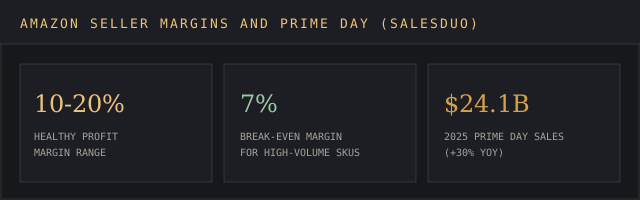
Sellers should aim for profit margins between 10% and 20%, per SalesDuo, and many sellers need high sales volume just to break even under a 7% margin, per the same source.
In 2025, Amazon Prime Day sales reached $24.1 billion, up 30% year over year, per SalesDuo, a strategic decisions moment that rewards sellers who had already run the profitability analysis on their Prime Day catalog well before the event. Discovering thin margins mid-sale leaves too little time to adjust pricing strategies.
Gain Insights for Marketing Strategy
Sellers gain insights for marketing strategy from the same data trail: demand shows what buyers are already looking for, reviews show what they complain about once they own the product, and competitor pricing shifts show where the strategy gap sits between what's being charged and what buyers seem willing to pay.
Guide explains this progression the same way most experienced Amazon sellers already work it out through trial: demand first, competition second, price and positioning last.
None of this guarantees a stay ahead outcome on its own. Market intelligence tools find gaps and surface data, but converting that data driven insights into a working marketing strategy, an ad spend plan, seasonal promotions, a bundle strategy, still takes a seller who understands their own category well enough to act on what the tools show.
Amazon Sellers and Amazon Business Considerations
Amazon sellers running a single-category business have different market intelligence needs than an amazon business spanning dozens of categories: the former can watch a handful of top sellers and competitors closely by hand, while the latter needs intelligence tools that flag category shifts and pricing changes automatically across too many listings for one person to track manually.
Multiple products across multiple categories multiply the market intelligence workload fast enough that most amazon business operators past a certain size adopt a dedicated tool well before they'd otherwise choose to.
Brand owners selling through Amazon face a version of this decision every established retailer eventually faces: how much of the category's competitors, customers, and market share can be tracked manually before the informed decisions those insights are meant to support start arriving too late to matter.
Scaling an Amazon Business Across Categories and Niches
A one-product business and a hundred-product business need the same market intelligence inputs, just at different scale.
A single-category business can watch its handful of direct competitors by checking their listings and reviews once a week; a business spread across a dozen categories and several niches needs competitor analysis tools that flag a rival's pricing change or a new entrant automatically, because no team can read every competitor's product listings by hand once the catalog and the competitor set both grow past a certain size.
Market intelligence tools built for this stage report on metrics beyond simple sales: market share by category, review counts against the category's top sellers, and how a business's own product listings compare against competitors on price, images, and bullet points.
A business tracking these metrics across categories catches a slipping niche months before the sales numbers alone would show it, because competitors and customers both signal a shift, through pricing changes and through reviews, well before revenue moves.
Customers behave differently by category and niche too, and a business that treats every category's customers the same way misses real differences in what drives a purchase. Customers buying a commodity product weigh price and shipping speed heavily; customers buying a considered purchase in a specialized niche read reviews, compare product listings in more depth, and convert slower but often at a higher price point.
A business that builds actionable insights from customer behavior by category makes sharper calls on where to add product listings and where to hold steady with the categories and niches it already owns.
Growing into a new category or niche without market insights first is how a profitable core business ends up subsidizing a struggling expansion.
The businesses that scale well treat every new category the same way they treated their first: research demand and competitors before listing, then track metrics, reviews, and customers with the same intelligence tools once the product is live, so the business's newest niche gets the same discipline as the one that built it.
Key Concepts to Know
A handful of key concepts recur across every part of Amazon market intelligence: market share within a category, the margin left after every fee lands, review velocity as a leading indicator, and category trends as the context that makes any single data point meaningful. Sellers who internalize these key concepts read a competitor's pricing change or a sudden shift in category rankings correctly. They don't treat it as noise.
None of this data replaces judgment. A business selling well across several categories still needs someone reading what customers say in reviews and deciding, category by category, if the competitors gaining ground are worth matching on price or worth ignoring while the business holds its position on quality instead.
Selling profitably across multiple categories long-term means checking that reviews and competitors both still support the price a listing charges.
Today's ranking holds only until a rival business, running the same business intelligence, notices the same opportunity.
FAQ
Can I make $1,000 a month selling on Amazon?
It depends heavily on the category, the profit margin the product supports, and how much competitor pressure exists in that niche. Sellers running proper profitability analysis before launch are far more likely to hit a stable number like that than sellers who price by guesswork.
What are the 4 P's of Amazon?
The 4 P's, product, price, promotion, and placement, apply to Amazon the same way they apply to any retail channel: the product needs real demand, the price needs to clear a sustainable profit margin, promotion covers ad spend and deals, and placement is the category rankings and search position a listing earns, the same 4 P's that apply to any retail channel.
What is a market intelligence system?
A market intelligence system is the combination of tools, data sources, and a standing process, and no single tool, that a business uses to continuously track market trends, competitors, and customer preferences.
What are the best market intelligence tools on the market today?
AMZScout, Helium 10's Market Tracker, and SalesDuo's platform are among the more established Amazon market intelligence tools, each covering some mix of keyword research, competitor analysis, and profitability analysis; the right choice depends on catalog size and which of those functions matters most to a given business.
See also our broader comparison of competitive intelligence platforms for teams whose market intelligence needs extend beyond a single marketplace.