Crayon vs Klue
 By Jan Suski. I go deep on every review, checking every number against its source and digging up details other coverage misses, a habit from six years of SEO and link building for tech companies. Bylines at Surfer, Brand24, and Senuto. How the scoring works.
· Prefer this source on Google
| WHAT EACH ONE DOES | CRAYON | KLUE |
|---|---|---|
| Core job | Watch the whole market | Arm the sales floor |
| Pages monitored | 300m+ web pages | Not published |
| Win-loss analysis | Through integration | Native module |
| Native mobile app | None | iOS and Android |
| AI assistant | Crayon Answers | Compete Agent |
| What the AI reads | Open-web monitoring | Battlecards, win-loss |
| Public status page | None published | kluestatus.com |
| Disclosed incident | None found | 12 June 2026 |
| Skip it if | Sellers are the users | You need wide coverage |
| WHAT YOU GET | CRAYON | KLUE |
|---|---|---|
| Billing unit | Competitors tracked | User seats |
| Published pricing | None, lead form | None at all |
| Published tiers | Standard, Intel Pro | None published |
| Tracked median | $30,000 a year | Not tracked |
| Tracked range | $12,700 to $46,000 | Not tracked |
| Tracked purchases | 93 | None |
| Average discount won | 20.19% on 72 deals | Not tracked |
| G2 score | 4.6 from 385 | 4.7 from 443 |
| Acquisitions made | None found | Three since Jan 2023 |
StrongerWeakerNo edge
Thirty-five further documented limits sit behind the button below: uptime commitments, notice periods, data extraction windows, insurance floors and what each contract caps. Crayon’s contract figures are Vendr’s tracked purchase data across 93 deals. Klue is not tracked there and publishes nothing, so its column reads blank. Neither vendor lists a price on its own site. Every figure is sourced in the section its row links to.
| Crayon | WHAT IT DOCUMENTS |
|---|---|
| Usage cap | Competitors tracked*, set in the order form |
| Uptime target | 99.5% a month, maintenance excluded |
| Maintenance window | 10pm to 8am ET on weeknights |
| Support hours | Phone 9am to 5pm ET, weekdays |
| Renewal notice | 60 days in writing, or it renews |
| Invoice terms | 30 days to pay, then 1.5% a month |
| Liability cap | Fees paid in the prior 12 months |
| Cure period | 30 days to fix a material breach |
| Dispute venue | JAMS arbitration in Boston, no class actions |
| Data location | Processed and stored in the United States |
| Barred users | Employees of Crayon’s rivals |
| AI models | Third-party LLMs; Crayon builds none |
| Model training | Customer data trains no general models |
| New competitor backfill | Last 30 days of news on adding one |
| Sparks adoption | 80% of Crayon customers use it |
| Deal-stage sources | Gong, Chorus, Clari and Slack |
| SSO options | Azure, Google, JumpCloud, Okta, OneLogin |
| Klue | WHAT IT DOCUMENTS |
|---|---|
| Uptime commitment | 99% a month, written into the terms |
| Scheduled downtime | Capped at 8 hours a calendar month |
| Maintenance window | 8pm to 8am Pacific on weekdays |
| Chronic outage exit | 3 misses in 6 months ends the deal |
| Support response | 1 business day when core use is blocked |
| Renewal notice | 90 days, or it renews for 12 months |
| Exit without cause | 60 days written notice, no refund |
| Data extraction | 90 days from the termination notice |
| Seat overage | Backdated to when usage first rose |
| Cyber insurance | $5M CAD errors and omissions cover |
| Trial data | Deleted when the trial period ends |
| Model training | No customer data in public LLMs |
| Encryption | AES-256 at rest, TLS 1.2 and up |
| Penetration tests | Third party annually, ASVS 4.0 |
| SOC 2 scope | Security, availability, confidentiality† |
| AI interview length | Two to five minute voice calls |
| Blindspot turnaround | Two weeks from request, typical |
| MCP connector | Win-loss data read inside Claude |
* and † mark a claim the vendor states two ways on its own domain. Crayon’s CI without limits post promises unlimited competitor tracking and unlimited user licenses, while section 6 of its terms of service says the licensed scope is typically limited by the number of competitors tracked and can cap authorized users too; the terms are used above, because that’s the document a buyer signs.
Klue’s security page says its SOC 2 Type II compliance covers the five Trust Services Criteria, while the post announcing that audit names three categories; the three named categories are used above, since audit scope is what a security review asks for.
Sources, and the two claims each vendor states twice
Every row comes from a vendor property.
- Crayon: the product, integrations, sparks and blog pages, plus the terms of service dated June 2026.
- Klue: the product, security, integrations and win-loss pages, plus its terms, the service level exhibit inside them, and the llm-info file Klue publishes for AI assistants.
Klue’s user count moves the same way the marked claims do. The competitive intelligence software page and the llm-info file both say 250,000 users, above the 200,000 quoted further down this page, and the 2021 SOC 2 post cites 80,000.
Crayon publishes no status page, Klue publishes no monitored-page count, and neither one publishes a seat price, an API rate limit or a contract minimum. No row claims any of them.
Crayon vs Klue is the comparison most product marketing owners run first when they formalize competitive intelligence, and in 2026 the honest split has moved. Both are strong competitive intelligence platforms solving slightly different jobs, but the decision now turns on three things the older comparisons miss: the billing unit, the ownership burden, and a disclosed breach.
This report is for the person who has to write the business case. It prices both against tracked purchase data, reproduces the claims each company publishes about the other, and states what happened to Klue's integrations in June 2026. If you are choosing between these two this quarter, the security section changes your diligence list.
Two rows above carry most of the decision: the billing unit, which decides which competitive intelligence platform is cheaper for your team shape, and the June 2026 incident. Most of a competitive intelligence evaluation follows from those two. Our competitive intelligence tools ranking covers the wider field; this page is the head-to-head.
↑ COMPARISONHow each vendor describes the other
Both companies publish a page attacking the other, and reading them side by side is more useful than either one alone. The asymmetry is the finding.
Klue's page, last modified 27 October 2025, runs roughly two thousand words and carries an eleven-row feature table making specific factual claims about Crayon's product limits. Crayon's page carries a last-updated stamp of 12 March 2026, five months later, and consists of two product demonstrations and three customer quotes. It answers none of Klue's claims.
| Klue's published claim about Crayon | Crayon's published response |
|---|---|
| Data sources "Very Limited for ‘Standard’ Tier" | None |
| Website monitoring covers "Only webpages on Competitor's Domain" | None |
| "No live chat support for admins or end users" | None |
| Content search available "Only In-App" | None |
| Browser extension is "Chrome only" | None |
| Teams integration "Doesn't work on Desktop client" | None |
| Salesforce AppExchange listing is an "Unlisted" page | None |
| Native mobile app is a "Mobile-friendly Website" | None |
Klue's sharpest line is a direct accusation about advertising. On its comparison page Klue writes that Crayon "have claimed they offer ‘unlimited competitors’, but it limits the data sources that they track on your Standard Rivals." Klue also states that "Over 80 clients have switched from Crayon to Klue" and that "a lack of end user adoption is the most common reason Crayon clients switch to Klue."
Treat all of that as one vendor's marketing, because that is what it is. The verifiable part is the shape of the exchange. One company published a detailed, checkable attack; the other updated its page months afterward and declined to engage with any of it.
Take Klue's eleven claims into the Crayon demo and ask for each to be confirmed or denied on the record. That is a better use of a sales call than any feature checklist.
Crayon's page does surface one useful detail. It names Cognism's Manager of Market Intelligence among its customer quotes, so a buyer wanting a reference in B2B data has a named starting point.
↑ COMPARISONThe billing unit decides who is cheaper
Crayon and Klue price on incompatible units, and this single mechanism reverses the apparent cost order depending on your team.
Crayon's pricing scales with the number of competitors tracked, alongside seats and feature tier. Klue's scales with user seats. Klue's own page frames this as a predictability argument, stating that Crayon's model "increases based on the number of competitors you want to track, which is much less predictable."
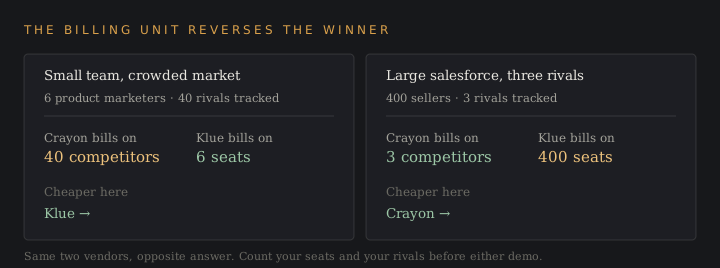
The practical consequence is arithmetic. A team of six product marketers tracking forty rivals pays Crayon for forty rivals and Klue for six seats. Flip it, and a company rolling battlecards out to four hundred sellers while watching three competitors pays Klue for four hundred seats and Crayon for three rivals. Same two vendors, opposite winner, and the pricing model alone produced the flip.
That is the first question to answer before either demo. Count your seats, count your rivals, and see which number is growing faster over the next two years.
↑ COMPARISONWhat Crayon and Klue cost
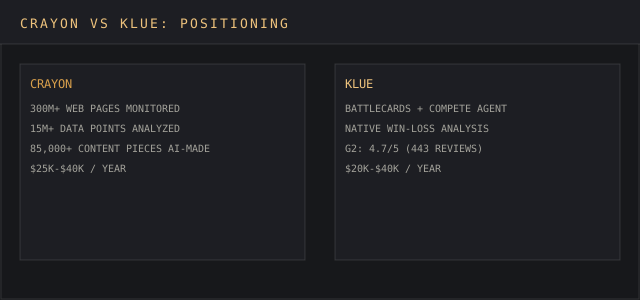
Neither vendor offers published pricing. Crayon's public pricing page is a lead-capture form with no tiers or figures; Klue publishes no price of any kind, and Capterra lists its starting price as "Contact vendor" with no free trial. Our Capterra legitimacy report has the site's own verification and moderation numbers.
Median annual Crayon contract across 93 purchases tracked by Vendr, ranging $12,700 to $46,000, with 20.19% average negotiated savings across 72 handled deals.
The widely repeated "$25,000 to $40,000" band that circulates through comparison blogs sits inside that range, but the median is the number to take into a negotiation.
The aggregator Zoftware lists Crayon's two named tiers, Standard and Intel Pro, priced by headcount band: at 200 employees, Standard runs $16,800 to $31,000 a year and Intel Pro $14,600 to $27,100; at over 1,000 employees, Standard runs $31,700 to $70,300 and Intel Pro $38,000 to $92,900.
There is no meaningful free plan at either vendor for a serious competitive intelligence program. Limited evaluation access is sometimes easily accessible, though full enterprise deployments are quoted individually.
Both platforms require a dedicated owner, and total cost of ownership includes that person's salary, which often exceeds the software line. Buyers comparing a crayon alternative or any other CI tool should price the person alongside the platform.
A formal competitive program with every competitor tracked and nobody accountable produces manual effort and human error. The automated alerts either vendor advertises only fire once someone owns the response. Our market intelligence platform pricing report covers how this category quotes generally.
↑ COMPARISONThe June 2026 Klue security incident
On 12 June 2026, an attacker used a compromised legacy credential, traced to a GitHub Personal Access Token created in 2022, to reach Klue's integration infrastructure, obtain OAuth tokens, and access customer data inside connected third-party platforms including Salesforce.
Klue disclosed this publicly and states there is no evidence that customer content stored inside the Klue platform itself was affected. Containment completed the same day, validated by an independent forensic investigation from CrowdStrike.
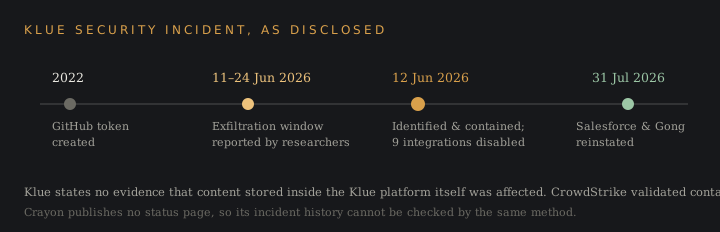
| Date | Event |
|---|---|
| 2022 | GitHub Personal Access Token created, later compromised |
| 11 to 24 June 2026 | Window reported by external researchers for token and CRM data exfiltration |
| 12 June 2026 | Intrusion identified; containment completed; status page logs a data sync integration incident at 18:00 UTC |
| June 2026 | Nine integrations disabled: Salesforce, HubSpot, SharePoint, Zoom, Gong, Chorus, Clari, Google Drive, Slack |
| 31 July 2026 | Salesforce and Gong integrations reinstated in their marketplaces |
Independent security firms including Kudelski Security, Rescana, Field Effect, Recorded Future and Huntress reported the same incident, describing exfiltration affecting roughly 200 organizations and a subsequent extortion attempt attributed to a threat actor identified as Icarus.
Klue's status page shows 82.76% uptime over the trailing 90 days, a figure that overlaps the incident window and the integration outages that followed it.
Crayon publishes no status page and no comparable disclosure, so Crayon's incident history can't be checked by the same method. Klue's number looks worse partly because Klue publishes one. Ask both vendors for their trailing-twelve-month incident log in writing before drawing a conclusion.
↑ COMPARISONMonitoring breadth, where Crayon pulls ahead
Crayon's automated web crawler tracks over 300 million web pages, and monitoring breadth is its key strength for teams covering many rivals at once. Crayon provides broader competitive intelligence across more competitors than Klue typically covers in a single deployment, and it suits tracking many competitors across pricing pages, job postings, press releases, website changes, and competitors digital footprints.
Crayon's AI has analyzed over 15 million data points and generated over 85,000 pieces of competitive content, classifying incoming signals and suggesting relevant material automatically. Real time insights arrive as automated alerts the moment a rival changes a pricing page or ships an update, giving a competitive intelligence team broader context before news reaches a sales conversation.
The tradeoff is volume. Coverage across hundreds of millions of web pages produces too much noise for a small team without a dedicated owner filtering it. Crayon's own critical reviews echo this: independent complaints on G2 and Capterra describe highly manual daily curation and repeated or duplicate news items. The full picture is in our Crayon review.
Teams that stay ahead of rival pricing changes inside a long sales cycle get the most from this, since a new discount tier surfaces before a rep meets it in a negotiation. For a dedicated CI analyst running a formal competitive program across an entire market, broad monitoring is usually the deciding factor for a competitive intelligence team.
↑ COMPARISONBattlecards and win-loss, where Klue pulls ahead
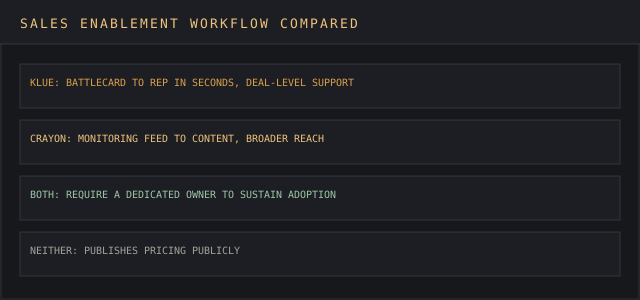
Klue built its battlecard workflow for sales enablement: high-impact battlecards and deal-level support come first, ahead of raw monitoring volume. Klue prioritizes user adoption through easy-to-consume battlecards a rep can scan in the thirty seconds before a call, which is why product marketers and sales enablement teams gravitate to it when the job is arming reps.
Klue's native win loss analysis is built into the platform, so win loss data from closed deals feeds straight back into the same battlecards reps already use. Crayon supports win-loss workflows through integration, a meaningful gap for a sales team that wants that feedback on the screen it already opens daily.
Klue has bought its way deeper into this specific workflow three times: DoubleCheck Research in January 2023, Goldpan.ai in March 2025, and Ignition in September 2025, each adding win-loss or agentic AI capability. Crayon has made no acquisitions we can source.
Those three purchases show up as four pieces inside Klue's win-loss suite.
- Human Expert Interviews.
- An AI Interviewer conducting voice conversations with buyers and sellers.
- Blindspots Interviews covering evaluations the vendor was never part of.
- A Win and Loss Story Agent generated from CRM data and call recordings.
In April 2026, Klue was named a Leader in the first Gartner Magic Quadrant for Competitive and Market Intelligence Platforms. Our Klue review goes deeper on the win-loss suite.
↑ COMPARISONAI features compared
Both vendors have invested heavily in generative assistants, and the two products mirror each other closely enough that the difference is the underlying data set.
Crayon Answers is Crayon's Gen AI compete assistant. A sales team member asks a plain-language question about a specific competitor and gets key insights pulled from the hundreds of millions of web pages Crayon monitors, without opening a battlecard. Answers cite the platform's own insights.
Crayon's wider AI suite adds Sparks, a research and analysis agent, plus an MCP server and AI-ready APIs that push validated compete content into ChatGPT, Claude, Copilot, Glean and Coveo.
Klue's Compete Agent, launched 10 June 2025, works from the opposite side of the data. It draws answers from curated battlecards and win-loss data. Open-web monitoring plays no part in that pipeline. Klue followed it with Auto Insights on 22 October 2025, generating deal-specific competitive insights continuously.
Crayon Answers is stronger on broad research questions about market intelligence trends, hiring and funding, because it draws on wide-lens coverage. Klue's Compete Agent is stronger on deal-specific competitive guidance, grounded in the same competitive content a rep would otherwise dig for by hand.
Neither vendor's AI tools replace human analysts; both platforms use AI assistively, flagging signals and drafting content for a person to approve. Teams evaluating AI features should ask each vendor the same question: does the artificial intelligence reduce effort on collection, Crayon's strength, or on delivery to sales reps, Klue's strength?
↑ COMPARISONOwnership, funding and stability
| Crayon | Klue | |
|---|---|---|
| Founded | 2014 or 2015, sources conflict | 2015 |
| Headquarters | 280 Summer Street, Boston | Vancouver, British Columbia |
| Founders in post | Jonah Lopin, CEO | Jason Smith CEO, Sarathy Naicker CTO |
| Stage | Series B | Series B |
| Disclosed raise | Amounts not published | $77M across two announced rounds |
| Latest round | Baird Capital led Series B | $62M Series B, 1 December 2021 |
| Headcount band | 101 to 250 | 201 to 500 |
Klue's funding history is fully public: a $15M Series A led by Craft Ventures announced 8 September 2020, then a $62M Series B led by Tiger Global with Salesforce Ventures participating, announced 1 December 2021. Crayon's rounds are not published in comparable detail; its own site names Baird Capital, Founder Collective and Baseline Ventures as investors, and Crunchbase records six rounds with amounts withheld.
Klue is roughly twice Crayon's headcount and has completed three acquisitions since 2023. Crayon's founding CEO Jonah Lopin, previously VP of Customer Success at HubSpot, still runs the company.
↑ COMPARISONReading the review scores honestly
The two vendors' ratings diverge by source, and the sample sizes explain most of it.
| Platform | Crayon | Klue |
|---|---|---|
| G2 | 4.6 from 385 reviews | 4.7 from 443 reviews |
| Gartner Peer Insights | 4.2 from 11 ratings | 4.8 from 20 ratings |
| Capterra | 4.5 from 8 reviews | 4.5 from 4 reviews |
G2 is the only platform with a sample worth weighting. Capterra's eight and four reviews cannot support a comparison between two products. On Gartner, Crayon's distribution runs 73% five-star with 18% three-star and no ratings below three; Klue's runs 55% five-star and 40% four-star.
A Norwegian software reseller also called Crayon holds a separate G2 listing at a different slug. Check which company a rating belongs to before quoting the number. Our G2 legitimacy report has Q1 2026's review-moderation numbers, including how many submissions get flagged as fake.
Adoption is the shared failure mode
Klue's steep learning curve can hinder new user adoption. Its G2 complaint themes carry counts.
- Difficult setup and overwhelming navigation, five reviews.
- UX and content-creation frustration, five reviews.
- Unclear navigation, four reviews.
- Learning curve and alert refinement, three reviews.
- Limited customization, three reviews.
- Limited collaboration, three reviews.
- Integration or formatting problems, three reviews.
Crayon's critical reviews cluster differently and thinner. Customer success responsiveness appears independently on G2 and Capterra, and manual or noisy data curation appears independently on both. A February 2024 G2 review rating Crayon 1.0 cites an unresponsive CSM and manual battlecard maintenance.
Product marketers report that either platform stays ahead of adoption problems only when one owner is accountable for the feed and the battlecards. That requirement shows up in comparisons of Crayon against Kompyte and Klue against Kompyte just as often, which suggests the adoption tax belongs to the competitive intelligence tool category.
Any competitive intelligence program buying either tool should budget onboarding time per team.
Building a CI program from scratch
Companies without an existing CI program underestimate two things: how much manual effort collection takes before a platform lands, and how fast the pricing model shifts as the program matures. A CI program starting with three named rivals and reaching fifteen inside a year outgrows an entry tier quickly, whichever vendor sold it. Research reports from both companies lean toward fast time-to-value; buyers who have done this before measure the real ramp in months.
Marketing teams are often first to ask for a formal competitive program, usually after a lost deal where competitive guidance arrived too late, or after a rival's product launches landed first without anyone catching the signal. Capture that first request before selecting a vendor.
The shape of that first ask points toward Crayon or Klue before a demo is booked: broader market research feeding several marketing teams, or tighter sales enablement material for the next sales call.
Data sources and monitoring depth
Both platforms pull from overlapping data sources, including competitor websites, pricing pages, job postings, press releases, review sites and social channels, then weight them differently. Crayon's skew toward automated high-volume page coverage; Klue's toward curated inputs a product marketing owner flagged as worth watching.
Several teams running a mature program eventually license both, covering monitoring competitors broadly while keeping a curated layer for the rivals that matter most to the sales team.
Enterprise deployments and scaling
At enterprise deployments scale the tradeoffs sharpen. Large sales teams wiring competitive intelligence into a wider tech stack alongside CRM, Slack and other sales tools tend to standardize on Klue for the delivery layer, since reps touch battlecards far more often than raw monitoring data.
Klue states over 500 companies and 200,000 users, naming Adobe, Dell Technologies, Shopify, Autodesk, UiPath and 6sense among them. Enterprise Crayon deployments more often sit upstream of several delivery tools no rep sees directly.
Ask about competitors tracked limits, since contracts cap the number before requiring an upgrade, and ask how each vendor's tiers handle mid-year headcount growth. That detail shapes year-two cost more than the opening quote.
Competitive enablement and proving it worked
Competitive enablement is where raw market intelligence stops being a research artifact and changes what a rep says on a call. Both klue and crayon describe their product as competitive enablement, though they mean different surfaces by the word, and both sell competitive enablement alongside market research to the same buyer.
Klue's route runs through the battlecard and Compete Agent, delivering actionable insights at the moment of need. Crayon's runs through competitive content pushed to a sales team from the broader monitoring layer.
A competitive intelligence platform earns its budget when it demonstrably influenced revenue. Product marketing owners who track win rates on competitive deals before and after adoption get a real answer; those relying on usage dashboards can't separate a platform that helped from one that generated key insights nobody used.
Neither vendor offers published pricing, so the before-and-after on sales calls and closed deals is the renewal case a buyer has to build alone. Did the team win more competitive deals in the twelve months after signing?
Klue and Crayon side by side
Put klue and crayon on one sheet and the split holds across every dimension here. Crayon wins on breadth: competitor monitoring across unlimited competitors, product launches tracked across a whole market, and raw data sources at scale. Klue wins on depth: sales enablement content, native win-loss, three acquisitions aimed squarely at that workflow, and a Gartner Leader placement.
Teams evaluating klue and crayon consistently report the same tradeoff. That's why so many comparisons of klue and crayon land on team size and rival count, the two variables that decide it.
Scope the dedicated CI role before writing the job description, since tooling and headcount get decided together far more often than vendor decks suggest. A dedicated CI function costs more than either licence, and a competitive intelligence budget funding software without an owner tends to underdeliver.
↑ COMPARISONWhich tool fits which team
Choose Crayon when the need is coverage across many rivals, a market with frequent new entrants, and marketing teams wanting competitive analysis feeding several downstream groups. The competitors-tracked billing unit works against you here, so model it before signing.
Choose Klue when the need is sales enablement against a stable set of two to four rivals, win loss data tied natively to real deals, and battlecards a rep opens before a sales call. Add the June 2026 incident to your security review and ask for the post-incident audit in writing.
Some enterprise deployments run both, Crayon upstream for monitoring and Klue downstream for enablement, which doubles the dedicated owner requirement. A smaller company evaluating market intelligence tooling for the first time should start with whichever gap, monitoring or enablement, is costing deals right now.
Teams still building a formal competitive program without a dedicated analyst may be better served by a lighter tool. A competitor battlecard template and a win-loss analysis template prove out the workflow manually first, at no cost.
Evaluating either platform before you buy
Pull three recent lost deals and check if the rep had the competitive information they needed when the prospect named a rival. If the gap was information the rep never had, Klue's battlecard and Compete Agent workflow is the direct fix. If the gap was a competitor move nobody saw coming until it surfaced in a lost deal, Crayon's monitoring breadth is the direct fix.
Most teams asking which competitive intelligence tool to buy are answering which failure mode happened most recently, and that is a better guide than either vendor's own comparison page. Take the June 2026 disclosure into the Klue demo and ask what changed. Both vendors will answer, and the answers will tell you more than the feature list.
Whichever wins, competitive intelligence compounds only when someone owns it past the first ninety days. Renewal is where the dedicated owner requirement gets tested: a program with an engaged owner expands seats and data sources, while a program nobody owns gets quietly cut regardless of how strong the platform was on day one.
FAQ
Is Crayon or Klue better for sales enablement?
Klue. Its battlecard workflow and native win loss analysis are built for sales enablement, and Klue's Compete Agent puts competitive insights in front of sales reps mid-conversation. Crayon supports sales enablement, though its core strength is broad monitoring across competitors.
How much do Crayon and Klue cost?
Vendr reports a $30,000 median annual Crayon contract across 93 tracked purchases, ranging $12,700 to $46,000. Klue lands on the same $30,000 median across 106 tracked purchases, ranging $16,000 to $60,000. Neither vendor publishes a rate card, and both need a dedicated owner whose salary often exceeds the software cost.
Did Klue have a security breach?
Yes. Klue disclosed that on 12 June 2026 an attacker used a compromised 2022 GitHub token to reach its integration infrastructure and access customer data in connected platforms including Salesforce. Klue states no evidence that content stored in Klue itself was affected. Nine integrations were disabled; Salesforce and Gong returned by 31 July 2026.
What is the difference between Crayon and Kompyte?
Kompyte, like Crayon, focuses on automated competitor monitoring. Buyer comparisons generally place Crayon ahead on monitoring breadth and AI-generated competitive content, while Kompyte is evaluated as a lower-cost option for smaller sales enablement teams.
Do Crayon and Klue offer a free plan?
No meaningful free plan exists at either vendor. Capterra lists Klue with no free trial. Limited evaluation access is sometimes arranged, and full deployments are quoted individually.
Which is cheaper, Crayon or Klue?
It depends on your ratio of seats to rivals. Crayon bills on competitors tracked, so a small team watching forty rivals pays more there. Klue bills on user seats, so rolling battlecards out to hundreds of sellers costs more there.
Sources: Vendr Crayon marketplace data; Zoftware Crayon tier pricing; klue.com/klue-vs-crayon (modified 27 October 2025); crayon.co/crayon-vs-klue (updated 12 March 2026); Klue security disclosures and status page; G2, Capterra and Gartner Peer Insights listings; Crunchbase. Accessed 6 August 2026.