Trustpilot pricing 2026: five plans, per-domain fees and a 30-day cancellation deadline
 By Jan Suski. I go deep on every review, checking every number against its source and digging up details other coverage misses, a habit from six years of SEO and link building for tech companies. Bylines at Surfer, Brand24, and Senuto. How the scoring works.
The numbers Trustpilot list prices, contract terms and tracked deals, checked 6 October 2026
The average customer's $11,513 sits $1,925 above one Premium domain at list, which puts the typical paying account past the highest of the published plans.
Vendr's $10,800 median and Trustpilot's own average land within 7% of each other, so roughly $11,000 a year is the going rate for a mid-sized account.
Cancellation notice must land at least 30 days before each term ends, and missing it commits customers to another 12 months at up to 5% more.
Trustpilot pricing runs from $0 to $799 a month for the highest plan with a published rate, and every paid plan is charged per domain on a 12-month commitment. Those are the figures on Trustpilot's own pricing page, read on 6 October 2026 in US dollars.
The list price is the smaller half of the bill. Trustpilot's H1 2026 results statement puts the average paying customer at $11,513 a year. One Premium domain lists at $9,588.
This report covers what each plan gates, the cost per review invitation, the contract clauses buyers sign, what 105 tracked deals paid, and six buyer complaints quoted in full. It's written for small businesses and marketing teams deciding if a paid Trustpilot profile earns its fee, because one contract clause can add 5% a year to a bill few people re-read.
Our report asking is Trustpilot legit covers fake reviews, regulators and how the platform handles customer feedback.
Trustpilot cost per plan and per domain
Four of the five Trustpilot plans carry a figure, and three of those plans cost money. Starter lists at $99 a month, Plus at $319 and Premium at $799, each "per domain, billed annually." Annualised, that's $1,188, $3,828 and $9,588 a domain. Enterprise is "Contact sales for a pricing estimate."
Trustpilot adds: "All contracts are a 12-month commitment, starting at the prices below." Section 29 of the Terms of Use and Sale for Businesses (version 9.0, June 2026) says fees for each subscription period "are owed to us upfront." Trustpilot sells annual contracts only, so the monthly figure on the page is the annual-contract rate.
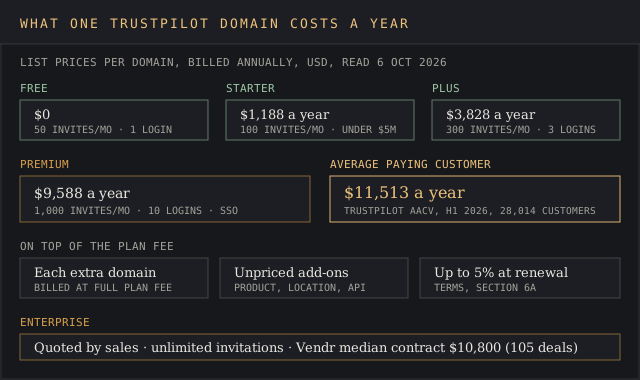
The word "from" matters, and so does an asterisk under the domain rows: "Each domain priced separately." A company running a US site and a UK site on regional domains pays the plan fee twice. The devil's in the details.
Trustpilot plans and what the higher tiers gate
Every plan, free included, can reply to Trustpilot reviews, flag reviews it believes break the guidelines, and read the performance overview of its reviews and ratings. Every plan also includes online customer support and full access to the Help Center. The money in the paid plans buys four features: more review invitations, more users, more TrustBox widgets, and analytics.
Trustpilot Free
The free plan lets a business claim its Trustpilot profile, the public profile shoppers see, and manage customer reviews from the Trustpilot Business dashboard. Per Trustpilot's Help Center, it includes "50 invitations per month" sent through e-commerce integrations, the Automatic Feedback Service or by hand.
It also gives a public reply to post under any review, the Review Collector widget for gathering feedback, online support, 10 e-commerce integrations and eligibility for Google's store ratings. One user login, no strings attached.
Starter
Starter costs $99 a month and doubles the cap to 100 automated requests for reviews. It adds basic profile customization, downloadable Trustpilot marketing assets and one TrustBox widget for showing ratings. Trustpilot restricts it to "new small business customers (up to $5M revenue)." Trustpilot's H1 2026 results describe it as a "low-cost digital only plan" released in April 2026.
Plus
Plus is where the analytics features start. At $319 a month it raises the cap to 300 invitations, gives logins to 3 users and allows up to 3 domains, each priced separately. It adds 9 TrustBox widgets, TrustScore Insights on a company's reviews and AI Search Analytics, and lifts integrations from 10 e-commerce connectors to 17, plus 22 marketing integrations covering email marketing tools.
Premium plan
The Premium plan, at $799 a month, is the first tier with live chat support and a dedicated Customer Success Manager. It carries 1,000 invitations a month, 10 users, unlimited domains, multi-domain management, single sign-on, 11 TrustBox widgets for star ratings plus 10 testimonial widgets, custom dashboards, visitor insights, AI-assisted replies and Review Follow-Up.
Two features, the topics report with sentiment analysis and the market & competitor insights, both read "Limited access" on Premium. Full access to both sits on Enterprise, which makes the advanced analytics Trustpilot offers a top-tier purchase.
Enterprise
Enterprise is priced against a company's specific requirements on a sales call. It lifts automated invitations for reviews to unlimited, raises the seat count to 1,000 users, opens full access to sentiment and competitor insights, keeps Premium's live chat support, adds a customizable TrustScore Forecast and allows 50 active QR codes against Premium's 5.
| Plan overview | Free | Starter | Plus | Premium | Enterprise |
|---|---|---|---|---|---|
| List price per domain, monthly | $0 | $99 | $319 | $799 | Quote |
| Annual cost per domain at list | $0 | $1,188 | $3,828 | $9,588 | Quote |
| Automated review invitations a month | 50 | 100 | 300 | 1,000 | Unlimited |
| User logins | 1 | 1 | 3 | 10 | 1,000 |
| Domains | 1 | 1 | Up to 3 | Unlimited | Unlimited |
| TrustBox widgets (marketing) | 0 | 1 | 9 | 11 | 11 |
| E-commerce integrations | 10 | 10 | 17 | 17 | 17 |
| Marketing integrations | 0 | 0 | 22 | 22 | 22 |
| Active QR codes | 0 | 0 | 1 | 5 | 50 |
| Support | Online | Online | Online | Live chat, CSM | Live chat, CSM |
Source: Trustpilot plans and pricing, read 6 October 2026. Every price is Trustpilot's own list price per domain.
Review volume and the cost per review invitation
Review volume is the lever Trustpilot prices on: more invitations to customers, more reviews. Divide each plan's monthly fee by its invitation cap and the cost of one automated invitation at full use comes out at $0.99 on Starter, $1.06 on Plus and $0.80 on Premium. Plus is the most expensive invitation Trustpilot sells.
That ratio hurts a store whose order count sits between plans. A shop sending 150 invitations a month outgrows Starter's 100 and pays $3,828 a year on Plus for capacity it uses half of. Each invitation is a request, and the review count rises only when customers answer.
Plus and above also meter two newer review collection channels: the In-App Review Collector, at 300 clicks a month on Plus and 1,000 on Premium, and QR codes. The caps count automated invitations, so customers can still be asked for reviews by hand on any of the plans.
TrustBox widgets, star ratings and SEO on each plan
TrustBox widgets are the part of a paid plan a website's visitors see. Trustpilot's investor relations page counts "160 billion annual TrustBox impressions," star ratings and review snippets embedded on customers' sites. Starter gets 1 marketing widget, Plus 9 and Premium 11.
The SEO benefit rests on Google. The Help Center says a free-plan website "can qualify for Google's store ratings, which add stars to your Google Ads campaigns." That one ships at $0, so the upgrade case rests on the widgets and the analytics.
Trustpilot pitches the free plan to brands as a way to "build trust in your brand" and to "help build a community of trust and transparency." Paid plans sell the measurement.
Plus adds AI Search Analytics and search engagement reports to the dashboard, the tools Trustpilot sells for tracking ratings & review data in search. Brands using customer feedback as social proof to build trust pay for those insights from $3,828 a year.
Add-ons and API access priced outside the plan fee
Four line items on the plans page read "Add-on" and carry no price. Product Reviews and Location Reviews are add-ons from Starter upward. API access is an add-on on Premium and Enterprise only. The Salesforce integration is an add-on on the same two tiers.
That puts star ratings on product pages, multi-store location pages and any custom pipeline of review data on three separate quotes. Ask for every add-on price in the same quote, or the second number arrives after the contract term is set in stone.
Contract term, renewal and the hidden costs in the terms
The Terms of Use and Sale for Businesses carry most of the hidden costs. An overview of the five clauses that set them:
- Section 6: "Most subscriptions run for 12 months," and each one "will automatically renew for a further subscription period."
- Section 6A: Trustpilot "may increase the total price of your subscription by up to 5%" at renewal, or by a different amount if it tells you at least 45 days before the renewal date.
- Section 35: cancellation goes to cancellation@trustpilot.com "at least 30 days before the end of your current subscription period."
- Section 27: no refund or credit if either side ends the subscription under the terms.
- Section 29: fees are owed upfront "unless your subscription order details say something else," and late payment can bring interest, collection costs and legal fees.
On a $9,588 Premium domain, the 5% uplift adds $479 in year two.
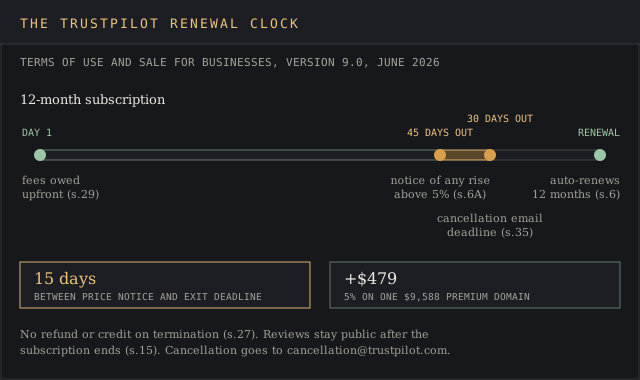
The 15 days between the price-notice deadline and the cancellation deadline are the whole negotiating window, and buyers working against the clock miss it. A Capterra reviewer, Grace W., an office manager in financial services, wrote on 22 May 2023: "You get ONE notice of renewal that went into my junk and didn't see." Erik O., an e-commerce and CRM manager in retail, wrote on 7 March 2025:
"They enforce automatic renewals at drastically increased prices without clear consent, and their support team does little to resolve disputes fairly."
Erik O., Ecommerce and CRM Manager, retail, Capterra, 7 March 2025
Section 15 says user reviews "will remain publicly displayed" after a subscription ends, so Trustpilot reviews, the profile and its ratings stay online. The paid TrustBox widgets showing star ratings, the analytics on reviews and higher invitation caps switch off.
Regulators have looked at the invitation tools these plans sell. Italy's competition authority fined Trustpilot €4 million in March 2026 over paying businesses choosing which customers received invitations to write reviews, as Business Reporter covered it. Trustpilot said it would appeal. The full regulatory record is in our Trustpilot legitimacy report.
What buyers pay for Trustpilot in practice
Vendr puts the median Trustpilot contract at $10,800 a year across 105 deals, with a low of $5,814 and a high of $30,000. Its average savings figure is 20.54%. The page was last updated in February 2026.
Trustpilot's own numbers agree. Its 28,014 paying customers, 5% growth on a year earlier, averaged $11,513 a year in H1 2026, up 18%. Revenue for the half was $151.4 million, 23% growth. Customers paying over $20,000 accounted for 45% of annual recurring revenue in June 2026. The FY2025 results announcement recorded customers paying over $20,000 up 35% while those paying under $10,000 fell 6%.
The lion's share of the revenue comes from larger customers. Smaller customers feel it when the term rolls over. Brent Burrows II, VP Retail & Sales at CBS Bahamas, wrote on TrustRadius in February 2026 about the basic plan his company had held since 2023:
"Now for 2026, Trustpilot is demanding $9,576/year for the EXACT SAME PLAN. That's a 152% increase since we started, with zero added value."
Brent Burrows II, VP Retail & Sales, CBS Bahamas, TrustRadius, 16 February 2026
A Capterra reviewer in IT marketing, listed as VR, described the same pattern on 21 July 2025:
"In the past 2 years we've been a Trustpilot customer, they've increased the subscription price whilst taking away features and not adding any new features to our plan, so we're paying for a diminished product, but so many software companies are doing this nowadays."
VR, Marketing, Information Technology, Capterra, 21 July 2025
Both sit on older plans; Trustpilot's FY2025 announcement refers to "the package migration in 2024."
How to negotiate Trustpilot pricing
Start 60 to 90 days before the renewal date. That puts the conversation ahead of the 45-day price-notice deadline and leaves room to send a cancellation email by day 30 if the quote doesn't move. A stitch in time saves nine: notice sent 31 days out counts, and notice sent 29 days out buys another year at the new price, a red flag for any team without a contract calendar.
Four negotiation strategies for customers, all in writing. A renewal cap of 3% or less, below the 5% section 6A allows. A multi-year term at a fixed rate, which the terms permit because the duration "will be listed in the commercial materials." The Product Reviews or API add-on priced inside the same quote. And a domain bundle, since every regional domain otherwise bills at full plan price.
Signing near quarter-end, or near Trustpilot's reporting dates of 30 June and 31 December, is the timing lever buyers use with most software vendors. Vendr's 20.54% average saving is the closest published figure for what negotiation takes off a first quote. Audit the invoice against the order details before paying.
Expect sales emails on the free plan. Samuel B., a co-founder in utilities, wrote on Capterra on 19 July 2025 that Trustpilot is "quite pushy with wanting you to buy a paid plan, emailing you every so often." That's par for the course with freemium software, and a free account can bite the bullet and ignore the emails.
Who Trustpilot pricing suits: small businesses and brands with several sites
Small businesses with under $5M in revenue and under 100 orders a month get the cheapest of the paid plans at $1,188 a year, provided they're new customers. Above that, a company needs 300 invitations or more and lands on Plus, where the per-invitation price is highest.
Of the paid plans, Premium fits companies running several brands across regional domains and a customer services team that needs 10 logins and SSO. A retailer with brands selling in four countries, each wanting reviews and ratings on its own site, is the case the per-domain pricing was built around, and it's also the case where the bill compounds fastest.
A Capterra reviewer listed as RS, a legal assistant in legal services, wrote on 27 April 2026 that locked analytics "can make the platform feel somewhat pay-to-play for businesses trying to actively manage their reputation." On the free plan, online reputation work means replying to reviews, flagging them and sending 50 invitations.
Trustpilot against its alternatives
Trustpilot competes with Google reviews, G2, Yotpo and Birdeye, and each sells review collection on a different unit. The table gives an overview of each platform's entry price on its own published terms.
| Platform | Published entry price | Billing unit | Free tier limit | Built for |
|---|---|---|---|---|
| Trustpilot | $99 a month (Starter) | Per domain, 12-month term | 50 invitations a month | Service ratings on consumer websites |
| Google Business Profile | $0 | Per listing | Whole product free | Ratings in Maps & Search |
| G2 | $299 a month or $2,999 a year (Starter) | Per profile, monthly or annual | Free profile | Software ratings for B2B buyers |
| Yotpo Reviews | $89 a month (Starter) | Monthly orders, 500 on Starter | 50 monthly orders | Product ratings for e-commerce brands |
| Birdeye | Quote only | Per location | None published | Location ratings for multi-site businesses |
Entry prices are each vendor's own list price, read 6 October 2026. Birdeye's is quote only.
Google is the comparison most buyers make. Its Business Profile lets a company "manage how your business shows up on Maps and Search at no charge," per Google's help page. Thomas Pittman, a marketing director at a surgery practice, put the trade-off on TrustRadius in August 2020: "it gets hard to justify the cost."
G2's rate card for software companies is in our G2 pricing report, and its review integrity in is G2 legit. Teams tracking customer feedback beyond review sites use a social listening platform or one of the customer feedback analysis tools we've ranked. Putting all your eggs in one basket leaves a brand exposed when one site's moderation changes.
What to budget for Trustpilot plans
Three budgets by plan and review volume, all at list and before add-ons:
| Buyer | Plan | Domains | Year one at list | Year two at the 5% cap |
|---|---|---|---|---|
| New store, 80 orders a month, under $5M revenue | Starter | 1 | $1,188 | $1,247 |
| Store sending 250 invitations a month | Plus | 1 | $3,828 | $4,019 |
| Two brands on .com and .co.uk sites, 800 invitations each | Premium | 2 | $19,176 | $20,135 |
Year one is Trustpilot's list price per domain. Year two adds the full 5% renewal uplift section 6A allows.
Two domains double the Premium fee, and the API or Product Reviews add-on lands on top. A $19,176 list bill is a drop in the bucket in Trustpilot's revenue and a real line item for a mid-sized brand.
Frequently asked questions
How much does it cost to go on Trustpilot?
It's free to start. Any business can claim its Trustpilot profile on the free plan, reply to reviews and send 50 automated invitations a month. Paid plans run $99, $319 and $799 a month per domain on annual contracts, with Enterprise quoted.
How much does Trustpilot cost per month?
The plan overview on Trustpilot's pricing page lists Starter at $99 a month, Plus $319 and Premium $799, each per domain and billed as one annual payment of $1,188, $3,828 or $9,588.
Can I add a business to Trustpilot?
Yes. A business signs up through Trustpilot Business and claims its profile on the free plan, and section 15 of the terms keeps its reviews public after any paid plan ends.
What are the disadvantages of using Trustpilot?
Per-domain pricing on reviews tools, 12-month auto-renewing contracts, a 30-day cancellation deadline, up to 5% renewal uplift, unpublished add-on prices, and analytics on customer reviews capped at "Limited access" below Enterprise. Buyers on TrustRadius and Capterra report price increases they didn't expect and renewal disputes with support.
Which is better, Google reviews or Trustpilot?
Google's Business Profile costs nothing and shows reviews and ratings in Maps and Search, alongside a company's services and hours. Trustpilot adds automated review invitations, TrustBox widgets for a website and Google store ratings eligibility. For online reputation in local search, a local services business usually starts with Google; an online store selling across several country sites is the buyer Trustpilot's plans are priced for.
What is more reliable than Trustpilot?
Reliability depends on moderation. Trustpilot's fraud detection system removed 3.9 million fake reviews in H1 2026, 10% of all submitted, per its H1 2026 results. For B2B software, see our reports on G2 and Capterra.
Bottom line
Trustpilot publishes prices for four of its five plans, every invitation cap and every user limit. What it publishes is a per-domain annual rate, and the bills buyers report run past it through extra domains, add-ons and the renewal clause.
A small business that fits Starter's revenue limit pays $1,188 a year and should diarise the 30-day cancellation deadline on day one. A multi-domain brand should budget Trustpilot pricing from the $11,513 average, price every add-on before signing, and use the negotiation strategies above 60 days out. If the quote doesn't move by day 30, cut your losses: the reviews stay public either way, and so does the online reputation they built.
Where each Trustpilot number was read, and the prices Trustpilot keeps off its plans page
Plan prices, invitation caps, user limits and add-on labels come from business.trustpilot.com/pricing, and the free plan's limits from help.trustpilot.com. Contract clauses are quoted from the Terms of Use and Sale for Businesses on corporate.trustpilot.com, version 9.0, June 2026.
Customer counts, the average contract value, revenue and fake-review removals come from Trustpilot Group plc's H1 2026 results statement, covering the half to 30 June 2026, and the customer-band trends from its FY2025 results announcement on lse.co.uk.
The median, low, high, purchase count and average savings are Vendr's header figures at vendr.com/marketplace, last updated February 2026. The Italian fine is as Business Reporter covered it in March 2026. Competitor entry prices are read off sell.g2.com, yotpo.com and birdeye.com, and Google's from support.google.com. Buyer quotes are dated reviews on Capterra and TrustRadius. Every figure was checked on 6 October 2026.
Trustpilot publishes no Enterprise price and no price for Product Reviews, Location Reviews, API access or the Salesforce integration, and Birdeye publishes no price for any plan.