Reputation management software pricing: what 1 and 10 locations cost in 2026
 By Jan Suski. I go deep on every review, checking every number against its source and digging up details other coverage misses, a habit from six years of SEO and link building for tech companies. Bylines at Surfer, Brand24, and Senuto. How the scoring works.
The numbers Reputation management software pricing, checked 6 October 2026
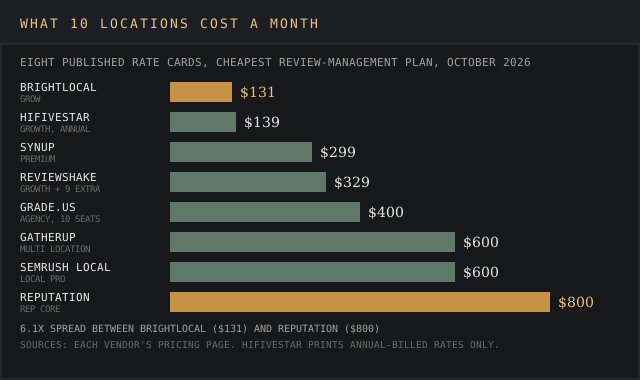
The same 10 locations cost 6.1 times more on Reputation's published card ($800) than on BrightLocal's ($131).
Reputation's $115 Pulse tier across 10 locations comes to $13,800 a year, within $200 of the $14,000 median Vendr tracks for the same vendor.
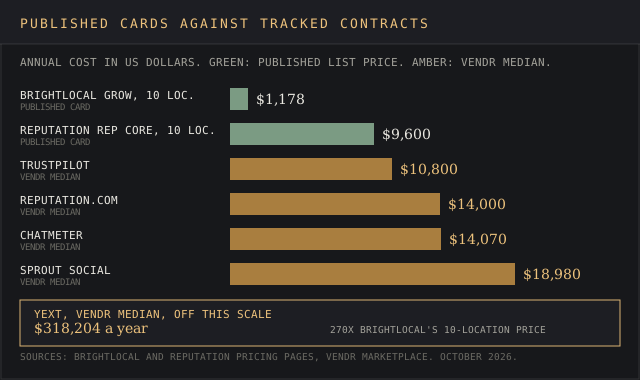
Chatmeter's $14,070 median is 11.9 times BrightLocal's $1,178 annual price for 10 locations.
Ten business locations cost between $131 and $800 a month on eight published rate cards for online reputation management software, for plans that each monitor reviews and draft replies. The low end is BrightLocal's Grow plan. The high end is Reputation's Rep Core at $80 per location.
Quote-only suites cost an arm and a leg. Vendr tracks Chatmeter at a $14,070 median annual contract, and Yext at $318,204.
This report reads 12 vendors' own pricing pages as of October 2026, from BrightLocal to Sprout Social, plus Vendr's tracked contracts for Yext, Chatmeter, Reputation.com, Trustpilot and Sprout Social. It's written for small businesses, multi-location brands and agencies budgeting a first review tool, and for anyone comparing software against reputation management services sold by a professional agency.
The figures matter because 89% of consumers expect a reply to their reviews, and every reply workflow on these cards is billed per location, seat or domain.
What 1 and 10 locations cost on published rate cards
The scenario is one business location, then 10. Each vendor sits on its cheapest plan that monitors reviews, answers them and sends review requests, at the monthly rate where the vendor prints one. Semrush Local Pro is the one row without a request feature. HiFiveStar prints annual-billed rates only, so its rows use those.
| Vendor | Plan used | Billing unit | 1 location, per month | 10 locations, per month | Per location at 10 |
|---|---|---|---|---|---|
| BrightLocal | Grow | Location band | $65 | $131 | $13.10 |
| HiFiveStar | Core, then Growth | Location band, annual | $28 | $139 | $13.90 |
| Synup | Solo, then Premium | Location, then band | $49 | $299 | $29.90 |
| Reviewshake | Growth | $59 plus $30 per extra location | $59 | $329 | $32.90 |
| Grade.us | Solo, then Agency | Seat (one profile) | $110 | $400 | $40.00 |
| GatherUp | Small Business, then Multi Location | Location | $99 | $600 | $60.00 |
| Semrush Local | Local Pro | Location | $60 | $600 | $60.00 |
| Reputation | Rep Core | Location | $80 | $800 | $80.00 |
Every price in this table is the vendor's published list price, read 6 October 2026. HiFiveStar's rows are annual-billed rates. No figure here is a Vendr median.
Grade.us is the dearest single location at $110 and sits mid-table at 10, because its Agency plan drops the seat price to $40. Semrush Local is the fourth-cheapest single location and ties for the second-most expensive 10-location account, because it charges a flat $60 for every location added.
The devil's in the details. Semrush Local's $30 Local Base plan carries no review management at all, per Semrush's own plan page, so the $60 Local Pro tier is the floor for this job.
What online reputation management software covers for the price
Reputation management software does five jobs, and the price climbs with each one a plan adds. The entry tier pulls reviews from multiple platforms into one dashboard. The next sends automated review requests, then drafts replies, then runs customer feedback surveys and sentiment analysis, and the top tiers add listings, social posting and reporting tools.
- Review monitoring: new reviews from Google, Facebook, Yelp and other review sites land in one inbox, with the number of platforms managed set by plan. GatherUp covers 100+ sites on every plan, and Semrush Local Pro pulls Google reviews into its dashboard every hour.
- Review collection: automated review requests by email, SMS or QR codes, the feature that lets a business collect reviews at scale and get new reviews posted. GatherUp's plans include QR codes and custom feedback links, and HiFiveStar sends unlimited SMS and email from its $85 Pro plan.
- Replies: AI drafts or auto-replies to positive reviews and negative feedback alike, so one manager can manage reviews across 10 locations from a single queue.
- Customer feedback analysis: Net Promoter Score surveys, user feedback forms, customer satisfaction scores and AI topic tagging, which turn customer sentiment into analytical reports a regional manager can read.
- Reporting and integrations: customizable reports, API access, Zapier and webhooks that plug review data into existing workflows and CRM records.
Spotting fake reviews costs extra where it's sold. GatherUp's Review Defense, built on The Transparency Company's fraud detection under a partnership announced 18 March 2025, costs $45, $125 or $300 per location a month, with automated review disputes from the $125 tier.
Predictive analytics that flags reputation risks early shows up on none of the eight published cards in this report, so any AI risk scoring a sales rep demos belongs to a quote. Real-time monitoring tools and automated tools for alerts do appear on the cards, starting with Semrush Local's negative-review email alert at $60 per location.
How reputation management software is billed
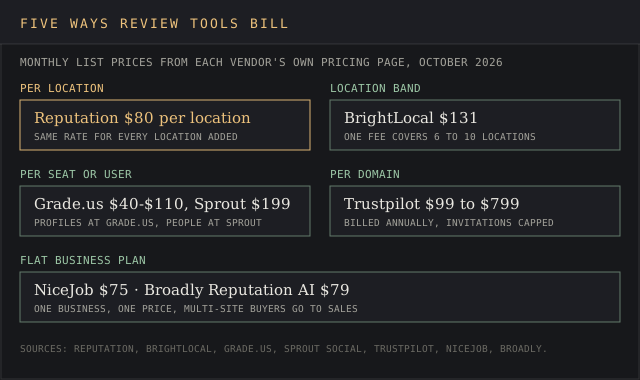
Every published card here is a SaaS subscription billed monthly or annually, and the billing unit decides which vendor is cheapest at your size. Most reputation management tools charge by location. The rest bill by seat, by domain, by flat business plan, or through a wholesale minimum an agency resells.
Per location
Reputation ($80, $115 or $150), GatherUp ($60 on Multi Location) and Semrush Local ($60 on Pro) multiply one rate by every location. Chatmeter's pricing page states it prices "by location, with unlimited users", then asks for a form before giving a number.
Per location band
BrightLocal and HiFiveStar charge one account fee for a range of locations. BrightLocal Grow runs $65 for 1, $87 for 2 to 5, $131 for 6 to 10 and $197 for 11 to 20. A business at 6 locations pays the same as one at 10, so buyers at the top of a band get the lion's share of the value.
Per seat and per user
Grade.us calls a managed profile a seat, priced at $110 on Solo, $60 on Professional, $40 on Agency and $25 on Partner. Sprout Social bills per user, and its review inbox starts on the Standard plan at $199 per seat a month, so three users cost $597 before a single location is counted.
Per domain and per review request
Trustpilot prices each website domain separately, billed annually: Starter from $99 a month, Plus from $319 and Premium from $799. Each tier also caps review invitations at 100, 300 and 1,000 a month, with 50 on the free plan. Our Trustpilot pricing report covers the contract terms behind those numbers.
Flat business plans and digital marketing bundles
NiceJob and Broadly sell one plan per business. NiceJob costs $75 or $125 a month with no contract and sends multi-location buyers to sales. Broadly sells Reputation AI from $79 a month on its own, or inside digital marketing bundles from $399 a month plus a $350 onboarding fee. Its à la carte list adds Conversations AI for customer engagement at $139 and Campaigns Pro marketing automation at $99, so one vendor can replace multiple tools.
Published reputation management plans, vendor by vendor
BrightLocal
Review tools sit only in Grow, the top of BrightLocal's three plans. Track ($41) and Manage ($54) carry local SEO audits, citation tracking, listings sync and GBP post scheduling, and leave reviews out. Grow adds review monitoring across multiple sites, review requests by email, SMS and in-store campaigns, and a website review widget. An annual commitment cuts every tier by 25% against month-to-month billing. One location falls to $49 a month, and 10 locations to $98.
HiFiveStar
HiFiveStar runs a permanent free reputation management plan, one of two here alongside Trustpilot's free tier. Forever Free covers 1 location and 1 user with review monitoring, replies and widgets, and leaves out text-message requests and AI drafts. Paid plans run from Core at $28 a month for 1 location to Unlimited at $749, every price billed annually. Growth covers 10 locations for $139 a month, or $1,668 a year.
Synup
Synup's Solo plan costs $49 per location a month, and Premium covers up to 10 locations for $299. Pro takes 25 locations for $499, Scale takes 50 for $899, and above 50 the price moves to an enterprise contract. Annual billing saves 20%. Synup's own page pitches review monitoring and responses as a replacement for "Birdeye, Podium at $30" per location, a vendor claim to test in a demo before you bite the bullet on a contract.
Reviewshake
- Starter: $29 a month, 1 location, 3 review sources, 250 email review invitations a month.
- Growth: $59 a month, unlimited review sources, 1,000 email and 500 SMS invitations a month.
- Ultimate: $99 a month, 2,000 email and 1,000 SMS invitations, plus competitor tracking.
- Extra locations: $30 a month each, on every plan, with 20% off for annual billing.
- Agency: from $199 a month for 10 clients and 25 locations, white-labelled.
Grade.us
Grade.us's plans page totals Solo at $110 for 1 seat, Professional at $180 for 3, Agency at $400 for 10 and Partner at $2,500 for 100. Text-message review requests cost $10 a month for 200 on the two smaller plans and come included above them. Premium white label adds $440 a year.
GatherUp
GatherUp charges $99 a month for one location and $60 per location from 2 locations up, with the rate flat across every band to 101 locations and beyond.
Each location gets 300 SMS and 3,000 email credits a month, monitoring across 100+ review sites, Net Promoter Score surveys and AI-crafted replies. Listings Hub adds $40 per location, and annual billing saves 20%. Customer upload integrations, Zapier and webhooks let a team manage feedback from customer interactions alongside its other business tools.
Semrush Local
Local Pro, at $60 per location a month, adds review management to Semrush's GBP agent and map rank tracker: hourly Google review updates, negative-review email alerts, AI reply drafts or auto-replies, and competitor review analytics for up to 10 competitors per report. It can run standalone or on top of an existing subscription, which our Semrush pricing breakdown prices separately.
Reputation
Reputation's pricing page lists three per-location tiers, and above 125 locations it's a custom enterprise package.
- Rep Core: $80 per location a month for reviews management (collection, requesting and AI responding) plus business listings.
- Rep Core + Pulse: $115, marked most popular, adding sentiment insights and an AI reputation manager.
- Rep Core + Surveys: $150, going the whole nine yards with advanced surveys, email survey requests and targeted outreach campaigns.
The Surveys tier stretches feedback across the full customer journey, from post-visit survey to follow-up outreach.
Sprout Social and G2
Sprout Social folds review replies into its social media management plans and bills marketing and sales teams per seat, so corporate teams of three pay $597 a month at any location count. Review management sits inside the same all-in-one platform as the team's social publishing, and our Sprout Social pricing report walks through the seat math.
B2B software companies manage brand reputation on review sites built for buyers, chiefly G2. G2 sells vendors profile upgrades plus buyer intent signals as a separate add-on, and our G2 pricing report prices each tier.
Quote-only reputation management suites and what Vendr's contracts show
Birdeye, Podium, Chatmeter and SOCi route pricing through a form or a demo, and so does Reputation above 125 locations. Vendr publishes tracked medians from real purchases for Yext, Chatmeter, Reputation.com, Trustpilot and Sprout Social. That's the nearest thing to a list price a quote-only vendor has.
| Vendor | Vendr median, per year | Tracked low | Tracked high | Median as monthly |
|---|---|---|---|---|
| Trustpilot | $10,800* | $5,814* | $30,000* | $900* |
| Reputation.com | $14,000* | $3,310* | $52,965* | $1,167* |
| Chatmeter | $14,070* | $8,574* | $24,582* | $1,173* |
| Sprout Social | $18,980* | $6,281* | $55,000* | $1,582* |
| Yext | $318,204* | $23,767* | $534,000* | $26,517* |
Prices marked * are Vendr median annual contract values and tracked lows and highs from anonymized buyer data, read 6 October 2026. None of them is a vendor list price. The monthly column divides the median by 12.
Vendr's Trustpilot and Sprout Social pages also print purchase counts: 105 and 361 deals, with buyers saving 20.54% and 14% on average against the opening quote.
Birdeye
Birdeye's pricing page asks for business email, company name and location count, then sorts buyers into six bands from 1 to 3 locations up to 1,000+, so large companies get a custom quote sized to their location count. It says pricing is "built around outcomes, not seat counts" and sold as "one platform, one contract". Contract length is the red flag in its reviews. One Capterra reviewer, a company president with 11 to 50 employees, wrote in September 2025:
"After six months, we could no longer, in good conscience, allow our clients to continue using such a flawed system and attempted to terminate our contract. Despite presenting all the issues we encountered from day one, BirdEye refused to cooperate and forced us to stay for the entire year."
Source: Capterra review of Birdeye.
Podium
Podium's pricing page compares three plans, Core, Pro and Signature, and says they're "designed to fit your specific business needs", with prices given on a call.
Its Capterra reviews focus on the exit. A construction brand ambassador wrote in May 2023, "After my contract was up, I switched to Birdeye which was cheaper," and a transportation business development director wrote in December 2023, "Once we cancelled the service we kept getting billed from Podium" (Capterra, Podium reviews).
Yext, Chatmeter and SOCi
Yext's $318,204 median is the outlier of the group, and BrightLocal's 10-location annual price is a drop in the bucket next to it, at 1/270th of the median. SOCi bundles reputation management with social posting and local listings for multi-location brands, and its pricing page asks visitors to "Book a personalized demo".
Key features that raise reputation management cost
Basic review monitoring is cheap. Reviewshake's Starter tracks 3 review sources for $29, and Broadly's $79 Standard tier manages reviews on Google and Facebook only. Reputation management prices climb as five features get added, and each one has a published price somewhere in this market.
AI-generated review replies
Broadly charges $79 for Reputation AI Standard and $89 for Pro, where the extra $10 buys an AI reputation specialist that drafts review responses. NiceJob's jump from $75 to $125 adds automatic replies to every review "in your brand voice". HiFiveStar gates AI reply drafts at Core, its first paid plan.
Customer feedback surveys and sentiment analysis
Sentiment analysis tags each review as positive, negative or neutral. Reputation adds it at the $115 Pulse tier, a $35 premium per location over Rep Core, and advanced surveys at $150. GatherUp includes Net Promoter Score surveys and AI topic tagging on every plan. Survey programs at enterprise scale move to Medallia or Qualtrics, each priced in its own report.
Review requests by text message
Vendors ration text messages by plan. Grade.us sells 200 texts for $10 a month, GatherUp gives 300 SMS credits per location, Reviewshake allows 500 to 1,000 a month, and HiFiveStar Core sends none.
Social posting and content creation
Content creation for social channels is sold as its own line. Broadly sells Social Marketing from $89 a month and a Social Media Management service from $199, and Sprout Social's per-seat plans cover publishing for marketing teams that already run social media tools for their marketing campaigns.
Listings, social media monitoring and alerts
Listings management, a common reputation management add-on, costs $40 per location at GatherUp. Social media monitoring of brand mentions outside review sites is a separate category with its own rate cards, priced in our social listening pricing report and the Brand24 pricing teardown.
Hidden reputation management costs: setup fees, contracts and add-ons
The plan price is the smallest number in most quotes. Five charges fly under the radar on top of it in the published terms.
- Onboarding: Broadly charges $350 for setup on its Standard, Pro and Premium bundles.
- Contract length: Vendasta's Professional and Premium reseller plans carry a 1-year contract with $499 and $999 monthly wholesale minimums.
- Renewal notice: Trustpilot requires cancellation at least 30 days before each term ends, per section 35 of its terms of use and sale for businesses.
- White label: Grade.us adds $440 a year, and Reviewshake's agency plan starts at $199 a month.
- Text credits: Grade.us charges $10 a month for 200 SMS requests on Solo and Professional.
Annual billing cuts 25% at BrightLocal and 20% at GatherUp, Synup and Reviewshake, the cheapest lever for small businesses on the published cards. It also locks the buyer in for 12 months, which is par for the course on the quote-only side anyway.
Reputation management services: what a professional agency charges
Agency reputation management is a different purchase. Software helps a business gather reviews, answer them and track ratings. Reputation management services push a negative article down Google search results, request removals, publish positive content and handle crises for companies and public figures.
Suppression targets the first page of search results, the organic links search engines show for a company or executive name. An agency publishes and promotes new pages built to outrank the negative ones in the search engine results, billed as a monthly retainer or a one-time project.
Reputation911's published price table sets the bands:
- Software and automated monitoring: $50 to $500 a month.
- Professional repair and suppression of search results: $500 to $7,000 a month.
- Permanent content removal: $500 to $15,000 or more per link.
- Enterprise and crisis management: $10,000 to $50,000 or more a month.
- One-time projects: $2,500 to $15,000 or more.
Reputation911 ties online reputation management cost to the authority of the sites carrying the negative content in search results and to how much of it there is.
WebFX sells reputation management from $125 a month for one location, per its own pricing page. The same page reports that 72% of businesses in its survey of 250+ US marketing and sales professionals pay $100 to $10,000 a month for reputation management, a range wide enough to cover both software and a full agency retainer.
Reputation management software can't remove a negative article from search engines. A business that needs results moved on Google search results buys reputation management services, and one that needs more reviews and faster replies buys software at a fraction of the price.
Reputation management cost by business size
Small businesses with one location can run reputation management for $0 to $110 a month on a published card. HiFiveStar's free plan and Reviewshake's $29 Starter cover monitoring at the bottom, and $49 to $80 buys requests, replies and AI drafts at Synup, Semrush Local, BrightLocal or Reputation.
For local businesses, a home-services firm or a single clinic, the cheapest route is a flat plan, with NiceJob at $75 and Broadly's Reputation AI at $79 covering one business at one price. Small businesses that outgrow one site hit per-location pricing at the second location.
Brands with 10 sites pay $131 to $800 a month on published rates, or $1,178 to $9,600 a year. A 25-location account costs $499 a month on Synup Pro, against $1,500 at GatherUp's or Semrush's $60 per location. At 25 sites, the billing unit for multiple locations decides reputation management cost.
Enterprise buyers above 50 or 125 locations move to quotes. Vendr's medians put that tier at $14,000 to $19,000 a year for Reputation.com, Chatmeter and Sprout Social, and at $318,204 for Yext. Reading between the lines, the median Reputation.com buyer pays for roughly 10 locations on Pulse.
Why online reviews justify online reputation management spend
Consumers read reviews before they buy locally, and BrightLocal's 2026 numbers put a size on it. BrightLocal's survey of 1,002 US adults, published 11 February 2026, found 97% read reviews for local businesses, 71% use Google for them, and 89% expect owners to respond.
Star thresholds tightened. 31% of consumers will only use a business rated 4.5 stars or higher, up from 17% in 2025, and 19% expect a same-day reply. Those thresholds shape brand perception before a customer ever calls, and vendors sell review generation to win new customers on Google Maps.
Online reviews also feed brand visibility in local search. Every vendor here sells a positive reputation as more reviews and faster replies, and the published cards put a per-location price on that online visibility and customer trust.
Fake reviews can land a business in hot water. The FTC approved a final rule banning fake reviews 5-0 on 14 August 2024, covering AI-generated fake reviews, bought positive or negative reviews and review suppression through threats. Our Trustpilot legitimacy report covers how review platforms police it.
Frequently asked questions
How much does reputation management software cost?
Published rate cards run from $0 on HiFiveStar's free plan to $110 a month for one location, and $131 to $800 a month for 10 locations. Quote-only suites track at $10,800 to $318,204 a year on Vendr.
How much does software cost for a business?
Review tools bill per location, social tools per seat, and a CRM per user, as our CRM software cost report shows across 11 vendors from $0 to $550 a seat.
How much does NetReputation cost?
NetReputation, a Sarasota, Florida agency founded in 2015, lists a $1,000 minimum project size and $100 to $149 an hour on its Clutch profile. Final prices depend on how many negative search results need suppression.
What is the best software for reputation management?
For one location on a budget, HiFiveStar Core ($28) or BrightLocal Grow ($65) covers the online reputation basics of monitoring, requests and replies. For 10 locations, BrightLocal Grow ($131) and HiFiveStar Growth ($139) cost the least, and Synup's bands run to 50 locations for $899. For 125+ locations, Reputation's enterprise package and Chatmeter sit near a $14,000 median.
What is the best software for business management?
Broadly's $399 bundle and Sprout Social's $199 seat come closest to one dashboard for reviews, social and messaging in this report, and our brand intelligence software ranking covers the monitoring side.
How much does online reputation management cost per month?
Online reputation management software costs $28 to $110 a month for one location on published cards. Reputation management services cost $500 to $7,000 a month for repair and suppression of search results on Reputation911's table, and 72% of businesses in WebFX's survey pay between $100 and $10,000 a month.
Is reputation management worth the cost?
For small businesses, BrightLocal Grow at $65 a month comes to $780 a year for one location. Against that, 68% of consumers in BrightLocal's 2026 survey will only use a business rated four stars or more, so a better online image is a competitive edge measured in new customers. Reputation management services at $500 a month and up make sense when the problem sits in search results, where review software has no reach on search engines.
Bottom line
Reputation management cost for 10 locations runs from $131 to $800 a month on published cards, and the billing unit sets the order. Band pricing favours BrightLocal and HiFiveStar, while per-location pricing at GatherUp, Semrush Local and Reputation scales in a straight line.
Quote-only reputation management suites start where the published cards stop, at medians from $10,800 to $318,204 a year. Price the scenario at your own location count before the demo, so the sales call starts on the same page as your budget, and read the contract term before the feature list.
Where each rate card was read, and the prices quote-only vendors keep back
Every price, quote and statistic on this page was checked against its origin on 6 October 2026, and each links to its source on first use.
Published rate cards come from brightlocal.com, reputation.com, hifivestar.com, synup.com, reviewshake.com, about.grade.us, gatherup.com, semrush.com, sproutsocial.com, business.trustpilot.com, get.nicejob.com, broadly.com and vendasta.com. Chatmeter's billing statement is read off chatmeter.com, and Birdeye's and Podium's plan names off birdeye.com and podium.com.
Tracked-contract figures are the header stat blocks on vendr.com/marketplace for Yext, Chatmeter, Reputation.com, Trustpilot and Sprout Social. Trustpilot's renewal notice is section 35 of its terms of use and sale for businesses on corporate.trustpilot.com, version 9.0, effective 23 June 2026.
Consumer figures are BrightLocal's Local Consumer Review Survey, published 11 February 2026. The fake-review rule is the FTC's final rule of 14 August 2024 on ftc.gov. Agency price bands come from reputation911.com and webfx.com, NetReputation's rates from its clutch.co profile, and buyer complaints from dated reviews on capterra.com.
Birdeye, Podium, Chatmeter and SOCi publish no price for any plan, and Vendr's Birdeye and Podium pages showed no tracked median when read, so no contract figure exists for either.