Is Capterra legit? What its own numbers and reviewer complaints show
 By Jan Suski. I go deep on every review, checking every number against its source and digging up details other coverage misses, a habit from six years of SEO and link building for tech companies. Bylines at Surfer, Brand24, and Senuto. How the scoring works.
· Prefer this source on Google
The numbers Capterra, G2, Software Advice and GetApp, checked 14-15 August 2026
A 3.5 average built from 61% five-star reviews and 24% one-star reviews reads as a lead-generation platform.
The $110 million sale confirms G2 has owned Capterra since February 2026, and any complaint dated earlier sits under different management.
Capterra's 30-plus moderators and 20-plus checks per review are real policy commitments. They don't prove every rejected review was rejected fairly.
G2, the new owner, turned away over a third of its February to April 2026 submissions and caught one in eight as fake, without saying if those figures include Capterra.
Software Advice and GetApp sell the same pooled 2.5 million+ reviews under two more brands, so checking all three adds no independent second opinion.
I'll write a 2,500+ word report on the site you name, built from its own policies, ratings and public records. Yours to publish, from $200.
Capterra's own Trustpilot page carries 1,076 reviews, split 61% five-star against 24% one-star. That's lopsided. Review farms cluster near the top with almost no bottom end, so a one-in-four share of one-star complaints means real dissatisfaction is reaching the page, and that distribution is the strongest evidence for how Capterra runs.
Capterra runs on a pay-per-click and pay-per-lead model, and its default sort favors vendors who pay for placement. Its own Trustpilot page carries a three-year pattern of reviewers accusing the company of dangling gift cards for a first review, then rejecting the ones that came back negative. This report checks that pattern against Capterra's verification process and Community Guidelines, and against G2, TrustRadius and Trustpilot on the same question.
It's for a buyer deciding how much weight a star rating deserves before a purchase, and for a vendor deciding if disputing a rejected review is worth an account manager's time. Buyers here range from solo founders to enterprise procurement teams comparing ten vendors at once, and the question that matters for both is how far that 61/24 split should move a 3.5 average before anyone trusts it.
What Capterra is and how it makes money
Capterra lists software across more than 900 categories and lets any user search, filter and read reviews for free. The buyer-facing site costs nothing. Capterra's paying customers are the vendors, and that distinction shapes every feature the site builds.
Capterra's revenue comes from the vendor side, through two paid programs: Pay-Per-Click, where a vendor bids for a sponsored profile that appears in category search results, and Pay-Per-Lead, where a vendor pays per qualified buyer contact generated from the site.
Capterra's own PPC Service Description confirms the mechanics directly: a sponsored profile links to a landing page the vendor controls on its own website, clicks are tracked, and "Vendor is responsible for all fees based on the set budget and the resulting clicks activity."
Riley Moore, CEO of DirectSuggest, laid out the same mechanism in a 2 February 2024 LinkedIn post and backed it with his own inbox. Between 30 October and 13 November 2023, he received four outreach emails from his Capterra account representative, one reading:
"Hoping I can entice you to make a change in your Gartner Digital Markets listing that will help boost you over your competitors."
That's a sales pitch. It isn't a neutral directory update, and Capterra's own site backs the structure Moore describes: the default sort on a category page reads "Sponsored," ahead of rating or relevance.
Moore's post also quotes Capterra's own vendor plan page: the "Grow" plan promises to "target marketing-ready leads across 1,400+ software and service categories," plus "landing page optimization for conversions" and access to "account-level identities and firmographic data for all visitors." None of those features activate for free.
A vendor comparing the plans has to contact a Capterra sales representative and negotiate a monthly budget first, and the site publishes no fixed price list a vendor can check without that call, beyond the recommended budget bands on the Gartner Digital Markets sign-up page: up to $2,000 a month on Promote and $10,000 on Grow.
Software companies large and small show up on the same list, from single-founder tools to household SaaS names, and a vendor that never pays for Pay-Per-Click can still get listed and reviewed. That vendor competing for placement against one who does pay starts at a disadvantage regardless of its review count.
How Capterra reviews get verified, on paper
Capterra publishes its process in detail. Every submission goes through what the company calls more than 20 control checks, run by a QA team it says numbers more than 30 human moderators, before anything goes live. The team confirms reviewer identity, checks for AI-generated or plagiarized text, and flags any reviewer with a financial connection to the vendor being reviewed or its competitor.
Capterra runs two review tracks. Non-incentivized reviews come from any user who submits one unprompted. Incentivized reviews are solicited, and the reviewer gets "a nominal incentive," commonly a small gift card, on approval regardless of the rating given.
Capterra's Community Guidelines, last updated 4 May 2026 and now pointing complaints to reviews@g2digitalmarkets.com, explicitly bar vendors from submitting their own reviews, paying for fake reviews, or using non-disparagement clauses to suppress negative ones: "We will not remove reviews on the basis that a reviewer agreed to such a clause, and the existence of these clauses may result in penalties to the vendor's account."
The same guidelines call for "meaningful, honest feedback" over filler, and vendors are expected to read that feedback and respond through the platform. Contacting reviewers directly isn't allowed.
On paper, that's a stricter policy than most review sites publish. The gap opens in practice, in what reviewers on other platforms say happens after they submit.
What reviewers say about fake reviews and rejected ones
The most repeated complaint across Trustpilot, Quora and Reddit follows one shape: a reviewer gets rewarded for one or two early reviews, then has later submissions rejected under Capterra's guidelines with no specific reason given. On Trustpilot, a reviewer named Kamaria wrote on 24 March 2026:
"Capterra will pay a few times, then flag your reviews as 'Unfortunately, your recent review(s) failed to comply with one or more of our published Reviews Guidelines.' This is a scam, don't waste your..."
G2, Capterra's parent company since February 2026, doesn't leave review volume to organic chance either. A 6 March 2024 G2 announcement introduced a partnership with Sendoso letting a vendor send a reviewer a physical gift once a review clears moderation, what G2 itself called "the first review gifting integration of its kind," alongside what G2's own materials describe as over 10 separate ways to collect reviews built into the platform.
None of that breaks Capterra's or G2's own rules, which cap incentive value and require disclosure of the incentive on the review itself. It does mean the review count sitting on a listing reflects how well a vendor works the incentive tools on offer, alongside how the product performs for the person using it.
Complaints on Trustpilot's own tally back up a narrower, verifiable version of the same pattern: several customers used the word "scam" specifically about how their feedback was handled after submission, separate from any complaint about the software itself.
None of this proves Capterra invents reviews. The complaints line up around a specific mechanic: an opaque rejection process with a form-letter explanation, applied inconsistently enough that both vendors and reviewers believe the fix is in against them specifically.
How vendors buy visibility across software categories
Because Capterra's default filter favors paying vendors, a market has formed around gaming the review count itself. A search for "buy Capterra reviews" returns a page of services (Reviewer, Reviewsar, SMM High, and others) selling packages of reviews from what they describe as aged or verified accounts across dozens of countries.
Capterra's Community Guidelines directly prohibit this: vendors may not commission, purchase or arrange reviews through third parties, and doing so risks account suspension and the removal of the vendor's listing.
Businesses that can't or won't pay lose the ability to appear high on the list regardless of review count, which is the mechanic Moore's post calls a pay-to-play scheme built into the discovery tools themselves. Third-party review-selling platforms don't limit themselves to Capterra; the same platforms sell fake reviews for G2 and Trustpilot listings too, and small businesses without a marketing budget are the most common buyers of that shortcut.
A market for fake Capterra reviews doesn't prove every review on the site is fake; it shows the incentive is strong enough that a small industry sells the service openly. Buying reviews is the fastest way for a business to manufacture a reputation it hasn't earned, and Capterra's QA process is the only thing standing between that industry and the site's rating column.
Capterra vs G2, TrustRadius, Software Advice and GetApp
Several review sites run the same paid-placement model, and Capterra sits in the middle of the group, neither the strictest nor the loosest. Software Advice is Capterra's sister site under the same G2 Digital Markets ownership, aimed more at guided phone consultations and customer service than self-serve browsing.
Each of these platforms uses different technology, and a different mix of paid and organic signals, to help clients determine which service and which technology stack is worth trialing; none of them independently audits the other's numbers.
| Site | Business model | Review verification | Independent rating (source) |
|---|---|---|---|
| Capterra | Pay-per-click and pay-per-lead vendor ads; free for buyers | 30+ QA moderators, 20+ checks per review, per Capterra | 3.5 / 5 (Trustpilot) |
| G2 | Paid review-campaign and intent-data tiers for vendors | LinkedIn, business email, or personal email plus screenshot; 43 data points per review, per G2 | 2.8 / 5 (Trustpilot) |
| TrustRadius | Paid research and lead tools for vendors; no pay-per-click ads | Phone or LinkedIn identity checks on a share of reviewers | 8.4 / 10 (TrustRadius, rating Capterra itself) |
| Software Advice | Pay-per-lead bids by market and size band, plus bid-sorted category pages | Same 30+ moderator QA process as Capterra, shared review pool | 4.2 / 5 (Trustpilot, 694 reviews) |
| GetApp | Pay-per-click and pay-per-lead vendor programs, plus referral fees | Shared review pool with Capterra and Software Advice | 2.2 / 5 (Trustpilot, 106 reviews) |
Copy these lines into an email, fill them in and send. I reply with scope and a price within 2 to 3 business days.
Open the emailG2 sells its own paid review-campaign and intent-data tiers to vendors, a separate rate card from Capterra's PPC and PPL programs, covered in our G2 pricing report.
TrustRadius reviewers rating Capterra itself, as a service, land at 8.4 out of 10 across 51 reviews, well above Capterra's 3.5 on Trustpilot. One TrustRadius reviewer flagged the same transparency gap raised elsewhere in this report, writing as a con: "It's not so clear when product reviews are being sponsored... perhaps make it more clear."
The gap between the two scores tracks who's answering: TrustRadius draws more B2B software buyers describing Capterra as a research tool, while Trustpilot draws a mix of buyers and rejected reviewers, several of whom showed up specifically to complain.
TrustRadius' higher score doesn't make it more reliable across the board. It draws from a narrower, more B2B-heavy reviewer base, and buyers still need to weigh the negative comments there as closely as the positive ones, since a positive-leaning sample skews any single platform's average.
Who owns Capterra, Software Advice and GetApp, and what changed with the G2 sale
Two of the three sites have documented histories before the G2 sale:
- 2005: Software Advice launches in Austin.
- 2010: GetApp is founded in Barcelona by Christophe Primault and Manuel Jaffrin, per B2B SaaS Reviews.
- 11 March 2014: Gartner announces its purchase of Software Advice, per Vista Point Advisors, which advised on the sale. Gartner then described a roughly 100-person company that had "helped more than 200,000 people choose the right software."
- 2015: Gartner buys GetApp and folds it into its Digital Markets unit, per B2B SaaS Reviews.
Gartner announced on 29 January 2026 that it would sell Capterra, Software Advice and GetApp to G2, and the deal closed 5 February 2026 at $110.0 million, per Gartner's own 10-K filing. G2 folded the three into a combined entity it calls G2 Digital Markets, reporting 6 million verified reviews, around 10,000 vendor customers and 2,000+ software and service categories across the merged network.
G2 chief executive Godard Abel called it "a transformational moment for G2, and, more importantly, the global B2B software industry" in G2's own announcement, which puts the combined network's reach at 200+ million annual software buyers. Gartner kept its research subscriptions, the business it still sells seat by seat.
The three sites also share one review catalog. GetApp's Category Leaders methodology says "review scores are calculated using reviews collected from GetApp and its sister sites, Software Advice and Capterra," and Software Advice's Reviews FAQ says reviews are shared and considered equally across all three. Each quotes the same 2.5 million+ verified reviews, and the G2 sale carried that pool across intact, with no re-verification.
Capterra's Community Guidelines now route every complaint to reviews@g2digitalmarkets.com. The old Gartner address is gone, and the guidelines document itself carries a 4 May 2026 update date, after the deal closed.
The change reached Software Advice's binding vendor terms too: its Pay-Per-Lead Service Description now routes account access through a "G2 Digital Markets account." GetApp's Reviews FAQ and Community Guidelines didn't mention the sale at all when checked in August 2026, six months after the close.
Every complaint dated before February 2026 in this report happened under Gartner's ownership. G2's own reputation for stricter review moderation, built since its 2012 founding as an independent company, is now attached to the same Capterra listings that generated the Trustpilot complaints above.
G2 hasn't published a new review methodology since the deal closed, and it would be a mistake to assume Capterra's QA team, apparently still managed under the same process, changed overnight just because who signs its checks did. A new contact email is confirmed; new substance is not, at least not yet, since the acquisition closed too recently for a full cycle of before-and-after review data to exist.
That's the same gap our reports on software pricing errors and end of life software found elsewhere: an acquisition or a platform change updates the contact details long before it updates the substance a buyer needs.
Is G2 legit? What Capterra's new owner publishes about its own moderation
G2 now signs Capterra's checks, so its own record is part of the answer. Five entrepreneurs founded it in 2012, its about page lists $257 million in total funding, and it says it hosts over 3 million verified reviews of its own. It also publishes a quarterly Trust & Safety Index, which is more than Capterra discloses about its own rejections.
What G2's February to April 2026 numbers show
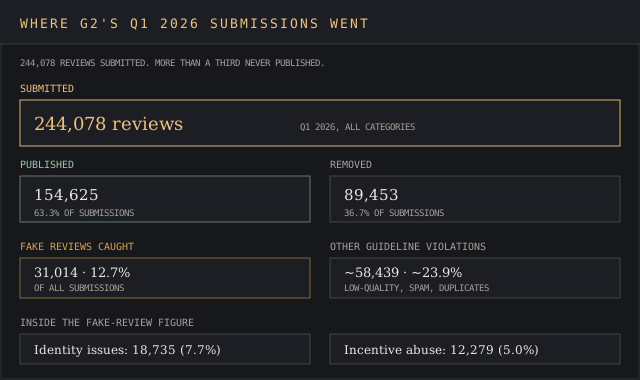
G2 received 244,078 review submissions between 1 February and 30 April 2026. It approved 154,625, or 63.3%, and removed 89,453, or 36.7%. Of the removals, 31,014 were flagged as outright fake, 12.7% of everything submitted, and roughly 58,439 were rejected for other guideline violations: spam, duplicates and answers too thin to clear the completeness bar.
Want a moderation-funnel chart like this for another review site? Send the name.
Email a briefThe fake-review figure splits two ways:
- Identity issues, 18,735 submissions, or 7.7% of the total: reviewers who couldn't back the account with a LinkedIn profile, a business email or a supporting screenshot.
- Incentive abuse, 12,279 submissions, or 5.0%: reviews G2 tied to a reward in a way that crossed into buying a positive score, which its incentive policy bans outright.
Identity failures outnumber incentive abuse by about 1.5 to 1, so the commonest way a submission dies is a reviewer who can't prove who they are. G2 publishes no appeal-reversal rate and no false-positive rate for those filters, so 36.7% measures how hard the filter works, with no published check on how often it gets a call right.
Two more gaps matter to a Capterra reader. G2 hasn't said if the February to April figures cover Capterra, Software Advice and GetApp or G2.com alone, and as of the August 2026 check, Capterra had issued no verification standard tied to G2's 43-data-point system.
How G2 verifies a reviewer
G2's Community Guidelines require every reviewer to authenticate one of three ways: a LinkedIn account, a business email, or a personal email paired with a screenshot of the product in use. G2 says a fraud detection system checks each submission against 43 behavioral, identity and content data points, with its Trust & Safety team reviewing anything the automated layer flags.
A valid review has to reflect firsthand use from the past two years, and three groups get handled differently:
- Employees of the reviewed vendor and its direct competitors can't submit at all.
- Business partners and resellers can review, but G2 labels the result Business Partner and leaves it out of the product's ranking calculation.
- Guest users reviewing without a full account still publish, and their reviews also sit outside the score.
AI-assisted writing, where a model tidies a real customer's grammar or clarity, is allowed from any verified account. AI-generated reviews, where the model drafts the substance, clear moderation only for LinkedIn-verified, vendor-verified or in-app reviewers. On 23 October 2025 G2 joined the Coalition for Trusted Reviews alongside Amazon, Trustpilot, Booking.com, Tripadvisor, Glassdoor and the Better Business Bureau.
The $100 reward cap and what reviewers receive
G2 lets businesses and G2 itself offer rewards, typically gift cards or charitable donations, capped at $100 per review and paid regardless of the rating. Two independent trackers of the program, Score My Reviews and Team4 Agency, report customers commonly get a $10 Amazon or Starbucks gift card, occasionally $25 in specific categories. Standard reviews get a decision in roughly three days; incentivized ones can take five business days.
Hayden Smith wrote on Trustpilot on 14 October 2025:
"This company baits you into writing a review by offering gift cards. After spending time and effort submitting a review etc they will say no gift cards are available."
Hayden Smith, Trustpilot review of g2.com, 14 October 2025.
G2's reply on 5 December 2025 said it couldn't locate an account under that username and asked for the email tied to it, leaving the reward question unanswered. Kamaria's Capterra complaint above describes the same arc: rewards for the first few reviews, then rejections.
What G2's own customers say about G2
G2 holds 2.8 out of 5 on Trustpilot across 4,927 reviews, on a profile it claimed in December 2020, against Capterra's 3.5. Trustpilot's dashboard shows G2 replying to 82% of its negative reviews, typically over a month later. Sally, reviewing on 26 September 2025, described the support side:
"Trying to get hold of a real person is next to impossible if you are a paying customer. Support cancels tickets without any response or assistance."
Sally, Trustpilot review of g2.com, 26 September 2025.
Eku Mayol wrote on 5 November 2025 that a review sent with multiple screenshots still hadn't cleared moderation weeks later. G2 answered that it has an entire team verifying reviews come from real people, then asked for an account email it said it couldn't locate.
On LinkedIn the argument runs both ways. Victoria Dalleau, who describes herself as building the revenue-management platform Hyperline, asked if G2 is a big scam, arguing that reviews mostly come from customers a vendor asked, sometimes with a reward attached. Benoit Decoene, in AI business development at element61, replied that screenshot verification and named references make a G2 review more trustworthy than a testimonial on a sales slide.
The FTC rule over every review site
The Federal Trade Commission's Trade Regulation Rule on the Use of Consumer Reviews and Testimonials, finalized in August 2024, moved several review-manipulation tactics into direct federal enforcement.
On 6 November 2024 the FTC acted against Sitejabber, a competing aggregator, over ratings collected at checkout before a customer had used the product and shown as ordinary reviews. One retailer's 83,154-review, 4.72-star average fell to 2.19 stars once those ratings were excluded. No FTC action against G2 appears in the same enforcement record.
One retailer's 83,154-review, 4.72-star average on Sitejabber fell to 2.19 stars once checkout ratings were excluded, per the FTC's 6 November 2024 action.
Stars left of a 4.72 average once checkout ratings were excluded
Source: FTCe.g. review-site practices in your market
Source: linked, checked, datedHow to read a G2 listing
G2 segments ratings by industry, company size and geography, so a 50-person startup isn't benchmarked against a 5,000-person enterprise. That segment score is the more useful number. Two labels change how a review should be weighted: Verified Current User means a screenshot cleared moderation, and Business Partner means the reviewer has a commercial tie to the vendor and the score stays out of the ranking.
G2 frames its scores as a read on customer satisfaction and market presence. The feedback is self-reported and moderated by software and people, with nothing checked against a vendor's usage logs or financial records. Its trust principles state that "vendor spend never influences moderation outcomes or Grid placement," and the moderation figures above are the evidence it publishes.
A buyer cross-checking a G2 rating against Capterra is now checking two listings under one owner, and neither had published a moderation change to match the other's when this was checked in August 2026. Trustpilot sits outside the group, which is why its 2.8 for G2 and 3.5 for Capterra carry weight a G2-owned listing can't.
Is Software Advice legit? A lead-generation business with a review site attached
Software Advice has run since 2005 and sells the same pooled reviews as Capterra through a different front end: free one-on-one advisor calls. Its homepage promises "independent, objective insights and personalized one-on-one support from our trusted advisors." Its own vendor documents describe who pays for that support.
How Software Advice makes its money
The Pay-Per-Lead Service Description spells out the mechanics. Vendors submit lead criteria like company size and industry, then pay to receive matching buyer contact details by email. They bid for leads by market and size band, pay extra for scheduled sales meetings, and pay again for direct CRM integration.
Neither that document nor Software Advice's vendor page publishes a per-lead rate, so a lead costs whatever the vendor bids. RetainTrust, run by a marketer who managed pay-per-lead budgets for three SaaS teams, reported a transportation-management-software client getting 10 to 15 leads a month and a construction-software client 20 to 25, with roughly 10% converting to closed deals.
The same lead can go to a vendor's direct competitors, since bidding by market and size band is the paid feature. Software Advice tells prospects to expect 3 to 5 software options within 15 minutes of a request, and that speed is what vendors bid to reach.
The sponsored-placement contradiction
Category pages default to a Sponsored sort, and Software Advice's Reviews FAQ describes the mechanic plainly:
Vendors may choose to bid for placement within our category listing pages. The Sponsored option sorts the directory by those bids, placing the vendors bidding highest above those bidding lowest.
Software Advice Reviews FAQ, accessed 14 August 2026.
A higher bidder gets the orange "Visit Website" button and the top spot. A vendor without a paid listing gets a blue "View Profile" button further down the page.
The FrontRunners Methodology, Version 5, ranks products on usability, satisfaction and search visibility, and it answers the sponsorship question two ways. Its scoring section reads:
Sponsorship or client status has no influence on the selection of products in the lists, but it may impact the order in which products appear.
Software Advice FrontRunners Methodology, Version 5, scoring section.
Its FAQ section, on the same page, gives the opposite answer:
Are software and SaaS providers running paid campaigns with Software Advice more likely to place higher on reports? No. A provider's status as a client or non-client is not a factor in any way.
Software Advice FrontRunners Methodology, Version 5, FAQ section.
Nowhere does the page reconcile the two. A product needs at least 20 reviews in 24 months to qualify for FrontRunners, the same bar GetApp sets for its Category Leader badge, and G2 had published no revised FrontRunners methodology when this was checked in August 2026.
Review policy, and what Software Advice's own users say
Its verification process matches Capterra's: 30-plus human moderators plus plagiarism and AI-content detection. Incentivized reviews pay a nominal reward regardless of the rating, cite the FTC's Endorsement Guidelines, and carry an "i" icon. Its Reviews FAQ says a review stays up when a vendor resolves the complaint, when a contract carries a non-disparagement clause, or when the product drops the feature it criticized.
What it lacks is an outcome report. The 30-plus moderators figure is a headcount, with no published rejection rate and no split of incentivized and organic reviews to set beside G2's quarterly index.
On Trustpilot, softwareadvice.com holds 4.2 across 694 reviews, checked 14 August 2026. Several one-star reviews blame Software Advice for the vendor it matched them with. Melanie Sivley wrote on 18 November 2025 that a vendor "never provided the necessary components" for a promised feature and refused a refund. Software Advice replied that it makes and sells no software and only helps buyers narrow their options.
Use Software Advice's reviews, which pass the same identity checks as Capterra's. Treat the Sponsored tab, a FrontRunners badge and an advisor's first three picks as placements vendors pay to influence, and expect vendor calls within minutes of a form submission, because that speed is the product vendors buy.
Is GetApp legit? Real company records, a 2.2 Trustpilot score and two policies that disagree
GetApp is a real, operating company. Its About page names the legal entity, Nubera eBusiness S.L., with a Spanish VAT number and a US address at 100 S. Wacker Dr., Chicago. The domain dates to 28 January 2004, and ScamAdviser's lookup shows a valid SSL certificate from Google Trust Services, a CSC Corporate Domains registrar and a top-tier Tranco traffic rank. B2B SaaS Reviews puts GetApp's network at roughly 2 million monthly users.
How GetApp makes money and awards its badge
GetApp's Community Guidelines link to separate PPC and PPL Service Description pages for vendors, and its resources page adds a third revenue line: referral fees when a buyer clicks through to a vendor's own site. Free profiles sit alongside the paid tiers, so a listing in search results doesn't by itself mean a vendor paid.
The Category Leader badge runs on a published formula. A product needs at least 20 unique reviews published within 24 months, all from North American users, and GetApp will "automatically consider all products with profiles on our site" that clear that bar. Scoring then splits 100 points evenly across five categories:
- Ease of use
- Value for money
- Functionality
- Customer support
- Likelihood to recommend
GetApp says products are "represented, included, and/or scored solely based on user reviews and independent of any relationship that GetApp has with vendors." The formula is public and the catalog behind it is vendor-funded, so read the methodology page before reading the badge as an independent result.
Two policy pages that disagree
GetApp's Reviews FAQ, last updated September 2021, says an "i" icon marks an incentivized review, the same icon Software Advice describes. Its Community Guidelines, updated May 2026, describe a "Reviewer Source" icon, and neither page mentions the other. The newer guidelines also add a "Buyer Alert" system for vendors caught using non-disparagement clauses: a warning email, then a disabled listing, then a public alert banner on the vendor's profile.
Incentives run through a documented path. Gartner Digital Markets typically paid a nominal $10, usually an Amazon voucher, once an incentivized review published, per Reviewflowz's account of the program. Undisclosed or repeated incentive violations trigger an "incentivization notice" before a review comes down, and a review found to be fraudulent is removed along with the reviewer's ability to post again.
What GetApp's own users say
GetApp holds 2.2 out of 5 on Trustpilot across 106 reviews of getapp.com, against 3.5 for Capterra and 4.2 for Software Advice. Most of those complaints concern site usability and vendor-side support, with fabricated reviews rarely in the mix. One reviewer, in a review last updated 7 September 2022, described trying to leave a review on GetApp itself:
"This is the most confusing site. If anyone knows how to go about writing reviews from the site itself, please guide me because the support team can't."
Trustpilot review of GetApp, last updated 7 September 2022.
The records settle the scam question: the WHOIS entry, the SSL certificate, the Spanish legal entity and the G2 sale all point to one operating company. The open risk for a buyer is reading a vendor-funded Category Leader badge as an independent result. A second source outside G2's catalog, Trustpilot or TrustRadius, gives a view that a third brand selling the same reviews can't.
Use cases: when Capterra is worth using, and when it isn't
A buyer building an early shortlist across a crowded SaaS category (project management, CRM, help desk) gets real value from Capterra: the volume of reviews and the ability to filter by company size and industry beats starting from a blank search.
A buyer who hasn't decided between three finalists, and a business still weighing implementation cost against the marketing promises on a vendor's homepage, can both use Capterra's filters to shortlist by company size, industry and integration, research a Google search alone won't assist with as directly.
Treat the "Sponsored" default sort as an ad placement, switch it to a rating or relevance sort, and read the negative reviews specifically for pattern complaints.
A buyer making a final decision on an expensive purchase gets less value from Capterra alone. Cross-reference the rating against TrustRadius, where more reviews carry named companies and roles, and against direct references the vendor supplies.
A vendor investing budget in Pay-Per-Click should focus the spend on categories where its win rate is provable, ahead of broad terms that waste clicks on browsers who were never going to buy, and should assume every review submitted through an incentivized campaign is subject to the same 20-plus checks as an unprompted one.
Support tickets and account-manager escalations, like the Trustpilot complaint about a broken account page, are the feedback loop that tells a vendor the support side needs its own fix before more budget gets committed. Vendors who track that feedback closely get better support outcomes than the ones who only look at their public rating.
How to read a Capterra listing before you buy
This site cross-references the same star ratings against Vendr contract data and named reviewer quotes; our social listening rankings page does this explicitly for G2 and Capterra reviews, and our editorial policy sets the same bar for every report we publish.
A few checks turn a Capterra listing from a marketing page into research a buyer can trust, at least partially:
Sort by rating; skip the default order. The "Sponsored" list favors businesses that pay for Pay-Per-Click over the businesses with the best software or the best reviews.
Read the one-star and two-star Capterra reviews first. Vendors can respond under Capterra's guidelines, so a pattern across several negative reviews carries more signal than any single five-star post.
Compare the same product across two or three review platforms. A listing that scores well on Capterra, G2 and TrustRadius at once is more reliable than one that scores well on Capterra alone, and comparing software this way costs nothing.
Check the features list against the vendor's own site. Capterra's feature checklists are self-reported by vendors and not independently verified, so cross-reference features, plans and pricing details on the vendor's own website before you decide.
Ask for implementation and support specifics directly. Reviews rarely cover onboarding cost, support response time or how a plan gets managed once a contract is signed, and those details matter more to most business buyers than the star rating.
Download or request a reference list. A vendor confident in its own customers will connect you with two or three actual references you can call.
Users evaluating a purchase for their organization should compare at least three data points before they decide: the Capterra rating, an independent reference from two existing customers, and the vendor's own technology documentation. That combination surfaces gaps in features and support details a five-star average can't, and it keeps the focus positive once the use cases are live in production.
None of this makes Capterra unreliable for every use case, and the same checklist applies across G2 and TrustRadius too. A single star rating works as a starting point for consumers and business buyers alike, short of the final word for a client about to sign a contract, and the checklist keeps the focus on the software itself.
Users and an organization's own buying committee who run this checklist, focused on features and support details, get more out of Capterra's service than the star rating alone would give them.
Delivered for your site and your byline. Hosting here is optional.
Frequently asked questions
Which review site is most trustworthy?
No single site scores as unambiguously more trustworthy across every category. TrustRadius publishes stricter reviewer-identity checks (phone or LinkedIn verification on a share of submissions) and runs no pay-per-click ads, which removes one incentive to favor paying vendors.
Capterra and G2 both run paid placement models, so the accurate approach for consumers and B2B buyers alike is reading reviews across two or three platforms, ahead of trusting a single list in isolation.
What exactly does Capterra do?
Capterra offers free search, filtering and comparison tools to buyers across more than 900 categories, and paid sponsored search results plus lead generation to vendors, who use the site to drive traffic back to their own website.
How does Capterra verify reviews?
More than 20 control checks, run by a QA team of more than 30 human moderators, screen every review for reviewer identity, conflict-of-interest flags, plagiarism and AI-generated text. Reviews that fail identity or content checks are never published, and repeat violators are permanently flagged.
Is Capterra free to use?
Yes, for buyers. Searching, filtering and reading reviews costs nothing. The company's revenue comes entirely from vendor customers paying for Pay-Per-Click placement, Pay-Per-Lead programs, and related data services.
How much does Capterra pay for reviews?
Capterra describes its reviewer incentives as "nominal," typically a small gift card for writing an honest review, paid on approval regardless of the star rating submitted. Quora and Trustpilot reviewers report common amounts in the $10-$20 range for early Capterra reviews, though Capterra does not publish a fixed rate.
How to earn money from Capterra?
Users who leave reviews of software they've genuinely used through Capterra's incentivized Reviews Collection Program receive a gift card on approval, provided the review passes identity and content verification. Capterra's guidelines cap this at nominal value per review and bar reviewers from repeat incentives for the same submission.
Is G2 a trustworthy source for software reviews?
G2 publishes its verification requirements and its own moderation numbers, which is more transparency than most review platforms offer, and it rejected 36.7% of its February to April 2026 submissions by that same standard. Counting it as trustworthy means treating the rating as sentiment evidence, which is how G2 itself frames it. Reading it as an audited fact goes further than what the data supports.
Are G2 reviews verified?
Every accepted review requires a LinkedIn account, a business email, or a personal email with a supporting screenshot. G2 says it checks each submission against 43 data points and pairs automated fraud detection with human review from its Trust & Safety team before anything publishes.
Who owns G2?
G2 is a privately held, venture-backed business founded in 2012, and its own about page lists $257 million in total funding. Since 5 February 2026, G2 owns Capterra, Software Advice and GetApp, bought from Gartner for $110.0 million.
How much does G2 pay per review?
G2's Community Guidelines cap any reward, typically a gift card or charitable donation, at $100 per review, paid regardless of the rating given. Independent trackers of the program report customers typically receive far less than that cap, commonly a $10 gift card.
Is Software Advice free?
Yes, for buyers. Software Advice charges nothing to browse reviews, compare software or talk to an advisor. The company makes its money from vendors through the Pay-Per-Lead program, where vendors bid for leads by market and size band, and through bid-based sponsored placement on category pages.
How do you get listed on Software Advice?
Software Advice's FrontRunners FAQ states that vendors don't need to request consideration; the company automatically evaluates any product with a profile that meets category eligibility criteria. A basic profile is free to create. Paid placement, the Sponsored bidding tier and Pay-Per-Lead access, requires a separate vendor account and contract.
Is GetApp (getapp.com) safe to use?
Yes. ScamAdviser's technical scan rates it "Very Likely Safe," the domain has been registered since 2004, and the company discloses its legal entity, VAT number and physical address on its About page. Safety and review trustworthiness are separate questions: the site is safe to browse, and its reviews go through a documented identity-verification process, even though its own Trustpilot score for customer service sits at 2.2 out of 5.
What is GetApp used for?
GetApp is a B2B software discovery and comparison site. Buyers browse categories, read verified reviews, and compare pricing across products; vendors claim free profiles or pay for sponsored placement and lead generation through GetApp's pay-per-click and pay-per-lead programs.
Bottom line
Capterra is legit as a company: it's owned by G2 as of February 2026, it publishes a real verification process, and its reviews come from verified software buyers. It isn't a neutral ranking.
G2's own numbers show an owner that rejects a real share of what reviewers submit, 36.7% from February to April 2026, while running a $100-capped gift-card program some reviewers say doesn't pay out as promised. Neither fact makes G2 a scam. Both are documented conditions to read its ratings through, and G2 still hasn't said if its moderation figures cover Capterra.
Software Advice and GetApp pass the same company-level test, and both sell Capterra's review catalog under another brand. Software Advice's FrontRunners methodology contradicts itself on what sponsorship does to ranking order, and GetApp's 2021 and 2026 policy pages disagree on how an incentivized review is marked. Read their reviews, and treat their badges and sponsored sorts as vendor-funded placements.
The default sort favors vendors who pay, the rejection process reads as arbitrary to a meaningful share of reviewers on Trustpilot and Quora, and a market exists specifically to sell fake reviews into the reputation gap that opens when verification isn't airtight. Neither Capterra nor its customers fully control what a given listing's star rating ends up meaning.
Use it as one input among several, weighted toward the negative reviews and cross-checked against TrustRadius or direct references, and treat a "Sponsored" listing at the top of a category page as an ad, because that's what Capterra's own PPC terms say it is. That's the answer this report can address with real numbers; anything more specific needs a category-by-category audit Capterra hasn't published.
Software vendors, review platforms and B2B marketers use reports like this one as buyer guides and link bait.
A report on your topic for a blog page, gated content or a lead magnet.
Written for your client and published under their brand, with my name left off.
Your report on marketintelligencetools.com, with 2 to 3 CTAs carrying your sponsored links.
Default terms: the report is yours to publish, and I keep the right to republish it on this site behind a gate, outside Google's index.
Sources, and what the four sites' own numbers don't cover
Capterra's verification claims, Community Guidelines and PPC Service Description are read from capterra.com's own legal and resources pages, guidelines updated 4 May 2026. The Trustpilot rating and reviewer quotes are from trustpilot.com/review/www.capterra.com. The TrustRadius rating and reviewer quote are from trustradius.com/products/capterra/reviews.
The acquisition price and combined-network figures are from Gartner's 10-K filing and G2's own PR Newswire release dated 29 January 2026. Riley Moore's account is from his LinkedIn post dated 2 February 2024. The Sendoso review-gifting partnership is from G2's own 6 March 2024 announcement on company.g2.com. All figures checked 14 August 2026.
G2's submission, approval, removal and fake-review counts for 1 February to 30 April 2026 are read from G2's Trust & Safety Index at sell.g2.com, checked 15 August 2026; the over-3-million review count was re-read there on 7 October 2026. G2's verification requirements, reviewer exclusions, AI-content policy and $100 reward cap are from its Community Guidelines at legal.g2.com.
The Coalition for Trusted Reviews membership, the founding year and the $257 million funding total are from company.g2.com.
G2's own rating and the quoted G2 reviews are from trustpilot.com/review/www.g2.com. The reward amounts reported by Score My Reviews and Team4 Agency are those trackers' own figures. The FTC rule is read from the Federal Register text dated 22 August 2024 and the Sitejabber action from the FTC press release dated 6 November 2024. LinkedIn comments are attributed to the named posters and their stated roles.
G2 publishes no appeal-reversal rate, no false-positive rate for its own filters, no category-level breakdown of rejections, and nothing stating which of the three businesses bought in February those figures cover. Those four gaps are the reason a G2 rejection rate can't be read as an accuracy rate.
Software Advice's ownership history is from Vista Point Advisors' account of the 2014 sale and Gartner's acquisition page of the time. Its Pay-Per-Lead mechanics are read from its own Pay-Per-Lead Service Description and vendor page, which publish no per-lead rate, and the lead volumes are RetainTrust's published case notes. Its verification page, Reviews FAQ, FrontRunners Methodology Version 5 and Trustpilot figures were checked 14 August 2026.
GetApp's About page, Category Leaders methodology, Reviews FAQ (dated September 2021) and Community Guidelines (updated May 2026) are read from getapp.com. Its Trustpilot rating and quoted review are from Trustpilot's GetApp listing, and the WHOIS, SSL and registrar details from ScamAdviser. Founding details and the 2015 Gartner purchase are from B2B SaaS Reviews, and incentive amounts from Reviewflowz, all checked 14 August 2026.
Capterra publishes no public log of how many reviews it rejects, no breakdown of incentivized versus non-incentivized review volume, and no year-by-year moderation-accuracy figure a buyer could check against the complaints above.