Capterra pricing for vendors: PPC bids, lead fees and plan budgets
 By Jan Suski. I go deep on every review, checking every number against its source and digging up details other coverage misses, a habit from six years of SEO and link building for tech companies. Bylines at Surfer, Brand24, and Senuto. How the scoring works.
Capterra pricing for vendors starts at $0 for a listing and carries no fixed fee above it. The paid plans on the Gartner Digital Markets vendor sign-up page are recommended budget bands, up to $2,000 a month on Promote and up to $10,000 a month on Grow, and the bill underneath them is metered per click, per buyer contact and per booked meeting.
Software buyers looking for the right software pay nothing. Capterra's own FAQ on why the site is free says "vendors pay us when they receive web traffic and sales opportunities," and since 5 February 2026 that money goes to G2, which bought Capterra, GetApp and Software Advice for $110.0 million, per Gartner's 2025 Form 10-K.
This report covers the free listing, the four plans, PPC and pay-per-lead billing, review incentives, the contract clauses that move the bill, and how the cost sits against G2. It's for software companies, founders & marketing business leaders deciding if a Capterra budget earns its keep. The buyer-trust side lives in our report asking is Capterra legit.
The numbers Capterra vendor plans, billing and ownership, checked 6 October 2026
The only Capterra pricing info a vendor can read before a sales call is a set of monthly budget ceilings; no plan carries a list price.
A Grow budget run at its ceiling for 12 months reaches $120,000, about 40 times the $2,999 year-one price of G2's Starter plan.
Gartner sold the three sites for less than the $150.0 million of goodwill it wrote off on them in 2025, and G2 sets the rates now.
How much does Capterra cost?
Capterra costs a vendor whatever its click and PPL bids add up to in a month, with a free tier at the bottom. The four plans on Gartner's sign-up sheet:
- Launch: free, with a "Product profile listing on Capterra" and "Turnkey review collection services."
- Promote: "Recommended for budgets up to $2K/monthly," adding PPC campaign management.
- Grow: "Recommended for budgets up to $10K/monthly," adding pay-per-lead campaigns and CRM integration.
- Excel: "Custom pricing for organizations of any size," adding buyer-level data feeds.
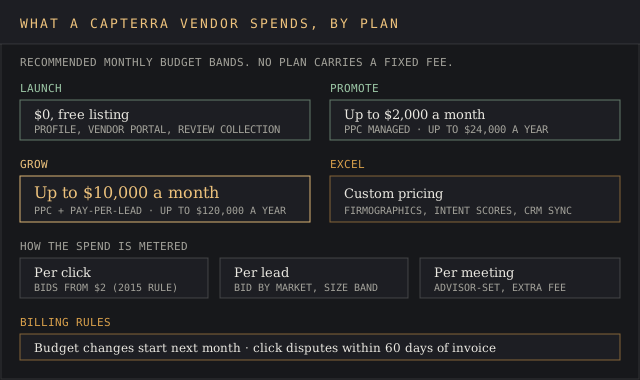
That's usage-based pricing, and Capterra's own software buyer's guide, dated 22 January 2026, defines the model for its users: "Costs scale with activity, such as transactions, storage, and API calls." Swap transactions for clicks and the definition fits the vendor side.
The sign-up sheet still carries Gartner branding eight months after the sale. G2 Digital Markets' own vendor site lists three programs (Engaged Buyers, Qualified Leads and profiles) without a dollar figure, so those bands are the only public pricing info for software vendors on any of the four platforms G2 now runs.
What vendors pay to reach on Capterra
Free access for buyers is the product vendors pay for. Capterra lists business software across 900+ categories, and its free research tools let users search a software category, filter by features and industry, read detailed reviews with star ratings, and run comparisons of software solutions before they purchase. A sponsored click lands on the vendor's website mid-research.
The buyer tools a sponsored profile competes inside:
- Category pages, where users from businesses of every size sort software tools by sponsorship, ratings or reviews.
- Product profiles listing features, screenshots, pricing details and reviews from customers.
- Compare tools that set products into side-by-side comparisons of features and prices.
- Shortlist reports ranking the best software in each category by ratings and search volume.
- Advisor calls through Software Advice, matched to each user's stated preferences.
G2 Digital Markets sizes that audience at "100M+ active annual buyers" and "2.5M+ verified customer reviews." Its profiles pitch cites a G2 survey dated February 2026: "54% of software buyers use AI chat when building their shortlist." Gartner listed the same shift as a risk in its 10-K, where AI answers "could reduce the need to enter our websites," the traffic every PPC click depends on. That moves research by users off the category page and into chat comparisons.
Capterra's vendor page pitches three outcomes: build a brand, capture demand, and "Gain actionable insights backed by real buyer behavior and market trends." Those insights come in grades. Free profiles get reviews insights, paid plans add click insights, and the Excel plan adds account-level buyer insights, which is where the price climbs.
Capterra pricing plans for vendors
Capterra's plans each stack features on the plan below, and only Launch has a fixed price.
Launch: the Capterra free listing
The free tier covers a software profile, Vendor Portal tools to edit "product profile description, feature lists, marketing assets, and more," reviews collection from a vendor's customers and a website consultation. The "Get Your Product Listed" button on Capterra's vendor page now opens G2's product form, so software providers create a listing on g2.com and it syndicates out.
A free listing gets the ball rolling, and free access has a hard ceiling. Category pages show users a sponsored sort by default, and a free profile is displayed under every vendor paying for a click, whatever its reviews. Paid features start at Promote.
Promote: up to $2,000 a month
Promote is the first paid plan. It adds managed PPC, landing page optimization, buyer targeting in "30+ countries" and an account service team. At its ceiling, a year of Promote spend comes to $24,000, eight times G2's year-one Starter fee, a figure worth having when vendors compare the two. The PPC budget tools let a vendor cap monthly spend well under the band.
Grow: up to $10,000 a month
Grow is the first paid plan focused on PPL. It adds "PPC campaign expansion and optimization," PPL campaign management, CRM integration, a "Competitive Comparison" feature, reviews collection "across eight languages" and a dedicated rep. The feature places a vendor inside buyers' comparisons and is the closest Capterra comes to selling competitive intelligence. A full year at the ceiling costs $120,000, and G2's $2,999 Starter fee is a drop in the bucket next to that.
Excel: custom pricing
Excel is the quote-only paid plan, focused on data features:
- "Account-level identities and firmographic data" on users who visit.
- "Daily export of buyer activity data," with API access.
- Integrations with three tools: Salesforce, HubSpot and Snowflake.
- "Product Awareness, Buyer Engagement, and Purchase Intent scores."
Those scores turn visitor insights into buyer intent data, the product G2 sells as a separate add-on and the subject of our intent data pricing report. G2's acquisition release promised "up to 3x more Buyer Intent signals," which tells a vendor where the next paid tier is headed.
How Capterra PPC advertising bills
One PPC campaign buys placement across a three-site network. Capterra's PPC advertising terms, the PPC Service Description, let a vendor "create advertising campaigns" shown to users "searching for business software or services on www.capterra.com, www.softwareadvice.com or www.getapp.com." To run one, a vendor must "upgrade to a Sponsored Profile, activate a PPC Campaign, and receive approval from a G2 Digital Markets representative."
Bids are set per category, so software companies compare their bid with every rival in it, and the average bid in a category sets the real price of entry. Capterra's 2015 explainer, What is PPC?, put the floor at $2: "Bids start at $2 per click and can be increased in $0.25 increments." It gave the ranking rule too: "The higher the bid, the higher up in the directory a vendor is displayed." G2's Engaged Buyers program now counts "1,200+ Software categories" to bid on.
The terms set the billing basis in one sentence, typo included: "Vendor is responsible for all fees based on the set budget set and the resulting clicks activity from the PPC Campaign." The service description names no minimum bid and no minimum monthly budget. The plan bands are the only spend thresholds the platform publishes.
PPC comes with three features: a Sponsored Profile, Conversion Tracking and Reporting & Analytics. Four mechanics shape what it costs in practice:
- Reporting tools: access to a Click Report showing clicks by category and date, the average cost per click and total monthly spend.
- Budget changes and campaign pauses "take effect at the start of the following month."
- Conversion tools credit a click for 30 days, once the vendor installs a code snippet.
- Invalid-click claims are "considered on a case-by-case basis" and must be filed within 60 days of the invoice date.
The monthly lag is the one to keep an eye on. A vendor that spots a bad click spike on the 3rd still pays the old budget until the 1st of the next month. Vendor Account users, the staff a vendor designates, all work inside that same billing cycle, and admin users manage who else has access.
Pay-per-lead and booked meetings
PPL runs through human software advisors. Capterra's PPL Service Description describes "a structured needs analysis and qualification process," and vendors gain "the ability to bid for leads by market and size band." G2's Qualified Leads program counts "60+ Software advisors" and "40+ Markets supported," screening businesses in each market on budget, authority, need and timing, with output "powered by buyer insights your sales team can act on."
PPL features include a summary of the vendor's lead criteria, email delivery and a downloadable report. Three items cost extra on top of each PPL bid:
- Booked meetings: "An additional fee may apply for successfully scheduled meetings," refunded if the buyer no-shows and can't reschedule.
- Expansion contacts: buyers who meet "most, but not all" of a vendor's criteria, sold as a separate purchase.
- CRM integration with a vendor's sales tools: "Additional fees may apply."
Refunds follow a policy "available in the Vendor Account," readable only after sign-up. The advisor desk is Software Advice's core business, covered in our report on Software Advice and its PPL model.
Review incentives and the rules vendors sign
Capterra pays for reviews with gift cards, and vendors run the reviews campaigns that recruit their customers. The Community Guidelines, last updated 4 May 2026, set the terms: incentives "must not exceed nominal value," go out "regardless of the rating provided," and are paid "only to a predetermined number of unique published reviewers."
Vendors create those campaigns through the Vendor Portal's review tools, must use the incentive link the portal provides, and must accept all verified reviews from an incentivized campaign.
The reviewer incentive FAQ adds the payout rules. Some campaigns cap payouts at "ten (10) reviews per campaign and/or per person," gift cards go out within three weeks of publication, and unclaimed ones expire after 30 days. Capterra publishes no fixed gift-card value.
Incentivized reviews carry a "Reviewer Source" icon, so users reading reviews can see which reviews were paid for. Video reviews don't count toward ratings, per the same guidelines.
Those review incentives sit inside a federal rule. The FTC voted 5-0 on 14 August 2024 to ban compensation "conditioned on the writing of consumer reviews expressing a particular sentiment," with civil penalties for knowing violators. A rating-blind gift card is the structure that rule permits, and Capterra also bars vendors from "selectively targeting users based on expected sentiment."
Capterra's verification explainer counts 2.5 million+ verified reviews, "more than 30" human moderators and "more than 20 control checks" per review. Its guidelines say the team won't "edit content at Vendor's request or simply because content is negative." Founders of software businesses who've run the campaigns describe what happened on their side.
"Capterra offered me and my customers something like $20 gift cards for the first 100 reviewers and I sent 500 emails with this offer and maybe had 1 reviewer bite and then later said he never received a gift card."
Hacker News, semireg, indie developer selling label printer software, 11 April 2021
"Then, they upsell the B2B vendor on the ability to manipulate those reviews; e.g., you pay an extra fee to triage negative reviews by telling customer support "nope, not a confirmed user - please remove.""
Hacker News, alexbrower, writing about Capterra, G2Crowd and TrustPilot together, 9 November 2020
Badges carry no listed fee. The Shortlist promotional hub says placement comes from "the overall rating from your software user reviews and search volume," and the badge "may be used in perpetuity" with attribution. G2's free tier licenses one badge, "Users Love Us," after 20 reviews with an average of 4.0 stars or better. Capterra's Shortlist badge needs a link to the relevant report, and the hub lists no fee for the badge displayed on a vendor's site.
What vendors report about clicks and conversions
Accounts from software companies on public forums span 13 years and land in one place: Capterra traffic converts at a price. A founder posting on Hacker News on 1 March 2012 called Capterra "HUGE for us" and added, "but we spend a lot of $$$$ with them."
"Capterra will drive good leads initially but they'll fall off after a while. Keep an eye on your spend there and pull it if the conversions dry up. Get App always had too high a cost of entry for me to try."
Hacker News, simonswords82, founder of an HR software app, 20 June 2016
"I don't think having a profile alone is enough given the amount of competition (you'll be buried in results), but acquiring reviews and paying for ads have worked for my SaaS. It's a bit expensive but the audience is generally pretty qualified"
Hacker News, blue232323, SaaS founder, 11 January 2023
"Its PPC services could be far more advanced and have far more options for targeting businesses"
TrustRadius, verified user, marketing professional at a company of 11-50 employees, 10 June 2025
Read between the lines and the pattern holds. Early clicks convert into customers, the free profile gets buried, and Capterra's targeting tools stop at the category and country. The same TrustRadius reviewer asked Capterra to "Provide better insights data." A vendor buying a category buys every company browsing it, from small businesses to enterprise companies, at one bid.
Which software companies should choose Capterra
Capterra's pricing model rewards companies that can measure a click with their own analytics tools. The fit looks like this:
- SMB-focused software companies whose solutions sell to small businesses and mid-market organizations that research on review sites.
- A high-traffic category, where 1,000 clicks a month is a realistic purchase.
- A sales team that calls PPL contacts the same day and turns them into customers.
Enterprise software companies selling through RFPs get less value, since their customers rarely shortlist from a category page. Niche businesses hit the fall-off simonswords82 described, and a bid that climbs while conversions fall is the red flag to watch.
For them the free listing plus reviews collection is the straightforward choice, and the paid plans are a long shot until reviews, ratings and click insights pile up. Decide on the paid tier after the free profile reaches 20 reviews from customers, the same mark G2 uses for its free badge.
Contract terms that change the bill
The devil's in the details of the General Vendor Terms, last updated 4 May 2026. The contracting party is G2.com, Inc., Capterra Inc., Software Advice Inc. or Nubera eBusiness S.L. for GetApp, and fees follow "the insertion order (or similar transacting document)." These clauses move the real cost:
- Collections: a vendor that falls behind reimburses costs "including attorney's fees."
- Liability cap: fees paid "in the 12 months preceding the claim."
- Disputes: binding arbitration in Chicago under ADR Systems, with a jury-trial waiver.
- Deadline: any claim "MUST BE COMMENCED WITHIN ONE (1) YEAR."
- Warranties: the vendor "complies with all applicable security standards."
- Changes: "Continued use" of PPC or PPL means acceptance of any update.
None of it is set in stone, which is the trouble. Save a PDF of both service descriptions the day the insertion order is signed, because the live text can change under a running campaign.
What the G2 acquisition changed for Capterra pricing
Gartner bought Capterra in September 2015 without disclosing terms, one of two deals that year alongside Nubera, the GetApp operator. Gartner sold all three businesses a decade later. They sat inside the segment Gartner renamed from Research to Insights in 2025, and the filings tell the exit story straight from the horse's mouth:
- Q3 2025: Digital Markets moved out of Gartner's Insights segment into a line called "Other."
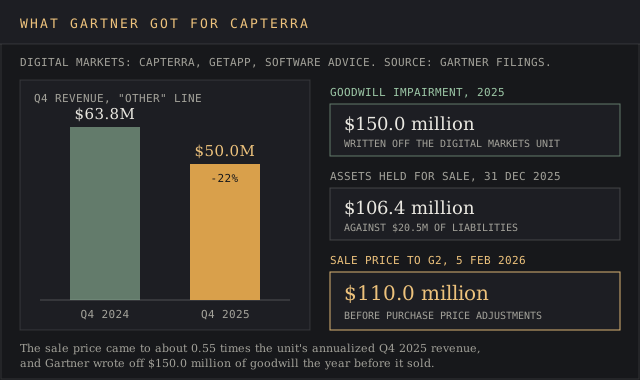
- 2025: a $150.0 million goodwill impairment, blamed on "ongoing weakness in the market."
- 31 December 2025: $106.4 million of assets held for sale against $20.5 million of liabilities.
- 5 February 2026: sale closed "for approximately $110.0 million."
Revenue was falling into the sale. Gartner's Q4 2025 results put the "Other" line at $50.0 million, down 22% from $63.8 million a year earlier. Annualize that quarter and the $110.0 million price comes to about 0.55 times a year of revenue. Gartner kept its subscription Insights business, the lion's share of its revenue at 78% in 2025.
G2 announced plans for the purchase on 29 January 2026. Its acquisition release claimed "200+ million annual software buyers" and "nearly 6 million verified customer reviews," and promised "new pay-per-lead offerings." CEO Godard Abel called it "a transformational moment for G2, and, more importantly, the global B2B software industry."
Vendor accounts are now G2 Digital Markets accounts on one platform, and disputes run to Chicago. The jury's still out on rates, since neither service description carries a dollar figure.
Capterra vs G2 pricing for vendors
G2 bills an annual subscription to its platform, and the table uses G2's published plans for its column. Our G2 pricing report covers G2 Marketing Solutions in full, and our G2 review covers the platform.
| Line item | Capterra (G2 Digital Markets) | G2 Marketing Solutions |
|---|---|---|
| Free listing | $0, Launch plan | $0, Free plan |
| Replying to reviews | $0, Vendor Portal reply tools | Starter plan and up ($2,999/yr) |
| Entry paid spend | Up to $2,000/month (Promote band) | $2,999 year one, $6,000 year two |
| Billing unit | Per click, per buyer contact, per meeting | Annual subscription or $299/month |
| Starting click bid | $2 (2015 rule) | G2 Clicks, no published bid |
| Badges | Shortlist badge, usable "in perpetuity" | Report badges need Starter or above |
| Intent data | Excel plan, custom pricing | Buyer Intent add-on, quote only |
Every figure is a published list price or plan term, and no cell carries a Vendr figure. The Capterra column comes from Gartner Digital Markets' vendor sign-up page and Capterra's legal pages, with the $2 starting bid taken from Capterra's 2015 PPC explainer and the badge terms from its Shortlist promotional hub. The G2 column comes from sell.g2.com/plans.
Comparisons between the two start with the billing unit. G2's subscription renews at double, $2,999 to $6,000 for its Starter customers, and the features above Starter are quote-only.
The comparisons that matter run on a vendor's own numbers. The Click Report's average cost per click lets a vendor compare Capterra with Google Ads or G2 Clicks, analyze click insights per category, and turn the 30-day conversion window into cost per buyer contact. Vendors weighing G2 and GetApp now buy both from one owner, and the intent data providers outside it are the main independent tools for buyer signals.
What to budget for Capterra
Business leaders signing off a Capterra budget should start from the bid. The Click Report math is straightforward: at the 2015 floor of $2, a $2,000 Promote budget buys 1,000 clicks, and a 2% click-to-contact rate would put each buyer contact at $100.
Businesses in categories with higher average bids pay more per contact, and costs scale with every bid step. Research the category's average bid before the first month, then bite the bullet on one full billing cycle. Capterra's buyer's guide tells readers to "model pricing based on" team size, expected growth and usage, and the advice fits a vendor's ad budget.
Total cost runs past the click invoice:
- Landing pages the vendor creates and the conversion tracking tools it maintains.
- Meeting fees, expansion contacts and CRM integration fees on PPL.
- Staff hours to manage reviews campaigns and reply to negative reviews.
- Analytics tools to tie clicks to closed deals.
- A one-month lag on every budget cut.
Run one category for one billing month, analyze the Click Report, then compare cost per contact with your other channels and cut your losses if Capterra comes out behind. Click insights from month one set the bid for month two.
Count closed deals and new customers from each campaign at month end, since comparisons across channels need one metric: cost per buyer contact. Vendr's Capterra marketplace listing carries no tracked deals, so a vendor's own invoices are the only benchmark.
Frequently asked questions
Is Capterra free for vendors?
Yes, for a basic listing. The Launch plan costs $0 and includes a profile, Vendor Portal access and reviews collection. Sponsored placement, PPL and buyer data features cost money.
What are Capterra's pricing plans?
Launch (free), Promote (budgets up to $2,000 a month), Grow (up to $10,000 a month) and Excel (custom pricing). Each paid plan bills by clicks and buyer contacts, and that's all the pricing info Capterra publishes.
How much does Capterra cost?
Nothing for buyers. Vendors pay per click from a $2 bid under the 2015 rule, plus PPL bids on Grow and above; a year at the top of Grow costs $120,000. Compare that with $2,999 for G2's Starter tier in year one.
What exactly does Capterra do?
Capterra helps users at businesses find the right software. It lists business software across 900+ categories, publishes verified reviews, research and comparisons, and sells sponsored placement and buyer insights to software providers.
Is Capterra free to use?
Yes. Users at businesses get free access to software search tools, reviews, ratings and comparisons, funded by the vendors who pay for clicks and buyer contacts.
How much does Capterra pay for reviews?
Capterra publishes no fixed amount for reviews. Its guidelines cap incentives at "nominal value," and a Hacker News founder described $20 gift-card offers.
Is Capterra a reputable site?
It's a real company with published reviews rules and 2.5 million+ verified reviews, owned by G2 since February 2026. Our Capterra trust report covers the reviewer complaints.
What are the best Capterra alternatives?
Vendors compare Capterra with G2 Marketing Solutions, TrustRadius and paid search, the three channels competing for buyers who search for the best software in a category. G2 and Capterra share an owner now, so companies wanting an independent second review platform have fewer choices than in 2025.
Bottom line
Under Capterra pricing, vendors pay no platform fee to list, collect reviews or reply to them, and nothing fixed to advertise. The cost is a bid times a click count, plus PPL and meeting fees on Grow, inside budget bands that top out at $10,000 a month before custom pricing takes over.
The terms favor the house: month-long lags on budget cuts, a 60-day dispute window, Chicago arbitration and service descriptions that change by continued use. G2 bought the three sites for $110.0 million as revenue fell 22%, and it hasn't published new rates.
Test one category for one month with the Click Report tools, track every click to a buyer contact, and treat the Gartner-era bands as a ceiling to stay under.
Where each Capterra figure comes from, and the rates G2 keeps off every page
Plan names, budget bands and plan features are read off Gartner Digital Markets' vendor sign-up page at digital-markets.gartner.com. Billing, dispute and refund rules come from Capterra's PPC and PPL Service Descriptions at capterra.com/legal.
Capterra's General Vendor Terms and Community Guidelines, both last updated 4 May 2026, supply the contract clauses and incentive rules, and the reviewer incentive FAQ at review.capterra.com the payout rules. The $2 starting bid comes from Capterra's 2015 PPC explainer at capterra.com/resources.
Capterra's FAQ, vendor page, review-verification explainer and software buyer's guide (dated 22 January 2026) are on capterra.com, and the badge terms on its Shortlist promotional hub at insights.capterra.com. Audience figures and the February 2026 G2 survey come from g2digitalmarkets.com, G2's plans from sell.g2.com/plans, and its 29 January 2026 acquisition release from company.g2.com.
The sale price, goodwill impairment and held-for-sale figures come from Gartner's 2025 Form 10-K at sec.gov, the Q4 2025 revenue line from Gartner's results release on businesswire.com, and the 2015 acquisition from Gartner's 25 September 2015 release at gartner.com.
The incentive rule is the FTC's 14 August 2024 release at ftc.gov. Vendor quotes come from Hacker News threads dated 2012 to 2023 at news.ycombinator.com and a TrustRadius review dated 10 June 2025. Vendr's Capterra page at vendr.com/marketplace lists no tracked deals. All URLs accessed 6 October 2026.
Neither Capterra nor G2 Digital Markets publishes a current minimum click bid, a per-lead or per-meeting rate, a gift-card value or a price for the Excel plan.