Is GetApp legit? What the ownership records and review data show
 By Jan Suski, six years working in digital. How the scoring works.
The numbers GetApp ownership and review record, checked 14 August 2026
The domain and ownership records back a real, operating company, not a shell.
A 2.2-star Trustpilot average and a five-year-stale verification policy page say more about how GetApp handles complaints about itself than about the software listings it grades.
GetApp's owner already changed again: G2 closed its purchase of the company on 5 February 2026, one week after announcing it.
GetApp's two verification policies disagree with each other. The Reviews FAQ, last updated September 2021, says an "i" icon marks an incentivized review. The Community Guidelines, updated May 2026, describe a "Reviewer Source" icon instead, and neither page mentions the other. That five-year gap sits under a platform holding a 2.2 out of 5 rating on Trustpilot.
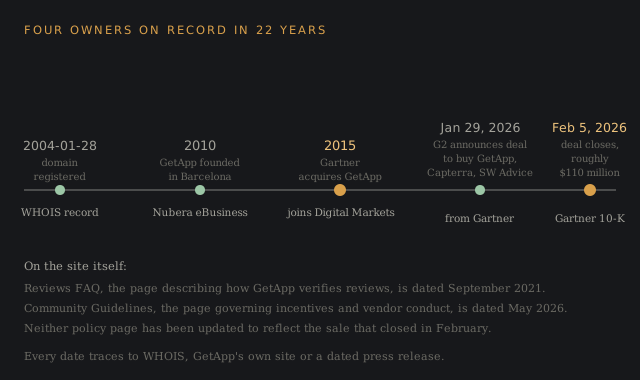
A WHOIS record confirms GetApp is a real company: the domain has run since January 28, 2004, the business was founded in Barcelona in 2010, and Gartner sold it to G2 in a $110 million deal that closed 5 February 2026. This report checks GetApp's own policy pages against that ownership record, its Trustpilot record, and the WHOIS registry, since a domain's age is a separate fact from if the reviews on it are real.
It's for a business leader deciding if a "Category Leader" badge is worth following before clicking through to a vendor, and for a software vendor weighing GetApp's pay-per-click and pay-per-lead programs against what they return. GetApp's own tagline promises "data-driven software recommendations," and most buyers testing that claim start with the same search this report answers: "is GetApp legit."
Is GetApp legit as a company: what the domain and ownership records show
GetApp's own About page names the legal entity behind the trademark: Nubera eBusiness S.L., with a VAT number registered in Spain and a US contact address at 100 S. Wacker Dr., Chicago. The footer carries a "16+ years recommending software" badge and copyright dating to 2010, matching the founding year reported by B2B SaaS Reviews, which names Christophe Primault and Manuel Jaffrin as co-founders.
The same page lists a Spanish phone number alongside the Chicago address, so a vendor or buyer can reach GetApp by phone or by mail, not only through a web form.
GetApp's earliest public Category Leaders methodology, published in 2017, described the badge as covering "the leading cloud-based software products in the industry." The current About page drops the word "cloud" entirely and just says "software," a small wording shift that tracks how unremarkable cloud delivery has become since.
Scamadviser's technical check adds independent confirmation: a Tranco traffic ranking in the top tier for site popularity, a valid SSL certificate issued by Google Trust Services, and a registrar (CSC Corporate Domains) that the site itself calls "well known and respected." None of that is a GetApp marketing claim. It's a third-party lookup against the domain's own registration data.
How GetApp's review sites compare on who checks the software vendors
GetApp isn't a standalone catalog. Its own Category Leaders methodology page states plainly that "review scores are calculated using reviews collected from GetApp and its sister sites, Software Advice and Capterra." A review submitted on any one of the three shows up on all three, since they run the exact same catalog under Gartner Digital Markets.
| Site | Review catalog | Revenue model | Owner as of Aug 2026 |
|---|---|---|---|
| GetApp | Shared with Capterra and Software Advice | Pay-per-click plus pay-per-lead | G2, since deal closed 5 Feb 2026 |
| Capterra | Shared with GetApp and Software Advice | Pay-per-click plus pay-per-lead | G2, since deal closed 5 Feb 2026 |
| Software Advice | Shared with GetApp and Capterra | Pay-per-click plus pay-per-lead | G2, since deal closed 5 Feb 2026 |
| G2 (the acquirer) | Separate catalog; over 100 million annual visitors per its own materials | Subscription and marketing packages | Independent; now owns the other three |
GetApp's own community guidelines confirm the pay-per-click and pay-per-lead programs directly, linking to dedicated "PPC Service Description" and "PPL Service Description" policy pages for vendors. Free product profiles exist alongside the paid tiers, so a listing showing up in search results doesn't by itself mean a vendor paid for placement.
GetApp's resources page discloses a third revenue line too: it may earn referral fees when a buyer clicks through to a vendor's own site, on top of what vendors pay directly for PPC and PPL access.
Gartner Digital Markets runs a fourth, differently shaped site alongside the three software catalogs. UpCity connects buyers with service providers, marketing agencies among them, and covers categories from commercial property management to freelance development. It's worth knowing about as a fifth data point when cross-checking GetApp against other platforms, even though it doesn't share GetApp's review catalog.
Buyers get a comparison tool on top of the review catalog: any product page lets a shopper add up to four apps to a side-by-side comparison, and a "Users Also Considered" tab surfaces similar products under the same listing. GetApp also runs a free advisory service that connects a buyer to a software advisor over a 15-minute call, a service layered on top of the review data.
What GetApp promises reviewers versus what its own pages show
GetApp's Reviews FAQ describes a real verification step: "the team verifies the reviewer's identity, checks for conflicts of interest, and evaluates the review against our site guidelines." The site also says it screens for "generative AI and plagiarized content."
The platform publishes negative reviews alongside positive ones by policy, not by accident: one-star reviews get the same treatment as five-star ones, per the same page, and a review found to be fraudulent gets removed along with the reviewer's ability to post again. Reviewers are also told to protect their own privacy and any vendor's, since the guidelines bar personal or identifying details from a published review.
Recency and completeness both count toward a review's weight in GetApp's own scoring. Reviewflowz, which tracks Gartner's ranking factors for vendors, notes that recent reviews are more valuable than old ones and that a complete, fully answered review carries more weight than a rushed one.
Vendors don't apply to be considered for a Category Leader badge either: GetApp's FAQ states it will "automatically consider all products with profiles on our site" that meet the eligibility bar.
Incentives run through a documented payment path. Gartner Digital Markets typically distributes a nominal $10 payment, usually an Amazon voucher, once an incentivized review publishes, per Reviewflowz's account of the program. Undisclosed or repeated incentive violations trigger what GetApp's own policy calls an "incentivization notice" before a review is removed.
GetApp's newer Community Guidelines, updated May 2026, add detail the 2021-dated FAQ doesn't carry. Incentivized reviews now display a "Reviewer Source" icon. The 2021-dated FAQ describes an "i" icon, and vendors caught using non-disparagement clauses to suppress a bad review face account penalties under a "Buyer Alert" system: a warning email, then a disabled listing, then a public alert banner on the vendor's own profile page.
The policy reads well. What a reviewer experiences trying to use it is a separate question. One Trustpilot reviewer, in a review last updated September 7, 2022, described trying to leave a review on GetApp itself:
"This is the most confusing site. If anyone knows how to go about writing reviews from the site itself, please guide me because the support team can't."
Trustpilot review of GetApp, last updated 7 September 2022.
That single review doesn't overturn a documented verification process covering 2.5 million reviews. It does explain why a site with real fraud controls can still sit at 2.2 stars on a review platform it doesn't own: most of GetApp's Trustpilot complaints are about site usability and vendor-side support, not fabricated reviews.
The incentive rule GetApp cites traces to a real regulatory requirement. It isn't an invented courtesy. Its Reviews FAQ points to "the Federal Trade Commission (FTC) Endorsement Guidelines," which require online platforms to disclose when a review was submitted for a reward.
The same page cites a 2009 case, settled by then-New York Attorney General Andrew Cuomo, in which a company posting fake reviews paid a $300,000 penalty. That case involves neither GetApp nor Gartner. GetApp cites it as the legal backdrop for why incentive disclosure and identity verification exist as line items in its policy at all.
Two of GetApp's own policies also disagree with each other on a small but checkable detail. The 2021-dated Reviews FAQ says an "i" icon marks an incentivized review. The 2026-dated Community Guidelines describe a "Reviewer Source" icon instead. Neither page cross-references the other, which is the kind of gap a five-year update cycle leaves behind.
G2 completed its purchase of GetApp from Gartner in February 2026
On January 29, 2026, G2 announced a deal to acquire Capterra, Software Advice and GetApp from Gartner. The deal closed fast: G2's own LinkedIn account posted "we've officially closed on our acquisition" on February 5, and CEO Godard Abel welcomed "new colleagues from Capterra, Software Advice, and GetApp to G2" after visiting their offices.
Gartner's 10-K filing puts the price at roughly $110 million, a figure the January release never disclosed. Abel had called the deal "a transformational moment for G2 and, more importantly, the global B2B software industry" when it was announced.
The combined company, per G2's own release, would:
- Hold 6 million verified, trusted customer reviews across the four platforms
- Reach more than 200 million annual software buyers globally
- Serve more than 10,000 software vendors with marketing tools
- Cover more than 2,000 software and service categories
Neither of GetApp's policy pages, the Reviews FAQ or the Community Guidelines, mentions the change of ownership at all, six months after it closed. Industry coverage of the deal expects no immediate changes to GetApp's branding or badge programs in the short term, with integration questions (a unified taxonomy, standardized vendor dashboards) left for 2026 and 2027.
The "200 million" buyer figure in the release spans software buyers around the world, not limited to North American users on GetApp's own Category Leaders scoring counts.
What this means for business leaders comparing software companies
A business leader worried that GetApp is a scam can drop that concern. The WHOIS record, the SSL certificate, the Spanish trademark filing and the G2 acquisition that closed in February 2026 all point to the same operating company. None of it resembles a spoofed lookalike.
The real diligence question is different. GetApp earns pay-per-click and pay-per-lead revenue from the same software companies its rankings evaluate, so a "Category Leader" badge reflects a documented scoring formula. It isn't an independent lab test, and the formula itself is public.
To earn a "Category Leader" badge, GetApp's published methodology requires a product to carry at least 20 unique reviews published within 24 months of the report's research window. Scoring then runs across five weighted categories, each worth up to 20 of a maximum 100 points:
- Ease of use
- Value for money
- Functionality
- Customer support
- Likelihood to recommend
The site states products are "represented, included, and/or scored solely based on user reviews and independent of any relationship that GetApp has with vendors." Reading the methodology page before trusting the badge is the fastest way to check that claim for yourself, category by category.
Not every product present on GetApp qualifies. The 20-review, 24-month bar filters out newer or thinly reviewed listings before scoring starts, and eligibility also runs through country, since reviews have to come from North American users for a product to compete for the badge at all.
Earlier formulas graded more than reviews. Versions 1 through 5 (2015 through early 2020) devoted a fifth of the total score to how secure a vendor's own completed survey showed its product to be, and another fifth to native iOS and Android device support, before the current version 6 dropped both in favor of the five review-based categories above.
A vendor's public listing is one example of what that scoring produces: B2B SaaS Reviews points to Ramp's accounting-software profile as an optimized Category Leader page, badge and all. It's a useful reference for what a fully built-out listing looks like next to a bare one, before picking a software solution off the strength of a badge alone.
How to verify any review website's popularity and security claims
This site weighs GetApp's own claims against WHOIS records, Trustpilot data and G2's acquisition filings, the standard our editorial policy sets for every report published here. The checks below apply to any software review website claiming a popularity score or a security badge, not only GetApp. Running them takes a few minutes:
- Pull the domain's WHOIS record to confirm how long the website has operated
- Check for a valid SSL certificate before creating an account or entering personal details
- Read the site's verification and security pages, not marketing copy
- Compare a popularity or ranking claim against other review platforms on the same list of finalists, since buyers rarely trust one site alone
- Look up the parent company on Google to confirm who owns the tools and data behind the badge
GetApp passes this checklist today. Its documented features, identity verification, incentive disclosure and fraud takedowns among them, hold up against its own policy pages, and the account and review-writing process, however "confusing" one Trustpilot reviewer found it, produces a published, checkable review.
Next steps: where to find more reviews before you decide
No single review site, GetApp included, should carry a purchase decision alone. Cross-checking a shortlist against a second and third source catches the gaps any one platform's incentive structure creates:
- G2 and TrustRadius run separate review catalogs from Gartner Digital Markets, useful for a second opinion on the same vendor
- Trustpilot and the Better Business Bureau surface vendor support and billing complaints and feature requests
- The vendor's own pricing and security pages confirm if a GetApp listing matches what the company publishes elsewhere
For a vendor deciding if GetApp's paid programs are worth the spend, the next step is reading the PPC and PPL service description pages linked from GetApp's Community Guidelines, since bid mechanics and lead-qualification rules sit in those documents.
Frequently asked questions
Is GetApp (getapp.com) safe to use?
Yes. ScamAdviser's technical scan rates it "Very Likely Safe," the domain has been registered since 2004, and the company discloses its legal entity, VAT number and physical address on its About page. Safety and review trustworthiness are separate questions: the site is safe to browse, and its reviews go through a documented identity-verification process, even though its own Trustpilot score for customer service sits at 2.2 out of 5.
What is GetApp used for?
GetApp is a B2B software discovery and comparison site. Buyers browse categories, read verified reviews, and compare pricing across products; vendors claim free profiles or pay for sponsored placement and lead generation through GetApp's pay-per-click and pay-per-lead programs.
Is "GetApps," the Android app store, the same company as GetApp.com?
No. "GetApps" (with an "s") is a preinstalled Android app store bundled with Xiaomi's MIUI and HyperOS software, unrelated to GetApp.com's B2B software review business. Questions about if you can delete GetApps, or if it's a Chinese-made app, concern Xiaomi's app store. They don't concern the site covered in this report.
What are other reliable sites for comparing business software?
G2 and TrustRadius run independent review catalogs outside Gartner Digital Markets. Software Advice and Capterra share GetApp's own catalog, so they won't add an independent second opinion, only a different presentation of the same reviews.
Bottom line
GetApp is a legitimate, 16-year-old company, now under new ownership after Gartner sold it to G2 in a deal that closed February 5, 2026. Its review-integrity machinery (identity checks, fraud takedowns, incentive disclosure) is real and documented, across policy pages that range from current to five years overdue for an update.
The risk for a buyer isn't fraud. It's mistaking a vendor-funded ranking for an independent lab result. Read the Category Leaders methodology before trusting the badge, and check a second review source before trusting the star rating, the same way you'd check a second source on any other business claim.
Sources, and what GetApp's own policy pages don't cover
GetApp's About page, Category Leaders methodology, Reviews FAQ and Community Guidelines are read from getapp.com's own legal and resources pages, guidelines updated May 2026, FAQ dated September 2021. The Trustpilot rating and reviewer quote are from trustpilot.com's GetApp listing. The WHOIS registration date, SSL and registrar details are from ScamAdviser's domain lookup.
The founding date and co-founder names are from B2B SaaS Reviews. The acquisition announcement and combined-network figures are from G2's own PR Newswire release dated 29 January 2026; the closing date and deal price are from Gartner's 10-K filing and G2's own 5 February 2026 LinkedIn announcement.
Incentive-payment detail is from Reviewflowz's account of the Gartner Digital Markets program. All figures checked 14 August 2026. GetApp publishes no public log of how many reviews it rejects, no breakdown of incentivized versus non-incentivized review volume, and no confirmation of if GetApp keeps operating as a separately branded site now that G2 owns it.