Supply chain management software price in 2026, from $29 a month to $3.8M a year
 By Jan Suski. I go deep on every review, checking every number against its source and digging up details other coverage misses, a habit from six years of SEO and link building for tech companies. Bylines at Surfer, Brand24, and Senuto. How the scoring works.
The cheapest supply chain management software with a public rate card costs $29 a month. Zoho Inventory's Standard plan runs at that price, billed annually, for 500 orders a month. At the other end, the US Defense Commissary Agency has obligated $11,457,629 to Manhattan Associates for warehouse management software as a service across a three-year base period, about $3.8 million a year.
The cost of supply chain management software in between sorts by who publishes a number. SMB inventory tools put list prices on their own pages. Microsoft and Oracle publish per-user rates. SAP prices its planning suite in blocks of €500 million of the buyer's revenue. Kinaxis, o9 Solutions and Blue Yonder publish nothing, so the only hard data is public procurement records, company filings and Vendr's tracked contracts.
This report covers the supply chain management software price for 18 vendors across five segments: planning, execution (WMS and TMS), visibility, risk & analytics, and SMB inventory. Every price comes from the vendor's own domain, a public contract record, a filing or Vendr's marketplace header.
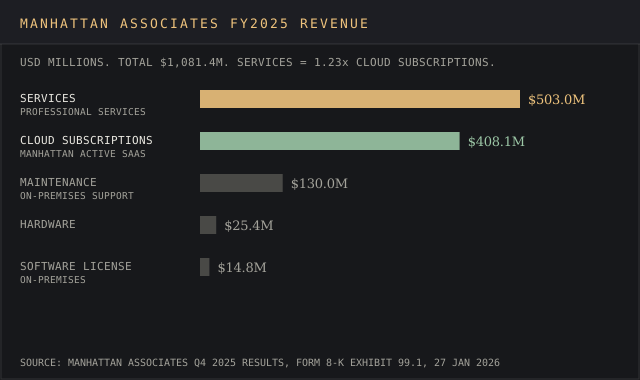
It's written for operations & finance buyers building a supply chain management software budget, and it ends on what implementation, data migration and ongoing maintenance add to the subscription. Those extras decide the budget: Manhattan Associates earned $1.23 in services for every $1 of cloud subscriptions in 2025.
The numbers Supply chain management software prices across 18 vendors, checked 6 October 2026
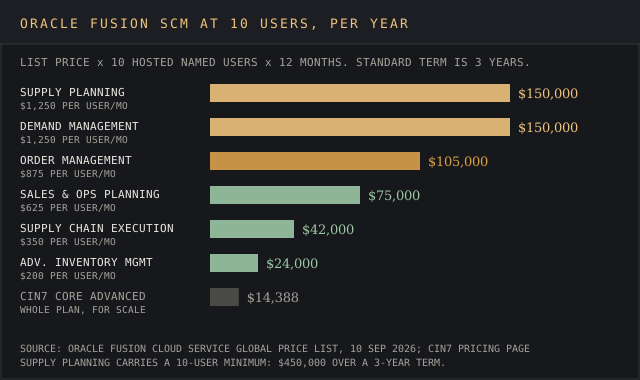
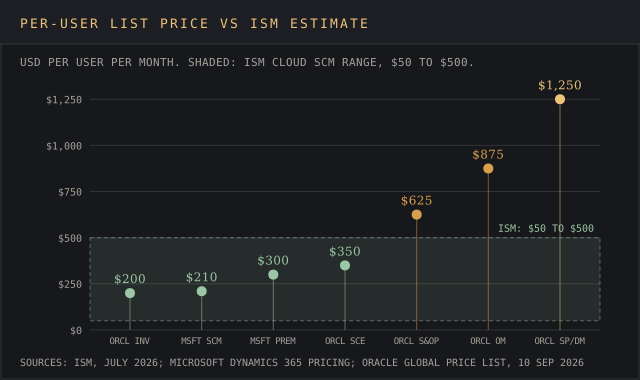
Per-user list prices for supply chain management software run from $200 to $1,250 a month, so one planning module for ten Oracle users costs $150,000 a year before services.
Manhattan Associates booked $503.0 million in services against $408.1 million in cloud subscriptions in 2025, which puts the services bill above the software bill at the vendor level.
A small business can run inventory tracking for under $3,000 a year on published plans; a planning suite starts where those plans end.
Supply chain software pricing models, from per order to per €500M of revenue
Seven billing units show up across the 18 vendors in this report, and most supply chain management software uses two or three of them at once. The unit decides how SCM software costs grow, so get on the same page with the sales rep about it before any demo.
- Order-volume tiers. Zoho Inventory caps each plan by orders a month: 500, 3,000, 7,500 and 15,000.
- Flat package fee. SAP's IBP starter edition is one monthly fee for a fixed bundle of modules and 10 concurrent users.
- Per named user. Oracle bills each SCM module per hosted named user; Microsoft bills Dynamics 365 per user a month.
- Per module. Katana sells warehouse management at $149 a month and traceability at $249 on top of its base plan.
- Usage-based. Katana's Core plan meters sales orders; Microsoft's Intelligent Order Management is $315 a month for 1,000 order lines.
- Revenue or cost-of-goods blocks. SAP IBP foundation bills in blocks of €500 million of annual revenue, and its demand-driven replenishment module in blocks of €350 million of cost of goods.
- AI credits. Dynamics 365 Supply Chain Management Premium bundles 1,000 Copilot Credits per user a month.
Subscription pricing for SCM software scales with user count or transaction volume on almost every vendor here. The cost of supply chain software depends on which one. A 40-person warehouse team with low order counts pays little on Zoho and a lot on per-user Oracle, and the reverse holds for a two-person ecommerce shop shipping 20,000 orders.
Published list prices for SMB inventory and order management
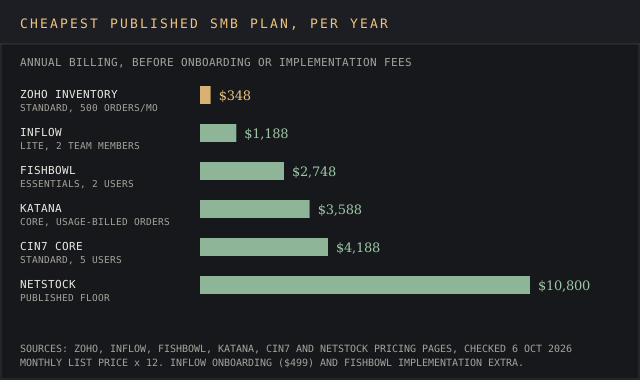
Six vendors selling inventory management & supply chain management software to small businesses publish rate cards. All six price per month, all six discount annual billing, and four of them charge a separate onboarding or implementation fee that never shows in the headline number.
Zoho Inventory: $29 to $249 a month
Zoho's four paid inventory management plans, billed annually, run $29, $79, $129 and $249 a month. The order cap climbs from 500 to 15,000 a month and locations from 2 to 10. A free plan covers 50 orders, one user and one location.
The devil's in the details of the add-on list: $7.50 a month per extra user, $7.50 per 500 extra orders, $10 per extra location and $124.17 a month for advanced warehousing. For basic inventory tracking with barcode scanning across two sites, the Standard plan's $348 a year is the floor for the cost of supply chain management software.
inFlow: $99 to $699 a month, plus a required $499 onboarding
inFlow's pricing page lists Lite at $99 a month billed annually ($129 month to month), Core at $299, Pro at $499 and Max at $699. Team members run from 2 on Lite to 20 on Max, and extra seats cost $29 a month each.
The onboarding line is where the initial costs move. inFlow states its $499 basic package is required on most plans, with a $999 training package and a $2,999 implementation package above it. Lite with basic onboarding comes to $1,687 in year one.
Fishbowl: $229 a month and a mandatory implementation package
Fishbowl Inventory runs $229, $429 and $729 a month billed annually for 2, 5 and 10 users. Fishbowl Advanced, its SCM software tier for warehouses and manufacturers, starts at $595 and $675 a month and is priced by users and deployment.
Fishbowl states it requires an implementation package with every purchase and doesn't print the price. That package covers data migration, a 6 to 8 week training certification and go-live support, so read between the lines: the published $2,748 a year for Essentials is the subscription alone, and the cost of supply chain software there runs higher.
Katana: $299 a month and usage-billed sales orders
Katana's Core plan starts at $299 a month with unlimited users, then bills sales orders on a usage basis. Warehouse management costs $149 a month, manufacturing management $199 and traceability $249. Onboarding is an optional $2,000.
Core plus all three add-ons and onboarding totals $12,752 in year-one SCM software costs before a single metered order. The Advantage tier moves to a custom annual contract, and Katana says exceeding the agreed volume by 20% triggers renegotiation, so keep an eye on order growth.
Cin7 Core: $349 to $1,199 a month
Cin7 Core lists Standard at $349 a month for 5 users and 6,000 sales orders a year, Pro at $599 for 10 users and 24,000 orders, and Advanced at $1,199 for 15 users and 120,000 orders. Cin7 Omni, the enterprise product, is quote-only.
Advanced costs $14,388 a year, the top of published supply chain management software prices for small businesses in this report. The integration count is capped too: 2, 4 and 6 ecommerce and app integrations by tier, which matters for any brand selling on Shopify, Amazon and a wholesale portal at once.
Netstock: from $900 a month
Netstock is the one demand forecasting tool in this segment with predictive analytics for inventory planning, and it prints a single figure: pricing starts at $900 a month. Everything above that comes from a questionnaire. That's $10,800 a year for the entry point, which is close to three times Cin7 Standard.
Per-user rates from Microsoft, Oracle and SAP
Three ERP-scale vendors publish supply chain management software prices, and each one hides the real cost of supply chain software in a minimum: a user floor, a three-year term, or a starter edition that can't run live operations.
Dynamics 365 Supply Chain Management: $210 or $300 per user
Microsoft lists Dynamics 365 Supply Chain Management at $210 per user a month, paid yearly, with limited demand planning. Premium is $300 per user and adds full demand planning plus 1,000 Copilot Credits per user a month.
Supply chain management software costs for ten users on the base edition come to $25,200 a year; ten on Premium, $36,000. Copilot use beyond the included credits bills through Copilot Studio, either pre-purchased or pay-as-you-go against an Azure subscription, so AI-driven analytics carry a meter of their own.
Oracle Fusion Cloud SCM: $200 to $1,250 per user, 10-user minimum
Oracle's Fusion Cloud Service Global Price List, dated 10 September 2026, prices each SCM module per hosted named user a month:
- Supply Planning (B91059): $1,250
- Demand Management (B91060): $1,250
- Order Management (B93429): $875
- Sales and Operations Planning (B91061): $625
- Supply Chain Execution (B91057): $350
- Advanced Inventory Management (B111756): $200
Supply Planning carries a 10-user minimum, and the same document sets three years as the standard term for Oracle Cloud subscriptions. That's $150,000 a year and $450,000 over the term for one module of supply chain management software. Oracle's planning seats cost an arm and a leg next to Microsoft's: $1,250 against $300 for Dynamics 365 Premium, 4.2 times as much. Our Oracle Fusion Cloud Supply Chain Planning review covers what those modules do.
SAP IBP: a $2,707 starter that can't run production
SAP prints one supply chain planning price: the IBP starter edition at $2,707 a month on a three-month term that auto-renews. It bundles IBP for demand, inventory, response and supply, sales and operations, demand-driven replenishment and the Supply Chain Control Tower for up to 10 concurrent users and 50 million planning points.
SAP's own terms list "Productive Use: No." The starter is a proof-of-concept tenant, and a budget built on it counts chickens before they hatch. The production product, IBP foundation, is "price upon request" and billed in blocks of €500 million of the buyer's annual revenue, so a €2 billion company buys four blocks before adding advanced demand or supply. Our SAP IBP review tracks the module list.
Quote-only enterprise planning, execution and visibility
Above the ERP rate cards, the price list disappears, and quote-only pricing is par for the course. Kinaxis, o9 Solutions, Blue Yonder, Manhattan Associates, e2open, project44 and Coupa publish no supply chain management software prices, so the cost of supply chain software from them comes from what each one has left on the public record.
Kinaxis: $548 million in revenue, no rate card
Kinaxis sells its Maestro supply chain management software by quote. Its FY2025 results show $548.0 million in total revenue, $362.4 million of it SaaS, and $433 million in annual recurring revenue. Our Kinaxis review covers the buyer profile, which skews to companies past $1 billion in revenue.
o9 Solutions and Blue Yonder
Both sell by quote. o9 sells its Digital Brain platform for integrated business planning; see the o9 Solutions review. Blue Yonder bundles planning, warehouse and transportation management on one data model and quotes module by module.
Blue Yonder's record carries one event any buyer of hosted supply chain management software should read about first. On 21 November 2024 a ransomware attack on its hosted environment disrupted Starbucks, Morrisons and Sainsbury's, and the Termite group claimed 680 gigabytes of stolen data, per TechCrunch. The Blue Yonder review has the rest.
Manhattan Associates: $3.8 million a year at a federal grocer
Manhattan publishes no prices, so the clearest number is federal. Contract HC108423C0005, signed 26 September 2023 for the Defense Commissary Agency's warehouse management system and replenishment module, obligated $11,457,629.19 against a $17,058,590.01 ceiling through a potential end date of 29 September 2028.
The record lists it as software as a service under full and open competition, with one offer received. One bidder on a $17 million ceiling is a red flag for anyone hoping enterprise WMS prices get tested in open tender.
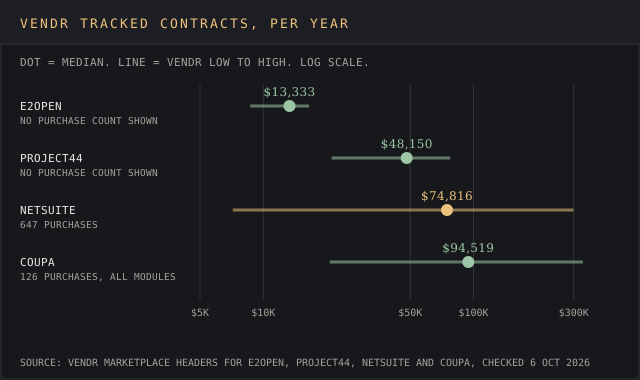
e2open: $13,333 median, 60-day auto-renew window
Vendr's header puts the median e2open buyer at $13,333 a year, with a low of $8,667 and a high of $16,494. The $7,827 spread between low and high is narrow for a planning & network vendor. Auto-renew clauses fly under the radar until the opt-out date passes. A buyer at a company with 201 to 1,000 employees left this note on Vendr:
"e2open includes auto-renew with a 60 day opt out in the terms and they do not make exceptions if you miss the opt-out window."
Vendr community insight, buyer at a 201 to 1,000 employee company
Our e2open review covers the product set.
project44: $48,150 median for real time visibility
Visibility platforms price per shipment volume and carrier network, and project44 is the only one with a Vendr header. The median buyer pays $48,150 a year, with a range of $21,150 to $77,630. That buys real time shipment tracking across carriers, the supply chain visibility layer that sits on top of a TMS.
It's a mid-five-figure line for real time tracking alone, before any planning SCM software reads the data. The project44 review lists its modules.
Coupa supply chain design: $94,519 platform median
Coupa absorbed LLamasoft's network design product in 2020 and sells it as Supply Chain Design & Planning. Vendr tracks Coupa as one vendor: a $94,519 median across 126 purchases, a range of $20,717 to $331,806, and buyers working through Vendr reduce costs by 23% on average. That figure blends procurement, invoicing and supply chain modules. The Coupa review and our report on the Coupa acquisition cover the ownership side.
NetSuite: $74,816 median and a 7% annual uplift
NetSuite's supply chain management module sits inside its ERP contract. Vendr's header shows a $74,816 median across 647 purchases, a low of $7,160, a high of $299,115 and 15.66% average savings, the share by which Vendr says its buyers reduce costs. Renewals are where the price moves. Seven percent added to every year compounds to 40% over a five-year term. A NetSuite customer posted this in the NetSuite Professionals community in 2025:
"NetSuite Renewal Nightmare: we have been on the platform for 13 years and this is the first renewal where NetSuite wants to add a 7% uplight [sic] TO EVERY YEAR"
NetSuite Professionals community archive, 2025
Interos: $3.95 million a year for supply chain risk monitoring
Risk platforms sit at the analytics end of the SCM software category. The Defense Logistics Agency's task order SP470425F0055, bought through reseller ThunderCat Technology, carries an $11,848,800 ceiling for Interos software subscriptions from 14 August 2025 to a potential end of 13 August 2028. That's $3,949,600 a year for proactive risk management across a defense supply base.
The Interos review and the supply chain risk management ranking compare it with Everstream and Resilinc.
Supply chain analytics platform features and pricing comparison
The table lines up the supply chain management software vendors in this report on the same five columns, from SMB supply chain software to planning suites. Entry price is the lowest cost of supply chain management software the source supports, annualized where the vendor bills monthly. Where software pricing is quote-only, the cell shows the best public figure.
| Vendor | Segment | Pricing model | Entry price | Source |
|---|---|---|---|---|
| Zoho Inventory | SMB inventory | Tiers by orders a month | $348 a year | Vendor site |
| inFlow | SMB inventory | Tiers by seats, plus onboarding | $1,188 a year + $499 | Vendor site |
| Fishbowl | SMB inventory | Tiers by users, implementation required | $2,748 a year | Vendor site |
| Katana | SMB inventory and MRP | Base plus usage plus modules | $3,588 a year | Vendor site |
| Cin7 Core | SMB inventory and orders | Tiers by users and orders | $4,188 a year | Vendor site |
| Netstock | Inventory planning | Quote above a floor | $10,800 a year | Vendor site |
| Microsoft Dynamics 365 SCM | ERP supply chain | Per user a month | $2,520 per user a year | Vendor site |
| Oracle Fusion Cloud SCM | Planning and execution | Per named user per module | $2,400 per user a year (inventory) | Oracle price list |
| SAP IBP | Planning | Starter flat fee; revenue blocks | $32,484 a year (non-production) | Vendor site |
| NetSuite | ERP supply chain | Quote | $74,816 median* | Vendr, 647 purchases |
| Coupa | Supply chain design | Quote | $94,519 median* | Vendr, 126 purchases |
| e2open | Planning and network | Quote | $13,333 median* | Vendr |
| project44 | Visibility | Quote | $48,150 median* | Vendr |
| Manhattan Associates | WMS execution | Quote | $3.82M a year (DECA)** | USAspending.gov |
| Interos | Risk analytics | Quote | $3.95M a year (DLA)** | USAspending.gov |
| Kinaxis | Planning | Quote | Not published | Kinaxis FY2025 results |
| o9 Solutions | Planning | Quote | Not published | Vendor site |
| Blue Yonder | Planning, WMS, TMS | Quote per module | Not published | Vendor site |
Entry prices with no mark are vendor list prices, read off each vendor's own pricing page or Oracle's global price list on 6 October 2026 and annualized where the vendor bills monthly. Prices marked * are Vendr median annual contract values from anonymized buyer data. Prices marked ** are annualized from federal contract records on USAspending.gov: an obligation for Manhattan Associates and a ceiling for Interos.
Key features split along the same price line. Inventory tracking and sales orders sit in every SMB plan. Basic order and stock tracking costs a fraction of AI analytics: Microsoft charges $210 per user for the base Dynamics 365 edition and $300 for Premium with Copilot credits, a $90 step for the AI layer.
Demand forecasting with predictive analytics starts at Netstock's $900 a month. Real time tracking of shipments, with real time data from carriers, starts at project44's $21,150 low. Advanced analytics such as concurrent what-if planning sit in the quote-only tier and on Oracle's $1,250 modules, where advanced analytics are priced per planner seat.
What each tier of supply chain management software includes
The SCM software market splits into the same five segments as the table, and the key features a buyer gets follow the price band. Manhattan Associates ($1,081.4 million in 2025 revenue) and Kinaxis ($548.0 million) are the two pure-play supply chain management software vendors here that report revenue, and both sell enterprise grade systems built for global supply chains.
Under $15,000 a year: inventory and order management
Supply chain management software for small businesses covers stock levels, purchase orders, order management systems for ecommerce & wholesale channels, and basic inventory tracking across a handful of locations. Zoho caps locations at 2 to 10 by plan; inFlow's Pro and Max plans lift the cap entirely.
Workflow automation at this level means automating repetitive tasks such as reorder points and pick lists. Katana and Fishbowl add manufacturing; Cin7 adds ecommerce connectors. Supplier management at this tier is the vendor record on each purchase order.
$25,000 to $150,000 a year: ERP supply chain and visibility
Dynamics 365, NetSuite and project44 sit in this band. The two ERPs add multi-entity accounting and links to transportation management software, so supply chain workflows run purchasing, receiving and fulfillment in one record. project44 adds real time data on shipments, real time visibility into in-transit stock and real time tracking by carrier.
Above $150,000 a year: planning and execution suites
Between them, Oracle, SAP IBP, Kinaxis, o9, Blue Yonder and Manhattan sell demand forecasting with predictive analytics, supply planning against capacity constraints, supplier portals for collaboration, supplier performance tracking and compliance tracking.
Kinaxis, o9, Blue Yonder and Manhattan sell them as hosted subscriptions on vendor-run cloud infrastructure. Buying planning, WMS and TMS from one hosted vendor puts all your eggs in one basket, which is how one breach at Blue Yonder in November 2024 reached Morrisons' and Sainsbury's supply chain operations and Starbucks' stores at once.
Interos and its rivals add a risk layer above planning, with supplier performance scores built from outside data. The procurement intelligence ranking covers the sourcing tools that share that data.
Implementation, data migration and ongoing costs
The subscription is the visible part of the cost of supply chain management software. Implementation consulting, data migration from legacy systems, user training and ongoing support land on top. inFlow's published onboarding runs from 6% of its Max plan's annual fee ($499 against $8,388) to 252% of Lite's ($2,999 against $1,188).
What SMB vendors charge to switch supply chain management software on
- inFlow: $499 basic onboarding (required on most plans), $999 training, $2,999 implementation
- Katana: $2,000 optional onboarding on Core; included on Advantage
- Fishbowl: implementation package required, price on quote, 6 to 8 week training certification
- Cin7 Core: onboarding not listed on the pricing page
Fishbowl lists data migration first among the contents of its required package, which is where the setup fee goes. A buyer with years of item, bin & supplier records should bite the bullet on the larger package.
Manhattan Associates services revenue outruns its subscriptions
At enterprise scale, the best public measure of implementation cost for supply chain management software is a vendor's own filing. Manhattan Associates reported $1,081.4 million in 2025 revenue: $503.0 million in services, $408.1 million in cloud subscriptions, about $130.0 million in maintenance, $25.4 million in hardware and $14.8 million in software licenses.
Services ran at 1.23 times cloud subscription revenue and took the lion's share of the total at 46.5%. That supports the claim that implementation and professional services can cost as much as the first year's software license on an enterprise deployment, and at Manhattan they cost more. The $14.8 million license line also shows how far the deployment model has moved: on-premises licensing is now 1.4% of revenue.
Maintenance costs, cloud hosting and support
For subscription SCM software, ongoing maintenance, hosting, bug fixes and security patches are inside the fee, so maintenance costs show up as a separate line only for self-hosted or custom supply chain systems. The figures below come from publishers estimating, with no named underlying study:
- ISM's July 2026 guide: $1,000 to $5,000 a month in ongoing maintenance and $500 to $5,000 a month for cloud hosting
- OrangeMantra: $5,000 to $25,000 a year for bug fixes and unplanned patches, $20,000 to $100,000-plus a year for security audits and compliance, $6,000 to $60,000-plus for cloud hosting
- APPWRK: support, updates and hosting adding 15% to 25% a year
ISM's monthly hosting band annualizes to $6,000 to $60,000, which matches OrangeMantra's figure for cloud infrastructure. Their maintenance percentages don't match: OrangeMantra puts annual maintenance at 15% to 40% of the initial build cost, APPWRK at 15% to 25%.
Integration with existing systems
Integration is the cost that breaks budgets. PwC's 2025 Digital Trends in Operations Survey of 610 operations and supply chain leaders found 92% cite at least one reason their tech investments haven't fully delivered. Integration complexity was the top reason, picked by 47%, ahead of data issues at 44%.
Disconnected systems are where that 47% comes from. A planning tool reading from an ERP, a WMS, a TMS and two ecommerce channels needs five connectors to existing systems kept current. On Cin7 Core, five integrations means the $1,199 Advanced tier.
Custom SCM software development cost
Building custom supply chain software from scratch is the alternative to every supply chain management software rate card above. The published software development estimates for custom SCM software come from agencies that sell the work, and the three that rank for this keyword disagree on the top tier by a factor of more than three.
Three published estimates, side by side
| Publisher | Small or MVP | Mid-size | Enterprise |
|---|---|---|---|
| APPWRK | $9,000 to $30,000 | $30,000 to $90,000 | $90,000 to $150,000+ |
| ISM | $30,000 to $70,000 | $80,000 to $150,000 | $150,000 to $300,000+ |
| OrangeMantra | $15,000 to $60,000 | $60,000 to $200,000 | $200,000 to $500,000+ |
All three rows are estimates for a custom build, read off appwrk.com, ism.ws and orangemantra.com on 6 October 2026, with no vendor list prices or Vendr medians in the table.
APPWRK and OrangeMantra are each a custom software development company quoting SCM software development for its own market, and ISM publishes its SCM software development ranges with no study behind them. Read the spread as three sales positions. ISM's implementation estimate for packaged software, $10,000 to $50,000, sits below every custom build floor in the table except APPWRK's MVP.
What a development team builds for the money
Custom SCM software development scopes core modules the same way the vendors sell them: inventory tracking, order management systems, supplier management with supplier portals, warehouse logistics and demand forecasting. The agencies price each SCM module separately, plus integration with existing systems. OrangeMantra lists the development team's type and location among its cost drivers, from an in-house team to an offshore agency.
ISM says an MVP-first approach cuts initial costs by 30% to 50% by deferring nonessential features. Custom development offers more flexibility than an off-the-shelf plan: the software changes on the buyer's own schedule when business strategy shifts, with no vendor roadmap to wait for. The trade is that all bug fixes and security patches after launch become the buyer's ongoing costs.
When a custom build costs less than a subscription
Take ISM's small-business build at $30,000 and add APPWRK's 15% annual upkeep. Over five years that's $52,500. Zoho Inventory's Premium plan at $79 a month costs $4,740 over the same five years, and Cin7 Advanced costs $71,940. Custom SCM software only undercuts a subscription at the top of the SMB price list, and only if the software development scope stays at MVP.
Key factors in a supply chain management software quote
Supply chain management software costs grow on some mix of seven key factors. Knowing which ones a vendor meters tells a buyer where the cost of supply chain management software grows next.
- Named or concurrent users. Oracle bills hosted named users; SAP's starter counts concurrent users.
- Order or transaction volume. Zoho, Cin7 and Katana scale SCM software prices on orders.
- Modules purchased. Oracle's six modules run $200 to $1,250 each per user.
- Company size. SAP's €500 million revenue blocks tie price to the buyer's revenue.
- Deployment model. Cloud based SCM software spreads the cost over the term, and cloud systems carry no server line; Manhattan's $14.8 million in licenses shows on-premises is now a sliver of the market.
- Term length. Oracle's standard term is three years; SAP's starter is three months.
- Renewal terms. e2open's 60-day opt-out and NetSuite's 7% yearly uplift both sit in the paper.
Global operations add a factor of their own: more entities, more currencies and more sites. SAP's revenue-block model charges a global supply chain business for its size whatever its planner headcount.
What supply chain performance returns on the spend
The case for paying any supply chain management software price rests on operational efficiency. Deloitte's 2014 study of 421 manufacturing and retail executives found that 79% of supply chain leaders had above-average revenue growth, against 8% of followers. The data is 12 years old, and it measures correlation between capability and growth.
Software's share of that result comes from three jobs: real time visibility into inventory and shipments across the entire supply chain, demand forecasting that aligns production with market signals, and workflow automation that removes manual steps. Integrated modules on one data model cut duplicate entry between planning and execution, which is how a vendor like Blue Yonder pitches the bundle.
Automating repetitive tasks such as purchase orders and replenishment is the part of that value a buyer can test before paying: Zoho runs a free plan and inFlow a 14-day free trial. Talk is cheap, so treat any vendor's single-percentage ROI claim as marketing until a reference customer confirms it on a call.
What supply chain management software costs by company size
These ranges come only from published prices and tracked contracts in this report. The cost of supply chain management software for each band:
Small businesses
Supply chain management software costs a small business $348 to $14,388 a year, plus $499 to $2,999 in onboarding. Zoho, inFlow, Fishbowl, Katana and Cin7 cover stock counts, purchase orders & sales orders. Add Netstock at $10,800 a year for demand forecasting.
Mid-market
Mid-market SCM software sits between $25,200 a year for ten Dynamics 365 users and the $74,816 NetSuite median. A project44 contract at a $48,150 median adds real time data on shipments. If services track Manhattan's 1.23 ratio, year one costs about 2.2 times the software line.
Enterprise
The cost of supply chain management software at enterprise scale begins with planning: enterprise SCM software starts at $150,000 a year for ten Oracle Supply Planning users and runs to the $3.8 million a year federal WMS contract above.
With services at 1.23 times subscription at Manhattan Associates, a $1 million annual subscription implies roughly $1.23 million a year in partner and vendor services during rollout at that ratio. Go the whole hog on a suite only with the services estimate in writing.
For the tools layer around planning, our supply chain intelligence ranking, the inventory analytics software ranking and the demand forecasting software ranking compare vendors on features. The sourcing side of the budget is in the procurement software pricing report, with the market context in market intelligence for supply chain.
Frequently asked questions
How much does supply chain software cost?
The cost of supply chain management software on published plans runs from $29 a month (Zoho Inventory Standard, billed annually) to $1,250 per user a month (Oracle Supply Planning). Tracked enterprise contracts run from Vendr's $13,333 e2open median to $3.8 million a year for Manhattan's federal WMS contract.
What is the SCM cost for a mid-sized company?
Supply chain management software costs a mid-sized company $25,200 a year at list for ten Dynamics 365 SCM users; the median NetSuite contract on Vendr is $74,816. Add implementation close to the first year's fee.
What are the software tools used in SCM?
Five types of SCM software: inventory management (Zoho, Cin7, Fishbowl), warehouse management systems (Manhattan, Blue Yonder), transportation management software, visibility platforms (project44) and supply chain planning suites (Kinaxis, o9, SAP IBP, Oracle).
What is the most popular supply chain software?
By revenue among supply chain management software vendors that report it, Manhattan Associates ($1,081.4 million in 2025) is larger than Kinaxis ($548.0 million). Among tools for small businesses, popularity has no public measure.
Will SCM be replaced by AI?
Vendors are pricing AI into the product. Microsoft's Premium edition includes 1,000 Copilot Credits per user a month for AI-driven analytics, and AWS moved its supply chain service into Amazon Connect Decisions, priced by the type of AI agent a buyer runs, with no figure published.
How much does custom supply chain software development cost?
ISM puts custom software development at $30,000 to $70,000 for small business needs and $150,000 to $300,000-plus for large enterprise programs. APPWRK's enterprise tier tops out at $150,000-plus and OrangeMantra's at $500,000-plus.
How much does management software cost per user?
ISM estimates $50 to $500 per user a month for cloud SCM. Published rates sit at $210 to $300 for Microsoft and $200 to $1,250 for Oracle.
Bottom line
The supply chain management software price splits in two at about $15,000 a year. Below that line, Zoho, inFlow, Fishbowl, Katana and Cin7 print their prices, and the surprise in the cost of supply chain software is the onboarding fee. Supply chain management software costs below that line top out at $14,388 a year. Above it, Oracle and Microsoft print per-user rates with minimums and three-year terms, and everyone else quotes.
For quote-only software pricing, public records do the work a price page won't. A $3.8 million federal WMS contract with one bidder, a 1.23 services-to-subscription ratio in an SEC filing and a 7% yearly renewal uplift on NetSuite are all on the public record for any buyer to check. Cut to the chase with any supply chain management software vendor: ask for the services estimate and the renewal clause in writing before the subscription number.
Where every supply chain price here was read, and the rate cards nobody prints
List prices come from the vendors' own pricing pages at zoho.com, inflowinventory.com, fishbowlinventory.com, katanamrp.com, cin7.com, netstock.com, microsoft.com and sap.com, plus Oracle's Fusion Cloud Service Global Price List on oracle.com, dated 10 September 2026. Tracked contract medians and ranges are the header stat blocks on vendr.com/marketplace for NetSuite, Coupa, e2open and project44.
Federal contract figures are the USAspending.gov award records for HC108423C0005, signed 26 September 2023, and SP470425F0055, starting 14 August 2025. Revenue figures come from Manhattan Associates' FY2025 results, filed as 8-K exhibit 99.1 on sec.gov in January 2026, and Kinaxis' FY2025 results on businesswire.com, 4 March 2026.
The Blue Yonder breach detail is TechCrunch's report of 9 December 2024. The NetSuite quote comes from the archive.netsuiteprofessionals.com community archive, posted in 2025. Cost estimates come from ism.ws (July 2026), orangemantra.com and appwrk.com, the survey figures from PwC's 2025 Digital Trends in Operations Survey on pwc.com, and the leadership figures from Deloitte's 2014 study, hosted at ndia.dtic.mil. AWS pricing was read on aws.amazon.com.
Every figure was checked against its origin on 6 October 2026. Kinaxis, o9 Solutions, Blue Yonder, Manhattan Associates, e2open, project44 and Coupa publish no rate card, Fishbowl prints no price for its required implementation package, and AWS publishes no figure for Amazon Connect Decisions. None of the quote-only vendors publishes an implementation or services rate.