EazyStock pricing in 2026: what the editions cost and what drives a quote
 By Jan Suski. I go deep on every review, checking every number against its source and digging up details other coverage misses, a habit from six years of SEO and link building for tech companies. Bylines at Surfer, Brand24, and Senuto. How the scoring works.
The numbers EazyStock pricing, checked 6 November 2026
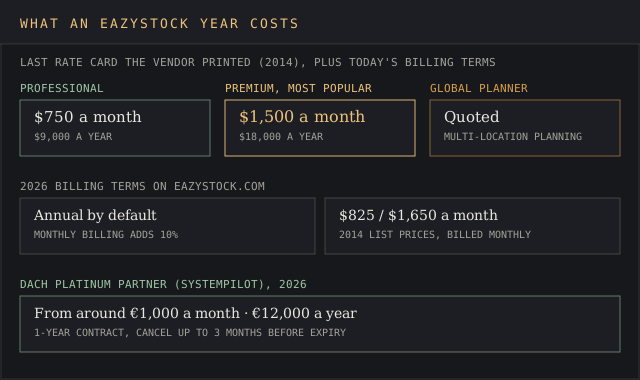
Year one at the 2014 Professional list price comes to $9,000 before any monthly-billing surcharge.
The partner's €1,000 floor works out to €12,000 a year on a one-year contract.
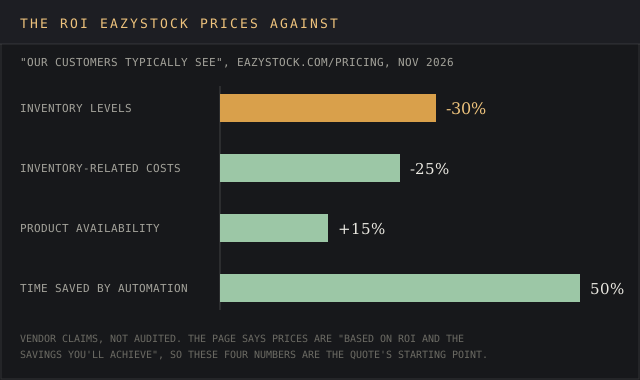
The vendor's own 30% inventory claim is the number the quote is built on, so test it against your own inventory data before you sign.
I'll write a 2,500+ word report on the vendor you name, with list prices, partner quotes and contract terms sourced line by line. Yours to publish, from $200.
EazyStock pricing comes from a quote. The vendor's pricing page says every price is drawn from "a standard price list" and then set by ROI, user numbers and SKU quantities. The list itself stays behind the sales call.
The last rate card EazyStock printed sits in a 2014 ERP guide on its own domain: Professional at $750 a month, Premium at $1,500 a month, Global Planner on request. In 2026, its DACH partner quotes from around €1,000 a month. This report lines up both, plus billing terms, contract length, implementation time and five user reviews.
It's written for purchasing teams & inventory planners at mid sized businesses who need an EazyStock cost figure for a budget line before the first demo. Every number links to the page that published it.
How much EazyStock costs in 2026
Quote-only pricing is par for the course in inventory optimization, and EazyStock doesn't print a 2026 price. The pricing page promises a free quote "in minutes" and says the price reflects "the savings you'll achieve by using EazyStock." That makes the EazyStock price a function of your stock, your suppliers and the size of your purchasing team.
Two published reference points narrow the range. The 2014 rate card puts the entry edition at $750 a month and the most popular edition at $1,500. Systempilot, the EazyStock Platinum Partner responsible for sales and implementation in Germany, Austria and Switzerland, says contracts run "typically from around €1,000 per month."
So a realistic budget for a single-warehouse distributor starts near $9,000 to €12,000 a year. Multi-site planning sits higher. The devil's in the details here, because the edition, the SKU count and the number of warehouses each move the quote.
EazyStock editions and the inventory planning each one gates
EazyStock sells three editions. The names come from the same 2014 guide, and the vendor's current pricing FAQ still refers to "the specific software version that best suits your needs," so the tiered model has survived 12 years even if the dollar amounts have moved.
Copy these lines into an email, fill them in and send. I reply with scope and a price within 2 to 3 business days.
Open the emailProfessional
Professional covered "Inventory Optimization for One or More Locations" at $750 a month. That's the core engine: demand forecasting, reorder points, safety stock levels and order quantities, calculated nightly and pushed back to your ERP as order proposals.
Premium
Premium added "Replenishment Planning & Vendor Management" for $1,500 a month and carried the "Most Popular" label. The step up doubles the bill and buys supplier management: scheduled supplier orders, lead time tracking and the order fill-up function that the Microsoft Marketplace listing says helps buyers "optimize container capacities and hit MOQ."
Global Planner
Global Planner adds "Advanced Multi-Location Inventory Optimization" and has always been quote-only. It fits companies that redistribute stock between warehouses, which the Marketplace listing names as "multi-site and redistribution capabilities." Expect the quote to scale with warehouse count.
Demand forecasting, safety stock and order proposals
EazyStock is an inventory optimization solution that sits on top of the ERP and does the inventory planning maths the ERP leaves to spreadsheets. The Marketplace listing says buyers "often use spreadsheets to forecast demand and calculate important planning parameters, such as reorder points, order quantities and safety stock levels."
The demand forecasting engine reads sales history from your inventory management system, classifies each item by demand pattern and recalculates nightly. Seasonality, promotions and supplier lead time feed the forecasting model. Safety stock then gets set against the service level target you choose per item class, so the system holds more cover on fast movers & less on slow ones.
Stated outcomes in that listing are concrete enough to test in a trial: "Reduce the risk of stock-outs and lost sales," cut "excess stock, carrying costs and the risk of obsolete items," and "Improve efficiency by eliminating time spent calculating and updating reordering policies." It also promises "full visibility and control of inventory KPIs."
Integration cost depends on your ERP. Per the same listing, "EazyStock connects with MS Business Central and NAV to automate inventory calculations." For Microsoft Dynamics shops, that makes the integration line of the quote the smallest. Teams on other ERPs should explore the connector list on the pricing page before they decide on an edition.
Carrying costs are where the ROI shows up first. Every pallet of slow stock held past its reorder cycle ties up cash, warehouse space and insurance, and the forecasting maths exists to stop that money sitting on shelves.
What the subscription includes
EazyStock's pricing page says there are "ZERO hidden fees." Ongoing support, system upgrades and access to the latest version come inside the subscription. The package lists four inclusions:
- Access to the inventory optimization software itself
- A dedicated Customer Success Manager for onboarding, integration and support
- Training and support at no extra charge
- Integration with your ERP over a secure cloud-based connection
Bundled training is the line item that separates EazyStock from tools that bill onboarding as a service package. Netstock's pricing, for comparison, quotes bundles and add-ons above its $900 floor. With EazyStock, the quote covers the software, the support team and the connector.
What drives the EazyStock cost in a quote
The vendor and its partner name six inputs between them. The EazyStock page names ROI, the software version, users and SKUs. Systempilot adds inventory value, warehouse count and the number of connected ERP systems.
- Edition: Professional, Premium or Global Planner.
- SKU count: the number of stock items the engine has to forecast.
- Users: how many buyers and planners need a login.
- Inventory value: the money tied up in stock, which sets the size of the saving.
- Warehouses: each extra stocking location adds planning load.
- Connected ERP systems: one ERP or several.
Inventory value takes the lion's share of the pricing logic. It explains why two companies with the same SKU count get different numbers. A distributor carrying $5 million of stock has more excess stock to release than one carrying $500,000, and EazyStock prices against that gap.
Annual versus monthly billing and contract terms
EazyStock bills annually. The pricing FAQ answers the billing question in one line: "EazyStock does bill annually but we offer the option of a monthly bill for a 10% fee increase." On the 2014 list, that turns Professional into $825 a month and Premium into $1,650.
Contracts "usually run for 1 year," according to Systempilot's FAQ, and can be cancelled up to 3 months before expiry. Keep an eye on that date from signing day. Miss the 3-month window and you're on the hook for another year.
Implementation and go live timeline
Systempilot's project plan runs about 14 weeks, from week 1 conception to go live and hypercare in weeks 13 and 14. The partner says "the fastest rollout was 8 days; 2 to 5 months is typical."
The vendor's own setup runs in three steps: connect your ERP, sync your inventory data, then let EazyStock "automatically" start to forecast demand, calculate reorder points and generate order proposals. The supported list on the pricing page names Microsoft Dynamics AX, NAV, 365 Business Central and F/SCM, plus NetSuite, Odoo, SAP Business One, Acumatica, Epicor Prophet 21 and Infor M3, among others.
If your ERP is on that list, EazyStock connects through a ready-made connector and your team can hit the ground running, which the homepage calls "ready-made connections." Other software takes a custom build, and ironing out the details there is where implementation stretches from weeks into months.
The ROI math: excess stock and carrying costs
EazyStock's pricing page lists four results "our customers typically see": 30% less inventory, 25% savings on inventory-related costs, 15% better product availability and 50% time saved through automation. These are the vendor's own figures, and the quote leans on them.
Want an outcomes chart like this for the tool your buyers compare you with? Send the vendor name.
Email a briefRun the arithmetic on your own numbers. A business carrying $2 million of stock that cuts 30% releases $600,000 of working capital, and lower carrying costs follow. Against a $9,000 to $18,000 annual fee, the vendor's case writes itself, if the 30% holds.
The case studies cover a wide range. EazyStock cites AFCAT cutting excess stock by $13,000 and lifting overall service level by 4%. Systempilot lists Deutsche Augenoptik at 38% less inventory at a 95% service level, FlexiTog at 98% fewer stockouts and Copiax at over 97% availability across nearly 43,000 products.
A $13,000 excess stock reduction is a drop in the bucket against $2 million of stock, and it barely covers one year of Professional. Treat the 30% headline as the vendor's best case and the AFCAT number as a floor.
EazyStock is a product of Syncron, the Stockholm-based service parts planning vendor. The Marketplace listing, published by Syncron AB, says Syncron handles "over 1.75 million stock items and 2.5 million order line recommendations per day." Syncron took a $67 million minority investment from Summit Partners in October 2018.
What users say about price and support
Reviews mention price less often than support. A supply chain manager in transportation titled his 24 October 2017 Capterra review "Great Software for a reasonable price" and listed "Decent price" and "Quick onboarding" as pros, with "No big customer support in Asia yet" among his three cons.
Support gets the warmest words. A director of supply chain and logistics in food and beverages wrote on Capterra on 2 August 2021:
"The support through implementation and continuous training has been superior."
Capterra review, Director of Supply Chain and Logistics, 2 August 2021
The criticism clusters around data lag & rigid reporting. A mid-market wine and spirits buyer reviewing on G2 on 15 October 2026 flagged a workaround that costs staff hours:
"We have to pull the provided plan out of EazyStock and manually manipulate the data in Excel."
G2 review, Verified User, Wine and Spirits, Mid-Market, 15 October 2026
Data freshness draws the most repeat comments. One small-business reviewer on G2 (13 October 2026) wrote that the system "does need time to update to the latest information; you often are looking at a day in the past." A wholesale user posted on 11 March 2026: "Too rigid. KPI reports cannot be individually modified."
Integration failures cost more than slow screens. One purchasing analyst on G2, writing on 20 October 2023 about a Dynamics NAV setup, put a cost on the integration risk:
"Some issues caused by data being lost between our NAV system and Eazystock can cause downtime"
G2 review, Sam N., Purchasing Analyst, Small-Business, 20 October 2023
Even the positive reviews carry a caveat. A purchasing specialist (G2, 9 October 2026) said "the system provides a lot of value and functionality," while noting it "can be slow at times." Take these as a red flag to test in the trial: ask the CSM how often inventory data syncs from your ERP.
EazyStock against other inventory optimization software
Netstock and Optiply publish entry prices, and EazyStock's printed and partner figures sit between them.
| Tool | Published entry price | Billing | What sets the price | Source |
|---|---|---|---|---|
| EazyStock Professional | $750 a month (2014 list) | Annual; monthly adds 10% | ROI, edition, users, SKUs | eazystock.com |
| EazyStock via DACH partner | About €1,000 a month | 1-year contract | Edition, inventory value, warehouses, ERPs | systempilot.net |
| Netstock | $900 a month | Annual subscription | Product and bundle | netstock.com |
| Optiply Lite | €79 a month | Annual or monthly; 14-day trial | SKUs, purchasing rules, sales orders | optiply.com |
- The planning tools and editions to compare
- Regions, years and segments
- Where it runs: blog, white-label, gated or lead magnet
- Whose byline goes on it
- Deadline
- 2,500+ words, human-written
- Every figure linked to its source
- Yours to publish, under your name or none
- Hosting here for +$200, with your sponsored links
The $750 EazyStock Professional figure is a 2014 list price from the vendor's own ERP guide; EazyStock prints no current rate card. The €1,000 figure is a partner quote from Systempilot, EazyStock's DACH Platinum Partner. Netstock and Optiply prices are each vendor's published list price, checked 6 November 2026. No row uses a Vendr median.
Netstock's annual floor is $10,800, which the Netstock review covers in depth. Optiply Lite caps at 1,000 SKUs and 1,000 sales orders a month, so it suits e-commerce shops with a small catalogue and few suppliers. EazyStock targets the mid market between them: wholesalers and manufacturers with thousands of SKUs and an ERP already in place.
For the wider field, the inventory analytics software ranking and the demand forecasting software ranking price the rest. Manufacturers who plan from bills of materials should check the manufacturing forecasting software ranking too.
How to negotiate an EazyStock quote
EazyStock prices against ROI, so the ROI inputs are your negotiating levers. Contact sales with your own numbers ready, and get the ball rolling on the vendor's ROI calculator before the sales rep runs it for you.
- Ask which edition the quote assumes, and price Professional and Premium side by side.
- Bite the bullet and pay annually. Monthly billing costs 10% more for the same software.
- Quote the SKU count you actively replenish. Dead items inflate the price.
- Get the cancellation window in writing: 3 months before expiry, per Systempilot.
- Ask for the renewal price and any uplift cap in the first contract.
The AFCAT testimonial on the pricing page gives the vendor's view of the ROI. Travis Heise, AFCAT's product and procurement manager, said he couldn't downgrade "without hiring at least 3-4 people," adding: "The revenue saved from preventing stockouts and holding excess stock easily justifies the cost of any software." Use the same logic in reverse: price the planner hours EazyStock saves your team, then hold the quote to that number.
AFCAT's product and procurement manager said dropping EazyStock would mean hiring at least 3-4 people, per the testimonial on EazyStock's pricing page.
Extra hires AFCAT says it would need without EazyStock
Source: EazyStocke.g. staffing savings claimed by vendors in your category
Source: linked, checked, datedWho EazyStock is priced for, from wholesale to e-commerce
EazyStock is priced for small and mid sized businesses running an ERP. The Microsoft Marketplace listing says it uses Syncron's technology but is "developed specifically for the needs of small and mid-sized businesses," and it supports Business Central Essentials and Premium in 13 countries.
It fits distributors, wholesalers and manufacturers that still forecast demand in spreadsheets, across supply chain operations with hundreds of suppliers and thousands of SKUs. E-commerce companies with an ERP behind the storefront fit the same profile. Systempilot lists the industries it skips: highly perishable goods, fast fashion, the process industry and special-purpose machinery with few common parts.
Enterprise supply chain teams with dozens of plants sit above this price point and look at suites like SAP Integrated Business Planning. The supply chain software pricing report maps that upper band, and the supply chain intelligence ranking covers the visibility layer on top.
Key features the price covers
The EazyStock homepage says it uses "machine-learning-powered algorithms" for demand forecasting. The Marketplace listing adds 10 features, among them seasonality forecasting, promotions management, dynamic supplier lead time management, system alerts and a KPI dashboard with drill-down to SKU level.
Orders work by exception. EazyStock calculates the right stock levels, then users review order proposals and confirm them with one click. Purchasing teams that want to automate purchasing further can schedule orders to generate automatically, which the vendor pitches as the way to reduce stockouts without adding headcount.
Buyers comparing procurement tools on the same budget line can check the procurement software pricing report, which prices 18 vendors, and the AI procurement software ranking.
Delivered for your site and your byline. Hosting here is optional.
Frequently asked questions
How much does EazyStock cost?
EazyStock quotes each customer. The last printed list put Professional at $750 and Premium at $1,500 a month, and the DACH partner Systempilot quotes from around €1,000 a month on a one-year contract.
What is the cheapest inventory management software?
Among the optimization tools on this page, Optiply Lite starts lowest at €79 a month for up to 1,000 SKUs. Netstock starts at $900 a month on an annual subscription.
How much do inventory management systems cost?
Inventory planning add-ons that sit on an ERP start at €79 a month and run to $1,500 a month or more for multi-supplier replenishment. The supply chain visibility software ranking covers the tools above that band.
What is the inventory management cost beyond the software?
Implementation time is the main cost outside the subscription. EazyStock bundles training, support and ERP integration, and Systempilot puts a typical rollout at 2 to 5 months of your team's time.
Bottom line
EazyStock's price is a quote, and the published markers put it near $9,000 a year for Professional on the 2014 list or €12,000 a year through the DACH partner today. Annual billing saves 10%, and the contract runs a year with a 3-month cancellation window.
The vendor sets the price against the savings it expects to deliver. Bring your own inventory value, SKU count and service level targets to the call, and the quote has to answer to them. After that, the ball is in your court.
Planning vendors, ERP partners and distribution teams use reports like this one in sales calls and budget reviews.
A report on your topic for a blog page, gated content or a lead magnet.
Written for your client and published under their brand, with my name left off.
Your report on marketintelligencetools.com, with 2 to 3 CTAs carrying your sponsored links.
Default terms: the report is yours to publish, and I keep the right to republish it on this site behind a gate, outside Google's index.
Sources, and the EazyStock numbers that stay behind a sales call
Billing terms, the four package inclusions, the claimed customer outcomes, the AFCAT case study and the supported ERP list were read off eazystock.com/pricing on 6 November 2026; the machine-learning line comes from the eazystock.com homepage. The Professional and Premium prices come from EazyStock's own ERP guide, uploaded to eazystock.com in February 2015 and carrying the 2014 rate card.
The €1,000 monthly floor, contract term, cancellation window, rollout plan, case studies and excluded industries come from systempilot.net, EazyStock's Platinum Partner for Germany, Austria and Switzerland. Feature claims and the Syncron volume figures come from the Syncron AB listing on marketplace.microsoft.com, and the 2018 investment from summitpartners.com.
Netstock prices come from netstock.com/pricing and Optiply prices from optiply.com/en/pricing, both checked 6 November 2026. User quotes come from capterra.com and g2.com and are dated in the text.
EazyStock publishes no 2026 rate card, no Global Planner price and no per-SKU or per-user rate, and Systempilot gives a floor with no ceiling, so every EazyStock figure here is a 2014 list price or a partner quote.