EazyStock review: Syncron's inventory optimization add-on for distributors who order from spreadsheets
 By Jan Suski. I go deep on every review, checking every number against its source and digging up details other coverage misses, a habit from six years of SEO and link building for tech companies. Bylines at Surfer, Brand24, and Senuto. How the scoring works.
Best for
Small and mid-sized distributors and light manufacturers on one of the 16 ERP systems EazyStock names a connector for, who want daily inventory optimization, order proposals and a customer success manager who answers the phone.
Not for
Teams that need a published price before a demo, same-hour data from the host system, or self-serve custom reports.
What it costs
No price on eazystock.com. Billing is annual, monthly billing adds 10%, and the quote moves with user numbers and SKU quantities. Capterra's listing shows a $750 starting price.
- Owner
- Syncron (Syncron Holding AB on the legal page)
- Syncron base
- Stockholm, $67 million Summit Partners minority stake, October 2018
- Engine
- Built on Syncron's Parts Planning product
- Hosting
- SaaS only, on Amazon Web Services
- Founded (EazyStock About page)
- 1999
- Forecast refresh
- Daily
- Calculates
- Min and max stock, reorder points, order quantities, safety stock
- Classification
- ABC analysis
- KPI set
- Six inventory KPIs
- Free tools
- EazyABC, EazyROI, EazySafetyCalc, EazyReorderCalc
- Price drivers
- User numbers and SKU quantities
- Monthly billing
- 10% surcharge over annual
- Included
- Customer success manager, training, upgrades
- G2
- 4.4 out of 5, 73 reviews, 48 at five stars
- Capterra
- 4.7 out of 5, 3 reviews
- G2 ease of setup
- 7.6 against Netstock's 8.2
- Connectors named
- 16 on the integration page
- Business Central editions
- Essentials and Premium
- Write-back
- Confirmed order proposals export to the host system
- Syncron platform volume
- 2.5 million order line recommendations a day
Netstock
Not forA buyer who wants monthly billing, which EazyStock sells at a 10% surcharge.
GMDH Streamline
Not forA team paying for hand-holding, where EazyStock’s 9.4 support score beats its 8.9.
Pairs well with EazyStock
EazyStock is cloud-based inventory optimization software that reads stock, demand history and lead times out of an ERP, runs demand forecasting on that inventory data every day, and hands buyers a list of purchase orders to approve. It replaces the spreadsheet a buyer keeps next to the host system, and the manual processes that go with it, for customers who sell from stock.
This review covers what the EazyStock software does, who owns it, how the integration behaves, what the pricing page does and doesn't say, and what 73 G2 users and 3 Capterra users report. Every price and limit links to the vendor page it came from. User quotes are verbatim and dated.
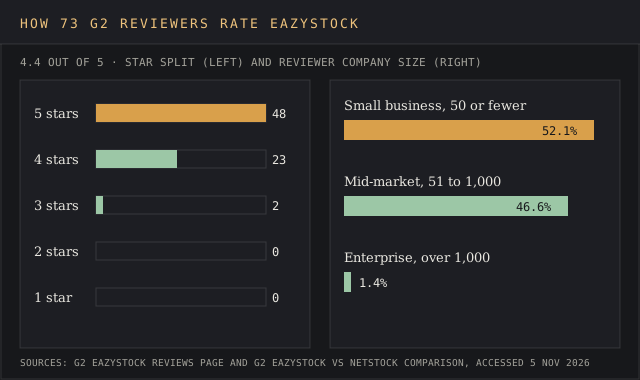
The buyer it suits is one of the mid-sized businesses EazyStock targets: a wholesaler or light manufacturer with a few thousand SKUs, one or two buyers, a list of suppliers to manage and a system such as Business Central, NetSuite or Acumatica. The user count tells the story: on G2's comparison page, 52.1% of EazyStock reviewers work at firms of 50 or fewer staff, 46.6% at mid-market firms and 1.4% at enterprises.
Eight of the ten G2 entries on the first page are dated October 2026, so the sentiment below is current. Three of the ten carry G2's seller-invite tag, which means EazyStock asked its customers for them; the other seven are tagged organic.
What EazyStock is and who owns it
EazyStock belongs to Syncron, a Stockholm company that sells after-sales service software to equipment makers such as Electrolux, Hitachi, JCB and Toyota. Summit Partners took a $67 million minority stake in Syncron in October 2018. The Microsoft AppSource listing, published by Syncron AB, says plainly that "EazyStock is a product of Syncron."
EazyStock is cloud-based by design. A Syncron job listing for an EazyStock implementation consultant fills in the engineering: the product is built on Syncron's flagship Parts Planning engine, runs only as SaaS on Amazon Web Services, and "works best with small and medium-sized clients." The same listing puts Syncron offices in the US, the UK, Germany, France, Italy, Japan, Poland and India.
The partner copy on Acumatica's marketplace reads like a brochure: "EazyStock is developed and supported by Syncron, a leading provider of inventory management solutions," and "Built on Syncron's powerful platform, EazyStock is the perfect solution for wholesalers." Read between the lines and the useful part is the second half of that sentence, which lists distributors, manufacturers and retailers as the target buyers.
How the demand forecasting and inventory optimization engine works
The forecast page says EazyStock "updates forecasts daily," picks a demand forecasting model per item, and feeds it historical demand, lost sales, lead times, supplier details and current stock levels. Seasonality is detected automatically, and planned promotions can be entered so a promotion spike doesn't get read as a new baseline. The page doesn't name the models, so the jury's still out on how it picks one and buyers take the engine on confidence.
Automated demand forecasting is the first of three stages of inventory optimization.
On the optimize page, EazyStock automates the second: it calculates minimum and maximum stock levels, reorder points, safety stock levels and optimal order quantities, segments the range with ABC analysis, and tracks six inventory KPIs. The UK site labels the module AI-powered inventory optimisation, and it also carries supplier management and multi-location planning, so one setup can cover several warehouses and the suppliers behind them.
The third stage is replenishment execution. The order page says the software "generates daily order proposals," and a buyer reviews them before they become purchase orders in the ERP, so the buyer and the tool stay on the same page. Nothing goes out without a person approving it, which matters when a forecast misreads a project order and the right stock is a judgment call. Software that orders the right items with no human check would be a red flag in this category.
That misread is the complaint a Director of Supply Chain at a food and beverage company left on Capterra in July 2021: "The issues we have are specific to products that are project driven and very sporadic in nature." Intermittent demand is the hardest case for any forecast engine, and EazyStock is no exception.
The praise on G2 lands on control. A purchasing specialist at a small firm wrote on G2 in October 2026:
"What I like most about EazyStock is how it gives us better visibility and control over our inventory."
G2 review, Purchasing Specialist, small business, October 2026
Forecast quality gets its own credit. A G2 reviewer at a small electrical and electronic manufacturing firm wrote in October 2026 that "It provides run rate based on historical data and helps for material planning." Buyers who want a tool to optimize reorder points without building a model themselves are the audience for that sentence.
Who EazyStock fits: distributors, buyers and suppliers
EazyStock automates the part of inventory planning that eats a buyer's week. hib. says buying time fell 75% across 3,000 SKUs, and that's the clearest case for the product: companies where one or two people raise every purchase order by hand and the time spent on it is the most time consuming part of the job.
The 16 connectors favour distributors and manufacturers on mid-market systems, and the G2 profile is 98.7% small and mid-sized firms. A buyer team focused on getting service level targets met without carrying excess inventory will use most of the functionality; a team that wants to plan an unplanned production run against its suppliers will hit the scenario gap users describe below, though a marketing calendar of promotions can go into the forecast.
Money runs through stock outs, lost sales and cash. If inventory levels sit high because nobody trusts the reorder points or safety stock levels, EazyStock's daily automation gives the buyer a number to argue with. If growth depends on adding a second warehouse, multi-location planning is listed in the product functionality. Before you invest, ask for a quote at your real SKU count, because that's one of the two inputs the price moves with.
Efficiency gains in the case studies come from automation of the reorder processes, and none of them claim the software replaced a buyer. Customers still own the plan and the control over suppliers; EazyStock tells them where to optimize it, and buyers who optimize weekly get more from the automation than those who log in monthly.
ERP integration and the one-day data lag
The ERP integration page names 16 systems, among them Business Central, NetSuite, Acumatica, NAV, Infor, Epicor, SAP, QuickBooks, ECI M1 and Microsoft Dynamics F&O. A second list on the same page adds Visma, Merlin, Pyramid, Monitor and Opera, and says it "isn't exhaustive." EazyStock pulls item number, stock balance, lead time, unit cost and transaction history, then "exports the confirmed order proposals back into your ERP."
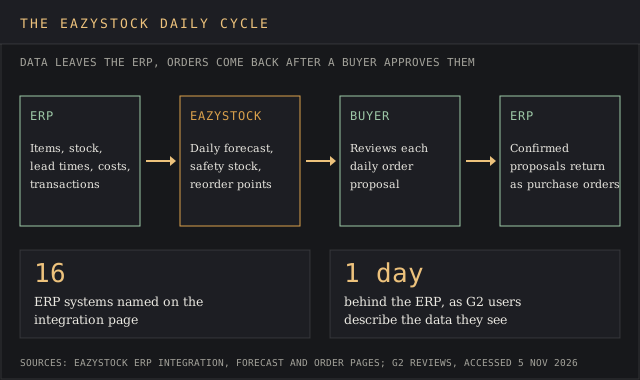
The integration is where the speed complaints come from. A G2 reviewer at a small firm wrote in October 2026 that "it does need time to update to the latest information; you often are looking at a day in the past." Buyers who order in the morning should keep an eye on that lag. A packaging company's reviewer put it more bluntly the same month: "The main downside is the amount of time it takes for information to reach our other system."
Sync failures show up too. A purchasing analyst who first reviewed in 2023 and updated the review in May 2026 wrote:
"Some issues caused by data being lost between our NAV system and Eazystock can cause downtime but it is rectified very quickly on the rare occasion it happens."
G2 review, Purchasing Analyst, small business, updated May 2026
The fast cases are real as well. Texar's Clyde Cornelius wrote on the Acumatica marketplace in February 2021: "When we fully migrated and went live on Acumatica, the integration with EazyStock took less than a day." For Microsoft Dynamics shops, the AppSource listing supports the Essentials and Premium editions of Business Central.
EazyStock pricing: no rate card and a 10% monthly surcharge
The pricing page prints no number. It says prices come from "a standard price list depending on ROI and the specific software version," scale with "different user numbers and SKU quantities," and that "EazyStock does bill annually but we offer the option of a monthly bill for a 10% fee increase." A customer success manager, training, ERP integration and upgrades are included, and the page claims "ZERO hidden fees." There's no separate onboarding invoice to budget for.
The only figure in circulation sits on Gartner's directories. Capterra lists a starting price of $750 per user per month, and Software Advice shows "Starting price: $750.00" without the unit. Treat it as a directory entry until a quote confirms it. Quote-only pricing is par for the course here: Slimstock and Streamline print no figure either.
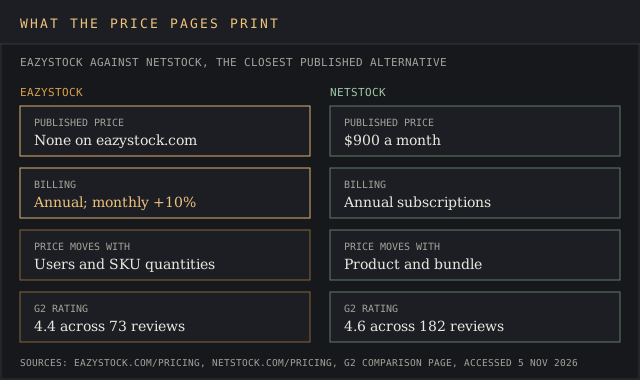
Against Netstock the gap is visible. Netstock prints "Pricing starts at $900/month" on annual subscriptions, which our Netstock pricing report breaks down by bundle. EazyStock gives a buyer of inventory optimization a monthly exit route, at a cost, and no figure to budget around before the first call. For category-wide price points, see the supply chain software pricing report.
Implementation, training and support
EazyStock's forecast page promises "Go live in one week," and the Acumatica listing makes the same under-a-week claim. The G2 ease-of-setup score is less upbeat: 7.6 out of 10 across 41 responses, against 8.2 for Netstock. A team with clean item data can hit the ground running.
Acumatica's listing says the tool will "decrease the amount of time spent on manual inventory management." The devil's in the details of the master data, and a team with messy lead times or stale supplier records will take longer.
Support is the strongest number EazyStock has with its customers. G2 puts quality of support at 9.4 out of 10 across 69 responses, above Netstock's 9.2 and Streamline's 8.9. On Capterra the support sub-rating reads 4.3 out of 5 across 3 reviews, and the AppSource listing says partners give "ongoing 1-to-1 assistance."
Training sits inside the subscription, and new users need it: the interface complaints below come from people already past onboarding.
The reviews back the support score. The Capterra food and beverage director wrote that "The support through implementation and continuous training has been superior." A G2 reviewer at a mid-market wine and spirits firm opened with "The customer support is top-notch." The purchasing analyst above praised "Ongoing high quality support provided on a consistently quick turnaround."
What EazyStock reviews praise and what they flag
G2 shows a 4.4 rating across 73 entries, and the lion's share sits at the top: 48 at five stars, 23 at four, 2 at three, none below. Capterra and Software Advice show 4.7 across the same 3 entries, two of them five-star, which is 67%. Those three date from 2014, 2017 and 2021, so G2 is where the current picture lives.
The praise clusters around getting off spreadsheets. A supply chain planning manager wrote on G2 in June 2026:
"After years of relying on Excel spreadsheets, moving to a system that helps us work proactively rather than reactively has changed the way we operate"
G2 review, Supply Chain Planning Manager (UK and ROW), small business, June 2026
An inventory controller at a mid-market firm called the interface "Very straightforward, common sense layout, wording and setup that make sense." On Capterra in 2014, an early user wrote of "Easy usage and implementation of software which quickly shows results regarding lowering inventory and saving costs."
Complaints center on the interface and reports. A maritime reviewer wrote in October 2026 that "The user interface isn't the easiest to navigate, and it could be more intuitive overall," then added that "creating custom reports currently requires a customer success manager to produce them, which makes the process less self-serve than I'd like." A reviewer in electronics production noted that "some reports are missing in evolution version, ex. Sales orders data report."
Planning scenarios are the other functionality gap. The wine and spirits reviewer said the product has no production scenario view: "We have to pull the provided plan out of EazyStock and manually manipulate the data in Excel."
Speed and reach draw the rest. A small-firm purchasing specialist added that "the system can be slow at times, particularly when navigating between screens or running certain processes." A 2017 Capterra reviewer asked for more languages and wrote "No big customer support in Asia yet."
Results EazyStock claims for its customers
These numbers come straight from the horse's mouth, so read them as vendor claims. The first page of the case study index lists 12 customers. hib., an e-commerce distributor, reports a 75% cut in buying time and a £1 million reduction in stock value across more than 3,000 SKUs. Deligo says it cut excess stock by £300,000 and air freight costs by up to 90%.
Daylong Direct claims sales up 120% and excess stock down 54%. Lecico claims excess inventory down 32%. Copiax, a Visma Business user with nearly 43,000 products, told EazyStock its stock availability is "consistently above 97%".
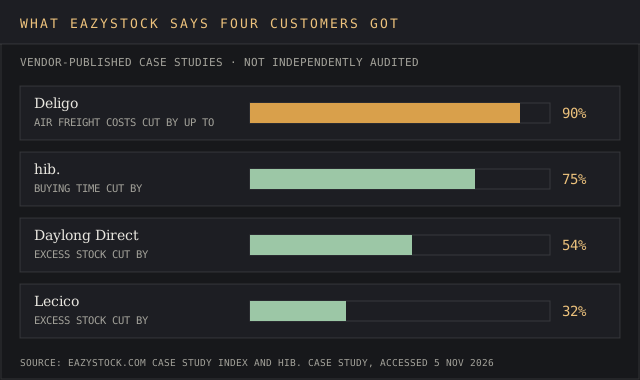
At platform scale, the AppSource listing says Syncron handles "over 1.75 million stock items" and "2.5 million order line recommendations per day." The About page adds inventory "in over 30k stock holding locations." None of these figures has an independent audit behind it.
Frequently asked questions
What is the best free inventory management software?
EazyStock's pricing page lists no free plan. It gives away four calculators, EazyABC, EazyROI, EazySafetyCalc and EazyReorderCalc, listed on the EazyStock homepage. Streamline offers a free trial on its G2 listing. For full inventory management with published entry prices, see our inventory analytics software ranking.
What are the top 5 inventory management software?
Our ranking of inventory management software places Fishbowl, Zoho Inventory, inFlow Inventory, Cin7 Core and Unleashed in its first five slots. EazyStock sits a layer above those tools for firms that already run one: it plans the inventory a host system already records.
Which AI is best for inventory management?
For mid-sized businesses, an inventory optimization add-on like EazyStock or Netstock covers daily demand forecasting, inventory planning and reorder points, and both pick a model per item to handle seasonality. For multi-plant demand forecasting software, our forecasting ranking puts o9 Solutions, Kinaxis and Blue Yonder at the top, and the manufacturing forecasting ranking covers plant-level solutions.
EazyStock vs alternatives
Netstock
Netstock is the closest match in inventory optimization: same buyer, same add-on model, same daily batch, and both sell automated demand forecasting to companies on mid-market systems. It wins on price visibility with a $900 a month floor, and on G2 it scores 4.6 across 182 reviews with 8.2 for ease of setup. EazyStock wins on support (9.4 against 9.2) and on the monthly billing option, which Netstock doesn't sell.
Our Netstock review covers its 24-hour data lag in detail.
Slimstock
Slimstock reports more than 1,700 customers in 75 countries and local offices in 28 countries, operating since 1993. It suits larger wholesalers and retailers that want consultants on site for inventory optimization and demand forecasting. Its site prints no price, so it shares EazyStock's weakest score.
GMDH Streamline
Streamline, the inventory optimization tool GMDH built, scores 4.4 across 278 G2 entries and beats EazyStock on ease of setup, 8.6 against 7.6. Its pricing page says "Pricing is tailored to your business," so neither tool gives a number up front. EazyStock's 9.4 support score against Streamline's 8.9 is the case for paying for the hand-holding.
Kinaxis
Kinaxis is a different product line for a different buyer, sold as an enterprise planning solution: global manufacturers running concurrent supply chain planning across plants, with $548.0 million in FY2025 revenue and six to eighteen month implementations, per our Kinaxis review. A 3,000-SKU distributor would bite off more than it can chew.
Enterprise buyers who need to optimize across plants should also read the Blue Yonder review and the supply chain visibility ranking; risk teams should start with the supply chain risk management ranking and the supply chain intelligence ranking.
Verdict
EazyStock is inventory optimization for small and mid-sized businesses on one of its 16 named ERP connectors who order from Excel today, want demand forecasting they don't have to tune, and want a support team that scores 9.4 out of 10 on G2.
It isn't for anyone who needs a price before a call, same-day ERP data, or custom reports without a customer success manager in the loop. It might suit a manufacturer with sporadic project demand if buyers keep reviewing every order proposal, because that's the case Capterra's 2021 reviewer flagged.