Indirect procurement software: 10 platforms ranked for 2026
 By Jan Suski. I go deep on every review, checking every number against its source and digging up details other coverage misses, a habit from six years of SEO and link building for tech companies. Bylines at Surfer, Brand24, and Senuto. How the scoring works.
· Prefer this source on Google
Indirect procurement platforms compared
The table shows each vendor's single strongest published number, its cheapest checkable price, and the buyer it fits. "Quote only" means the vendor posts no rate card and Vendr's header shows no tracked median.
| # | Provider | Published scale figure | Entry price | Best fit |
|---|---|---|---|---|
| 1 | Coupa | $6 trillion in community transactions | Vendr median $95,000/yr* | Enterprises with 5+ ERPs |
| 2 | JAGGAER | 13M+ suppliers, $2.9T spend managed | Quote only | Universities, research, manufacturers |
| 3 | Procurify | $100B+ run through the platform | Vendr median $15,000/yr* | Mid-market on NetSuite or QuickBooks |
| 4 | ProcureDesk | 7 named accounting and ERP connectors | $9,960/yr for 10 users | Finance-led teams of 100 to 1,000 staff |
| 5 | Precoro | 6 named accounting and ERP connectors | $499/mo, billed annually | Small teams wanting a public rate card |
| 6 | Order.co | 4 named connectors, 5% average savings claim | Quote only | Multi-location operators buying supplies |
| 7 | Zycus | 500+ enterprises on its Merlin platform | Quote only | SAP or Oracle shops wanting AI intake |
| 8 | SAP Ariba | Compliance mandates in 40+ countries | Vendr median $61,513/yr* | SAP S/4HANA estates |
| 9 | Ramp | Three-way match with Ramp POs | $15/user/mo plus add-on | Startups already on Ramp cards |
| 10 | Ivalua | Gartner Leader, source-to-pay, 2026 | Quote only | Enterprises wanting one configurable suite |
Medians marked * are anonymized buyer-reported contract values published by Vendr. Everything else is the price the vendor publishes itself.
Where these figures come from
Scale figures, connector counts and rate cards are each vendor's own published figure, read on 16 October 2026. The three medians marked * are Vendr's anonymised buyer-reported contract values for Coupa, Procurify and SAP Ariba. User quotes come from TrustRadius, G2 and Capterra and link to the review page.
JAGGAER, Order.co, Zycus and Ivalua publish no price, and Ramp publishes none for its procurement add-on, so no row invents one.
Procurement tools built around AI agents sit on the AI procurement software ranking, and supplier-risk and spend-data platforms sit on the procurement intelligence ranking. This list is the procure-to-pay layer: requisition, catalog, purchase order, receipt, invoice.
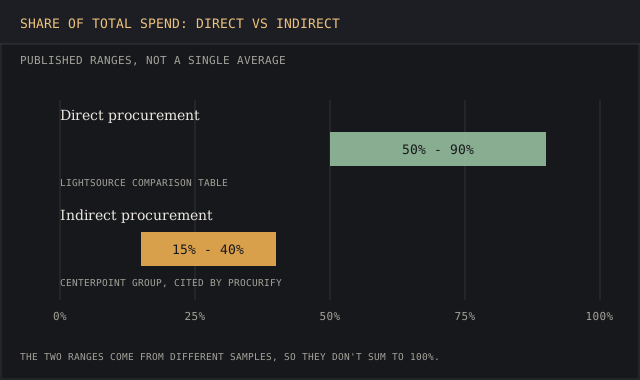
Indirect procurement tools run the buying a company does to keep itself open: laptops, SaaS seats, cleaning contracts, agency retainers, travel. Procurify's own guide to direct vs indirect procurement cites Centerpoint Group's estimate that indirect spend "typically represents 15% to 40% of total organizational expenditure." That's the slice of indirect purchases nobody on the factory floor watches.
This page ranks ten platforms by what their vendors publish: network size, invoice matching, named ERP connectors and a price a buyer can check. It covers enterprise source-to-pay suites for direct and indirect procurement and the mid-market tools finance and procurement teams buy when a spreadsheet stops working.
It's written for controllers, procurement teams and operations managers deciding which purchase order tool to put between employees and a company card. The timing matters because the suites are adding AI to invoice matching: Coupa bought an invoice-reading AI company on 12 May 2026.
Evaluation criteria for indirect procurement tools
Four criteria decide the shortlist, and the ranking below applies them in this order. Each one is a test a buyer can run against a vendor's own pages in under ten minutes, which is the point. A tool that won't publish a figure loses ground to one that does.
Published network or spend figure
Does the vendor state how many suppliers sit in its network, or how much spend runs through it? A number like JAGGAER's 13M+ suppliers is checkable against a sales demo. A phrase like "the world's largest business network" isn't.
Invoice matching documented on the vendor's page
Does the pricing or product page say the tool matches a purchase order, a receipt and an invoice? Two-way and three-way match are what stop duplicate payments. Yes or no, and which tier carries it.
ERP and accounting connectors named
Count the connectors the vendor names: NetSuite, Sage Intacct, QuickBooks, SAP, Oracle, Workday, Microsoft Dynamics. "Multiple ERP integration" counts as zero. The count tells you how much of the integration is product and how much is a services project.
A price you can check
Either a published rate card or a Vendr median with its purchase count. Vendr's anonymised buyer data is the closest thing this category has to a price index. Quote-only vendors still rank, but they lose ties.

Two suites land lower than their market share suggests. SAP's procure-to-pay page names no ERP connector and no network count, and Ivalua's public pages name neither a connector nor a price. The order rewards what a vendor writes down, and that's a level playing field for every name on the list.
The 10 best indirect procurement platforms
Coupa
Best fit
An enterprise running several ERPs that wants one buying front end across all of them.
Coupa is a business spend management suite that Thoma Bravo took private in an $8 billion deal completed in February 2023. Its procurement product page says the Coupa Community draws on "data from $6 trillion in real-world transactions" and that customers averaged savings of 8.1% on total spend. The full Coupa review covers the suite module by module.
On 12 May 2026 Coupa acquired Rossum, whose language model reads invoices and purchase orders. That's the invoice-matching layer of indirect procurement getting an AI engine bolted on.
Key features
- AI guided buying that steers users to contract-approved goods
- Coupa Advantage Marketplace with pre-negotiated rates
- Named connectors for SAP, Oracle, NetSuite, Workday and Microsoft Dynamics
- SpendGuard, which monitors user and supplier behaviour for fraud
- Coupa Supplier Portal for supplier-managed catalogs
Pricing
Coupa publishes no rate card. Vendr's anonymised buyer data puts the median Coupa contract at $95,000 a year, based on 127 purchases, with a range of $20,761 to $331,445.
Pros
- The largest published transaction figure on this list, $6 trillion
- Five ERPs named on the product page
- The deepest Vendr sample in the category, 127 purchases
Cons
- A $95,000 median costs an arm and a leg for most companies under 1,000 staff
- Suppliers on the other end of the purchase order complain about invoicing through it
- Requesters find the PO-creation wording confusing
"Many parts of Coupa are unclear, especially in the 'how to create a PO,' as the wording is confusing."
Social Impact Program Manager, 10,001+ employees, TrustRadius review, 6 February 2020
The supplier side is harsher. A vice president of accounting at a 1-10 person vendor wrote on the same TrustRadius page: "I'm considering not to accept purchase orders that require invoicing through Coupa." TrustRadius scores Coupa 7.3 out of 10 on 167 reviews and ratings.
Why it’s ranked #1. Coupa's $6 trillion community figure is the biggest published scale number here, more than double JAGGAER's $2.9 trillion, and it names five ERPs. Nothing above it.
JAGGAER
Best fit
A university, research institute or manufacturer with 40-plus systems to connect and a large supplier base.
JAGGAER's homepage claims a "13M+" supplier community and "$2.9T" in annual spend managed, the only supplier count any vendor on this list publishes. Its FAQ says it connects to "40+ ERP systems," with SAP, Oracle, Workday and Microsoft Dynamics named. The JAGGAER review has the module detail.
The procure-to-pay figures are vendor claims, so read them as the ceiling a sales team will quote: 50% time saved from requisition to purchase order, 85% time saved on invoice processing, and 18% savings from realigning maverick spend to contract. Gartner placed JAGGAER as a Visionary in its source-to-pay Magic Quadrant in 2024, 2025 and 2026.
Key features
- eProcurement with guided buying
- Invoicing, Global eInvoicing Compliance and Autonomous AP
- JAGGAER Link, which the vendor says connects to 1,000+ systems
- Research Material Management for lab buying
- JAGGAER AI (JAI) assistants across sourcing and buying
Pricing
JAGGAER publishes no price, and pricing is quote only. Budget the way you would for Coupa: annual subscription plus an implementation partner.
Pros
- 13M+ suppliers, the only published supplier count among the ten
- 40+ ERP systems, the widest connector claim here
- Named customers include Procter & Gamble, NYU and the University of Notre Dame
Cons
- No public price and no Vendr median to anchor a negotiation
- Users describe the interface as dry
- Older reviews ask for integration that fits existing processes
"JAGGAER is well suited to be a modern, cloud procure to pay application for large organizations."
Executive in Finance and Accounting, 501-1,000 employees, TrustRadius review, 30 November 2018
A procurement systems administrator at KIPP Texas Public Schools gave it 9 out of 10 in January 2024 and still wrote: "The UI is pretty dry form a user point of view." JAGGAER scores 7 out of 10 on 63 TrustRadius reviews and ratings.
Why it’s ranked #2. JAGGAER's $2.9 trillion in managed spend trails Coupa's $6 trillion, but it beats Procurify's $100 billion by a factor of 29 and adds 40+ ERP connectors.
Procurify
Best fit
A mid-market company on NetSuite, QuickBooks or Sage Intacct that wants requisitions, approvals and purchase orders in one place.
Procurify's pricing page says "Hundreds of finance and operations teams run $100B+ through Procurify." It prices on Pro users and gives customers unlimited Basic users, so a company with 12 buyers and 300 staff raising requests pays for 12. Its homepage quotes Canal Barge cutting requisition cycle time "from 29 days to one day."
Key features
- Order requests, purchase orders, product catalogs and vendor records in the base Purchasing product
- Approval routing, budgets and Spend Insights dashboards
- Punchout and catalog integrations with Amazon Business, Staples and ZAGENO
- Accounting connectors for NetSuite, QuickBooks Online, QuickBooks Desktop, Sage Intacct and Business Central
- Accounts Payable and Expense & Card sold as separate products
Pricing
Procurify publishes no number. Vendr's buyer data shows a median contract of $15,000 a year, with a low of $4,210 and a high of $40,000.
Pros
- Free Basic users keep the per-requester cost at zero
- Five accounting and ERP connectors named
- A $15,000 median, about one sixth of Coupa's
Cons
- AP, expenses and contracts are add-ons priced on top of Purchasing
- Budgets have to exist before the fiscal year starts
- Reviewers in larger companies find inventory management thin
"Not requiring a budget to start the new year. We never have our budgets ready by 1/1."
Controller in Finance and Accounting, 201-500 employees, TrustRadius review, 1 March 2021
A finance director at a 501-1,000 person company put the other side in five words: "The end-user experience is fantastic."
Why it’s ranked #3. Procurify's $100 billion is the third and last published spend figure here, which puts it above ProcureDesk, and its $15,000 median is a fraction of JAGGAER's quote-only suite.
ProcureDesk
Best fit
A controller at a 100 to 1,000 person company who wants every purchase approved and GL-coded before the invoice lands, and wants to hit the ground running.
ProcureDesk is one of three procurement vendors in our procurement software pricing report that publish a full rate card. The pricing page lists Startup at $9,960 a year for 10 users and Growth at $15,000 a year for 20, with each extra user at $20 a month. G2 scores it 4.4 out of 5 on 49 reviews.
Key features
- Requests, POs, receiving and invoices on every plan
- Basic three-way matching with OCR on Startup, unlimited OCR on Growth
- Month-end close lock with a full audit trail on Growth
- Supplier onboarding with EIN and W-9 collection on Growth
- Unlimited punchout catalogs on Enterprise
Pricing
Startup costs $830 a month billed annually ($9,960) and connects to QuickBooks, Xero and Bill.com. Growth costs $1,250 a month ($15,000) and adds NetSuite, Sage Intacct and Business Central. Enterprise is custom and adds SAP S/4HANA.
Pros
- A public price for 10 and 20 users
- Seven accounting and ERP connectors named across the tiers
- Three-way match on the cheapest plan
Cons
- Punchout catalogs only appear on the custom Enterprise tier
- SSO and 2FA start at $15,000 a year
- No receiving reminder for users who forget to confirm delivery
"ProcureDesk is saving us around four hours each week thanks to its smooth, clean integration with QBO."
Kent R., Chief Financial Officer, mid-market, G2 review, 7 May 2026
The recurring complaint is the receiving step. Sarah P., an accountant at a small business, wrote on G2 in May 2026: "It doesn’t have a reminder to notify users to complete receiving, and there’s no clear way to tell when a supplier is missing bank information."
Why it’s ranked #4. ProcureDesk names seven connectors to Precoro's six and includes three-way match at $9,960, but no published spend figure, which leaves it below Procurify's $100 billion.
Precoro
Best fit
A small or mid-sized team that wants to read the price before it talks to sales.
Precoro's pricing page starts Core at $499 a month and Automation at $999 a month, both billed annually. Core already carries purchase requests, POs, receipts, invoices and 2- and 3-way matching, which is the whole procure-to-pay loop for $5,988 a year. TrustRadius scores it 9.5 out of 10 on 22 reviews and ratings.
Key features
- Service and item catalogs on Core, PunchOuts on Automation
- Automated approvals and custom workflows
- Invoice payments with prepaid virtual cards
- Supplier portal, vendor onboarding and RFPs on Automation
- Connectors for QuickBooks Online, Xero, NetSuite, Sage Intacct, Business Central and BILL
Pricing
Core is $499 a month, Automation $999, Enterprise custom with unlimited users, and the AP Module $499 a month on its own.
Pros
- The lowest published price for a tool with three-way match
- Duplicate-invoice warnings at upload
- Approvers can sign off from a phone
Cons
- PunchOut catalogs need the $999 package
- Notes and documents on a request don't carry into the PO
- Seat counts per package aren't published
"All notes & comments and documents submitted in PR were not flow thru to the PO."
Account Manager in Finance and Accounting, 1-10 employees, TrustRadius review, 1 December 2022
A finance officer at MyBucks Banking Corporation named the feature that pays for itself: "Precoro makes a notification that an invoice with the same number was already uploaded for payment."
Why it’s ranked #5. Precoro names six connectors, one fewer than ProcureDesk, and beats Order.co's four with a $499 public price.
Order.co
Best fit
A multi-location operator (gyms, clinics, offices) buying the same office supplies and maintenance goods across dozens of sites.
Order.co's homepage claims "average hard-dollar savings of 5%, and up to 10% in categories like maintenance and office supplies." It also says one customer, CORE Power Yoga, "Eliminated $50,000 in monthly unapproved spending," which is the cleanest maverick spend number any vendor on this list publishes.
Key features
- AI-built catalogs tailored to each customer
- Automated GL coding and 3-way match
- Budgets, approvals and real-time reporting
- Connectors for QuickBooks Online, NetSuite, Sage Intacct and Workday
- Okta and Ping Identity single sign-on
Pricing
Order.co publishes no price; the site offers a demo and nothing else.
Pros
- Sourcing and buying in one marketplace, so tail spend lands in one invoice stream
- A dollar figure for blocked unapproved spend
- Capterra scores it 4.5 out of 5 on 176 reviews
Cons
- No public price
- Delivery can lag a direct Amazon order
- Four named connectors, the fewest among the mid-market tools here
"shipping can take a little longer for items that usually arrive faster through Amazon"
Erin W., Brand Manager, health and fitness, 201-500 employees, Capterra review, 8 October 2025
Karissa G., a director of administration at a 11-50 person farming business, wrote that Order.co "really gives the ability to have all our expenses on one platform."
Why it’s ranked #6. Order.co's four named connectors beat Zycus's three, but trail Precoro's six, and it posts no price where Precoro posts $499.
Zycus
Best fit
An SAP, Oracle or NetSuite enterprise that wants AI intake in front of its purchase requisitions.
Zycus says on its homepage that "500+ enterprises run on the Merlin Agentic Platform," and Gartner named it a Leader in the 2026 source-to-pay Magic Quadrant. The AP module promises touchless invoices and three-way match. The Zycus review tracks the suite.
Key features
- Merlin Intake for purchase requests
- eProcurement and eInvoice modules
- AP and invoice management with three-way match
- Merlin Autonomous Negotiation Agent for tail spend
- Named connectors for SAP, Oracle and NetSuite
Pricing
Zycus posts no price, and Vendr's marketplace page shows no tracked median.
Pros
- Gartner Leader for source-to-pay in 2026
- Three-way match documented on the homepage
- The vendor claims 80% request automation from Merlin
Cons
- No price and no Vendr data
- Only 9 TrustRadius reviews and ratings for the P2P suite, scoring 7 out of 10
- SAP customers report manual re-entry
"Even after all the effort the information has to manually entered or entered through an interim application in SAP for those businessess that would like to have their data maintained in SAP."
Manasa Uppara, Senior Procurement Specialist, IFF (5,001-10,000 employees), TrustRadius review, 18 December 2022
Why it’s ranked #7. Zycus names three ERP connectors where SAP Ariba's page names none, but trails Order.co's four, and neither posts a price.
SAP Ariba
Best fit
A company already on SAP S/4HANA that wants buying, invoicing and supplier collaboration inside SAP's own network.
SAP's procure-to-pay page describes guided buying, buyer- and supplier-managed catalogs, and invoices "systematically matched against POs, contracts, and receipts." The SAP Business Network page says suppliers can comply with e-invoicing mandates in more than 40 countries. The SAP Ariba review page tracks the product.
Key features
- Guided buying with risk-aware guidance
- Buyer- and supplier-managed catalogs with contract-compliance enforcement
- Invoice matching against POs, contracts and receipts
- Real-time tax, budget and inventory checks
- A free hands-on tour of guided buying
Pricing
Vendr's buyer data shows a median of $61,513 a year across 16 purchases, ranging from $15,531 to $371,134.
Pros
- Three-document matching, the strictest described here
- A Vendr median to negotiate against
- Toyota runs its electronic procure-to-pay on it
Cons
- No ERP connector named on the procure-to-pay page
- Supplier enablement counts that fall short after go-live are a red flag
- User experience draws a 1-out-of-10 review
"We feel we were misled by the number of suppliers that were enabled and actively using SAP Ariba."
Manager, 5,001-10,000 employees, TrustRadius review, 12 October 2026
A finance director at Toyota wrote on the same page that "SAP Ariba has been instrumental in Toyota achieving an electronic PTP process." TrustRadius scores SAP Ariba 7.6 out of 10 on 756 reviews and ratings.
Why it’s ranked #8. SAP Ariba's $61,513 Vendr median gives buyers a price Ramp's unpriced procurement add-on doesn't, but its page names zero ERP connectors to Zycus's three.
Ramp
Best fit
A startup already paying for Ramp cards that wants POs without a second vendor.
Ramp's pricing page lists Free at $0 per user and Plus at $15 per user a month plus a platform fee, with 20% off for annual billing. Procurement is an add-on to Plus or Enterprise, carrying intake and approval workflows, automated PO creation and three-way match with Ramp purchase orders. Capterra scores Ramp 4.9 out of 5 on 223 reviews.
Key features
- Advanced intake and approval workflows
- Automated PO creation and tracking
- Three-way match with Ramp purchase orders and item receipts
- AI-driven vendor compliance reviews
- Vendor tracking, contract extraction and price intelligence on the Free plan
Pricing
Plus is $15 per user a month plus a platform fee based on team size. The procurement add-on has no listed price.
Pros
- Card, bill pay and purchase orders in one ledger
- Free vendor tracking before you pay for anything
- Receipt submission routes purchases to approvers
Cons
- The procurement add-on price is unpublished
- No catalogs or punchout on the pricing page
- Merchant holds linger on cards
"the receipt submission flow makes it easy for purchases to get reviewed and approved as needed."
Sarah K., People Ops Manager, computer software, 201-500 employees, Capterra review, 17 July 2025
On the same page, a vice president of HR and administration at a construction firm complained that "card authorizations (or merchant holds) take a long time to drop off."
Why it’s ranked #9. Ramp publishes a $15 per user price where Ivalua publishes none, but its procurement add-on is unpriced and it lists no catalogs, behind SAP Ariba's $61,513 Vendr median.
Ivalua
Best fit
An enterprise that wants one heavily configured suite and has the budget for a partner to configure it.
Ivalua's homepage says Gartner named it a Leader in the 2026 Magic Quadrant for Source-to-Pay Suites and lists a procure-to-pay module with eProcurement, AP Automation, Expense Management, Payments and Inventory Collaboration. G2 scores it 4.3 out of 5 on 116 reviews. The Ivalua review page tracks it.
Key features
- eProcurement with multi-supplier catalog orders
- AP Automation and Payments
- Intake Management in front of requisitions
- Supplier Management and onboarding
- Inventory Collaboration for stocked indirect items
Pricing
Ivalua publishes no price and Vendr's header showed no median during this review.
Pros
- One order can span several suppliers' catalogs
- Gartner Leader in 2026
- Admins can add process statuses through configuration
Cons
- No connector, network figure or price on its public pages
- Implementation partners draw the sharpest complaints
- A mid-market user calls it hard to use
"Ivalua streamlines purchasing for our buyers by letting them access multiple supplier catalogs in one place, create a single order that includes multiple suppliers, and handle payments without extra work outside the platform."
Verified user, transportation, enterprise, G2 review, 22 September 2026
"I find Ivalua not very user-friendly. The system isn't intuitive, which makes it hard to navigate."
Verified user, mid-market, G2 review, 14 September 2026
Why it’s ranked #10. Ivalua's 4.3 G2 score on 116 reviews shows buyers like it, but it publishes zero connectors, zero network figures and no price, one fewer checkable number than Ramp's $15.
What is indirect procurement?
Indirect procurement is the purchase of goods and services a company consumes to run itself, none of which ends up in what it sells. Amazon Business's guide to indirect procurement defines it as "everything your organization buys that doesn't go into the products or services you sell." Indirect procurement refers to the printer toner a manufacturer buys; the steel in its product is direct.
Procurify's guide lists ten indirect procurement categories:
- IT, software, and telecommunications
- Facilities and workplace services, including facilities management and janitorial contracts
- Professional and outsourced services
- Travel and employee expenses
- Marketing and events, including marketing services and agencies
- Human resources, recruitment, and learning
- Office supplies and equipment
- Fleet and transportation
- Uniforms and personal protective equipment
- Corporate and employee services
Software subscriptions and software licenses sit in the first bucket. Most indirect procurement teams find more software subscriptions than they expected once spend data sits in one system. Each indirect purchase is a drop in the bucket. The total isn't.
Direct vs indirect procurement: key differences
Direct procurement buys the raw materials and direct materials that go into the finished product, and supply chain teams own it as part of the wider supply chain.
Amazon's guide says "Supply chain teams own direct procurement," while indirect procurement is usually managed by procurement, finance or individual departments. That split is why indirect procurement covers dozens of buyers and direct procurement covers a handful, even though direct takes the lion's share of spend.
The spend shares differ too. LightSource's comparison table puts direct procurement at "Typically 50-90% of total spend," and Centerpoint Group's figure puts indirect spend at 15% to 40%. Direct and indirect spend add up to most of what a company pays out, but they're managed in different systems by different people.
| Factor | Direct procurement | Indirect procurement |
|---|---|---|
| What it buys | Raw materials, components | Office supplies, software, professional services |
| Share of total spend | 50% to 90% (LightSource) | 15% to 40% (Centerpoint Group) |
| Owner | Supply chain teams | Procurement, finance, business units |
| Risk if it fails | Production schedules slip | Maverick spend and missed savings |
| Supplier base | Fewer, long-term key suppliers | Many vendors, high tail spend |
Direct procurement focuses on supplier performance, supplier lead time and quality, because a late part stops a line. Direct procurement refers to inventory management and production, and inventory management software sits on that side; unlike direct procurement, indirect purchases rarely stop anything when they fail, so nobody notices the leak. In SAP the difference is mechanical: direct materials post to inventory, indirect purchases post to a cost center.
Indirect procurement challenges
Maverick spend is the biggest cost driver in indirect procurement. Amazon's guide calls it "the single biggest cost driver in indirect procurement," and blames friction: the approved channel is harder to use than a company card, so purchases fly under the radar. Order.co's CORE Power Yoga case put a number on it, $50,000 a month of unapproved spending.
Decentralized buying creates the other problems. Amazon's guide states that "Decentralized procurement increases the risk of regulatory violations," because an employee who can't find a compliant supplier buys from a non-contracted one. Indirect procurement is harder to control than direct procurement for the same reason: 40 departments, 40 procurement processes, no process standardization.
Poor spend visibility hides the savings in indirect spend. If nobody can see that three teams bought the same SaaS seat, nobody negotiates a volume discount, and mismanaged indirect procurement turns into redundant services and duplicate invoices. It's a needle in a haystack until spend data sits in one place.
Supplier concentration is the test that shows if a program works. Procurify's guide says mid-market organizations hold "approximately 55–65% of total spend concentrated among their five largest vendors," citing its 2026 benchmarking data. A company far below that band has a long tail of indirect suppliers and no preferred suppliers to steer volume to.
How e procurement tools solve them
The software attacks the friction that causes maverick spend. Guided buying catalogs send employees to approved suppliers and negotiated contracts, and automated approval workflows enforce spending authority before the money moves. Coupa, SAP Ariba and JAGGAER all sell guided buying; Amazon Business sells a version of it for as little as $179 a year.
- Faster purchasing. JAGGAER claims 50% time saved from requisition to PO, and Procurify's Canal Barge case went from 29 days to one.
- Invoice matching. Three-way match stops duplicate payments; Precoro flags an invoice number that's already been uploaded.
- Audit trail. ProcureDesk's Growth plan locks month-end close with a full audit trail, so every approval sits on record.
- Compliance monitoring. Coupa's SpendGuard watches users and suppliers for suspicious behaviour.
- Real-time dashboards. Procurify's Spend Insights and Amazon Business's Spend Visibility show spend across departments as it happens.
- ERP integration. Every tool here posts POs and invoices into an ERP or accounting system, from QuickBooks to SAP S/4HANA, and that's what separates e procurement tools from a shared inbox.
Automation also cuts manual errors and processing time. JAGGAER claims 85% time savings on invoice processing, and Order.co claims it removes "up to 80% of manual reconciliation tasks." Both are operational efficiency claims, so treat them as vendor ceilings; talk is cheap until a pilot proves them.
Pricing across indirect procurement tools
Indirect procurement costs on the software side run from $0 to six figures. Ramp's Free tier costs nothing, Precoro Core costs $5,988 a year, ProcureDesk Startup $9,960, Procurify's Vendr median $15,000, SAP Ariba's $61,513 and Coupa's $95,000. That's a 16x spread between Precoro and Coupa before implementation.
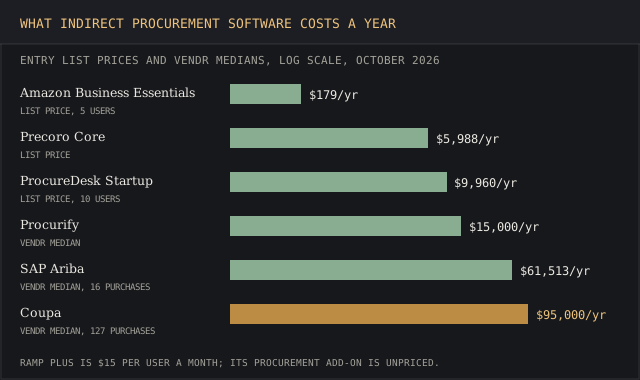
Amazon Business is the cheapest guided buying on the market, and it works as a catalog channel with procurement controls on top. Business Prime runs from Essentials at $179 a year for 5 users to Enterprise at $10,099 a year for unlimited users, and only Enterprise lets an admin block purchasing behaviour. Procurify lists Amazon Business as an integration, so a Procurify buyer can use it as a catalog inside the purchase order flow.
The devil's in the details, and the details are the add-ons. Procurify sells AP and expenses as separate products, so a Purchasing quote alone won't control costs. Precoro puts PunchOut on the $999 package; ProcureDesk keeps SSO off the $9,960 plan. The full breakdown, with implementation and supplier fees, is in the procurement software pricing report.
Indirect procurement KPIs that measure procurement ROI
Procurement teams should track five indirect procurement KPIs from day one, because procurement ROI only exists if the baseline exists. Pick numbers the software can report without a spreadsheet:
- Spend under management, as a share of total indirect spend
- Requisition-to-PO cycle time in days
- Share of invoices arriving without a PO
- Share of spend with preferred suppliers, against Procurify's 55% to 65% band
- Supplier compliance rate on negotiated contracts
Cost savings figures from vendors (Coupa's 8.1%, Order.co's 5%) are averages across their own customers, and cost savings in your own ledger are the only ones that count. Measure yours against the same KPIs before and after go-live, and keep an eye on the invoice-without-PO share; it's the one that moves first.
Indirect procurement strategy: centralize, then automate
An effective indirect procurement strategy centralizes policy before it buys software. Establish clear procurement policies (approval thresholds, preferred vendors, a catalog for the top 50 items) and then configure the tool to enforce them. Buying the tool first sends the project back to square one, and the wild goose chase that follows usually ends in a re-implementation.
Centralized procurement improves visibility and compliance across departments, and regular spend analysis finds the consolidation opportunities: three marketing agencies, two cloud infrastructure contracts, four office supplies vendors.
Strategic sourcing on those categories delivers volume discounts and stronger supplier relationships. Those supplier relationships are where the next round of savings comes from, and they help control costs at renewal. Procurement teams that skip the spend analysis cut corners on the one step that pays.
Indirect procurement BPO is the alternative to buying software at all, and it lets a small finance team pass the buck on day-to-day purchasing. A business process outsourcer runs requisitions, sourcing and supplier management for a fee, and the buyer keeps the policy. It suits companies whose indirect spend and professional services budget are too small to justify a team and too large to leave unmanaged.
Managing indirect procurement: strategic importance and risk management
Managing indirect procurement well is a cost management job first. At 15% to 40% of total spend, indirect spend management touches more invoices than direct procurement spend does, and every one of them passes through a different budget owner. Procurement teams that treat indirect categories as an afterthought give up the cost reduction that pays for the software.
The strategic importance shows up in three places. Spend management that puts direct spend and indirect spend in one view lets finance see total spend by supplier, so direct spend and indirect purchases share one ledger.
Supplier relationship management on the 20 largest vendors turns renewals into strategic partnerships, with competitive pricing locked into negotiated contracts. Consolidating purchasing decisions across business units is how teams identify cost saving opportunities and control costs that never show up in a direct materials budget.
Risk management is the part most indirect procurement processes skip. A single cloud provider outage or a cleaning contractor that fails a background check won't cause supply chain disruptions on the scale of a missing component, but it still interrupts internal operations. Check each key supplier's financial health once a year, track supplier performance against the contract, and keep a second approved supplier for every category that would hurt to lose.
Supplier collaboration works the same way in both worlds, and supplier relationships carry it. Direct procurement focuses on supplier performance because a late part halts a line; indirect procurement focuses on the same metric because a late laptop idles a new hire. Teams that strengthen supplier relationships on both sides turn procurement into a competitive advantage, and they get there by scoring on-time delivery every quarter.
Operational efficiency is the payoff finance teams feel first, and it's the reason managing indirect procurement pays for a tool. When internal stakeholders raise every request through one procurement process and everyone's on the same page, approvals take days, invoices match on arrival, and cost savings stop depending on someone remembering to check.
Operational efficiency in direct and indirect procurement, cost management and spend management all rest on that one change, and spend management software is how procurement teams keep it in place.
Key takeaways: indirect procurement
- Indirect procurement covers everything a company buys to run itself, from office supplies and professional services to facilities management and marketing services.
- Indirect spend runs 15% to 40% of total spend; direct procurement runs 50% to 90%, mostly raw materials.
- Maverick spend is the largest leak, and Order.co's CORE Power Yoga case put it at $50,000 a month.
- Mismanaged indirect procurement shows up as duplicate software subscriptions and missed volume discounts.
- The ten platforms above split into enterprise suites from $61,513 a year and mid-market tools from $5,988.
- Strategic sourcing on the top indirect categories pays more than automating the tail.
Frequently asked questions
What is an example of indirect procurement?
Indirect procurement covers purchases like laptops for new hires, a Salesforce renewal, or a cleaning company for the office. None of them ends up in the product the company sells.
What is an indirect purchase order?
An indirect purchase order sits on the indirect side of direct and indirect procurement: a PO for goods or services consumed internally, coded to a cost center and not to inventory. Every tool on this list issues them.
What is direct vs indirect procurement?
Direct vs indirect procurement is a split by destination: direct and indirect procurement both run sourcing and POs, but direct buys feed production and indirect buys feed the business. Direct procurement focuses on supply chain continuity; indirect procurement focuses on policy compliance.
What is the difference between direct and indirect suppliers?
Direct suppliers provide raw materials and components for the direct procurement process; indirect suppliers provide everything that supports internal operations, from janitorial services to software.
What are the four types of procurement?
The common split is direct procurement, indirect procurement, goods procurement and services procurement. Direct and indirect procurement describe where a purchase ends up; goods and services describe what is bought.
What are the top 5 procurement software tools?
For indirect spend, this ranking's top five are Coupa, JAGGAER, Procurify, ProcureDesk and Precoro, in that order.
What is a BPO in procurement?
A procurement BPO (business process outsourcing) contract hands day-to-day procurement operations to an outside firm, which runs sourcing and purchasing on the buyer's behalf.
Bottom line
Coupa wins for enterprises with several ERPs and the budget for a $95,000 median contract; JAGGAER wins where a 13M-supplier network and 40+ ERP connectors outweigh the missing price tag. SAP shops will end up on SAP Ariba regardless of where it sits here.
Mid-market procurement teams have three real choices, and each fits a different procurement process. Procurify suits a company that wants unlimited free requesters, ProcureDesk suits a controller who wants three-way match at $9,960, and Precoro suits anyone who wants the whole loop for $499 a month. Ramp and Order.co fit buyers already inside their card or marketplace.