Data Feed Providers: 10 Market Data Feeds Ranked for 2026
 By Jan Suski. I go deep on every review, checking every number against its source and digging up details other coverage misses, a habit from six years of SEO and link building for tech companies. Bylines at Surfer, Brand24, and Senuto. How the scoring works.
· Prefer this source on Google
Quick comparison of the top data feed providers
Ten data feed providers in ranked order, with the history and book depth each publishes, its lowest published price and the buyer it fits.
| # | Provider | History and depth | Entry price | Best fit |
|---|---|---|---|---|
| 1 | Databento | 16+ years, Level 3 order-by-order | $199/mo Standard, or pay per GB | Quants who need full depth on futures and equities |
| 2 | LSEG Real-Time | 30+ years of tick history, 575+ venues | $4,752/yr median* | Banks and funds trading global markets |
| 3 | Massive | 20+ years on Stocks Advanced | $0, then $29/mo, $199/mo real-time | Developers building US stock apps |
| 4 | CME Group | 40+ years | $1.55/mo retail Level 1 per exchange | Futures and options traders |
| 5 | Nasdaq | TotalView full depth of book | $15/mo non-professional | US equity traders who read the book |
| 6 | Finnhub | 30+ years OHLC and tick | $0 at 60 calls/min, $3,500/mo All-In-One | Apps mixing prices with fundamental data |
| 7 | Alpaca | 7+ years | $0 IEX feed, $99/mo all US exchanges | Algorithmic trading through a broker account |
| 8 | Twelve Data | 800 free calls a day | $79/mo Grow | Hobby projects outgrowing a free tier |
| 9 | EODHD | 30+ years, 150,000+ tickers | $19.99/mo Historian | End-of-day research across global stock exchanges |
| 10 | dxFeed | 8 data categories | From $19/mo inside trading platforms | Retail futures traders on ATAS, Quantower or Bookmap |
Prices are the lowest published plan on each vendor’s site in October 2026. Exchange fees for CME Group and Nasdaq are per device per month. The median marked * is an anonymized buyer-reported contract value published by Vendr.
Where these figures come from
History depth, venue counts and plan prices are each vendor’s own published figure, read in October 2026, and the exchange fees come from the CME Group and Nasdaq fee lists linked in each entry. The LSEG median marked * is Vendr’s anonymized buyer-reported contract value across LSEG’s products. LSEG publishes no list price for its feeds, and dxFeed prices its exchange packages by quote.
LSEG also ranks first in the financial data providers ranking, which covers reference data, credit and fundamentals. News and sentiment APIs sit in the market intelligence API ranking, and finished research apps for investors in the investment research platforms ranking.
Data feed providers sell the stream of prices, quotes and trades that powers every chart, trading bot and risk model in the markets. A retail trader pays $1.50 a month for New York Stock Exchange Level 1 quotes through a broker, and a professional pays $134.50 a month per device for CME Group real-time data. This page sorts ten providers across that spread.
This ranking covers ten market data feeds sold to traders, developers and funds: exchange-direct feeds from CME Group and Nasdaq, global consolidated feeds from LSEG, and API vendors such as Databento, Massive, Alpaca and Finnhub. Each entry carries its published price, its history depth and the order-book depth it delivers, with a link to the vendor page the figure came from.
It's written for three buyers: a developer wiring real time market data into an app, a quant backtesting trading strategies on years of history, and a desk choosing a direct feed for execution. The wider field of reference data, credit and fundamentals sits on the financial data providers ranking, and the fee schedules behind every price here are broken down in the market data pricing report linked above.
Timing matters this year. Polygon.io renamed itself Massive on 30 October 2025, and Nasdaq's three-year price list raises the professional TotalView fee each year through 2027, so buyers who want to stay ahead of fee rises should read the schedules first.
Evaluation criteria for data feed providers
Five criteria decide the shortlist, and each one is a test a buyer can run against a vendor's own pages in under an hour. Together they cover the facts traders and investors need for informed decisions on market data feeds.
Depth of book on the feed
Does the data feed carry Level 1 top of book, Level 2 depth by price, or Level 3 order-by-order events? The answer is a yes or a no per level. Full depth matters for anyone reading queue position or large orders resting away from the touch.
Venues and asset classes in named units
Count the venues, exchanges, symbols or assets the vendor publishes. "Global coverage" fails this test. "575+ venues" or "650,000+ symbols" passes.
Years of historical data at the price you pay
Every backtest needs history, and vendors gate the years by tier. Massive sells 2 years free and 20+ years on its $199 plan, so the number that counts is the one attached to the plan you'd buy.
Published real-time price and licence
A listed monthly price beats a sales call. The licence counts as much as the price.
At Databento, personal use on 2 devices and external redistribution are separate products, $1,551 a month apart.
Free allowance
Measure the free tier in calls per minute, credits per day or dollars of data. Finnhub gives 60 calls a minute, Twelve Data 8, and Databento $125 of historical data.
The 10 best data feed providers, ranked
Databento
Best fit
Quant teams and solo developers who need order-by-order data on CME futures markets and US equities, with self-serve access and no sales contract.
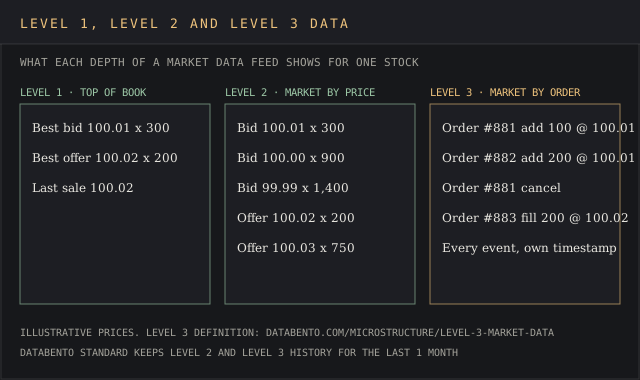
Databento is a company that normalises feeds from multiple exchanges and sells them through one API, covering over 45 exchanges and 650,000+ symbols on its live CME feed. It defines Level 3 as every individual order at every price level, with each add, modify, cancel and fill recorded as its own event.
Key features
- Level 0 through Level 3 schemas, including market-by-order (MBO) data
- 16+ years of Level 0 history on CME, CBOT, NYMEX and COMEX
- Usage-based billing per GB for historical data
- Live and historical data through one client library
- $125 of free historical credit per team, valid 6 months
Pricing
Standard costs $199 a month with licence fees included for personal use on 2 devices. Plus runs $1,750 a month in licence fees and Unlimited $4,500, both on annual contracts with external distribution rights.
Pros
- Published prices from $199, so a trader can access live markets the same day
- Level 3 depth on a published $199 plan
- Pay-as-you-go history for one-off backtests
Cons
- Standard keeps Level 2 and Level 3 history for the last 1 month only
- Redistribution starts at $1,750 a month
- Options markets carry heavy bandwidth loads
Users split on price against history. A Hacker News commenter wrote in October 2025, "I've been happy with Databento as a low-friction way to get market data." Another questioned the cost in July 2024, "Their MBO data is not cheap and they don't have much history."
Why it’s ranked #1. Databento publishes a $199 real-time plan with Level 3 depth, which LSEG at #2 sells only by quote. It beats Massive at #3 on book depth, since Massive's $199 plan stops at trades and quotes.
LSEG Real-Time
Best fit
Banks, brokers and funds that trade global markets across asset classes and need one consolidated feed for every desk.
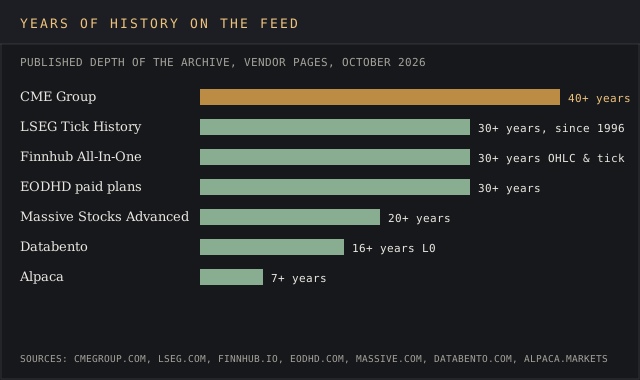
LSEG's Data & Analytics division, the former Refinitiv business, runs market data feeds covering over 575 venues and more than 90 million instruments, processing 100 to 200 billion messages per trading day. Its Tick History archive reaches back to 1996. The LSEG review covers the Workspace desktop that sits on top of the same data.
Key features
- Real-Time Ultra Direct, an exchange-native feed handler with single-digit microsecond processing
- Real-Time Direct, a full-depth managed direct feed
- Real-Time Optimized, conflated quotes from hundreds of sources, plus a delayed version without real-time fees
- Tick History PCAP with nanosecond, GPS-synchronised timestamps
- On-premises, cloud or hybrid delivery, plus managed distribution services for clients
Pricing
LSEG prices on request. Vendr's anonymised buyer data puts the median contract at $4,752 a year*, a contract total across LSEG's products.
Pros
- 575+ venues, the widest coverage of markets and assets on this list
- 30+ years of tick history for backtests on OTC markets and listed instruments alike
- Low latency market data options down to microseconds
Cons
- No public price list
- A user describes corrupt and blank files in historical deliveries
- Contracts sized for institutional clients
The most critical complaint is about the archive, from a Hacker News commenter in February 2025:
"You pay unbelievable sums to TR/Refinitiv/whatever they are called now and they ship you a HD/point you at an S3 bucket which contains a mix of valid/incomplete/corrupt/blank files which you then spend months checking."
Hacker News comment, February 2025
Why it’s ranked #2. LSEG covers 575+ venues and 30+ years of ticks, which beats Massive's US focus at #3. It loses to Databento at #1 because a buyer can't see LSEG's price without a sales call.
Massive
Best fit
Developers building apps on US stock and options markets who want unlimited API calls at a flat monthly price.
Massive is the API business formerly called Polygon.io. Its stock plans run from a free tier at 5 calls a minute to Stocks Advanced at $199 a month with real-time data and 20+ years of history. Developers who want to hit the ground running get unlimited calls on every paid tier, and the company sells the same data to business clients on a separate price list.
Key features
- REST and WebSocket APIs for stocks, options, indices, currencies and futures
- Flat files for bulk historical downloads
- Trades on Developer, quotes on Advanced
- Financials & Ratios add-on at $29 a month
Pricing
Stocks Basic is $0 with end-of-day data and 2 years of history. Starter is $29 and Developer $79, both 15-minute delayed feeds. Advanced is $199 for real-time data, sold to non-professionals. Annual billing saves 20%.
Pros
- Unlimited calls from $29 a month, delayed
- Streaming for all US stocks and markets on the real-time plan
- 20+ years of stock history at $199
Cons
- Real-time plans restricted to individual, non-professional use
- One user reported duplicate and missing records in financial data
- Book depth limited to trades and quotes on the stock plans
A developer who left a broker API for it wrote in June 2023 that "you can stream trades/quotes for the entire stock market in real-time, without any caps, which is amazing!" A second user reported in July 2023, "I too have noticed that the data can be unreliable, repeats, and has many records missing certain data."
Why it’s ranked #3. Massive streams every US stock in real time for $199 with unlimited calls, a bundled price CME at #4 can't match. It loses to LSEG at #2 on coverage, 575+ venues against a US-focused catalogue.
CME Group
Best fit
Futures and options traders who need the source feed for interest rate, energy, metals and equity index markets.
CME Group runs four exchanges, CME, CBOT, NYMEX and COMEX, and publishes over 40 years of historical depth across seven asset classes. More than 570 distributors resell its data around the world, so traders can reach it through a vendor.
Key features
- Direct access through Globex and co-location
- REST and WebSocket market data APIs
- DataMine bulk history by API, SFTP or S3, part of CME's wider data solutions and services
- Delivery on Google Cloud
- EBS Premium FX feed across 700+ currency pairs
Pricing
For a retail account in these markets, the exchange fee is a drop in the bucket. CME's June 2026 fee list charges retail traders $1.55 a month per exchange for top of book and $12.10 for depth. A professional real-time device costs $134.50 a month.
Pros
- 40+ years of history, the deepest on this list
- Source data for the full range of CME futures and options trades
- Retail top of book at $1.55
Cons
- Professional devices cost 87 times the retail rate
- Licensing paperwork before any company can redistribute
- Retail Level 2 depth costs $12.10, nearly 8 times Level 1
Exchange control of the data is the long-running complaint. A Hacker News commenter wrote in August 2022 that "NYSE, NASDAQ, CME, etc.. are historically the ones that are the gatekeepers of the data and putting up financial barriers."
Why it’s ranked #4. CME owns 40+ years of futures data and sells retail depth at $12.10, which beats Nasdaq at #5 on history. It loses to Massive at #3 because a developer still needs a vendor and a licence on top.
Nasdaq
Best fit
Traders in US stock markets who read the full order book and want the exchange's own depth feed.
Nasdaq sells TotalView, its full depth-of-book feed with real-time visibility into every displayed order, alongside Nasdaq Basic for top of book and Last Sale for broad distribution. Nasdaq Data Link adds more than 250 datasets over cloud APIs, from equities to fixed income and commodities, and the company says its data solutions reach investors in 85 countries.
Key features
- TotalView with every displayed order on the book
- Nasdaq Basic, an alternative to Level 1 data
- Nasdaq Basic Canada for Canadian equities
- Nasdaq Data Link API with 250+ datasets
Pricing
Nasdaq's 2025 to 2027 price list sets TotalView at $15 a month for non-professionals in all three years.
The professional fee rises from $80.50 in 2025 to $84 in 2026 and $86 in 2027.
Pros
- Full depth from the venue that lists the stock
- Retail price frozen at $15 through 2027
- 250+ datasets and analytics on one API
Cons
- Covers Nasdaq's own book, so a full US view needs other stock exchanges too
- Professional rate 5.6 times the retail rate
- Distributor fees apply to anyone redistributing
Costs climb once a buyer redistributes. A developer explaining exchange licensing on Hacker News wrote in April 2022 that "sites pay a pretty penny (we are talking probably tens of thousands per month for a single data source) to access it."
Why it’s ranked #5. Nasdaq sells full depth at $15 a month, which Finnhub at #6 can't offer at any price. It loses to CME at #4 on archive depth, where CME publishes 40+ years.
Finnhub
Best fit
App builders who want prices, estimates and fundamental data on each company from one API.
Finnhub's free plan allows 60 API calls a minute with US coverage and a WebSocket for 50 symbols. The All-In-One plan gives access to 30+ years of US OHLC and tick data and 25+ years of international OHLC across other markets.
Key features
- 30+ years of standardised financial statements
- Company news and press releases with 20 years of history
- EPS and revenue estimates with 20+ years history
- Bond tick data from FINRA TRACE
- Alternative data, including ESG scores and supply chain insights
Pricing
Free costs $0. All-In-One costs $3,500 a month, billed annually, with 900 market data calls a minute.
Pros
- 60 free calls a minute, the largest free rate here after Alpaca
- Fundamentals, estimates and prices in one subscription
- Survivorship-bias-free US data on the paid plan
Cons
- A jump from $0 to $3,500 with no tier between, the widest price difference here
- LSE data delayed 15 minutes, other international markets end of day
- Personal-use licence on both plans
A founder who built a consumer app on it wrote in March 2022, "their data quality is great and their coverage is excellent."
Why it’s ranked #6. Finnhub pairs 30+ years of US tick data with fundamentals and estimates in one plan, a breadth Alpaca at #7 doesn't sell. It loses to Nasdaq at #5 because it sells no depth of book.
Alpaca
Best fit
Developers running algorithmic trading strategies through Alpaca's own brokerage.
Alpaca bundles market data with its trading API. The $0 plan streams the IEX exchange feed at 200 calls a minute, and Algo Trader Plus at $99 a month gives access to all US exchanges with unlimited calls.
Key features
- US stocks, options and crypto data, with OPRA quotes for implied volatility work
- 7+ years of historical data on both plans
- Real-time OPRA data from US options markets on the paid plan
- Snapshots, aggregate bars and corporate actions
Pricing
Free is $0 with IEX data and a 30-symbol WebSocket limit. Algo Trader Plus is $99 a month with unlimited symbols.
Pros
- 200 free calls a minute
- Data and order execution for trades in US markets under one account
- $99 for all US exchanges
Cons
- Free data comes from one venue, IEX
- 7 years of history, the shortest stated archive here
- Built for retail trades and brokerage services
Quant users question it for research. A Hacker News commenter wrote in March 2023, "You are doing your users no favors by pushing them towards Alpaca and Yahoo finance."
Why it’s ranked #7. Alpaca gives 200 calls a minute at $0, 25 times Twelve Data's 8 at #8, and all US exchanges for $99. It loses to Finnhub at #6 on history, 7 years against 30.
Twelve Data
Best fit
Small teams building dashboards that have outgrown 800 calls a day.
Twelve Data meters API credits by the minute. Basic is free at 8 credits a minute and 800 a day, and paid plans run from Grow at $79 to Ultra at $999 a month.
Key features
- REST API with credit-based metering
- WebSocket credits from the Pro plan
- Pre-computed technical indicators, analytics and price insights
- Yearly billing saving 17%
Pricing
Basic $0, Grow $79, Pro $229 and Ultra $999 a month on monthly billing. Enterprise is quoted.
Pros
- Four published tiers between free and enterprise
- Indicators delivered by the API
- Free trial under the Basic plan
Cons
- 8 free credits a minute, the tightest free rate here
- Plan cards and the comparison table list different credit counts
- WebSocket only from $229
A developer pricing options data wrote in November 2021 that "A good starting point I'd recommend is the $30/mo plan from https://twelvedata.com/pricing where you can pull down indicators that are pregenerated for a specified timeframe." That plan now starts at $79.
Why it’s ranked #8. Twelve Data streams over WebSocket from its $229 Pro plan, where EODHD at #9 caps streaming at 50 tickers. It loses to Alpaca at #7, which gives 200 calls a minute at $0 against Twelve Data's 8.
EODHD
Best fit
Researchers who need end-of-day prices across world markets on a small budget.
EODHD covers 150,000+ tickers worldwide with 30+ years of history on every paid plan. The cheapest, Historian, costs $19.99 a month for 100,000 API calls a day.
Key features
- End-of-day and intraday data for stocks, ETFs, funds and other assets
- Fundamentals feed on the Equity analyst plan
- WebSocket for 50 tickers on two plans
- Free Sandbox with 20 calls a day
Pricing
Historian $19.99, Active trader $29.99, Equity analyst $59.99 and ALL-IN-ONE $99.99 a month, with annual billing near 17% lower.
Pros
- 30+ years of history from $19.99
- 100,000 calls a day on every paid plan
- 150,000+ tickers
Cons
- Real-time streaming capped at 50 tickers
- Free tier limited to 20 calls a day
- One user traced bad values to EODHD's upstream data
A builder migrating from another vendor wrote in December 2023 that "the data is a lot higher quality from what I've seen and they have 24/7 live chat support." Another found in October 2022 that "the data comes in already completely buggy from my upstream data provider."
Why it’s ranked #9. EODHD publishes 30+ years of history at $19.99, an archive depth dxFeed at #10 doesn't state. It loses to Twelve Data at #8 because its real-time WebSocket stops at 50 tickers.
dxFeed
Best fit
Retail futures traders who buy data inside ATAS, Quantower, Bookmap or MotiveWave.
dxFeed sells data across eight categories, from equities and futures to fixed income, forex and crypto data, and says it processes up to 10Tb of raw data a day. Retail traders can buy it at checkout inside a charting platform, and the company's client logos include TD and tastytrade.
Key features
- APIs for Java, C, .NET, JavaScript, Python and FIX
- Market Replay and a Data Lake for history
- 11 trading platform integrations
- Embeddable widgets and analytics for brokers' clients
Pricing
Platform bundles start at $19 a month on ATAS, Quantower, Optimus Flow and MotiveWave, and $37 on Bookmap for full depth.
Pros
- CME depth from $19 a month
- Works inside the platform a trader already uses, with the data that powers its charts
- Eight asset categories
Cons
- Prices shown per platform, with exchange packages by quote
- A January 2026 complaint of delays up to 10 seconds
- Few independent reviews to judge it by, so the critical one carries weight
The one recent Trustpilot review, posted in January 2026, reads "I'm getting delays of up to ten seconds or even more, which is unacceptable for a paid data feed." dxFeed replied that it had added monitoring and capacity.
Why it’s ranked #10. dxFeed puts CME depth in front of retail traders for $19 a month. It loses to EODHD at #9 because it publishes no history depth and holds 1 recent independent review.
What a market data feed delivers
A market data feed is a continuous stream of financial information: price quotes, trade volumes and bid and offer prices for a set of financial instruments across markets. Data feed providers aggregate, standardise and deliver that stream so traders and software don't have to collect it by hand. That automation removes manual entry and the duplicates it creates, though every feed still needs validation, as the complaints above show.
The phrase "data feed" covers more than finance. Retailers push product feeds to shopping channels, property sites syndicate real estate listings, and web scraping tools build feeds that track competitor pricing. Financial data feeds for traders in capital markets are the subject here.
Level 1 data shows the best bid and offer prices plus the last sale and its volume, enough to see where trades print. Level 2 adds depth by price, the size waiting at each level. Full depth, or Level 3, shows every order, which Databento defines as each add, modify, cancel and fill. Most retail charting runs on Level 1. Depth of book matters to anyone placing large orders in thin markets.
Real-time data versus historical data
Real-time data feeds drive execution, alerts and risk management during the trading day, and reducing risk on open trades depends on quotes that arrive on time. Historical data drives research. A backtest of algorithmic trading strategies on 10 years of minute bars tells a trader how a rule behaved through changing market conditions, from calm months to volatile markets.
Vendors price the two separately, and the difference shows on every invoice. Databento bills history per GB, Massive gates years of history by tier, and CME sells DataMine archives apart from its live feeds. Delayed feeds sit between the two. Exchanges let vendors publish quotes from their markets 15 minutes late without real-time fees, and that rule keeps Massive's $29 Starter plan cheap.
How market data feeds are delivered
Exchange-direct feeds reach trading firms over dedicated lines, often as UDP multicast, which sends one packet stream to many receivers at once. High frequency trading firms co-locate servers beside the matching engine to power their trades and read volume first, the route CME sells through Globex co-location and LSEG through Real-Time Ultra Direct.
Ultra low latency is a niche requirement. Most individual traders and app developers access data over REST or WebSocket APIs, which suits charting, alerts and backtests. Futures traders on retail platforms often connect through firms such as Rithmic, which sells market data and connectivity for futures and options, or through dxFeed.
Bandwidth is the hidden cost of full feeds. A Hacker News commenter described the OPRA options feed in April 2026:
"We're talking about feeds that sustain 25+ Gb/s and can have spikes at twice or even three times that. And that's only for options market data."
Hacker News comment, April 2026
Pricing across data feed providers
Data feed providers charge either a subscription or usage-based fees, and the exchanges that run the markets add their own fees underneath. The split that moves the bill most is professional against non-professional.
CME’s professional device costs $134.50 a month against $1.55 for retail top of book, 87 times more for the same Level 1 quotes.
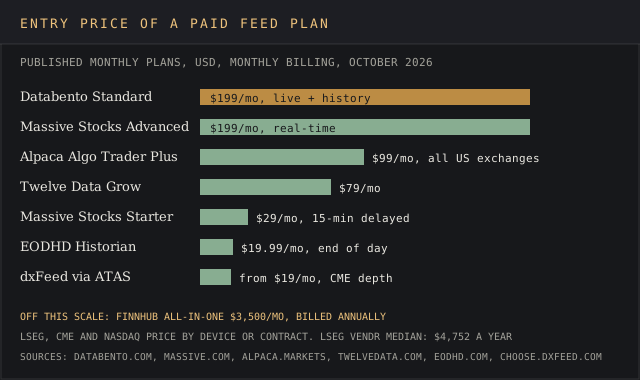
API vendors fold exchange fees into one monthly price for personal use. Massive's $199 real-time plan is limited to non-professionals, and Databento's $199 plan covers 2 devices.
A side project that turns commercial moves from $199 to $1,750 a month at Databento, nearly nine times the bill, and buyers who skip the licence terms bite off more than they can chew.
Terminal seats are a separate budget line, broken down in the Bloomberg Terminal pricing report, and the FactSet vs Bloomberg comparison covers the desktop choice.
Free market data and what it can't do
Real-time data at $0 exists, with limits that bite fast. Alpaca's $0 plan streams one venue, the IEX exchange. Finnhub allows 60 calls a minute, Massive 5 with end-of-day data on US markets, Twelve Data 8, and EODHD 20 calls a day. Beggars can't be choosers on a $0 tier, and none of these licences allow redistribution.
Many traders start on a $0 tier, which is par for the course for a hobby dashboard. For a first backtest in liquid markets, a $0 tier gives enough insights into how a strategy trades. For live trading on more than 30 stocks, the no-cost tiers run out, and the $99 to $199 plans are the next step.
How to choose a data feed provider
Start with the asset classes and markets you trade. Futures point to CME data through Databento, dxFeed or Rithmic. US stocks point to Massive, Alpaca or Nasdaq. Global equities, forex, fixed income and other assets in one feed point to LSEG.
- Write down the depth you need: Level 1, Level 2 or full depth.
- Count the symbols you'll stream at once.
- Fix the years of historical data your backtests need.
- Decide professional or non-professional status before comparing prices.
- Search the licence terms for redistribution clauses.
- Test the trial or credit against a known week of trades in the markets you follow.
The devil's in the details on the last point. Pull one trading day from two vendors and compare trade counts before paying for a year, since that test gives more insights than any sales demo, and keep an eye on corrections, which separate a clean archive from a pile of files. Buyers wanting news and sentiment on top of prices can look at the market intelligence API ranking and the news API pricing report for financial news feeds.
Investors who want screens, analytics and fundamentals in a finished app, without writing code, will get more from the investment research platforms ranking. Funds looking past prices to card spend, app usage and web data should read the alternative data providers ranking.
Frequently asked questions about data feed providers
What are market data feeds?
Market data feeds are streams of quotes, trades and volumes from stock exchanges and other venues across global markets, delivered in real time or as historical files. They feed charts, trading algorithms and risk models.
What is an example of a data feed?
Nasdaq TotalView is one. It's a real-time feed of every displayed order on Nasdaq's book, sold at $15 a month to non-professionals. A product feed sent to a shopping channel is a non-financial example.
Where can I get real-time market data for free?
Alpaca streams IEX data at $0 for 200 calls a minute, and Finnhub's free plan allows 60 calls a minute on US stocks. Both are licensed for personal use.
What is L1, L2 and L3 data in trading?
L1 is the best bid, best offer and last sale. L2 adds the size at each price level. L3 shows every individual order and each change to it.
Who are the biggest market data providers?
LSEG, Bloomberg and the exchanges themselves, led by CME Group and Nasdaq, sit at the top of world markets for data, and each company sells to banks, brokers and investors. The data providers ranking covers the wider field beyond market data, and real-time market intelligence explains how firms use these feeds for faster decisions.
Bottom line
Databento wins for quants who want full depth and a published price, at $199 a month. LSEG wins for institutions that need 575+ venues in one feed and can sign a contract. Massive is the pick for developers building US stock apps, and CME Group or Nasdaq for traders who want the exchange's own book.
On a budget, Alpaca's $99 plan covers all US exchanges, EODHD's $19.99 plan covers 30+ years of end-of-day history, and Finnhub's free 60 calls a minute cover a prototype. dxFeed suits futures traders who'd sooner buy data inside the platform they already use.