Win loss analysis software: 9 tools ranked for 2026
 By Jan Suski. I go deep on every review, checking every number against its source and digging up details other coverage misses, a habit from six years of SEO and link building for tech companies. Bylines at Surfer, Brand24, and Senuto. How the scoring works.
· Prefer this source on Google
Quick comparison of win loss analysis software
The third column decides the order. Tools 1 to 5 record the buyer's own account after the decision; tools 6 to 9 read the seller's calls or the CRM. Prices are each vendor's published rate, or Vendr's buyer-reported median for the five vendors with no rate card.
| # | Provider | Whose account it records | Entry price on record | Best fit |
|---|---|---|---|---|
| 1 | Clozd | Buyer, live and AI interviews; 295 G2 reviews | $50,100 Vendr median* | Mid-market and enterprise programs that want an interview on most closed deals |
| 2 | Klue Win-Loss | Buyer, human and 2 to 5 minute AI interviews; 94 G2 reviews | $30,000 Vendr median* (whole Klue contract) | Teams already running Klue battlecards |
| 3 | TruVoice (Corporate Visions) | Buyer, deal-triggered surveys plus interviews; 114 G2 reviews | $25,000 Vendr median* (all Corporate Visions products) | Enterprises wanting survey volume across many deals |
| 4 | Anova Consulting Group | Buyer, consultant-led interviews; 99 G2 reviews | Quote only | Firms selling complex services that want analyst interpretation |
| 5 | Buried Wins | Buyer, 1:1 interviews; 10 G2 reviews | $1,200 per interview | A first project with a fixed budget |
| 6 | Avoma | Seller-side calls, meetings and email | $29 a seat a month plus $29 Revenue Intelligence add-on | Small teams wanting deal analysis on every recorded call |
| 7 | Gong | Seller-side calls against CRM outcomes | $55,359 Vendr median* | Large sales orgs with 100+ closed deals in range |
| 8 | Sybill | Seller-side calls and email | $90 a seat a month (Business) | Reps who want a pipeline review run on demand |
| 9 | Crayon | CRM win rates by named competitor | $30,000 Vendr median* | Competitive intelligence teams tracking competitive deals |
Medians marked * are anonymized buyer-reported contract values published by Vendr. Everything else is the price the vendor publishes itself.
Where these figures come from
Review counts come from each vendor's page in G2's win-loss analysis services category, read on 14 October 2026. Medians marked * are Vendr's anonymized buyer-reported contract values for Clozd, Klue, Corporate Visions, Gong and Crayon; the Klue and Corporate Visions figures cover every product those companies sell. Buried Wins, Avoma and Sybill publish their own rates.
Anova publishes no price and Vendr tracks none for it, so its row reads quote only.
Two sibling rankings judge four of these vendors on a different job. The conversation intelligence software ranking scores Gong and Avoma as call-recording platforms, and the competitive intelligence tools ranking ranks Crayon and Klue as competitor-tracking suites. Both produce a different order from this one.
Win loss analysis software asks the buyer why a deal closed the way it did, then turns the answers into data a sales team can sort. The category splits in two. Interview platforms like Clozd and Klue put a question to the buyer after the decision. Conversation tools like Gong and Avoma read what the buyer said during the sales process and score it against the result.
This page ranks nine tools on five tests a buyer can run before signing, with a price on record for eight of them. It's written for sales leaders, product marketers and revenue leaders deciding which win loss data to collect, who collects it and what it costs a year.
The reason to look now sits in the vendors' own numbers. Clozd's win-loss page says nearly 70% of buyers name a different primary competitor than the one in the CRM, and that buyer and seller reasons for lost deals match 15% of the time. If that holds for your pipeline, the closed lost field your reps fill in is the weakest data you own.
The free win-loss analysis template covers running a program by hand in a spreadsheet. This ranking covers the software that replaces the spreadsheet, for teams where finding the real loss reason in CRM notes has become a needle in a haystack.
Evaluation criteria for win loss analysis tools
Five criteria decide the shortlist, and the ranking below applies them in this order. Each one returns a yes, a no or a number you can check on the vendor's site or a review platform before a win loss analysis contract is signed.
The category has more than nine vendors, so this ranking runs nine entries for a reason. G2's win-loss category lists 32 providers, and most are interview agencies. Koji, an AI interview tool sold for win-loss among other research, has no reviews in that category. Satrix Solutions and IcebergIQ, two agencies in it, list no price on their home pages and sell interview programs with no product to log into.
1. Who gives the account
Does the tool record the buyer's own words after the decision, or the seller's side of the conversation before it? Buyer interviews and surveys pass, because the answer comes straight from the horse's mouth. Call recording fails this test even when it's useful: Anova puts the share of prospects who give the full reason for a loss at 40 percent. This criterion carries the most weight, so every buyer-voice tool ranks above every seller-side tool.
2. Coverage beyond a hand-picked sample
Can the tool reach most closed deals, through AI interviews or surveys fired automatically, or only the few deals a person schedules by hand? The test is the cheapest unit the vendor sells: an AI interview, a triggered survey, or a minimum deal count before the analysis runs.
3. A named CRM connection
Does the vendor's own site name the CRM or call recorder that triggers outreach when deals close, or that receives the results? A named Salesforce, HubSpot or Gong integration passes. A page that promises delivery to an unnamed CRM scores half.
4. Independent review volume
How many reviews does the tool hold in G2's win-loss analysis services category? The count is a proxy for how many programs have run on the product long enough for someone to write it up.

5. Price on record
Is there a published rate, or a Vendr median with a purchase count behind it? A median from 81 purchases beats "talk to sales", and a per-interview rate beats both.
The best win loss analysis software, ranked
Clozd
Best fit
Mid-market and enterprise companies that want buyer interviews on a large share of closed deals, with live interviewers for enterprise deals and AI interviews for the rest.
Clozd runs buyer interviews after a decision and stores them in its own platform. Founded in 2017 in Lehi, Utah, according to its Gartner Peer Insights profile, it holds 295 reviews at 4.8 on G2, the largest count in the category.
Its platform page says the AI Interviewer "asks relevant follow-ups", and live interviews slot in when a deal calls for a person. The integrations page sells "first-party customer insights", which in plain terms means real customer insights from the buyer.
Clozd's own 2025 State of Win-Loss figures, quoted on its software page, say 63% of companies report an increase in win rate, rising to 84% for programs running two years or more. Those are Clozd's survey numbers about its own category, and it sells the answer. The same page says ongoing, cross-functional win loss programs see positive ROI 85% of the time against 55% for project-based ones, an argument for continuous improvement over one-off studies.

Key features
- Live Interviews and AI Interviews (sold as Flex Interviews), with automated outreach, scheduling and incentives
- Transcription, Decision Analysis and Tagging agents that code every interview by theme
- CRM integration that pulls closed deals to trigger outreach, plus Outlook and Gmail sending
- Gong, Crayon, Slack and Calendly integrations, a REST API that exports interviews as structured data, and the Clozd MCP in beta
- ISO 27001 and 27701 certification, and eight interview languages listed on G2
Pricing
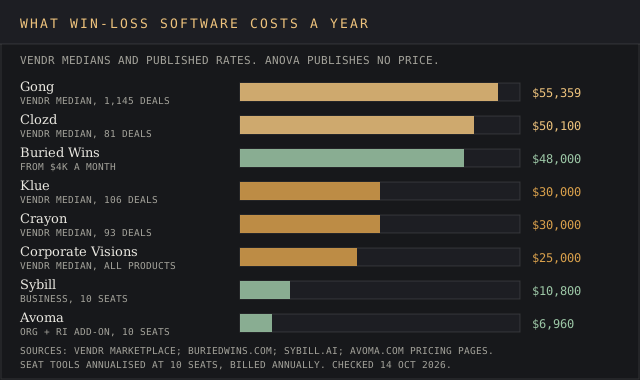
Clozd publishes no rate card. Vendr's anonymised buyer data puts the median contract at $50,100 a year across 81 purchases, from $26,490 to $130,530.
Pros
- 295 G2 reviews, more than TruVoice and Anova combined
- AI interviews extend coverage to lower-value deals without a person on every call
- Named integrations with Gong and Crayon carry buyer insights into call and battlecard tools
Cons
- The $50,100 median prices out teams closing a few dozen deals a year
- Transcripts can take days to publish, per a 2026 G2 reviewer
- The ten G2 reviews on its first results page all came through seller-sent G2 invites
A G2 reviewer at an enterprise software company named both sides of the trade in May 2026.
"Can be expensive compared to some other providers. Sometimes it takes a few days for them to publish the transcripts."
Verified user, computer software, enterprise, G2 review, 25 May 2026
Another enterprise reviewer wrote in April 2026: "The response rate from customers using Clozd is higher than we had experienced previously."
Why it's ranked #1. Clozd and Klue both pass the first three tests, so criterion four decides it: 295 G2 reviews against Klue's 94, three times the written record of programs run on the product. It beats every tool below on that count.
Klue Win-Loss
Best fit
Product marketing teams already paying for Klue battlecards that want buyer interviews feeding the same competitor profiles.
Klue Win-Loss bolts buyer research onto Klue's competitive intelligence suite, the subject of our Klue review, to turn insights from closed deals into battlecard updates. Klue bought two interview firms to build it: DoubleCheck Research, announced 18 January 2023, and Goldpan, a firm founded in 2021, announced 18 March 2025.
The Win-Loss page lists five capture methods. The AI Interviewer runs async voice interviews of two to five minutes with buyers and sellers, and Blindspot Interviews reach buyers outside your pipeline with a "typical turnaround" of two weeks.
Key features
- AI Interviewer, Human Expert Interviews and Blindspot Interviews
- Win & Loss Story Agent, written from CRM data and Gong call recordings when a deal closes
- Bring Your Own Interview for uploading existing recordings or transcripts
- Win-Loss Clips, Ask Klue and Deal Tips in Slack and Microsoft Teams, where revenue teams operate during deals
- Win-Loss MCP connector for Claude and ChatGPT
Pricing
No published price. Vendr's buyer data shows a $30,000 median across 106 purchases, from $16,000 to $60,000, for Klue as one product, so the figure mixes battlecard and win-loss spend.
Pros
- Interview findings land in the battlecards reps already open
- Two-to-five-minute AI interviews ask a fraction of the 20 to 30 minutes CompeteIQ's guide budgets for a buyer call
- 4.9 rating on 94 G2 reviews, the highest score among the big four
Cons
- 94 G2 reviews, a third of Clozd's count
- Theme tagging struggles on small samples, per a 2022 reviewer
- Win-loss pricing is buried inside the full Klue contract
"The text tagging does not work well with smaller sample sizes of around 13 interviews."
Verified user, computer software, enterprise, G2 review, 12 October 2022
A mid-market IT services reviewer added in September 2024: "Originally, the win-loss insights weren't very deeply incorporated into the rest of the product".
Why it's ranked #2. It loses to Clozd on review count, 94 to 295. It beats TruVoice on criterion three, because Klue names Gong, Slack and Teams integrations where TruVoice's page names none.
TruVoice from Corporate Visions
Best fit
Enterprises that want a survey on every deal outcome, with live interviews reserved for the deals that matter most.
TruVoice is the old Primary Intelligence platform. Corporate Visions, a sales training firm owned by The Riverside Company, bought Primary Intelligence in February 2023; Riverside's release says the business had analysed nearly 100,000 B2B purchase decisions across 50 industries. Our customer insights platforms ranking covers the broader research tools this sits beside.
The TruVoice page says sellers and buyers disagree about why deals are lost 50 to 70% of the time. Dynamic surveys fire on deal outcomes, customer milestones or experience events, which is how TruVoice passes the coverage test without a person on every deal.
Key features
- Dynamic surveys triggered by deal outcomes and customer milestones
- Live interviews run and analysed by the Corporate Visions team
- Real-time dashboards and automated alerts
- Win-Loss, Sales Performance and Customer Experience Analysis modules, the second aimed at teams trying to improve sales performance from buyer ratings of the sales process
Pricing
Quote only. Vendr lists one Corporate Visions product with a $25,000 median and a $205,793 high, and shows no purchase count.
Pros
- Surveys scale to deals no interviewer would schedule
- 114 G2 reviews, second in the category
- Pairs with Corporate Visions' sales training when findings point at rep behavior
Cons
- Several G2 reviewers call the interface dated or hard to navigate
- No CRM integration named on the product page
- Interview volume gets expensive at enterprise scale
"Difficult and expensive to scale. Can only afford to do a few per quarter"
Frank T., senior director of sales ops and enablement, enterprise, G2 review, 17 May 2022
A mid-market market research and CI manager wrote a month later:
"I would like to see a way to integrate back into the CRM tool against the opportunity record"
Why it's ranked #3. It loses to Klue on criterion three, naming zero integrations to Klue's 3. It beats Anova on criterion two: deal-triggered surveys reach every closed deal, where each Anova interview needs a consultant.
Anova Consulting Group
Best fit
B2B firms selling complex products or services, where product and service positioning both decide the deal, that want senior interviewers and an analyst's read of the results.
Anova wrote what its own history page calls the first book about win/loss analysis, published by McGraw Hill in 2011, and launched its myView dashboard in 2015. Its global capabilities page says prospects give the full reason for a loss only 40 percent of the time, and that interviews run in English and local languages.
Key features
- Consultant-led win/loss interviews by a senior interviewing team
- myView client portal with searchable interview transcripts
- AI View for natural-language querying across completed interviews
- Competitor Battlecards inside myView, plus churn and customer experience analysis
Pricing
Quote only. Anova publishes no rate card, so budget it like an agency: per program, agreed with the account team.
Pros
- 99 G2 reviews at 4.7, third in the category
- Interview depth that reviewers credit to the interviewers themselves
- Churn and post-implementation research from the same team
Cons
- No price on record anywhere
- One 2025 enterprise reviewer rated its platform weaker than rivals'
- Consultant-led cadence is slower than an automated survey
"they interpret it thoughtfully and provide clear context around why deals are won or lost"
Patrick C., senior partner, enterprise, G2 review, 26 January 2026
The same reviewer called the service "highly consultant‑led and qualitative, which can feel less immediate". An IT services reviewer in July 2025 wrote: "The actual interviews felt scripted and superficial, lacking meaningful insights."
Why it's ranked #4. It loses to TruVoice on coverage, since every Anova interview needs a consultant. It beats Buried Wins on criterion four, 99 G2 reviews to 10, and adds a 2015-built portal Buried Wins doesn't have.
Buried Wins
Best fit
A team running its first program that wants a fixed price, a fixed deadline and a live readout.
Buried Wins is an interview agency, and the only vendor in this ranking that prices by the interview. Its pricing page lists $1,200 per interview with your own contacts and $1,400 when it sources competitor buyers, incentives included in both.
A one-time project runs $15,000 to $30,000 over six weeks, with 15 interviews recommended. An ongoing program starts at $4,000 a month with a three-interview minimum, and the FAQ says "Most teams start with a one-time project to prove value, then scale." Its home page promises same-day transcripts and weekly video highlights as interviews complete.
Key features
- 1:1 buyer interviews on wins, losses and no-decision prospects
- Prospect Research that sources competitor buyers without a contact list from you
- Same-day transcripts, full interview videos and weekly highlight reels
- Detailed reports: an executive report and a live readout with your team
Pricing
$1,200 or $1,400 per interview, $15,000 to $30,000 per project, or from $4,000 a month ongoing.
Pros
- The only per-interview price on record in this ranking
- Recruits competitor buyers for teams with thin contact lists
- A six-week project caps the first-year risk at $30,000
Cons
- 10 G2 reviews
- No software platform, CRM trigger or AI interviewer
- Agency bandwidth limits volume, per one 2026 reviewer
"as a boutique agency, scaling can be a constraint, bandwidth gets tight"
Alex S., senior manager of CX operations, G2 review, 20 May 2026
Why it's ranked #5. It loses to Anova on review count, 10 to 99. It beats Avoma on criterion one: every Buried Wins interview is the buyer talking, where Avoma reads the seller's calls.
Avoma
Best fit
Small and mid-sized sales teams that record their calls and want win and loss reasons filled into the CRM automatically.
Avoma is a meeting assistant with a deal analysis add-on. Its win-loss page says it reads calls, meetings and emails tied to each deal, flags objections, competitors and decision drivers, and auto-fills win and loss reasons in the CRM. It also charts win-to-loss ratios by month or quarter and scores each insight with a signal-strength rating. The result is structured insights tagged by objection and competitor, and Avoma says 1,000+ revenue teams use the product.
Key features
- AI Win-Loss Deal Analysis, Deal Risk Alerts and Deal Health Score (Revenue Intelligence add-on)
- CRM write-back to Salesforce, HubSpot, Pipedrive, Copper, Zendesk Sell and Zoho CRM
- Recording across Zoom, Google Meet, Microsoft Teams and dialers including Aircall and Dialpad
- Ask Avoma for questions across pipeline reviews and coaching
Pricing
Avoma's pricing page lists Startup at $19, Organization at $29 and Enterprise at $39 per recorder seat a month, billed annually. Win-loss sits only in the Revenue Intelligence add-on, $29 a seat annually or $35 monthly.

Pros
- Published per-seat price, $58 a seat a month with the add-on on annual billing
- Covers every recorded deal with no minimum deal count
- Six named CRMs for write-back
Cons
- Seller-side data only; the buyer is never asked after the decision
- Win-loss is locked out of every base plan
- Annual contracts have been hard to shrink, per a 2022 reviewer
"We only have 48 active users and are paying for 87. We don't have the headcount that we did at the beginning of the year, which we let them know about, and they signed us up for another year with the same amount of people."
Jessica W., IT specialist, mid-market, G2 review, 30 September 2022
A sales director at a company under 50 employees wrote in August 2024:
"Avoma is a more cost effective solution than Gong. That was the main reason for our transition."
Why it's ranked #6. It loses to Buried Wins on criterion one, reading seller calls. It beats Gong on coverage: Avoma analyses any recorded deal, where Gong needs 100 closed deals in range before it shows a single insight.
Gong
Best fit
Large sales organisations already on Gong Forecast that want win rates broken down by deal behavior.
Gong's win/loss analytics, documented in its help center, compare won and lost deals across seven areas: number of contacts, power in deal, deal duration, deal size, number of calls, competitor mentions and any custom tracker. It needs at least 100 qualifying closed deals in the selected range and reruns the analysis weekly. The Gong review and Gong pricing report cover the wider product.
Key features
- Win rate by contacts, call count, deal size and deal duration
- Power in deal: win rate when 75% of active participants hold Director, VP or C-level titles
- Competitor mentions for the three most-mentioned competitors, from the pre-built tracker
- Filters on imported CRM fields, which take up to 24 hours to appear
- CSV export of every matching deal, including the ones that didn't qualify
Pricing
Win/loss sits in Forecast Essentials and Gong Forecast. Vendr's buyer data shows a $55,359 median across 1,145 purchases, from $11,497 to $203,683, with 14% average savings.
Pros
- 1,145 tracked purchases, the deepest price record here
- Ties sales behaviors to wins and losses with a documented method
- Competitor mentions measured from what buyers said on calls
Cons
- Gong doesn't collect data from the buyer after the decision
- Shows nothing below 100 closed deals
- The highest median here, $55,359
"After a while, they started to put a lot of features in the product that I felt like, while we were paying for, we ended up not using. The product became expensive compared to competitors."
Verified user, computer hardware, G2 review, 30 April 2026
Why it's ranked #7. It loses to Avoma on coverage, needing 100 closed deals before it reports. It beats Sybill on criterion three: Gong filters by any imported CRM field, while Sybill's Business plan caps CRM autofill at 10 fields.
Sybill
Best fit
Reps and sales managers who want a win/loss analysis run from a prompt across their own calls and email.
Sybill is an AI sales assistant that writes call summaries and fills CRM fields. Its pricing FAQ says a pipeline or win/loss analysis costs about 50 to 100 credits on any plan, against 500 credits a week on the free tier and 5,000 per user a week on Business.
Key features
- Ask Sybill across meetings, dialer calls and emails
- Deal workspace with summaries across calls, email, CRM and Slack (Business)
- CRM Autofill, 10 fields on Business and unlimited on Enterprise
- API and MCP access on Business
Pricing
Free at $0, Pro at $30 and Business at $90 per user a month billed annually ($36 and $108 monthly), with Enterprise quoted.
Pros
- A free tier with enough credits for several win/loss runs a week
- Published pricing at every self-serve tier
- Summaries reviewers praise for speed
Cons
- Seller-side data only
- Deal context across CRM and Slack needs the $90 Business plan
- Transcription accuracy drops with accents, per a 2026 reviewer
"It is not cheap. Sometimes the transcription is not the best specially with people with different accents."
CEO, computer software, Capterra review, 14 May 2026
A small-business reviewer wrote on G2 in February 2023: "Summaries are out of this world."
Why it's ranked #8. It loses to Gong on CRM depth, 10 autofill fields on Business. It beats Crayon on criterion two: a 50 to 100 credit analysis runs over every recorded deal, while Crayon reads only CRM outcome fields.
Crayon
Best fit
Competitive intelligence teams that want competitive win rates by rival, pulled from Salesforce.
Crayon is a competitor-tracking platform, covered in our Crayon review, with a win-rate module on top. Crayon's 2022 Impact module post describes a bidirectional Salesforce integration that computes competitive win rate from closed opportunities and pulls in their notes. Buyer feedback comes from partners: Clozd lists a Crayon integration that sends interview findings into battlecards.
Key features
- Impact module: competitive win rate from Salesforce opportunities, filterable by any opportunity field
- CRM notes pulled from closed opportunities
- Battlecards in Slack and the CRM
- Clozd integration for buyer interview findings
Pricing
No published price. Vendr shows a $30,000 median across 93 purchases, from $12,700 to $46,000. The Crayon pricing report covers the contract terms, and the Crayon vs Klue comparison sets it against the #2 tool's parent suite.
Pros
- Win rate by named competitor with no export to a spreadsheet
- Battlecard updates sit next to the win-rate data
- Connects to Clozd for buyer interviews
Cons
- Records no buyer or seller conversation itself
- Only as good as the CRM data hygiene behind it
- $30,000 median, priced for the full battlecard platform
"Planning to switch to another tool when our renewal is up. It is not worth the money."
Verified user, computer software, mid-market, G2 review, 15 February 2024
Why it's ranked #9. It loses to Sybill on criteria one and two, recording no conversation at all. Its $30,000 median buys win rates computed from closed lost fields, the CRM data Clozd says matches the buyer's reason 15% of the time.
What win loss analysis platforms do
The job is collecting direct feedback from buyers after deals close, coding it into themes and putting the results in front of the teams that can act on them. Most win loss programs answer three questions: why buyers chose you, why lost prospects picked a competitor, and which competitive dynamics repeat across deals.
The same data feeds four internal teams. Product teams look for feature gaps that cost deals. Sales enablement builds talk tracks from findings on which messaging resonates, and sales managers coach against what buyers perceive in the sales process, so everyone ends up on the same page. Marketing tests competitive positioning and value perception against the buyer's own words.
Survey and support-ticket analytics for existing customers sit in the separate customer feedback analysis tools ranking.
Hanover Research's five-step guide frames it plainly: product teams "can address feature gaps identified through customer feedback." CompeteIQ's win/loss guide adds that the interviews reveal which rep behaviors correlate with wins and losses, which is where seller-side tools like Gong earn their place.
Win loss data earns its cost when it changes sales strategies and product development. CompeteIQ's guide lists six uses, from refining sales messaging to coaching sales reps, and every one starts with buyer feedback coded by theme so a team can identify strengths, identify gaps and count deals lost to each rival. That coding step is what turns 20 transcripts into actionable insights for sales teams, and into a competitive strategy for each rival.
The same guide says win-loss findings feed battle cards, product roadmaps, sales training and go to market strategy, and lists competitive response, messaging and positioning as the first things they change.
It also claims companies that systematically analyze wins and losses improve competitive win rates by 10 to 20%, and a headline stat beside it says win loss analysis can improve forecast accuracy by 25%. CompeteIQ names no study behind either figure, so treat both as a vendor's pitch.
Buyer interviews versus conversation intelligence
Interview platforms ask after the decision. Conversation intelligence reads what was said before it, and Anova's 40 percent figure says most lost buyers keep the full reason under the radar. The conversation intelligence software ranking and the revenue intelligence software ranking cover the call-recording side in full. Clozd's own integration page puts the split in one line: Gong "captures what happens during the sales process", and Clozd asks the buyer afterward.
Albert V., a mid-market G2 reviewer, took the other side in July 2026, writing that "Clozd's approach feels inefficient" set against the faster read from Gong conversations. Both camps have a case. The buyer interview gets the candid feedback; the call recording gets every deal with no recruiting. Clozd sells a Gong integration to join the two, which gets the best of both worlds at the price of two invoices.
How to run a win loss program with software
Corporate Visions' implementation guide lays out the steps most vendors repeat, and it's a vendor guide, so read between the lines where it recommends a third party. The steps that hold up:
- Set boundaries. The guide's example for enterprise software sellers is to focus on deals above $100,000 in your core market, against your top two rivals.
- Use a neutral interviewer. "When buyers talk to a neutral party, they're more likely to share candid feedback," the guide says. Its heading is blunter: "Use an unbiased third party to conduct interviews and interpret data." Third party interviews are the default at Clozd, Anova and Buried Wins.
- Automate data collection. The guide's version is to "automatically send feedback requests when deals close in your CRM system". Clozd and TruVoice both trigger outreach this way.
- Create real-time feedback loops. Its line: "Win-loss analysis doesn't work if insights arrive too late to be useful."
- Link insights to action plans. CompeteIQ's version: every significant finding "should generate a specific recommendation with an owner." That owner is what makes a finding one of the actionable insights the program exists to produce.
- Track win rates over time to see if changes made from buyer feedback move the result.
Hanover's guide adds a filter for step five: start "by prioritizing the most critical findings based on their potential impact on revenue, customer experience, and competitive positioning." With surveys, it says, "companies get an aggregate but statistically significant picture".

Timing, sample size and response rates
CompeteIQ's guide says to interview losses within two weeks of the decision and wins within two months, and to target 20 to 30 win loss interviews per quarter as a minimum. Fewer than that, and the devil's in the details: three interviews can't separate a pattern from noise.
It also recommends a 50/50 or 60/40 win loss ratio in the interview sample, and names a hybrid program, internal interviews for wins and third party interviews for losses, as the fit for most companies selling mid-market and enterprise B2B.
Response rates set the budget. The Corporate Visions FAQ cites a customer getting 20 to 25 percent response on wins and 10 to 15 percent on losses, and says the right timing can push participation past 70 percent. At a 10% loss response rate, 20 loss interviews a quarter means asking about 200 lost prospects.
Pricing across win loss analysis tools
The spread runs from $6,960 a year to a $55,359 median. Ten Avoma seats on the Organization plan with the Revenue Intelligence add-on cost $6,960 a year at published rates. Gong's Vendr median is $55,359, and win/loss only ships with Forecast Essentials or Gong Forecast, so buyers bite the bullet on a forecasting contract to get it.
The interview platforms sit between: Klue at a $30,000 median, Clozd at $50,100. Against one enterprise deal above $100,000, a $30,000 contract is a drop in the bucket; for a team closing 40 deals a year, it's $750 a deal.
Per-interview math makes the agencies comparable. At Buried Wins' $1,200 rate, CompeteIQ's 20 to 30 interviews a quarter costs $24,000 to $36,000 a quarter, or $96,000 to $144,000 a year. That's why AI interviews matter: Clozd and Klue sell them to cover the long tail of lower-value deals that would cost an arm and a leg at agency rates.
Two contract traps show up in reviews. The Avoma reviewer above paid for 87 seats while using 48. A Gong reviewer said the product "became expensive compared to competitors" as features piled up. Read the renewal clause before the first-year number. A seat count fixed for a year is a red flag when headcount moves.
Common buying mistakes
- Buying call recording and calling it win-loss. Seller-side tools measure the sales process; they don't ask the lost prospect anything after the decision.
- Trusting closed lost reasons. Clozd's 15% buyer-seller agreement figure and TruVoice's 50 to 70% disagreement range point the same way: CRM data on lost deals needs a second source.
- Running too few interviews. A Klue reviewer found theme tagging broke down around 13 interviews.
- Taking price at face value. CompeteIQ's guide says "price" is often a proxy for a buyer who didn't see enough value, and its fix is to always ask follow up questions about value perception and separate symptoms from root causes.
- Collecting without owners. CompeteIQ calls not acting on insights "the most common failure." A report nobody owns is where programs drop the ball.
- Letting sales reps interview their own buyers. CompeteIQ's guide says buyers won't be candid with the rep who sold them, and puts marketing, CI or a third party in the chair.
Win loss insights also feed churn and customer feedback work. Clozd sells Churn Analysis, Anova runs customer churn analysis, and Buried Wins prices churn and renewal interviews at the same $1,200 rate, which matters to revenue leaders trying to cut customer attrition with the same budget.
Market context: consolidation in win loss analysis
The category has consolidated fast. Klue bought DoubleCheck Research in January 2023 and Goldpan in March 2025. Corporate Visions bought Primary Intelligence in February 2023, and TruVoice is that product. Clozd, Anova and Buried Wins still sell win-loss as their main product, alongside a long tail of agencies that brings G2's count to 32 providers.
Spending isn't shrinking: Clozd's 2025 report says 97% of companies running win loss programs plan to maintain or increase their investment.
The other shift is AI tools on both sides. Klue's AI Interviewer, Clozd's AI Interviews and Anova's AI View all sit on the vendors' current product pages, and Avoma & Sybill sell AI deal analysis. Each AI interview still needs a buyer willing to answer, so the response-rate numbers above still set the ceiling. A vendor that promises coverage of every deal without naming its response rate is close but no cigar.
Win loss analysis FAQ
What is win-loss analysis?
Win-loss analysis is interviewing or surveying buyers after a deal closes, won or lost, to find the reasons behind their decision and the decision making processes they followed. Software automates the outreach, records the answers and codes them into themes, and the results inform sales strategies, product roadmaps and messaging.
How do you calculate a win-loss ratio or win rate?
Win rate is deals won divided by total closed deals. Corporate Visions' guide gives the example: 30 wins from 50 closed deals is a 60 percent win rate. Gong's formula is the same, won deals over won plus lost. It's the number a win loss analysis program tracks quarter over quarter to see if changes made from buyer feedback move the result. The win rate calculator runs the math for any segment.
What does Clozd do?
Clozd runs live and AI buyer interviews after deals close, transcribes and tags them, and sends the findings to Slack, the CRM, Gong and Crayon. Vendr's median Clozd contract is $50,100 a year.
What is the best tool for competitor analysis?
Win-loss tools measure why you lose to a competitor; tracking what the competitor ships is a separate job. The competitor analysis tools ranking and the competitive intelligence tools ranking cover that side.
Bottom line
Clozd wins for companies that want buyer interviews on most closed deals and can carry a $50,100 median. Klue Win-Loss wins for sales teams already on Klue, since the findings land in the battlecards their reps open. TruVoice fits enterprises that want a survey on every deal outcome.
Buried Wins is the cheapest fixed-price start: a $15,000 project buys a first look before anyone signs an annual contract. For teams that only record calls, Avoma's $58 a seat a month covers win loss analysis on every recorded deal, and Gong suits sales orgs with 100+ closed deals that already pay for it.
Crayon and Sybill fill narrower gaps. Crayon tracks competitive win rates for CI teams that already own its battlecards, and Sybill's free tier lets a single rep test AI win/loss analysis at $0.