Crayon pricing in 2026: a $30,000 median contract and no list price
 By Jan Suski. I go deep on every review, checking every number against its source and digging up details other coverage misses, a habit from six years of SEO and link building for tech companies. Bylines at Surfer, Brand24, and Senuto. How the scoring works.
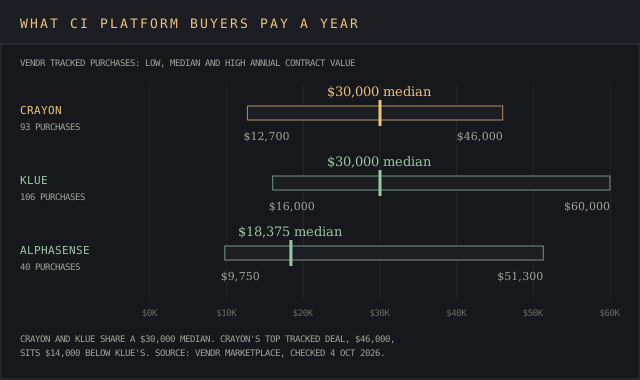
Crayon's median annual contract is $30,000, across 93 purchases tracked by Vendr, in a range running from $12,700 to $46,000. That's the only dollar figure with a real sample behind it, because Crayon doesn't publish pricing anywhere on crayon.co. Its pricing page redirects to a request-an-estimate form with 10 required fields.
Crayon here means the Boston competitive intelligence software vendor at crayon.co. This guide breaks down what the contract meters, which features each tier gates, what the June 2026 terms of service say about renewal, and what Klue, Kompyte, Contify, AlphaSense and four self-serve tools cost against it. Every page cited was checked on 4 October 2026.
It's written for product marketers and competitive intelligence teams building a budget case for their revenue teams, and for procurement leads who've been handed a quote and want to read between the lines. The Crayon review covers the product itself. This page stays on the rate card.
The numbers Crayon pricing and contract terms, checked 4 October 2026
Crayon and Klue share a $30,000 median, so the choice between them comes down to the meter each one bills on.
Crayon's highest tracked purchase, $46,000, sits $14,000 below Klue's $60,000 top deal.
Buyers who negotiated through Vendr took 20.19% off on average, which on a $30,000 quote comes to about $6,000.
How much Crayon costs a year
Plan on $30,000 a year, or $2,500 a month, for a typical deployment. That's Vendr's median across 93 purchases on a page last updated in February 2026. The same header block shows a $30,000 average contract value across 72 deals Vendr handled itself, with buyers saving 20.19% on average.
Two buyers of the same product can sit $33,300 apart. The cheapest tracked purchase was $12,700 and the most expensive $46,000, a 3.6x gap. Vendr's buyer guide names the drivers behind that spread: tracked competitors, user seats, feature tier and contract term. At the top of the range, enterprise pricing follows Vendr's Enterprise tier of 25 or more competitors.
Among competitive intelligence platforms that quote by request, Crayon's median matches Klue's and runs $11,625 above AlphaSense's $18,375. Vendr tracks purchases for all three CI tools, which makes them the easiest trio to benchmark against each other.
Crayon's price sits at the dedicated CI platform level. Owler Pro, a news-following tool now owned by Meltwater, checks out at $468 a year for unlimited company following. Crayon's median contract is 64 times that figure, which makes Owler a drop in the bucket next to it. The gap buys monitoring, battlecards, CRM delivery and win/loss analytics in one system.
What the Crayon contract meters
Crayon's own terms of service name the billing unit. Section 6 says the licensed scope "is typically limited by the number of Competitors Customer may use the Services to track, but could also include a limit to the number of Authorized Users." Tracked competitors come first, and seats are optional.
Vendr's Crayon page lists the pricing basis as "competitors tracked, seats, and tier." The contract puts competitors first, so read your quote with the competitor count as the main line item and the seat count as a possible second one. That's straight from the horse's mouth, and it outranks any third-party summary.
Competitors tracked
Tracked competitors get competitor profiles that Crayon crawls for website changes, pricing updates, news, support documents and customer reviews, according to its Aggregate product page. Specific competitors you rarely meet in deals still cost a slot. Zero in on the competitors that show up in live deals before you ask for a number, because the competitor count drives the lion's share of the quote.
Authorized users
The pricing-inquiry page says "It doesn't matter how many competitive assets you'll create or how many stakeholders need access to the intel," and the integrations page describes SSO "capable of handling as many users as your company has employees." Users can still be capped in the Authorization Form, so check the seat line before signing.
Most programs need few editing seats. A TrustRadius reviewer at BambooHR described the split:
"We have several different teams that consume the content we compile in Crayon, but only have 2-3 power users who create and then push the content to the other teams."
Eric Serdar, Product Marketing Manager at BambooHR, TrustRadius, 10 September 2021
The pricing-inquiry form
The form asks for name, business email, phone, company, website, job title, how you heard about Crayon, a free-text message and an employee band. That band runs across eight options, from 1-10 up to 10,001+, so company size is an input before any sales call starts.
What each tier of the competitive enablement platform gates
Review sites list Crayon as Crayon Intel on Capterra and Crayon Intel Pro on TrustRadius, names that appear nowhere on crayon.co's pricing, product or terms pages. Vendr's buyer guide sorts deals into three tiers, and its descriptions give the competitive intelligence features and limits each one carries:
| Tier (Vendr's label) | Tracked competitors | User seats | What it adds |
|---|---|---|---|
| Essentials | 5 to 10 | 3 to 10 | Competitor tracking, basic analytics, email alerts |
| Professional | 10 to 25 | 10 to 50 | Battlecard automation, Salesforce and HubSpot, Slack and Microsoft Teams |
| Enterprise | 25 or more | 50 or more | Custom integrations, API access, dedicated customer success |
Tier names, competitor counts and seat ranges are Vendr's editorial descriptions from its Crayon buyer guide. Crayon's pricing form, product pages and terms carry no plan names.
Essentials
Vendr describes this as the entry tier for small teams new to competitive intelligence, sold on annual contracts. With 5 to 10 competitors and 3 to 10 seats, it suits small teams in product marketing that want the morning digest and battlecards on their top competitors.
Professional
Professional adds the sales enablement layer, with battlecard automation, CRM integrations and chat delivery to the sales team. For mid-market teams it's the first tier that puts intel inside the tools reps already open.
Enterprise
Enterprise is built for enterprise teams, with 25 or more competitors, 50 or more seats and API access. Crayon launched its Insights API on 1 October 2026 without naming the plans that include it. Vendr says Enterprise deals typically require multi-year commitments. Enterprise pricing is custom, so the competitor count drives most of the number.
Crayon AI and AI tools in the quote
The Crayon AI page lists eight capabilities and prices none of them separately:
- Sparks, for research, analysis and content runs on a schedule
- Crayon Answers, a chat assistant for sellers
- Automatic tagging into more than 80 subcategories
- Importance scoring that ranks each insight
- Sentiment analysis on competitor coverage
- Anomaly detection that alerts on unusual trends
- AI-generated summaries of news and content
- An MCP server and APIs for ChatGPT, Claude, Copilot, Glean and Guru
Crayon's April 2026 Gartner Magic Quadrant post, on its Leader placement in the first Magic Quadrant for Competitive and Market Intelligence Platforms, adds listening agents for Slack and Teams, a website tracking agent and automated Win Stories. Ask the rep which of these AI agents sit inside your tier, and get the answer in the Authorization Form.
One TrustRadius reviewer, a marketing contributor at a 10,001+ employee company, wrote in October 2025 that "Sparks allows me to offload manual research and spreadsheet updates." Crayon's homepage pitches Crayon AI as the source of talk tracks and sales plays for reps, and its G2 profile pitches the platform to revenue teams.
Integrations, collaboration tools and API access
Crayon's Compete page names nine places battlecards can live: Salesforce, HubSpot, Slack, Teams, Highspot, Seismic, Showpad, Guru and SharePoint. Battlecards embed in open opportunity CRM records and pull win/loss data back when those deals close. The Aggregate page adds call recordings from Gong, Chorus and Clari plus collaboration tools such as Slack.
Map the quote against your technology stack before the demo. Sales enablement tools such as Highspot, Seismic and Showpad matter only if your sales team opens them daily, and each connector you don't use is scope you can drop from the Authorization Form.
Vendr places CRM and chat integrations at Professional and custom integrations plus API access at Enterprise. Kompyte, by contrast, says on its plans page that all integrations are included at no extra cost. Use that line as a lever if your Crayon quote prices Highspot or Seismic separately.
Contract length, renewal and onboarding
The devil's in the details here. The terms put the subscription length in the Authorization Form and run a set clock around it:
- Each period renews automatically for the same duration "at the then current Subscription Fees."
- Stopping renewal takes written notice at least 60 days before the renewal date.
- Invoices are due within 30 days of receipt.
- Unpaid fees accrue interest at 1.5% a month.
- Cancelling mid-term refunds nothing, and the committed period stays payable.
- Tracking beyond the licensed scope needs a new form and a negotiated additional fee.
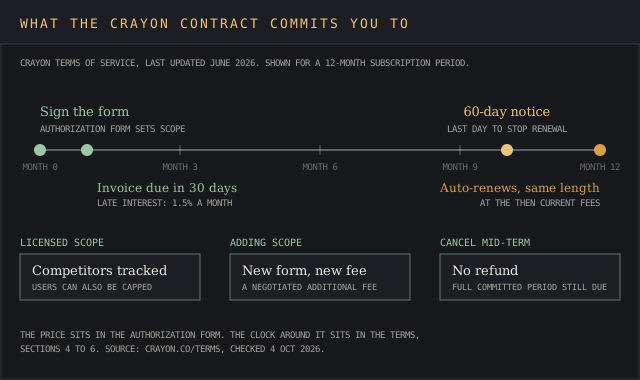
Onboarding takes about a month. G2's reviewer averages put time to implement at 1 month and return on investment at 14 months, across 385 reviews averaging 4.6 out of 5. Mark the 60-day deadline in the calendar on the day you sign. Miss the boat on that notice and the renewal is set in stone at whatever Crayon charges that year.
Hidden costs in a Crayon contract
Labor is a cost the quote leaves out. Crayon automates collection of competitive intelligence, and somebody on your payroll still writes and maintains the battlecards the sales team reads. An enterprise reviewer in health care put it this way on G2 in February 2024:
"Having to manually create our battle cards for the organizations we want to track. I assumed this would be a process the Crayon tool/team would take on but was left manually adding the updates."
Verified User in Hospital & Health Care, enterprise (over 1,000 employees), G2, 15 February 2024
Budget for human analysts, or at least a named owner, alongside the subscription. The other line items to price before signing:
- Competitors added mid-term, which need a new Authorization Form and fee
- Seats above any user cap in the form
- The renewal uplift that "then current Subscription Fees" allows, a red flag on any multi-year deal without a cap
- Overlapping subscriptions Crayon doesn't replace, such as news or research feeds
That last point shows up in reviews too. A mid-market marketing reviewer wrote on G2 in November 2022: "I would value tie-ins to more content, so that I could replace other subscriptions." Running multiple tools for one competitive intelligence workflow is a cost the quote never shows.
What buyers pay against the quote
Vendr's 20.19% average saving shows the first quote is an opening position. G2's reviewer average discount for Crayon is 11%, about 9 points below the Vendr figure.
Unhappy buyers leave at renewal. A mid-market software reviewer gave Crayon 1 out of 5 on G2 in February 2024:
"Planning to switch to another tool when our renewal is up. It is not worth the money."
Verified User in Computer Software, mid-market (51-1,000 employees), G2, 15 February 2024
An earlier enterprise review, from a sales rep in July 2020, made the same call on the interface: "There's probably better tools on the market. I wouldn't spend much money on this interface the way it is right now." Crayon has shipped Sparks, Crayon Answers and an MCP server since then, so weight the 2024 and 2025 reviews more heavily.
How to negotiate a Crayon quote
The form collects your employee band before any call, so prepare your own numbers first. Walk in with these figures and asks:
- Anchor to Vendr's $30,000 median and its $12,700 low, and state how many competitors show up in your live deals.
- Price two Crayon alternatives first and name them. Vendr lists Klue, Kompyte, Contify and Similarweb among the platforms Crayon competes with.
- Ask for free competitor swaps in writing. Kompyte publishes that swaps cost nothing, and Crayon's terms require a new form for usage beyond the licensed scope.
- Cap the renewal increase, since the default renews at then-current fees.
- Get onboarding and integrations into the base price.
- Time the signature for Q4. Vendr reports Crayon's fiscal year ends in December.
Swaps matter for teams whose competitors change. A mid-market health care reviewer on G2 described a quarterly routine: "Every quarter, we update our competitor list tracking in hubspot and their team always helps share the data quickly." If your rival set moves that often, a fixed list of tracked competitors with paid swaps costs money every quarter.
Ask the rep to show battlecard engagement metrics from a live account during the demo. Crayon's homepage cites a 40% increase in battlecard adoption at Alteryx, and it quotes Allego's sales director saying the win rate against a top competitor tripled to 95%. Build your own version of that number for your sales team, because it's the competitive edge you'll need to show at renewal.
Who Crayon is priced for
Crayon's 2021 Series B announcement says it "helps mid-sized and large enterprises capture, analyze and act on competitive intelligence." That round raised $22 million, led by Baird Capital, taking total funding to $38 million across more than 500 customers. Mid-market companies with a dedicated CI owner are the core buyer.
Three kinds of teams fit the $12,700 to $46,000 range:
- Competitive intelligence teams of one to three people supporting a sales team that meets the same competitors every week, in markets where competitive dynamics shift monthly
- Product marketing teams that own battlecards and competitive positioning, and need win/loss reporting from Salesforce
- Enterprise teams and revenue operations groups in regulated industries that need SSO and a SOC 2-certified vendor, which the integrations page states Crayon is
Startups with three competitors and no CI headcount on their teams will find $30,000 a year hard to justify. A founder tracking pricing pages can cover the basics with self-serve tools for a few hundred dollars a year, and buying an enterprise platform first means putting all your eggs in one basket before the program has proven itself.
Crayon alternatives and what they cost
Crayon alternatives fall into two groups. Four of the seven below don't publish pricing and quote by request. Three sell through a self-serve checkout. The table pairs each with its own sourced figure. Vendr's comparison says Klue focuses more on user seats and feature tier, and the Crayon vs Klue comparison runs that difference through real team shapes.
| Vendor | Published price | Pricing unit | Tracked buyer data |
|---|---|---|---|
| Crayon | None, 10-field estimate form | Tracked competitors, optional user cap | $30,000 median, $12,700 to $46,000, 93 purchases (Vendr)* |
| Klue | None, demo-gated | Seats and feature tier | $30,000 median, $16,000 to $60,000, 106 purchases (Vendr)* |
| Kompyte (Semrush) | Limits only: 10 companies and 25 users, 20 and 100, or unlimited | Competitors, licenses, SSO | None on Vendr |
| Contify | None, pricing URL redirects to a contact form | Quote, free trial offered | None on Vendr |
| AlphaSense | None | Quote | $18,375 median, $9,750 to $51,300, 40 purchases (Vendr)* |
| Owler Pro | $468 a year, billed annually | Subscription | Self-serve checkout |
| Competitors App | $14.90 or $19.90 a month | Per competitor | Self-serve checkout |
| Salesmotion | $85 a month | 100 monitored accounts, 1 user | Self-serve checkout |
Figures marked * are Vendr median annual contract values and tracked low-to-high ranges from buyer-reported purchases. Unmarked prices are vendor list prices read off each vendor's own pricing page, checked 4 October 2026.
Klue matches Crayon's median, and its $60,000 high runs past Crayon's top tracked deal. Vendr says Klue emphasises sales enablement and battlecard automation. Its homepage counts 250,000+ users, and its battlecards reach sales teams in Salesforce, Slack and HubSpot.
Kompyte's plans page lists Essentials, Professional and Unlimited by their limits, and a sales quote sets the monthly price on each. Kompyte publishes the most generous limits of the quote-only group, with 25 user licenses at its entry tier, free onboarding and free competitor swaps. Vendr says bundled pricing suits teams already using Semrush, and Kompyte's pricing feeds through the wider Semrush pricing structure since Semrush bought it.
Contify offers a free trial on its site, and its news aggregation suits teams whose rivals announce through trade journals and press releases. AlphaSense is a research platform, with broker research, company filings, expert transcripts and earnings calls across 500 million-plus documents, per its homepage.
Teams that need deep insight into public competitors from earnings calls and filings can pair it with a CI tool, and its rate card gets its own AlphaSense pricing teardown.
The self-serve tools cover pieces of the job. Competitors App charges per competitor, with Business AI at $14.90 a month and Business Plus AI at $19.90, both at a 50% promotional rate, plus a Custom plan. Salesmotion sells account monitoring with sales intelligence contact credits at $85 a month, and its own blog says it tracks competitor moves at each account from 1,000+ public and private sources, updated in real time.
RivalSift lists Starter at $149 a month for 3 competitors, Growth at $299 for 5 and Pro at $599 for 10, with Enterprise quoted for unlimited tracking.
For a full view of competitive intelligence platforms and other Crayon alternatives, the competitive intelligence pricing report covers what 18 vendors of CI tools charge, and the competitive intelligence tools ranking scores them on features. Teams that need traffic estimates and traffic sources on top of change monitoring should read the Similarweb pricing breakdown.
Competitor tracking and competitive signals Crayon monitors
Crayon's 2018 funding announcement said it monitored "more than 300 million pages across 7.6 million domains and 2.4 million companies." Today's Aggregate page lists the competitive signals its continuous monitoring watches across competitor websites, covering page changes with before-and-after views, pricing updates, news, support documents and customer reviews.
A daily email summarises the previous day's key insights.
A price drop on one of your competitor websites should reach the battlecard before the next sales call. Crayon's AI importance scoring sorts insights from high to low importance, so a pricing change can rank above routine blog posts.
Through Slack and Teams, Crayon also sends real-time alerts on market shifts and big news about rivals. Kompyte's plan sheet lists comparable sources for competitor activities, including job postings from LinkedIn and Indeed, review sites and app stores.
Automated monitoring has limits worth pricing in. Crayon's terms describe the web data as publicly available information whose content Crayon doesn't control. Private deal terms reach the platform only through your own reps. Crayon's GTM Insights module pulls that field intel from call recordings and Slack in live deals.
What to budget for a competitive intelligence workflow
A realistic first-year budget for a Crayon-based competitive intelligence program covers three lines:
- The subscription, $30,000 at Vendr's median and anywhere from $12,700 to $46,000
- One owner's time to turn monitoring into actionable intelligence, covering battlecards, win/loss review and competitor comparisons
- Any research subscription you keep for revenue estimates, SEC filings or earnings transcripts
Enterprise budgets also need room for the integrations a tier doesn't include. Competitive intelligence teams should set aside one month for implementation and plan the renewal decision for month 10, two months before a 12-month term rolls over. Keep an eye on adoption from the start, and check battlecard views at month six, four months before the notice deadline. Switching vendors later sends the battlecard library back to square one.
For revenue operations leaders weighing CI against other go-to-market spend, the 6sense pricing and market intelligence platform pricing reports put Crayon's $30,000 next to intent data and research platforms. Free starting points help too: the competitor battlecard template and the win/loss analysis template let a team test the process before buying a platform for it.
Frequently asked questions
How much does Crayon cost?
Crayon costs $30,000 a year at the median, across 93 Vendr-tracked purchases ranging from $12,700 to $46,000. Crayon quotes every deal through a form and prices mainly on the number of competitors tracked, with the sales team's seat count as a possible second line.
What is Crayon AI used for?
Revenue teams and sales teams use Crayon AI to tag and score incoming competitive intelligence, summarise news, run scheduled Sparks research, answer seller questions through Crayon Answers, and feed intel into ChatGPT, Copilot or Glean through an MCP server. It ships inside the platform with no separate AI price on any Crayon page.
Does Crayon offer a free trial or free plan?
Crayon's homepage offers a demo request and a self-guided product tour. Capterra and TrustRadius both list no free version and no free trial.
What are the best tools for market intelligence?
It depends on the job. Crayon and Klue focus on battlecards and sales enablement, AlphaSense on research and filings, Similarweb on digital traffic. Our competitive intelligence tools ranking and the sales intelligence ranking compare them in detail.
Is Crayon the same company as Crayon Group?
They're separate companies. This report covers Crayon, Inc., the competitive intelligence vendor at crayon.co. Crayon A/S, an IT services company, holds a separate G2 listing under the plain crayon name, so check the domain before trusting any review page.
Bottom line
Budget $30,000 a year for Crayon and expect quotes between $12,700 and $46,000, set mainly by how many competitors you track. The number Crayon won't print is easy to estimate. The contract around it catches buyers out, with automatic renewal at then-current fees, a 60-day notice window and no refund for leaving early.
Crayon earns its price for mid-market and enterprise teams with a named CI owner who turns the feed into actionable intelligence, a sales team living in Salesforce and competitors who change pricing pages and positioning every quarter. Crayon's daily digest is built for a market that moves that fast.
Smaller programs should start with a template and a self-serve tracker, and come back when the competitor list and the seller count justify a dedicated CI platform.
Where these figures come from, and the prices no CI vendor prints
Crayon's contract values, purchase counts, savings rate, tier descriptions and fiscal-year timing come from Vendr's Crayon marketplace page at vendr.com, last updated February 2026. The Klue and AlphaSense medians and ranges come from the same marketplace. Contract terms are Crayon's own terms of service at crayon.co/terms, last updated June 2026.
Product scope comes from crayon.co's Aggregate, Compete and Crayon AI pages, its integrations page, its homepage, the Insights API post of 1 October 2026 and the Gartner Magic Quadrant post of April 2026. Funding figures are from Crayon's Series B release on businesswire.com, 4 May 2021, and its April 2018 funding announcement on crayon.co.
Reviewer quotes, implementation time, ROI and discount averages are from g2.com, trustradius.com and capterra.com, each dated where quoted. Alternative prices and limits were read off kompyte.com, owler.com, competitors.app, salesmotion.io, rivalsift.com, klue.com and alpha-sense.com. Every page was checked on 4 October 2026.
Crayon prints no rate card, no per-competitor price and no separate price for Crayon AI or the Insights API. Klue, Contify and AlphaSense publish no list price either, and Kompyte publishes its plan limits with the dollar figures left to a sales quote.