Klue pricing in 2026: a $30,000 median contract and no rate card
 By Jan Suski. I go deep on every review, checking every number against its source and digging up details other coverage misses, a habit from six years of SEO and link building for tech companies. Bylines at Surfer, Brand24, and Senuto. How the scoring works.
The numbers Klue contract data and published terms, checked 17 October 2026
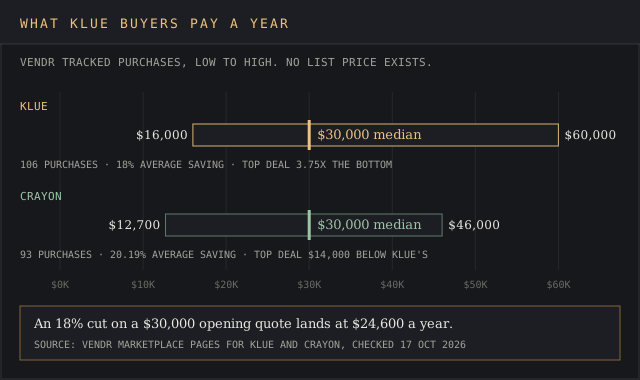
Klue and Crayon share a $30,000 median, so the choice between them turns on the meter each one bills.
The top tracked Klue deal is 3.75 times the bottom one, which means seat count moves the price more than any other line.
An 18% saving on a $30,000 opening quote takes $5,400 off, landing the contract at $24,600 a year.
CI teams and product marketers compare Klue, Crayon and the rest before every renewal. Send the vendors and I'll source a version you own.
Klue's median annual contract is $30,000, across 106 purchases tracked by Vendr, in a range running from $16,000 to $60,000. That's the only dollar figure with a real sample behind it. Type klue.com/pricing into a browser and you land on the homepage: on 17 October 2026 the address redirected there, and the page carried a "Get a demo" button and zero prices.
Klue here means Klue Labs of Vancouver, the competitive intelligence platform behind two products, Compete and Win Loss. This report covers what the contract meters, what each product adds, the costs that sit outside the subscription, what buyers pay in practice, and how Klue's price compares with Crayon, AlphaSense, Similarweb and two self-serve tools.
It's written for product marketing leads, competitive intelligence managers and the revenue teams they serve, plus procurement teams holding a Klue quote. Every page cited was checked on 17 October 2026, and each figure carries that date. The Klue review covers the product itself. This page stays on the money.
How much Klue costs a year
Plan on $30,000 a year, about $2,500 a month, for a typical deployment. That's Vendr's median across 106 purchases on a page last updated in February 2026. The same header block says Vendr handled 82 Klue deals itself and that buyers saved 18% on average. The exact figure in Vendr's stat tile is 17.63%.
Two buyers of the same platform can sit $44,000 apart. The cheapest tracked purchase was $16,000 and the most expensive $60,000. Klue pricing has no public list to anchor that spread, so the first number on a quote comes from the sales team and nobody else.
Copy these lines into an email, fill them in and send. I reply with scope and a price within 2 to 3 business days.
Open the emailG2's listing says the same thing in fewer words. Its Klue pricing page states that pricing "is not listed on G2 by the vendor", that Klue offers no free trial, and that the vendor's pricing information was last updated on 14 January 2020. Nearly seven years without a refresh is par for the course in this category.
What the Klue contract meters
Klue names its own billing unit, straight from the horse's mouth. Its Klue vs Crayon page, last modified 27 October 2025, puts the pricing model this way:
"Klue's pricing model scales with the number of users as your organization grows. Crayon's pricing increases based on the number of competitors you want to track, which is much less predictable."
Klue, Klue vs Crayon comparison page, 27 October 2025
The same page says Klue tracks "an unlimited number of competitors" at no extra cost, with no cap on data sources such as website changes, customer reviews and third-party blog mentions. So the quote grows with headcount, and adding specific competitors to monitoring costs nothing on Klue's own account.
Read between the lines and the user count is the whole negotiation. A program feeding 40 sales reps prices differently from one feeding 400, even if both watch the same eight competitors. Vendr's Klue page puts the typical contract minimum at 5 to 10 users.
What unlimited competitors means for the quote
Crayon prices the number of competitors you track. Klue prices the people reading about them. A team watching 25 competitors pays Klue the same as one watching 5, so programs with a long tail of niche competitors get the better deal on Klue's meter.
That cuts both ways. A business with three competitors and 200 sellers pays for 200 seats to read three cards. Count competitors and readers before the first call, and focus the quote on whichever number is smaller. The same page says a new webpage can be added for monitoring at any time, so monitoring depth on a known rival carries no surcharge either.
Who counts as a user
Every rep who opens a battlecard inside Salesforce, Slack or Microsoft Teams is a consumer of the intel, and Klue's model ties price to that audience. That is the trade: costs track adoption, so a sales organization that rolls Klue out to every revenue team pays for every seat it adds.
The more reps read the intel, the cheaper each insight gets. A $30,000 contract read by 100 reps costs $300 per reader a year; read by 10, it's $3,000 per reader. Competitive intelligence pays back on usage, so the intel has to reach the deals where it's needed.
What the Klue platform delivers for the money
Strip the pitch away and a Klue contract buys five jobs, each one named on klue.com or in its review-site profiles. All five turn competitor data into competitive insights a rep can use mid-deal, and the competitive insights are what reps quote back to buyers.
- Monitoring. Automated tracking of competitor websites, news and customer reviews, so intel collection runs without a person refreshing tabs, and market trends surface as they happen.
- Battlecards. High quality battlecards with positioning, messaging, strengths and weaknesses for specific competitors.
- CRM integration. Delivery into Salesforce, Slack and Microsoft Teams, so the card sits one click from the opportunity and a rep needs one click more to share it.
- Win-loss analysis. Interview and deal data that shows why companies win or lose against each rival.
- Analytics. Reports on which cards reps open, the adoption signal leadership asks for at renewal.
Those features cover the competitive intelligence most B2B companies need for sales. Market intelligence work, such as industry sizing, market trends and financial analysis, sits outside them.
Each integration counts toward onboarding effort, so list the integration targets your sales stack needs before the quote. Features beyond those five jobs, such as API access and custom connectors, belong on the order form as named line items.
Support is part of the package too. The vendor's Crayon comparison page promises in-app live chat support with a 5 minute response time for admins and end users. That's a vendor claim on a vendor page, and worth writing into the support terms if it matters to your team.
Customer support also shows up in the reviews. G2's AI summary of user reviews lists customer support among the top five advantages, from 9 mentions, and difficult setup as the top disadvantage, from 5. Limited customization appears among the weaknesses too, from 3 mentions, so price onboarding support before signing.
The manual work a Klue contract replaces
The vendor's own 2021 post said product marketers spent about 25% of their time on intel collection. On a 40-hour week that's 10 hours, or 520 hours a year, spent copying competitor data into slides. The platform exists to automate intel collection so those hours go to strategic work: analysis, messaging and the competitive positioning sales leadership asks for, plus the strategic decisions on which rivals to fight.
That's the business case most companies take to finance, and the analysis behind it is short. A $30,000 contract set against a quarter of one product marketer's year is an easy sum to run, and the answer depends on that salary more than on Klue. Teams that win more deals against specific competitors after rollout can add competitive win rates as the second half of the case.
Sales teams should weigh their competitive landscape as much as the price. A business facing two rivals gets less from the platform than one facing twenty, because the analysis load grows with the number of competitors while Klue's price grows with users. Data freshness is the hidden variable: a card citing last year's competitor pricing loses deals, so someone has to keep the competitive data current.
What each Klue product adds to the bill
Klue doesn't publish plan names. Its homepage lists two products, Klue Compete and Klue Win Loss, plus the Compete Agent. Vendr's buyer guide sorts deals into Essentials, Professional and Enterprise tiers, labels that appear nowhere on klue.com. The products below are the ones Klue itself sells.
Klue Compete
The core competitive intelligence platform: competitor monitoring, battlecards and delivery into the CRM. Its content product page pitches help to "create and maintain actionable content", and curators can create and update cards from inside the platform.
Every insight lands in one library, which is the feature the per-user price pays for. Klue's Series B announcement framed the goal as "Investing in machine-learning to not only automate intel collection, but automate insight generation." The same post said its machine learning removed 87% of collection noise.
Compete Agent
Klue calls the Compete Agent "Your AI research analyst and deal assistant", one that collects competitive intel and delivers it to sellers "the moment they need it." Sellers put competitive questions to it on positioning, objections and live deals, inside tools like Claude. No AI line item shows on any page Klue publishes, so ask the sales team in writing if the agent sits inside your quote.
Klue Win Loss
The second product runs buyer interviews: Human Expert Interviews, an AI Interviewer, Blindspot Interviews and a Win & Loss Story Agent that writes the summary when a deal closes.
It ranks #2 in our win loss analysis software list, and its insight on lost deals feeds straight back into battlecards and the actionable messaging reps use against competitors. Win loss research produces competitive insights public data can't, and it's where competitive win rates get measured. Win rates against each named rival are the number leadership watches, so buyers who want both programs should price the bundle on one quote.
Costs outside the subscription
The subscription is the tip of the iceberg on most Klue deals, and the devil's in the details of three extra lines.
- Onboarding. Vendr's Klue page says onboarding fees "can range from low-to-mid five figures depending on deployment complexity."
- Annual escalation. Vendr's buyer guide says Klue contracts "may include automatic price escalations (e.g., 5–10% annually) unless explicitly negotiated out."
- Curator time. Someone has to maintain the battlecards, and that salary never shows on the invoice.
Rivals price the third line loudest. ARISE GTM, a London agency that sells its own competitive intelligence system, published a Klue cost model on 18 January 2026. It estimates a £30K to £60K subscription, £10K to £20K of implementation, and £52K of labour, for a first year of £92K to £132K.
ARISE's page prices its own first year at £69K to £89K, and claims its system cuts maintenance to 6 hours a month, reaches 85% weekly battlecard usage and deploys in 2 to 4 weeks.
Those are a competitor's estimates, and the page names no data sources for them. ARISE says a Klue program requires 30 to 40 hours a week for CI research, synthesis and maintenance, while its own labour line assumes 35 hours a month at a £95K salary.
It also puts Klue's monthly battlecard access rate at 20-30%, citing "industry benchmarks", and the implementation timeline at 3-4 months, both unsourced. G2 reviewers report a 2 month average time to implement.
What buyers pay for Klue in practice
G2's reviewer answers add three averages to Vendr's purchase data: 2 months (roughly eight weeks) to implement, 13 months to return on investment, and an 11% average discount. Vendr's 18% sits above G2's 11%, which fits a dataset of buyers who brought a negotiator.
The quotes buyers leave are rarely about the invoice. They're about the work the invoice buys. One G2 reviewer, a mid-market user writing on 9 December 2025, credited the account team:
"We also had help from a customer success manager who did a lot of the manual work for us, which was great."
Tyler B., mid-market company, G2, 9 December 2025
That help is part of what the price pays for, and buyers who lean on it get more of their contract back. A product marketing director on Capterra put the value case in one line:
"Much better usability for both users and admins/curators, much better sales team and customer service, and better value for price overall."
Juanma R., Director, Product Marketing, computer software, Capterra, 7 September 2023
How to negotiate a Klue quote
Bite the bullet and get competing quotes before the first call. Buyers who evaluate Klue against two other platforms walk in with numbers the sales team has to answer. Vendr's negotiation notes name Crayon, Kompyte and Contify as the reference rivals, and recommend settling onboarding and mid-contract user expansion pricing before signing.
- State a budget anchor early, repeat it, and keep the focus on the per-seat rate.
- Bring a Crayon quote. Its median matches Klue's, so the comparison lands as a peer price.
- Price user expansion now. On a per-user meter, growth is the lion's share of year-two cost.
- Offer a multi-year term in exchange for flat pricing, which Vendr recommends over a lower rate that climbs every year.
- Strike the escalation clause, or cap it. Vendr suggests "no more than 3% per year."
- Time it for Q4, Klue's calendar year-end, per Vendr. Vendr's reasoning is that deals happen faster in the last weeks of the year, when Klue's sales team is motivated to close.
Ask for the analytics too. The same Capterra reviewer flagged a gap worth naming in the deal:
"Also more and deeper out-of-the-box metrics would be nice for admins to assess the impact without depending on customer success."
Juanma R., Director, Product Marketing, Capterra, 7 September 2023
If leadership will judge the program on win rates, get the reporting written into the order form. Otherwise the ball is in your court every quarter to prove the spend.
Who Klue's pricing fits
A per-user meter suits sales teams large enough that competitor objections repeat across deals and long sales cycles, with a named owner keeping cards current. Companies that choose Klue tend to run a sales enablement program already, with sales reps used to opening content inside the CRM. Reps see the intel where they work, which is the adoption case reviewers make:
"What's great about Klue is that it shows up within the workflow so I don't have to go to a different tool to access competitive intelligence/daggers."
Haruki T., Sr. ADR, computer software, Capterra, 28 December 2024
Inside a larger organization, the buyer is rarely one person. Product marketing owns the platform, sales leadership owns the win rates, and revenue operations owns the CRM integration. Get all three into the evaluation, because the business case needs each one's numbers and the platform has to serve the whole organization.
A marketing specialist in real estate described the research it replaces:
"Klue filters and feeds us all of the good information that would take us weeks to compile."
Tyler M., Marketing Specialist, real estate, Capterra, 18 June 2024
Revenue teams spread across several product lines get the most from per-user pricing, because one seat reads every competitor's card. It suits a solo founder far less. At a $16,000 floor and a 5-user minimum, Klue costs an arm and a leg next to a $39 self-serve plan. Product managers with one or two rivals to watch should zero in on the cheaper tools below before booking a demo.
Klue says over 250,000 users rely on it and that it ranks as a G2 industry leader in 4 categories. Its 2021 funding post claimed product marketers on Klue were "covering 14x more competitors." Those are the vendor's own numbers, published on its own pages.
Klue against its alternatives
Klue sits in the premium band of competitive intelligence tools, beside Crayon and above AlphaSense on Vendr's medians. Self-serve competitive intelligence tools, built around competitor monitoring, price in dollars a month. Those suit companies that want alerts on a handful of rivals and have no sales program to feed.
| Tool | Billing meter | Published entry price | Tracked contract |
|---|---|---|---|
| Klue | Per user | None published | $30,000 median, 106 purchases* (Vendr) |
| Crayon | Per tracked competitor | None published | $30,000 median, 93 purchases* (Vendr) |
| AlphaSense | Per seat, quoted | None published | $18,375 average* (Vendr) |
| Similarweb | Per package | $199 a month | $37,800* (Vendr) |
| Competely | Per plan, 3 users included | $39 a month | Not tracked |
| Visualping | Per checks and pages | $0 Free, $120 a year paid | Not tracked |
- The CI tools and contract terms to compare
- Regions, years and segments
- Where it runs: blog, white-label, gated or lead magnet
- Whose byline goes on it
- Deadline
- 2,500+ words, human-written
- Every figure linked to its source
- Yours to publish, under your name or none
- Hosting here for +$200, with your sponsored links
Figures marked * are Vendr annual contract values from anonymized buyer data, median unless labelled average. Entry prices are each vendor's own published list price, checked 17 October 2026.
Crayon is the closest match. Its terms of service say the licence "is typically limited by the number of Competitors Customer may use the Services to track", so its meter runs on rivals while Klue's runs on people. The Crayon pricing report breaks that contract down, and the Crayon vs Klue comparison sets the two products side by side.
AlphaSense answers market analysis questions Klue's cards leave open, from filings to transcripts, and buyers who need that depth should evaluate a broader market intelligence platform alongside it. The market intelligence platform pricing report covers that tier, and the AlphaSense pricing report covers its contract.
Pick competitive intelligence tools by the meter that matches your program, since revenue spent on the wrong meter buys seats or slots nobody uses. Similarweb measures a rival's traffic, and the Similarweb pricing report lays out its packages. The full field of 18 vendors sits in our competitive intelligence pricing report, and the best competitive intelligence tools ranking scores them on fit.
What to budget for a Klue year one
Start from the median and work outward. A team that buys at Vendr's average saving pays about $24,600 against a $30,000 opening quote. Add onboarding, which Vendr puts in the low-to-mid five figures, and a curator's time. Don't cut corners on that last line: a card library nobody maintains is a red flag at renewal.
- Subscription: $16,000 to $60,000 a year on Vendr's tracked range, $30,000 at the median.
- Onboarding: low-to-mid five figures, per Vendr, quoted separately.
- Year two: the subscription again, plus any escalation you didn't strike.
Track cost per insight used: the analytics report which cards reps open, so the insight count is a number you can pull at renewal. Strategic decisions about renewal go easier with that number in hand.
Base strategic decisions on the per-user rate. Divide the quote by seats, then compare that figure with Crayon's per-competitor price for the same program. That's the only like-for-like number either vendor lets you build.
Delivered for your site and your byline. Hosting here is optional.
Frequently asked questions
What is the company Klue?
Klue Labs is a Vancouver company selling a competitive intelligence and win-loss platform. Its products are Klue Compete, Klue Win Loss and the Compete Agent, and it bills per user.
What is the best software for competitive intelligence?
It depends on the job. Klue and Crayon lead the sales enablement end at a $30,000 median each, AlphaSense covers market research, and self-serve tools like Competely start at $39 a month. Our competitive intelligence tools ranking scores each one.
How much does Crayon AI cost?
Crayon publishes no price, and its AI features carry no separate line item. Vendr's median Crayon contract is $30,000 a year across 93 purchases, from $12,700 to $46,000.
Is Klue a legitimate company?
Yes. Klue raised a $62M Series B in December 2021, led by Tiger Global with Salesforce Ventures participating, and holds a 4.7 out of 5 rating across 444 G2 reviews.
Bottom line
Klue costs $30,000 a year at the median, across a $16,000 to $60,000 range, and none of it is published. The meter is the user, so the seat count you sign for sets the price more than anything else on the order form.
Buy it when your sales organization will open the cards, someone owns them, and revenue teams use the insights effectively across sales cycles. Take a Crayon quote to the table, strike the escalation clause, and price expansion seats before you sign.
CI vendors, product marketing consultancies and procurement teams use reports like this one in sales calls and renewal prep.
A report on your topic for a blog page, gated content or a lead magnet.
Written for your client and published under their brand, with my name left off.
Your report on marketintelligencetools.com, with 2 to 3 CTAs carrying your sponsored links.
Default terms: the report is yours to publish, and I keep the right to republish it on this site behind a gate, outside Google's index.
Where every Klue number comes from, and the prices Klue keeps off its site
Contract figures come from Vendr's Klue marketplace page (updated February 2026): the median, the low and high purchase, the purchase count, the average saving and the onboarding and escalation notes. Crayon, AlphaSense and Similarweb contract values come from their own Vendr pages. G2's Klue pricing page supplied the implementation, ROI and discount averages, and its reviews page the rating. All were read 17 October 2026.
Klue's own claims come from klue.com: the homepage, the Klue vs Crayon page (modified 27 October 2025), the content and Compete Agent product pages, and the December 2021 Series B post. Crayon's billing clause is from crayon.co/terms. Self-serve prices come from similarweb.com, competely.ai and visualping.io. The ARISE GTM cost model is from arisegtm.com (18 January 2026). User quotes are verbatim from G2 and Capterra, dated in the text.
Klue publishes no rate card, no plan names, no per-user rate and no price for the Compete Agent, and klue.com/pricing redirects to the homepage. Vendr's Essentials, Professional and Enterprise labels are Vendr's own, so every Klue dollar figure on this page is tracked buyer data.