Website Traffic Analysis Tools: 11 Platforms Ranked (2026)
 By Jan Suski. I go deep on every review, checking every number against its source and digging up details other coverage misses, a habit from six years of SEO and link building for tech companies. Bylines at Surfer, Brand24, and Senuto. How the scoring works.
· Prefer this source on Google
Quick comparison of the eleven ranked tools
The table below orders all eleven by final position. The coverage column shows the one figure that decides each tool's fit; the price column shows the cheapest tier that unlocks the website traffic data named in its entry, read off each vendor's own price list on 2 and 3 September 2026.
| # | Tool | Coverage figure | Entry price | Best fit |
|---|---|---|---|---|
| 1 | Positive Surfer | 100 AI prompts a day across 5 engines | $49/mo Discovery; $158/mo AI Search Analytics | Content teams measuring search & AI citations for their own site |
| 2 | Similarweb | 100M+ websites, 37 months of history on paid tiers | $199/mo Starter | Analysts sizing a market or a rival's whole channel mix |
| 3 | Leadfeeder | Names the company behind each visit; 100 a month free | €0 Lite; €79/mo Discover annual | B2B teams naming the companies behind their own traffic |
| 4 | Ahrefs | 171 countries, 200 websites per batch | $129/mo Lite; Web Analytics $0 to 1M events | SEOs who want search traffic estimates plus a first-party tag |
| 5 | Google Analytics 4 | 14-month event retention on the standard property | $0; 360 quoted | Any website owner who needs the default first-party count |
| 6 | SE Ranking | AI Overviews clicks split from classic organic | $103.20/mo Core | Budget agencies reporting organic & paid estimates to clients |
| 7 | SpyFu | 10+ years of monthly click history on Professional | $39/mo Basic | PPC managers checking a rival's paid & organic clicks |
| 8 | Matomo | 24 months of raw data on Cloud; unlimited hits self-hosted | $0 On-Premise; 29/mo Cloud | Teams that must own the raw data on their own servers |
| 9 | Microsoft Clarity | 2M+ websites and apps, no traffic cap | $0 | Product teams that need recordings & heatmaps at zero cost |
| 10 | Semrush | Up to 100 competitors per Traffic & Market seat | $289/mo Traffic & Market Pro, 1 seat | Agencies needing organic, paid & AI channel splits for any website |
| 11 | Plausible | 313B views tracked, 3-year retention on Starter | $9/mo Starter | Small websites that want a one-screen dashboard and no cookie banner |
Prices are each vendor's own published rate; the Similarweb and Semrush figures are monthly billing, Leadfeeder's €79 is the annual rate (€113 monthly), and Matomo Cloud lists 29 before tax in the currency of your billing region.
Where these figures come from
Every price above is the vendor's own price list, read 2 September 2026 and re-checked for Semrush on 3 September 2026: surferseo.com, similarweb.com, leadfeeder.com, ahrefs.com, seranking.com, spyfu.com, matomo.org, clarity.microsoft.com, semrush.com and plausible.io. Contract medians for Similarweb ($37,800 across 157 purchases) and Semrush ($12,239 across 60) are Vendr's anonymized buyer-reported figures.
Google publishes no list price for Analytics 360 and Ahrefs publishes no Vendr median, so neither row claims one. Leadfeeder's help center publishes no identification rate, so its coverage figure is the free plan's cap and nothing else.
Similarweb, Semrush and Ahrefs also lead our competitive intelligence tools for SEO ranking, the panel vendors behind the estimates sit in the clickstream data providers ranking, Leadfeeder holds #5 in the visitor intelligence software ranking, and the digital marketing intelligence ranking covers the wider measurement stack. Each of those ranks the same vendors for a different job.
Traffic analysis tools answer two questions that share one name. The first is how many visitors your own website gets, where they came from & what they did. The second is how much traffic a competitor's domain gets, which nobody outside that company can measure, so every third party tool models it.
This ranking covers both. Six of the eleven tools put a script on your pages and count real website traffic: Google Analytics 4, Matomo, Microsoft Clarity, Plausible, Leadfeeder & Positive Surfer's Search Console connection. The other five estimate web traffic for any website you type into a search bar: Similarweb, Ahrefs, SE Ranking, SpyFu & Semrush.
Leadfeeder is the odd one out on purpose. It counts the same visits a tag counts, then names the company behind each one, which no other tool here attempts, and its free plan does that for 100 companies a month.
Every price below was read off the vendor's own price list on 2 September 2026, and every contract median comes from Vendr's marketplace header stats. User quotes come from Capterra, Hacker News & G2, linked to the thread they sit in.
Evaluation criteria for a website traffic checker
Five criteria decide the shortlist, and the ranking below applies them in this order. Each one produces a number or a yes/no that a buyer can check against the vendor's own pages in under ten minutes.
1. Data source, stated on the record
A tool either counts site traffic with a tag on your pages or models it for any website. The test is a published method. Semrush names a clickstream panel refreshed every one or two days; Similarweb lists four source types and 10 billion signals a day; SE Ranking states keyword rankings, search volume, SERP features & estimated click through rates. A vendor that won't say how the number is made loses points.
2. History and country coverage
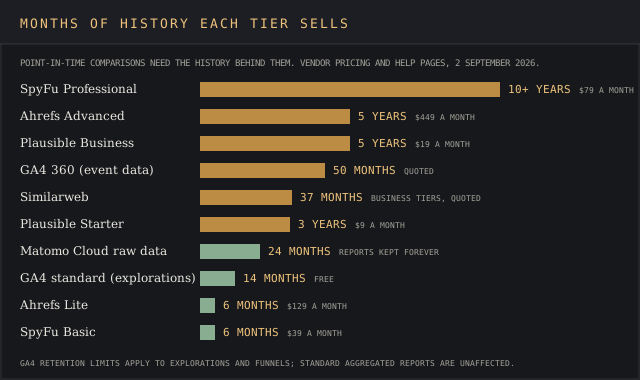
Traffic trends need months behind them. Ahrefs sells 6 months on Lite and 5 years on Advanced across 171 countries; Similarweb's paid tiers add up to 37 months; GA4 keeps event data for 2 or 14 months on a standard property. The score is months of historical data on the entry paid tier, and how many different countries it covers.
3. Published entry price and what it caps
The criterion counts the cap attached to it: seats, daily requests, tracked keywords, views or hits, and which advanced features sit behind the next tier. A $9 plan capped at 10,000 views and a $289 plan capped at 3,000 requests a day are both honest; a quote-only tier scores zero until Vendr's medians fill the gap.
The gap between Similarweb's $199 Starter and its $37,800 Vendr median contract, on a monthly basis. Nothing published sits between the two.
4. AI search split
Since Google's AI answers rolled out widely in May 2024, a report that lumps AI clicks into organic search hides the drop. The test: does the tool separate AI-driven visits or citations from classic search results, and at how many prompts or referrers per day? Positive Surfer tracks 100 prompts daily across five engines; SE Ranking splits AI Overviews clicks from classic clicks; Ahrefs Web Analytics and Plausible both label chatbot referrals.
5. Bulk and API access
One website at a time doesn't scale past a five-client agency. Ahrefs Batch Analysis takes 200 websites per report on Standard and 1,000 on Advanced; Semrush Traffic & Market Pro allows 3,000 requests a day; Plausible's Stats API allows 600 requests an hour on Business. A tool with an MCP server (SE Ranking, Semrush, Ahrefs, Clarity, Surfer) gets the same credit as one with a REST API.
Run your own domain through any estimator before trusting its number on a rival. The ratio between the estimate and your real GA4 or Matomo count is the correction factor for sites like yours.
The 11 best website traffic analysis tools, ranked
Ranked on stated data source, history and country coverage, published entry price and its cap, AI search split, and bulk access, in that order.
Positive Surfer
Best fit
A content marketing team that needs to know how its own website pages perform in Google search and in AI answers.
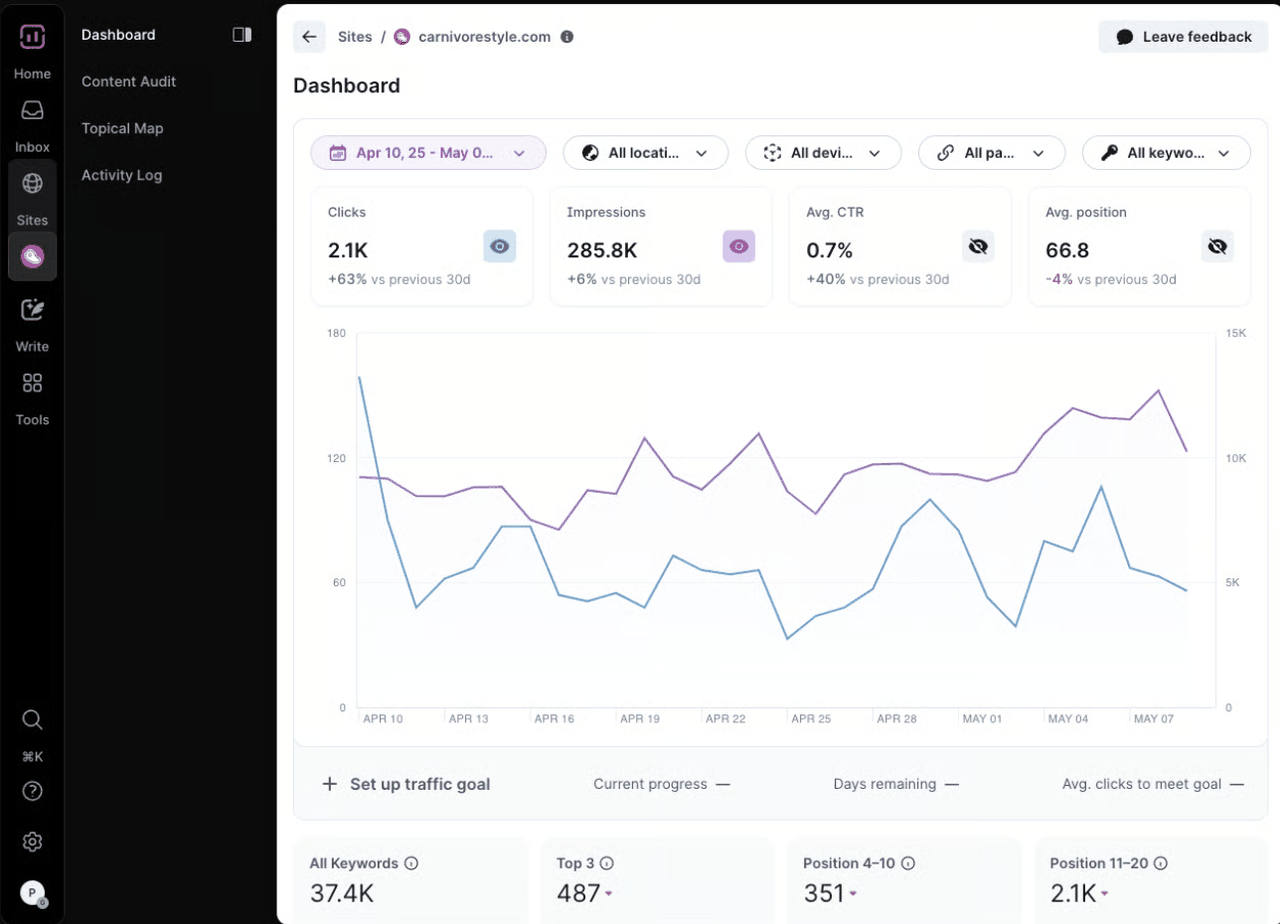
Positive Surfer measures your own site traffic and estimates nothing about a rival's. Its Sites module connects to Google Search Console and builds a dashboard of clicks, impressions, ranking positions & rank-drop alerts, with Google core updates marked on the chart, per the Sites launch post.
The AI Tracker scrapes real answers from Gemini, AI Overviews, AI Mode, ChatGPT & Perplexity and reports a visibility score, mention rate and cited sources. Surfer's price list shows 100 prompts refreshed daily on the $158 AI Search Analytics plan and on Peace of Mind at $299.
The Pro card and the AI Tracker FAQ both put Pro at 50 prompts a day, though the comparison table on the same page shows 100. The vendor claims 2,800+ companies on the tracker and 150,000+ customers overall.
Key features
- Sites dashboard fed by Search Console: clicks, impressions, keywords by position band & rank-drop alerts.
- AI Tracker across 5 engines, daily refresh on Pro and above, with Mention Gap and Brand Sentiment reports.
- Content Audit with weekly refresh recommendations tied to traffic drops on individual pages, plus a new page brief from Topical Map.
- MCP server on Pro and above; REST API on Peace of Mind at $299.
Pricing
Discovery at $49 a month on annual billing tracks 10 pages and 0 AI prompts; Standard at $99 tracks 25 prompts weekly on ChatGPT only; Pro at $182 and Peace of Mind at $299 refresh daily across all five engines. The standalone AI Search Analytics plan is $158 a month for 100 prompts.
Ranked #1 in this guide
See Positive Surfer's Sites dashboard on your own domain
Search Console clicks, rank-drop alerts and Google core updates on one chart from $49/mo, and 100 AI prompts a day across 5 engines at $158/mo.
 See Surfer pricing →
May earn a commission if you sign up through this link, at no extra cost to you. Full affiliate disclosure.
Pros
- Scrapes real AI answers where rivals read an API feed, per its own AI Tracker FAQ.
- 5 engines per prompt at no extra charge, where Ahrefs bills 1 check per platform.
- Published prices up to Enterprise at $999.
Cons
- Competitor numbers need Similarweb or Semrush alongside; the Positive Surfer vs Semrush comparison weighs that pairing.
- Search Console feeds it, so referral, social and direct visits never appear.
- Two prompt counts for Pro on one price list (50 and 100).
A Capterra reviewer working as an SEO specialist, with one to two years on the tool, wrote on 29 June 2026 that "I love how it provides real-time feedback with the SEO score meter as I write" (Capterra). The price complaint is louder. A CMO at a 2-to-10-person marketing firm gave it 2 of 5 in April 2025:
"At nearly five times the cost of comparable tools, Surfer AI simply doesn't deliver enough unique value to justify the premium. While the interface is clean and the keyword mapping feature shows potential, these surface-level positives can't compensate for the unreliable core functionality."
Amin N., CMO, marketing and advertising, Capterra, 12 April 2025
Why it’s ranked #1. On criterion 4 it wins outright: 100 daily prompts across 5 AI engines for $158, where Similarweb sells AI search as a separate package above a $199 Starter and Ahrefs bills 5 checks on Lite. Its own Search Console feed is the first-party truth every estimator below is modelling toward.
Similarweb
Best fit
A research analyst or investor who needs every channel of a competitor's traffic, across 100+ countries, with three years of history.
Similarweb is the tool most people mean when they say website traffic checker. Its method page lists four inputs: first-party analytics shared by website owners, a contributors network of devices, public data crawled from the web, and partner feeds from ISPs and measurement firms.
It claims 10 billion signals a day, 100M+ websites and 200 data scientists. The Semrush vs Similarweb comparison runs the two head to head.
Key features
- Traffic and engagement for any website: visits, views per visit, average time, bounce rate.
- Channel mix across direct, referral, search, social, email & display.
- AI Traffic Checker for referrals from ChatGPT, Perplexity, Claude, Grok, Gemini & DeepSeek.
- Real-time and bulk APIs, Snowflake and AWS feeds, MCP.
Pricing
The Starter plan is $199 a month, or $1,500 a year, the only published figure. Above it, Vendr's anonymized buyer records put the median contract at $37,800 a year across 157 purchases, from $14,220 to $96,000, with buyers saving 12.27% on average.
Pros
- All channels in one view: direct, referral, search, social, email, display.
- 10 years of history on the enterprise set, 37 months on standard paid tiers, 100+ countries.
- 4 stated inputs, the most transparent method here.
Cons
- Everything past $199 is quoted, and the Vendr median is 190x the Starter monthly rate.
- Add-on modules run $20,000 to $60,000 a year each, per Vendr.
- Small-site figures are modeled from thin panel coverage.
A marketing director at a 51-to-200-person agency, on the tool for 2+ years, wrote on Capterra on 30 April 2026 that "One problem with Similarweb is the difficulties in providing accurate raw numbers for traffic and spend" (Capterra). A market research founder on the same listing, 23 April 2026, described the opposite experience:
"We use them both to feed data into Looker Studio and to support integration with an internal software solution we are currently developing, which makes Similarweb even more important within our workflow."
Founder and CEO, market research, 2-to-10 employees, Capterra, 23 April 2026
Why it’s ranked #2. It beats Leadfeeder on criterion 2: any domain, 100+ countries and 37 months of all-channel history, where Leadfeeder watches one website and its free plan keeps 7 days. It trails Positive Surfer on criterion 3 because a $199 Starter gives way to a $37,800 median contract with no published tier between.
Leadfeeder
Best fit
A B2B sales or marketing team that wants the companies behind its own website traffic named and pushed into HubSpot, Salesforce or Pipedrive, on EU-hosted data.
Leadfeeder is the one tool on this page that says who is behind the visits a tag already counts, at company level. A tracking script plus a reverse-IP database matches each visit to an organisation, filters ISP traffic out before it reaches the feed, and records pages viewed, time per page, referral source & Google Ads keyword per identified company.
The brand has carried three names in four years. Great Hill Partners put €180 million into merging it with Echobot on 21 June 2022, the pair became Dealfront on 3 April 2023, and on 24 March 2026 Dealfront became Leadfeeder again. The vendor sizes its database at 60 million companies and 400 million contacts, hosted on AWS in Ireland under ISO 27001 and ISO 27701.
The hit rate is the open question. The homepage promises up to 45% of visiting companies identified, the help center article of 27 March 2026 declines to put any percentage on it, and a Capterra CMO measured 2% in 2021. Person-level identification is excluded by design; a named person appears only when a HubSpot form fill supplies one.
Key features
- Web Visitors feed: company name, pages viewed, time per page, referral source and Google Ads keyword for every identified visit.
- Custom feeds with 100+ filters, and lead scoring by ICP fit, page depth and return visits.
- Two-way sync with Salesforce, HubSpot, Pipedrive, Zoho and Microsoft Dynamics; alerts into Slack, Teams and Zapier.
- Google Ads, Looker Studio and Gong integrations, plus an IP Enrich API that returns firmographics for an IP address.
- Lite plan at €0 for the last 100 identified companies a month, 7 days of history and unlimited users.
Pricing
Lite is €0 with 20 credits. Discover runs €79 a month billed annually for up to 50 identified companies, stepping to €309 at 1,000 (€113 monthly at entry); Activate is €369 to €729 for up to 4,000 companies and adds verified emails and phones; Scale is €599 to €2,089 for up to 10,000, per leadfeeder.com/pricing.
Every paid plan carries a 14-day free trial on an email address alone, and enrichment or CRM sync spends credits at 0.2 to 1 per action.
Try it yourself
Start a Leadfeeder trial
14 day free trial on every paid plan with an email address alone, and Lite stays free at 100 identified companies a month.
 Visit Leadfeeder →
May earn a commission if you sign up through this link, at no extra cost to you. Full affiliate disclosure.
Pros
- Names the company behind a visit, which none of the ten tags and estimators around it do.
- Unlimited users on every tier, the free one included, so Discover at €79 covers a 12-person team.
- 56 Activate and Scale price points published; only Enterprise is quoted.
Cons
- No published identification rate: a homepage claim of up to 45% against a reviewer's measured 2%.
- Annual contracts renew for 12 months unless cancelled 30 days ahead, and no reminder is sent.
- Plan credits expire at period end; one reviewer lost 700+ when her subscription lapsed.
A senior account manager in business supplies checks the feed daily, per a five-star Capterra review of 18 November 2023: "The ability to see who is on the website, what pages they've been looking at and their keyword searches helps me to do everything from understand intent leads better to helping to plan ABM campaigns based on behaviours" (Capterra). A medical-device marketing specialist measured a full year and gave it one star:
"Out of nearly 20,000 contacts from 2,000 companies that visited our website in a year, less than 100 were from the purchasing department I really need."
Marketing specialist, medical devices, Capterra, 9 April 2024
Why it’s ranked #3. It beats Ahrefs on criterion 1 for your own domain: a first-party script that names the company behind each visit, free to 100 companies a month, where Ahrefs Web Analytics counts sessions and names nobody. It sits under Similarweb because Leadfeeder watches one website, and Lite keeps 7 days of history against Similarweb's 37 months.
Ahrefs
Best fit
An SEO who wants organic and paid traffic estimates for rivals plus a cookie-free tag for their own website at $0.
Ahrefs estimates search traffic from keyword rankings and search volume, and its traffic checker states coverage for 171 countries, with top pages, subfolder and subdomain reports in Site Explorer. Batch Analysis checks up to 200 websites at once.
The quieter product is Ahrefs Web Analytics: a 2 KB cookie-free script, $0 for verified websites up to 1 million events a month, with website visitors visible within 1 minute of an event. Its own table puts GA4 at a 24-to-48-hour lag and a ±98 KB script, and it labels referrals from ChatGPT, Perplexity & Gemini as AI traffic.
Key features
- Site Explorer traffic estimates per site by country, subfolder and subdomain.
- Organic keywords and paid keywords reports showing which keywords send paid traffic and organic clicks.
- Batch Analysis: 200 URLs per report on Standard, 500 on Advanced, 1,000 on Enterprise.
- Web Analytics tag with funnels, custom events, UTM breakdowns and a Search Console link.
Pricing
Lite is $129 a month with 6 months of history and 1,000 credits per user, Standard $249 with 2 years, Advanced $449 with 5 years, Enterprise $1,499 on an annual commitment. Ahrefs states it never discounts, and Vendr lists 58 handled deals with no published median.
Pros
- 171 countries in the traffic checker, the widest stated country list here.
- First-party analytics to 1M events at $0 with unlimited history.
- Batch checks of 200 websites from the Standard tier.
Cons
- Lite's 1,000 credits a month run out fast on report-heavy days.
- Extra seats cost $40 to $80 a month each.
- Search-only estimates; direct, social and referral visits sit outside the model.
A design-agency CEO with 2+ years on the tool described the billing side on Capterra in April 2024:
"The new scheme is so complicated that your credit card can suddenly charge $1000s without your knowledge. When we contacted to customer support, they told us that beside the $2000 annual fee we pay, we also need to pay $3500 for additional keyword tracking (which we never signed up for, it was migrated from our old account, where usage was free) without our knowing."
CEO, design, 51-to-200 employees, Capterra, 9 April 2024
Why it’s ranked #4. It beats GA4 on criterion 2: any website, 171 countries, 5 years of history on Advanced, where GA4 sees one property for 14 months. It loses to Leadfeeder because Lite's $129 buys 6 months of search-only estimates, and its own $0 tag counts sessions without naming the company behind any of them.
Google Analytics 4
Best fit
Any website owner who needs the default first-party count of visitors, sessions and conversions, and who runs Google Ads.
Google Analytics 4 is the $0 baseline every other first-party tool compares itself against. It uses an event model, links to Google Search Console for query-level clicks, and reports traffic sources across organic search, paid ads, referral, social and direct. Standard properties keep event-level records for 2 or 14 months; 360 properties can choose 26, 38 or 50.
Key features
- Event-based tracking with a Google Tag Manager container.
- Acquisition reports by source, medium and campaign, plus a landing pages report and a pages report by views.
- Google Ads link for paid search cost and conversion figures.
- BigQuery export, unsampled on 360.
Pricing
The standard property is $0. Google publishes no list price for Analytics 360; resellers quote it, and Google's help page describes it as the upgrade path when a property hits the large-property limits.
Pros
- $0, on the website that also runs your Google Ads.
- Natively supported by most CMS platforms and ad tools.
- Import path into Matomo, Plausible and Ahrefs Web Analytics if you leave.
Cons
- 24-to-48-hour lag, per Ahrefs' comparison table.
- Consent banners and ad blockers remove a share of visits before counting.
- Standard properties sample reports past a few million sessions a month.
A travel-company founder, one to two years in, put the standard property's weakness plainly on Capterra on 15 September 2025:
"It is very complicated now, and hard to really understand what is going on, especially as there are gaps when web users choose not to share their information by opting out of Cookie tracking."
Lamia W., founder, leisure, travel and tourism, Capterra, 15 September 2025
Why it’s ranked #5. It beats SE Ranking on criterion 3 at $0 with no seat or request cap, and on criterion 1 because a tag counts sessions where SE Ranking models them. It sits under Ahrefs because it measures one property and estimates nothing about rivals.
SE Ranking
Best fit
A small agency that reports organic and paid traffic estimates to 10 or more clients and wants AI Overviews clicks broken out.
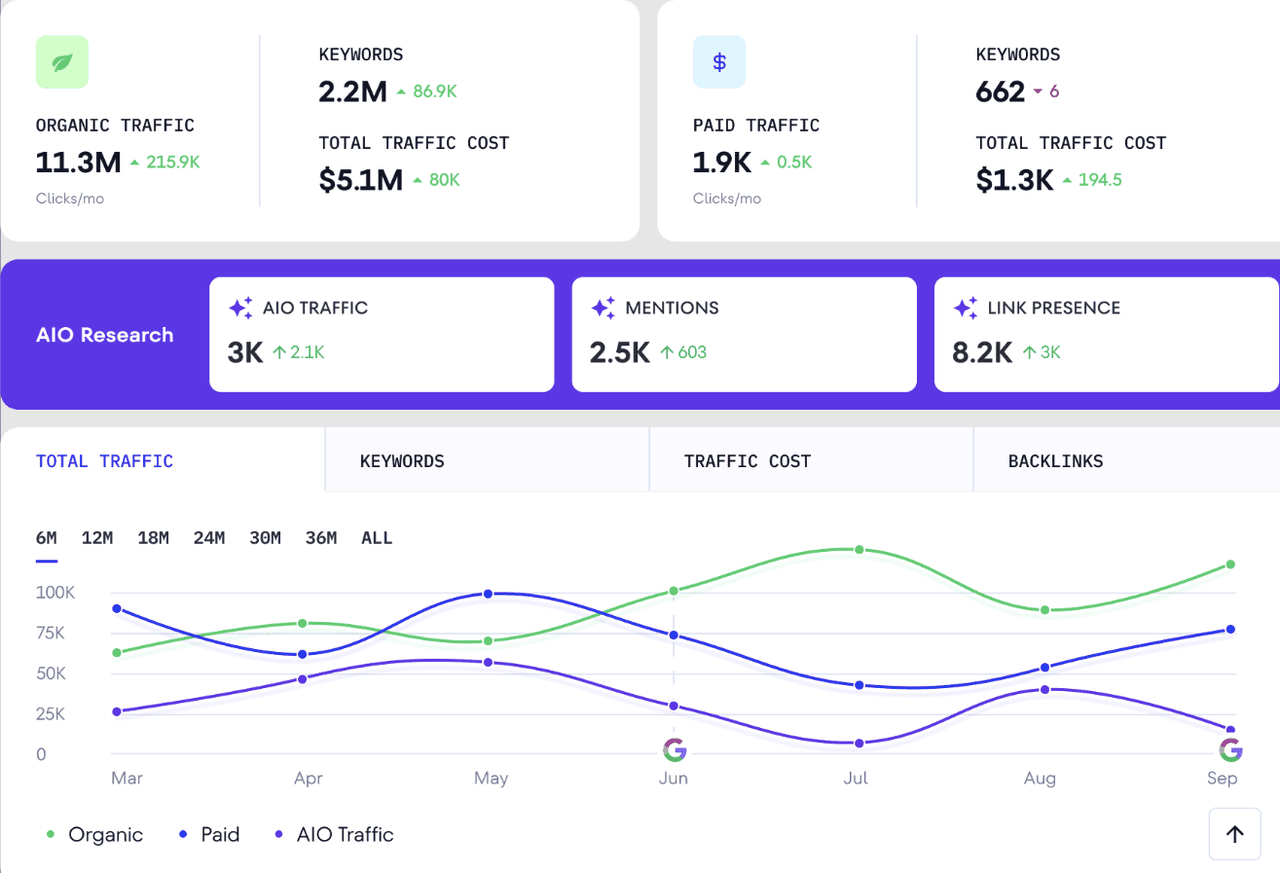
SE Ranking's website traffic checker shows the estimated number of clicks a website gets from Google's classic results and from AI-powered results as two figures, beside keyword counts, traffic cost and monthly paid traffic from PPC clicks.
The MCP server, added in 2026, pulls live organic and paid estimates for any domain into Claude, Cursor or a custom agent; GA4 and Search Console connect on the same plan.
Key features
- Organic and paid click estimates with an AI-answers versus classic split.
- Traffic by country, top pages and top keywords for any site.
- Traffic cost estimate: what the organic clicks would cost as search ads.
- MCP server, API and Google update markers on the history chart.
Pricing
The Core plan is listed at $103.20 a month on the traffic checker page, with a trial and no card required. API plans are priced separately.
Pros
- AI-answer clicks shown as their own number, the only estimator here that does.
- $103.20 entry against Ahrefs' $129 and Semrush's $139.
- 4.7 across 297 Capterra reviews.
Cons
- Rank tracking outages that show every keyword down for a couple of days.
- Price rises across the last 4 years, per reviewers who joined in 2020.
- Keyword coverage smaller than Ahrefs', per a 2023 reviewer.
A managing director at a small agency, switching from Semrush, wrote on Capterra on 6 November 2025:
"There's been a few occasions where rank tracking has had some kind of issue so everything looks down for a couple of days and then reverts to normal. Not ideal having to explain this to clients."
Marcus H., MD, marketing and advertising, Capterra, 6 November 2025
Why it’s ranked #6. It beats SpyFu on criterion 4 with a published AI-answer click split, which SpyFu lacks, and on GA4 and Search Console connectors. It trails GA4 on criterion 1 since $103.20 buys a model, and a tag counts real sessions for $0.
SpyFu
Best fit
A PPC manager who needs a competitor's monthly paid and organic Google clicks, with years of history, for under $40.
SpyFu counts estimated clicks from Google search results, split into SEO and paid, and its traffic guide says it tracks monthly clicks and keeps years of history so you can look back at how much traffic a site got in any past month. Daily snapshots appear once a site is added to My Sites. The free checker has no search limit; only daily tracking needs a subscription.
Key features
- Monthly organic and paid click estimates per site, plus the paid keywords behind them.
- Historical traffic data back 6 months on Basic, 10+ years on Professional.
- Traffic share against similar websites, with their top keywords.
- Country switcher for regional click estimates.
Pricing
Basic is $39 a month ($33 annual) with 6 months of history, 10,000-row results and 5,000 weekly tracked rankings; Professional is $79 ($58 annual) with 10+ years of history, unlimited exports, API access and 15,000 tracked rankings. Extra seats are $15 and $30. A 30-day money-back guarantee applies to both.
Pros
- Cheapest paid estimator on the list at $39.
- 10+ years of monthly history on Professional, the deepest here.
- Cancel by email, chat or phone with no form to fill.
Cons
- Google search clicks only; direct, social, referral and AI referrals sit outside the model.
- National reports, with no regional split for local clients.
- 6 months of history on Basic.
A G2 reviewer working as an SEO and digital strategist at a mid-market company wrote in March 2026 that "The dashboard enables one to easily and seemlessly examine paid data performance (keywords, audience, etc) across platforms and vitally competitors, which drives paid campaigns via channel, bidding strategy, content and align SEO efforts" (G2). A vice president of account services at a marketing firm put the geography con on Capterra in February 2019:
"What I like least is that it is not a geo specific if i would like so it is a national no regional report. for our local clients this provides no added value in keyword research."
Vice president of account services, marketing and advertising, Capterra, February 2019
Why it’s ranked #7. It beats Matomo on criterion 2 for competitor work: 10+ years of monthly click history on a $79 plan, where Matomo measures your own website only. It loses to SE Ranking on criterion 4 because SpyFu publishes no AI-answer split.
Matomo
Best fit
A team in a regulated industry that must keep raw visitor records on its own servers, or in the EU, with no sampling.
Matomo is the open-source analytics platform formerly called Piwik. The On-Premise Community edition is $0 forever with unlimited users and hits; Matomo Cloud hosts it in Frankfurt with 24 months of raw data retention, reports kept forever, 30 websites and 30 team members on the entry tier, per the price list.
Its September 2023 blog claimed more than 1 million websites, including NASA and the European Commission.
Key features
- Self-hosted or Frankfurt-hosted, ISO 27001:2022 certified, no sampling.
- Cookieless, consent-exempt configuration option for GDPR setups.
- Google Analytics importer and a Tag Manager with 30 containers on Cloud.
- Log analytics for server-log imports where JavaScript is blocked.
Pricing
On-Premise Community is $0. Cloud lists 29 a month before tax for 50,000 hits, with 2 months free on annual billing, a 21-day trial and no card required; the currency shown follows your billing region. Sites above 10 million hits a month are quoted.
Pros
- 100% raw data ownership, exportable at any time.
- Unlimited hits and users on the self-hosted edition.
- 24 months of raw records on Cloud against GA4's 14.
Cons
- Self-hosting needs servers, updates and a store that grows with events.
- Premium plugins cost 275 euros a month and up for On-Premise.
- Email support only on Cloud entry tiers.
A creative director at a cosmetics brand who left Google Analytics wrote on Capterra on 27 February 2025 that "It's easier to analyze than Google Analytics 4," adding "They also have heat maps and funnels in one" (Capterra).
Why it’s ranked #8. It beats Microsoft Clarity on criterion 1: raw records on your own server, 24 months of retention and no sampling, where Clarity keeps everything on Microsoft's side. It trails SpyFu for this category because it estimates nothing about rivals' keywords or visits.
Microsoft Clarity
Best fit
A product or CRO team that needs session recordings, heatmaps and an AI-visibility view at no cost, alongside GA4.
Microsoft Clarity is free forever with no traffic cap, and its homepage claims 2 million-plus websites and apps. Heatmaps show where users click, scroll and drop off; session recordings replay the visit. The 2026 AI visibility module tracks when your content is cited by AI experiences, which queries drive those citations and which AI bots crawl your site.
Key features
- Session recordings with rage-click and dead-click detection.
- Click, scroll and area heatmaps with AI summaries.
- AI visibility report: citations, driving queries and AI crawler activity.
- Mobile SDKs for Android, iOS, Flutter and React Native; MCP server.
Pricing
$0, no limits on traffic, per clarity.microsoft.com.
Pros
- $0 with no traffic cap, where Hotjar's free plan caps daily sessions.
- 2M+ websites, so browser and device edge cases are well covered.
- AI citation tracking added without a price change.
Cons
- All recordings and heatmap records sit with Microsoft.
- Recordings and heatmaps only; channel totals come from GA4 or a rival covered in the Google Analytics vs Hotjar comparison.
- Small websites wait weeks for enough recordings to show a pattern.
On Hacker News in October 2024, a commenter recommended it in an analytics thread: "it's free, offers session recordings, heatmaps, and detailed insights," adding that "unlike usage-based platforms, has no hidden costs" (Hacker News). The counterpoint, from a May 2025 thread on an open-source GA replacement: "I think Clarity also added more analytics features, but you're still sending all your data to Microsoft" (Hacker News).
Why it’s ranked #9. It beats Semrush on criterion 3, $0 with no traffic cap against $289 a month for one Traffic & Market seat, and adds recordings and heatmaps Semrush doesn't sell. It sits under Matomo because it can't self-host, keeps no raw export you control and reports no traffic totals by channel.
Semrush
Best fit
An agency that reports a client's organic, paid, referral & AI traffic against three named competitors every month, with the budget for a second Semrush invoice.
Semrush sells traffic analysis twice. The free website traffic checker returns estimated monthly traffic for any website, and the Traffic & Market Toolkit turns that into 8 channel dashboards, from AI traffic to display, each with device splits and a top pages report, per the knowledge base.
Adobe closed its $1.9 billion purchase on 28 April 2026, covered in the Adobe acquisition report. The method is public: clickstream bought from a panel every one or two days, cleaned by a machine-learning model, then modeled into daily and weekly figures, per the method article.
Deeper insights come from the AI traffic dashboard, which counts referrals from chatgpt.com, claude.ai, gemini.google.com & copilot.microsoft.com as their own channel.
Key features
- Traffic Analytics overview: visits, engagement, channel distribution for any website.
- Traffic Distribution dashboards for 8 channels including AI traffic.
- Market Overview ranking up to 100 competitors per seat, with market share by visits.
- Competitor Monitoring alerts for a new page, campaign or ad change on a rival's website.
Pricing
Traffic & Market Pro is $289 a month on monthly and on annual billing, for 1 seat and 3,000 requests a day; extra users are quote-only, and the $0 tier shows sample websites only. The SEO plan starts at $139 a month, Starter at $199, Pro+ at $299, Advanced at $549, and the traffic toolkit bills separately from all four.
Vendr records a median contract of $12,239 a year across 60 purchases, from $4,825 to $57,026; the tier walk sits in the Semrush pricing teardown.
Pros
- 8-channel split including AI referrals, the widest on this list.
- Daily and weekly competitor figures, where most modeled tools stop at monthly.
- 7-day trial on the toolkit, and 50 tracked AI prompts bundled into the $199 Starter plan.
Cons
- $289 a month for a single seat; extra users are quote-only on this toolkit.
- Traffic & Market bills separately from the SEO plan, so two invoices.
- Refunds are limited to 12-month-plus subscriptions under Semrush's policy.
A SaaS specialist at an IT services firm said in a Capterra review on 10 December 2024 that "organic traffic estimates are not very accurate at times" (Capterra). A designer with six to twelve months on the tool wrote in May 2026:
"It saves immense time by consolidating backlink analysis, site audits, and traffic insights into one centralized platform, making it well worth the investment."
Palash R., graphic design, Capterra, 26 May 2026
Why it’s ranked #10. It beats Plausible on criterion 5, 100 competitors per seat and 3,000 requests a day against a count of one website. It sits at #10 on criterion 3: the traffic data lives in a separate Traffic & Market toolkit at $289 a month for one seat, extra seats quote-only, the highest entry price on this page and 2.1x the $139 SEO plan, which bills separately.
Plausible
Best fit
A small website or agency that wants one screen of numbers, no cookie banner and EU hosting, for $9.
Plausible is a 10-person, self-funded company running since 2018, with 20,000 paying subscribers and 313 billion tracked views on its homepage. The script is 54 times smaller than Google Analytics, it sets no cookies, and the dashboard refreshes every 30 seconds. It labels visits from ChatGPT, Perplexity and Claude as AI traffic and connects to Search Console for query figures.
Key features
- One-screen dashboard covering traffic sources, top content, countries, devices, goals and the keywords Search Console reports.
- Automatic scroll-depth tracking and AI referral labeling.
- Google Analytics import and Search Console connection.
- Open-source code, self-hostable, EU-only processing.
Pricing
Starter is $9 a month for one website and 10,000 monthly views with 3 years of retention; Growth is $14 for 3 websites and 3 team members; Business is $19 for 10 websites, 5 years of retention, a Stats API at 600 requests an hour, funnels and ecommerce revenue attribution. Prices rise by traffic band to custom past 10 million views; a 30-day trial needs no card.
Pros
- $9 entry, the cheapest paid first-party tag on the list.
- No cookie banner required, per the vendor's privacy page.
- 3 to 5 years of retention against GA4's 14 months.
Cons
- Dashboard locks when a website exceeds its traffic tier for 2 months running.
- Recordings and heatmaps are absent; Clarity supplies them at $0.
- Capterra profile holds 8 reviews, a thin record.
A building-materials CEO described the tier lock on Capterra on 1 February 2024:
"For more then 3 months i have my dashboard locked , because plausible.Io measured more the 10 000 page views per months for more then 2 months in the raw"
Nicu C., CEO, building materials, Capterra, 1 February 2024
Why it’s ranked #11. It beats every $0 tag on retention, 3 years against GA4's 14 months, and beats Clarity on data location with EU-only processing. It ranks last because $9 buys a count of your own website, where Semrush's $289 seat covers 100 rivals, and it lacks the recordings Clarity gives away.
Where the traffic data comes from
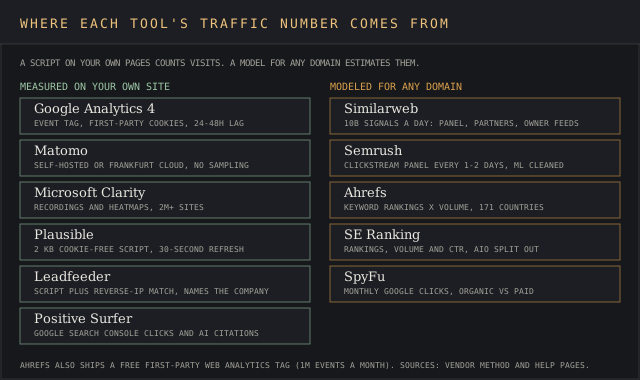
Six tools count and five tools model, and the modelers say so, which takes the guesswork out of choosing. GA4, Matomo, Clarity, Plausible and Ahrefs Web Analytics put JavaScript on your website pages and log each session as it happens, so their website traffic data is complete for everyone who didn't block the script or decline consent, and that traffic data is yours to export.
Positive Surfer reads the same first-party truth through Search Console. Leadfeeder runs a first-party script too, then adds a reverse-IP match that names the company behind each visit, so it counts like a tag and answers a question the tags leave open.
The estimators work from two kinds of input. Similarweb and Semrush buy clickstream from panels and partners, then model the gaps. Ahrefs, SE Ranking and SpyFu start from ranking positions, multiply by search volume and apply estimated click through rates per position, which is why their figures cover search traffic and nothing else.
A rankings model can't see a newsletter visit, and a panel under-samples a niche B2B site with 4,000 visits a month. Expect the two families to disagree on the same domain, and read the trend line before the total.
The clickstream data providers ranking covers the panel vendors, and the competitive intelligence tools for SEO ranking covers the SEO suites.
How much traffic a website gets: reading the estimates
Treat any competitor number as a range, and confirm the direction with a second source. How much traffic a rival gets is a modeled answer, and two models of the same website traffic will differ. For example, if Semrush says 180,000 visits and Ahrefs says 95,000 organic clicks, both can be right: Semrush counts every channel and Ahrefs counts Google search alone.
Compare like with like, and read the trend line before asking how much traffic the total represents.
Three checks make an estimate usable. First, run your own site through the same tool and compare it to your own traffic numbers; the ratio between estimate and real count is the correction factor for similar websites in your niche. Second, check the top countries breakdown, because a global figure can hide that 60% of visits sit in one market. Third, read the top keywords and top pages, since traffic on three pages behaves differently from traffic spread across 300.
For your own website the question flips from how much traffic to how many visitors, people versus sessions, and which pages convert. GA4 counts users and sessions; Plausible counts unique visitors per site from a daily-rotating hash; Matomo counts visits and, with a user ID, returning users. Each defines new visitors differently, so pick one definition before you set a target.
The identification rate one Capterra reviewer measured on Leadfeeder in 2021, against the up-to-45% figure on the vendor's homepage. The help center publishes no rate at all.
Traffic metrics worth tracking and what each one measures
Six key metrics carry most decisions, and a measured count beats gut feel on every one. Sessions count trips to the website; unique visitors count people, as well as the tool can tell; views count screens; bounce rate is the share of single-view sessions.
Average time on a page is the gap between one view and the next, so the last view of a visit records zero. Organic traffic value prices the organic clicks at what the same keywords would cost as paid traffic through search ads, so it measures an advertiser's cost, and other pages with cheap keywords look small on it.
Channel split is the metric that changed in 2025, and the key insights sit in it: it's where budget moves between channels and where revenue per channel shows up. A traffic metrics report that shows organic search flat while AI referrals grow from 0.4% to 3% of visits tells a different story from one that lumps them, and it shows which traffic sources send the most visitors.
The site's AI traffic report works through what chatbot referrals amount to.
Organic traffic, paid traffic and AI answers in the same report
Organic traffic is the visits that arrive from non-ad search results, and how much traffic a domain earns there is the number most SEO reports lead with; paid traffic is the visits from paid ads at the top of the results page. Every estimator on this list separates the two, since the inputs differ: organic comes from keyword rankings, paid traffic from the search ads a site is seen running and the keywords behind them.
AI Overviews sit between them. SE Ranking reports the AI clicks as a separate estimate; Semrush's Traffic Distribution reports referrals from chatgpt.com and its peers as an AI traffic channel; Surfer's tracker reports the citation where the others report the click.
Pull the AI channel out of organic search before comparing two months. A site whose organic line looks flat can be losing classic clicks and gaining AI referrals at the same time, and only a split report shows both.
Pricing across the category: the spread and the traps
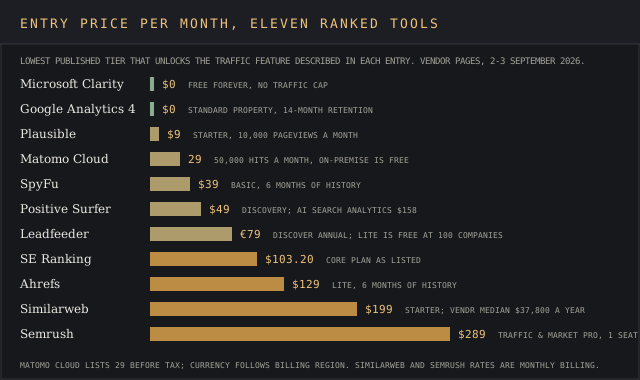
The published entry prices run from $0 to $289 a month, and the median contract for the priciest vendor runs 13 times its own Starter rate on an annual basis. Similarweb's $199 Starter becomes a $37,800 median across 157 Vendr purchases; Semrush's $139 SEO plan becomes a $12,239 median across 60.
Leadfeeder's ladder is the exception on transparency: 56 published price points from €79 to €2,089 a month, with only the Enterprise tier quoted, and unlimited users at every step.
Similarweb's median annual contract across 157 Vendr purchases, against a $199 Starter. Buyers saved 12.27% on average against the first quote.
Common buying mistakes with website traffic checkers
Buying an estimator to measure your own website is the first. If you own the domain, a tag counts every session for $0; a model of your web traffic costs $103.20 to $289 a month and is wrong by an unknown margin. Buy the estimator for other websites and keep GA4, Matomo or Plausible for your own website data.
Ignoring the cap under the price is the second. For example, a $289 seat with 3,000 requests a day starves an agency that automates lookups, and a $9 plan at 10,000 views locks a shop the month a campaign lands.
Expecting a visitor-ID tool to name people is the third. Leadfeeder names the company and stops there by design, so a team that needs a person behind the visit budgets for a contact database on top of the €79 feed.
Annual plans on Leadfeeder renew for 12 months unless cancelled 30 days before the date, and Semrush refunds are limited to 12-month-plus subscriptions. Put both dates in a calendar the day you sign.
Frequently asked questions
Is there a way to monitor website traffic and keywords for free?
Yes. GA4 counts sessions and traffic sources at $0; Microsoft Clarity adds recordings and heatmaps with no traffic cap; Ahrefs Web Analytics counts up to 1 million events a month for a verified website; Leadfeeder Lite names 100 visiting companies a month. For a domain you don't own, the free website traffic checker at Semrush, Similarweb, Ahrefs, SE Ranking or SpyFu shows a headline estimate.
How do you analyze website traffic from a competitor's domain?
Enter the domain into a traffic checker, then analyze traffic data in four steps: total visits and the 12-month trend, the channel split, the top countries, and the top keywords. Confirm the trend with a second tool from the same family before it goes in a deck.
Does a website traffic checker cover traffic from AI chatbots?
Increasingly. Semrush counts referrals from chatgpt.com, claude.ai, gemini.google.com and copilot.microsoft.com as a channel; Plausible and Ahrefs Web Analytics label the same referrers on your own website; SE Ranking estimates clicks from Google's AI answers; Positive Surfer reports citations across 5 engines, even when no click follows, so you can see how your content performs in AI answers.
Which tool on this list identifies the companies visiting my site?
Leadfeeder. Its script matches each visit to a company through a reverse-IP database and lists pages viewed, time per page and referral source per company, free for the last 100 identified companies a month on Lite and from 79 euros a month on Discover. No tool on this page names the person.
How much does Semrush charge for competitor traffic data?
$289 a month for the Traffic and Market Pro toolkit, one seat, 3,000 requests a day, on monthly or annual billing. That toolkit bills separately from the SEO plans, which start at $139 a month, and extra seats are priced by quote.
Bottom line
A content team that lives in Search Console and needs to know which AI engines cite its pages buys Positive Surfer, at $158 for 100 daily prompts or $182 for the Pro bundle. A research or investment analyst who needs every channel across 100 countries budgets for Similarweb and walks in holding the $37,800 Vendr median.
A B2B team that wants the companies behind its own traffic named installs Leadfeeder, free to 100 companies a month and €79 on Discover. An SEO who needs search estimates for rivals and a $0 tag for their own website takes Ahrefs Lite at $129 with Web Analytics, and an agency reporting competitor traffic by channel pays Semrush $289 for the widest split, or SE Ranking $103.20 if AI Overviews clicks and a lower invoice matter more than 8 channels.
Everyone else installs a tag and reads their own traffic data. GA4 at $0 for the default, Matomo for records on your own server, Clarity for recordings at no cost, Plausible at $9 for a dashboard that fits on one screen. The estimators tell you about other websites; only a tag tells you the truth about yours.