NeuronWriter review: the SERP-driven content editor that undercuts Surfer SEO on price
 By Jan Suski, six years working in digital. How the scoring works.
·
Best for
A freelance SEO writer or small agency already sold on the SERP-analysis-plus-content-score workflow who wants Surfer-style output without Surfer-style annual spend.
Not for
A team that wants a fully automated draft-to-publish pipeline with no manual editing; the plagiarism checker isn't exposed via API, and G2's own cons summary flags the AI-generated suggestions as generic.
What it costs
$23 to $117 a month across five tiers, $19 to $97 on annual billing. Gold at $57 a month annual is the floor for WordPress, Google Search Console and API access.
- Bronze
- $23/mo, $19/mo annual; 2 projects, 15,000 AI credits
- Silver
- $45/mo, $37/mo annual; 5 projects, 30,000 AI credits
- Gold (most popular)
- $69/mo, $57/mo annual; unlocks WordPress, GSC, Shopify and the API
- Platinum
- $93/mo, $77/mo annual; 25 projects, 60,000 AI credits
- Diamond
- $117/mo, $97/mo annual; 50 projects, 75,000 AI credits
- Free trial
- 7 days under Gold-plan terms, no credit card
- Refund window
- 30 days, first plan purchased only
- Content writer analyses
- 25/month on Bronze, up to 150/month on Diamond
- Plagiarism checks
- 0/month on Bronze and Silver, 75 to 150 from Gold up
- Entities language support
- 19 languages
- AI-monitored questions
- 5/month on Bronze, up to 20/month on Diamond
- Content Designer
- One-click articles, Gold plan and up only
- WordPress integration
- Gold plan and up only
- Google Search Console
- Gold plan and up only
- Shopify integration
- Gold plan and up only
- Neuron API access
- Gold plan and up only
- Own OpenAI key
- Gold plan and up only
- Team content sharing
- Read-only on Bronze and Silver; unlimited create/edit/read from Gold up
- Zapier
- 1,000+ connected apps, every plan
- Boost.space
- 2,186 connected apps, every plan
- AI engines monitored
- 4: Google AI Overviews, AI Mode, ChatGPT, Perplexity
Positive Surfer
Not forA buyer whose deciding factor is monthly cost, which is the reason the Capterra reviewer who tested both called NeuronWriter "a no brainer."
Frase
Not forA publisher past ten articles a month on a budget, since Frase's hard article cap bites where NeuronWriter meters AI credits instead.
Pairs well with NeuronWriter
NeuronWriter AI is a content optimization tool built around SERP analysis, natural language processing term recommendations and AI writing, sold by the Polish company Conti sp. z o.o. under the CONTADU umbrella. The vendor's own site puts it at 300,000 to 350,000 users, a number that appears in two different places on the same page without reconciliation, so treat it as an order-of-magnitude estimate.
This review covers the content editor, the pricing tiers, the new AI Visibility module, the WordPress and Google Search Console integrations, and what buyers say on G2 and Capterra after paying for it.
It's aimed at freelance SEO writers, small agencies and in-house content teams comparing NeuronWriter AI against Surfer SEO, since that's the comparison NeuronWriter's own marketing leans on hardest. This site's digital marketing intelligence tools ranking covers the wider category NeuronWriter AI competes in.
Among AI writing tools built for search engines, NeuronWriter AI sits closer to a dedicated SEO tool than a general-purpose writer. NeuronWriter AI's pitch is straightforward: enter a target keyword, get a content score built from what's already ranking on search engines, write against that score inside the editor.
The Gold plan, priced at $69 a month or $57 a month billed annually, is the one the vendor's own pricing page marks "Most popular," and it's also the first tier that unlocks WordPress publishing, Google Search Console data and API access. Buy the Bronze plan or Silver plan and none of those three things exist in your account.
The rest of this review walks through what that $69 buys, what the free trial runs on, and where the twelve-plus user reviews sourced from G2 and Capterra agree and disagree with NeuronWriter AI's marketing copy, plus how it stacks up against other AI writing tools built for organic traffic.
↑ FACT SHEETWhat NeuronWriter AI does
The core of NeuronWriter AI is the content editor: submit a target keyword, and it pulls the top-ranking pages for that query on major search engines and analyzes their structure, word count and language. Out of that analysis comes a list of natural language processing terms, phrases the top-ranking competitors use that NeuronWriter's own site calls key phrases to fully cover your topic.
A companion Entities feature pulls out people, places and events from the same competitor set, supported across 19 languages according to the vendor's content-writer feature page. Keyword research happens inside the same flow: submit one seed keyword and the SERP pull doubles as competitor and keyword research in one step.
The content score updates as you type, from 1 to 100, color-coded against how many of the suggested terms you've used and how close your structure sits to the competition. An AI writer sits inside the same content editor for drafting sections, alongside a plagiarism checker that scans your draft against other sources before you publish.
The user interface groups all of this, SERP data, AI writing prompts and the plagiarism checker, inside one screen, which is part of why NeuronWriter AI gets pitched as a single SEO tool.
None of this is unique to NeuronWriter AI. What differentiates the pitch is price: the entry Bronze plan costs $23 a month, well under Surfer SEO's cheapest published tier, while still running the same SERP-analysis-to-content-score loop that most AI writing tools in this category use to justify a claim on organic traffic.
If that holds up depends on which plan you buy, since the feature list changes sharply between the Silver plan and the Gold plan, and content creation at scale, landing pages included, only becomes practical once WordPress and the API unlock.
Content ideas, outlines and multi-project management
Past the core content editor, NeuronWriter's Content Ideas feature suggests future articles and content ideas built from the same competitor data pulled during SERP analysis, aimed at content marketers planning a content calendar.
The content outline step happens before the writing workflow starts: pick headings, let the tool suggest keyword usage across each section, then move into the editor with a structure already matched against top ranking pages and top ranking articles for the target keyword.
The same competitor pull also drives meta description suggestions and title options, plus internal link ideas that generate internal link ideas from existing pages already indexed on a connected WordPress or Shopify content management site, useful for anyone auditing existing content.
On page SEO checks flag content length against the median of ranking pages, and the plagiarism checker doubles as a check against external links your own draft may unintentionally echo.
Custom AI templates, available from the Gold plan up, let content creators reuse a content structure across a series without rebuilding natural language processing terms each time, one of the advanced features that separates a semantic SEO workflow from a traditional content creation process built around a blank document; that content creation process is the whole pitch of a SERP-driven SEO optimization tool over a plain document editor.
Multiple projects, gated by tier from 2 on the Bronze plan to 50 on the Diamond plan, keep each client or site's competitor data and content plan separate, with unlimited team members able to view shared work once an account sits on the Gold plan or above; the Bronze and Silver ceiling stays read-only regardless of team size.
NeuronWriter AI markets itself as an SEO optimization tool first and an AI writer second, and the key features line up with that order: SERP analysis, natural language processing terms and a content score come before the AI writing capabilities. Among the broader field of AI tools competing for the same SEO friendly content budget, that ordering is the tell for which category a buyer is paying for.
An optimized page, in NeuronWriter AI's own framing, is one where the writing process starts from the content score, which is a different workflow than most general AI SEO tool products that bolt a scorer onto a chat interface after the fact.
↑ FACT SHEETPricing and the limit that binds per tier
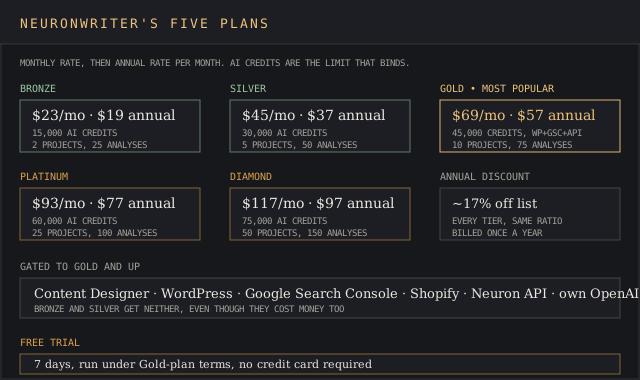
Five plans exist, each defined mostly by AI credits and project count, with one sharp exception: the Gold plan is the floor for WordPress, Google Search Console, Shopify, the Neuron API and bringing your own OpenAI key. The Bronze plan at $23 a month gets 2 projects, 25 content writer analyses and 15,000 AI credits.
The Platinum plan sits above Gold at $93 a month, or $77 annual, aimed at a business managing several domains at once. The Diamond plan at $117 a month gets 50 projects, 150 analyses and 75,000 credits, plus 150 plagiarism checks a month against zero on the Bronze plan.
Annual billing knocks roughly 17% off every tier, consistently: Bronze's $19-a-month annual rate against its $23 monthly rate, and Diamond's $97 against $117, land at the same ratio. That consistency is unusual; a lot of SaaS vendors weight the annual discount toward higher tiers to push upsells. NeuronWriter doesn't do that here.

The trial runs for 7 days with no credit card, but the vendor's own FAQ specifies it runs "under the Gold plan terms," meaning a trial account sees the WordPress and GSC integrations a Bronze or Silver buyer never will. A G2 reviewer, a web consultant writing in August 2023, found this out the hard way after purchasing:
Depending on the plan that you sign up for, some of the options may not be available in your account... GSE integration in particular was something I wanted and will need to upgrade to get it.
Refunds exist too, capped at 30 days and only on the first plan purchased on the account, per the vendor's own pricing FAQ.
The content editor and content score in practice
Reviewers who like NeuronWriter tend to describe the same workflow: type a keyword, get a competitor breakdown, write against a live score. A G2 reviewer, a director writing in December 2025, wrote:
As I type, I am able to see my page's score in real time... The tool helps me analyze the competitors' content and keywords, making it easier for me to create content that will outrank them.
The Capterra review pool tells a similar story with more specifics. A verified reviewer, an owner in retail writing in February 2026, called the SERP analysis and content scoring "the standout features," adding that they push articles into "the 80+ score range before publishing" as a routine step.
A marketing specialist on Capterra, writing in June 2026 after a year and a half on the platform, said research tasks that used to eat up an hour now take ten minutes.
Not every account finds the editor intuitive on day one. That same June 2026 reviewer flagged the other side of it directly:
The interface feels a bit dated and takes some getting used to... It also slows down noticeably on longer documents, which can break my flow when I'm deep into a piece.
A one-star G2 review from a health care manager in January 2024 went further, arguing the SEO recommendations aren't "always be completely accurate or effective potentially leading to problems," and calling out a steep learning curve on top of it.
What users complain about most
Two complaints recur across the review pool independent of star rating: the learning curve, and AI-generated draft quality. A business consultant reviewing on G2 in August 2025 liked the competitor breakdown but flagged that the landing page generator "doesn't really generate a landing page, it reads more like a blog," alongside "a learning curve."
On draft quality, a job training specialist gave NeuronWriter 1.5 stars on G2 in January 2024, writing that "the AI generated content not always reaching the level of quality as other tools," and adding that heavy reliance on user prompts "can restrict creativity and originality."
A retail owner on Capterra, more measured, put a specific number on the gap in automation: the plagiarism checker "isn't exposed via API," so anyone automating large parts of a content workflow has to trigger checks manually inside the interface instead.
G2's own pros-and-cons summary for the product, aggregated from its full review set, backs this up in its cons list: users find the AI-generated suggestions "generic, often requiring additional manual editing for better results."
What users praise most
Set against those complaints, the volume of five-star reviews on both G2 (4.4/5 across 31 reviews) and Capterra (4.9/5 across 17 reviews) leans hard toward the internal linking suggestions, the plagiarism checker and the price relative to Surfer SEO specifically.
A CEO on Capterra writing in March 2025 described a workload of up to 100 SEO-optimized pieces a month, averaging 65, and said switching to NeuronWriter after a year on a competitor's editor produced content that "ranks even higher on Google" with clients "more satisfied."
Speed shows up as a recurring theme too. A founder on G2, writing in December 2025, wrote:
Really clean interface and easy to get moving fast... I like that it nudges structure + coverage…
A web designer on Capterra reported reaching the top of page 2 in under a week using the tool's recommendations, a specific enough claim to weigh against the vaguer "boosts rankings" language on NeuronWriter's own marketing pages.
↑ FACT SHEETAI Visibility: the newest module
NeuronWriter added an AI Visibility module, tracking how often a brand gets mentioned across Google AI Overviews, AI Mode, ChatGPT and Perplexity, four engines total per the vendor's own feature page.
The module scores each tracked query from 0 to 100 for AI visibility, tags sentiment as positive, neutral or negative, and surfaces what NeuronWriter calls "Earn mention" and "Optimize" opportunities, with 68 or more opportunities typically surfaced per account according to the same page.
This sits on top of the AI-monitored-questions cap baked into every plan tier: 5 questions on Bronze, scaling to 20 on Diamond, with an add-on available to raise the question count and add more monitored models beyond the standard set.
NeuronWriter bundles this module into every tier, which is the differentiator, not the underlying idea; Frase and Scalenut both ship comparable AI-visibility tracking too, as the comparison section below shows.
Five monitored questions on the entry plan matters only if the vendor supports tracking more. The feature exists; for a freelancer tracking one keyword it works, for an agency tracking all client questions it needs an upgrade.
Fitting NeuronWriter AI into a content strategy
A single-page NeuronWriter review can make the workflow sound simpler than it plays out across a real content strategy. Search intent still has to be judged by a human before the SERP pull starts, since the tool optimizes content against whatever pages already rank, right or wrong for the searcher's actual intent.
Search engine optimization built entirely from a content score risks matching search engine rankings that are themselves poorly matched to the query, which is a known limit of any SERP-driven SEO content optimization tool, not a NeuronWriter-specific flaw.
Inside that constraint, the workflow to create content or to optimize content that already exists looks the same: pull the content outline, apply the AI writing templates available from Gold up (Standard AI writing templates ship on every plan, Custom ones from Gold), and let custom AI templates carry a consistent SEO strategy across a batch of AI generated content.
The custom AI templates and AI generated content drafts both draw on the same NLP term list, so neither drifts far from what the SERP pull already found. AI content writing tools in this category generally treat the content outline and the meta description as the two fastest wins; NeuronWriter AI is no exception, and its word count guidance follows the same competitor median it uses for content length.
For landing pages specifically, the writing process leans on the same internal link and internal linking suggestions used to optimize content on blog posts, which is why several reviewers flagged the landing page generator as reading more like a blog post than a conversion page; a second internal link pass usually fixes the gap.
SEO optimized content built this way still needs a human pass for tone; the tool's own content creators on Gold and up can split that work across a team once the AI writer output lands in the shared queue, one of the key features Gold buyers cite most.
SEO friendly content and AI tools built around it are only as good as the SERP set they pull from, and that set updates on a schedule the vendor doesn't publish. Shopify content management works the same way as the WordPress side, syncing product and blog content once Shopify content management is connected on Gold and up.
↑ FACT SHEETIntegrations: WordPress, Google Search Console, Zapier and the API
Five integrations exist: Boost.space (2,186 connected apps per NeuronWriter's own count), WordPress, Google Search Console, a Chrome extension for writing inside Google Docs, WordPress and Shopify directly, and Zapier (1,000+ connected apps), per the vendor's integrations page. A sixth, the Neuron API, lets Gold-and-up accounts add queries in bulk and pull share URLs programmatically, authenticated with an API key against the endpoint documented at app.neuronwriter.com.
The Google Search Console link does more than display rankings; it feeds the Auto-insert Internal Links feature, which the vendor's content-writer page describes as using GSC data plus AI to pick anchor text and target pages, then insert links automatically based on the length of the surrounding text.
A G2 reviewer, a marketing consultant writing in August 2025, praised the WordPress side of the same equation directly:
The upload from URL makes it easy to rewrite or update blog posts. The ease of implementation with WordPress makes sending a post simple.
All of it, WordPress, GSC, Shopify and the API alike, sits behind the Gold plan; a Bronze or Silver buyer gets Zapier and Boost.space only.
NeuronWriter vs the alternatives
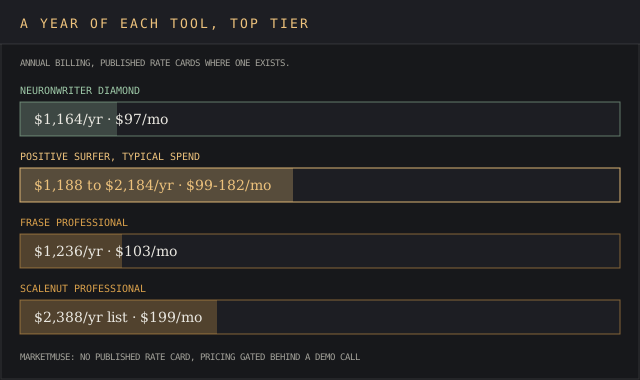
Positive Surfer is the comparison NeuronWriter invites directly; several of its own reviewers switched from Surfer specifically. Surfer's typical spend for serious users on annual billing runs $99 to $182 a month once real publishing volume and credit resets are accounted for, against NeuronWriter's top Diamond tier at $97 a month annual, which unlocks 50 projects against Surfer's smaller per-seat allotments.
A G2 reviewer, a director writing in November 2024, called NeuronWriter "a good alternative to Surfer SEO, more affordable with similar features," while a Capterra reviewer who tested both alongside Frase, Contentpace and MarketMuse in July 2023 wrote plainly:
NeuronWriter and Surfer were the standouts. After taking price into account I decided that NeuronWriter was just a no brainer.
A third Capterra review titled the tool outright "better than Surfer SEO." Where Surfer wins is credit rollover discipline and a larger set of third-party plugins built around it; where NeuronWriter wins is the AI Visibility module bundled into every tier instead of sold as an add-on.
Frase starts cheaper on paper, at $39 a month billed annually for its Starter tier per Frase's own pricing page, but that plan caps at 10 articles and 50 audit pages a month, a volume ceiling NeuronWriter's Bronze tier doesn't impose in the same way since NeuronWriter meters by AI credits.
Frase's Professional tier, the one most in-house teams land on, runs $103 a month annual, above NeuronWriter's Gold at $57. Frase includes AI Visibility monitoring across ChatGPT and Google AI on every paid tier and adds Perplexity at Professional, matching NeuronWriter's four-engine coverage roughly plan-for-plan once you're past the entry tier on both.
Scalenut lists Starter, Plus and Professional at $59, $89 and $199 a month respectively before any promotional discount, per Scalenut's own pricing page, putting its top tier well above NeuronWriter's Diamond plan. Scalenut's AI visibility tracking refreshes weekly across ChatGPT and Google AI Overviews on every plan, with Perplexity arriving at Professional, the same three-then-four engine pattern Frase follows.
Scalenut wins on bundled extras like a backlinks marketplace and social monitoring; NeuronWriter AI wins on the raw per-credit cost of running SERP analyses at volume. All four tools sell the same underlying promise, more organic traffic from content built for how search engines and AI models rank pages today, and all four gate their heaviest AI writing and content creation features behind a mid-tier plan. Marketing shows the entry price.
MarketMuse publishes no rate card at all; every tier from Free through Strategy routes to "Book a demo" with no dollar figure attached anywhere on its pricing page. What is public is the quota structure: Free caps at 10 queries a month with no content briefs, Optimize adds 100 tracked topics and 5 briefs, Research scales to 1,000 topics and 10 briefs, and Strategy tops out at 10,000 topics and 20 briefs for agencies managing many sites at once.
Buyers who want a fixed number before a sales call has to happen will find NeuronWriter's published rate card the more direct route; buyers who want MarketMuse's proprietary topic-modeling approach will have to negotiate to find out what it costs them.
Frequently asked questions
Is NeuronWriter worth it?
For a freelancer or small agency running fewer than 25 pieces of content a month, the Bronze or Silver plan gets the same SERP analysis and content-score loop as Surfer SEO at roughly a third of the annual spend cited by reviewers who made the switch. It stops being worth it the moment WordPress, Google Search Console or the API matter, since those sit behind Gold regardless of how light your content volume is.
How much does NeuronWriter cost?
$23 to $117 a month across five tiers, or $19 to $97 a month on annual billing, a consistent 17% discount at every level. The AI Monitoring Addon that expands AI Visibility beyond the standard question cap starts at $0 a month and scales with the number of questions and models tracked, per the vendor's own pricing page.
What is the best AI to use for writers?
There's no single answer; it depends on the job: SEO content creation, general drafting, or AI-search monitoring. NeuronWriter AI, Frase and Scalenut all combine an AI writer with SERP-based optimization at broadly similar price points, while a tool like ChatGPT or Claude without a SERP layer is faster for first drafts but won't tell a writer what a target keyword's top-ranking pages on search engine results pages already cover.
None of the three replaces general content management tools for scheduling and approval workflows; NeuronWriter AI's own content plan view is closer to a lightweight calendar than a full production system.
How accurate is a neural writer?
NeuronWriter's own content score runs from 1 to 100, built from real-time SERP data on the competitors it pulls from search engines, but multiple reviewers on G2 flagged that the SEO recommendations "is not always be completely accurate or effective," and G2's cons summary separately notes the AI-generated suggestions read as generic.
Treat the score as a structural checklist against competitors, not a guarantee that following it produces a ranking result. Among the key features that make up the content editor, the score is the one most reviewers on both G2 and Capterra cite as the reason they kept paying for the SEO tool after the trial ended.
Verdict
This NeuronWriter review comes down to one trade: NeuronWriter suits a freelance SEO writer or small agency already sold on the SERP-analysis-plus-content-score workflow who wants Surfer-style output without Surfer-style annual spend.
Anyone reading a NeuronWriter review to decide between search engine optimization tools that combine SERP data with search engine optimization guidance and a plain AI writer should weigh the Gold-plan floor against how much of that combined workflow they'll use.
The Gold plan at $57 a month annual is the one to buy, since it's the floor for WordPress, Google Search Console and the API, and multiple reviewers who switched from Surfer specifically confirm the workflow holds up at that price.
It isn't for a team that wants a fully automated draft-to-publish pipeline with no manual editing; the plagiarism checker still isn't exposed via API for programmatic workflows, and G2's own cons summary for the product flags AI-generated suggestions as generic and needing manual editing. It's also a weak fit for anyone who needs WordPress or GSC access on a tight budget, since both sit locked behind Gold regardless of how few credits that buyer needs.
It might suit an enterprise content team cautiously, with the caveat that the interface itself draws repeated criticism for feeling dated and slowing down on longer documents, and the AI-monitored-question caps on lower tiers make the AI Visibility module more of a taste test than a full tracking system until you're paying for the Platinum plan or the Diamond plan.