Statista review: what $2,388 a year buys, and the renewal clause buyers miss
 By Jan Suski. I go deep on every review, checking every number against its source and digging up details other coverage misses, a habit from six years of SEO and link building for tech companies. Bylines at Surfer, Brand24, and Senuto. How the scoring works.
· Prefer this source on Google
Best for
Analysts, marketers and founders who need a citable chart on a market they don't cover daily, and who can live with one licensed user at $199 a month billed annually.
Not for
Anyone who needs one industry covered in depth, wants month-to-month billing, or plans to forget the renewal date.
What it costs
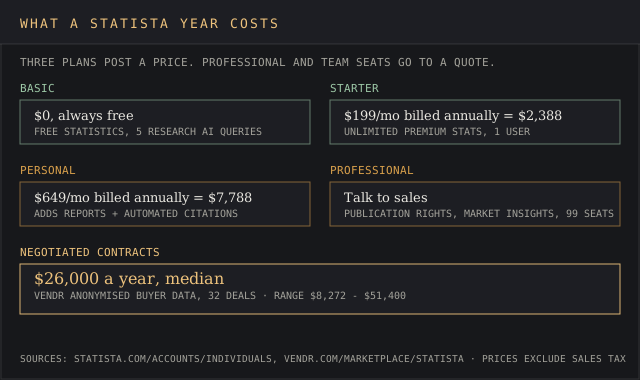
$0 for Basic, $2,388 a year for Starter, $7,788 a year for Personal, and a sales quote for Professional; Vendr's anonymised buyer data puts the median negotiated contract at $26,000 a year.
- Basic
- $0, free statistics only, 5 Research AI queries
- Starter
- $199 a month billed annually, unlimited premium statistics
- Personal
- $649 a month billed annually, adds reports and automated citations
- Professional
- Quote only, adds publication rights and Market Insights, up to 99 seats
- Vendr median
- $26,000 a year across 32 deals, $8,272 to $51,400
- Statistics
- Over 1 million across 80,000+ topics
- Industries
- 170
- Sources
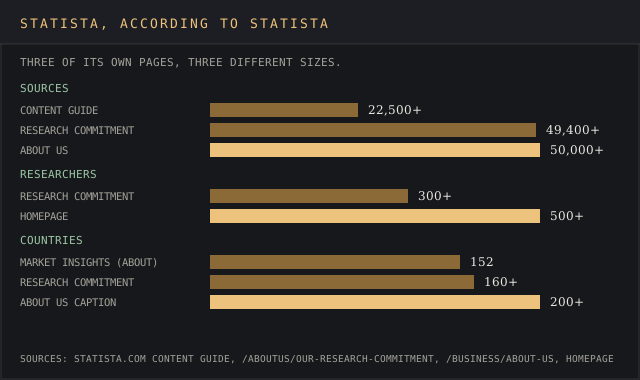
- 22,500, 49,400 or 50,000+, depending on which Statista page you read
- Researchers
- 300+ or 500+, again depending on the page
- Premium share
- About 93% of statistics sit behind the paywall
- Global Consumer Survey
- Over 400,000 consumers
- Term
- 12-month annual contract on every paid plan
- Renewal
- Automatic, at the regular list price
- Notice
- Six weeks before the end date in one Statista reply, three months in another
- Cancellation route
- A prefilled email from Account Details
- Use
- Commercial use only, per the plans page footnote
- G2
- 4.4 out of 5 from 30 reviews
- Capterra
- 3.0 out of 5 from 6 reviews
- Trustpilot
- 1.8 TrustScore from 302 reviews
- Company
- Founded in Germany in 2007, almost 1,200 employees, 7 locations
GlobalData
Not forA buyer who wants a posted price before the first sales call, since GlobalData publishes none and Vendr's median sits at $68,500 a year, over twice Statista's $26,000.
Similarweb
Not forA buyer who needs offline market sizes, industry statistics or consumer survey data, since Similarweb measures internet behaviour only.
Pairs well with Statista
Where Statista's own figures disagree, and which prices are third-party
The source, researcher and country counts come from four Statista pages that disagree: the content guide says 22,500 sources, the research commitment page 49,400 sources and 300+ experts, the homepage 500+ researchers, and the about page 50,000+ sources. Both notice windows come from Statista's own Trustpilot replies. The $26,000 median is Vendr's anonymised buyer data across 32 deals.
Statista is a statistics database out of Germany that packages other people's numbers, plus some of its own survey work, into downloadable charts. Its about page says the company was established in 2007, has almost 1,200 employees and operates in seven locations around the world, and the homepage says it's "Trusted by more than 23,000 companies." The US arm, Statista Inc., is based in New York, NY, per its Facebook page.
This review covers what each of the four plans unlocks, where the data comes from, the auto-renewal terms that drive most negative reviews, what users praise, and four alternatives for market analysis. It draws on Statista's own pricing, about and help pages, Vendr contract data, and 16 user quotes from G2, Capterra and Trustpilot.
It's written for the buyer about to make a purchase at the Starter checkout, and for companies weighing team subscriptions. Statista holds the #1 ranking in our market database list on price transparency, and the same publicly posted price list is why Statista reviews split so hard between users who praise the speed and users billed for a second year they didn't plan on.
It matters now because the homepage entry price reads $2,388 a year while older listings still quote $1,788, so the figure in most Statista reviews online is out of date.
What Statista is and where the data comes from
Statista describes itself as a data and research platform for businesses and professionals, and its content guide says it gives access to "more than one million statistics across over 80,000 topics from more than 22,500 sources." The same page says about 7% of that data is Basic and roughly 93% is Premium, so the free account opens a small window on a large database.
Most of it is secondary data. Statista screens government agencies, trade associations, company filings and journals, then reformats each figure into a chart with a source line. A chart on US retail sales may trace back to the U.S. Census Bureau, a series that has run for decades and costs nothing at the source.
The time saved comes from that aggregation: one search on the platform replaces a dozen visits to agency websites, and the research commitment page says Statista tracks developments "Every day."
Statista also runs primary survey work with its own participants: its research commitment page says the Global Consumer Survey draws on "over 400,000 consumers," and every statistic page lists survey time, region, respondents and last update.
Here's the catch for anyone checking reliability. Statista's own pages don't agree on their own size. The research commitment page cites "more than 49,400 sources" and 300+ experts, the homepage says "Over 500 researchers and specialists gather and double-check every statistic we publish," and the about page captions 50,000+ sources and 200+ countries. A buyer paying for verified numbers should note that the vendor can't hold one headcount steady across three pages.
Market Insights, Consumer Insights and Research AI
The database itself is the core product, and three add-on layers sit on top. Market Insights builds market size, revenue and forecast models by country, with the about page claiming coverage of "up to 152 countries and territories" across 170 industries. For example, a typical page shows revenue, market share by segment and the expected growth curve, which is the chart most companies came for. It saves the effort of building a market model from scratch.
Consumer Insights is the survey layer, with the about page citing 3M+ interviews across 30+ active countries. Research AI lets users query the database in natural language and returns answers with links back to Statista sources, and its product page carries its own warning: "Our AI can make mistakes. Please check important information." Statista Connect, the API and MCP layer, plugs the data into a company's AI stack and is priced as a custom add-on.
Buyers who need these services should contact sales early, since none carry a posted price.
Users who like the platform tend to like how fast they hit the ground running. A G2 review from Steve F., Director Analytical Services at an enterprise, February 2025, puts it in one line: "I start, and usually end, with Statista". The AI layer gets a cooler reception. A G2 Verified User in computer software at an enterprise, October 2025, wrote that "The AI feature still feels like a work in progress, and could be refined further."
Statista pricing: four plans and the gates between them
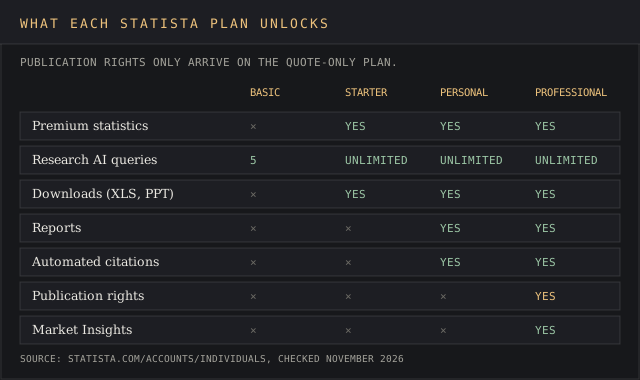
Statista posts a real price list, which most vendors in our market research tools ranking won't. Per the individual accounts page, Basic costs $0 with 5 Research AI queries and free statistics only. Starter runs $199 a month billed annually, or $2,388 a year, for unlimited premium statistics and downloads in PNG, PDF, XLS and PPT. Personal runs $649 a month billed annually, or $7,788 a year, and adds reports and automated citations.
Professional means a contact with sales for a quote, and adds publication rights, every Market Insights topic and up to 99 seats. That gate matters more than the price. Starter and Personal don't include publication rights, so marketers, agencies or consulting partners who want to create a client deck or a blog post with a Statista chart legally sit on the quote-only plan.
Agencies presenting to companies every week should price that in before they join. Older listings still quote a "starting from $1,788" figure; the homepage today reads "$2,388 USD yearly," so the old number is out of date.
Above the list price, the negotiated numbers climb fast. Vendr's anonymised buyer data puts the median Statista contract at $26,000 a year across 32 deals, with a low of $8,272 and a high of $51,400. That range reflects Professional and team seats, which cost an arm and a leg next to the $199 Starter checkout.
Each plan's payment is due as one annual contract. A G2 review from David B., Founder and CEO at a small business, February 2025, names the pain point most founders hit:
David B., Founder & CEO, small business, G2, February 27, 2025
Contracts, auto-renewal and cancellation
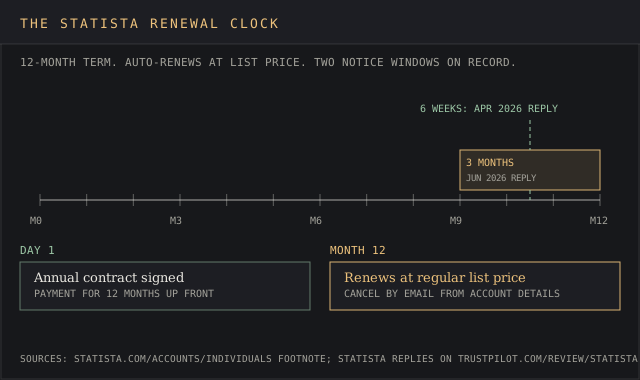
Most of the money that goes sideways goes here. All Statista subscriptions run on the same terms. The plans page footnote reads: "The account requires an annual contract and will renew after one year to the regular list price. For commercial use only." The Starter cancellation help page describes the process as a prefilled email from Account Details, and states no deadline at all.
The deadline shows up in Statista's own replies on Trustpilot. In April 2026 the company told one customer "The cancellation period is six weeks prior to the end of the subscription." In June 2026 it told another that "cancellation requests must be submitted at least three months prior to the renewal date." Two windows from one vendor is a red flag, so set the calendar reminder for three months out.
Another Trustpilot review is titled "Ongoing billing after cancellation + no support response," so keep the cancellation email and Statista's reply on file.
Users who missed the window are vocal about it. A Capterra review from Harsh Vardhan P., CEO in management consulting, March 2024, says Statista "would renew your contract and auto-issue an invoice without intimation." A G2 review from Jef W., Digital Account Manager at a mid-market company, July 2023, goes further:
Jef W., Digital Account Manager, mid-market, G2, July 21, 2023
A Trustpilot review from Adam Wardach in Poland, March 2025, describes the same trap:
"Your contract terminates and basically you cannot cancel it and they extend it for a year to come."
Adam Wardach, Poland, Trustpilot, March 2025
Once bitten, twice shy: diarise the date on the day you sign.
Statista reviews: what users praise
The positive reviews cluster around breadth, charts and support, and G2 lists Statista at 4.4 out of 5 from 30 reviews. A G2 review from Nataliia L., a librarian at a mid-market organisation, May 2026, says "The visualisation is excellent, and the graphs are available for download in various formats." A Capterra review from a Head of Marketing Strategy in entertainment, November 2023, says "There is a lot of high-quality data. Nice (if simple) visualization".
Support gets credit too. G2 reviewer Stephen F., Group Director at an enterprise, February 2025, says "Customer support is excellent and a good way to keep up with the latest features." A Trustpilot review from Sascha Brittner in Germany, September 2025, reports "Received a helpful reaction from customer support within minutes resolving my issue." A G2 review from Wells D., VP Strategy, November 2025, adds "I greatly appreciate the proprietary data offered by Statista".
The interface earns praise from newer users too. A Capterra review from Chariz C., a student in education management, February 2023, calls it "Easy to use, handy for accurate and accountable and accurate data." The same reviewer adds a limit: it "Can be hard to navigate very specific target segments in Canada." Support replies that users found helpful and quick show up across platforms, which matters on a contract with a hard notice window.
Negative reviews: accuracy, sourcing and the free account
The critical side is louder, and the comment threads suggest a pattern. Statista's Trustpilot page shows a 1.8 TrustScore from 302 reviews, and the complaints fall into three buckets: data quality, hidden sources and the free account.
On accuracy, the Capterra reviewer in entertainment who praised the data also wrote "I encountered some data that was completely off (market size, market shares etc.)." A Capterra review from John M., Senior Principal in pharmaceuticals, October 2023, called it "Very pricey and hidden charges. Customer service was very poor."
Freshness is the other accuracy question. Every statistic page shows its release date, and a figure from two years back in a fast-moving technology market is stale whatever the chart looks like.
On sourcing, the sharpest post comes from author Josh Bernoff, December 2020, who argued that for non-members a chart without its source is "worse than useless" and wrote: "Not providing the source link is malpractice."
The free account draws the most anger, and the £1,908 figure keeps coming up. A Trustpilot review from Ross K in the UK, August 2026, titled "Don't even bother with free acc: £1908 to view anything," says "Total waste of time. I feel tricked into signing up for a free account." Another Trustpilot reviewer, Steven C in Australia, July 2026, complained that "once they have you in their database they simply won't stop emailing you".
Generative AI adds a new complaint. A Trustpilot review from Amin Moradi in the Netherlands, May 2026, is titled "Don't buy if you're in Europe":
"The service is terrible, you can almost get the same result asking ChatGPT, Claude or even Grok."
Amin Moradi, Netherlands, Trustpilot, May 2026
That comment lands hard on a tool whose core value is citable numbers.
Reading Trustpilot ratings and fake reviews
Weigh the 1.8 against who writes it. Statista replies that it's "a B2B data and research platform," and the plans page marks paid accounts "For commercial use only," so it doesn't sell a consumer product. Many 1-star reviewers are students or consumers who hit the paywall. Trustpilot says it uses technology to fight fake reviews but doesn't fact-check them, so treat each comment as one user's account.
Read between the lines and the pattern still holds across the reviewer community. When reviewers in Poland, the UK and the Netherlands describe the same renewal clause, the devil's in the details, and the plans page footnote confirms the auto-renewal they describe.
Is Statista credible, free, and fit for academic work?
Is Statista a trustworthy source?
For a quick market estimate, yes, with one rule: cite the original publisher named on the statistic page, since Statista republishes most figures. For academic work that makes Statista a secondary source, so ask your supervisor before citing it directly. The Capterra and Bernoff complaints above are the reason to open the source line every time.
Is Statista free to use?
Partly. Basic is $0 and opens the 7% of statistics marked free plus 5 Research AI queries. Everything else needs a paid account, so ask your university library if it already holds a licence before you pay. Our free market analysis tools ranking lists options that cost nothing at all.
Checking a third quarter figure back to its source
The homepage features charts such as Intel and AMD CPU share by quarter and the US monthly inflation rate. To check one, open the statistic, read the source and release date, then pull the third quarter number from the original publisher. If it's a Census Bureau or central bank series, the original is free online with no account needed, and you've saved the subscription for data you can't get elsewhere.
Statista alternatives
Four competitors win specific buying situations against Statista, and two of them work best as a companion to Statista. The wider field of market analysis platforms sits in our tools for market analysis list, and three of the four entries below link their own full review.
GlobalData wins when a team needs analyst depth in one sector with company and deal data underneath. It loses on price transparency: nothing is published, and Vendr's anonymised buyer data puts the median contract at $68,500 a year, so Statista's $26,000 median costs under half as much.
Similarweb wins when the question is digital: website traffic, competitors' audience and online market share. Its pricing page lists web intelligence plans from $199 a month, or about $125 a month billed annually. It loses on anything offline, since it measures internet behaviour and carries no industry statistics or consumer survey layer.
Exploding Topics wins for spotting trends early. Its pricing page lists $39, $99 and $249 monthly tiers, all cheaper than Statista Starter. It loses when you need a citable market size or forecast, which it doesn't produce.
Google Trends wins on price at $0 and answers "is interest in this rising?" in seconds. It loses on everything else: it shows relative search interest, never revenue, users or market size. Pair it with Statista's free Basic tier and you kill two birds with one stone before paying for anything.
Verdict
Best fit: analysts, marketers and consultants who need a sourced chart on an unfamiliar market by end of day, and who'll use a $2,388 Starter seat every week. The 4.4 G2 rating and the "I start, and usually end, with Statista" comment come from exactly that user.
Poor fit: students paying out of pocket, anyone who needs publication rights without a sales call, and teams who need one industry covered deeply. The 1.8 Trustpilot score and the "completely off" market size complaint come from those buyers.
Fit with caveats: small teams on Personal at $7,788 a year who use it to inform pitch decks and planning, provided someone owns the renewal date three months out and every figure gets traced to its original source before it goes in a report.