Brandwatch vs Meltwater: consumer research against media monitoring
 By Jan Suski. I go deep on every review, checking every number against its source and digging up details other coverage misses, a habit from six years of SEO and link building for tech companies. Bylines at Surfer, Brand24, and Senuto. How the scoring works.
| WHAT EACH ONE DOES | BRANDWATCH | MELTWATER |
|---|---|---|
| Core job | Consumer research | Media monitoring |
| Social archive | Back to 2010 | 15 months on base |
| Print and broadcast | Factiva add-on only | 400k+ print, 210 TV mkts |
| Podcasts | 70,000+ trending | 20,000+ monitored |
| Journalist database | None | 450,000+ contacts |
| Query building | AI Query Writer | Mira Boolean assist |
| AI search tracking | Trajaan, acquired | GenAI Lens, built |
| Sales intelligence | None | Owler, 14m profiles |
| Skip it if | PR is the whole job | Research is the job |
| WHAT YOU GET | BRANDWATCH | MELTWATER |
|---|---|---|
| Published floor | None | From $10,000 a year |
| Vendr median | $50,000 a year | $25,800 a year |
| Tracked range | $19,542 to $81,200 | $5,375 to $56,993 |
| UK G-Cloud entry | Listen: £7,200 a year | Base: £22,800 a year |
| Notice to cancel | 30 days, written | 60 days, written |
| Billing | Paid in advance | Upfront, non-refundable |
| Owner | Cision, S&P 'D' 2025 | Marlin and Altor |
| Security | ISO 27001:2022 | SOC 2 II, ISO 27001 |
| G2 rating | 4.4 from 730 | 4.1 from 2,677 |
StrongerWeakerNo edge
Thirty-six further documented limits sit behind the button below: Brandwatch’s seat caps, export quotas and module prices, and Meltwater’s add-on rates, plan gates and coverage counts. Test scenario: an enterprise team choosing one listening platform for an insights desk or a PR desk. Prices are Vendr header stats, Meltwater’s 9 July 2026 pricing blog and both vendors’ UK G-Cloud 14 filings; capabilities come from brandwatch.com and meltwater.com, all read 17 Oct 2026.
| Brandwatch | WHAT IT DOCUMENTS |
|---|---|
| CI Pro users | Up to 5, unlimited view-only |
| CI Premium users | Up to 20, unlimited view-only |
| CI Enterprise users | Up to 50, unlimited view-only |
| Mention exports | None Pro, 10k a day Premium, 100k Enterprise |
| Content uploads | 100k a month Premium, 1m Enterprise |
| Mention tiers | From 500K a month, £30,600 a year Premium |
| Queries past 40 | £1,440 Premium, £1,740 Enterprise each |
| Historical mentions | Capped at 24x live monthly limit |
| Vizia Command Centre | £3,600 per screen a year |
| Image Insights | £14,440 a year; included at Enterprise |
| Logo Recognition | £4,608 per logo a year |
| SSO | SAML £800, JWT £300, one-off |
| Benchmark module | 20 channels, 8 years of data*, £9,720 a year |
| SMM extra admin | £2,000 a user a year |
| Influence API | £5,400 a year |
| Expert hours | £190 to £200 an hour |
| Support SLA | 6h weekdays Pro and Premium, 4h Enterprise* |
| CR API rate limit | 30 calls per 10 minutes per client |
| Meltwater | WHAT IT DOCUMENTS |
|---|---|
| Workspaces on base | 2, with 10 users and 25 searches |
| Global broadcast | £5,700 a year |
| UK broadcast | £2,950 a year |
| Podcast monitoring | £2,950 a year |
| Press distribution | £6,480 UK, £7,880 global a year |
| Newswire | £500 one country, £2,500 global per wire |
| Branded newsletter | £3,250 a year, 1,000 recipients |
| AI insight reports | £2,950 to £8,250 a year by frequency |
| API & MCP | Enterprise and Agency plans only |
| Mira AI level | Starter, Advanced, Enterprise-grade† |
| Influencer gate | Pro on the plan grid†, Enterprise per blog |
| AI Journalist Search | Up to 200 journalists per search |
| GenAI Lens | 6 assistants named, launched 29 Jul 2025 |
| Broadcast processed | About 55,000 hours a day |
| Online publications | 200M+ |
| Unique sources | 6+ million, including APAC social |
| Public-sector pricing | Preferential for public bodies, universities, NFPs |
| Onboarding | One-time charge on complex setups |
*A marked Brandwatch figure is one Brandwatch states two ways in its own documents. Its G-Cloud pricing document sells the Benchmark module with 8 years of data, while its Benchmark product page says two years of historical data; the module figure is used above because a buyer can purchase it.
*The same Brandwatch pricing document sets support response at 6 weekday hours on Pro and Premium and 4 hours on Enterprise, while Brandwatch’s G-Cloud service listing says 8 hours on Pro and 1 hour on Premium.
†A marked Meltwater figure is one Meltwater states two ways. Its pricing page labels Mira AI “Enterprise-grade” on the Enterprise card and “Advanced” in the plan grid’s Enterprise column, and the same grid ticks Influencer Marketing at Pro, while its 9 July 2026 pricing blog says influencer marketing “isn’t part of the Starter or Pro configurations”.
Two government rate cards, one procurement dataset, and nine figures stated two ways
Brandwatch rows come from brandwatch.com product and plans pages, its information security page, its Consumer Research API documentation on developers.brandwatch.com, and the pricing document and service listing Brandwatch filed to the UK Digital Marketplace for G-Cloud 14 (pricing document dated 16 February 2026).
Meltwater rows come from meltwater.com pricing, product, coverage and AI pages, its 9 July 2026 pricing blog, its mCommunity product updates, and the rate card and terms it filed for G-Cloud 14 (May 2024).
Medians and ranges are Vendr header stats; G2 figures are G2’s compare page; all read 17 October 2026. Meltwater leaves its creator database size, its Agency floor and its API price (“TBD”) unpublished. Neither vendor publishes a base consumer-intelligence price, a renewal-increase percentage, an uptime figure, or how it counts a source.
Brandwatch vs Meltwater comes down to one question: is the job reading what consumers say about a category, or tracking what the press and social media say about your brand? Brandwatch is a consumer intelligence platform built on an archive of 1.7 trillion conversations reaching back to 2010. Meltwater is a media intelligence suite that pairs news monitoring across print, TV, radio and podcasts with social listening and journalist databases.
Brandwatch and Meltwater both sell by custom quotes on annual contracts. Vendr's tracked purchases put the median Brandwatch contract at $50,000 a year and the median Meltwater contract at $25,800, so the research tool costs about twice the PR tool.
This page is for insights team leads, PR and communications teams, and procurement holding two proposals. It covers what each tool indexes, the UK government rate cards both vendors filed, what the contracts say about leaving, ownership, the AI layer, influencer marketing, support and fit. Every figure was checked on 17 October 2026 against the vendor's own domain, a filing, or Vendr. Prospective buyers who already know which desk is buying can skip to the last section.
↑ COMPARISONBrandwatch and Meltwater sell to different desks
Most enterprise buyers who compare Meltwater with Brandwatch are comparing two departments. Meltwater's pricing page sells five capabilities: Media Intelligence, Social Listening, AI Visibility Tracking, Media Relations and Influencer Marketing.
The buyer it describes is the comms team that needs media monitoring, broadcast clips and press contacts in one platform, with PR reporting at the end of the month. The product is built around communications workflows: monitor, pitch, report.
Brandwatch offers deep consumer intelligence to the insights team. Its Consumer Intelligence suite draws on 100 million unique sites and adds 501 million new conversations a day, and the analysis runs on query segmentation, emotion analysis and audience demographics.
Its publishing suite, the former Falcon.io, and Brandwatch Influence are sold separately. Brandwatch is a consumer intelligence platform with listening at the centre; Meltwater is a media monitoring suite with listening attached.
The overlap is social listening. Brandwatch and Meltwater both index social media conversations, run Boolean queries, and report brand mentions and sentiment. Everything else splits along the desk that signs the contract, which is why the two rarely meet in the same evaluation unless a CMO owns both budgets. A comms lead shopping Brandwatch for press clips is barking up the wrong tree.
↑ COMPARISONCoverage: what each tool indexes, and how far back
In any Brandwatch vs Meltwater evaluation, Brandwatch's archive is deeper and Meltwater's media list is wider. Every row below shows the trade offs.
| Coverage | Brandwatch | Meltwater |
|---|---|---|
| Social history | 1.7 trillion conversations back to 2010; X firehose to 2007 | 15 months on the base licence |
| Editorial history | No separate figure published | 10 years of retrospective editorial |
| News sources | Factiva print as a paid add-on | 270,000+ news sources; 400,000+ print titles |
| Broadcast | No broadcast line on its rate card | All 210 US media markets |
| Podcasts | 70,000+ trending podcasts, transcripts analysed | 20,000+ podcasts |
| Languages | 44, with sentiment and emotion analysis | 240+ languages of coverage |
| Daily intake | 501 million new conversations | 1.3 billion+ documents |
| Competitive benchmarking | Benchmark: 300,000+ brands on 4 networks | Included from the Pro tier |
Sources: Brandwatch's Consumer Intelligence page, its G-Cloud 14 listing and its 20 November 2025 product release; Meltwater's media monitoring and global coverage pages, its July 2026 blog, and its G-Cloud 14 rate card.
For multi-year trend analysis the gap is the whole story. A brand launch from 2012 is still queryable in Brandwatch; Meltwater's G-Cloud card keeps 15 months of social history on the base licence. That depth carries a price, because data volume drives the quote. Brandwatch's rate card caps historical mentions at 24 times the live monthly mention limit, and extra historical data for five queries lists at £2,880.
Each tool states its own scale two ways. Brandwatch's Consumer Intelligence page says 1.7 trillion conversations, and its Meltwater-alternative page, updated 16 September 2026, says 1.6 trillion. Meltwater's coverage page gives "over 400,000 traditional media sources" in one FAQ answer and "over 300,000 editorial sources" in the next, and its podcast count reads 20,000+ on one page and "more than 25,000 channels" on another.
Quote any of those figures with the page it came from. Raw data counts are marketing copy on both sides, and neither vendor publishes how it counts a source.
↑ COMPARISONBoth vendors filed a UK government rate card
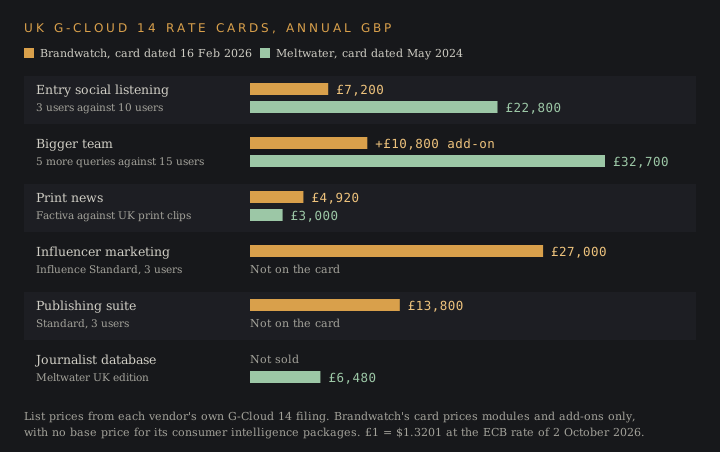
Neither company publishes enterprise pricing on its own site. Both filed priced documents on the UK government's G-Cloud 14 marketplace, though, and those are the closest thing to a list price either has put its name to. It's straight from the horse's mouth. Meltwater's card prices its base media monitoring platform at £22,800 a year; Brandwatch's card, dated 16 February 2026, prices modules and add-ons but gives no base price for its consumer intelligence packages.
| Line item | Brandwatch | Meltwater |
|---|---|---|
| Entry social listening | Listen Standalone, 3 users, 3 searches: £7,200 ($9,505) | Base platform, 10 users, 25 searches: £22,800 ($30,098) |
| Bigger team | 5 more queries on Consumer Intelligence Pro: £10,800 ($14,257) | 15 users, 50 searches: £32,700 ($43,167) |
| Publishing suite | Standard, 3 users: £13,800 ($18,217) | Not on the card |
| Influencer marketing | Influence Standard, 3 users: £27,000 ($35,643) | Not on the card |
| Journalist database | Not sold | UK edition: £6,480 ($8,554) |
| Print news | Factiva at Pro: £4,920 ($6,495) | UK print, 100 clips a month: £3,000 ($3,960) |
| Onboarding | Free tier, or £3,000 and £6,000 packages | Support fees included in the subscription |
| API | API+ rate-limit increase: £4,880 | Priced "TBD" |
Neither card sells unlimited keyword searches: Meltwater meters 25 searches on the base licence, and Brandwatch's Listen Standalone meters 3 saved searches with unlimited quick searches. Converted at the European Central Bank's 2 October 2026 reference rates, where £1 is $1.3201. Meltwater's card dates from May 2024.
Procurement data fills the gap that custom quotes leave. Vendr's header stats put the median Brandwatch contract at $50,000 a year across 40 purchases, from $19,542 to $81,200, with 15.29% average savings. Meltwater's median is $25,800 across 126 purchases, from $5,375 to $56,993, with 15.23% savings. Brandwatch's tracked low sits $9,542 above Meltwater's own Starter floor.
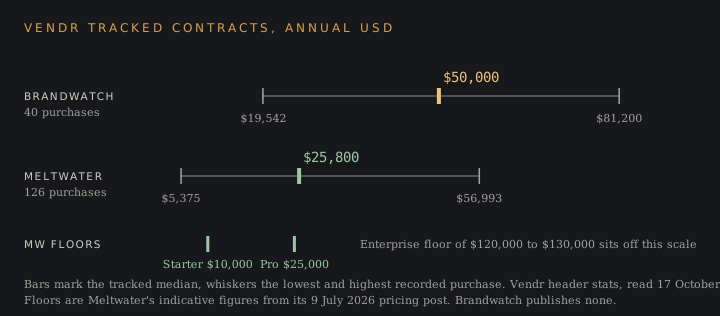
Meltwater is the vendor that published indicative floors: $10,000 a year for Starter, $25,000 for Pro and $130,000 for Enterprise in a 9 July 2026 blog post whose own FAQ says $120,000 for the same tier. The $15,000 Meltwater starting figure repeated on comparison sites matches no figure Meltwater publishes. Our Meltwater pricing report carries the tier-by-tier breakdown.
The $800 to $15,000 a month Brandwatch band quoted across this SERP doesn't trace to Brandwatch. Annualised, its bottom end is $9,600, under every one of Vendr's 40 tracked contracts.
Quote-only pricing is par for the course here, and enterprise only pricing describes both vendors: Meltwater's pricing page shows "contact for pricing" on all four plans, and the Brandwatch plans page ends in a demo form. Neither tool runs a self serve tier or a free trial; our Brandwatch pricing report has the rest.
↑ COMPARISONWhat each contract costs to leave
Brandwatch and Meltwater both bill annual contracts, with two different exit doors. The devil's in the details, and the details sit in the terms each vendor filed.
| Clause | Brandwatch | Meltwater |
|---|---|---|
| Notice to stop renewal | 30 days, in writing to the account manager | 60 days before expiry, in writing |
| Billing | Paid in advance | Full term upfront, net 14, non-refundable |
| Offboarding | No extra costs; download data before notice expires | Exit interview reported by a Capterra reviewer, January 2023 |
Meltwater has a 12-month minimum, and its terms renew the agreement "at Meltwater's then-current prices". Its mCommunity renewal article tells customers to expect "a rate increase at point of each annual renewal" and gives no percentage. That's the red flag in its contract, and the 60-day window is where buyers get caught. A CEO who rated Meltwater 1 out of 10 on TrustRadius wrote that it buries "a 60 day auto-renewal in their terms of use".
Brandwatch's information security page commits to deleting customer data within 30 days of contract termination, so export from each of its three platforms before the notice period ends. On either tool, the number to write into the order form is a renewal cap.
↑ COMPARISONWho owns each vendor, and the multiple acquisitions behind them
Brandwatch and Meltwater are both private equity holdings now, so neither files public results. The elephant in the room is debt. Brandwatch's parent has a public ratings history; Meltwater's balance sheet went dark when it delisted. Both facts matter for multi-year enterprise deployments.
- January 2020: Platinum Equity completes a $2.74 billion take-private of Cision.
- 1 June 2021: Cision closes its $450 million Brandwatch acquisition.
- 18 June 2021: Meltwater buys Owler for $24.5 million, adding 14 million company profiles for sales intelligence.
- March 2022: Brandwatch buys Paladin, now sold as Influence.
- 9 August 2023: MW Investment B.V., owned by Marlin Equity Partners and Altor, completes the Meltwater take-private at NOK 18.00 a share, against an IPO price of NOK 43.50 in December 2020.
- 13 May 2025: after Cision's April 2025 debt exchange, S&P Global Ratings cuts the borrower entity to 'D', calling the deal "tantamount to a default".
- 29 July 2025: Meltwater launches GenAI Lens.
- December 2025: Cision buys Trajaan and folds it into Brandwatch as Search Intelligence.
Meltwater's last public revenue figure is $439 million for 2022, and it now claims 27,000 customers. Brandwatch publishes no customer count of its own; Cision claims 75,000+ organisations across all its brands. Our Meltwater acquisition report covers the buyout and the eleven deals before it, and Brandwatch vs Sprinklr covers Cision's restructuring in full.
Brandwatch vs Meltwater, in each vendor's own words
Brandwatch and Meltwater each run a page aimed at the other's buyers. Brandwatch's is /p/meltwater-alternative/, last updated 16 September 2026. Meltwater's is a blog post, "Best Brandwatch Alternatives for AI Visibility (2026)", published 9 July 2026 and modified 10 September 2026. Read both as marketing.
| The claim | Made by | What checks out |
|---|---|---|
| Users rate Brandwatch's offerings "in many categories better than the Meltwater solutions" | Brandwatch | G2 has Brandwatch Consumer Intelligence at 4.4 from 730 reviews against Meltwater's 4.1 from 2,677. The charts on the page are images uploaded in 2023, with no scores in the text. |
| "Access to 1.6 trillion historical conversations online, going back to 2010" | Brandwatch | Its own product page says 1.7 trillion. |
| "A database of over 30m+ influencers" | Brandwatch | Its Influence product page says 65 million. |
| Brandwatch's "GenAI monitoring runs through Trajaan, a separate, acquired layer" | Meltwater | True. Cision bought Trajaan in December 2025 and sells it as a module. |
| "270,000+ news sources, 15+ social channels, TV, radio, and podcasts" | Meltwater | Its coverage page gives 300,000 and 400,000 in two FAQ answers. |
Read between the lines of these Meltwater vs Brandwatch pages and neither lands a checkable punch on pricing, support or the learning curve. Brandwatch's page makes no specific factual claim about Meltwater at all.
↑ COMPARISONAI capabilities: the Iris AI engine against Mira and GenAI Lens
The AI layer is the closest-fought row of Brandwatch vs Meltwater. Iris AI is Brandwatch's, and its feature sheet lists thirteen named parts. Four matter in a demo:
- AI Query Writer, which builds complete Boolean queries from a chat prompt, suggests hashtags, keywords and subreddits, and explains each query it wrote.
- Custom Classifiers, custom machine learning classifiers that sort mentions into categories you define, such as purchase stage.
- Out-of-box analysis that segments data by sentiment, emotion, topic, location and demographics.
- Peak Detection and Signals, which explain mention spikes and send alerts when a dashboard shifts.
Mira is Meltwater's assistant. It summarises conversation clusters, speeds up Boolean searches and drafts media coverage reports from what Meltwater calls billions of media and social signals a day, and its depth is tiered: Mira AI on Starter, Advanced on Pro, Enterprise-grade on Enterprise.
Meltwater's AI page cites a Forrester Total Economic Impact study for the line that teams "saved 25% of their time overall". Forrester TEI studies are commissioned by the vendor, so treat the 25% as Meltwater's figure.
GenAI Lens, launched on 29 July 2025, tracks how a brand appears in ChatGPT, Claude, Gemini, Perplexity, Grok and DeepSeek. The launch release claims coverage of "more than 90 percent of all LLMs" without saying what the denominator is. Brandwatch reached the same problem by acquisition: Trajaan tracks search and AI-assistant results, and Meltwater's blog is right that it's a bolted-on module.
Brandwatch adds generative AI integrations for deeper analysis of online conversations, and its Premium package accepts 100,000 content uploads a month, so first party data such as survey responses can sit beside social data.
Neither tool's AI layer removes the steep learning curve. The AI Query Writer in Iris AI writes the first Boolean draft, but trained analysts still interpret results, and that's why Brandwatch sells £3,000 and £6,000 onboarding packages and runs an academy. G2's ease-of-setup scores are 8.0 for Brandwatch and 7.9 for Meltwater, so the curve is close to level on both sides.
↑ COMPARISONInfluencer marketing and journalist outreach
Influencer marketing is where Brandwatch and Meltwater overlap most outside social listening. Brandwatch Influence covers the full campaign lifecycle for a brand: discovery, a creator CRM, campaign management and measurement across YouTube, Instagram, TikTok, Facebook, X and Twitch. Its creator count reads 30 million on its plans and comparison pages and 65 million on the Influence product page.
The G-Cloud card prices Influence Standard at £27,000 a year and the discovery-only edition at £8,100.
Meltwater's influencer product uses AI to personalise discovery, vets creators with authenticity scoring and fake-follower detection, and captures ephemeral content like Stories so their performance can be measured after they expire. It tracks EMV and social ROI; the product page makes no forecasting claim. Meltwater's own pages disagree on access: the blog says influencer marketing "isn't part of the Starter or Pro configurations", while the plan grid ticks it at Pro.
Press pitching is Meltwater-only. Its Media Relations module carries journalist databases with 450,000+ journalists and bloggers, per the G-Cloud card, and AI Journalist Search, which recommends up to 200 journalists from the text of a pitch or press release, the feature PR teams open first. Brandwatch sells no journalist database. Inside Cision that's CisionOne's job on a separate contract, priced in our Cision pricing report.
Meltwater includes one more thing Brandwatch lacks: Owler, the sales intelligence tool it bought in 2021. Teams that want competitor news, company profiles and media relations under one roof get the best of both worlds from one vendor.
↑ COMPARISONBrandwatch and Meltwater support, review scores and security
Support in Brandwatch vs Meltwater depends on the package. Meltwater's pricing FAQ says it "provides 24/7 multi-channel support for all customers", and its plan grid reserves Premium support for Enterprise.
Brandwatch's G-Cloud listing offers 24/7 in-app, phone and chat support, with SLAs that depend on the package. That listing says 8 hours on Pro and 1 hour on Premium. Brandwatch's own pricing document on the same marketplace says a 6-hour weekday response on Pro and Premium and 4 hours on Enterprise, where a dedicated customer success manager is included.
Support quality varies with contract size on both sides, so iron out the details of the SLA before signing. Both vendors sell training because both carry a steep learning curve, and a brand in crisis can't wait on a 6-hour response. The claim that Brandwatch's standard accounts run on help-desk tickets comes from Mentionlytics, which sells a competing tool.
| G2 metric | Brandwatch Consumer Intelligence | Meltwater |
|---|---|---|
| Rating | 4.4 from 730 reviews | 4.1 from 2,677 reviews |
| Meets requirements | 8.4 | 7.9 |
| Ease of use | 8.2 | 7.9 |
| Quality of support | 8.6 | 8.5 |
Meltwater's sample is 3.7 times larger, which drags any average toward the middle. Its Trustpilot profile stood at 1.7 from 17 reviews on 4 October 2026, mostly about renewals. Brandwatch sits in the Niche Player box of the 2026 Gartner Magic Quadrant for Social Media Management and Listening, per third-party coverage of the paywalled report.
On a Meltwater Brandwatch shortlist, the security rows are close. Meltwater announced a SOC 2 Type II report on 8 January 2026 and names ISO 27001, ISO 27701 and ISO 42001 certifications. Brandwatch holds ISO/IEC 27001:2022, and its own security page discloses no end-user MFA and no bug bounty programme.
↑ COMPARISONWhich enterprise brands and teams each tool fits
The right tool depends on the desk, and the split is clean once you know which desk is buying.
- An insights team running category research, audience segmentation and multi-year trends: Brandwatch. The archive back to 2010 is the core feature, and it works best with dedicated analysts.
- PR and comms teams that live on news monitoring, broadcast, media monitoring alerts and coverage reports: Meltwater.
- Brand reputation and crisis work that starts in the press: Meltwater. Work that starts in consumer conversations on Reddit and forums: Brandwatch.
- Brand managers benchmarking most competitors on four social networks: Brandwatch's Benchmark, which covers 300,000+ brands.
- Agencies: Meltwater sells a dedicated Agency plan with API and MCP access.
- Social media managers who need publishing: Brandwatch's social media management suite is a separate contract from £13,800 a year, and Meltwater sells social media publishing as a separate product.
Some enterprise deployments run Brandwatch and Meltwater together: Meltwater for PR teams, Brandwatch for research. At Vendr's medians that's $75,800 a year, and running both makes sense only when two budgets exist. Brandwatch alone spreads its users across three platforms: my.brandwatch.com, Influence and app.falcon.io.
Smaller budgets are better served elsewhere. Social listening platforms with published rates start under $2,400 a year, and our social listening tools ranking and media monitoring tools ranking price them side by side. Cision and Muck Rack, the other quote-only PR suites, carry Vendr medians of $12,625 and $13,000.
Frequently asked questions
Is Meltwater similar to Brandwatch?
They share social listening and influencer marketing. Meltwater adds news, print, broadcast, podcasts and journalist outreach; Brandwatch adds a deeper archive, Iris AI classifiers and audience segmentation. A meltwater vs brandwatch decision is usually a PR budget against a research budget.
Who are Brandwatch's competitors?
Meltwater, Sprinklr, Talkwalker and Sprout Social. Our Brandwatch vs Sprout Social page covers the publishing side.
Who competes with Meltwater?
Cision, Muck Rack and Brandwatch sell by quote in the same media monitoring market. Brand24 and Sprout Social publish self-serve pricing for teams that need social media only.
Is Brandwatch real or fake?
Real. The brand dates to 2006, has been owned by Cision since June 2021, and holds official firehose access to X.
Is Brandwatch worth it?
For an insights team that needs years of history and segmentation, yes, at a $50,000 median. For a comms team that needs news coverage and journalist databases, Meltwater does that job at about half the median. Our Brandwatch review scores it in full.
Who acquired Brandwatch?
Cision, for $450 million, closed on 1 June 2021. Platinum Equity has owned Cision since January 2020.
What is the main difference in Brandwatch vs Meltwater?
Archive depth against media breadth. Brandwatch keeps social conversations back to 2010; Meltwater adds print, TV, radio, podcasts and a journalist database to its listening.
Which is cheaper, Brandwatch or Meltwater?
Meltwater is the cheaper tool by Vendr's medians: $25,800 against $50,000. Both sell on custom quotes, so a quote can land anywhere in the tracked range. Meltwater's published Starter floor is $10,000 a year; Brandwatch publishes no floor.
Which one to buy
Choose Brandwatch when the output is consumer research: category trends, audience segmentation, classifier models and an archive that reaches back to 2010. Brandwatch makes sense as the research tool for an enterprise insights budget of around $50,000 a year. Keep an eye on historical-data add-ons, and staff it with trained analysts who'll write and own the queries.
Choose Meltwater when the output is earned media: media monitoring, broadcast, journalist outreach and the monthly coverage report on your brand. Budget around $25,800, and put the 60-day notice date in a calendar the day you sign.
The meltwater vs brandwatch call is a desk question first and a price question second. Get the PR and insights leads on the same page about which desk is buying, then line up Brandwatch and Meltwater quotes and hold each against Vendr's tracked range.